Showing posts with label Ben Meyer. Show all posts

Wednesday, June 07, 2017

Meat of the Matter: Upending the Status Quo


This series looks at how one small processor, Marks Meats in Canby, is transitioning from the founding owner-operators to a new generation of ownership under the name Revel Meat Company. This post was developed in collaboration with Old Salt Marketplace, a supporter of Good Stuff NW.

"The first thing to note about Ben Meyer is not his polite Midwestern manners, his oh-so-Portland uniform of stocking cap, flannel shirt and scruffy beard or that he's opened two restaurants in what were then—and still are, to some extent —underserved areas of the city. It's not even that he's been interviewed by the likes of Forbes and the Wall Street Journal wanting to hear about the local pasture-raised beef and pork he features on his menus. The key to Meyer is that this evangelist for whole animal butchery, whose walk-in is chock-full of large cuts of dry-aged beef, spent 10 years as a vegan."

Planning a day's work.

Since the time I wrote those words three years ago for the Oregonian, the scruffy beard has come and gone (and come and gone again), the stocking cap and flannel shirt can vary with the season and his two restaurants are still putting out luscious plates of grass-fed meat and farm-raised vegetables. And this former vegan-turned-omnivore is still intent on upending a system he sees as intrinsically unhealthy for his family, his community and the environment.

"I always say that Old Salt and Grain & Gristle are a food system," Meyer said. "We buy raw ingredients from people and we turn them into all the products that we use, [like] grains that are custom-milled to turn into the breads and contract tomatoes where I give the seed to the farmer and they grow it out for us."

But in his latest venture he's diving deeper into the stream that our food travels in getting from the field to our plates. With partners Jimmy Serlin and Ryan Ramage, his Revel Meat Company is attempting to bring local meat back to local tables, in the process revitalizing a nearly extinct local meat processing industry that enables small farmers to bring their animals to a market hungry for the kind of meat they raise.

Bringing local meat to market.

In the spirit of upending the status quo they tossed around the idea of calling their venture Revolution Meat, or saluting the history of Marks by calling it High Mark Meat, but then Serlin suggested Revel Meat for what he thought of as a gustatory celebration of the best the region had to offer. The name stuck.

An unusual part of this new venture is that Meyer isn't just branding all the meat they process under the Revel Meat banner, regardless of the source. According to a 2015 article, discussing the practice of "localwashing," many large processors, like Carlton Farms in Oregon, buy animals from Canada or elsewhere, bring them to their facility for slaughter and processing, then brand the products with their name. Meyer's plan for Revel Meat is to have the name of the ranch or farm that raised the animals follow the product, whether it ends up as hamburger or sausage or charcuterie, all the way to the consumer.

"My whole goal with all food is getting rid of the smoke and mirrors,"  he said. "We want to make sure that if somebody’s buying it, they know who they’re buying it from, the name of the ranch and where it is. We’re not going to co-brand it; it’s not just going be Revel Meat pork, it’s going to be Payne Family Farms pork delivered by Revel Meat."

Jimmy Serlin, a happy man.

Since Meyer and Serlin are both chefs, they are intimately connected to Portland's restaurant community and have already begun wholesaling their meat products like sausages to some of the city's restaurants. But entering the wholesale business has meant adding layers of complexity to an already complicated process.

In the normal course of running his restaurants, Meyer said, he would talk to his ranchers a week ahead for pork and two weeks or more for beef so that the animals would be in the pipeline to go to the processor. They would then hang for two to three weeks, after which he would butcher and process them for his menus.

With wholesaling, not only does he need to have pork in hand to make the sausage in time to get it to restaurant chefs for their menu, he said, "I now have to plan weeks out to make sure that we have pigs lined up to get them killed, cleaned, hung up, turned into sausage, packaged, labeled and then driven up to the city. It’s just a whole other layer back."

As if that wasn't enough, the partners are adding animal husbandry into the mix, raising their own animals on two parcels of land near the facility. It means working not weeks or months, but years out, he said, with animals on the ground that are slated to come through their process two years from now.

Helping local ranchers thrive.

But even with intimidatingly steep learning curves on multiple fronts, this former vegan never wants to forget that he is responsible for taking the life of a living creature.

"My biggest fear is that you would become callous and not care," Meyer said. It's why he chose to take on the challenge of revitalizing a medium-sized, locally owned slaughterhouse that would serve small farmers and ranchers, rather than scaling up to operate at the same volumes as larger processors.

"You can imagine the level of care when you’re killing 340 head an hour on five different lines," he said. "That’s stunning an animal every 3.2 seconds or something. That is factory work where the cog happens to be a living creature. That is the most mortifying part to me."

"No matter how much love or care you put into the raising of an animal, if that’s how it finishes its life, you’ve broken that covenant with the animal," he added. "That covenant is the most important thing for us. If you break your part of the covenant, then we’re asking that species, this pig or that beef or these sheep or goats, to keep their end without us keeping ours. It’s not fair."

Read the other posts in this series, Rejuvenating Local Processing and Transitioning a Family Business.

Photos by Rich Crowder.

Wednesday, May 17, 2017

Meat of the Matter: Transitioning a Family Business


This series looks at how one small processor, Marks Meats in Canby, is transitioning from the founding owner-operators to a new generation of ownership under the name Revel Meat Company. This post was developed in collaboration with Old Salt Marketplace, a supporter of Good Stuff NW.

Floyd Marks opened Marks Meats on South Mulino Road in Canby, Oregon, in 1963. His daughter, Kris, who was a very young child at the time, still remembers the opening party in the brand new slaughterhouse. The band was set up on a platform over the drain where the animals were hung to bleed out, with the dance floor in the middle of the room. Originally solely a slaughterhouse, Floyd designed the compact footprint of the facility to maximize efficiency and, as the business expanded, to accommodate an on-site processing facility to make sausages, bacon and smoked meats.

Floyd and Martha Marks (c. 1975).

In the mid-1970s, when their mother decided it was time to think about retiring from the business, she asked Kris and her sister Judy if they'd be interested in stepping in, Judy working with the animals on the kill floor and Kris managing the new processing side. By this time Kris had married her husband, Joe Akin, and they were the parents of two young children. As a teenager, Joe had applied for a job at the plant and, like Jimmy Serlin would many years later, he found his calling working there.

With the daughters' agreeing to the arrangement, their father retired and turned the business over to Judy and Kris. When I expressed surprise that a slaughterhouse might be run by two young women, she reminded me that in many old farm families it was not unusual for the women to do the butchering.

* * *

"Dealing with the animals that you raise
and the vegetables that you raise and
processing them all the way through,
it wasn't something foreign to us."

* * *

"If you grew up on a farm, you also did that as part of it," she said. "Dealing with the animals that you raise and the vegetables that you raise and processing them all the way through, it wasn't something that was foreign to us."

Judy eventually left the business, and Joe took over running the kill floor while Kris worked on the processing side and took care of the immense amount of record-keeping required for the facility's Federal Grant of Inspection from the USDA. The grant allowed the business to slaughter and butcher animals, and involved a difficult and costly approval process, one that guarantees that procedures are in place to ensure that the meat it sells is safe and inspected before, during and after slaughter.

Processing room at Marks Meats (c. 1975).

Around ten years ago it became difficult for Kris and Joe to find trained, competent help in the slaughterhouse, so Kris stepped onto the floor to work alongside her husband. While he did the stunning—essentially rendering the animals brain-dead—at the height of their production they managed a schedule that rotated through 30 beef in a day, and other days processed 24 to 30 pigs or 75 or 80 lambs, a crushing amount of output for a small facility.

Approaching retirement age, they both knew that this kind of heavy production schedule was unsustainable, so Kris began to put the word out that Marks was looking for a buyer. An attractive prospect, the business drew several inquiries because of its up-to-date plant and that all-important grant of inspection, not to mention its accessibility to both area farms and a Portland customer base. But none had quite the right combination of factors required for a transition of ownership that would take several years to complete.

Enter Jimmy and the young crew of food revolutionaries from Let Um Eat who had bought a farm down the road and, driving by one day, saw a sign outside advertising a sale on steaks.

The young people were just customers at first, but the sudden departure of an employee left Kris short-handed, so she asked if they knew of anyone who might be be interested in helping out.

"Then Jimmy showed up because he was interested in learning what we did," Kris said, though it was obvious from the get-go that he had no idea what an immensely physical job it was. "It’s like working out at the gym for eight to ten hours. He was on the kill floor, doing skinning and pushing and pulling and different movements that you don’t normally do."

For Jimmy’s part, he said, ”I didn’t realize how excited I was about it till I started.” When his own father passed away a few weeks into his stint at Marks, a particularly heartfelt conversation with Kris and Joe about her father and the beginnings of Marks cemented his decision. "It became clear that it was something I’d wanted to do for awhile [but] I never really thought about it," he said. "Being there, I think it keeps me in line with with what my old man did."

* * *

"We’d been doing this for a long time and
physically we needed to have younger people do it
in order to keep the business running."

* * *

Kris remembers that fairly soon after he started, Jimmy said he was looking for something more permanent than simply being an employee.

"He wanted to know more about the business and possibly join us in some capacity," she said. "And we were wanting to get out. We’d been doing this for a long time and physically we needed to have younger people do it in order to keep the business running."

The key phrase Jimmy got from his conversation with Kris? "If you’re interested, let’s talk."

Marks Meats (c. 1975).

At that point, as far as he was concerned, the decision was made. "How can we can we all talk about Let Um Eat and the collective and not take the opportunity to take over one of the most crucial pieces to the small farm and sustainable food movement?" he remembers thinking.

The other members of the collective, however, were not on board with making that kind of long-term commitment. Or as Jimmy said, "They were like, haha, we have a thousand other things going on."

Knowing he couldn't do it alone, however, meant that he needed to find partners who could bring additional skill sets to the table. He approached Ben Meyer, who was already working with local ranchers and farmers on a whole animal program for his Portland restaurants Old Salt Marketplace and Grain & Gristle. Bringing butchery, merchandising, retailing and processing expertise, Meyer was the perfect fit. To complete the team, Meyer brought in cattle rancher Ryan Ramage of Ramage Farm in Oregon City.

Meyer had already identified that it was critical to keep Oregon's surviving small processors alive, as well as the need to add more. Crucial to this was figuring out the stumbling blocks faced by existing processors, which had been steadily closing since the '70s. "Every one we lose is another opportunity for a small rancher to process," he said. So when Jimmy presented him with the opportunity to buy Marks, he recalled, "I immediately said we need to at least talk about it."

* * *

"[Handling the physical aspect of the work] is the
most important part, because if they can’t do that,
the rest of the business isn’t going to work."

* * *

Meyer began working alongside Jimmy on the kill floor soon after that, with Kris teaching them the arcane, detailed and exhausting work that goes into processing in a USDA facility. Also involved were endless conversations about how to transition to new owners from a second generation, family-owned and run business.

Marks Meats (c. 1975).

Kris said that the last eight to ten months have been spent seeing if Ben and Jimmy could learn how to handle the work.

"It’s the most important part, because if they can’t do that, the rest of the business isn’t going to work," she said, emphasizing that the learning curve is a steep one. "You need to get up from kindergarten to college really fast. If you’re going into this business from an apprenticeship level up to a journeyman, it can take up to ten years. So doing it in this [short] length of time, it’s difficult."

Other complicating factors are that Marks is a corporation, with a USDA grant of inspection involved. Being the shrewd businesswoman she is, the key to a successful transition, Kris said, is that "you’ve got to make it work for a business, because you can’t make it work for everybody if it doesn’t make business sense."

When I asked what the hardest part of the process has been for Kris personally, she paused. "Probably the letting go and letting somebody else do something for me," she said. In the past, she said, "If it didn’t get done, I had to do it and make sure it got done."

Read the first post in the series, Rejuvenating Local Processing. The final post in the series focuses on the future of small processors, titled Upending the Status Quo, with an interview with Revel Meat co-owner Ben Meyer.

Photos courtesy Kris Akin.

Thursday, May 04, 2017

Meat of the Matter: Rejuvenating Local Processing


This series looks at how one small processor, Marks Meats in Canby, is transitioning from the founding owner-operators to a new generation of ownership under the name Revel Meat Company. This post was developed in collaboration with Old Salt Marketplace, a supporter of Good Stuff NW.

The first time in his life that Jimmy Serlin walked onto a kill floor was just about a year ago. It was lamb day at Marks Meats in Canby, and 60 sheep were scheduled for slaughter and processing. Intense, smelly, dangerous work, with trolleys weighing 15 pounds hanging 20 feet over his head, it could have been disastrous.

Instead, the words he used to describe it were more like those of someone falling in love.

“I was just instantly enamored,” he said, and remembered thinking, “This is what I want to do.”

Left to right: Ben Meyer, Ryan Ramage and Jimmy Serlin of Revel Meats.

That feeling didn’t diminish even though he recalls going home at the end of the week so tired and sore he walked in the house and flopped down on his bed. When his roommate came in and asked him how it had gone, he said, “I can’t lift my arms off the bed.”

It’s tempting to paint the picture as one of the prodigal son finding his calling, since his father had owned a wholesale meat packing business in Manhattan supplying area restaurants. Young Jimmy often skipped school to go to work with his dad, helping load the trucks for tips, but he found himself more drawn to the restaurants those trucks were heading to.

Revel Meat Co. USDA stamp.

So, starting as a dishwasher at 13, he began cooking on the line soon after, eventually ending up at culinary school where he became fascinated with butchery. Stints in far-flung restaurants in New York, Vermont, Colorado and California, many with his culinary school buddy Karl Holl, cemented those nascent skills. Working for well-known restaurateur Staffan Terje at Perbacco in San Francisco, a high-rolling customer named Frank offered the pair a chance to come to Oregon and work on a start-up producing naturally raised geese for foie gras.

That, of course, went the way of many high-concept start-ups, leaving Karl and Jimmy and a few friends they’d moved with to Oregon sitting on a farm they’d leased near Salem and needing to pay the rent. But being a flexible and talented group, they decided to start a pop-up restaurant and catering business called Let Um Eat, with the lofty goal of “uniting the seeders, feeders and eaters of the food revolution.”

A move to a permanent location, a farm on Milk Creek near Canby, proved to be pivotal in a way the group couldn’t have foreseen. They’d often stop down the road to buy steaks at a small meat processor, where Jimmy boasted to its owner, Kris Akin, about the Let Um Eat collective. “She, of course, looked us up on the internet and said, ‘What the hell is Let Um Eat? You guys sound like weirdos,’” he said.

Weirdos or not, Akin saw the value in the local network they had created, especially since she needed help finding qualified employees to process the animals into sausages and cuts of meat. And because she and her husband Joe were looking to turn the business over to new owners so they could retire.

The Processing Bottleneck

It’s probably a good point to “pivot,” as the au courant phrase has it, to discuss some of the history of meat processing in Oregon.

Tools of the trade.

According to Akin, in the mid-20th Century there were more than 1,000 small meat processors operating in Oregon, with one in almost every small town. They served as slaughterhouses and processing plants for local farmers and ranchers, and most were regulated by the Oregon Department of Agriculture’s (ODA) meat inspection program established in 1957. By 1967 the Wholesome Meat Act passed by Congress gave the USDA the responsibility of ensuring that animals were slaughtered humanely and that states maintained meat and poultry inspection programs at least equal to the federal program.

[Historical factoid: The Wholesome Meat Act, a reform pushed by consumer activist Ralph Nader in the 1960s, was known as “The Jungle, Part 2,” after Upton Sinclair’s book, “The Jungle,” about the deplorable conditions in meat processing plants in turn of the century Chicago, resulted in the passage of the Federal Meat Inspection Act in 1906.]

Discussing cuts.

At that point Oregon turned over its meat inspection program to the USDA, which meant that small processors had to upgrade to meet federal standards—an extremely expensive proposition for marginally profitable businesses—or become “custom exempt,” meaning that they could only slaughter and process livestock for the exclusive use of the farmer and agree to inspection by both ODA and USDA once or twice a year.

Without access to funds to invest in updating equipment, hire skilled workers or do the marketing to find producers, not to mention consumers to buy their products, small facilities suffered. The implementation in 1996 of the Hazard Analysis and Critical Control Point (HACCP) system—establishing new requirements to improve food safety—and the simultaneous consolidation in the grocery industry were an “inflection point,” according to Lauren Gwin of Oregon State University’s Niche Meat Processor Assistance Network.

“People blame regulations, and that shift was really hard for small plants,” she said. “But there were larger changes in the meat industry at the same time that were putting pressure on those small plants. The consolidation in the industry, including the shift to boxed meat, really changed things for the smaller plants.”

This shift from small grocers to large supermarkets, which closed butcher departments and switched to boxes of pre-cut meat from large processors, caused many of the state’s small slaughterhouses to shutter. From 2000 to 2015, mobile and custom-exempt facilities in Oregon dropped more than 30 percent, from 93 to 63, and the number of USDA-inspected slaughterhouses fell 25 percent, from 16 to 12.

Another consequence of the loss of these small processors is that farmers and ranchers have been forced to transport their animals longer and longer distances to get them slaughtered and processed, a costly and environmentally questionable practice. An article in the Eugene Register-Guard, titled “A Meaty Bottleneck,” quotes a 2005 study by Ecotrust concluding that “42 percent [of growers] said they would consider raising more animals if they had improved access to meat-processing facilities.”

Because pasture-raised and grass-fed meat from small farms is in increasingly high demand from consumers who want to know where their food comes from, including how it was raised, slaughtered and processed, it’s critical to the health and vibrancy of Oregon’s food system that small processors survive to serve them.

Read the next post in the series, an interview with Kris Akin, owner of Mark’s Meats, about the challenges of passing on a family business. The third post focuses on the future of small processors in an interview with Ben Meyer, titled Upending the Status Quo.

All photos by Rich Crowder.

Saturday, September 17, 2016

Lamb Raised Right: Braised Lamb with Fava Beans


When I first started this writing gig I had no idea of the opportunities I'd get to meet amazing, caring, thoughtful people who've dedicated their lives to providing their families and communities with food that is, as Slow Food likes to put it, "good, clean and fair." In terms of meat animals like cattle, sheep, pigs and chickens, it means that they've been raised humanely, on pasture, where they can live with other animals, feeling the soil under their feet and the sun on their backs. These farmers feed their animals none of the genetically modified corn and soy that most conventionally raised animals are raised on.

Really, it's exactly the picture of the farm that we all carry around with us from the stories read to us as children.

Les and her dogs at Jo-Le Farms.

Why am I so convinced that pasture-raised meat is better? Well, everyone's heard the phrase "you are what you eat" when it comes to junk food versus healthy foods. But I heard a phrase a few years ago that goes "you are what you eat eats," and it kind of blew my mind. In other words, if the animals we eat have a diet of the food that they are intended to consume—found in healthy pastures—rather than commodity grains laced with antibiotics and chemicals, then it follows that they'll be healthier animals and the meat and milk they provide will be healthier for us to eat.

Ben Meyer butchering lamb.

Not to mention that raising animals on pasture is better for the environment and actually sequesters carbon in the soil rather than contributing to climate change or groundwater pollution from waste products. (Read Nicolette Hahn Niman's Defending Beef: The Case for Sustainable Meat Production for more on the subject.)

And when it comes time to die, the larger animals are either killed in their pastures instantly with a swift shot behind the ear, or trucked a short distance to a humane processing facility where they aren't waiting in fear, listening to the panicked sounds of other animals.

It had been awhile since I'd bought a lamb (really a nearly-year-old sheep) because I hadn't found a farmer nearby who had pasture-raised sheep available. But when I visited my friends Kendra and Ivan at Shimanek Bridge Farm, who raise cattle, pigs, chickens and turkeys on pasture, they introduced me to their neighbors, Les Carter and her husband Jon of Jo-Le Farms, who raise—get this—pastured sheep!

Meat from one lamb.

Les mentioned that they'd be slaughtering a few of their sheep in the near future, and I nearly jumped into her arms. She promised to call when it was time, and a couple of weeks later she contacted me to let me know when they'd be available. I then called my friend Ben Meyer of Old Salt Marketplace to see if he'd help me butcher it, a process I prefer because I get to decide whether I get chops versus racks and bone-in or boneless roasts.

Animals like goats and lambs are generally small enough to carry in the back of my Mini Clubman, Chili, so I pulled up in front of Ben's place and he graciously carried it inside for me. An hour or so later I walked out with a cooler-full of cut and wrapped chops, ribs, shanks and roasts, and I saved out a big bone-in shoulder roast for our first lamb dinner in some time.

Braised lamb with favas.

Braised lamb is the easily one of my favorite ways to cook and eat a lamb roast, though I've had several grilled boneless leg roasts that run a close second. Braising is also one of the easiest methods for cooking lamb, since all you have to do is add some vegetables and liquid to the lamb in a pot and cover it for two or three hours in the oven. The lamb slowly melts into fall-off-the-bone tender chunks, the liquid and meat juices meld into gravy and the vegetables and any herbs give it a marvelous depth. I added a pound of fava beans from Ayers Creek Farm, a cup or so of tomatoes I'd just roasted, and that night we sat down to our first lamb dinner in quite some time.

And now there are so many more lamby meals to look forward to this winter, thanks to the hard work of Les and Jon. I can't wait!

Braised Lamb with Fava Beans

1 lb. fava beans, soaked overnight
4-5 lb. bone-in lamb shoulder
3 Tbsp. olive oil
1 yellow onion, roughly chopped
3 large carrots, quartered and cut crosswise in 1/2" pieces
3 large cloves garlic, smashed
3 large bay leaves
5 sprigs of fresh thyme or oregano
6 c. chicken or lamb stock
1 Tbsp. salt plus more to taste

Preheat oven to 375°.

Heat olive oil in large Dutch oven over medium-high heat until it shimmers. Add onion and sauté, stirring occasionally, until it is tender. Add carrots and garlic and sauté until tender. Add lamb, bay leaves, herbs, salt, fava beans and stock. Cover and place in oven. Check every half hour or so to make sure there is still liquid; if it has all been absorbed, add water or stock. Braise for 2-3 hours until meat is ready to fall off the bone.

Remove meat, bay leaves and any stems from herb sprigs. Cut or pull the meat off the bones and chop into serving-sized pieces. Place in serving bowl and ladle beans, vegetables and gravy over it. Serve with hunks of artisan bread for sopping up the juices.

Check here for more recipes for lamb, then read farmer Les's recipes.

Friday, March 25, 2016

Showing Off My Take on Portland's Food Scene


Where would you take a well-known food writer who asked you to show her your favorite Portland haunts? That happened to me last week when Leslie Kelly, Seattle food and wine writer and staff writer for the Dish section of Allrecipes.com, asked if I'd be interested in meeting up and showing her a few of my go-to spots.

She made it easy when she asked to start a few blocks from our house at Muscadine, the tiny outpost of genuine Southern American cooking owned by chef Laura Rhoman. During our sumptuous order of fried chicken, sea island red peas, collard greens, biscuits, oxtail ragu, cheesy grits and eggs arrived—did I mention we're both passionate eaters?—she did a short video of the meal while we plotted a few stops in the 'hood.

Since, like me, Leslie's a committed carnivore, I wanted her to meet my favorite vegan-turned-whole animal-butcher Ben Meyer (left). Handily for us he was right next door at Grain & Gristle for the day, so we marched in and promptly ordered G&G's signature and justly lauded burger along with a tap cocktail, a house-made hibiscus gin fizz that was an ideal counterpoint to the richness of the juicy pasture-raised beef in the burger.

Leslie managed to moan over the burger while at the same time talking cuts of beef with Ben. With second lunch literally under our belts, we drove up the street to tour the newly burgeoning businesses on 42nd Avenue. We stopped in so I could buy a chuck roast from Old Salt Marketplace's butcher case (right), and as it was being wrapped I gave Leslie a tour of the meat aging gracefully in the walk-in, then showed off the dry goods and value-added pickles and preserves that Ben has begun producing out of the space.

Across the street was Tommy Habetz's new Pizza Jerk, so we popped in for a slice of cheese pizza (left). (If you're keeping count we're now at third lunch…) Part of my not-so-hidden agenda was to drag my guest away from restaurants and shift the conversation to ingredients. Knowing that the Cully neighborhood is home to two urban farms, we drove a few blocks down NE 42nd to Simpson Street Farm, Rex Rolle's nearly 1-acre plot that supplies vegetables to farmers' markets and local restaurants.

A little further up the street is The Side Yard Farm (top photo), one of the small-acreage urban plots that is also a farm-to-plate catering service and supper club, the brainchild of chef and farmer Stacey Givens. As we stood surveying the orderly planted beds, Stacey herself emerged from one of the outbuildings and gave us the background on the project, along with farm schwag of mugs and a shopping bag. Do I need to mention that Leslie was totally impressed with the scale and ambitiousness of our urban agriculture scene as embodied by these two places?

My guest was needing to get back for her next appointment, but I prevailed upon her to make one more stop at Providore Fine Foods (right) the new location for the patres familias of the city's provisioners, Peter de Garmo and Don Oman, who opened their legendary Pastaworks shop on Hawthorne 25 years ago. This new incarnation is now owned by de Garmo's son Kevin and his wife, Kaie Wellman, who converted (in an oh-so-Portland move) a former car dealership on what is a still-developing stretch of lower Sandy Boulevard.

After chatting about kalettes and sea beans with Ken Fisher, wet rack wunderkind and body man to Rubinette Produce owner Josh Alsberg, exchanging fish stories with Flying Fish's Lyf Gildersleeve, then oohing and aahing over the fresh-baked focaccia, cheese-and-charcuterie counter and pasta display, I almost had Leslie packed in the car when she saw the Pie Spot (left). Part of the Ocean micro-restaurant hub that backs up to Providore, she had to run in and grab a few samples of the mini-pies on display and try to recruit them to open a branch in Seattle.

I'm guessing that means she was happy with our three-hour tour.

Read more about Providore Fine Foods and its purveyors.

All photos by Leslie Kelly.

Wednesday, February 24, 2016

Pig Errands: Pick Up, Butcher, Make Stock


Not many husbands get to say, as mine did recently, that their wives are running "pig errands." In that case, I was heading to Mt. Angel in Dave's pickup to fetch the half pig I'd ordered from Kendra Kimbirauskas (above, with her pigs) and her husband, Ivan Maluski, of Shimanek Bridge Farm in Scio.

Bungied and secure for the trip to Portland.

Waiting for me at Mt. Angel Meat Company was owner Eric Fietz, and while he finished a call I got to play with a feral kitten who'd discovered that a meat processing plant was a fine place to hang out. (Eric said he'd been working on taming the black-and-white cutie so he could find it a home, so let him know…) One of his butchers, a big burly guy, came walking out cradling my 125-lb. half as if it was a tiny baby and kindly loaded it in the back of the truck.

It's our fourth half pig in as many years, and I've slowly been learning the basics of butchery with help from Melinda Casady at Portland's Culinary Workshop. She was tied up with classes, though, so I called Ben Meyer of Old Salt Marketplace, hoping he could spare some time to help out, and he graciously agreed, even offering to hang the carcass in his walk-in for a couple of days until we butchered it.

The craftsman at his bench. Thanks, Chris!

The day came, along with a text from Ben saying that he'd come down with a fever and needed to change plans. With visions dancing in my head of me driving around the city with a half pig in the back of the truck, looking for someone to help cut and wrap it—yes, I can be a drama queen—Ben offered to see if his head butcher, Chris Carter, could step in.

Chops for days!

Spending a couple of hours in a freezing walk-in may not be most folks' idea of a good time, but watching a whiz like Chris work through a carcass is pretty awe-inspiring, and getting a few tips on deboning a belly and skinning cuts without mangling the meat was well worth it. (The right kind of knife and making sure it's well-sharpened are a great place to start.)

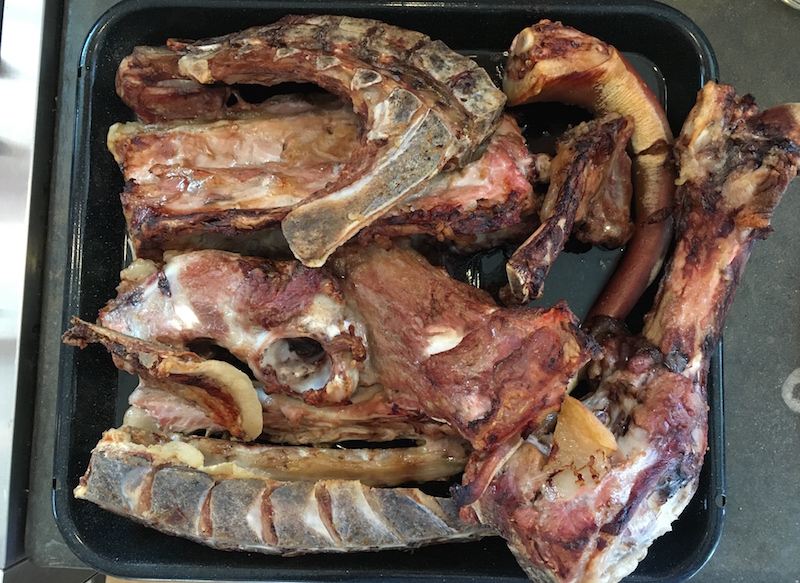
Bones roasted and ready for the pot.

Two hours later we were done, and I was on my way with my pig packed in nice white paper packages in a chest cooler. Of the 125-pound carcass, only the skin, less than five pounds, wasn't used—bones, fat, trim, leaf lard and meat all came home. If you're interested in the particulars, Kendra charges $3.50 per pound for the hanging carcass (after the internal organs are removed); the processing fee I paid to Mt. Angel was $32.50; and Chris's butchering fee was $50.

Just add water!

Frozen immediately after butchering, the meat will last a year, until we buy our next pig. We'll make stock (popularly known as "bone broth") after roasting the bones, and we'll use the leaf lard for baking after it's rendered. The trim meat goes into the grinder along with some of the fat to make bulk sausage, and any remaining fat will be rendered and used in frying and cooking. I call it a pretty darn good deal for a year's worth of very fine eating.

Pork Stock ("Bone Broth")

Bones from half pig, including backbone, tail, etc.
1 large onion, roughly chopped
2 ribs celery, roughly chopped
2 carrots, roughly chopped
2 bay leaves

Preheat oven to 400°.

Thaw bones, if frozen, and place on large sheet roasting pan. Place pan on middle shelf of the oven and roast for 1 hour. Remove from oven and place bones in stock pot big enough to cover bones with water. Add onions, carrots, celery and bay leaves to the pot, then fill the pot with cold water to cover the bones. Bring to a low boil, then reduce heat to lowest setting and simmer for 12 to 24 hours, occasionally removing scum that may rise to the top. Cool and strain. Freeze in containers. Keeps for up to a year.

Monday, December 28, 2015

When Everyone Else Goes Right…


No, this isn't about Hill vs. Don or Bernie. It's about perspective, and, from what I've seen so far, mine is pretty different from the pack. As background, Mattie John Bamman, the new editor for the Portland outpost of the restaurant-industry website Eater, sent the following request: "Would you be interested in sharing your dining opinions as part of Eater Portland's end-of-year coverage?"

Now, I met Mattie—yes, it is his real name and isn't short for Matthew (the reason he gives is that he had "hippie parents")—at a media lunch given by the wonderful Bette Sinclair. For whatever reason he decided to include me in this year's survey. Here are the questions and my answers. I'll include links so you can read what others felt was noteworthy.

What were your top restaurant standbys of 2015?
My husband and I don’t go out much because, frankly, dining out is way too expensive for us to do on any kind of regular basis, so I’m hopelessly out of date on the “hot list.” As a matter of fact, several of them will close before we ever get a chance to go to them. (Cases in point: June, Levant, Noisette.)


Nostrana's Cathy Whims (r) and one of her—and my—favorite farmers.

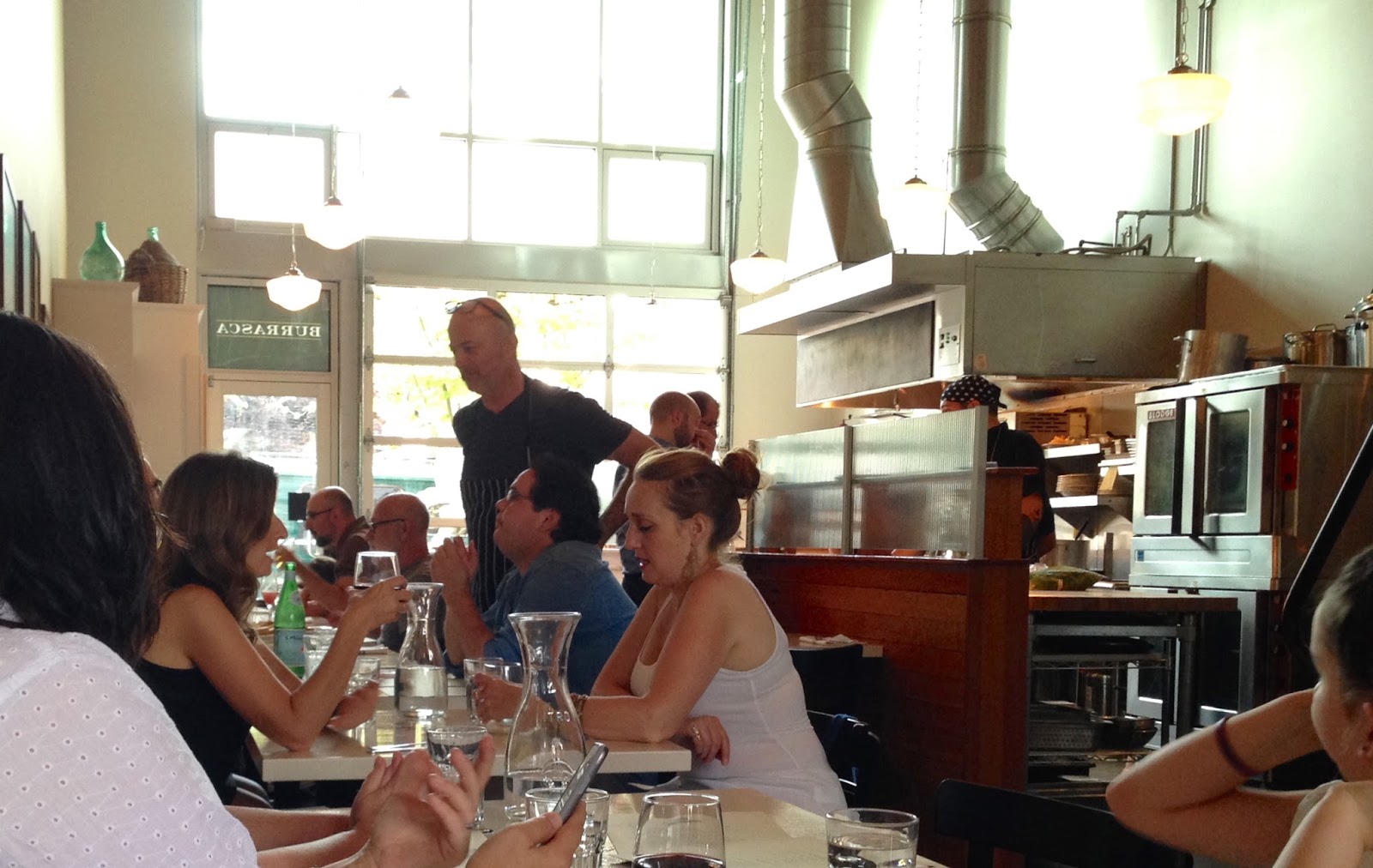
So our standbys are places that make the kind of food we love and source ingredients from local farms and farmers: Bar Avignon, Lovely’s Fifty-Fifty, Old Salt Marketplace, Nostrana, Lucca and Davenport. Tastebud has to be included even though it’s just opened (we’ve been twice) because Mark Doxtader and Sarah (of Lovely’s) are the god and goddess of woodfired pizza made with local ingredients. Burrasca has become a favorite on our hit parade, as well.  Read more.

What were the top restaurant newcomers of 2015?
Tastebud because of the reasons listed above (Mark Doxtader, right). Burrasca (top photo). Love their take on Florentine classics like ribollita, peasant food that uses the simplest ingredients like old bread, leftover beans and greens to make a bowl of comfort; pappa al pomodoro; the deeply intriguing combination of squid and kale that is inzimino.

I’m hoping they’ll find a source for the fourth stomach of a cow, the abomasum, so I can have the famous street food favorite of Florence called lampredotto. Read more.

Describe the 2015 Portland restaurant scene in one word.
Free-for-all. Read more.

What was the best dining neighborhood in 2015?
No place like NE: We live within walking distance of Alberta, Killingsworth, Cully, Williams and Mississippi. (Sarah Minnick of Lovely's Fifty-Fifty, left)

Cully has to be the up-and-comer. Read more.

What was the biggest dining surprise of 2015?
No idea.

What was your single best meal in 2015?
Overall, very few meals can match what we have at home on a regular basis, from roast chicken to braised beef neck to pig trotters in a pot of Ayers Creek Farm beans to steaks on the fire when we’re camping.

Ben Meyer (l) and Bill Hoyt.

Meals out, wonderful as they can be from any of the places listed above, become more special because I don’t have to cook them. Current crave is the beef tartare at Old Salt using beef from Bill Hoyt of Hawley Ranch in Cottage Grove. Read more.

What was the biggest restaurant grievance of 2015?
The focus on chefs and technique versus good food made simply using the best ingredients (preferably local). Read more.

What are your headline predictions for 2016?
No idea.

Friday, December 04, 2015

Great Gifting: The Gift of Class(es)


Making lists, checking them twice…and don't get me started on the whole naughty or nice thing. It’s all too much to keep track of!

So I say opt out, walk away, leave it at the door. No one I know needs more stuff, and the idea of the holidays—and, come to think of it, life in general—is to share joy, spread peace and love and generally try to make the planet a better place, right?

Jessica Hansen's couples date night classes at Middleground Farms.

I've sworn off the kinds of gifts that require displaying or dusting, preferring instead to give items that are 1) consumable or 2) useful in some way. That means no tchotchkes or gewgaws allowed. And though I could never convince my mother of this, gift certificates, especially for learning experiences, are the gift that keeps on giving.

Ben Meyers' sausage-making is perfect for a budding charcutiere.

One that's been particularly well-received, and that I've found personally rewarding even if it's given to someone else, is a gift certificate for a cooking class. Learn basic kitchen skills like how to use a knife more effectively. Create an ethnic feast of the classic flavors of Asia, Europe or India. Has someone in your family decided to become a vegan? Or developed an intolerance or (heaven forfend) an allergy? You can find classes for all of these, from your youngest giftee to great-grandma. Contact any of those at the links listed below for gift certificates.

  • Portland's Culinary Workshop (top photo) offers classes for all ages (plus camps for kids) and an astonishing and wide-ranging roster of learning experiences too long to list here, but all are excellent and taught by professional culinary instructors. Seriously, you can't go wrong.
  • Old Salt Marketplace offers butchery, sausage-making and seasonal cooking classes to adults of all skill levels. I've given these classes as gifts and have heard nothing but raves about owner Ben Meyer's ability to make these skills accessible (and fun) for the home cook.
  • The Kitchen at Middleground Farms in Wilsonville has a wide range of cooking classes for individuals and couples (think date night), all taught in a state-of-the-art kitchen by self-described "accidental farmer" and terrific teacher and chef Jessica Hansen. I've experienced her in action and she's awesome.
  • Cook With What You Have offers individualized instruction with chef and local foods maven Katherine Deumling who makes it a joy to cook with fresh and seasonal ingredients. She also has an online recipe collection available for simple, quick and family-oriented meals that would make an awesome (and ongoing) gift.
  • Turnip the Heat Cooking School has kids classes that can't be beat and that are perfect for the aspiring chef in the household. Owner Joanna Sooper also teaches classes for teens and adults, and makes it tasty, too, since most classes include a shared meal. I would have loved taking one of these when I was young!

Others offering cooking classes include Proletariat ButcheryElder Hall, the Portland Meat Collective and, occasionally, Zenger Farm. If you've taken great cooking classes at other places, please feel free to share them in the comments at the link below!

Tuesday, September 08, 2015

Smoking the Perfect Brisket


Ask my husband what he'd like to grill for any given event and, barring Thanksgiving and Christmas when he smokes a whole turkey, there is only one answer.

His birthday? Brisket. Friends gathering for barbecue? Brisket. Anniversary dinner? Brisket. Our son's birthday (assuming we can get him to agree…)? Brisket.

Six hours in the smoker, many more to go.

There's something about that giant piece of meat that calls his name, that sings a siren song of smoke and meat and juicy perfection like no other. He's grilled and smoked dozens of them over the years, and they've all been deliciously satisfying. Smoke rings, that little red line just inside the surface of the slices that signals smoke-infused perfection? He's had them.

At 170°, ready to wrap.

But recently he read a recipe by Julia Moskin in the New York Times that piqued his brisket-loving soul. It called for a very simple crusting with peppercorns and salt, smoking the brisket for several hours—and here's the part that got him salivating—then it said to wrap the meat in unwaxed butcher paper and return it to the grill for another several hours.

Further research revealed that this method, called the "Texas crutch" by purists, allows the meat to cook in its own juices and better break down the collagen so that it melts into the meat. The brisket is then wrapped in foil and deposited in a closed ice chest to rest.

Wrapped, tied and going back in the smoker.

We happened to have friends coming for a Labor Day barbecue, so I called our new favorite meat source (and advertiser on this blog), Ben Meyer of Old Salt Marketplace, requesting a full brisket from Bill Hoyt's Hawley Ranch grass-fed cattle. A full brisket includes the flat, the meatier end of the cut, and the point or deckle, which has more fat. It also includes a thick cap of fat, which adds moisture when smoking or grilling for long periods.

The result? Smoky perfection, a big hunk of heaven that was meltingly tender yet still intact enough to slice and serve. And one that was crowned "Best Ever" by a very discerning group of carnivores.

Here's Dave's adaptation with his own step-by-step instructions.

Dave's Perfect Brisket
Loosely adapted from Julia Moskin's recipe in the New York Times.

I used an 18-inch Weber Smokey Mountain Cooker, for which these instructions apply. The Times article tells how to do it on a kettle grill.

1 whole beef brisket, 10-12 pounds
1/2 c. black peppercorns
1/3 c. coarse kosher salt
Hardwood briquets
Several chunks of oak wood

The night before smoking:

  • Grind the peppercorns very coarsely. Sift through a fine sieve to remove the fine pepper dust. Use only the coarse peppers. Mix the salt and pepper. Trim the brisket fat to 1/4 inch if necessary. Rub the salt and pepper mix on the brisket. Wrap in plastic and place in a baking sheet in refrigerator overnight.
  • Put a half dozen small chunks of oak in a pan of water to soak overnight.
  • Cover outside of smoker’s water pan with aluminum foil to make cleanup easier.
  • Clean cooking grates.
  • Fill the charcoal ring to an inch or so from the top with charcoal.

On smoking day, flip the charcoal chimney upside down. Put 20-15 briquets in the upended chimney. Place paper in the chimney below the charcoal and light it. When the coals are flaming and are covered with ash, spread the lit charcoal over the charcoal in the ring. Open the bottom vents all the way.

Assemble the rest of the smoker. Fill the water pan 2/3 full with hot tap water. Oil the top cooking grate. Remove the brisket from the refrigerator and place on the top cooking grate. I had to place it very carefully so that it would fit.

Place top dome on smoker. Open the top vent all the way. Close bottom vents to about 25 percent open. Put three chunks of the wet oak on the charcoal.

In a half hour check the temperature and adjust the bottom vents as necessary to keep the smoker temperature to 225-240. Add the remaining wet oak to the charcoal.

I checked the temperature about every hour or more frequently if necessary. The charcoal should smolder for hours without needing a refill.

I put the brisket on the smoker at 6 am.

At about 11 am the internal temperature was 175-180. I then wrapped the brisket in butcher paper, tying it with string, and put it back on the smoker.

After an hour I began poking it with my finger, testing to see if it was becoming more soft and jiggly as the fat, meat and collagen softened. At 3:30, 3 1/2 hours after wrapping the brisket and 9 1/2 hours after putting the brisket in the smoker, I pulled it from the smoker and wrapped it, paper and all, in aluminum foil. I then placed it into a cooler to await dinnertime. At 6 pm it was still hot.

Wednesday, December 10, 2014

Great Gifting: Give the Gift of Local


I always seem to draw a blank this time of year. It happens I'm running out of time to ship a package off to the East Coast or find a little something to take as a gift to the host of a gathering. Plus there's my "no tchotchkes, gewgaws or bibelots" rule, i.e. never giving anything that needs to be dusted. (Books—and I mean those physical object with the paper pages—don't come under that rubric.) So I decided to make a list of ideas for my own reference, and I welcome you to borrow any that fit your needs. (Or even add your own in the comments at the end of the post!)

The Store at Cooking Up a Story. My friends Rebecca and Fred Gerendasy have produced videos for many years about local food producers, farmers and the people who make Oregon's agricultural scene so vibrant, and they've just opened a store featuring some of the handmade products they've come across. Check out Nancy Arcement's fabric goats (top photo), perfect for cuddling, Debbie Dean's fanciful country ceramics or the best plum preserves you'll ever have in your life from Anthony and Carol Boutard at Ayers Creek Farm (left).

The Meat Box at Old Salt Marketplace. Ben Meyer buys his grass-fed beef, pork and poultry from small family ranches and farms and is making some of the most delicious housemade charcuterie in town. The meat lover in your life—or the host of the holiday potluck you've been invited to—will be thrilled with either the Salami Pack, a grab bag of sausages, thuringer and braunschweiger with mustard, pickles and cheese, or the Snack Pack, a muncher's dream of Slim Jims, landjaegers, knoblauchwurst, pickles and two kinds of cheddar cheese. Yum!

Seasonal Recipe Collection from Cook With What You Have. Do you have someone on your list who's wanting to start cooking meals that are healthier and more seasonal but doesn't have a clue what to do with a turnip or how to cook meltingly tender beans? A year's subscription to Katherine 's easy-to-make, easy-to-shop-for recipes will guide cooks on a budget through how to make the most of what's in season using pantry staples to eat deliciously.

Olive oil, salt, spices and other goodness from Real Good Food. Jim Dixon is expanding his offerings of the small-batch, artisanal olive oils that he imports directly from small producers in Europe, and his pop-up "warehouse" will be open frequently in the days leading up to Christmas. Think of a gift box of olive oil, sea salt and a couple of packages of fennel pollen and oregano from a tiny island in Italy, or mix and match from his other amazing products.

Gift Certificates from Portland's Culinary Workshop. Give the gift of knowledge to the person on your list who's wanting to expand their culinary horizons. Even newbies can benefit from learning how to hold a knife without slicing off digits, and who wouldn't love to crack the mysteries of pho, Chinese dumplings, the perfect artisan loaf or learn about cuts of meat by watching a master butcher work through a carcass? From personal experience I can tell you that giving this gift will return nothing but raves…and maybe even an invitation to dinner to demonstrate the skills they've learned!