Showing posts with label bone broth. Show all posts

Wednesday, February 24, 2016

Pig Errands: Pick Up, Butcher, Make Stock


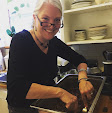
Not many husbands get to say, as mine did recently, that their wives are running "pig errands." In that case, I was heading to Mt. Angel in Dave's pickup to fetch the half pig I'd ordered from Kendra Kimbirauskas (above, with her pigs) and her husband, Ivan Maluski, of Shimanek Bridge Farm in Scio.

Bungied and secure for the trip to Portland.

Waiting for me at Mt. Angel Meat Company was owner Eric Fietz, and while he finished a call I got to play with a feral kitten who'd discovered that a meat processing plant was a fine place to hang out. (Eric said he'd been working on taming the black-and-white cutie so he could find it a home, so let him know…) One of his butchers, a big burly guy, came walking out cradling my 125-lb. half as if it was a tiny baby and kindly loaded it in the back of the truck.

It's our fourth half pig in as many years, and I've slowly been learning the basics of butchery with help from Melinda Casady at Portland's Culinary Workshop. She was tied up with classes, though, so I called Ben Meyer of Old Salt Marketplace, hoping he could spare some time to help out, and he graciously agreed, even offering to hang the carcass in his walk-in for a couple of days until we butchered it.

The craftsman at his bench. Thanks, Chris!

The day came, along with a text from Ben saying that he'd come down with a fever and needed to change plans. With visions dancing in my head of me driving around the city with a half pig in the back of the truck, looking for someone to help cut and wrap it—yes, I can be a drama queen—Ben offered to see if his head butcher, Chris Carter, could step in.

Chops for days!

Spending a couple of hours in a freezing walk-in may not be most folks' idea of a good time, but watching a whiz like Chris work through a carcass is pretty awe-inspiring, and getting a few tips on deboning a belly and skinning cuts without mangling the meat was well worth it. (The right kind of knife and making sure it's well-sharpened are a great place to start.)
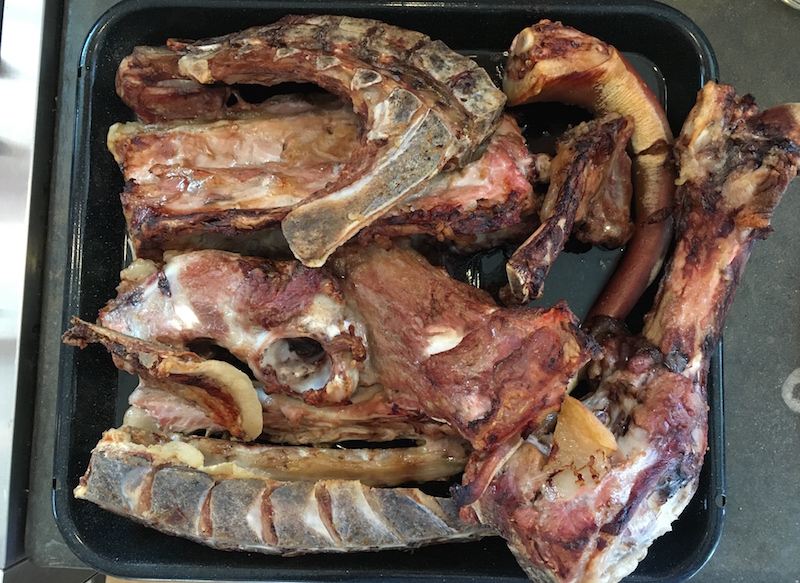
Bones roasted and ready for the pot.

Two hours later we were done, and I was on my way with my pig packed in nice white paper packages in a chest cooler. Of the 125-pound carcass, only the skin, less than five pounds, wasn't used—bones, fat, trim, leaf lard and meat all came home. If you're interested in the particulars, Kendra charges $3.50 per pound for the hanging carcass (after the internal organs are removed); the processing fee I paid to Mt. Angel was $32.50; and Chris's butchering fee was $50.

Just add water!

Frozen immediately after butchering, the meat will last a year, until we buy our next pig. We'll make stock (popularly known as "bone broth") after roasting the bones, and we'll use the leaf lard for baking after it's rendered. The trim meat goes into the grinder along with some of the fat to make bulk sausage, and any remaining fat will be rendered and used in frying and cooking. I call it a pretty darn good deal for a year's worth of very fine eating.

Pork Stock ("Bone Broth")

Bones from half pig, including backbone, tail, etc.
1 large onion, roughly chopped
2 ribs celery, roughly chopped
2 carrots, roughly chopped
2 bay leaves

Preheat oven to 400°.

Thaw bones, if frozen, and place on large sheet roasting pan. Place pan on middle shelf of the oven and roast for 1 hour. Remove from oven and place bones in stock pot big enough to cover bones with water. Add onions, carrots, celery and bay leaves to the pot, then fill the pot with cold water to cover the bones. Bring to a low boil, then reduce heat to lowest setting and simmer for 12 to 24 hours, occasionally removing scum that may rise to the top. Cool and strain. Freeze in containers. Keeps for up to a year.

Friday, December 11, 2015

One Simple Roast Chicken = At Least Three Dinners


It's the dinner that keeps on giving. Not just a single feast-like meal, roast chicken fits in the category of those magical dinners that, if you can whisk away the platter before there are just scraps left, you've got the makings for at least two more meals, not to mention a decent lunch. And even with just a few scraps left over you can have a big pot of soup and enough stock for risotto.

You can see where I'm going here.

Say you make a roast chicken for your Sunday dinner (left). (Shopping hint: I always buy the biggest one in the case because there's a better chance for leftovers, and it only takes a few minutes longer to cook.) After it's been ripped apart by your ravenous family/fellow diners and they've gone off to their postprandial pursuits, take the plates into the kitchen. Scrape the bones into a pot along with any innards that came with the chicken. Then pull off the meat from any pieces left on the platter, scraping the bones into the aforementioned pot.

Now it's time to attack the carcass with your hands, pulling off even smaller shreds and adding it to your growing pile of meaty bits. Break the carcass in half—this is super easy once all the meat is gone—and put it in the pot. Add water to cover the carcass and put it on the stove to simmer for about an hour (this can be done anytime, really—just put the pot in the fridge until you've got an hour to make the stock). Notice I don't add any other vegetables to make the stock…I like to add those when I'm making whatever the final dish calls for. Put the leftover meat in the fridge.

So what do you have? Well, you'll probably come away with two to three quarts of stock once the bones have been strained off, which you can freeze for soups, risottos or whatever other quickie dinner you choose to make later in the week. Depending on how much meat I've yanked from the mouths of my family and scavenged from the carcass, I usually get upwards of a couple of cups of meat or maybe more. It's enough to throw in a pot of chicken soup, a chicken pot pie or a risotto, with perhaps enough left for a chicken curry sandwich for lunch.

As for that first, lovely roast chicken dinner, if you make the recipe below, in 90 minutes you'll have a one-pot meal, if you count the carrots as your vegetable. Which, of course, I do.

Roasted Chicken with Root Vegetables

3 Tbsp. olive oil
1 onion, roughly chopped
2 carrots, halved and cut in 1/4" slices
3 cloves garlic, chopped fine
1 tsp. dried thyme
3-4 c. root vegetables like sweet potatoes, yams, squash, parsnips, potatoes, turnips, etc.
1 roasting chicken or large fryer
1/2 c. white wine or dry vermouth
Salt and pepper

Preheat oven to 375°. Pull the chicken out the fridge, removing any wrapping, and let it sit on the counter on a couple of paper towels to come to room temperature.

Pour 2 Tbsp. oil into a large frying pan over medium-high heat until it shimmers. Add onions and sauté until translucent. Add carrots and sauté till tender, then add garlic and sauté briefly. Turn off heat and stir in the thyme and root vegetables. Put mixture in 9" by 12" Pyrex casserole dish. Pour wine over vegetables.

Rub chicken with remaining 1 Tbsp. oil and throw 1 tsp. or so salt into the cavity and place the chicken on its side on top of the vegetables. Place in oven and roast for 25 minutes. Remove from oven, turn chicken on its other side and roast for another 25 minutes. Remove from oven, turn chicken so it is breast-side up, baste with pan juices and sprinkle with salt and pepper. Roast another 15 minutes, remove and baste, then roast a final 20 minutes or, for our tastes, until an instant-read thermometer reads 150° on the inside of the lower thigh and the inner side of the breast next to the rib cage. Remove from oven, allow to rest for 10 minutes. Cut it into pieces, removing the breasts whole and slicing them crosswise.