Showing posts with label Ivan Maluski. Show all posts

Thursday, February 28, 2019

Lost Valley Farm Sold to Washington Buyer


Well, it's happened. Lost Valley Farm, the infamous factory farm dairy that in its first two years racked up more than 200 violations related to overflowing manure pits, leaking tanks of dead animals, over-application of manure that threatened area groundwater and drinking wells, and even failure to provide restroom facilities for employees, has been sold.

Cow stands in liquid manure at Lost Valley.

Who would be crazy enough to buy a facility that will require millions of dollars to clean up and more millions to install a new irrigation system? Apparently Cody Easterman of Easterday Farms of Pasco, Washington, a large potato and onion grower, who paid $66.9 million through a company called Canyon Farm LLC. (Easterman was contacted by phone but did not respond by the time of posting.)

With some 47 million gallons of liquid manure still remaining onsite—which one source estimated would fill 71 Olympic swimming pools—what is the draw that would make it attractive to a buyer like Easterman?

For one thing, the water rights.

"The irrigation rights for growing crops on the several thousand acres of land are in place, and very valuable," said Ivan Maluski, policy director for Friends of Family Farmers, an organization that had been involved in fighting against Lost Valley Farm since it was first proposed due to a lack of regulation and oversight on the part of the state. Though he added, "The water is for sustaining livestock and dairying year-round is still contested and not secure."

The site was originally the Boardman Tree Farm.

In an e-mail responding to questions I posed to the Oregon Department of Agriculture (ODA) about the sale, spokesperson Andrea Cantu-Schomus said that the ODA and the Oregon Department of Environmental Quality (DEQ) have signed what's called an "Order and Mutual Agreement" (OMA) with the federally appointed trustee for Lost Valley Farms, Randy Sugarman, that "ensures the wind-down and cleanup process for the facility."

"The priority of ODA, and our partner agencies DEQ and the Oregon Department of Justice (DOJ), was that the OMA fulfill three principles: accountability, no gaps in responsibility and effort, and achieving the state’s desired outcomes," Cantu-Schomus wrote in an e-mail. "We believe the signed OMA achieves those principles."

Aside from the cleanup of the manure and dead animals remaining on the property, the OMA also requires that the remaining cows—still numbering as many as 8,000, according to some reports—be removed from the facility. (An auction of the cows is part of a separate agreement with the trustee.) The agreement requires that Easterman must apply for a new CAFO (Confined Animal Feeding Operation) permit if he wants to reopen the dairy or, if he does not, that the dairy must be decommissioned "to the satisfaction of the ODA."

Emissions into air and water are problems for communities near industrial dairies.

A complicating factor for Easterman, if he decides to reopen the dairy or lease the facility to another operator, are SB 103 and SB 104, two bills before the legislature that seek a moratorium on approval of new dairy operations in the state and require establishment of regulations governing factory farm dairies that are already located, or that may want to locate, in Oregon.

Both bills apply to mega-dairies, that is, facilities with more than 700 cows that are confined without seasonal access to pasture, or a total of 2,500 cows—Lost Valley was originally permitted for 30,000 cows. The legislation would regulate these dairies as the industrial factories they are rather than treating them as traditional agricultural farms, and would require limits on toxic emissions to air and water, including groundwater. These bills would also require studies on the impacts to Oregon's small and mid-size dairies and on animal welfare and would close existing loopholes that allow excessive use of scarce groundwater, as well as establishing a course of action if a facility fails to meet state standards, as happened with Lost Valley Farm. (Follow the progress of the legislation in Your Food, Your Legislature postings here.)

The sale of Lost Valley makes the passage of these bills even more critical, according to Amy van Saun, a staff attorney for the Center for Food Safety.

"I think ODA realizes that Lost Valley was a giant problem, but the fixes they have suggested to the legislature at this point aren’t enough, in our minds, to fix the problem," van Saun wrote in an e-mail. "But [the ODA] realizes they need more oversight and are seeking it from legislature. The moratorium is all the more important now that once Lost Valley gets cleaned up, these owners may well want to restart dairy operations, and that could be within the year."

* * *

Read my series of posts outlining the long history of problems at Lost Valley Farm since it opened two years ago, including cows standing in manure from overflowing lagoons and a leak in a tank containing dead cows, plus massive groundwater pollution, lawsuits from the state of Oregon and the farm's creditors, and former owner Greg te Velde's own arrest for soliciting a prostitute and possession of methamphetamine in Benton County, Washington.

My article Big Milk, Big Issues for Local Communities reports on the issues mega-dairies pose to Oregon's air, water, environment and communities. You can also find out Why I'm Quitting Tillamook Cheese and read other coverage about factory farms in Oregon.

Wednesday, January 30, 2019

Your Food, Your Legislature: 2019 Session Kicks Off with Big Issues on the Docket


On the first day of the 2019 Oregon legislative session, more than 1,500 bills were introduced, and there are likely to be at least twice that many by the time the session ends in five months. Here at Good Stuff NW I'll be reporting on the issues facing our legislators, particularly those bills that could affect our food system here in Oregon. Plans are afoot for monthly installments titled Your Food, Your Legislature, bringing you updates with background on, and the dirt from, the major players.

A bill banning aerial application of pesticides considered.

Among the top issues for our food system so far are bills that could ban or heavily limit aerial spraying of pesticides (HB 2493); a bill that seeks to assign responsibility to the patent-holder of genetically modified seeds for losses to a farmer's income due to contamination from genetically modified crops (SB 434); restrictions on the home use of neonicotinoid pesticides (HB 2619); and the proposed moratorium on current and future mega-dairies—factory farms that typically house thousands of cows in indoor facilities—until legislators establish regulations for these industrial facilities (SB 103 and SB 104).

Another big issue that's being pushed this session is the so-called "Clean Energy Jobs" bill (HB 2020), a cap-and-trade effort that seeks to, in the words of advocates, "put a limit and price on climate pollution from the largest polluters in the state" as well as "secure greenhouse gas reductions and reinvestment into communities across Oregon to create clean energy jobs and a thriving economy, especially in communities that need it most."

Wind turbines in the Columbia River Gorge.

An article in the Oregonian said that Oregon Governor Kate Brown, Senate President Peter Courtney and House Speaker Tina Kotek "are all in on putting a price on greenhouse gas emissions, and Oregon could become the second state after California with an economy-wide cap on such emissions. What remains to be negotiated is how many big emitters qualify for free emissions allowances under the law, and whether the program has any environmental integrity." Another big question is whether the new bill will broadly exempt agricultural sources like factory farms from the cap, as did a similar cap-and-trade bill that failed to pass two years ago.

Ivan Maluski, Policy Director for Friends of Family Farmers (FoFF), which conducted a series of "listening sessions" with farmers across the state, said that farmers expressed the need for legislators to do more to support Oregon's small and mid-size family farmers. "Small and mid-sized family farmers face significant challenges," Maluski said. He outlined the farmers' primary concerns as getting assistance in accessing land and capital, enabling access to small farm meat processing infrastructure, expanding opportunities for agritourism, and aiding farmers in improving water conservation efforts. Follow HB 2020.

On the issue of aerial spraying of pesticides, concerns around this practice—widely used on agricultural and public lands in Oregon—center on the damage cause by "off-target drift," that is, the tendency for these sprays to drift beyond the targeted areas, causing damage to nearby crops, waterways, wildlife and beneficial insects. Several environmental, agricultural and consumer groups can be expected to be involved in this legislation as it develops. Follow HB 2493.

Oregon taxpayers are on the hook for cleaning up escaped GE bentgrass.

The subject of what happens to a farmer who suffers losses when a crop is contaminated by genetically modified crops is an issue that the legislature has wrestled with in past sessions.

"I’ve had a front row seat to the damage caused by Roundup Ready GE bentgrass, which spreads easily on the wind and through water, infesting irrigation ditches and cross-pollinating with wild relatives," wrote Vale farmer Jerry Erstrom in an op-ed when a similar bill was before the 2017 legislature. "I am not opposed to genetically engineered crops, but as a farmer of some non-GE varieties, and after my experience with GE contamination in my alfalfa seed production, and with the GE creeping bentgrass escape, I am a supporter of making the right people accountable if crops are damaged."

 "The legislature tends to be crisis-oriented," said Maluski, indicating that FoFF will be actively involved with the Center for Food Safety and Our Family Farms Coalition as the bill moves through the legislative process.

"We shouldn't have to wait for a contamination incident before we put rules in place," he said, citing the appearance of an experimental variety of Monsanto's genetically modified wheat that appeared in an Oregon field in 2013. Follow SB 434.

Toxic emissions are just one problem with factory farm dairies.

Two bills, SB103 and SB104, are an effort to establish regulations governing factory farm dairies that are already located, or that may want to locate, in Oregon. Both bills apply to mega-dairies, that is, facilities with more than 700 cows that are confined without seasonal access to pasture, or 2,500 cows. The legislation would regulate these dairies as the industrial factories they are rather than treating them as traditional agricultural farms, and would require limits on toxic emissions to air and water, including groundwater. These bills would require studies on the impacts to Oregon's small and mid-size dairies and on animal welfare. They would also close existing loopholes that allow excessive use of scarce groundwater, and establish a course of action if a facility fails to meet state standards, as happened with Lost Valley Farm, a mega-dairy that piled up more than 200 violations in less than two years of operation and yet was still allowed to keep operating.

“Lost Valley showed us how horribly wrong things can go given our current laws,” said Amy van Saun, staff attorney at the Center for Food Safety in Portland, in an article in the Salem Statesman-Journal. If these bills pass, according to the article, factory farms "wouldn’t qualify for regulatory exemptions available to farmers under the state’s right-to-farm and other laws. That would allow local communities to have input into siting decisions and enact health and safety ordinances restricting or prohibiting air and water emissions," a problem that's occurred with other industrial agricultural operations looking to locate in Oregon.

Since it's still early days in this session, there will be more to come, and you can count on reading about the legislative sausage-making in future updates. Stay tuned!

Read more about the ongoing problems at Lost Valley Farm.

Wednesday, September 19, 2018

Court Orders Feds to Take Over Lost Valley Farm, Appoint Trustee


“[Owner Greg] Te Velde is unwilling, or unable, to comply with his duties as a fiduciary,” wrote Judge Fredrick Clement of the U.S. Bankruptcy Court of the Eastern District of California in his decision to allow a federal takeover of Lost Valley Farm in Boardman, Oregon.

“Since filing (bankruptcy), [te Velde] has continued his long-standing habits of methamphetamine usage and gambling," Judge Clement continued. "Drug usage has occurred once or twice per week, and he has gambled estate monies of $2,000 to $7,000 monthly. Te Velde borrowed $205,000 without court authorization, and in a one-month period took personal draws of $28,000 more than authorized.”

With that damning decision by Clement, te Velde failed in his efforts to maintain control of Lost Valley Farm in Boardman as well as the two mega-dairies he owns in California. Clement then ordered the appointment of a trustee to manage the three factory farm dairies.

According to an article in the Salem Statesman-Journal, "it's uncertain whether replacing te Velde with a trustee will hasten or slow environmental improvements at the dairy" since "creditors have said they are reluctant to approve any spending on environmental compliance until a consultant completes a report outlining the cost of all needed improvements."

Until that report is done, and even in its current questionable state, the dairy will continue to operate, selling the milk from its approximately 7,000 cows under the contract it has with the Tillamook Creamery Association's processing plant in Boardman. That is despite Tillamook's claims in bankruptcy hearings in June that the milk from Lost Valley violated the company's testing standards for safe levels of bacteria on at least 60 occasions.

"The Lost Valley mega-dairy has been a disaster from the beginning, and hopefully this decision will lead to it finally being closed down," said Friends of Family Farmers Policy Director Ivan Maluski in the Salem paper's article. "The Oregon Departments of Environmental Quality and Agriculture could have prevented this fiasco and should have denied this operation a permit at the outset. This situation makes it clear that Oregon needs stronger laws to prevent this kind of thing from happening in the future."

* * *

Read my series of posts outlining the long history of problems at Lost Valley Farm since it opened just a year ago, including cows standing in manure from overflowing lagoons and a leak in a tank containing dead cows, plus massive groundwater pollution, lawsuits from the state of Oregon and the farm's creditors, and te Velde's own arrest for soliciting a prostitute and possession of methamphetamine in Benton County, Washington.

My article Big Milk, Big Issues for Local Communities reports on the issues mega-dairies pose to Oregon's air, water, environment and communities. You can also find out Why I'm Quitting Tillamook Cheese and read other coverage about factory farms in Oregon.

Wednesday, June 20, 2018

In Discussion: Lost Valley Farm and Mega-Dairies in Oregon


When Chris Seigel, host of the Food Show on KBOO Community Radio, contacted me wanting to do a segment on my reporting on Lost Valley Farm and mega-dairies in Oregon, I saw it as a chance to get the word out about how these large factory farm dairies are affecting Oregon's communities and our air and water, as well as the health of Oregonians.

I immediately called in Amy Van Saun, staff attorney for the Center for Food Safety, and Ivan Maluski, policy director for Friends of Family Farmers, who have been working on the issues these out-of-state-owned, corporate factories present to the state. (Give our discussion a listen by clicking on the audio bar below the photo, above.)

* * *

Read the series of posts outlining the long history of problems at Lost Valley Farm since it opened just a year ago, including cows standing in manure from overflowing lagoons and a leak in a tank containing dead cows, as well as groundwater pollution, lawsuits from the state of Oregon and creditors, and te Velde's own arrest for soliciting a prostitute and possession of methamphetamine in Benton County, Washington.

My article Big Milk, Big Issues for Local Communities reports on the issues mega-dairies pose to Oregon's air, water, environment and communities. You can also find out Why I'm Quitting Tillamook Cheese and read other coverage about factory farms in Oregon.

Monday, April 17, 2017

Your Food, Your Legislature: Mega-Dairies Win, Oregon's Air Quality Loses


"Threemile Canyon Farms in Boardman, Oregon, reported that its 52,300-dairy-cow operation emits 15,500 pounds of ammonia per day, totaling more than 5,675,000 pounds per year. That is 75,000 pounds more than the nation’s number one manufacturing source of ammonia air pollution (CF Industries of Donaldson, Louisiana)." - from a letter to the EPA from the National Association of Clean Air Agencies, March 27, 2008

Not to scare the pants off of you, but Threemile Canyon Farms, the mega-dairy mentioned above, now has 70,000 cows, with a concomitant increase in the amount of ammonia produced per day—meaning its cows now produce 20,746 pounds of ammonia per day, every day, for a grand total of 7,572,180 pounds per year. Not only that, it's soon to be joined by Lost Valley Farm, which is initially slated to have 30,000 cows. Oh, and Boardman? It's right on the banks of the Columbia River, at the east end of the Columbia River Gorge.

Slurry at Threemile Canyon Farm.

Luckily for these factory farms—both of which have contracts to supply much of their milk to Oregon's own Tillamook cheese so it can be sold from here to Micronesia—the legislature's Senate Committee on Environment and Natural Resources today killed a bill, SB 197, that would have begun the process of setting up basic regulations on air contaminant emissions (like ammonia) from these types of mega-dairies. Contaminants are not monitored or regulated due to a loophole in Oregon law that exempts these factory farms from any requirement to monitor, report or reduce air pollution associated with the manure from the tens of thousands of animals they keep.

Cow standing in slurry at Threemile Canyon.

In a statement on the demise of SB 197, a coalition of farm and environmental watchdogs said that "large mega-dairies like Threemile Canyon Farms, with 70,000 cows, and the recently approved 30,000-cow Lost Valley Farms, have been identified as major sources of ammonia, a gas responsible for haze and acid deposition in the Columbia River Gorge."

"The landscape of agriculture in Oregon is changing," according to Ivan Maluski, Policy Director of Friends of Family Farmers. "Since 2002, the state has lost roughly 75% of its dairy farms even as cow numbers have grown and large industrial scale dairies have moved in. Instead of supporting small and mid-sized family farms, the state has opened its doors for increasingly large, factory-scale industrial dairy operations. All the while, Oregon decision-makers have been putting their heads in the sand with regard to their harmful emissions of gases like ammonia and methane from these increasingly large operations. Today will be marked as one in which Oregon chose to do nothing to address the harmful air emissions from the growing number of large confinement dairy operations coming here to take advantage of our misguided air pollution loophole."

Read my post on Why I'm Quitting Tillamook Cheese.

Read the other posts in this series. Find your legislators here and share your concerns.

Thursday, February 16, 2017

The Future of Our Food: Supporting Family Farmers in Oregon


This series interviews farmers, food activists, politicians and policy wonks to try to get a handle on the seismic shift in our local food landscape due to the change of administrations in Washington.

Ivan Maluski owns and operates Shimanek Bridge Farm with his wife, Kendra Kimbirauskas, in rural Linn County where his focus is on producing high quality pasture while rotationally grazing pigs, poultry, goats and cattle. With nearly twenty years of experience working on natural resource policy issues at the state and federal levels, he has served as the Policy Director for Friends of Family Farmers (FoFF) since 2012. He works to accomplish FoFF's legislative and policy priorities at the State Capitol in Salem, representing small and mid-sized farmers and ranchers. He can often be found testifying at the Oregon Board of Agriculture, the Legislature and in other venues. He also makes a terrific cheese from the milk from his herd of LaMancha goats.

What are the critical issues affecting agriculture and our food system a) here in the Northwest and b) in the country as a whole?

In the Northwest, one of the most critical issues facing our food system is rapidly rising farmland prices that is making access to land for beginning farmers increasingly difficult. The average age of Oregon farmers is now at 60 years old and a significant portion of Oregon's farmland base is likely to change hands in the next decade or two. Increasingly, Oregon farmland is being bought by out-of-state real estate investment firms and larger agricultural production firms, which is driving prices beyond the reach of family-scale and newer farmers. This trend could lead to vastly less family ownership of farmland in Oregon in the future, fewer smaller and mid-sized independent farms, and less resiliency in local and regional food production systems.

In the country as a whole, rising market consolidation and corporate mergers are a major threat to family farm ownership and consumer choice, as our food system increasingly falls into the hands of a smaller number of large corporations. A generation ago, America's food and farm economy was dominated by family-scale operations. Now, just handful of companies control most meat production and a major share of dairy production in the U.S. The world's largest seed and input companies also in the process of merging, which reduces marketplace competition, which will likely raise prices for farmers while reducing options for seeds and other inputs. This will ultimately translate into higher prices for consumers as well.

Putting on your best prognosticating hat, what are the issues you think are going to be at the top of the list of the new administration, and how do you think they will address them?

I think the new administration is going to be heavily focused on repealing regulations that they view as obstacles to large, industrial agricultural firms doing business how they see fit. To the extent EPA rules, for example, currently work to keep manure from large factory farms, or fertilizer runoff, out of waterways, these rules will be under attack by the Trump administration and the current leadership in Congress. Expect both administrative and Congressional action to repeal as many regulations as possible over the next two years, with the primary beneficiary in agriculture being bigger operations with the most significant pollution issues. I think we can also expect that, despite historical bipartisan support for the Farm Bill, the 2018 Farm Bill debate will likely be colored by efforts by the Trump administration to slash spending. If they are successful, I would expect there to be cuts to important farm conservation programs, organic research, local food system programs, programs aimed at helping beginning and socially disadvantaged farmers, and the nutrition programs like SNAP (Supplemental Nutrition Assistance Program, formerly known as food stamps) that make up a big part of the Farm Bill.

What do we as citizens need to be paying attention to? What are the best sources for information on the issues?

Pay attention to how the Trump administration deals with pending mergers between companies like Monsanto and Bayer, and Syngenta and Chem China. Before being inaugurated, Trump met with the CEOs of Monsanto and Bayer at Trump tower and seemed to endorse the merger, which would have devastating impacts on many American farmers. Additionally, the Trump administration has put on hold long-overdue Farmer Fair Practices rules to level the playing field for family-scale livestock producers and increase transparency in the marketplace to address unfair practices that large meatpacking companies sometimes engage in to control prices. The fate of large agribusiness mergers and the Farmer Fair Practices rules will be an early, major test of the Trump administration on whether they will stand with family farmers, or large agribusiness companies when those interests diverge. While some of the most prominent groups in the agribusiness sector support mega-mergers and oppose the Farmer Fair Practices rules, groups that support independent and sustainable producers are also speaking up. Sign up for alerts and newsletters from groups like the National Farmers Union and the National Sustainable Agriculture Coalition to stay on top of national policy.

In your opinion, what’s the most effective action citizens can take in the short term? In the long term?

In the short term, concerned citizens may need to look at getting more involved at the local and state level to advance good food and farm policies. For at least the next two years, the federal government has been taken over by corporate ag interests that will likely take policy backwards. This must be opposed, but it is also an opportunity for state and local governments to enact or strengthen policies that promote local and regional food systems and sustainable agriculture. State and local governments will need to lead the way if the federal government is going backward.

What organizations most need our support?

Friends of Family Farmers and the National Sustainable Agriculture Coalition.

Read more in the Future of Our Food series.

Wednesday, February 24, 2016

Pig Errands: Pick Up, Butcher, Make Stock


Not many husbands get to say, as mine did recently, that their wives are running "pig errands." In that case, I was heading to Mt. Angel in Dave's pickup to fetch the half pig I'd ordered from Kendra Kimbirauskas (above, with her pigs) and her husband, Ivan Maluski, of Shimanek Bridge Farm in Scio.

Bungied and secure for the trip to Portland.

Waiting for me at Mt. Angel Meat Company was owner Eric Fietz, and while he finished a call I got to play with a feral kitten who'd discovered that a meat processing plant was a fine place to hang out. (Eric said he'd been working on taming the black-and-white cutie so he could find it a home, so let him know…) One of his butchers, a big burly guy, came walking out cradling my 125-lb. half as if it was a tiny baby and kindly loaded it in the back of the truck.

It's our fourth half pig in as many years, and I've slowly been learning the basics of butchery with help from Melinda Casady at Portland's Culinary Workshop. She was tied up with classes, though, so I called Ben Meyer of Old Salt Marketplace, hoping he could spare some time to help out, and he graciously agreed, even offering to hang the carcass in his walk-in for a couple of days until we butchered it.

The craftsman at his bench. Thanks, Chris!

The day came, along with a text from Ben saying that he'd come down with a fever and needed to change plans. With visions dancing in my head of me driving around the city with a half pig in the back of the truck, looking for someone to help cut and wrap it—yes, I can be a drama queen—Ben offered to see if his head butcher, Chris Carter, could step in.

Chops for days!

Spending a couple of hours in a freezing walk-in may not be most folks' idea of a good time, but watching a whiz like Chris work through a carcass is pretty awe-inspiring, and getting a few tips on deboning a belly and skinning cuts without mangling the meat was well worth it. (The right kind of knife and making sure it's well-sharpened are a great place to start.)

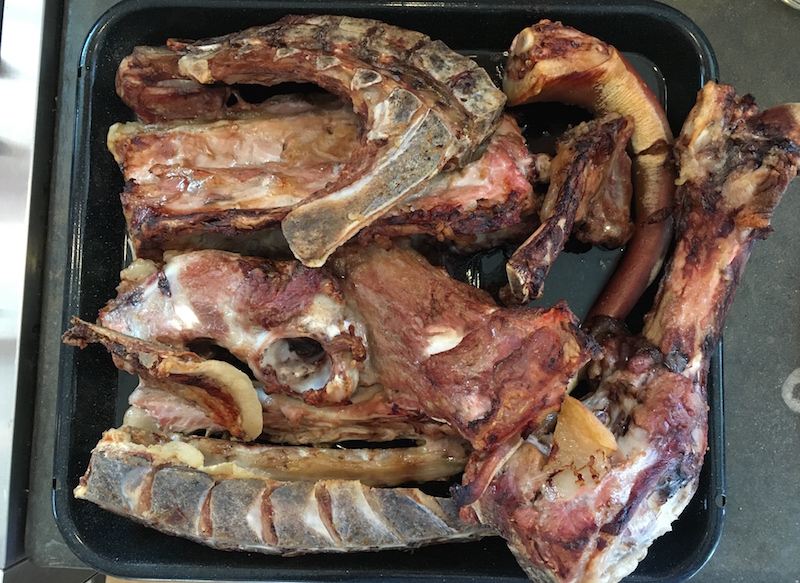
Bones roasted and ready for the pot.

Two hours later we were done, and I was on my way with my pig packed in nice white paper packages in a chest cooler. Of the 125-pound carcass, only the skin, less than five pounds, wasn't used—bones, fat, trim, leaf lard and meat all came home. If you're interested in the particulars, Kendra charges $3.50 per pound for the hanging carcass (after the internal organs are removed); the processing fee I paid to Mt. Angel was $32.50; and Chris's butchering fee was $50.

Just add water!

Frozen immediately after butchering, the meat will last a year, until we buy our next pig. We'll make stock (popularly known as "bone broth") after roasting the bones, and we'll use the leaf lard for baking after it's rendered. The trim meat goes into the grinder along with some of the fat to make bulk sausage, and any remaining fat will be rendered and used in frying and cooking. I call it a pretty darn good deal for a year's worth of very fine eating.

Pork Stock ("Bone Broth")

Bones from half pig, including backbone, tail, etc.
1 large onion, roughly chopped
2 ribs celery, roughly chopped
2 carrots, roughly chopped
2 bay leaves

Preheat oven to 400°.

Thaw bones, if frozen, and place on large sheet roasting pan. Place pan on middle shelf of the oven and roast for 1 hour. Remove from oven and place bones in stock pot big enough to cover bones with water. Add onions, carrots, celery and bay leaves to the pot, then fill the pot with cold water to cover the bones. Bring to a low boil, then reduce heat to lowest setting and simmer for 12 to 24 hours, occasionally removing scum that may rise to the top. Cool and strain. Freeze in containers. Keeps for up to a year.

Tuesday, July 21, 2015

Your Food, Your Legislature: Wins, Losses and Draws


Key pieces of legislation that would have affected the food we put in our shopping baskets and serve to our families were in play in the session of the state legislature that just concluded. Up for debate were issues on genetically engineered (GE) crops, antibiotics in animal feed, urban agriculture and a loan program to help beginning farmers, among many others.

Unprecedented efforts by concerned citizens—including readers of Good Stuff NW—and small farm organizations helped to offset some of the lobbying and money thrown around by out-of-state agribusiness interests, resulting in big wins for family farmers and consumers, but there were also some disappointing losses. Here's the wrap-up.

Wins

Loans for beginning farmers (aka Aggie Bonds): With the average age of an Oregon farmer nearing 60, HB 3239 will make a big difference in bringing younger farmers online quickly. It expands the types of loans issued by NW Farm Credit Services, as well as seller-financed loans. Through HB 5005, the Legislature authorized up to $10 million in state bonding authority to support dozens of lower-interest rate beginning farmer loans over the next two years.

Agritourism: The ability of Oregon farmers to educate more people about farming and farm practices and earn income from those visits without fearing liability claims was given a big boost by SB 341. As long as risks are clearly posted, it provides protection for farms engaged in agritourism including U-pick, corn-mazes, hay rides, farm stays and more.

Farm-to-school programs: Oregon's children will be eating healthier meals at school thanks to HB 2721*. Funding for the popular program will increase from $1.2 million to $4.5 million over the next two years and was expanded to cover school meal programs statewide.

OSU Extension: This critical agricultural service will get $14 million in new funding with HB 5024, reversing a decade of staff and budget cuts. It allows the University to hire new positions to support farmers statewide, including beginning farmer support, pollinator health, sustainable grazing management, fermentation sciences and more.

Losses

Genetically engineered (GE) crops: Significant legislation to give the Oregon Department of Agriculture (ODA) the authority to keep genetically engineered crops away from non-genetically engineered crops was dropped after Gov. Kitzhaber, who had favored this effort, resigned, and when out-of-state industrial interests worked to quash efforts to revive it.

Farm antibiotics reform: A major battle was waged over SB 920, which would have limited the use of "medically important" antibiotics—i.e. those used on humans—on otherwise healthy animals by Oregon's livestock industry. An outpouring of support from consumers (and readers of Good Stuff NW), as well as support by the medical community and many of the Oregon's livestock producers was strongly opposed by the state’s biggest corporate factory farms and out-of-state agricultural pharmaceutical companies.

Draws

Urban agriculture: While this bill didn’t pass, there was a strong show of support in the legislature for HB 2723, which would have encouraged the establishment of urban agriculture incentive zones, where lower property tax rates could be offered for small-scale urban farms. This suggests future legislation may be in the mix.

Regulation of canola: Canola is a major concern for the specialty seed industry, organic producers and fresh market vegetable growers due to issues of crop contamination. HB 3382 is a setback to those concerns because it allows 500 acres of canola to be grown per year between 2016 and 2019, a period previously subject to a "no-canola" moratorium. However, the bill also requires more comprehensive research on the harmful impacts of canola and for the ODA to present recommendations on rules needed to protect the specialty seed industry from canola in the future.

* * *

Read the rest of the posts in the Your Food, Your Legislature series.

Thanks to Ivan Maluski and Friends of Family Farmers for help with understanding and reporting on these important issues. I couldn't have waded through the reams of legislative data without their input.

* In the closing hours of the session, HB 2721 was folded into appropriation measures SB 5507 and 5501.


Wednesday, January 21, 2015

Your Food, Your Legislature: Opening Salvos


This blog is about my ongoing journey to discover the connections between what's going on in the field and what I put on my table. It took me awhile to realize part of that road makes a detour through the halls of the Capitol building in Salem. In other words, the decisions that our elected officials make about agriculture in Oregon directly affect what I'm going to feed my family, whether I buy it at the farmers' market or the grocery store.

With the opening of the 2015 regular session of the state legislature, I thought it might be helpful to sit down with Ivan Maluski, the Director of Friends of Family Farmers, an organization working to promote and protect socially responsible agriculture in Oregon, and get the bullet points on what's he's paying attention to this session.

Senate Bill 207: Authorizes the Oregon Department of Agriculture to establish control areas to allow for the regulation of genetically engineered crops to prevent conflicts with growers of non-GMO crops.

The ability of communities to make decisions about their local food systems as well as assuring farmers that the integrity of their crops is protected is at the center of this bill. The federal system for regulating genetically modified organisms (GMOs) is an "outdated patchwork" according to Maluski, who said that protecting non-GMO crops is a hot topic nationally. He added that no other state has taken a leadership position on this issue, and doing so would put Oregon at the forefront of the debate.

The bill basically gives the ODA the authority to establish legally binding isolation distances between GMO and non-GMO crops, necessary because pollen and seed from GMO crops can potentially contaminate fields of non-GMO crops. It's clear that Oregon industries like organic farms, organic seed producers and conventional vegetable growers can be potentially devastated by contamination from GMO crops.

For instance, last November the Salem Statesman Journal reported that Monsanto Co. reached a $2.4 million settlement with Pacific Northwest wheat farmers who sued after unapproved genetically modified wheat was discovered growing in Eastern Oregon. According to the article, the discovery of the wheat had prompted Japan and South Korea to temporarily suspend some wheat orders, a disastrous situation in any industry.

* * *

House Bill 2598: Prohibits the use of medically important antibiotics on healthy food-producing animals for non-therapeutic purposes such as growth promotion and disease prevention. Requires documentation of reporting of antibiotic use in large concentrated animal feeding operations in Oregon.

Simply put, this bill says that large factory farms will only be able to use antibiotics on sick animals. Currently, concentrated animal feeding operations (CAFOs) routinely use antibiotics on healthy animals to promote faster growth and for disease prevention (rather than treatment when an animal is actually sick). OSPIRG is currently taking the lead in this effort, positioning it as an important public health issue, since overuse of antibiotics in food-producing animals—meat animals in particular—is causing existing antibiotics used to combat human illness to lose their effectiveness. A prominent example of this was the outbreak of antibiotic-resistant salmonella traced to Foster Farms chicken that sickened hundreds across the country in 2014.

* * *

Senate Bill 204: Establishes a new Working Forests and Farms Advisory Program to provide low interest loans, loan guarantees and grants to help maintain or restore conservation benefits on working forests and farms.

In essence this bill would provide loans, loan guarantees and grants to keep existing farmland in production and encourage farmers to pass their land on to a new generation of farmers rather than convert farmland to non-farm uses. Considering the average age of a farmer in Oregon is 58, it's critical for the continuation of our local food supply to keep farmland in production and provide avenues for new farmers to get onto the land.

* * *

Other issues that may come up this session are:
  • Establishing pilot projects to give Supplemental Nutrition Assistance Program (SNAP, formerly known as food stamps) recipients regular access and incentives to purchase fresh fruits and vegetables.
  • Creating incentive areas and reducing roadblocks to the development of urban agriculture enterprise zones on underutilized city lots.
  • Promoting agritourism through liability protections for farmers who want to offer public access to their property.
  • Allowing farms to advertise raw milk sold on their farms. Currently farms are not even allowed to put that information on their websites.

Click here for more information on the bills that are coming up before the Legislature this session. Find your legislators and let them know what you think. And stay tuned for further updates as the 2015 session progresses!

Read the other posts in this series, The Good, The Bad and the UglyThe Personal Gets Political , The Fight Takes Shape and Hanging in the Balance.

Photos of Oregon Capitol building and CAFO from Wikipedia.