Showing posts with label Burrasca. Show all posts

Thursday, July 18, 2019

Summer Discoveries: Cicely Straws, New Greens and…Fries with Eyes?


Though I love to travel to faraway locations as much as anyone, I don't have to go far from home to make some (potentially life-changing) discoveries. We're only a little over a month into the summer—in the Pacific Northwest the good weather can extend well into September or October—and it's been a banner season so far for eye-opening experiences.

Along with making my own infused vinegar and oil from the spiky pink pompoms in my chive patch, I've had three other new-to-me revelations.

At the Hoodland Farmers Market.

While I was planning a week-long sojourn in a cabin on Mt. Hood, I heard that the Hoodland Farmers Market in Welches had launched its first season and would be open during our stay. Being the farmers' market obsessive that I am, it was immediately put on our schedule. The day after we arrived, I had picked up a few greens to tide us over for the week when a small pile of green stick-like bundles caught my eye.

A hand-lettered sign said "Sweet Cicely Straws 10¢," so I asked the tall bearded fellow standing behind the table what they were like. He said they had a mild, slightly sweet flavor and that they'd be good with light sodas, but when he mentioned he preferred them with gin and tonics, I was sold. A little research revealed that cicely is related to anise, fennel and caraway—it's sometimes used to flavor akvavit—and that the leaves, seeds and roots are all edible.

In the interest of science, on our return to the cabin we immediately tested them with gin and tonics, served al fresco by the river, and while the flavor was subtle, indeed, they were a perfect (and perfectly local), functional garnish.

* * *


Confession time: My name is Kathleen and I have a greens problem.

There. I said it. I can't pass by a pile of leafy vegetation at a market without stopping and admiring the fluorescent light green, dark green or medium green hue, caressing a leaf to find out whether it's thick and substantial or soft and ephemeral. I imagine what it would be like to cook with (or not), whether to steam, chop, chiffonade or leave it whole, what preparation would bring out its best flavor.

Like I said, a problem.

So, of course, when Josh Alsberg of Rubinette Produce mentioned in passing that he'd just received some sweet potato greens from Groundwork Organics north of Eugene, it was all I could do not to grab him by the lapels—Josh with lapels is an odd image, but an apt metaphor for my mania—and insist he give me some right away.

But I held myself in check, picked up a bunch (well, two) and brought them home. Fairly substantial, the deep forest green leaves seemed like they would hold up to a quick stir-fry, so I threw them into a hot pan already heaped with sautéed spring onions and green garlic, spritzed them with tiny bit of chive vinegar and served them alongside rotisserie chicken.

So, you might ask, am I going to try to free myself of this greens obsession? Um…no…not anytime soon, as a matter of fact.

* * *


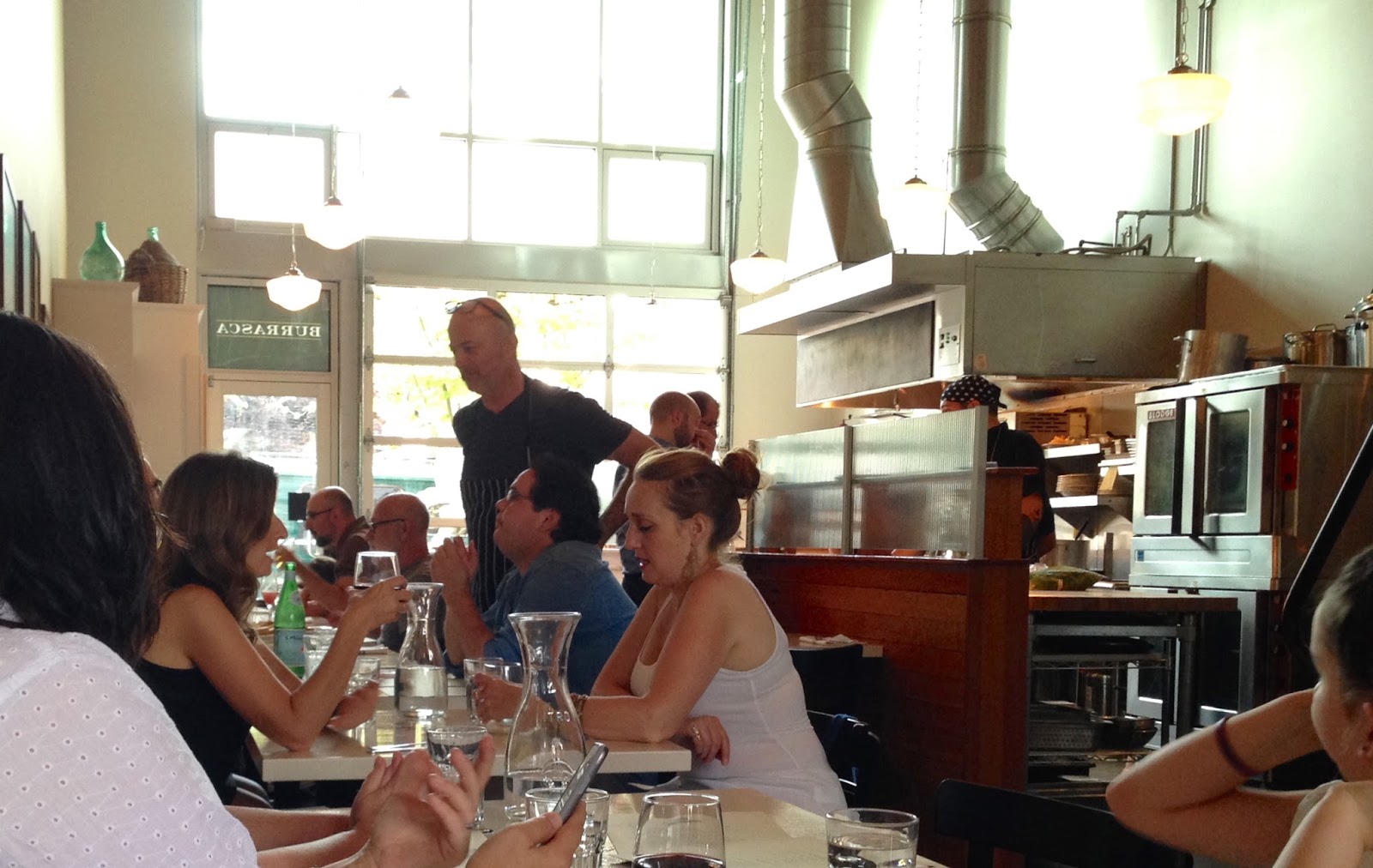
It started with a dinner on the garden-like patio at Burrasca with owners Elizabeth Petrosian and Chef Paolo Calamai. Elizabeth had posted photos of their Tuscan artichoke dishes made with organic purple Italian artichokes, grown by Tom and Patreece DeNoble of DeNoble Farms, which included a salad of raw shaved baby artichokes, tiny and tender fried baby artichokes and a creamy, delicate artichoke sformato.

Over the fire.

Another dish on the menu was frittura con gli occhi, amusingly translated as "fries with eyes," which was, to me, an irresistible must-have, not only because of the name but it also being fresh West Coast anchovies simply breaded and fried whole. (Yes, whole, as in heads on.) Tiny, crispy and tasting of the sea, I was entranced.

Tiny, tender and delicious.

So it was fortuitous when, the very next day, I stopped by Flying Fish, Lyf Gildersleeve's outpost for sustainably sourced fish, and what should be in the fresh case but some of those very same fresh anchovies. I bought a pound and brought them home, breading half of them in a flour, salt, pepper and pimenton mixture and the other half in a panko, salt and pepper mix.

Frying them in olive oil on a cast iron skillet on the grill, the flour breading coated them more completely and gave the little fish some extra crunch, while the panko was a bit scanty and not as crispy. But oh so fun and so delicious! (Plus I got to say frittura con gli occhi several times that evening.)

Sunday, March 10, 2019

Ciaffagnoni: Delicate Crepes from Tuscan Cowboy Country


Elizabeth Petrosian, co-owner of Portland's (tiny) palace of Florentine cuisine, Burrasca, is a fabulous writer, and when I asked if she'd share their Portland Dining Month recipe for ciaffagnoni—one of three courses for $33 during the month of March—she agreed, and then offered to write the whole post. I was thrilled! Get their full Dining Month menu here.

Italy isn't really a country; it's a patchwork of regions held together by a common respect for carbohydrates. But more than this, Italy is a tight, often rivalrous amalgamation of micro-regions. Take Tuscany, for example (my adopted home for 12 years). There's the postcard Tuscany you're all familiar with: the burnished gold, cypress-dotted mounds of the Val d'Orcia; the undulating hills of vineyard-strewn Chianti; the smug stones of Florence and the empty-headed starlet that is Cortona. With a land area of just under 9,000 square miles—about the same size as New Jersey—it's a remarkable solar system of mico-regional planets, each spinning in its own gastronomical orbit, all revolving around one Tuscan culinary sun.

There's the taciturn Mugello, peppered with ochre-colored Medici hunting villas, with its neighbor Emilia-Romagna sitting just over the spine of the Appenine mountains and casting its long glance over the local cuisine; the heavily forested, chestnut-loving Casentino; the rugged Lunigiana, playing mountain-bred, culinary Romeo to next-door Ligurian Juliet; there's the impossibly lovely Etruscan coast, with many of its gastronomic tradtions—as is to be expected—rooted in antiquity. Then there's the Maremma.

An appetizer, a simple folded crepe (top) or a hearty main course (left), ciaffagnoni are infinitly flexible.

The Maremma is Tuscany's Wild West: a no-nonsense-talking, game meat-loving region of rustic beauty known for longhorn cattle, butteri (Maremman cowboys), hunters, and winemakers who know how to wrangle grapes in iron-rich soil kissed by Tyrrhenian sea breezes. It's the place to eat cinghiale (wild boar), either stewed with mele cotogna (quince) or with small black local olives and red wine. With its rolling hillsides and pastureland, it's also the place where fresh, deeply flavored sheep's cheese is a common ingredient.

If you're lucky enough to find your way to the small hill town of Manciano in the Maremma, you can eat tortelli mancianesi and be much an improved person for having eaten them. Every part of Tuscany has its version of tortelli, but in Manciano they exalt the excellent local sheep's ricotta in a filling along with spinach and a touch of cinnamon, dressing the pasta with fine local Chianina beef ragù. Likewise, sheep's cheese stars in another specialty of tiny Manciano: ciaffagnoni. These are savory crepes traditionally adorned with ricotta or pecorino. Leafy greens or even a bit of fruit are often added, as in this version we're currently serving at Burrasca all March long as part of our Portland Dining Month menu: the crepes are filled with ricotta and diced pear, along with a whisper of nutmeg and cinnamon, then folded into fagottini and topped with a sauce of pecorino toscano, drizzled with honey and sprinkled with chili and black pepper.

Contrary to what you might believe, crepes, or crespelle—a gift from Catherine de' Medici to France—are as Italian as Vespas, four-hour lunches, and crippling bureaucracy. Legend has it that they were willed into being as pilgrim-fodder by Pope Gelasius I in the late 400s, an early example of peninsular ingenuity when it comes to paltry ingredients. Regardless of origins, Manciano has a way with crepes that is, well, celestial.

As mentioned, ciaffagnoni lend themselves to a variety of fillings; we've also served them filled with ricotta and Swiss chard, topped with a bit of béchamel and truffled pecorino toscano, and served over tropea onions in dolceforte and oven-dried tomato. They make lovely appetizers. Use your imagination!

Ciaffagnoni with Ricotta Filling and Pecorino Sauce

Ingredients to make about 2 dozen crepes.

For the crepes:
4 eggs
1 c. (150g) all-purpose flour
1 1/4 c. (300 ml) warm water
Pinch of salt

For the filling:
1 c. (250g) fresh ricotta
1 c. (250g) ricotta salata (or you can use all fresh ricotta if you prefer)
2 whole eggs, plus 2 yolks
1/2 c. (60g) grated parmigiano-reggiano
1 D'Anjou pear, diced small
1 tsp. freshly grated nutmeg 
1/2 tsp. cinnamon
A bit of salt and black pepper

For the sauce:
1/2 c. (100g) fresh young (not aged) pecorino, diced—Tuscan preferred but we won't hold it against you if you go rogue
3/4 c. (80g) grated parmigiano-reggiano
3 tsp. (10g) corn starch
1 3/4 c. (400 ml) whole milk
3 eggs

Additional ingredients: honey, red chili pepper, black pepper

The crepe batter has to rest for a half hour, so you can get the filling and sauce ready in that time. You'll need a 6" or 7" non-stick pan to make the crepes.

To make the crepes: Whisk the eggs, add warm water little by little, then add flour little by little. Add salt and whisk until smooth. There should be no lumps. Let batter rest for a half hour.

Preheat the oven to 350°.

Over medium heat, warm your pan and grease it lightly with olive oil or butter. Ladle in just enough batter to cover the pan surface—don't make it thick; the crepes should come out very thin. When it begins to bubble and detaches from the pan, flip it; it should have a light golden-brown color. Cook other side until lightly colored. Make sure to leave them moist, not crisp, otherwise they'll crack! Set aside.

Prepare the filling: Simply mix all the filling ingredients well.

Prepare the sauce: Put the sauce ingredients into a bowl and blend with an immersion blender. Then, in a small pot on the stove, bring to 170 degrees, stirring constantly, and remove immediately once the temperature is reached.

Assembly: Take a crepe and lay it flat. Place some of the filling (don't put too much or overstuff it) on 1/4 of the crepe and then fold the crepe over it into a half circle. Then fold it over again into a triangle (one-fourth of the original shape). Once you've folded all your crepes, place as many as you can onto an oven sheet pan and bake for 4 to 5 minutes. They'll crisp a bit at the edges.

Drizzle the finished crepes with the pecorino sauce, some honey, and a tiny bit of red chili pepper if you like a bit of a kick, and/or a bit of freshly cracked black pepper.

Thursday, June 30, 2016

Italian Herb Risotto: Making the Most of Summer's Best


I first saw this spectacular dish among the drool-worthy photos on the Instagram feed of Portland's Florentine outpost, Burrasca, and was intrigued with its verdant green color and creamy texture. You see, we eat a lot of risotto around here, since it's easy to adapt to whatever you have in your pantry or vegetable bin, it's quick—around twenty minutes cooking time—and, in summer, doesn't heat up the kitchen. Summer is also when fresh herbs are plentiful in gardens and at farmers' markets.

Plus, if you make it in the summer and get too warm standing in front of the stove, you are allowed a glass (or more, depending on how quickly you drain it) of a chilled white or rosé.

For this particular recipe, I had a fair amount left of the arugula and parsley I'd bought at the farmers' market over the weekend, as well as chives and tarragon from the garden, but you can use any greens that come to hand, like spinach, chard, sorrel, kale, chervil, dill, basil or the like. Eminently flexible, you can design your own flavor profile—I'd only caution you to not overload the mixture with stronger-tasting herbs, but let them weave in and out of the milder ones.

Risotto Alle Erbe/Italian Herb Risotto

3 Tbsp. olive oil
2 Tbsp. butter or margarine
Half of a medium yellow onion, chopped fine
3 cloves of garlic, minced
2 c. arborio or other short-grained rice
1 c. white or rosé wine
5 c. chicken stock
3 c. mixed green herbs (I used arugula, parsley and chives), chopped fine
2 Tbsp. tarragon, chopped fine
1 1/2 c. parmesan or romano, grated fine

Heat olive oil and butter over medium heat in large saucepan until it shimmers, then add onion and sauté until translucent. Add garlic and sauté briefly, then add rice and sauté for 2 minutes, stirring constantly to prevent sticking. Add wine and stir until it is absorbed into the rice, then begin adding stock a ladle-full at a time, stirring frequently, allowing the stock to be absorbed before adding more. When about half the stock has been used, add the finely chopped herbs and stir them in until they wilt slightly, then continue adding the stock until the rice is slightly chewy and the risotto has a creamy texture. Add 1/2 c. parmesan and stir to combine. Serve immediately.

Check out these terrific risotto recipes and expand your risotto horizons!

Monday, December 28, 2015

When Everyone Else Goes Right…


No, this isn't about Hill vs. Don or Bernie. It's about perspective, and, from what I've seen so far, mine is pretty different from the pack. As background, Mattie John Bamman, the new editor for the Portland outpost of the restaurant-industry website Eater, sent the following request: "Would you be interested in sharing your dining opinions as part of Eater Portland's end-of-year coverage?"

Now, I met Mattie—yes, it is his real name and isn't short for Matthew (the reason he gives is that he had "hippie parents")—at a media lunch given by the wonderful Bette Sinclair. For whatever reason he decided to include me in this year's survey. Here are the questions and my answers. I'll include links so you can read what others felt was noteworthy.

What were your top restaurant standbys of 2015?
My husband and I don’t go out much because, frankly, dining out is way too expensive for us to do on any kind of regular basis, so I’m hopelessly out of date on the “hot list.” As a matter of fact, several of them will close before we ever get a chance to go to them. (Cases in point: June, Levant, Noisette.)


Nostrana's Cathy Whims (r) and one of her—and my—favorite farmers.

So our standbys are places that make the kind of food we love and source ingredients from local farms and farmers: Bar Avignon, Lovely’s Fifty-Fifty, Old Salt Marketplace, Nostrana, Lucca and Davenport. Tastebud has to be included even though it’s just opened (we’ve been twice) because Mark Doxtader and Sarah (of Lovely’s) are the god and goddess of woodfired pizza made with local ingredients. Burrasca has become a favorite on our hit parade, as well.  Read more.

What were the top restaurant newcomers of 2015?
Tastebud because of the reasons listed above (Mark Doxtader, right). Burrasca (top photo). Love their take on Florentine classics like ribollita, peasant food that uses the simplest ingredients like old bread, leftover beans and greens to make a bowl of comfort; pappa al pomodoro; the deeply intriguing combination of squid and kale that is inzimino.

I’m hoping they’ll find a source for the fourth stomach of a cow, the abomasum, so I can have the famous street food favorite of Florence called lampredotto. Read more.

Describe the 2015 Portland restaurant scene in one word.
Free-for-all. Read more.

What was the best dining neighborhood in 2015?
No place like NE: We live within walking distance of Alberta, Killingsworth, Cully, Williams and Mississippi. (Sarah Minnick of Lovely's Fifty-Fifty, left)

Cully has to be the up-and-comer. Read more.

What was the biggest dining surprise of 2015?
No idea.

What was your single best meal in 2015?
Overall, very few meals can match what we have at home on a regular basis, from roast chicken to braised beef neck to pig trotters in a pot of Ayers Creek Farm beans to steaks on the fire when we’re camping.

Ben Meyer (l) and Bill Hoyt.

Meals out, wonderful as they can be from any of the places listed above, become more special because I don’t have to cook them. Current crave is the beef tartare at Old Salt using beef from Bill Hoyt of Hawley Ranch in Cottage Grove. Read more.

What was the biggest restaurant grievance of 2015?
The focus on chefs and technique versus good food made simply using the best ingredients (preferably local). Read more.

What are your headline predictions for 2016?
No idea.

Monday, July 07, 2014

Great People and Great Food Make A Great Story: Burrasca


Just named one of the Oregonian's top ten food carts, Burrasca is a celebration of the foods of owner Paolo Calamai's native Florence, Italy. After sampling many of Paolo's offerings at his food cart on SE 28th Avenue, I knew I had to write about him and his wife, writer Elizabeth Petrosian, and their journey to Portland. Here's an excerpt from that article, "At Portland food cart Burrasca, homey Italian dishes are rooted in owner's Florentine past."

When they announced their decision to move their family lock, stock and pasta machine from Florence, Italy, to Portland, Oregon, to open a food cart, American friends of Florence native Paolo Calamai and his Michigan-born wife, Elizabeth Petrosian, were aghast.

Gnudi con pomodoro.

“But you’re living in Florence!” the friends wailed, thinking their life in Italy must be like all those I-left-my-boring-life-for-the-Tuscan-sun books that were popular a few years back.

The life their friends imagined the couple was living?

“It was a postcard,” Paolo said. “You’re living in a postcard or you’re living in the reality.”

Paolo, educated in restaurant management, had traveled back and forth from Italy to the United States many times since his maiden voyage in 1984 when he visited the families of Stanford students he’d met at the Florence villa that university owned. Remembering his first trip to the states, his expression still carries the awestruck quality of his younger self.

Pappa al pomodoro.

“It was a beautiful experience,” he said. “Visiting the national parks and seeing the Grand Canyon, the big cities. I mean, you see New York in the eighties, oh my god, to us, coming from Europe it was like, wow.”

After that first trip, he worked the front of the house—as waiter, manager, wine buyer and menu consultant—in several high-end Italian restaurants in New York and San Francisco. He met Elizabeth at the former Etrusca restaurant in San Francisco where she was supporting herself as a waitress, saving on food bills by taking full advantage of shift meals at the restaurant while attending graduate school in English literature.

The proprietor.

“She was the cutest one there,” he said. They dated, then moved across the country to work in New York, he at Pino Luongo’s Tuscan Square in Rockefeller Center, a forerunner of market-based restaurants like Eataly, and she at Gramercy Tavern. While it may have sounded glamorous from the outside, they realized that they weren’t able to spend much time together or enjoy the city. Plus they were missing the slower pace of life on the West Coast.

“We realized there’s something about the West Coast lifestyle, it’s closer to a Mediterranean life,” she said.