Showing posts with label Nostrana. Show all posts

Monday, December 28, 2015

When Everyone Else Goes Right…


No, this isn't about Hill vs. Don or Bernie. It's about perspective, and, from what I've seen so far, mine is pretty different from the pack. As background, Mattie John Bamman, the new editor for the Portland outpost of the restaurant-industry website Eater, sent the following request: "Would you be interested in sharing your dining opinions as part of Eater Portland's end-of-year coverage?"

Now, I met Mattie—yes, it is his real name and isn't short for Matthew (the reason he gives is that he had "hippie parents")—at a media lunch given by the wonderful Bette Sinclair. For whatever reason he decided to include me in this year's survey. Here are the questions and my answers. I'll include links so you can read what others felt was noteworthy.

What were your top restaurant standbys of 2015?
My husband and I don’t go out much because, frankly, dining out is way too expensive for us to do on any kind of regular basis, so I’m hopelessly out of date on the “hot list.” As a matter of fact, several of them will close before we ever get a chance to go to them. (Cases in point: June, Levant, Noisette.)


Nostrana's Cathy Whims (r) and one of her—and my—favorite farmers.

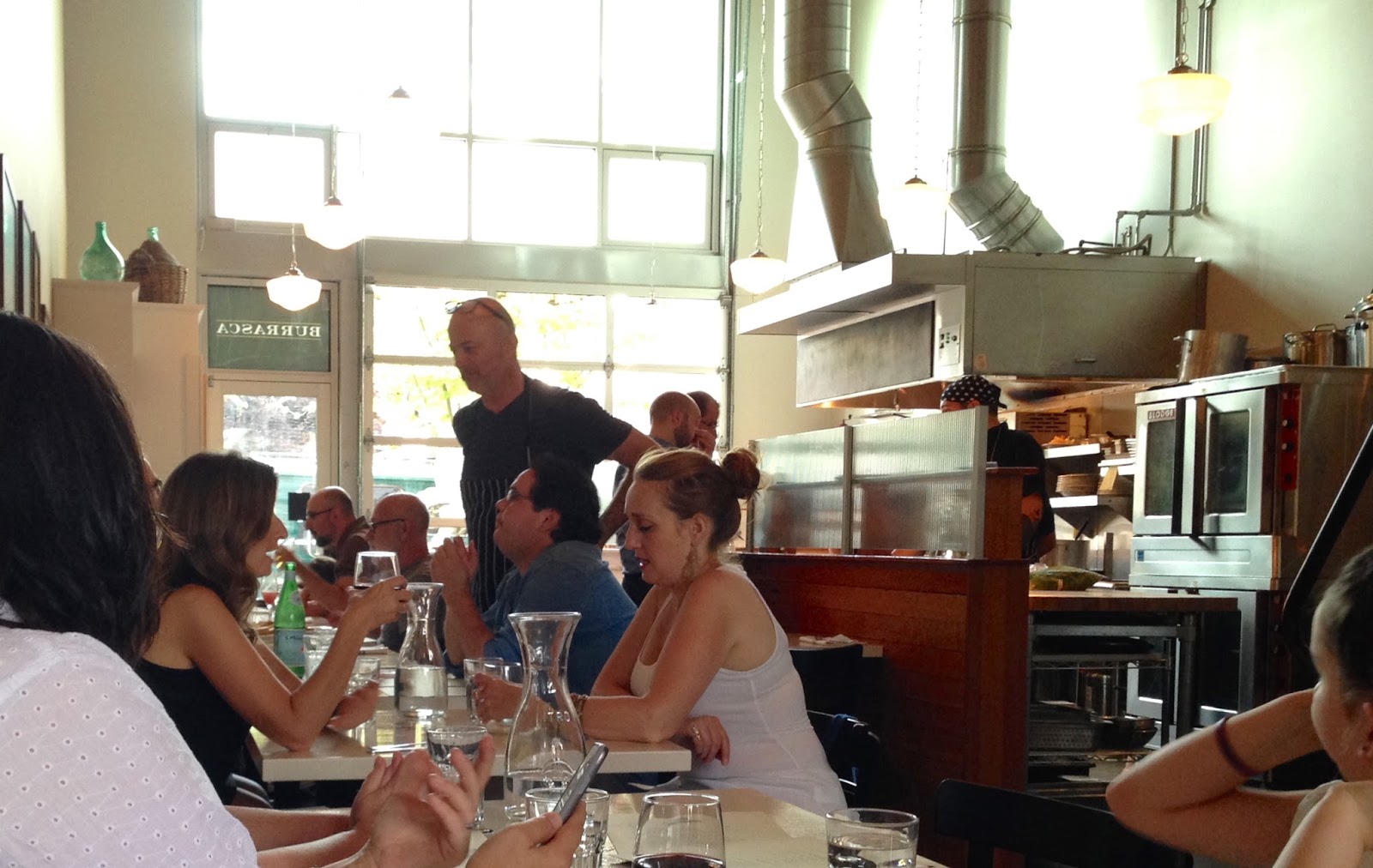
So our standbys are places that make the kind of food we love and source ingredients from local farms and farmers: Bar Avignon, Lovely’s Fifty-Fifty, Old Salt Marketplace, Nostrana, Lucca and Davenport. Tastebud has to be included even though it’s just opened (we’ve been twice) because Mark Doxtader and Sarah (of Lovely’s) are the god and goddess of woodfired pizza made with local ingredients. Burrasca has become a favorite on our hit parade, as well.  Read more.

What were the top restaurant newcomers of 2015?
Tastebud because of the reasons listed above (Mark Doxtader, right). Burrasca (top photo). Love their take on Florentine classics like ribollita, peasant food that uses the simplest ingredients like old bread, leftover beans and greens to make a bowl of comfort; pappa al pomodoro; the deeply intriguing combination of squid and kale that is inzimino.

I’m hoping they’ll find a source for the fourth stomach of a cow, the abomasum, so I can have the famous street food favorite of Florence called lampredotto. Read more.

Describe the 2015 Portland restaurant scene in one word.
Free-for-all. Read more.

What was the best dining neighborhood in 2015?
No place like NE: We live within walking distance of Alberta, Killingsworth, Cully, Williams and Mississippi. (Sarah Minnick of Lovely's Fifty-Fifty, left)

Cully has to be the up-and-comer. Read more.

What was the biggest dining surprise of 2015?
No idea.

What was your single best meal in 2015?
Overall, very few meals can match what we have at home on a regular basis, from roast chicken to braised beef neck to pig trotters in a pot of Ayers Creek Farm beans to steaks on the fire when we’re camping.

Ben Meyer (l) and Bill Hoyt.

Meals out, wonderful as they can be from any of the places listed above, become more special because I don’t have to cook them. Current crave is the beef tartare at Old Salt using beef from Bill Hoyt of Hawley Ranch in Cottage Grove. Read more.

What was the biggest restaurant grievance of 2015?
The focus on chefs and technique versus good food made simply using the best ingredients (preferably local). Read more.

What are your headline predictions for 2016?
No idea.

Tuesday, December 15, 2015

Great Gifting: More Deliciousness, From Italy


As mentioned in the previous post, there's more than enough goodness to go around this time of year. But this one was too good not to add to the list.

Before I get to the "gift" part of this post, I have to tell you about the mind-blowing factoid I learned while sitting in on Jeff Bergman's presentation to the staff at Nostrana. He's the brand manager of Manicaretti Italian Food Importers in Oakland, California, and was there to educate the staff about just-pressed olive oils from Italy—called olio nuovo in the north and olio novello in the south—that had just been air-freighted in that day.

Cathy Whims (l) and Jeff Bergman.

What Jeff said that countered everything I'd heard was that this newly pressed oil, while it's freshest in its first three months, won't go bad.

"These oils don't go bad," he said as my jaw dropped. "They just settle and soften." Indeed, he said, up to about a year old or so, they will gradually lose that signature peppery quality of new oil and become what he called "a common oil" after the initial three-month period of peak freshness. That is, they remain usable as long as they're kept away from olive oil's three enemies: light, heat and air.

Jeff Bergman of Manicaretti.

My shock was apparent, and he laughed as we proceeded to the tasting portion, where the traditional blue cup of oil—which conceals the color to avoid prejudicing your judgment of the flavor—is held cupped in one hand while the other hand covers the top in order to warm the oil and trap the polyphenols that give the fresh oil its distinct flavor and aroma. After a few seconds you lift the hand covering the top and take a strong whiff. Then you take a sip and inhale it with some air, similar to the way wine tasters do, to aerate the wine and spray it all around the inside of your mouth. If you're not coughing from the pepperiness hitting the back of your throat, something Jeff said even experts sometimes do, swallow and breath out so you can get more of the aroma coming back through your nose.

The three oils we tasted, and here's where the gift part comes in, are all very limited in production, and Cathy Whims is not only using them to flavor dishes on her menu, she's offering them to the public until the supply runs out. They were all flown in under controlled conditions and are as fresh as you would get them in Italy itself, so they're well worth giving to your favorite Ital-ophile or food fan. You can pick them up at the front desk at Nostrana during business hours or, better yet, have a meal and try them from the menu!

Jeff's notes are as follows:
  • Capezzana Olio Nuovo 2015 Toscana This year's Capezzana is unlike any we have previously tasted. The aroma is of fresh-cut grass and almonds. It offers a buttery, mild, fruity beginning—grassy and green—that fills the mouth with a delicate flavor of herbs and green olive. On the finish, there is a spicy note in the back of the mouth that is ticklish, fun, and pleasing. Truly amazing. Suggested Use: Drizzle it all over hearty soups, fresh cheeses, or winter squash. 500ml $51
  • Gianfranco Becchina Olio Verde Novello 2015 Sicilia This extraordinary oil has a fresh, grassy nose with a hint of bay leaf, green apples, green bananas, green almonds (note the trend?) and fresh hay. The taste is buttery and dances in the mouth, and the finish is a spicy thrill—a clean, bright chili pepper without any bitterness or pungency. Suggested Use: Use in green salads with hearty, bitter greens such as kale and collard greens, as well as over steamed romanesco and brussels sprouts. Drizzle over fish and vegetables hot off the grill or over a traditional Sicilian caponata. 500 ml $47
  • Frescobaldi "Laudemio" First Pressing 2015 Toscana What a Tuscan olive oil! This is a sophisticated oil for the connoisseur, with a complex aroma of soft and loud notes held in equal balance. On the nose, there is a hint of cinnamon and eucalyptus. The taste is bitter, green, and spicy—like taking a healthy bite of a raw artichoke heart—and as tannic as a big structured wine. The color is unreal, like an emerald; the cut of the bottle emphasizes this jewel-like quality. Their best in many years. Suggested use: Drizzle on fettunta (toasted bread rubbed with garlic), over warm beans and chickpeas, broccoli and romanesco, or any bitter green salad. Pour generously over grilled meats such as a bistecca alla Fiorentina (grilled sliced T-bone steak). 250ml $35
Read this year's other Great Gifting posts: The Gift of DeliciousnessThe Gift of Class(es) and A Gift that Keeps on Giving.

Wednesday, March 18, 2015

Stuffed Peppers: Inspiration from Virgin Territory


Great cookbooks are more than just the sum of the recipes they contain. Gorgeous photos and recipes can stimulate both the mind and appetite. The stories an author shares can introduce exciting new cultures and ideas, not to mention information about ingredients both familiar and new. And the recipes themselves often teach me new cooking techniques or ways of combining flavors that I hadn't thought of before.

The best do all of the above, and provide the opportunity for me to go off on my own tangents depending on what I have in my pantry or what's in season.

In the category of the best, I would place the new cookbook Virgin Territory: Exploring the World of Olive Oil by Nancy Harmon Jenkins. Though I have to admit that I'm a little jealous that this Maine native who grew up to become a leading authority on olive oil and the Mediterranean diet now lives on a 25-acre olive farm in Tuscany where she and her family produce their own olive oil.

I met the author recently at a reception at the invitation of Cathy Whims of Nostrana, where Nancy told the story of the book while guests were served dishes based on recipes featured in it. One, though, a nettle and spinach flan that the kitchen was inspired to create, was served as an entremet. It celebrated both the spirit of the book and the freshest spring things from our area. It was smooth, bright—obviously I'm still thinking of it—and knee-bucklingly good. Carol Boutard of Ayers Creek Farm was sitting opposite me and I had to laugh as our eyes rolled back in our heads at its incredible deliciousness.

A couple of days later I was paging through the book and came across Nancy's recipe for Eastern Mediterranean Stuffed Peppers with bulgur, tomatoes and spices that would give it a rich Moroccan scent. I didn't have any bulgur on hand, but I did have some of Ayers Creek Farm's frikeh that I'd thoughtfully stashed in the freezer. But then I looked at the cover of the book and there was another roasted stuffed pepper pictured, though this was stuffed with anchovies, tomatoes and capers, meant for serving as an appetizer.

Hm.

Stuffed Peppers with Frikeh, Tomatoes and Anchovies
Loosely adapted from Virgin Territory by Nancy Harmon Jenkins

1/2 lb. frikeh, barley, farro, bulgur or rice
3 Tbsp. olive oil, plus additional for drizzling
1 onion, chopped fine
1 large fennel bulb, chopped fine
4 cloves garlic, minced
1 2-oz. tin anchovies, or 8 salted anchovy fillets, rinsed
10 oil-cured black olives, chopped fine
1 pint assorted cherry tomatoes
3 Tbsp. capers
1 tsp. paprika, pimenton or piment basquaise
4 medium sweet peppers, halved, seeded and membranes removed
1 c. boiling water
3 oz. fresh chèvre
Pepper

Place grain (whichever you choose) in medium pot. Add water to cover by 2”. Bring to boil and reduce heat to simmer for ten minutes. Check occasionally to make sure water hasn’t been completely absorbed; add more if necessary. When grain is al dente, drain in colander and rinse with cold water.

While grain cooks, heat olive oil in large skillet over medium-high heat. When it shimmers, add onion and sauté till translucent. Move onion to edges of pan and add anchovies in center, chopping them until they dissolve. Stir into onions. Add fennel and garlic and sauté till tender.

Preheat oven to 350°.

Put onion mixture into large bowl. Add cooked grain, olives, tomatoes, capers and paprika and combine. Stuff mixture into pepper halves, top with thin slice of chevre, a grinding of pepper and a drizzle of olive oil.

Grease a 9” by 11” glass baking dish with olive oil and pour in boiling water to a depth of 1/2”. Add peppers skin-side down. Bake at 350° for 1 hour.

Monday, February 09, 2015

The Maialata: Building Community by Celebrating the Pig


A community coming together over the preparation of food is an ancient tradition, one that can connect us to our roots and to each other. The Oregon version of the Italian festival known as the Maialata, or slaughtering of the pigs, brought chefs, farmers and producers together in a day-long sharing of skills, stories and the bounty of the season.

It came as a surprise when Cathy Whims, Portland chef, owner of two of the city’s most fabled Italian restaurants, Genoa (now closed) and Nostrana, and six-time finalist for the prestigious James Beard Award, admitted that early in her career it was the cuisine of France that captured her heart.

Demonstrating making pasta by hand.

“I think a lot of cooks early in their careers are really drawn to French cuisine because everybody tells you that it’s the height of gastronomic whatever,” she said. “Which is ironic because I was working at Genoa, which was supposed to be an Italian restaurant, though it had a lot of French influence.”

Eventually she bought the restaurant and became the de facto wine buyer, meeting Italian wine distributors who would invariably invite her to come stay at their wineries.

“And I was like, a place to stay in Italy, that sounds pretty good,” she said. “So at that point I really started traveling to Italy a lot.”

Butcher Rob Roy shows how to skin a pig's head.

It was then that she fell in love with the very simple, pared down treatment of ingredients that is the hallmark of traditional Italian cuisine. Attending classes taught by legendary Italian cookbook author and teacher Marcella Hazan, whom Whims considers one of her two mentors, along with author and teacher Madeleine Kamman, set her on the path she still finds intriguing today.

“The more I traveled, the more I realized that you could travel three kilometers and a dish that you thought you knew could be completely different,” she said. “It was an endless opportunity for learning and I was really attracted to that.”

Rolling out and shaping the pasta.

On one of those trips, to Le Vigne di Zamo winery in Friuli in the north of Italy, Whims heard about a traditional celebration called the Maialata (pron. my-uh-LAH-tuh). Held on the first new moon after the first full moon, usually in late January or February, and coinciding with the time when the pigs—“maiale” in Italian—are ready to be slaughtered, the community comes together for a day-long event to butchering the pigs and make sausages, salami and cure all the pork for the coming year. They then gather and have a feast, which usually lasts most of the the night, to celebrate and give thanks for the bounty that will carry them through the winter.

It was a celebration that she felt would fit perfectly with the emerging culture of food in the Northwest, but it took two years before the elements would fall into place to make it possible. Nostrana had been doing all its own butchery since its inception, but it wasn’t until she thought of Rudy Marchesi at Montinore Estate in Forest Grove that she had a partner to help realize her dream of bringing the Maialata to Oregon.

“He has such a beautiful, old world sensibility,” she said of Marchesi’s biodynamic approach to winemaking and food. “He makes his own cheeses, he makes his own salami. I told him about it and he got really excited and said we should do it at Montinore.”

The first two celebrations were ticketed events where the public could observe the butchering of a pig and participate in making sausages and ravioli alongside well-known Portland chefs, then sit down for a multicourse feast accompanied by Marchesi’s Montinore wines. They were hugely successful, but weren’t living up to the spirit of the Maialata that Whims had envisioned.

“I just thought it was like the commercialization of Christmas or something,” Whims said. “It took away the whole spirit.”

So for this year’s Maialata, held on January 18 at Montinore, she went back to the theme of the original festival that she’d heard about from her friends in Friuli: a gathering of a community.

“I thought, why don’t we do it with colleagues and other people who are interested in food,” she said. “One of the hardest things about being a chef is that you’re in your restaurant and you don’t get to interact with other chefs. We all have something to learn from each other.

“I just wanted the spirit to be that of sharing and not worrying about promoting this event to sell it. It just took a real load off of it, I think, and brought it back to what it really should be.”

In that spirit, two pigs were raised just for the festival, one a black-and-white Hampshire from a Forest Grove firefighter and friend of Marchesi’s, Steve Statelman, who got into raising pigs, in his words, “as a midlife crisis of sorts, but it was more productive and cheaper than buying a Porsche and getting a 20-year-old girlfriend.”

The other pig, a Berkshire and Duroc cross, came from Wolfgang Ortloff and his wife Susan at Worden Hill Farm in the Dundee Hills and had been fed on apples from Baird Family Orchards and Briar Rose Creamery whey, both Dundee producers.

The butchery itself was handled by Nostrana’s in-house butcher, Rob Roy, and Camas Davis of the Portland Meat Collective. They narrated the steps involved in breaking down a carcass to the crowd of their peers who had gathered around them. At one point, Roy was demonstrating how to skin the head for porchetta di testa, an Italian specialty made from the meat of the head wrapped in its scalp and ears. When Roy started the process from the back of the head instead of the front, Davis exclaimed, “I never thought of doing it that way!”

“It’s like he sneezed his face off,” Roy joked.

Whims then took over the pasta-making portion of the event. She demonstrated making a bowl-shaped well in the center of a mound of flour, then pouring water into the well and whisking the water into the flour while maintaining the bowl shape. A natural teacher, she guided her colleagues into kneading and rolling out the dough, then pressing it through the wires of a chitarra, a traditional pasta-making implement, to make the spaghetti alla chitarra, a pasta she’d learned to make on her recent trip to Rustichella d’Abruzzo, one of Italy’s premier pasta producers.

As Whims and her colleagues adjourned to the subterranean wine cellar lit by a dozen flickering candelabras, everyone dug into the food they’d helped prepare that day. Was it the successful Maialata , the gathering of a community, that Whims had envisioned?

Judging by the flood of photos and videos that began appearing on her colleagues’ Instagram, Twitter and Facebook pages, the spirit of the Maialata was alive and well and spreading its message into the broader community.

Tuesday, December 17, 2013

Great Gifting: Good Eatin'


Self-liquidating gifts are a favorite theme around the holidays. It's so much easier and guilt-free…no need to remember to wear that hideous pendant at family gatherings so Aunt Esther knows how much you appreciate her generosity, or where to place the reindeer-or-is-it-a-deranged-gorilla that little Bobby made in his art class.

No, I believe in the gift that disappears without a trace within a few weeks of the giving, and a nicely chosen food item fits that description to a T. Think of it as a hostess gift for the holidays, whether it's a single jar of picked-at-the-peak-of-ripeness organic berry jam or some exotic spices with the aroma of a magical Mediterranean island. Whether it's given singly or packed in a basket, there's no end of goodness to share.

Here are a few of my favorites. Feel free to vamp on these for the lucky giftees on your list:

Real Good Food: Last year I put together baskets of Jim Dixon's imported olive oil and packets of the most amazingly fragrant oregano, fennel pollen and capers (right) from Pantelleria, a tiny island between the toe of Italy's boot and Tunisia. Jim also has wonderful grains, dried beans and Crystal hot sauce from Louisiana, any combination of which would make a greatly appreciated gift. Find him on at his annual Olive Oil Garage Sale on Fri.-Sat., 12/20-21, from 12-5 and then on Mon., 12/23, from 3-7 pm at his retail location at 833 SE Main, #122, on the corner of SE 9th and Main.

Nostrana: This year Cathy and David are offering specially labeled 375ml bottles of Italian olive oils (top photo). In addition to their house arbequina, they have four kind of olio nuovo, the freshly pressed oil that is loaded with phenolic compounds (i.e. pungency) and that is a greatly anticipated seasonal treat in Italy. Their house oil is $15, and the olio nuovo varies from $30 to $50 per bottle. In addition, they have their famous pizza scissors for $20 a pair should you want to combine them with the oil for a "pizza package" or slide them into a deserving pizzaiolo's stocking.

Ayers Creek: Nothing makes foodie friends happier than giving the best of region's bounty, especially items that are hard to find and that give a real "taste of the place," the terroir of Oregon. I've given baskets brimming with Ayers Creek Farm farmstead polenta and beans packed around a jar of their fabulous jam. You will find Anthony and Carol this Sunday (12/22) at the Hillsdale Farmers' Market, and you can get their jams at Vino on SE 28th and at Pastaworks on Hawthorne.

Read the other posts in this series: Gifts That Give Back, Mad Skills, Kids' Stuff and Bookin' It.

Saturday, August 24, 2013

Farm Bulletin: The Call of Community


To be part of a community is crucial to farmers, both for economic and personal reasons. Contributor Anthony Boutard of Ayers Creek Farm outlines a few examples of both.

For years, we have strongly suspected that Tito was once a dog model who finally chucked the fast life and, after a streak of hard luck, wound up in the Newberg pound where we met him. The chief bit of evidence of his former life was a spread on urban picnics in the New York Times fashion supplement. The dog in the Open Bar picnic (top photo) is sitting on a $495 Luxembourg bench with an open bag of chips next to him, and looks just like our lovable cur, except he lacks Tito's black toenails. There were also some chips left uneaten, very un-Tito. But you can never trust digital photos completely, maybe they added the chips later or he was more disciplined in his modeling days.

Regardless of his past, Tito's modeling chops can be seen in this month's issue of Cucina Italiana (left, behind Carol), where he appears with the Cameron Winery's Jackson. The article is about a special tradition we have enjoyed since Cathy Whims and David West opened Nostrana, the farmers' dinner. Every October, Cathy and David invite a group of us for dinner and we meander our way through their menu and wine list. They, along with the staff at the restaurant, make it a fun and relaxed evening for the gang that spends most of it time at the back door. Nostrana is a comfortable place for a farmer at either door, and that is due to the respect Cathy and David have for our ilk.

We deliver to a variety of restaurants in addition to Nostrana. Each place has its own culture and expression of generosity. A container of tart cherry ice cream from Lovely's, a bit of cured pork from Greg Higgins, a jar of miso from Chef Naoko or a pastry with our plums from Giana at Roman Candle, these gestures all make the effort a little bit easier and fun. Good restaurants also make us better farmers by drawing us into the process. For example, the incomparable Borlotto Lamon is one of Cathy's contributions.

When we first moved to the farm and settled into the double-wide trailer at Ayers Creek, we decided we would be there for a long, long time so, heeding Malvina Reynolds' advice, we planted an apple tree and a couple of grape vines. One was Interlaken and the other was sold as "Sweet Seduction." We hated the silly name. In grapes as in other fruits, the character of the grape is defined by the blend of acids in the fruit as opposed to simple sugars. We felt if cute was needed, then "Acid Assignation" would be a more apt name.

When we decided to scale up our table grape production, we retained the late Lon Rombaugh to give us advice on varieties to plant. We mentioned Sweet Seduction as one variety we would plant. Almost two years ago, we enjoyed a early autumn dinner in the Hungry Gardener's yard and had some time to visit with Lon. That evening, he told us the grape we were growing had been mislabeled, was not Sweet Seduction, and he would get back in touch with us with the correct name. We were glad to be rid of a name better suited to chocolates or lingerie than fruit. Winter descended and Lon died too young. You can call it what ever you want, but for us it is now a grape with no name, a bittersweet remembrance of an inquisitive and kind fruit grower who we were lucky to have known as an advisor and friend.

Friday, April 19, 2013

Eat a Sandwich, Help a Farmer


The straccetti sandwich was created in the 1960s in a small trattoria in Rome, according to Cathy Whims. The name tranlates as "small rags" and refers to the thin strips of marinated steak that are seared quickly then tossed with bright seasonal greens.

When Rick Gencarelli of Lardo invited Whims to create the first sandwich in his "Guest Chef" series, with proceeds going to the chef's designated charity, the Roman sensation seemed the perfect ticket for Lardo's meat-centric menu. With provolone cheese, chopped roasted asparagus and horseradish creme fraiche added to the traditional preparation, I can tell you from a personal taste test that this Italian import is not to be missed.

And the charity? Whims chose Friends of Family Farmers, a group dedicated to fostering and supporting small family farmers in Oregon. Smart cookie, that Whims, since her restaurant, along with so many in our area, depends on those same small farmers to supply them with the goodness they feature on their menus!

Details: Guest Chef Series at Lardo: Cathy Whims' Straccetti. Available mid-April through mid-May, $10, with proceeds benefiting Friends of Family Farmers. Lardo East, 1212 SE Hawthorne Blvd.; 503-234-7786. Lardo West, 1205 SW Washington St.; 503-241-2490.

Monday, May 21, 2012

Master of Meat: Dario Cecchini


My profile of storied Italian butcher Dario Cecchini and his recent trip to Portland appears in this week's FoodDay section of the Oregonian.

Cecchini said of this shot, "Two pig."

There was so much to this story that I couldn't squeeze into the article, so I hope to post about it in the future. But for now, you can read what I think of as Part One: "Portland Butchers Learn from an Italian Master of the Craft."

Saturday, March 03, 2012

Quick Hits: Mextiza, Smallwares, Luce


Recent noontime visits to this trio of newcomers revealed much promise, with a side of newbie-itis.

With big bro Autentica holding court on the hot corner of NE 30th and Killingsworth with the likes of Yakuza, DOC, Beast and Cocotte, a little sister down the street might feel a teeny bit overshadowed. Indeed, Mextiza, Oswaldo Bibiano's new outlet a few blocks west of Interstate, is understated, but has a certain sophisticated style all its own.

Autentica specializes in the cuisine of Bibiano's home state of Guerrero in Mexico. But with a menu spanning the whole country and a wall o' tequila and mescal that rivals any the big boys boast, this little girl might just be poised to have her moment in the spotlight very soon.

On a recent lunch visit the housemade guacamole was laced with lime and the queso-and-salt sprinkled chips (left) were crisp and light. But what captured my eye were the enchiladas with roasted poblanos in a sauce of—be still my heart—huitlacoche cream sauce and sprigs of epazote (top photo). One whiff took me back to the Plazuela Machado in Mazatlan, the last time I'd had that particular combination, and this version stood up to my memories of it. The dinner menu covers much broader territory, and I've heard reports that it and the cocktails are worth seeking out. I definitely will!

Details: Mextiza, 2103 N Killingsworth. 503-289-3709.

* * *


Northeast 46th and Fremont has seen a couple food businesses come and go. The latest entrant to attempt to anchor this key corner in the Beaumont neighborhood, Smallwares, has a bit of a pedigree in owner and former Nostrana sous-chef Johanna Ware. An alumna of David Chang's much vaunted Momofuku restaurants in New York City, she's revisiting those roots with what's billed as an "inauthentic Asian" spot.

My lunch there, shortly after it opened, revealed a menu with tastes collected from many Asian cultures with, as you might expect, a twist thrown in. For instance, the kimchi featured the expected cabbage and daikon, but then also included apple, which worked quite nicely. The mapo dofu (above) was a small cup of pork richly combined with a fermented black bean sauce, but it was served sitting on a cushion of savory egg custard. Mussels (left)—see, I told you I can't resist 'em—were the most traditional, in a nice broth of sake and chile flake, and had little slivers of doughy rice cake mixed in.

The only complaint was that the same chile sauce seemed to make an appearance in several plates, though this sameness of saucing may change as the kitchen adjusts the menu.

Details: Smallwares, 4605 NE Fremont. 971-229-0995.

* * *


No sign, shelves full of Italian food products and a few tables scattered across the floor. On a side wall, a listing of delicious-sounding plates. Such is the caché of John Taboada, originator of the Spanish-inspired Navarre on NE 28th, that he can open a minimalist spot like Luce and pack in eager foodies looking to be the first among their peers to tweet about it.

On a mid-week stop for lunch, a friend and I had our choice of tables (the hipsters must still have been in bed) and we sat down to sample a few plates. The price is the only giveaway of the size of the plates…for instance, for $2 each we ordered stuffed clams, a beet dumplings and a slice of squash tart (above). Six bucks, right? What came out was a salad plate that featured three teensy little clams containing maybe a half teaspoon each of "stuffing," two 1-inch beet fritters and a maybe-1-inch-wide sliver of tart. The chicken in wine sauce was a little more generous, with a decent-sized leg divided into thigh and drumstick in a capered wine sauce. I'd like to go back in the evening and have a glass of wine and a couple of plates, but it's definitely not the kind of place to go and expect heaping plates of food or cheap prices.

Details: Luce, 2140 E Burnside St. 503-236-7195.

Thursday, January 12, 2012

Farm Bulletin: The Vegetables of Vinegar & Salt, Pt. 2


Just when I start thinking we 21st Century types are soooooo smart, someone digs up some old dude who had it so much more together than we do. One such old dude is John Evelyn, who was all over a diet of vegetables about, oh, 300-plus years ago. Contributor Anthony Boutard of Ayers Creek Farm has been getting to know Mr. Evelyn of late, and shares his discoveries with us. Read Part One here.

Before Karen and Frank Morton veered into the seed business, their Wild Garden Seed salad greens were cherished by Portland restaurants. We love hearing Cathy Whims [when she was the chef at Genoa in the late 90s] describe the careful attention the Mortons paid to preparing the ever-changing mixture of greens, every leaf perfect, delivered in a damp muslin bag. Evelyn (above, by Robert Walker) demanded the same attention for his mixture; "let your herby ingredients be exquisitely cull'd and cleans'd of all worm-eaten, slimy, canker'd, dry, spotted or in any ways vitiated leaves." He specifies spring water for washing and, after draining, swinging them gently in a coarse napkin to draw off excess moisture.

The carefully gathered greens need the finest couture de cuisine. For oil in the dressing, he commends omphacine pressed from olives native to the Republic of Lucca, now a province of Italy and still producing superb olives. Olive oil had a range of uses and grades, including lighting and lubrication, as well as food. Omphacine is the first pressing of green olives, what we call, implausibly, "extra virgin" today. For the contrasting acid, the best wine vinegar is specified, though lemon and the tart juice squeezed from verjus grapes also meet his approval. If that special grape type is not available, the freshly squeezed juice from other small, unripe grapes will do. For salt, he favors the "brightest bay grey-salt," what is sold today as fleur de sel and sel gris. The seasonings are English mustard, preferably from Tewksberry, and pepper (black or white). The yolk of a freshly laid egg, boiled moderately hard, is allowed as desired.

He finishes up with the tools needed. These include a willow or osier basket with partitions to separate the various salad greens as they are collected so the correct proportions are used, a silver knife to trim them, and a porcelain or Delft-ware bowl for serving. The iron knife, pewter and silver bowls in use at the time would leave the salad with an unpleasant metallic flavor. In his attention to detail and proportion in preparing and presenting his salad, Evelyn has no rival even among the most fussy modern chefs and gardeners.

The latter half of "Acetaria" deals with seasonality and health, and what we refer to as "industrial food" today. Evelyn inveighs against the flaccid vegetables raised in urban hotbeds prepared from over-rich stable muck and other filth collected from the city streets, favoring instead the healthy vegetables grown in the rich humus of the countryside and hedgerows. He also disparages "forwarding," pushing the vegetable and fruit growth outside of their natural seasons and into inferior quality. He promotes the merits of a diet of vegetables.

Evelyn was not a vegetarian per se; he was an ardent lover of vegetables and a southern diet, what we refer to as the Mediterranean diet. He advocated eating mostly plants, and was appalled by the slaughter methods in London's abattoirs, much in the same spirit as Michael Pollan pushes us to think about our food's origin and quality. However, he was not wantonly dogmatic, so he leaves the question of whether salad should come before or after the savory dishes convincingly explored and learnedly unresolved, as it still is more than three centuries later.   

In addition to the original 1699 edition, "Acetaria" has been reprinted at least four times. In 1934, the Women's Auxiliary of the Brooklyn Botanic Garden published the complete work in an edition of 1,000 copies, nicely bound with hand cut signatures. This version is available electronically on Gutenberg. Still Point Press of Dallas, Texas published a numbered edition of 1,000 on high quality French paper (1985) along with a few illustrations, bound with a leather spine. Unfortunately, this handsome edition leaves out the Greek and Latin passages and the margin notes, and the artsy illustrations have no botanical merit. A 1996 version of "Acetaria," published by Prospect Books, now in paperback (2005), retains the whole text and translates the Greek passages, a more satisfactory approach. Finally, The Grand Salad (Peacock Vane, Isle of Wight, 1984) is a book based on passages from "Acetaria." Sadly, it is hard to read as it is handwritten in a calligraphic style. The work also has egregious deletions and some additional dry text that adds nothing to Evelyn's original, despite its good intentions.

Read The Vegetables of Vinegar & Salt, Part One.

Monday, August 08, 2011

Memorable Meals: Nostrana, Autentica, Tabla


The blurby nature of this grouping in no way reflects the quality of the meals at these three establishments; each was deserving of a full post on its own. Chalk it up to laziness on the writer's part.

I hadn't been to Nostrana for lunch for way too long, so when a friend that I hadn't seen for way too long wanted to meet on her lunch hour to catch up, it seemed like the perfect fit. It was a sunny, warm day and Nostrana had added a bevy of brightly colored umbrellas to the patio in front of the restaurant, as well as a bright canvas panel to block the breeze that seems to constantly flow up some invisible chute from the river. Most of the windows on the river side also slide open, so even if you're sitting inside it feels like you're dining al fresco, and diners are encouraged to adjust them to suit their tastes. And speaking of taste, there are few lunch menus in town as dependably awesome yet accessible as that found here. From salads to pizzas to the piatti lunch specials, there is almost no way you can go wrong. And splitting a salad, particularly their version of a Caesar made with radicchio or the albacore (left), and a pizza is not looked down upon. The wines by the glass, while terrific choices all, can almost double the cost of your lunch and I haven't had the courage to ask to split a glass, so I tend to stick to iced tea ($2.50).

Details: Nostrana, 1401 SE Morrison St. 503-234-2427.

* * *

A warm summer evening and meeting friends for dinner meant finding a restaurant that offered outdoor dining, wasn't too expensive and served killer drinks. Additional points were awarded for proximity to home. Fortunately, before we got to the spreadsheet stage (yes, it has happened…we're very nerdy around here), someone mentioned that Autentica has a charming patio (top photo), fabulous margaritas and wouldn't cost an arm and a leg. And, since again I hadn't been there in WTL (way too long), we made a date. We were ushered through the restaurant to a tiny back door that opened onto a spacious patio with plantings of tall cannas separating the long space into two "rooms." With the walls painted in bright, Mexican-inspired colors, we felt like we were back  in Mazatlan on the Plazuela Machado. The margaritas came almost instantly, and we dove into our guacamole, ceviche and queso fundido with handmade tortillas and chef Oswaldo Bibiano's signature trio of stunning chile salsas. Our entrées, including an enchilada platter, a filet of whole trout with a garlic epazote purée and a fall-apart tender carne asada with black-eyed peas (above right), were all crazy good, especially with a second round of those delicious margaritas. With that dinner in mind, I can't wait to try his new venture, Mextiza, scheduled to open on N Killingsworth later this summer.

Details: Autentica, 5507 NE 30th Ave. 503-287-7555.

* * *

When it's time to celebrate a major anniversary with a dinner out, we tend to go back to a favorite that never disappoints, is not outrageously priced and where we'll be treated like family. That's a pretty tall order and a very short list, and you'll not be surprised that, for us, Tabla on NE 28th is at the top of it. Not only is chef Anthony Cafiero a warm and funny guy who has a gas playing with his food, he gets that food from frequent trips to local farmers' markets. I know because I'm constantly running into him on whatever day of the week he needs to restock, loaded down with armloads of heavy bags and waving fronds. The night we went with my brother and his lovely bride, Anthony was offering his $28 three-course dinner with the likes of an appetizer of sous vide farm egg with ham, green beans garlic scapes and ricotta cream, a pasta course of Cavatelli with calamari, garlic and piquillo peppers with the Mar y Montaña (above left) entrée featuring Spanish octopus, pork chop, ajo blanco, cilantro and carrot foam. As I've mentioned before, Cafiero is still having huge fun making foams, infusions and smears without taking away from the real flavors of his market ingredients. And that's always worth coming back for.

Details: Tabla, 200 NE 28th Ave. 503-238-3777.

Saturday, July 23, 2011

Farm Bulletin: Fabulous Frikeh


Last week I was fortunate to have the chance to go to Ayers Creek Farm in Gaston and watch the process involved in taking frikeh from field to table. Contributor Anthony Boutard is one of the only farmers in the United States producing this ancient foodstuff, and its extreme seasonality makes it an unparalleled treat.


Frikeh (freekeh, farik, etc.) is parched green wheat and a Middle Eastern specialty. We prepare it using the traditional method of collecting heads of wheat while the grain is still green (left), burning them (top photo) and then threshing the grain from the head. The process produces a jade green grain that is slightly charred and has a smoky quality. Although durum wheat is usually used, we have started using the much thinner-skinned soft red wheat, producing a more tender grain.

The parched wheat.

Using fire to process green grains is also practiced in southern Germany where spelt is roasted to produce grünkern, and in the southwestern United States where unripe corn in the soft dough stage is roasted and dried to produce chicos with their own characteristic light smokiness.

Anthony loading the parched grain into the threshing machine.

To prepare frikeh, rinse well in couple of changes of water. Pull out any errant hulls or chaff. Drain and put in a saucepan. Add water to about double the depth of the grain, or more. Bring to a boil and then simmer 45 minutes to an hour. Drain, salt as desired and store in the refrigerator without liquid.

The threshed grain, called frikeh, is spread on screens to dry.

At this point, the grain can be used in many different dishes. It appeals to the most careful vegans and raw meat omnivores. In it simplest use, we use frikeh to build a seasonal grain salad along the lines of tabbouleh, using olive oil, lemon juice, mint, parsley, cucumbers, and tomatoes, and perhaps a bit sauteed summer squash. Chef Naoko Tamura of Naoko Bento adds frikeh as a topping for her seasonal salads using a traditional Japanese soy and rice vinegar dressing.

Stacked screens are spaced apart to facilitate air circulation; the grain dries for two weeks.

Frikeh is delicious with yogurt and buttermilk. Nostrana serves a buttermilk and frikeh soup based on a similar soup from Deborah Madison's "The Savory Way."Linda Colwell guided us in putting together an Ayers Creek version of this soup. It uses two cups of frikeh in a quart of buttermilk. Add a couple tablespoons each of fresh cilantro and dill, a tablespoon of ground coriander toasted gently in a dry pan, and two cups of purslane whole if very young, or chopped coarsely. Linda also brought a jar of her tuna, and we made a tuna and frikeh salad (recipe on her blog).

Cold frikeh and buttermilk soup.

Yesterday, we prepared the Middle Eastern dish kibbeh using frikeh. In its traditional form, raw lamb is mashed with bulgar wheat in a mortar with parsley, onion and mint. The mixture is dressed and served raw as a tartar. Unfortunately, the raw version is seldom served in restaurants, and it is more often roasted with addition of spices. In our version, we ran a half pound of lamb through a meat grinder and then mixed it in with the herbs and frikeh. We dressed it with olive oil and lemon juice, and served it with salad and Siljans, the round rye crisp bread. Linda brought a pan of dolmas, stuffed grape leaves, to complete the feast.

Frikeh and albacore salad.

Frikeh is also very good in heated dishes. Egyptians stuff fowl, usually pigeon and chicken, with frikeh. Add it to a mix of sauteed vegetables. Its gentle smokiness and grassiness is welcome summer fare. If you plan on storing the frikeh, we suggest pouring it into a glass jar and keep it in the freezer. This preserve its quality. It is shelf stable, but the flavor drifts away over time. For us, though, it is linked with the flavors and texture of summer, and we have no inclination to prepare it in the winter.

Monday, May 02, 2011

Hook, Line and Sinker


It's like dangling a string in front of Otter, or reaching for Walker's favorite balls. Mention that a portion of my restaurant tab will benefit a good cause and I'm picking up the phone to make a reservation.

Oysters Apicius at Nostrana.

So all it took was hearing that during the month of May select Portland restaurants and New Seasons Markets will be donating 10% of the sales from designated menu items to The Wetlands Conservancy. Celebrating its 30th anniversary, the Conservancy's mission is to protect and preserve Oregon's greatest wetlands. And what better time to have that particular benefit than during American Wetlands Month?

Squid ink tonnarelli with shrimp at Nostrana.

Called the Aqua Plate Special and featuring seafood whose habitat is dependent upon the health of Oregon’s estuaries, it's not only designed to raise money for the Conservancy's efforts, but to build an awareness of the connection between healthy wetlands and a healthy food system.

Even better, at least as far as I'm concerned, is that the fishy friends to be featured include Oregon oysters, Dungeness crab and pink shrimp, as well as Pacific NW wild-caught salmon. See what I mean? Dangle that hook and I'll bite!

Details: Aqua Plate Special benefit for The Wetlands Conservancy. List of participating restaurants and markets.

Top photo from The Wetlands Conservancy. Oysters and tonnarelli from Aqua Plate introductory media dinner at Nostrana.