Monday, October 29, 2018

Empowerment through Food: Claudia Lucero of Urban Cheesecraft


"The line I draw between my former career in nonprofits and my company, Urban Cheesecraft, is empowerment." - Claudia Lucero

Raised for the first three years of her life by her grandmother, who'd immigrated from Mexico and lived in a neighborhood near the border in San Diego, Claudia Lucero said that her grandmother was a huge influence on her life and that they shared a special bond, one bound up in culture and a common passion for good food. Lucero remembers regular visits to Mexico so that her grandmother could see relatives there, and that during those visits they'd go to the tortillerias and fresh cheese shops and make cheese tacos right on the spot. Another treat was the instant chocolate mix called Maizena that her grandmother used to make a drinking chocolate called atole.

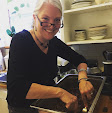
Cheese maker and author Claudia Lucero.

There were also the doughnuts her grandmother would make using inexpensive rolls of biscuit dough from the store that she'd roll out into disks. She'd have Lucero rummage in the kitchen for a just-the-right-size cap from a bottle to use for cutting the hole, then she'd fry the disks in oil until they puffed up before young Claudia's eyes.

Large blocks of surplus government cheese were a staple that was always available and "kept us going," Lucero recalled. After the age of three, she and her sister lived with their mother, who considered herself "a modern woman and working single mother" who had no interest in cooking. Lucero took over the job and recalled cutting the orange government cheese into cubes and cooking them in the microwave until they melted, turning them into crunchy cracker-like crisps just like the frico that's so popular now on restaurant menus and at deli counters.

Fresh cheeses you can make at home.

For several years Lucero worked for nonprofit organizations in San Diego focused on providing support services to girls, women and the LGBTQ community, then came to Portland to work for the Rock and Roll Camp for Girls. For several years she'd been dabbling in home cooking projects like pickling and making bread, yogurt and simple fresh cheeses such as paneer, but it was feedback from friends at a weekly soup night that caused Lucero to take these pursuits more seriously.

The breads and cheeses she made and contributed to the communal meals got consistent raves, so when a friend's mother was visiting, Lucero put together a simple cheese making kit—containing citric acid, salt and cheesecloth—as a gift. With her nonprofit job barely covering her living expenses and with student loans to pay off, she had the timely epiphany that these home cheese making kits might be something people would buy for themselves or for a gift.

Queso blanco and paneer traditional cheese kit.

At the time, that meant getting her home kitchen approved for food production from Oregon's agriculture department, a process that has been made easier by Oregon's Home Kitchen Licensing law passed in 2016. Coincidentally, the website Etsy had launched a couple of years before Lucero formed her company, Urban Cheesecraft, in 2009, and it provided the creator-friendly platform she needed to get her business up and running.

A success almost from the start, Lucero was producing her kits solo, doing all the purchasing, promoting, packaging, sales and distribution out of her home. That's when she got a call from Whole Foods asking if she could supply their Pacific Northwest stores with her kits, to the tune of 20 kits per store, which added up to 500 kits per month. Shortly thereafter, New Seasons Market started requesting her kits for their stores. The good news? She paid off her student loans within a year. The bad news? After two years, she was exhausted and realized she could no longer do everything herself.

Lucero's first book on home cheese making.

Fortunately, at about that time Portland distributor Provvista Specialty Foods (sold in 2011 to Chef's Warehouse) stepped in to pick up the sales and distribution aspects, which took a huge load off of Lucero's shoulders. Then she was laid off from her job, giving her more time to focus on the business. Fortuitously, within a month of being laid off, kitchenware and home furnishings retailer Williams Sonoma came to her with an opportunity to develop custom kits for the chain's stores, and Workman Publishing offered her a book deal.

Her book, One-Hour Cheese: Ricotta, Mozzarella, Chèvre, Paneer—Even Burrata, was an almost instant hit with its simple instructions and step-by-step photos that guided even the most cooking-averse readers through properly heating milk, stirring curds, molding, kneading, and stretching the cheeses. One reader commented, "[Lucero] starts you out at the very beginning with a fast and easy farmer's cheese. This is so basic and easy that it encourages you to know you can do this and will keep people reading the rest. She also has many photos, so you can really see if you are on track. Very well thought out."

New dairy-free kits.

As the business grew, Lucero found a co-packer, DePaul Industries, which could put together the kits for her. She then switched to another outsourcing company, Relay Resources, to assemble the kits so she could concentrate on recipe development and work on her second book about making dairy-free cheeses at home. Called One-Hour Dairy-Free Cheese, it came about because of the questions she got "from day one" about using non-dairy ingredients with her traditional kits. (You can't.) She also hired a sales director to manage the business flow, and found a new distributor, Frontier Co-op, to handle the new dairy-free kits.

Urban Cheesecraft's dairy-free cheeses.

Lucero said that, as a person who loves cheese, it was interesting to start making the dairy-free versions. Judging from the types of vegan cheeses available in stores, she came to believe that most vegan cheese makers—understandably—don't know what real cheeses taste like any more. So her aim? To develop vegan cheeses that taste like real brie, fondue and feta, just a few of the many styles she's developing.

"Cheese is milk's leap toward immortality," she says in her video on Etsy, quoting author and media personality Clifton Fadiman. She adds, "Whether it takes an hour or a month [as with aged cheeses], I want to make it easy, accessible and empowering for people."

Saturday, October 27, 2018

EU Comes To PDX, Talks Turkey (and Hazelnuts and Wine and Olive Oil and…)


Perhaps the most surprising thing about the event I moderated the other night, A Taste of Europe, came toward the end of the evening when the featured speaker, Dr. Lorenzo Terzi, European Union Minister Counselor for Health and Food Safety, said that if he had his way there would be no barriers to trade between the European Union (EU) and the United States. Zero. None.

Dr. Lorenzo Terzi.

That's a pretty big bombshell coming from a guy who's spent his career negotiating trade deals, and he admitted it was a risky thing to say, but Terzi posited that if the EU and the US were to agree to drop trade barriers in both directions at the same time, everyone would benefit. (Obviously regulations on safety, health, etc., would still be in force.) I'll leave it to those more knowledgeable about world trade to hammer out the details, but I'm inclined to give him the benefit of the doubt on this one.

With Center for Animal Law Studies Dir. Kathy Hessler.

Earlier in the day I'd joined Terzi for a lunch lecture to students at Lewis and Clark Law School's Center for Animal Law Studies where he discussed the EU's "Trade for All" policy, a vision for global trade and values described as having a "lighthouse effect" when it came to trade in animals, plants and food. One example of this effect is the EU position that all animals are sentient beings, and that animals used in the production of food in the 28 member states are entitled to what are termed the "Five Freedoms":

• Freedom from hunger and thirst
• Freedom from discomfort
• Freedom from pain, injury and disease
• Freedom to express normal behavior
• Freedom from fear and distress

Touring a hazelnut orchard.

At the evening panel discussion, the 100-or-so guests packed into the room sampled Belgian waffles from Offty Waffles, which were piled sky-high with whipped cream; pretzels from Urban German Grill; and cheeses and dips from Elephants Delicatessen, as well as beverages from Europe and the U.S., while Terzi presented his case for opening up trade with the EU. His main focus was the imbalance between the U.S. treatment of the EU as 28 separate entities, forcing the member states to individually work out separate export request files, a duplicative, expensive and time-consuming effort, rather than treating the EU—as the member states have since the Maastricht Treaty of 1993—as a "Single Entity" trading partner.

A regular Johnny Carson!

The evening also featured Alexis Taylor, Director of the Oregon Department of Agriculture, who outlined the extensive nature of Oregon's longstanding trading relationship with Europe. Katy Millard, owner and chef of Coquine and a 2018 James Beard Award finalist, discussed her view of the contrasts between her work in the kitchens of France and U.S., as well as the food safety environment in both countries, which she considers comparable if subtly different. Rounding out the panel was New Seasons Market's Oren Kariri, who gave an overview of the company's food safety program as well as covering the importance of foods imported from the EU in its mix of products.

Questions from the diverse audience ran the gamut from questions about Italian olive oils imported from Italy, Terzi's home country; to the ways that the EU and the US view the relationship between agriculture and climate change; to the potential value of seeking a career in food safety.

As for his response to his whirlwind trip to Portland that involved the lecture, several farm tours and the evening panel? It was summed up in a tweet he sent out when he got home: "It was a real privilege to talk the 'EU lighthouse' effect on food safety and animal welfare [to the Lewis & Clark students]. Let’s continue to change the world together!"

Read my interview with Dr. Terzi and find out why he says, "Farmers are my heroes."

Guest Essay: "Green" Your Farmers' Market Routine


The following essay by Jacqui Stork, assistant manager of the Hillsdale Farmers' Market, is full of helpful tips for making your farmers' market shopping more earth-friendly. (Hint: These tips also work for shopping at the grocery store!)

We farmers' market people tend to care a lot about the earth, and our impact on it. As such, we work hard to have a net positive impact in our actions and approach to food and always seek to pass that along to our customers. That being said, there are times when the drive for quality and convenience means that we use plastics or other disposable products. Because we want to balance our desire to be more green with the realities of running a public market, we thought we'd share six super simple ways you (the customer) can help green up the market every time you shop.

Reusable bags are the best!

Remember Your Market Bag(s)
This one is probably the lowest hanging fruit—most of us have a least one reusable bag hanging around at home. Keep it somewhere that you'll remember to bring it with you. If you forget, or just want to sport a new look, most markets have heavy-duty bags available at the information booth. They can hold a pretty hefty market haul and are machine washable. If you are doing an especially heavy shop, consider bringing a wagon (some markets provide wagons) to pack it in and out!

Decline the Plastic Bag
Along these same lines, you will likely be offered smaller plastic bags for produce at market stalls—you can always decline to take one. Just use your market tote as a carryall for the day's purchases. If you like to keep your items separated (or simply need to corral smaller items, like tomatoes) consider purchasing cotton or mesh produce bags.

Look for the recycling station.

Recycle the Right Way
One of the biggest challenges we face at the market is making sure that our recycling is "clean." We often find that things have been tossed into the recycling bins that we end up having to trash. The biggest culprits? Coffee cups, bottle caps, plastic straws and containers with food refuse on it. When these get mixed in with the recycling, our volunteers have to hand-sort and remove them (which is no fun at the end of a long day). If you aren't sure whether or not something is recyclable, ask before tossing it in.

Prioritize Plants
Eating a plant-based diet is one of the best things we can do for the environment. This doesn't have to mean eschewing meat and other animal products entirely—it can simply mean shifting your focus to prioritizing foods like vegetables, legumes and fruits. Stock up on fresh, seasonal items that fit this bill and use recipes that make these items the star.

A wagon can come in handy!

Rethink Scraps
A lot of the time we don't know what to do with those "extra" bits (like mushroom stems, corn cobs and onion peels). Try keeping a zip-top bag or airtight container in your freezer to fill with scraps for making stock. Once you get a full bag or two, dump the contents into a large soup pot and cover with about a quart of water. Add salt, pepper, bay leaves and any other aromatics you have on hand and let simmer for one to two hours to create a light broth to use in soups or other cooking projects.

Practice Durable Dining
If you plan on eating or drinking at the market, consider bringing (some) of your own dishes. While our hot food vendors can't fill your personal tupperware, you can use silverware you bring from home to eat your meal. (Anybody else love those camping sporks?) You can also bring your travel coffee mug to be filled at some coffee vendors' stands, and carry a reusable water bottle to hydrate at the info booth.

Small steps can make a big difference when we all practice—try some of the tips above to help us help the planet!

Photo of recycling station from Portland Farmers Market.

Monday, October 15, 2018

In Season: Check Out Chicories!


In the most recent Beaverton Farmers Market newsletter, market manager Ginger Rapport shared a comprehensive compendium of one of my favorite winter salad greens—though some tend to the reddish end of the spectrum. Their slightly bitter edge can be mitigated by soaking the chopped leaves in cold water for a couple of hours ahead of time, a trick I learned from Nostrana's Cathy Whims. Scroll down for a fantastic and slightly sweet dressing to serve on a salad of these lovelies.

Chicories are closely related to lettuces, but are heartier and have a bitter edge. They are cool weather crops that come into season in late fall and some are starting to appear in our grower’s stalls. They include Belgian endive, curly endive, escarole and radicchio.

Belgian endive.

Belgian Endive is grown indoors, in the dark, to maintain the extremely pale yellow, almost white, tightly packed head of leaves. Red Belgian Endive is technically a small, forced radicchio. They can be used interchangeably with traditional Belgian Endive.

Curly Endive (a.k.a. Frisée) has tightly closed, frizzy heads most commonly used in salads but it is also tasty when quickly sautéed with a bit of vinegar, such as sherry vinegar or balsamic.

Escarole.

Escarole is crunchy, green and bitter. It stands up to bold dressings in salads but is also good grilled or broiled for a powerful accompaniment to roasted or grilled meats, and is fabulous creamed or in soups.

Radicchio, possibly the most well-known chicory, grows in small heads that are brilliant magenta. It is often used in salads but also shines when cooked a bit. It pairs particularly well with assertive ingredients such as olives, blue cheese, apples, figs and walnuts.

Speckled Radicchio is a cross between radicchio and escarole. It has a mild flavor with delicate leaves that can be used in salads but is sturdy enough to stand up to a little cooking.

Arch Cape chicory from Ayers Creek Farm.

Treviso Radicchio is similar in flavor to regular radicchio but is a little sweeter and grows in longer, looser-leafed heads. One unusual type, developed from an Italian variety and available locally in early March, is the Arch Cape chicory developed by Anthony Boutard of Ayers Creek Farm. Use treviso leaves in salads. Whole heads can be quartered and lightly grilled, or even stuffed and sautéed.

Fig Balsamic Salad Dressing

1/3 c. balsamic vinegar
1/3 c. olive oil
1 Tbsp. fresh chopped shallots
6 small brown turkey figs
4 tsp. honey, or to taste
1/8-1/4 tsp. salt, or to taste

Put all ingredients in a blender and blend on high until emulsified.

Top photo of chicories from Flying Coyote Farm at the Hollywood Farmers Market. List of chicories was distilled and edited from The Spruce Eats.

Wednesday, October 10, 2018

A Taste of Europe with Dr. Lorenzo Terzi


Get a taste of food policy as well as Oregon and European food and wine next Thursday, October 18, when I moderate a panel discussion featuring Dr. Lorenzo Terzi, European Union Minister Counselor for Health and Food Safety; along with Alexis Taylor, Director of the Oregon Department of Agriculture; Katy Millard, owner and chef of Coquine and a 2018 James Beard Award finalist; and Oren Kariri, Food Safety Manager of New Seasons Market. Scroll to the bottom of the post for details!

Trade in food, plants and seeds has been going on since humans appeared on the scene, when potatoes and corn made their way from the Americas over to Europe, and the Spice Route, also known as the Silk Road, spread food and other goods along thousands of miles of terrain between Asia and Europe.

Dr. Lorenzo Terzi.

Now things are a little more complicated, with strict regulations governing imports and exports between trading partners, and with standards on both sides of the Atlantic affecting what's on our plates today and how our global health might be affected tomorrow. One of the people who gets to worry about those regulations is Dr. Lorenzo Terzi (pron. TEHRT-see), a minister for health and food safety with the European Union (EU).

He's coming to Portland to help raise awareness about the European Union's standards for health and safety, touted to be, along with those of the U.S., among the highest standards in the world. The EU Delegation decided to come to Oregon because of its standing as an important trading partner in agricultural products, or what Terzi calls "agri-food."

In fact, it's the second trip for Terzi to Oregon in the last month, the first being an audit of U.S. standards and controls for plants and seeds intended for export to the EU to avoid the spread of pathogens. On this trip, in addition to the tasting and panel discussion, he'll be visiting a mint farm and a hazelnut orchard, both export crops for the state.

With school children (and the school's goat) in Austin, TX.

His current position involved moving to Washington, D.C., a little over a year ago and working on the complexities of negotiations of trade agreements and regulations as they intersect with animal health, public health and food safety, animal welfare, and plant health. It also involves the difficult task of maneuvering around what he terms "red lines," or, as he describes it, "where it is objectively difficult to make progress or almost impossible." Those involve issues like hormones in meat or the use of certain chemicals in slaughterhouses, or the ability for the EU to export pasteurized dairy products like yogurt to the U.S.

Since coming to the United States, Terzi has noticed a definite shift toward products that are sold as sustainable, grass-fed, pasture-raised or non-GMO, though he said there is almost no visibility of those products in Europe. As for organic products, the U.S. and EU have been able to work out equivalent labeling and, he said, "wide areas [of grocery stores] are dedicated to these products both here and in the EU."

Terzi said that his passion for his work springs from his upbringing in a family of farmers in the Emilia-Romagna region of Italy near Bologna. He still owns a small farm in the area and tries to make it back at least twice a year where, as he says, he has to fight with the weeds that seem determined to take it over. Should he win that battle, he said, he'd like to cultivate his current interest in the medicinal plants of the Mediterranean bush, and maybe some olive trees to support the olive production of his province.

"Farmers are farmers, both in the US and the EU," Terzi said. "They have hard work and to me they are heroes."

Find out what happened at the Taste of Europe panel and why Dr. Terzi, the lifelong diplomat, said that "there would be no barriers to trade between the European Union (EU) and the United States. Zero. None."

Monday, October 08, 2018

Warm-Up for Fall: Pot Roast Bourguignon


One neighbor remarked while passing by that the ash trees surrounding our house were "over-achievers" since their golden leaves are the first to fall in our neighborhood. Which means we're finished with the raking and piling when the leaves are still relatively dry and easy to gather up rather than sodden and heavy later on.

Before roasting…

Raking even our relatively small corner lot is still a lot of hard work, especially if your normal workout involves lifting a coffee cup to your lips or casually strolling around the neighborhood with your dogs. The heavenly pot roast recipe below is super simple and can be assembled and put in the oven to braise for a few hours while you're outside doing yardwork. Plus it provides an excuse to schedule breaks every hour or so to check and make sure the liquid hasn't all cooked away (add water if it seems low).

…and after. Mmmmmm!

The smell when you come in the house for those "breaks" will give you motivation to get the outside work done quicker, too, the better to come inside and enjoy a cocktail while you make a salad and boil some potatoes to serve alongside. And sitting down to a hearty and flavor-filled dinner that basically cooks itself? I can't think of a better reward for all that hard work!

Pot Roast Bourguignon

This is extremely easy to make, but you'll need to get it in the oven four hours before dinner or make it the day before. Cutting back on the time in the oven makes for a less than stellar texture.

4 slices bacon, cut in 1/4" pieces
1 3-5 lb. chuck roast
Salt and pepper
1 large onion, chopped in 1/2" dice
4 cloves garlic, chopped roughly
2 ribs celery, chopped in 1/4" slices
4 carrots, sliced in 1/4" rounds
1 lb. mushrooms, sliced
1 Tbsp. basil
1 tsp. thyme
2 sprigs rosemary
1 quart (32 oz.) roasted tomatoes
3-4 c. red wine

Preheat oven to 375 degrees.

Put bacon in a large braising pot that can go in the oven and fry till fat is rendered and it starts to brown. Add onions and garlic and sauté 2-3 min., then add carrots and celery and sauté 2-3 min. Add sliced mushrooms and sauté till soft. Stir in tomatoes and herbs, then add wine. Sprinkle roast generously with salt and pepper add to pot. Bring to a boil, then cover and place pot in oven, baking for 2 hrs. Remove meat from pot and slice in 1/4" slices, then return the sliced meat to the pot, covering with sauce and vegetables. Cover and bake for another 1 1/2 hrs.

Saturday, September 29, 2018

Umami Bomb from…Tomato Skins?


I'm admitting up front that I am borrowing this from the estimable Ms. Katherine Deumling of Cook With What You Have, who mentioned this unique idea recently. Intrigued, and still in the middle of processing, oh, about 100 pounds of tomatoes, I was swimming in tomato skins that I had plucked out of the sheet pans of roasted tomatoes that were flying out of my oven.

Dried tomato skins.

Instead of tossing them into the compost, I spread them out in a thin layer on a parchment-lined sheet pan and put them in the oven, which I'd preheated to 150°. It took a few hours, but eventually there was a whiff of roasty tomato smell coming from the oven. Checking them, they were very slightly moist but with that leathery texture of good dried peppers. So after letting them cool, I threw some in the spice grinder, and in a few seconds they were reduced to a fine, flakey consistency, with that gorgeous red color intact.

As a layer in rolled pork loin.

So far I've sprinkled them in scrambled eggs, scattered them on top of macaroni and cheese, and layered them in a pork loin roast with rosemary, fennel pollen and salt, all to delicious effect. Their roasted tomato essence carries through when they soften, and adds a layer of umami that you might get from, say, roasted peppers. I can see using them in hummus or a sour cream dip, in sauces and as a sprightly addition to some of my favorite deviled eggs.

Thanks, Katherine, for the suggestion!

Tuesday, September 25, 2018

Pasture Network Grows with New Online Guide


When I'm at the grocery store or the farmers' market, I'm inundated with so many labels and certifications it makes my head swim. From "non-GMO" to "organic" to "pasture-raised" to "natural," I feel like I have to be a legal expert to suss out which ones are questionable—sometimes even fake—and which ones I can trust.

How do you know what you're buying?

And I hate to say it, but even at the farmers' markets you have to be careful of claims by farms that their products are "all-natural" or "no-spray" or even "local." In one case, Willamette Valley Cheese, which in previous years had won top honors from the American Cheese Society, had its dairy, Volbeda Farms, shut down by the state Department of Agriculture for more than 200 violations since 2007. Since it stopped using milk from its own cows, it is instead buying milk from a regional cooperative, Darigold, while claiming on its website that it is buying from a "local dairy." And showing pictures of cows on grassy pastures belies that fact that much of Darigold's milk is sourced from large factory farm dairies.

But help is here for people like me wanting to buy my meat, dairy and eggs from local farmers who raise their livestock outdoors, on pasture in a humane and ecologically sustainable manner. The  Oregon Pasture Network Product Guide is a free statewide online guide for buying products from more than 60 Oregon farmers who are committed to agricultural practices that put a high value on family farms, animal welfare, public health, the planet and our local rural economies.

Cattle raised on pasture.

Organized by Friends of Family Farmers, the Oregon Pasture Network (OPN) requires producers to sign a Pasture Network Pledge, as well as go through an application process that includes a farm visit. Farmers who sign the pledge agree to operate "on a scale that is appropriate to our land and to use practices that allow our animals to live a high-quality life on pasture [and] make operational decisions intended to foster the long-term viability of the land, air, and water of our local community."

Farmers at a Potluck and Pasture Walk.

Once a farm is accepted into the network—a no-fee process at this point—farmers are listed in the product guide with an accompanying farm profile, as well as being given access to classes that provide expert assistance to improve their pasture-based systems and deepen their understanding of the art and science of responsible grazing. The OPN also provides a producer listserv where farmers can share tips and information, and the network launched a Potluck and Pasture Walk series this past summer, scheduled around Oregon so producers can share stories of what it's like to raise animals on pasture in their particular part of the state.

And if you want to know more about local producers and where your food comes from, Friends of Family Farmers is sponsoring a series of free informational evenings called InFARMation that will take a deep dive into the benefits of responsible grazing and pasture-raised poultry (including eggs), meat and dairy. Each evening will feature tastings and a panel discussion, as well as beer provided by Lagunitas Brewing, which sponsors the meeting place and donates all sales of beer to Friends of Family Farmers. Dates and topics are:
  • Pasture-Raised Poultry and Eggs featuring farmers Geoff Scott and John Mathia of Marion Acres Farm; Piper Davis, co-owner, and Laura Ohm, product director of Grand Central Bakery; Justin Ashby is meat monger for Flying Fish Company and owner of Tidal Boar Foods.Aug. 25, 6-9 pm, Lagunitas Community Room, 237 NE Broadway St., Suite 300.
  • Pasture-Raised Pork, Oct. 9, 6-9 pm, Lagunitas Community Room, 237 NE Broadway St., Suite 300.
  • Pasture-Raised Dairy, Nov. 13, 6-9 pm, Lagunitas Community Room, 237 NE Broadway St., Suite 300.

Wednesday, September 19, 2018

Court Orders Feds to Take Over Lost Valley Farm, Appoint Trustee


“[Owner Greg] Te Velde is unwilling, or unable, to comply with his duties as a fiduciary,” wrote Judge Fredrick Clement of the U.S. Bankruptcy Court of the Eastern District of California in his decision to allow a federal takeover of Lost Valley Farm in Boardman, Oregon.

“Since filing (bankruptcy), [te Velde] has continued his long-standing habits of methamphetamine usage and gambling," Judge Clement continued. "Drug usage has occurred once or twice per week, and he has gambled estate monies of $2,000 to $7,000 monthly. Te Velde borrowed $205,000 without court authorization, and in a one-month period took personal draws of $28,000 more than authorized.”

With that damning decision by Clement, te Velde failed in his efforts to maintain control of Lost Valley Farm in Boardman as well as the two mega-dairies he owns in California. Clement then ordered the appointment of a trustee to manage the three factory farm dairies.

According to an article in the Salem Statesman-Journal, "it's uncertain whether replacing te Velde with a trustee will hasten or slow environmental improvements at the dairy" since "creditors have said they are reluctant to approve any spending on environmental compliance until a consultant completes a report outlining the cost of all needed improvements."

Until that report is done, and even in its current questionable state, the dairy will continue to operate, selling the milk from its approximately 7,000 cows under the contract it has with the Tillamook Creamery Association's processing plant in Boardman. That is despite Tillamook's claims in bankruptcy hearings in June that the milk from Lost Valley violated the company's testing standards for safe levels of bacteria on at least 60 occasions.

"The Lost Valley mega-dairy has been a disaster from the beginning, and hopefully this decision will lead to it finally being closed down," said Friends of Family Farmers Policy Director Ivan Maluski in the Salem paper's article. "The Oregon Departments of Environmental Quality and Agriculture could have prevented this fiasco and should have denied this operation a permit at the outset. This situation makes it clear that Oregon needs stronger laws to prevent this kind of thing from happening in the future."

* * *

Read my series of posts outlining the long history of problems at Lost Valley Farm since it opened just a year ago, including cows standing in manure from overflowing lagoons and a leak in a tank containing dead cows, plus massive groundwater pollution, lawsuits from the state of Oregon and the farm's creditors, and te Velde's own arrest for soliciting a prostitute and possession of methamphetamine in Benton County, Washington.

My article Big Milk, Big Issues for Local Communities reports on the issues mega-dairies pose to Oregon's air, water, environment and communities. You can also find out Why I'm Quitting Tillamook Cheese and read other coverage about factory farms in Oregon.

Saturday, September 15, 2018

In Season: Late Summer and Fall Bounty


As Anthony Boutard of Ayers Creek Farm is fond of pointing out, we here in the Northwest live in a maritime climate, on the same latitude as Italy's Piedmont and, interestingly, Hokkaido, the northernmost of the islands that comprise Japan. Which means, fellow travelers, that we have a relatively mild climate moderated by its proximity to the ocean, with a fairly long growing season that can extend well into the fall.

So here we find ourselves, on the cusp between late summer and autumn with the harvest still pouring in from local fields, and I thought it was a good time to chat with Josh Alsberg about what we can expect to find at farmers' markets (as well as at local greengrocers like his own Rubinette Produce).

His summary? "Apples, pears, squash, roots and greens. 'K, bye!"

Price and canadice grapes.

Pushed for just a teensy bit more detail, he added that local table grapes are just coming into full bloom and should be available for the next three or four weeks. One of his favorite farms for grapes, aside from Ayers Creek Farm, is Farmers Table Grapes, owned by Bill and Karen Farmer in Rickreall. Certified organic, they grow more than 30 varieties of grapes like Interlaken and Eisenstadt.

As for apples, he suggests getting them at farmers' markets, since most apples found in supermarkets come from large corporate farms. Whether at the market or the store, he said the best way to know if you'll like a variety is to ask for a taste. His mantra? "You have to be brave enough to ask questions," whether for a sample or to learn more about a farm's practices. Fresh local apples—as opposed to storage apples, which tend to be "older and more tired"—should be available until the end of November.

Forell pears.

Alsberg noted that pears are also going to be available in abundance, at least through the end of October. He said the early pears like Bartlett, Starkrimson and Cascade tend to have a slightly more astringent quality, and that as we move into October dessert pears—think Comice, Bosc and Taylor's Gold—will start appearing along with Seckel and Forell pears.

Local plums and pluots, which hang to ripeness on the trees and tend to have a more nuanced flavor than those imported from outside the Northwest, will be available through September. He said that melons are on the way out, so enjoy them now because they'll disappear from the scene.

There's still time to make corn salsa!

Sadly, I am obligated to report that the supply of local tomatoes is also waning rapidly (personally, I'm eating as many tomato sandwiches as I can) and the window for corn and eggplant is closing quickly. Peppers will be strong through early October, and a few farmers' markets are featuring fresh-roasted peppers for sale.

The good news is that local potatoes, onions and winter squash are beginning to appear. Some sage advice Alsberg shared is to pace yourself when it comes to winter squash. "You don't want to burn out before the good stuff gets to you," he said, and suggested referring to the Winter Squash Cooking Chart that lays out the four categories of winter squash—Simple, Saucy, Sweet and Salad—and easy recipes to take advantage of each variety's unique flavor profile.

Fresh shell beans are a fleeting pleasure.

Asked what excites him about this time of year, he mentioned different onion varieties that are being grown by area farmers. "It's more than just red and yellow," he said, and suggested trying Tropea, a sweet red onion often labeled "Torpedo," along with cipollini, shallots and elephant garlic.

Greens are still available in abundance but Alsberg said that we're moving away from leaf lettuce and into the hardier varieties like kale, chard, radicchio and other chicories, as well as frisée, all of which he says are best in late September when cooler temperatures cause the plants to put out more sugars to protect them from frost. Green beans are also going strong, and we should be looking for shell beans and brussels sprouts in October and November. Roots like beets, turnips and rutabagas will come on in October, too, so check out some recipes for roots and belly-warming soups to whet your appetite.

A quick note that Rubinette will be holding it's annual Apple Tasting on Oct. 20 that will feature at least a dozen heirloom and hard-to-find varieties like the Oregon-bred Rubinette—not surprisingly Alberg's favorite—Crimson Crisp, Ashmead's Kernel, Pippin and more for sampling as well as for sale.

Friday, September 14, 2018

Dropping Knowledge Word by Word


Revelations often come from unexpected places, and this week's CSA newsletter from Gathering Together Farm struck me with the idea that the food I put on my table has much deeper benefits than just a meal for my family—it's also nourished the minds and hearts of the farmers and crew members who grew and harvested it.

"Whenever I sit down to write this newsletter, the conversations that took place while we harvested your produce starts flitting through my mind. More than any one particular conversation, I wanted to draw attention to the amazing language immersion experience that one has on our harvest crew. While we’re sharing immense amounts of knowledge about how to harvest vegetables properly, in doing so we are also exchanging immense amounts of language in order to get the job done.

"Our 2018 harvest crew is an incredibly diverse bunch of folks, all of whom speak different combinations of languages. There are those who speak Spanish and English to varying degrees, those who speak either Spanish or English, and then there are Spanish speakers who speak indigenous languages, including Mixteco from Mexico, and Mam and Kanjobal, both Mayan languages from Guatemala. Some people have been farming their whole lives, some for the past decade, and others are experiencing farm life for the first time.

"At the beginning of the season, it felt like the language barrier hindered efficiency, but the barrier has since been broken. Over this season, everyone has learned so much English and Spanish, and a few select language buffs have even taken to learning the differences and similarities between the indigenous languages. For me, I have honed my Spanish abilities to a whole new level that is simply not possible in a classroom. But what’s more important than the words we’ve learned has been the relationships that we’ve built with each other as we laughed and grumbled our way through communication breakdowns and successes, just as any good learning process should be.

"As you eat your way through your box this week, remember the diversity of words that passed through the air as we harvested, the words that made possible the logistics of assuring quality control and efficiency as we moved from field to field, the words that maybe didn’t make sense the first time and had to be laughed off and said again before they got the message across. As we have spent our days working our bodies in the fields, our minds have been far from dormant. It’s been one stimulating season of knowledge exchange, and I wouldn’t trade it for the world.

"Best, Laura Bennett"

Read more about Gathering Together Farm and owner John Eveland.

Top photo by Gathering Together Farm.

Thursday, September 06, 2018

The Braise is Back: Beer-Braised Poblano Pork


Now, I'm not one to trumpet the end of summer and the beginning of that four-letter word beginning with "f" (and ending with "double toothpicks" for those of you old enough to remember that old saw). But I do appreciate the moderating temperatures during the day and the rapid cooling at night, making pulling up the covers a welcome necessity.

Yes, I'm a native Oregonian. Is it that obvious?

A drizzle of cilantro chimichurri? Sure!

While there's still plenty of grilling weather in the forecast, with salmon and albacore running strong, and tomatoes, peppers and a bounty of other delicious things coming in from local farms (whew!), it's also possible to turn on the stove without the fear of making your home feel like you're living in some hot, humid East Coast city. (No wonder those politicians in DC are so grumpy all the time, huh?)

The other day I'd picked up a pork shoulder at the store, pondering what to do with it when I got home—Chili? Posole? Pulled pork?—and then, while rummaging in the vegetable bin, found several large poblano peppers that had jumped into my farmers' market basket the weekend before. Excellent!

A little chopping, a little sautéing, a can of Hopworks pils from the fridge, and in under half an hour I had a pot of pork bubbling away on the stove. Then two hours later we were sitting down for what I have to say was a spectacular dinner. By the way, the chimichurri came about when during the aforementioned rummaging I ran across a bunch of cilantro that was soon to expire, so whizzed that up in the processor with some lime and garlic and, voilà, instant zhoosh!

Beer-Braised Poblano Pork

4 lbs. pork shoulder, cut in 1” pieces
3 Tbsp. vegetable oil
1 large yellow onion, in 1/2” dice
4 cloves garlic, roughly chopped
3 large poblano peppers, seeded and chopped in 1” pieces
2 serrano peppers, seeded and minced
12 oz. light beer (a Northwest pilsner works nicely)
2 c. chicken stock
2 tsp. dried oregano
2 bay leaves
2 tsp. salt plus more to taste

Heat oil in Dutch oven over medium heat until it shimmers. Add onion and sauté until translucent, then add garlic and peppers and sauté until tender. Add pork, beer, stock oregano, bay leaves and salt. Bring to a boil, then reduce heat to simmer and cover. When pork is tender (almost falling apart), taste for salt and serve in bowls with rice or grain and a drizzle of chimichurri (recipe below).

* * *

Cilantro Chimichurri

2 c. cilantro
1/3 c. olive oil
2 large cloves garlic
2 tsp. oregano
1 tsp. red pepper flakes
2 Tbsp. lime juice
Salt to taste

Place all ingredients in food processor or blender and process until smooth.

Tuesday, September 04, 2018

Summer Book Report, Part II: Two in the Far North


Memoir. History. Love story. Ecological screed. A meditation on our place in nature. Astute political analysis. Even some murder and mayhem (of the natural world sort).

I've never read anything quite like Margaret Murie's Two in the Far North, which is, at its core, a memoir of her life growing up in pre-statehood Alaska, meeting her husband, Olaus, a wildlife biologist, and spending much of their lives together studying and working to preserve Alaska's wild places. It was a lifetime of effort and advocacy that eventually led to the creation of the Arctic National Wildlife Refuge (ANWAR) in 1960.

With one of her beloved sled dogs.

We meet Murie when she is just nine years old, at the point when she and her mother traveled from Seattle to meet her father, an assistant U.S. attorney for what was then called the Territory of Alaska. In the early 1900s, that meant a several-day journey via steamship from Seattle to Skagway, in Alaska's southeast panhandle, then another several days to travel by train to Whitehorse in Canada's Yukon. The next leg took the pair up the Yukon River to Dawson where they were met by Murie's father, and then traveling together up the Tanana River to Fairbanks on a river steamer.

The first woman to graduate from Alaska Agricultural College and School of Mines.

"In 1911 the river steamer was queen. There was a great fleet then, nearly all with feminine names, churning and chuffing their stern wheels up the rivers and sliding briskly down them. When the great two-stacker Mississippi-style steamer came in to any dock, she came like a confident southern beauty making a graceful curtsy at a ball. [These steamers] lived their lives between St. Michael at the mouth of the river and Dawson, sixteen hundred miles upstream." Arriving in Fairbanks, the family moved into the one vacant house which Murie describes as "way out on the edge of town," with only four rooms, a handpump in the kitchen and a woodstove that heated the house.

Murie's early life is described from her vivid memories growing up in the far north, cooking on that woodstove, walking to school even in fifty-below-zero weather and exploring the world of the gold rush town where "there were no others nearer than eight days by horse sleigh or ten days by river steamer."

Dressed for the trail.

Going off to college—in Portland, to Reed College, no less—at the age of fifteen, she traveled by dogsled accompanied only by a driver and his dogs for nine days, traversing frozen rivers and mountains and staying in rough-and-tumble roadhouses along the way. From this point on, Murie quotes extensively from her astonishingly descriptive diaries about meeting her husband and spending their honeymoon on a research expedition above the Arctic Circle, studying its flora and fauna with the idea that documenting this unexplored region could help to preserve it for future generations.

The camp on Lake Lobo on the Sheenjek River above the Arctic Circle.

This love of the wilderness, her enchantment with the natural world and the difficult, funny and moving experiences they had together that bring the times and places to life, putting flesh on the characters they meet along the way, some in the most unexpected circumstances. Murie is a storyteller of great warmth and humanity, and I can't recommend this book highly enough.

Read Part One of my summer book report, "Henry David Thoreau: A Life."

Photos from U.S. Fish and Wildlife Service and Alaska's Digital Archives.