Showing posts with label tomatoes. Show all posts

Saturday, September 29, 2018

Umami Bomb from…Tomato Skins?


I'm admitting up front that I am borrowing this from the estimable Ms. Katherine Deumling of Cook With What You Have, who mentioned this unique idea recently. Intrigued, and still in the middle of processing, oh, about 100 pounds of tomatoes, I was swimming in tomato skins that I had plucked out of the sheet pans of roasted tomatoes that were flying out of my oven.

Dried tomato skins.

Instead of tossing them into the compost, I spread them out in a thin layer on a parchment-lined sheet pan and put them in the oven, which I'd preheated to 150°. It took a few hours, but eventually there was a whiff of roasty tomato smell coming from the oven. Checking them, they were very slightly moist but with that leathery texture of good dried peppers. So after letting them cool, I threw some in the spice grinder, and in a few seconds they were reduced to a fine, flakey consistency, with that gorgeous red color intact.

As a layer in rolled pork loin.

So far I've sprinkled them in scrambled eggs, scattered them on top of macaroni and cheese, and layered them in a pork loin roast with rosemary, fennel pollen and salt, all to delicious effect. Their roasted tomato essence carries through when they soften, and adds a layer of umami that you might get from, say, roasted peppers. I can see using them in hummus or a sour cream dip, in sauces and as a sprightly addition to some of my favorite deviled eggs.

Thanks, Katherine, for the suggestion!

Tuesday, September 04, 2018

Cast Iron Cooking: Tomato Cornbread


Reading recipes has always inspired me, and even those I'm annoyed by can contain the seeds of a good dish. Contributor Jim Dixon of Real Good Food shares one of those that he used despite quibbles with its moniker.

Tomato Cornbread

A recipe in the Washington Post inspired me, but the name, "Savory Tomato Cornbread Cobbler," is both too long and misleading. "Savory" is just superfluous food porn, and cobbler, while not really precisely defined, really requires the batter portion on top. It's not exactly a pie, but nether is the tamale version. Whatever you call it, it tastes good.

Put a nine-inch or so cast iron skillet (or similar baking dish) in a 350° oven. Cut three or four tomatoes into bite-sized pieces, add a bit of chopped garlic or shallot, some chopped herbs (basil, mint and parsley for me; if you don't have any growing in your yard, just use basil), a splash of one of the the Katz vinegars and the same for oil. I used about 2-3 cups of this tomato mix.

The cornbread is a simple hot water version made with extra virgin olive oil instead of butter or lard. The real star is the cornmeal: I used Ayers Creek Amish Butter, but the purple Peace, No War would also work (I've got both in stock). Mix a cup of cornmeal with a teaspoon of sea salt and 2 tsp. of baking powder. Add a cup of boiling water and one of extra virgin olive oil, mix well. It'll be a little oily, but that's okay.

Pull the hot skillet from the oven, pour in the cornmeal batter, and spread out into a smooth layer. Spoon the tomato mix on top, distributing evenly. Bake for about 45 minutes, and let cool. I like it best at room temperature.

Check out more of Jim Dixon's recipes on Good Stuff NW!

Thursday, August 02, 2018

Got Tomatoes? Get Gazpacho!


In tomato season, a big pitcher of gazpacho on a sweltering day served with a thick slice of crusty artisan bread (the better for sopping) is my idea of the perfect no-cook meal. Here's contributor Jim Dixon's recipe that I made just the other day.

Gazpacho Sevillano

Julia Moskin's article a few years ago about the gazpacho of Seville appeared in the New York Times when the temperature here in Portland was bumping up to triple digits. I probably wasn't the only one who connected a tall glass of cold tomato goodness with the overloaded plants in my backyard. I've made her Seville-style gazpacho a couple of times since, and it's not just great a good way to use up an abundant harvest; it's delicious. Drink it on its own or serve a piece of grilled fish in a pool of the creamy gazpacho.

Follow her recipe if you like, or just wing it. This much will make a full blender: five to six medium tomatoes; one small cucumber, peeled if it has a thick, waxy peel [I like the small Persian cukes that you can chop and throw in whole. - KAB]; one poblano, Anaheim or similar green pepper (not a green bell); half a medium onion; two cloves garlic. Cut into rough chunks, put in the tomatoes first (they'll liquify quickly and pull in the the other stuff); add a shot of good vinegar (Katz apple cider, sparkling wine, or red wine), a few pinches of sea salt, and blitz until very smooth. Then add a lot (a half cup at least) of extra virgin olive oil while the motor is running. Chill or serve with ice, and add a little water if it's too thick to drink easily.

Moskin calls for straining out any solids, but don't bother. You want all that fiber, and it's just another thing to clean. And while a blender works best, your food processor can do the job.

Thursday, January 25, 2018

Southern Style: Tomato Gravy


Contributor Jim Dixon of Real Good Food loves the Northwest, its people, its farms, its producers and its food, but he has a special fondness and respect for Southern foodways. Here he shares a favorite recipe for a Southern version of gravy.

This is not Italian-American Sunday gravy, the long-cooked tomato sauce used for the week's pasta dishes. Southern tomato gravy has its roots in Appalachia, where the cold winters meant produce had to be put up when it was ready. Tomatoes in the garden meant canned tomatoes for the pantry. Ronni Lundy, one of the founders of the Southern Foodways Alliance and part of the hillbilly diaspora, says that "tomato gravy is a quick winter fix intended to remind you of the sharp tang of the summer garden."

Love that there are lots of roasted tomatoes put away!

And gravy, traditionally made with flour-thickened drippings from some kind of cooked meat, makes a little something extra from a few scraps, something that any cook can appreciate. Gravy adds flavor to simple, filling foods like rice, grits, biscuits or potatoes. While you could use just olive oil for this tomato gravy, some bacon grease will give it the real flavor of Appalachia. Tomato gravy was traditionally served with cornbread, rice, or biscuits, but it's also great with beans, especially red peas.

Chop an onion and a couple of cloves of garlic and cook them with a good pinch of salt in a few tablespoons of bacon grease or extra virgin olive oil (or a mix of both) for a few minutes, preferably in a cast iron skillet. (Sometimes I'll also add a little chopped celery and some kind of pepper, often a seeded and chopped jalapeño.) Sprinkle about a tablespoon of flour into the skillet, stir it in and cook for another minute or two until it just begins to color. Add a 14-oz. can of crushed or diced tomatoes (I like Pomi brand) [You can also use a quart of those tomatoes you roasted this summer. - KB] and a small drizzle of cane syrup or sorghum syrup, if you have any. Add a healthy amount of freshly ground black pepper, more salt if needed, and simmer for about 15 minutes. It should be thick, like, well, gravy.

Wednesday, September 13, 2017

Tomatoes Galore


"And now for your delectation, the delicious Tomatoes Galore will tickle your fancy with her juicy rendition of 'On Top of Old Smoky'…"

Forgive me, dear readers, but I'm in head-down tomato processing mode. I've got two baking trays of chopped tomatoes in the oven that need to come out in 30 minutes, so this is going to be quick. They're the tail end of 60 pounds of the red-ribbed beauties known as Astiana tomatoes from Ayers Creek Farm, the first round of the 150 pounds I plan to process (I know, crazy, right?) this year and squirrel away in the freezer for the winter.

Astiana tomatoes at Ayers Creek Farm.

Those tomatoes, with just the right balance of tart-to-sweet, the product of more than a decade of selecting for flavor, plant health and field-hardiness on the part of Carol and Anthony Boutard, began with a meal that the couple had in the Piedmont region of Italy. There they tasted a fresh tomato that Carol said they had to bring back to their organic farm in Gaston—Anthony would remind me that Italy's Piedmont is on roughly the same latitude as Oregon, meaning that the seeds could be adapted to our climate—and the story goes that she ran out to the dumpster behind the restaurant, diving in to gather enough seeds to bring back.

Roasted tomato soup (recipe below).

My method of roasting is super simple: preheat the oven to 400°, chop the tomatoes into quarters, load onto two sheet trays skin-side down and roast for an hour. Cool enough to pull most of the skins off (easiest by hand if you like chunky sauce; a food mill smooshes them too much for our uses), load into quart freezer bags and you're done.

Speaking of done, it's time to pull those tomatoes out of the oven. Here's a recipe for a fabulous tomato soup I made last year, one that I think rivals the best you're likely to have.

Creamy Roasted Tomato Soup

8 Tbsp. (1 stick) butter
2 med. onions, chopped fine
3 cloves garlic, minced
1/4 c. flour
2 qts. (8 c.) roasted tomatoes or 3 28-oz. cans crushed tomatoes with their juices
2 c. chicken broth
1 Tbsp. kosher salt plus more to taste
1 tsp. celery salt
1/2 tsp. black pepper

In a Dutch oven or large soup pot, melt butter over medium heat. Add onion and sauté until tender and translucent. Add garlic and continue to sauté 2 minutes. Add flour and stir, making sure it doesn’t stick to the bottom of the pan, for 3 minutes. Add broth, tomatoes, salt, celery salt and pepper. Bring to a boil, then reduce heat to simmer for 30 minutes, stirring frequently to make sure nothing sticks to the bottom of the pan. Remove soup from heat and, using an immersion blender,  purée the soup thoroughly until smooth*. Add more salt to taste, if needed. Serve.

* I don't mind a little texture from any bits that don't get totally blended in, but if you want a completely silky smooth finished product, you can press it through a fine mesh sieve, which will catch any remaining seeds or other bits.

Tuesday, August 15, 2017

Samfaina: Spain's Ratatouille


Contributor Jim Dixon's been on a tear lately over the cooking of Spain, inspired by the release of his pal Robin Willis's new cookbook from Bar Pinotxo in Barcelona. Here's his version of one of the legendary bar's signature dishes.

With basically the same ingredients and cooking technique, samfaina usually gets tagged as Spanish ratatouille. But Catalonians would argue that their neighbors to the north are really just making French samfaina. We can leave the wrangling to the nationalist gastronomes and just be happy it's the time of year when all of the produce used in making this summery dish are abundant and delicious.

Samfaina

To make samfaina, you'll need an eggplant, a zucchini or two, an onion, some kind of not-very-hot pepper (green preferred, but not a green bell pepper unless that's all you can find), a clove or two of garlic and a few good tomatoes. (If you're a fan of the version served at Bar Pinotxo in Barcelona, add raisins and pine nuts to the shopping list; add the raisins with eggplant, toast the nuts and add at the end.)

Start by chopping the onion and cooking long and slow in plenty of extra virgin olive oil. While the onion is getting soft and golden brown, cut your tomatoes in half (across their "equator" so the stem end is on one half). Most recipes, including Pinotxo's, tell you squeeze out the seeds, but the seeds and their surrounding "jelly" contain most of the umami-rich glutamates, so leave them in. Rub the cut tomatoes gently across the large holes of a box grater (over a bowl, natch) until all that's left is the peel.

Add the grated tomato to the onions with some salt and cook for about 15 minutes (or longer) until they've thickened. Cut the eggplant, zucchini, garlic and pepper into small pieces and add. Cook over low heat for at least an hour (or, if you have time, put the skillet in the oven at 200° for a few hours, checking and stirring every once in awhile).

In the end you want a thick, jam-like sauce. You can eat samfaina by itself, spread it on grilled bread, set a piece of fish on it, spoon it over chicken, or stir it into a bowl of garbanzos. It tastes like slow-cooked summer.

Monday, July 24, 2017

Simple Pleasures: Romano Beans, Cherry Tomatoes


A skillet slicked with olive oil, a few random, slightly crushed garlic cloves browned over a hot fire. Big, flat, meaty romano beans from a local organic farm, sautéed to a satisfying crunch. Halved red cherry tomatoes at their sweet peak, thrown in and melted with the beans. This not-really-a-recipe recipe requires no cheffy tweezers to zhoozh it to perfection, no cloth-napkined, candlelit table set with the finest silver. Though a spoon to drizzle the slightly reduced tomato juices over the top of your beans might be nice.

Sautéed Romano Beans with Cherry Tomatoes

2 Tbsp. olive oil
3 garlic cloves, peeled and lightly crushed
1 pint sweet, in-season cherry tomatoes
1 lb. romano beans
Salt to taste

Heat oil in a large skillet over medium-high heat. Add garlic and sauté till browned on all sides. Add cherry tomatoes and beans and sauté until beans are tender but still slightly crunchy. Serve with a shower of salt.

Tuesday, June 13, 2017

In Season: Summer's Upon Us—Berries & Veg Aplenty


"Strawberries strawberries strawberries!" are the words spilling out of Josh Alsberg's mouth when I ask what's going to be appearing on his shelves at Rubinette Produce and on farmers' market tables. First are the June-bearing—"Hoods! Seascapes! Albions! Shuksans!" he chants—followed by the ever-bearing varieties with two harvests, one in early summer and one in the fall. To say this guy is excited this time of year is indeed an understatement; he virtually vibrates with anticipation of the fruit and vegetables that are about to cascade in from local farms.

Hood strawberries.

When I asked about the cherries I was seeing at local supermarkets, he scoffs and spits out "California" as if he just bit down on the pit in an unripe specimen. He emphasizes that unlike the last two years, the harvest this year is trending back in the normal direction because of the wet, cool spring we've had.

Cherries lookin' good!

Like a good farmer, Alsberg doesn't tempt fate, so he hedges his bet when saying that, assuming rain doesn't come at the wrong time and ruin the crop, it looks like the supply of cherries this year will be robust. Look for Northwest varieties from local farms to start appearing in the next couple of weeks and for them to be in good supply—Alsberg stops to knock on a wood crate—through August.

Blueberries and raspberries.

Cane berries—starting with raspberries, followed by marionberries, loganberries, tayberries (a blackberry-raspberry cross), boysenberries, silvanberries (or sylvan blackberry)—will start trickling in now but really get going at the end of June and early July. In mid-July look for gooseberries, jostaberries and currants, along with blackberries (thorned first, then thornless) going strong through August.

Peeeeeaches!

As cherries bow out, peaches—be still my heart!—will roll in sometime in mid to late July, with August being their time to shine. Also in August are the sun-loving melons, grapes, figs, plums and prunes that will keep picnickers and preserves busy. When I ask if that'll be all in the fruit category, Alsberg declares, "I'm never done talking about fruit!"

Tomatoes? Yes, please.

But when I force him to look at other seasonal crops, he somewhat reluctantly turns his attention to tomatoes, corn and cucumbers, with the first sweet red globes of the earliest-ripening varieties appearing at the end of June (thanks largely to hoop houses) with local sweet corn starting in July and cukes of the lemon and Persian persuasion getting started at the end of June.

Multicolored cauliflower.

Leafy greens that are so fresh they practically leap into your basket are happening now, with Little Gems at the top of my personal list, but look for spinach, pea tendrils, fava greens and fava beans now, with string and pole beans following close on their heels. Spring onions are plentiful now, too, with new crop potatoes trickling in and the denser brassicas—cabbages, broccoli and cauliflower—scheduled for the end of June through the summer.

Before you lock in any of those dates, though, be like a good farmer and accept that the weather is going to do what it wants to do. So hope for the best and maybe knock on some nearby wood.

Monday, February 27, 2017

Best Tomato Soup (Apologies to Campbell's)


Dinner at my family's table growing up was a product of the then-new and novel notion of convenience for housewives. Why spend hours preserving fruits and vegetables when you can simply open a can and have dinner on the table in less than half an hour? Cookbooks, women's magazines and television commercials touted "open a box" instant gratification for puddings, cakes, hamburger helpers and soup mixes with brand names that became part of the family—think Duncan Hines, Campbell's, Lipton and, yes, Betty Crocker.

Going in the oven to roast.

With three kids and a husband to feed every night, and especially when she started working full time, my mother needed all the help she could get. I've joked that during my childhood I thought that Campbell's cream of mushroom soup was the glue that held the universe together. Even when I was on my own, a good tuna casserole needed that special touch that only one product—I've since found a superior recipe—could achieve. My future husband wooed me with lunches he made himself with cream of tomato soup (Campbell's to the rescue again!) and grilled cheese sandwiches.

So, as with that tuna casserole, recreating the flavors I remember and the satisfaction they provided has become a bit of an obsession. A cream of tomato soup like the one from the can with its smooth, silky, tomatoey flavor—we always made it with water rather than milk—that filled your mouth and warmed your belly is one that has been at the top of my "figure this out" list.

After roasting, ready for anything.

Lots of recipes I researched called for various herbs and spices to be added; some add vinegar or honey, probably to balance out the acidity of the tomatoes. But I was looking for a recipe that was simple to make and that would have been easy enough for my mom to whip up for her family's dinner after a long day at the office, a glass of wine in one hand (would that she would have allowed herself that) and a wooden spoon in the other.

With a good supply of frozen, roasted astiana tomatoes in the freezer, I was all set with the main ingredient, and their perfect balance of sweetness to acidity made the notion of adding anything else just so much unnecessary froo-froo. Having made this soup a few times now, both with and without grilled cheese sandwiches, it's always brought back those days of yore, but with the satisfaction of knowing I no longer need help from the folks at Campbell's.

Creamy Roasted Tomato Soup

8 Tbsp. (1 stick) butter
2 med. onions, chopped fine
3 cloves garlic, minced
1/4 c. flour
2 qts. (8 c.) roasted tomatoes or 3 28-oz. cans crushed tomatoes with their juices
2 c. chicken broth
1 Tbsp. kosher salt plus more to taste
1 tsp. celery salt
1/2 tsp. black pepper

In a Dutch oven or large soup pot, melt butter over medium heat. Add onion and sauté until tender and translucent. Add garlic and continue to sauté 2 minutes. Add flour and stir, making sure it doesn’t stick to the bottom of the pan, for 3 minutes. Add broth, tomatoes, salt, celery salt and pepper. Bring to a boil, then reduce heat to simmer for 30 minutes, stirring frequently to make sure nothing sticks to the bottom of the pan. Remove soup from heat and, using an immersion blender,  purée the soup thoroughly until smooth*. Add more salt to taste, if needed. Serve.

* I don't mind a little texture from any bits that don't get totally blended in, but if you want a completely silky smooth finished product, you can press it through a sieve, which will catch any remaining seeds or other bits.

Monday, September 26, 2016

Preserving Summer: Tomato Overload


I've reached total tomato overload.

It happens every year: I get to the point where I can't look at one more tomato without cringing. Though I have to admit it's usually after processing well over a hundred pounds of them, packing them away in my freezer in quart ziplock bags.

When tomato season first begins, I'm driven by the knowledge that sometime around March of next year, after profligate use of them in the soups, braises, risottos and pasta dishes that fuel my family during the winter months, I'll realize that…oh no!…there are just a few precious packages left. So I start laying out my battle plan, determined that this year, by gum, I'll have enough to last us until next tomato season starts up again.

Last year Dave and I basically picked and brought home 140 pounds of Astiana tomatoes from Ayers Creek Farm, not realizing that meant that they'd all need to be processed within a few days. Which led to five days of full-time, head-down tomato roasting, with the oven blasting in the kitchen and the grill blazing away on the patio. The good part is that we got it done in one fell swoop—I can't even write that without hearing my father saying "one swell foop"—the downside being that there was a major case of burnout for days afterward.

I've heard a similar story from other ants living the real-life version of this ant-and-grasshopper fable. One woman told me that she went cucumber crazy one year in her garden, and when she came to she found herself sitting on top of 140 jars of pickles. Or the guy who asked a few too many of his friends to send over any extra fruit they had. By the time he dug his way out of that one, he had made enough jam to last several lifetimes.

This year I took a more moderate path, bringing home a couple of 20-pound lugs of tomatoes at a time, which required a few hours to process, after which I'd squirrel away those precious bags, each time estimating how many more it would take to feel satisfied we'd somehow make it through the winter. Well, my friends, I'm here to tell you that I finally chopped, roasted and bagged my last quart of tomatoes, tossing it (carefully) onto the pile with 39 of its brethren.

I'm feeling pretty rich right now, and ready for the tomatoey free-for-all to come. Just as long as I don't have to (shudder) face processing any more. I'll keep you posted on how long they last (and what I make with them).

Check out my technique for roasting tomatoes!

Wednesday, August 31, 2016

Farm Bulletin: Of Tomatoes and Green Shoulders


Followers of Good Stuff NW know that I am a dedicated fan of the Astiana tomatoes grown by Anthony and Carol Boutard at Ayers Creek Farm. They are my family's sauce tomato, and this year I'm planning on roasting upward of 200 pounds of them to last us through the winter. Below, Anthony outlines just a few of the reasons I love them so.

Astiana is our cooking tomato derived from a Po River Valley tomato landrace of northern Italy. The fruits are large, usually green-shouldered, pear-shaped and pleated to varying degrees. A landrace is a population of fruits, vegetables or livestock that is shaped by the environment and culture of the region to which it belongs. More broadly construed than a simple catalogue variety, representatives of the landrace will vary from village to village, garden to garden, plant to plant, but they have similar qualities. In their natal valley, these tomatoes were selected for the quality of their flavor and texture after their encounter with the stove, and not for the salad plate.

We never use the word heirloom in reference to the crops we grow. We avoid the term as it coveys the idea of something not for daily use, delicate teacups for special occasions and their ilk. Our goal is to grow everyday food. Also, the honorific "heirloom" is merely defined as named varieties that have been around for at least 25 years without regard to quality or link to the land. A callow, boring and not very useful definition, up there with the silly term ancient grains. We work hard and take great care to produce fresh grains and legumes every year, and bridle at the thought that people describe them as ancient, not fresh and flavorful. If you want ancient, the bulk bin of the grocery is a good source for ancient beans and grains that don't cook up quite right.

Seeds are living plants, reshaped by their cultivators and the environment year after year, and landrace is the better term. It recognizes that living organisms are constantly adapting to changes in environments, cultures, and cultivators. The idea of a precious variety frozen in time may have a romantic pull, but the competent cultivator works to observe and guide the genetics of the crop.

Astiana, as we have named it, is our own tomato. It is the result of a decade of reselection of traits that two of us have mapped out in what we call a "design brief." We are, in effect, sheepdogs herding a milling bunch of traits. The most distinct and important trait of our tomato is its persistent green shoulders. This is an ancestral trait in tomatoes that modern breeders have long selected against because in the market they are seen as not yet ripe. It is a visual imperfection because people have long associated pure red fruit as ripe. Nonetheless, the green shoulders are closely linked to elevated flavor and recently some breeders have been looking to reincorporate this gene complex into their breeding populations. A good cooking or culinary tomato has high acidity as well as a high level of sugars and pectins. For a salad tomato, pectins are undesirable because in the raw fruit they mask certain flavors, and when dressed with vinegar or lemon juice, high acidity is not so important.

The large, blocky shape of the Astiana holds the field heat much longer than the smaller pear types favored further south in Italy and in the U.S. The ample body below the lovely green shoulders stays warm after sundown, allowing it to ripen and develop its intense flavor even during the short days followed by long, cool, late summer nights typical of the Po and Willamette Valleys, both sharing a perch on the 45th parallel. The plump, pear shape is a functional trait.

As a sauce tomato, we want a fruit with a high solid content, a relatively dry fruit. For seed production, we favor fruits with a dry locular or seed cavities. When you slice into the fruit, there is often air around the seeds. Acceptance of this trait carries some risk because if there is an opening to the outside environment, one of the cavities may mold.
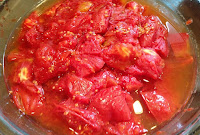
In addition to the traits described above, there are a few other qualities we have selected as part of our breeding population. We include plants that are very late ripening, well into October if the rains hold off. A long counter life is another desirable quality. We have held them on the counter for more than five weeks without the slightest loss of quality, in fact they improve over that time. Disease resistance in an important consideration. Flavor is paramount, though. Every tomato is cooked and tasted before its seeds go from the cutting board to the seed jar. We want a good culinary tomato, not a slicer. It is superb as a dried fruit, as well.

So as you prepare your tomatoes, whether it is this weekend or sometime in October, you will have this mental map of how we approach the fruit. And if you hit a mold locular cavity, know that it is the nature of the beast, a trade-off we accept in our quest for a good sauce tomato.

As a bit of trivia, the tomato Gretl drops in the market of Salzburg is almost identical to the Astiana in size, shape and pleating, though it lacks the lovely green shoulder. The Sound of Music was filmed on location in the summer of 1964, providing a historical reference for this style of tomato that ranges up into Austria. If we had made the connection earlier, we might have been tempted to call our tomato 'Gretl'. (Not really, the green shoulders are missing in the Salzburg rendition.)

NOTE: Here's my technique for roasting these luscious beauties. Or check out the Boutard's recipe for tomato sauce.

* * *

For those interested in obtaining some of these seasonal beauties, Anthony has sent this additional note on Monday, Sept. 5:

"For those who find it hard to travel west to Ayers Creek on the weekends, Rubinette Produce will order 20-pound lugs of Astianas from us upon request. Rubinette will charge $42 per lug if paid by credit card, or $40 by cash/check. Place your order by e-mailing Josh Alsberg, the owner of Rubinette. He will need your order by Wednesday afternoon. He will get his order in to us Wednesday evening so we can harvest and pack the tomatoes for delivery Friday. The tomatoes will be available for a few weeks, weather permitting."

Tuesday, October 06, 2015

Tomatoes Ending…But Don't Toss 'Em!


If you're like me and your visits to the garden to check on your tomatoes are getting more infrequent, before you just give up and plow them under, grab a bowl or basket and pick those tired old bushes clean. I just went out to our back forty and picked enough ripe green Aunt Ruby tomatoes to roast and make two quarts that'll get bagged and frozen to use for something delicious later this winter.

You could also just toss the chopped up unripe tomatoes into a pot, cook them down and run them through a food mill for sauce. Freeze them as is, or put them in the oven at 200° for a few hours to make a paste to flavor all kinds of dishes.

And if I don't get too lazy and remember to do it, I'll make one more trip out before the rains come this weekend. Maybe I can even get Dave to make a green tomato sorbet with some…

Monday, September 14, 2015

Preserving Summer: Tomatoes


The avalanche started in mid-August, and now, in mid-September, it's pretty much over. The onslaught of roasting, bagging and freezing tomatoes that normally takes place in late fall—in posts from 2010-2013 it hit squarely in early October—began, as it did last year, in late August. If that's not enough of a hint about Oregon's "new normal," then just ask the vineyard owners who are experiencing their earliest grape harvest in history.

If you want to grab a box of tomatoes at the farmers' market, you can read about the Ayers Creek Farm method for making the planet's best tomato sauce or check out my lazy cook's version of oven roasted and frozen tomatoes. I'm (most likely) calling it quits with twenty-eight quarts of roasted lovelies resting comfortably in the freezer, so it looks like we're set for most of the coming winter's soups, braises and sauces. As Jackie Gleason used to say, "How sweet it is!"

Saturday, August 29, 2015

Farm Bulletin: Getting Saucy with Tomatoes


In this essay contributor Anthony Boutard of Ayers Creek Farm guides us through the process of making tomato sauce from his most excellent Astiana paste tomatoes, the descendants of an Italian variety, the seeds of which his wife, Carol, dug out of a compost pile during a trip to the Piedmont many years ago. I am a devoted fan of these tomatoes, and plan to freeze about 150 lbs. of them this year using this method. Oh, and Anthony has stated that present company is excepted when he refers to certain food writers. Whew.

We had several questions about making tomato sauce last week. Here are our thoughts. Despite what food writers stress, fully ripe or over-ripe fruit should be avoided for canning purposes, use these in a fresh sauce. (Another calumny of the present crop of food writers is that tomatoes instantly stop ripening when they are picked from the vine. This is absolute nonsense, foolish fussiness from people who are paid to know better but never seem to actually work with fruits, just write about them.) We find the brightest and most flavorful sauce comes from fruit on the near side of ripeness, a diversity of stages produces a more interesting sauce. Avoid the fixation on color; flavor is what counts come January. A high level of acidity assures a bright and flavorful sauce.

Picked at the "nicely pinked" stage…

We resist the Macbeth "boil and bubble, toil and trouble" approach to sauce making. Nothing is gained from the drama of watching and stirring the cauldron, and it leads to time wasted and an over-cooked sauce. (Akin to putting berries one-by-one, never touching, on a cookie sheet prior to putting them in the freezer when it is much easier to put the whole flat in instead.) Cooking does not concentrate the sauce, heat-facilitated evaporation does. Only at the canning stage is a higher heat briefly necessary.

…tomatoes can fully ripen within a couple of days.

We wipe off the whole tomatoes if needed, pierce them a few times with a knife and place them in a big oven pan. Mound them up as they will settle down as they cook, and sprinkle some salt over the top if desired, which helps preserve the color. Put the pan in a slow oven, around 200°F. You can leave them there for hours, or overnight. Periodically, we decant off the "nectar," the amber liquid that drains from the tomatoes. We put this into 1-quart canning jars as a stock for stews and soups. After the tomatoes have fully collapsed, we run them through a food mill. We also can some whole tomatoes.

At this point, the sauce is medium thick, and can be be canned. We also further concentrate some sauce by returning it to the low oven for a day or so. Slowly and gently, it will evaporate and thicken. We find this gentle heat produces a far better sauce than rushing the process over the stovetop flame. Commercial sauces are often made with a vacuum cooker which concentrates the sauce quickly at a relatively low temperature in the range of 180°. Once again, a gentle process but as of yet there are no home kitchen vacuum cookers. The oven method works very well.

Tomatoes roasting in the oven.

We pressure can because, well, we have one, and it is fast and easy. You can also process in a hot bath per standard instructions because these traditional tomatoes are acidic enough. Many people freeze the sauce instead of using a canner. Although we put up over 100 pints of tomato sauce at varying degrees of thickness, we never add anything but salt. We prefer to add seasonings later. Caution applies especially to ingredients that lower the acidity (increase the pH) like peppers. The acidic nature of tomatoes makes them safe and easy to can. Best not to mess with that comfortable margin of safety.

Because Astiana is our own variety and not a precious heirloom or such, we can sell them at $35/20 pounds without shame, and you get the stylish Ayers Creek Farm lug in the bargain. We will have some tomatoes prepackaged and, with a measure of trepidation, accept requests to hold 20# lugs as supply permits. Please email us before 4 pm on Saturday, and we will try to fill requests for 20# lugs only. And don't fret if this isn't the week for you, we will have them for the next few weeks.

Wednesday, August 26, 2015

Garden 2015: Mixed Bag of Tomatoes


Tomatoes this year? A mixed bag. The cherry tomatoes—one Sungold and a black cherry—were prolific, as was a full-sized green variety called Aunt Ruby's. The two Purple Cherokees, on the other hand, were disappointing, both in terms of healthy plant growth and yield. The darker tomatoes are our perennial favorites for their robust flavor and gung-ho willingness to lend a hand for slicing, as well as serving in sandwiches and tomato salads, so we'll probably opt for another variety next year.

A simple sandwich.

Fortunately, though, the farmers' markets and local supermarkets have given us plenty of supplemental, organic "heirloom" tomatoes—a term d'art used to describe not just old varieties, but almost any open-pollinated (i.e. non-hybrid) tomato, whether bred for commercial or private consumption.

Gazpacho.

And consume them we have, from simply sliced on a platter to wedging them between two slices of Dave's homemade whole wheat bread to a snack bowl of cherry tomatoes on the kitchen island, perfect for grabbing as you pass by. There's been cool gazpacho and panzanella, and more of those cherry tomatoes tossed in a grilled corn salad. And of course let's not forget the pasta with cherry tomatoes, garlic and anchovies that's one of our go-to quick dinners.

Tomato salad.

Even after all that, there was a moment when I walked in from the garden with another gallon of cherry tomatoes—we were also watering our vacationing neighbors' tomato plants, which were producing like crazy—and I would have shed some tomato-laced tears, but I remembered a tomato jam (top photo) I made a few years ago.

So if you get to that "too many tomatoes" stage and you've made all the tomato dishes you can think of, and even created a few more out of sheer desperation, here's a simple fix for the problem that you can enjoy any time this winter when the supply of the fresh article has dwindled.

Tomato Jam
Adapted from Mark Bittman for the New York Times

1 1/2 lbs. good ripe tomatoes(Roma are best), cored and coarsely chopped
1 c. sugar
2 Tbsp. freshly squeezed lime juice
1 Tbsp. fresh grated or minced ginger
1 tsp. ground cumin
1/4 tsp. ground cinnamon
1/8 tsp. ground cloves
1 tsp. salt
1 jalapeño or other peppers, stemmed, seeded and minced, or red pepper flakes or cayenne to taste.

Combine all ingredients in a heavy medium saucepan. Bring to a boil over medium heat, stirring often. Reduce heat and simmer, stirring occasionally, until mixture has consistency of thick jam, about 1 hour 15 minutes. Taste and adjust seasoning, then cool and refrigerate until ready to use; this will keep at least a week. [I put them in clean, lidded glass jars and freeze them. - KB]

Yield: About 1 pint.

Thursday, August 20, 2015

Essential Tomato Recipe: Gazpacho


I share contributor Jim Dixon's recipes here for a couple of reasons, one being he's a really fine writer, but the other is that his (literally) down-to-earth approach to cooking with the best of the season's bounty is simple, unfussy and always delicious. This week, one of my all-time tomato season faves, gazpacho.

Gazpacho Sevillano

Julia Moskin's article about the gazpacho of Seville appeared in the New York Times on July 28 when the temperature here in Portland was bumping up to triple digits. I probably wasn't the only one who connected a tall glass of cold tomato goodness with the overloaded plants in my backyard. I've made her Seville-style gazpacho a couple of times since, and it's not just great a good way to use up an abundant harvest; it's delicious. Drink it on its own or serve a piece of grilled fish in a pool of the creamy gazpacho.

Follow her recipe if you like, or just wing it. This much will make a full blender: 5 to 6 medium tomatoes, 1 small cucumber (peeled if one with a thick, waxy peel), 1 Anaheim or similar green pepper (not a green bell), half a medium onion, 2 cloves garlic. Cut into rough chunks, put the tomatoes in first (they'll liquify quickly and pull in the the other stuff), add a shot of good vinegar (Katz apple cider, sparkling wine, or red wine), a few pinches of sea salt, and blitz until very smooth. Then add a lot (1/2 cup at least) of extra virgin while the motor is running. Chill or serve with ice, and add a little water if it's too thick to drink easily.

Moskin calls for straining out any solids, but don't bother. You want all that fiber, and it's just another thing to clean. And while a blender works best, your food processor can do the job. But do serve it in a glass.

Saturday, July 25, 2015

How Panzanella Solved My Bread Problem


I have a bread problem. Not that many people would feel much sympathy for my situation. You see, my husband has become a bread maven. He might even be tiptoeing along the edge of evangelism, such is his passion for his newfound calling. At least twice people have shown up at our doorstep to be shown "the way"—actually Chad Robertson of Tartine Bread's way—of producing perfect artisan loaves in a home oven.

How could this be a problem?

Now, in his defense, I have to say I've been encouraging this discipleship every step of the way. The guy has a definite touch with flour, water and salt, and when you throw in a natural tendency toward tinkering plus a creative bent, that's pretty much the definition of a baker. So every two weeks for quite awhile now he's been making six loaves of sourdough, interrupted only by a trip out of town or summer temperatures soaring into the 90s.

Our five-year-old nephew spent the night last week, and his first question before being taken to daycare the next morning was, "Does Uncle Dave have any bread I can take with me?" He was comforted only by the promise that yes, indeed, Uncle Dave would bake bread for him in a couple of days. Oh, the obligations!

A perfect (and delicious) solution.

So the problem comes when one of those loaves is brought to the bread board. Being artisan-style loaves, when sliced there's always the rounded bit at the end that ends up, if it's not eaten immediately, sitting on the board and getting stale. Big deal, you say. But multiply that over dozens and dozens of loaves and you've got quite a pile of bits.

I've been chopping them up into cubes, drying them completely and then freezing them in bags, but I just don't make that many croutons for salads. And I utterly refuse to toss them out—there's nothing worse than wasted bread karma, believe me.

Then the other day, needing to make a salad for dinner and having some ripe, heirloom tomatoes on hand, I hit on the perfect solution: panzanella! I don't think of it often, since it needs tomatoes that only come at this time of year, perfectly ripe, not-too-hard, not-too-soft and terrifically flavorful. And I wasn't sure the rock-hard cubes would absorb enough of the juices to soften up to just the right consistency.

But I threw it together anyway, chopping up a little cucumber and some basil from my neighbor who couldn't use all that was in her CSA share. And you know, those dried crusty bread ends turned into luscious tomato juice bombs and solved my bread problem, at least for the duration of tomato season. What could I say but hallelujah!

Panzanella, Italian-Style Tomato-Bread Salad

For the dressing:
1/4 c. red wine vinegar
2/3 c. olive oil
2 cloves garlic, pressed through a garlic press or minced fine
1 tsp. salt

For the salad:
4 c. bread, 2 or 3 days old, cut into 1/2” cubes
4-6 c. tomatoes, chopped in 1/2” cubes
1/2 c. basil, sliced into chiffonade
1/2 red onion, finely chopped
1 cucumber, peeled and seeded, cut into 1/4” cubes
1/2 c. kalamata olives, pitted and chopped (optional)
Salt to taste

In medium mixing bowl whisk dressing ingredients together. Set aside.

Put salad ingredients in a large salad bowl. Pour dressing over the top and combine thoroughly. Allow to stand 20-30 minutes before serving (an hour if the bread is very dry), mixing occasionally to distribute the juices.

Sunday, December 28, 2014

Need A Quick Dinner? Pasta Arrabiata Fills the Bill


Pasta seems to be the first thing I think of when we need a quick and hearty dinner, whether it's bacon carbonara or sausage and garlic or a quick toss with a sauté of whatever's lingering in the vegetable bin. After all, boiling a pot of water takes no time at all, and a sauce can be made in the time it takes the pasta to cook.

A few weeks ago I got a big bag of dried Aci Sivri peppers (left) from Ayers Creek Farm at the Hillsdale Farmers' Market. It's a cayenne-like, long red pepper that originated in Turkey that gives a moderate kick when ground fresh. I'd been wanting to make an arrabiata sauce with them and some of the tomatoes I'd roasted and stashed in the freezer last summer, so one night when we needed something fast—okay, okay, I'd been sucked into the vortex of the internet and looked up to see it was frighteningly close to dinnertime—I decided it was the perfect time to give it a whirl.

Pasta Arrabiata

As mentioned above, I used the fabulous tomatoes I'd roasted and frozen the summer before, but while this recipe would work with any canned tomatoes, since there are so few ingredients, the tomatoes play a key role in the flavor of the final dish and it'd be worth using the best quality you can get. The amount of pepper will vary depending on the type of pepper used. Start with a little and add it to the sauce gradually until it suits you.

1 lb. dried pasta
2 Tbsp. olive oil
3 c. roasted, puréed tomatoes
2 Tbsp. minced garlic
1 tsp. freshly ground dried hot red pepper (or to taste)
Freshly grated parmesan

Bring a large pot of water to boil. While the water heats, place the oil in a medium skillet over moderate heat until it shimmers. Add the garlic and sauté briefly to warm it (watch that it doesn't brown), then add the tomatoes and red pepper. Bring to a simmer.

When the pot of water boils, cook the pasta till al dente, then drain and place in a serving bowl. Add the sauce and toss. Sprinkle with parmesan and serve with more parmesan in a small bowl on the table.