Showing posts with label New York Times. Show all posts

Monday, November 27, 2017

My Kimchi Quest: First Try and Kimchi Fried Rice


I've finally decided to get over my fear of fermentation, that nagging worry that I'm going to kill my family with a deadly bacteria, or at a minimum have glass shards and vinegary vegetables blown all over my kitchen. (Is it any wonder my superpower is coming up with the worst case scenario for any and all occasions?)

Korean kimchi crocks.

But with assurances from experienced friends that neither of those outcomes was likely, and with one quick experiment under my belt—a shrub, or drinking vinegar that my neighbor Bill shared with me—I've decided to tackle kimchi, the ubiquitous pickled and red-peppered cabbage dish found at every meal in Korea. My goal is to make a kimchi similar to the one I had as a foreign exchange student in that country, made by my host mother and stored in earthen crocks on the flat roof of her home.

Kimchi ingredients.

I've found a commercial one that's very reminscent of hers, the Napa Kimchi made by Choi's Kimchi, a local company that began when founder Chong Choi took his kimchi, which he'd been making for his family and sharing with his neighbors, to sell at the farmers' market. Starting with that profile, for my recipe search I decided to start slow, with a super simple recipe by Julia Moskin of the New York Times that she adapted from Tart and Sweet by Kelly Geary and Jessie Knadler.

While it worked like a charm—No death! No explosions!—and was quite delicious, it's not as spicy or quite as vinegary as my Korean mother's (or Choi's). So I'll keep looking for recipes that will measure up to those fond and drool-inducing memories.

Kimchi, and lots of it!

In the meantime, these experiments mean that I've got jars of the pickled, cabbagey Korean condiment resting comfortably in my fridge. Julia's recipe produced about three quarts or so of the stuff, and since my family isn't in the "let's have kimchi for every meal" groove, in order to clear space for the next batch I've had to come up with some creative uses for it.

This kimchi fried rice recipe is cobbled together from several online sources and is terrific all on its own or when combined with various proteins—think tofu, leftover chicken, even seared slices of beef. You can cook up the rice just for the recipe, but if you have leftover rice sitting in the fridge, I think it actually works better.

And I'll keep you updated on my quest for that kimchi of my dreams!

Kimchi Fried Rice

2 Tbsp. vegetable oil
1/2 c. bacon, chopped
1/2 large yellow onion, chopped fine
2 Tbsp. garlic, minced
2 c. kimchi (with juice)
2 c. enoki mushrooms (or other mushrooms)
4 c. cooked jasmine rice
1-2 Tbsp. sesame oil, to taste
1 Tbsp. fish sauce, to taste
2 Tbsp. gochujang, to taste (available at Asian or specialty grocers)
Salt, to taste
4 eggs

In large skillet or wok, heat vegetable oil over medium-high heat until it shimmers. Add bacon and sauté until it starts to render its fat. Add onions and sauté till tender. Add garlic and stir to warm it, then add kimchi and mushrooms. Sauté until tender. Add rice and sesame oil and combine well. When it’s warm and starting to stick to the bottom of the pan, taste it for seasoning and add fish sauce and gochujang, as well as salt, if desired.

When ready to serve, fry eggs separately in a bit more vegetable oil, keeping yolks soft and runny. Put the fried rice in a bowl and top each serving with a fried egg (or two).

Serves four.

Photo of kimchi crocks (onggi) from Wikimedia.

Friday, September 15, 2017

Setting a Big Table: Oregon Wine Comes of Age


In a recent edition of the New York Times, wine editor Eric Asimov waxes poetic about Oregon wine, saying that "Oregon is right now the single most exciting winemaking area in the United States," that "nowhere else does the level of quality seem so high, the perspectives so diverse or the experimentation so fierce as it is in Oregon right now." He goes on to extoll several of our best winemakers, especially Brian Marcy and Clare Carver of Big Table Farm. Here's an article I wrote about them seven years ago. Nice that Mr. Asimov has caught up!

* * *

Clementine, the Catahoula leopard hound, has been anxious since dawn, not wanting to be too far from her owner, Clare Carver of Big Table Farm. Clare has been moody for the last couple of days. Even Clare’s husband, Brian, has been giving his wife a wide berth. When Clare goes up to the hill pasture to sit with her pigs, Picnic and Pancake, Clementine stations herself with a good view of the road. She knows something is coming, something that is making Clare sad, and she wants to be ready.

Clare Carver sits in the pen with her pigs, scratching their backs when they lean their 300-pound bodies against her, snorting and squinting in the bright sunlight. Like a couple of big dogs, they dash off to play with each other or to chase something in the bushes or to root through the grass in the pasture, but eventually they come back to get more attention from Clare. She's raised them from tiny weaner pigs, and today is their last day.

An inspired painter whose subjects are the cows, horses, chickens, goats, pigs, old trucks and tractors that populate the farm she owns with her husband, Brian Marcy, in Williams Canyon outside Gaston, Oregon,she also has a large vegetable garden that supplies most of the couple’s food and the large farm dinners they host for people who buy the wines Brian makes under the Big Table Farm label.

Growing up in a large Catholic family (she has eight brothers and sisters), Clare heard stories about the farm in upstate New York that her parents had bought in the late 50s. They sold the farm when Clare was seven and moved their large family to the suburbs of Valley Forge, Pennsylvania.

She carried those tales of the farm with her into her career as an advertising art director for an East Coast ad agency, and one day a consultant for the agency told her, “You need to go out and see the world. You shouldn’t be doing this because your life is going to look exactly the same in ten years as it does now.”


“It was a complete wake-up call,” Clare said. She sold all her belongings and moved to San Francisco to start her own business. Shortly after the move she began dating Brian, who was transitioning to making wine after working for several years as a beer brewer.

“With beer, the whole goal is to take varying inputs and make the same product year in and year out without considering season or ingredients,” she said. “In wine it’s just the opposite, where people expect the product to be affected by season and ingredients. It felt more creative to him.”

Their move to Oregon was prompted, oddly enough, by a season spent harvesting grapes in Australia.

“It was a really romantic time for us and we started looking around at the land,” she said. “Honestly, that was the first time it started to creep into our consciousness that we could have a farm as well as have a winery.”

Their requirements for their farm were fairly simple: It had to be within an hour of a big city so Clare could continue her graphic design business, it needed to be located in a wine-producing area so Brian could be a consulting winemaker while developing their vineyard and, of course, it had to be within their budget.

The farm they found in 2006 fit their list to a T: Close to Portland, it was in the middle of a burgeoning wine region. It had perfect southeast facing hills and a charming Victorian farmhouse. Their bid was accepted.

“We didn’t really know anything about farming, and we read ‘The Omnivore’s Dilemma’ by Michael Pollan when we were closing on the property,” Clare said. “It totally changed the way we thought we were going to set up our farm.”

While the book is mostly about what Pollan believes is the broken food system in the United States, where people are disconnected from the sources of their food, he also writes about a visit to Polyface Farm in the Shenandoah Valley and farmer Joel Salatin. Salatin calls himself a “grass farmer” and believes in rotating the animals on the land to keep the soil and the plants, and thus the people who eat the animals and plants, healthy.

With Salatin’s principles in mind, they’re transforming the nearly ruined hillsides and pastures of their Big Table Farm to an organic, balanced system. Brian made a trailer, called the “chicken bus,” to transport their laying chickens from one area to the next. Goats clear blackberries and scrub, watched over by a “guard llama” who challenges any predators who get too close. The cows, pigs and Clare’s beloved draft horses are confined by electrified tape that can be easily moved when the pasture needs a break from grazing.

When Salatain made a trip to Oregon, she asked him about organic feed, an important part of the system at their farm.

Salatin’s answer? “People can handle nudists and they can handle Buddhists, but they can’t handle nudist Buddhists.

“What he was saying is that people can handle the concept of pasture, they can get their head around that. But when you start talking about pasture and then you start talking about organic feed, they hold their heads and scream.”

She told Salatin that while that might be the case in his home state of Virginia, she felt that Northwesterners were able to handle that kind of information. Like the fact that she flat out refuses to send any of her animals to processing facilities to be slaughtered.

“The primary reason is because of the stress on the animal,” she said. “The stress and the adrenaline that goes through the animal changes the meat, and there’s hard science behind that.”

Take pigs, she said. They’re very smart and sensitive, so when they’re put into a truck for the first time in their life, it’s terribly stressful. And a pig’s sense of smell is even keener than a dog’s.

“Can you imagine what a processing center smells like to a pig?” she asked. “It makes my hair stand up just to think about it. Those poor animals.”

Because strict federal regulations require any meat that is sold to the public has to be processed in a USDA-approved facility, the meat from her pasture-slaughtered pigs can’t be sold in supermarkets or at farmers' markets. This is despite the growing demand for just the kind of pasture-raised meat she and other small-scale farmers in the region are producing.

With small processing plants closing down because of the recession, it’s hard for small producers to get their animals into larger slaughter facilities. With just a handful of USDA-approved mobile slaughter trucks in the entire Northwest, there isn’t one available for Clare’s farm.

Which brings us back to Clementine standing watch and Clare waiting with her pigs in their hillside pasture. When the truck from Frontier Custom Cutting finally pulls into the driveway in the late morning, Clemmie starts barking. She won’t stop until it leaves.

Richard, a burly man wearing orange rubber overalls and carrying a black rifle, walks up the hill. While Clare distracts Picnic with some fresh eggs, Richard puts the rifle behind Pancake’s ear and pulls the trigger. Then he walks over to Picnic munching on her egg and does the same.

Clare feels it’s the most respectful way to kill them.

“The bullet goes right to the spinal cord, but their heart is still pumping, so they’re essentially brain dead,” she said. “It’s a little violent but it doesn’t last very long. That part is the part I hate to watch, but dying is dying and it’s not pretty. It is what it is.

“I really hope when it’s my time I get afforded a respectful, quick death,” she added. “That’s what I would want. So I do the best I can for my animals in that sense.”

And each time she allows herself to feel the loss.

“It’s the way you feel when a human dies. They’re gone…really gone,” she said. ”I go out to their pasture the next day and I’m like, oh, they’re gone. It’s a reminder of how much power we have and how careful we have to be of that power, that we just created and took this life.

An observer could note that, in the way they run their farm and raise their animals, she and Brian haven’t chosen an easy route. And, like the move to Oregon and buying the land, it’s all been done without a business plan.

“If we had a business plan some things might be smoother for us,” Clare said. “But, like anything in life, it’s like, ‘Well, I’m going up that hill and maybe I’m not going to take the straightest path. But maybe I’m going to see some things I didn’t expect if I don’t have an exact map of how I’m going to get there.

“Sure, if we had a business plan we might get to the top of the hill faster,” she continued, “but we’re still going up there because we have the same goals and that hasn’t changed. Or if it does, we talk about it and we change it together.”

Asked about the best part of their lives on Big Table Farm, she thought for a moment, then answered.

“Almost every morning when I do chores I look around and this incredibly deep sense of satisfaction strikes me,” she said. “Being deeply happy with this path we’re on now.”

Top photo by Amanda Lucier for the New York Times.

Sunday, November 20, 2016

The Future of Our Food: New York Times Looks West


The New York Times panel described below was held on October 5, 2016, a month before the recent election, but brought out some key insights that I hope to explore in future posts in this series. Installments over the next few months will include interviews with farmers, food activists, plant breeders and policy wonks to try to get a handle on the seismic shift in our local food landscape due to the change of administrations in Washington.

The New York Times has been fascinated with Portland for years now, featuring it as a travel destination, for sure, but mostly focused on watching its food and restaurant scene evolve from a backwater of middle class meh to a powerhouse of groundbreaking local, seasonal, chef-driven cuisine. In its own transition from a national newspaper to a national media corporation, the Times has been expanding its New York-centric, issues-based series called Times Talks to a more national platform.

Recently it brought this form of live journalism to Portland, sending out Times national food correspondent Kim Severson to moderate a panel titled "The Future of Food in Portland.” The panel featured local food notables Piper Davis of Grand Central Bakery; Kanth Gopalpur of the Business Oregon Commission; chef Joshua McFadden of Ava Gene’s and Tusk; and Amanda Oborne, Vice President of Food and Farms at Ecotrust.

In an interview before the event I asked Severson why the Times chose to come to Portland.

"I’m just fascinated with where Portland is going to go now," she said. "Because [the city] got really cute and we all fell in love with it. Portland was like a really attractive 20-year-old college sophomore with a great life. But now what?"

Echoing that question after introducing her panelists, she opened the discussion asking if it wasn't time for Portland to mature a little bit.

"It all goes back to Colin the chicken," Piper Davis answered, referring to a much-joked-about sketch on the TV series "Portlandia" where two foodies pester their server with questions about their entrée. "Those of us who care where our food comes from can no longer ask that question." Instead, she said, the concern has shifted in her mind: Did this food leave the soil in better condition than it started?

"Major problems still need to be solved," she continued, saying that the national perception is that most of the work is done, when in reality people aren't talking about the gaps in the food system when it comes to the environment, sustainability and universal access to good food regardless of income or where a person lives.

Severson then turned to Josh McFadden and asked him about the city's "cheffy culture," asking how its Olympic-level chef game will affect Portland's producer-driven reputation.

Answering that he initially moved back to Portland from stints in San Francisco, Chicago and New York because of the people more than the food scene here, he said he found that "the product is as good or better than anyplace else," and that local farmers like Anthony and Carol Boutard of Ayers Creek Farm and John Eveland and Sally Brewer of Gathering Together Farm are producing innovative crops at the highest level.

Severson herself is no stranger to the Northwest, having lived in the region and worked for newspapers in Seattle, Anchorage and right here in Portland during a short stint at the Oregonian.

In our interview I asked what differentiates the Northwest and its food from that found in the rest of the country. She paused.

"There’s just something about the mix of the ruggedness of the place and the purity of the raw ingredients here," she said. "The most memorable things I’ve eaten come from the Northwest."

She added that when she was working in Alaska she got sick of salmon, referring to it as "the zucchini of Alaska." But having been away for decades now, and with wild-caught salmon a rare thing to find on the East Coast, she had an epiphany.

"Last night [at a Portland restaurant] I had a beautiful, perfectly seared piece of wild salmon," she said. "It was like heaven to me and, especially on the East Coast, the beauty of wild salmon—I know it sounds so cliché and terrible even as I’m saying it—but it’s spectacular."

Bottom line?

"I think your baseline of deliciousness is very high here," Severson said. "Your baseline, how good food that grows around here tastes, I think that’s exceptional. Exceptional."

In the South, where Severson is now based, she said, "There’s some really great produce, but it’s so crazy hot it’s tricky to grow stuff there. But there’s something very clean about it here that other places don’t have. There’s a freshness here that makes it super special to me."

Any Portland cook can tell you that freshness also has a lot to do with the proximity of local farms to the city's core, a point that was brought up by Grand Central's Piper Davis.

"No one talks about the urban growth boundary and food, but it's critically connected," Davis said of the line drawn around the city in 1980 as a land use planning boundary to control urban expansion onto farm and forest lands.

Amanda Oborne of Ecotrust, tasked with developing The Redd, an effort in inner Southeast Portland's former produce district designed to support local food enterprises, said that Portland is a city of innovators and, as with the urban growth boundary in the '80s, is still experimenting with ideas to provide services to make food more accessible and sustainable.

"The Redd is not about the food scene, it's about the food system," she said of what is envisioned as a working hub for the regional food system.

It's an idea that Severson echoed in our interview as a distinguishing characteristic of the city.

"The ability to make things happen in this city, foodwise, the potential [that] if you have an idea you can probably make it happen, is exciting," she said, attributing it to both the city's size and its culture.

"There’s not a lot of people who say no here," Severson mused. "It’s a function of size, of culture and people who are, like, 'Huh, you wanna like have a chicken-powered ancient grain mill and coffee shop? That could be cool.'"

One thing that surprised her, in a city so well known for its food culture, is that there is no food council here to direct, support and develop food policy for Portland, Multnomah County or the metro region. [The now-defunct Portland/Multnomah Food Policy Council served as a citizen-based advisory board to the City of Portland and Multnomah County from 2002-2012 and was dissolved in 2012 due to "lacking relevancy."]

As to the future, Severson seemed of two minds about where the Northwest is headed. "You certainly saw Berkeley get very popular, [but] San Francisco and Northern California cuisine is very hidebound," she said of larger West Coast cities known for innovation in the past but hampered by stagnation and the cost of doing business there. "Maybe Portland can do it differently."

Read the first installment in this series: Post-Election Pondering.

Top photo from The New York Times: (l to r) Josh McFadden, Kanth Gopalpur, Kim Severson, Amanda Oborne, Piper Davis.

Friday, September 25, 2015

Food News: Perdue, Carcinogens, Academia for Sale


Perdue Farms, the 800-pound gorilla of the poultry business, has bought the Niman Ranch brand in a move that's seen as its "transformation into one of the largest suppliers of premium meats," according to an article in the New York Times. You may recall that, in 2013, Perdue bought the assets of Washington state's Draper Valley poultry brand in a bid to expand into the "natural" and "organic" arena.

It was way back in 1969 that Bill Niman moved from Minnesota to California to accomplish what a rock anthem  of the time urged: "Got to get back to the land and set my soul free." Starting with a few pigs, goats and chickens, he gradually switched to raising cattle. When the property was bought by the State of California for a cool $1.3 million to make Point Reyes National Seashore, he began production in earnest, marketing his "natural" beef under the Niman Ranch label and taking on investors.

In 2007, Niman left the company in a dispute with his partners over the changes they were making in the animal husbandry protocols he had established. He returned to raising cattle on pasture and without the use of hormones and antibiotics under the new BN Ranch brand. (He was contractually prevented from using his own name on the new brand.) How the sale to Perdue will affect the Niman Ranch business, and its reputation, is a matter of speculation.

* * *


In a "notice of intent" issued in early September, California's Office of Environmental Health Hazard Assessment (OEHHA) has said it plans to label glyphosate, an agricultural herbicide and the main ingredient in Monsanto's Roundup, as a chemical "known to the state to cause cancer."

In addition, an article in the East Bay Express noted that research by the World Health Organization (WHO) recently found that glyphosate "is probably carcinogenic to humans" and linked it to "the steep decline of monarch butterflies." It also reported that there are "new alarms about potential negative health impacts tied to Roundup," including a recent study suggesting that "long-term exposure to tiny amounts of the chemical (thousands of times lower than what is allowed in drinking water in the US) could lead to liver and kidney problems."

So if you're walking down the street with your dog and notice your neighbor out with a sprayer attached to a jug of the stuff, maybe cross the street and avoid that place in the future.

* * *


And in more Monsanto news, this time about its products that contain genetically modified organisms (GMOs), the New York Times reports that—no surprise here— the company has been paying off academics to say nice things about them. The article said that an e-mail the company sent to an academic researcher gushed that "professors/researchers/scientists have a big white hat in this debate [about GMOs] and support in their states, from politicians to producers. Keep it up!"

In what it calls "a billion-dollar food industry war," companies like Monsanto and, to a much lesser degree, even some organic food industry companies have funded academic research to try to sway public and political opinion in their direction.

It quotes one academic as saying, "They want to influence the public. They could conduct those studies on their own and put this information on their website. But nobody would believe them. There is a friggin’ war going on around this stuff. And everyone is looking to gain as much leverage as they can."

Photo of a field of genetically modified canola in Washington County in Oregon.

Thursday, August 20, 2015

Essential Tomato Recipe: Gazpacho


I share contributor Jim Dixon's recipes here for a couple of reasons, one being he's a really fine writer, but the other is that his (literally) down-to-earth approach to cooking with the best of the season's bounty is simple, unfussy and always delicious. This week, one of my all-time tomato season faves, gazpacho.

Gazpacho Sevillano

Julia Moskin's article about the gazpacho of Seville appeared in the New York Times on July 28 when the temperature here in Portland was bumping up to triple digits. I probably wasn't the only one who connected a tall glass of cold tomato goodness with the overloaded plants in my backyard. I've made her Seville-style gazpacho a couple of times since, and it's not just great a good way to use up an abundant harvest; it's delicious. Drink it on its own or serve a piece of grilled fish in a pool of the creamy gazpacho.

Follow her recipe if you like, or just wing it. This much will make a full blender: 5 to 6 medium tomatoes, 1 small cucumber (peeled if one with a thick, waxy peel), 1 Anaheim or similar green pepper (not a green bell), half a medium onion, 2 cloves garlic. Cut into rough chunks, put the tomatoes in first (they'll liquify quickly and pull in the the other stuff), add a shot of good vinegar (Katz apple cider, sparkling wine, or red wine), a few pinches of sea salt, and blitz until very smooth. Then add a lot (1/2 cup at least) of extra virgin while the motor is running. Chill or serve with ice, and add a little water if it's too thick to drink easily.

Moskin calls for straining out any solids, but don't bother. You want all that fiber, and it's just another thing to clean. And while a blender works best, your food processor can do the job. But do serve it in a glass.

Wednesday, July 29, 2015

Want a Thrill? Chuck Your Grill


It was one of those food articles designed to attract attention: a photo of a giant steak sitting on a pile of fiery coals, like someone just had their worst grilling nightmare come true. "Uh, honey, you know that $300 porterhouse your dad bought for me to grill for their 50th anniversary…?"

Kind of scary looking, isn't it?

The article in the New York Times by brothers Matt and Ted Lee described the way that restaurateur Tim Byres is cooking steaks in his Texas restaurants. It quotes Byres as saying, "I heard a rumor of Ike [President Dwight Eishenhower] grilling these really thick four-inch sirloins." Byres "tracked down a 1953 article in The Miami Daily News that confirmed his hunch: Eisenhower, it said, 'rubs the steak with oil and garlic and then, as the horrified guests look on, casually flings the steak into the midst of the red and glowing coals.'"

This is the way a steak should look!

As you can imagine, this was more than enough to get Dave's grilling juices flowing, and he declared then and there that he needed to attempt this flaming feat with our trusty Weber. Deciding that it might be better to start conservatively rather than potentially incinerating a hundred bucks worth of cow flesh, we bought a couple of nice grass-fed New Yorks from Old Salt and got the fire started.

For this initial experiment we decided to go by the book and use Byres' chile and coffee dry rub from the article, coating the meat generously on both sides. Per the article and his own preference, Dave used hardwood charcoal in the chimney and dumped it out when it was white and ashy, then waited until the flames died down.

A nigh perfect meal.

Putting the meat on the coals was tricky, since the coals were pretty lumpy and uneven, but down went the steaks. Immediately they were enveloped by some pretty hefty flames, so we put the lid on the grill to smother the fire and provide some smoke. After a couple of minutes they were turned over and the lid replaced, and in two more minutes we pulled them off. Crusty and black, they looked a little scary on the outside but a check of the interior temperature with our trusty instant-read thermometer said the interior was perfect for rare steaks. Whew!

A few minutes resting under tin foil was all I could stand, and when I sliced into them it was astounding to see that rosy red, warm meat under the dark outer shell. And delicious…it was one of the best steaks we've ever had here, though a quibble is that the coffee in the rub somewhat overwhelms the subtler flavor of the grassfed beef. But now I'm jonesing to try a slightly bigger, if not Brobdingnagian, hunk of meat using Ike's method. I think we might like it.

Thursday, April 16, 2015

Fabulous Roast Chicken with Apologies to Sam Sifton


I don't know if this is true of other cooks, but I can't seem to follow a recipe to save my life. Even though I consider myself a recipe-dependent cook rather than one of those people who, like my friend Denise, freestyles her way through ingredients, following her intuition to come up with creative, fabulous meals.

This entire blog is a testament to my need for guidance, chock-full as it is of favorite recipes gleaned from family dinners and camping trips, or—ssssshhhh…don't tell!—stolen from friends. So the other day when I was browsing through the New York Times magazine and saw a gorgeous photo of a dish of roasted chicken legs, I had to stop and check out the recipe.

The article, by the Times' food editor, Sam Sifton, whose writing I find pretty irresistible, clever without being one of those "Look at me! Look at me! I can do a double flip!" food writers, was an interview with the designer Steven Stolman. He'd first had the dish, called Roasted Chicken Provençal, as a college student in New York.

Sifton wrote, "the chicken was seasoned with spices meant to evoke the flavors of southern France: rosemary, thyme, bay leaf, lavender, marjoram, chervil, sage. It all seemed exotic and wonderful to Stolman, a child of the Hartford suburbs and new to Manhattan. 'I thought it was the coolest thing,' [Stolman] said. The dish and the evening left an impression on him that has lasted for almost 40 years."

A couple of paragraphs later Sifton wrote, "it is still the coolest thing: chicken dusted in flour and roasted with shallots and lemons and vermouth under a shower of herbes de Provence until it has gone crisp above the fat and wine and lemon juice, and the shallots are melted and sweet."

It's a dead simple recipe, and with my crazy love of roasted chicken it seemed like a natural for a test run. And that's where I went ever-so-slightly off the rails. You see, I had almost everything the recipe called for…except shallots. Hm. While it sounds like they're pretty crucial to getting the dish just right, I've also cooked enough chicken to know that shallots aren't a make-or-break ingredient.

So I decided to throw in a few extra garlic cloves and call it good. Then I saw a half-full basket of cherry tomatoes left over from a vinaigrette I'd made a couple of days before sitting on the counter. Those'd be good, too, and still keep it in the Provençal theme. Pulling the chicken out of the fridge my eyes fell on a dozen or so leftover oil-cured olives. They're Mediterranean, too, right?

Except for those "tweaks," if you can call it that, I pretty much made the chicken as originally intended and it was indeed as wonderful as advertised. Like Stolman, I'll definitely make it again and probably serve it to company. Maybe I'll even follow the recipe.

Roasted Chicken Provençal (Kind Of)

4 chicken legs or 8 bone-in, skin-on chicken thighs
2 tsp. kosher salt
1 tsp. freshly ground black pepper
1/2-3/4 c. all-purpose flour
3 Tbsp. olive oil
2 Tbsp. herbes de Provence
1 lemon, quartered
8-10 cloves garlic, peeled
1 1/2 c. cherry tomatoes, halved
1 dozen or so oil-cured olives, pitted and halved
1/3 c. dry vermouth

Preheat oven to 400. Season the chicken with salt and pepper. Put the flour in a shallow pan, and lightly dredge the chicken in it, shaking the pieces to remove excess flour.

Swirl the oil in a 9” by 12” pyrex roasting dish, and place the floured chicken in it skin-side up. Season the chicken with the herbes de Provence. Arrange the lemons, garlic cloves, cherry tomatoes and olives around the chicken, and then add the vermouth to the pan.

Put the pan in the oven, and roast for 25 to 30 minutes, then baste it with the pan juices. Continue roasting for an additional 25 to 30 minutes, or until the chicken is very crisp and the meat cooked through.

Serve in the pan or on a warmed platter.

Friday, May 09, 2014

Breakfast for Dinner: Craving Spring Things


Let's face it: Spring is all about sex. Call it reproduction, fertility or, to use Anthony Boutard's favorite word, fecundity, nature is having a field day making more of itself. Hens start laying eggs again, little green things (weeds included) are popping out of the bare earth and farmers are finally able to get out in their fields to plant crops, muddy and clumpy though those fields may be.

Chorizo and spring vegetables…yum!

I've been longing for spring things lately, especially after a winter diet of root vegetables and winter greens, and my freezer is looking mighty empty since we've cleaned out most of the roasted tomatoes, lamb, pork and beef I crammed into it last fall. Luckily the farmers' market season is roaring back to life now, so it's easy to satisfy my craving for these first sweet sproutings.

Homemade sourdough cubes, natch!

With that in mind, a recent article by David Tanis in the Dining section of the New York Times about a Spanish dish of eggs and spring vegetables piqued my interest. Called revueltos or huevos revueltos, it basically means scrambled eggs and usually includes vegetables of one sort or another. Often found at tapas bars or served as a light supper dish—my fondness for these "breakfast for dinner" dishes is longstanding—the one that Tanis shared featured asparagus and bread cubes toasted in olive oil and garlic.

I happened to have picked up a couple of bunches of asparagus at the mid-week Shemanski market from Leslie at Viridian Farms, and had about half a bunch of green garlic left over from an earlier trip. Dinner was still an open question and I'd just replenished the egg supply, so I decided to follow the seeming synchronicity and give the dish a whirl.

Needless to say, and anyone who's made a frittata, quiche or even an omelet can attest, it was simple, quick and delicious. Perfect for a spring supper!

Revueltos (Scrambled Eggs) with Green Garlic and Asparagus
Adapted from David Tanis

Olive oil
2 peeled garlic cloves
2 c. dried bread cubes, cut in 1/2" cubes
3 oz. diced Spanish chorizo*
1 bunch asparagus, about 1 1/2 lbs., sliced in 1" lengths
1/2 bunch green garlic, sliced in 1" lengths
8 large eggs, beaten
1/2 tsp. Spanish pimentón (smoked paprika)
Salt to taste

Heat 3 tablespoons olive oil in a large non-stick skillet (or well-seasoned cast iron pan) over medium-high heat. Add peeled garlic cloves and let them sizzle until lightly browned, then remove. Add bread cubes, lower heat to medium and gently fry until lightly browned and crisp, about 2 minutes. Remove bread and set aside to cool.

Add chorizo and fry lightly. Add asparagus and green garlic and stir-fry until cooked through but firm, 3 to 4 minutes. 

Reduce heat to low. Add pimentón to eggs. Pour eggs into skillet with vegetables and cook, stirring with a wooden spoon, just until soft and creamy, 2 to 3 minutes. Top with bread cubes and serve in the skillet, or transfer eggs to large serving bowl, topping with bread cubes, and serve immediately.

This would also make a great breakfast or brunch dish.

* I used my friend Paul Bertolli's Fra'Mani Chorizo Pork Sausage.

Wednesday, January 09, 2013

On the High Wire with a Big Hunk of Meat


I've always had a certain fear of large hunks of animal flesh.

I know, I know…you're thinking, "But Kathleen, weren't you just butchering half of a pig (your second) just a couple of weeks ago? Wazzup?"

Herb marinade ingredients.

So I guess I should modify my phobia: my fear is cooking a large hunk of animal flesh and ruining it. And there's nothing like eight-plus pounds of gorgeous standing rib pork roast to make my knees start knocking. Add in the fact that it was the main course for Christmas dinner with company and you've got the makings for a world-class disaster, one I'd never hear the end of.

"Remember the time you practically burned down the kitchen and ruined Christmas dinner?" The words echoed in my head.

All dressed and ready.

Then there was the fact that I'd decided to use a recipe for a fennel, lemon and herb marinade I'd read in the New York Times. Problem was, Melissa Clark, whose recipes I like and trust, had used it on a crown roast, not a standing rib. So aside from the rub itself, all her other sage advice about how to make it the crowning achievement (no pun intended) of the dinner was pretty much useless.

I nevertheless forged ahead, pulled the roast out of the freezer in plenty of time for it to thaw, made the rub and got it marinating on Christmas morning. Dinner was scheduled for evening—we're not mid-day holiday diners—and I made sure I had a couple of instant-read thermometers that actually worked.

Coming off the bone.

With the size of the roast, I was estimating two or two-and-a-half hours. It was originally going to go on the grill, another holiday tradition, but the weather was awful (bone-chilling cold and rain) and Dave was threatening to come down with a cold. So into the oven it was going. Our guests came, we drank and snacked and I checked the temperature starting about 90 minutes in.

The carving…whew!

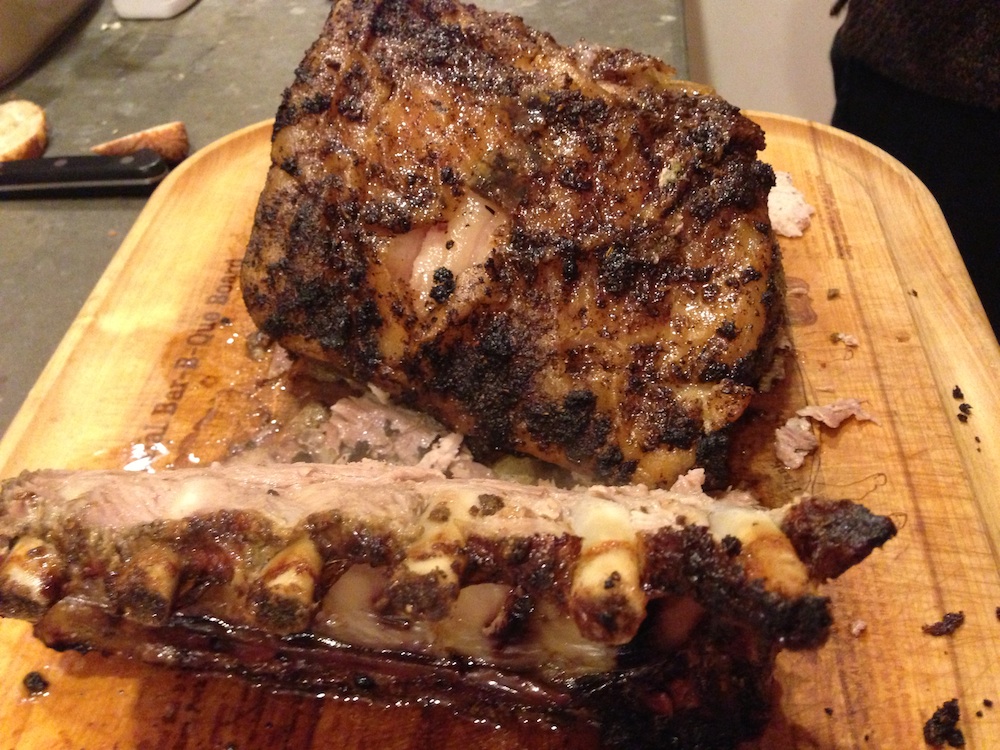
The roast itself had gone in the roasting pan backbone down, with the ribs sticking up, following Clark's instructions to roast it at 450° for 20 minutes, then at 350° for the remainder of the cooking time. We'd decided on pulling it when it reached 135°, then letting it rest for twenty minutes. I was the designated carver, and with some sound advice from the guys in attendance I sliced down under the ribs and against the backbone. This freed the roast completely and it plopped onto the cutting board in one piece, making it possible to simply slice the roast into what looked like boneless chops. As a bonus, I also sliced between the ribs and piled them on a side plate for those of us who like to have something to gnaw on.

Truly succulent, it was indeed a glorious achievement, one I'll definitely be proud to hear about in the future. And though I'm not totally over my fear—high-stakes occasions are always at least somewhat fraught—I'll definitely have more confidence the next time I try this type of high-wire act.

Fennel, Lemon and Herb Rub for Pork
Adapted from The New York Times

1 1/2 tsp. fennel seeds
Rosemary leaves from 2 bushy sprigs
5 garlic cloves, coarsely chopped
1/4 c. sage leaves and tender sprigs
Finely grated zest of 1 lemon
1 tsp. fennel pollen (optional)
1 Tbsp. coarse kosher salt
5 Tbsp. extra-virgin olive oil
1 tsp. cracked black pepper

Place fennel seeds in small dry skillet over medium heat until they are fragrant, about 1 minute. Keep moving them around the pan so they don't scorch—you're just trying to bring out the essential oils. Combine all ingredients in a blender and process until they make a paste. Rub all over pork roast* and allow to marinate in the fridge for at least 2 hours or overnight.

* If you're using a pork leg roast or rolled roast, you can untie it and rub it inside the roast as well. Then you can retie it or roast open-faced, either way.

** The USDA recently modified the cooking temperature for pork to 145°…we feel that's still a bit high, but you should use your own judgment.

Thursday, December 24, 2009

Dogs as Social Media


When I got to the Home section of today's New York Times, the fellow pictured in the article below the fold rang a vaguely familiar bell. Then when I saw he was sitting on steps made from thousands of tiny stones meticulously cemented into tightly arranged patterns, it hit me that this was the neighbor I'd met on one of my walks around the neighborhood.

My neighbor.

And not to get off on a rant, but when I'm out with Walker and someone stops to admire him, then looks at me with dewy eyes and says, "We've been thinking about getting a dog," I immediately launch into my "Well, that's nice. You realize they need to be walked four times a day, at least, right? Or if you're not able to do that, you'll need to hire someone to walk them mid-day, and that costs at least a couple of hundred bucks a month." But by then they've backed away, since what they want is not a reality check but someone to ooh and aaah and talk about what their chances are to score the latest golden-Labra-cocker-doodle.

I admit to being torn about dog ownership. I love the fact that they force me to get out every day and walk them for two or three miles in all kinds of weather, but I also dread exactly that same chore. They're great companions, too, but can't they find something else to do besides follow me around the house all day? But I also admit they've been the conduit for getting to know most of my neighbors, who would only be nodding acquaintances if I didn't have to engage them in conversation while waiting for Rosey or Walker (or both at once) to…well…"finish their business" so I can pick up after them and move on.

Which is how I met my neighbor, the rock guy, Jeffrey Bale, who was out unloading rocks from his truck when I'd stopped to…well…you know. I'd admired the magical pebble mosaics that I'd seen (or rather, glimpsed while nosily peering as unobtrusively as possible) while walking by his house, and the enforced break gave me a reason to tell him how much I admired his work.

So when I opened the paper and saw him in the article titled "Turning Every Stone for a Perfect Fit," then read that he was constructing garden mosaics for Hollywood, it didn't really surprise me all that much. Bale had been written up a while ago in the garden section of the Oregonian, where I got to see more of the incredibly detailed mosaics he'd designed around town. Each one looks like a rich, earthy Oriental carpet and turns a garden into a journey to an exotic, foreign land. You can see a slide show of the photos from the article here.

I imagine he'll be a little busy now that he's hit the NYT, but I have to say, "Congratulations, Jeffrey. Maybe I'll see you again when I walk by with the dogs!"

Photos by Stephanie Diani for the New York Times.

Thursday, October 29, 2009

"Waiter, there's a fly in my soup."


My pet peeve when it comes to wait staff in restaurants, the thing that makes my skin prickle with irritation? It's when a staff person comes to the table, glances at the mostly-finished food left on my plate and utters the phrase, "Are you still working on that?"

Working on that? As in constructing a scale model of the Eiffel Tower out of the bones from the rabbit stew?

So it was with some amusement that I read the first installment of "One Hundred Things Restaurant Staffers Should Never Do" by Bruce Buschel in today's New York Times. The first five are:
  1. Do not let anyone enter the restaurant without a warm greeting.
  2. Do not make a singleton feel bad. Do not say, “Are you waiting for someone?” Ask for a reservation. Ask if he or she would like to sit at the bar.
  3. Never refuse to seat three guests because a fourth has not yet arrived.
  4. If a table is not ready within a reasonable length of time, offer a free drink and/or amuse-bouche. The guests may be tired and hungry and thirsty, and they did everything right.
  5. Tables should be level without anyone asking. Fix it before guests are seated.
If you have a pet peeve, please leave it under "Comments" below and GSNW readers will vote on the best one submitted. The winner will receive a prize yet to be determined.

Thursday, May 28, 2009

My Latest Love Affair


In any long marriage there are ups and downs, times of passion and times when Dave probably thinks, "What the heck am I doing with this person?" I've done the same thing with food, from what's known in our family as my Velveeta Period in grade school through my decades-long affair with pesto (I blame the garlic).

Several years ago the attraction waned and I moved on to other fascinations with poached eggs and stuffed pork, but recently a piece by Melissa Clark in the New York Times piqued my interest in looking up my old flame.

The reason? It had undergone some cosmetic surgery and I was finding its new look curiously fetching. The basil had been replaced with pea shoots, and after a brief dalliance with those curly greens last spring, I've been flirting with them a lot more this spring.

So when I saw some shoots waving their fronds at me from a table at the farmers' market, I brought them home and immediately looked up the recipe. A whirl in the processor, a little heat, and this new affair was off to a promising start.

Pasta with Pea Shoot Pesto
Adapted from The New York Times

For the pesto:
1/4 c. pine nuts
3 c. pea shoots
1/2 c. fresh cilantro leaves
2 cloves garlic, chopped
3/4 tsp. kosher salt
1/3 c. extra virgin olive oil
1/4 c. grated Parmesan

For the pasta:
1 lb. penne (or your favorite shape)
1 Tbsp. olive oil
2 cloves garlic, minced
2 c. pea shoots
1 6-oz. can albacore tuna
Zest of 1 lemon
Salt and pepper to taste
Parmesan for sprinkling

Put pine nuts, pea shoots, cilantro and garlic in processor. With processor running, drizzle in olive oil to make a paste. Pour pesto into mixing bowl and stir in parmesan.

Bring pot of water to boil and add pasta. Cook till al dente. While pasta cooks, heat olive oil in saute pan and add garlic. Saute briefly and add pea shoots, cooking till just wilted. Add tuna and stir to warm. Remove from heat and stir in lemon zest. Season to taste with salt and pepper.

Drain pasta and put in serving bowl. Add pesto and stir to coat (you may not need all of it). Top with pea shoot mixture and sprinkle with parmesan.

Wednesday, April 29, 2009

Slicing Meat So You Pay More


Cutting, slicing and slashing are words commonly used to describe decreasing the price of a product. But the beef industry of late has been intent on cutting and slicing to increase the prices you pay at the meat counter.

As reported in the New York Times article "Same Cow, No Matter How You Slice It," writer Kim Severson describes a recent effort on the part of the National Cattlemen's Beef Association to "dig around in the carcass and find muscles that, when separated and sliced in a certain way, were tender and tasty enough to be sold as a steak or a roast."

The study, costing $1.5 million and taking five years to complete, basically took traditionally cheap cuts of meat and, by cutting them differently and renaming them, justified an increase in their price. Tom Mylan, a Brooklyn butcher, said, "The difference in a good name is worth $3 or $4 a pound."

One example is the newly named "Denver steak" that, instead of being ground into hamburger and sold for $2.99 a pound, can be cooked like a steak and sold for $5.99 a pound. Traditional butchers are pooh-poohing this marketing ploy, saying European and American butchers have known about these cuts forever. One butcher said, "This is just a glorified chuck steak that they cleaned the junk off of."

A "meat scientist" in Nebraska ("Hi Mom! Hi Dad! Guess what I've decided to be? A meat scientist!"), one Chris Calkins, is quoted as saying, no doubt in his most chipper voice, "If we can dig out a muscle and use it in a new way that hasn't been done before, it seems to me we are obligated to give that muscle an identity so someone can understand what it is."

Sunday, March 09, 2008

Bittman's Blogging

Here at the homestead we are all up ons about Mark Bittman. He's been doing his Minimalist column in the NYT Dining section for several years, preaching that good food doesn't have to be complicated or time-consuming to prepare. And for the last few months he's also been doing a (near-) weekly video podcast. In these five-or-so-minute-long videos, he demonstrates the recipe that he wrote about in his column that week, and they are uniformly engaging and informative.

And as different from typical food TV fare as you can get. Not only are they filmed casually, he makes messes and even the occasional gaffe which, like my personal goddess of the kitchen, Julia Child, he uses to show that mistakes happen and they're not fatal.

Now he's even started a blog where he discusses various food topics and recipes, as well as his travels, and (gasp!) even answers comments. I'll be putting it on my feed list, and I'll keep you posted if anything intriguing pops up.

Saturday, December 15, 2007

First New York, Now London?

A couple of months ago it seemed like the New York Times couldn't get enough of Portland. For awhile you couldn't open the paper without seeing an article on our food, our wine or the local sights. It was like they'd sent their feature folks out here on a staff retreat and they all caught the same virus.

Well, now the Guardian of London seems to have picked up the same bug that infected the NYT folk. In a piece in yesterday's issue, Guardian writer Laura Barton lists her ten favorite spots to nosh. What's interesting is that she eschews the usual hot spots for the more approachable fare of close-in eastside haunts like Navarre, The Farm and Montage, and even made it out to FoPo's Cava, about which she writes:

"A relatively new addition to the Portland scene, Cava sits in the rapidly-evolving south east of the city, and its a smallish, simple-ish menu concentrates on perfectly-prepared dishes made with the best local ingredients — consider butternut squash soup with brown butter and fried sage or Moroccan spiced roast chicken with stewed onions, saffron and olives on cous cous, for example. The staff are super-friendly, and the desserts — classic pecan pie with chantilly cream, espresso brûlée with cocoa nib shortbread — are magnificent."

I mean, that's really swell, but then in today's issue there's more. An essay by writer Beth Ditto (right) referring to our fair city as "the US's coolest city." She lists her top spots for finding vintage duds (Red Light), lunch under ten bucks (Thai Noon), best place for live music (Wonder Ballroom) and more.

So what's next? Paris Match dumping New York and declaring PDX the country's new fashion HQ? Pravda touting our distiller's spirits as non pareil? I can't wait to hear!

Wednesday, September 26, 2007

NYT Discovers Portland

Looks like someone back East has finally heard the news that there's something going on here in Portland. And it's got nothing to do with flannel shirts and Birkenstocks and a whole lot of something to do with organic, seasonal and, dare we say, sensational food. But we knew that awhile ago with places like Higgins and Castagna and the (still-lamented) Zefiro and with people like Monique Siu, Kevin Gibson, Greg Higgins and Cathy Whims singing the praises of Northwest ingredients.

And credit is due to Eric Asimov, wine critic for the New York Times and author of "Portland: Chefs flock to a city where food is the star, produce is stellar and real estate is cheap." He actually got over to the east side of the river (four out of his eight "emblematic restaurants" are in SE Portland), possibly a first for the Times. Though, oddly, in his wine picks he only names Brickhouse, Eyrie, Ponzi, Domaine Drouhin and some winery called Soter (that only just opened last year) as his favorite producers, most of them fairly standard, old-line picks with very expensive prices. What about Cameron, Sineann, Owen Roe, St. Innocent or J. Christopher, you might ask? Winemakers who are taking Oregon wine to the next (and often more affordable) level.

As for his restaurant picks mentioned above, they are Carafe, Clyde Common, Higgins, Ken's Artisan Pizza, Le Pigeon, Paley's Place, Pok Pok and Vindalho. While Asimov was ostensibly focusing on chefs who came to town from other places, and all could qualify as among the best in Portland, I would add Pho Van, Ciao Vito, Castagna (and Castagna Cafe), the Country Cat, Andina (talk about coming from someplace else!), Lolo and Toro Bravo, Nuestra Cocina, Three Doors Down and Alba Osteria.

Granted, the guy didn't have the whole dining section at his disposal and I know, as a writer, you have to stop at some point. And he obviously does "get it" and we should be thankful for the huge splash the article made. Plus he included the recipe for Le Pigeon's signature apricot bacon cornbread with maple ice cream. So fine. But hopefully he'll come back someday and write about the real revolution taking place here, the one that is centered around making eating locally and seasonally something that everyone knows about and can afford to do, not just foodies who eat in expensive restaurants. Now that would be worth reading about!