Showing posts with label pork roast. Show all posts

Saturday, August 15, 2015

Budget Cuts: Rolled Stuffed Pork Loin


At $6.99 per pound, it's not a steal, but for some fine eating for a decent price, pork loin is a good place to start, and they're often on sale at our supermarket butcher counters. We usually cook it on the grill, searing it directly over the coals then moving it to the side so it can achieve maximum succulence.

Slice roast lengthwise through the middle, but not all the way through.

One way to assure juiciness in what can often be a rather dry cut of pork is to stuff it with something savory, whether a mixture of greens and herbs—a garlic pesto or kale stuffing would be awesome—or, what I've been doing lately, a variation on Dario Cecchini's treatment with garlic, fennel pollen, salt and rosemary.

Open like a book, then slice horizontally through the left side.

Prepping the roast for the stuffing process is extremely easy. The simplest method is to snip off the twine binding the roast, turn it so the short end is toward you, then slice it halfway through the long way, stopping before you slice all the way through. Open the roast like a book, slather it with your stuffing, then roll it up starting at the right-hand end. Using some butcher's twine (available at most markets), tie the roast in three or four places.

Repeat with right side, open flaps and spread with stuffing.

The other method is a little harder but gives a much more satisfying result. Slice and open the roast as above, then make a shallow slice down the center, again stopping before you go all the way through the roast. Then make a horizontal slice to the left from the center cut to the end, stopping before slicing it through. Repeat going from the center to the right side. Open these two flaps and you'll end up with a long slab of meat that you can slather with stuffing and roll up from one end to the other.

Roll up, tie and roast…easy!

Grilling takes close to an hour, and roasting it in the oven at 400° will take about the same amount of time. If you don't mind heating up your house by turning on the oven—I'm writing this in the middle of a very warm NW summer—a really great thing to do, which gives you an instant side dish, is to roast the meat on top of root vegetables, as in this recipe. I usually aim for an internal temperature of 125° to 130°, then remove it from the grill or the oven, cover it with aluminum foil and let it rest for fifteen to twenty minutes before slicing.

Here are some stuffings to try: Kale and Pine Nuts, Nettle Pesto. The stuffing pictured above is a cilantro pesto. Try it with green garlic, carrot top pesto, or a flavorful combination of greens and herbs.

Tuesday, February 18, 2014

A Pig Named Roger: Celebrating a Life Given


Two years ago I met a pig named Roger. This is the last in a series of three videos that was filmed at that time. Here are the initial paragraphs of my post about the meal that celebrated his life.

The very first post in this series started with a question: Can I eat an animal I've played tag with?

At first it was merely an interesting notion. I'd buy half a pig from my friend Clare at Big Table Farm, something I'd been wanting to do for some time. But I didn't want to simply wait for the time, some months hence, when she'd call to say my half was butchered and ready to pick up from the packing house. I wanted to meet this pig named Roger, and trace his life from his pasture to my plate.

Roasted bones for stock.

I didn't have an agenda in mind. This wouldn't be an attempt to follow the already well-trodden path of other food writers like Michael Pollan or Barbara Kingsolver. I didn't want to hammer home points about whatever-vores, 100-mile diets or the evils of corporate agriculture. It was simply a documentation of my experience, with no expectations of a major life change ("I'll never be able to look a pork chop in the eye again…") or revelation ("Roger came to me in a dream one night…").

Read the rest of the post, Thinking of Eating: Pasture to Plate.

Watch the other videos in the series, Getting to Know My Food and Learning to Butcher.

Wednesday, January 09, 2013

On the High Wire with a Big Hunk of Meat


I've always had a certain fear of large hunks of animal flesh.

I know, I know…you're thinking, "But Kathleen, weren't you just butchering half of a pig (your second) just a couple of weeks ago? Wazzup?"

Herb marinade ingredients.

So I guess I should modify my phobia: my fear is cooking a large hunk of animal flesh and ruining it. And there's nothing like eight-plus pounds of gorgeous standing rib pork roast to make my knees start knocking. Add in the fact that it was the main course for Christmas dinner with company and you've got the makings for a world-class disaster, one I'd never hear the end of.

"Remember the time you practically burned down the kitchen and ruined Christmas dinner?" The words echoed in my head.

All dressed and ready.

Then there was the fact that I'd decided to use a recipe for a fennel, lemon and herb marinade I'd read in the New York Times. Problem was, Melissa Clark, whose recipes I like and trust, had used it on a crown roast, not a standing rib. So aside from the rub itself, all her other sage advice about how to make it the crowning achievement (no pun intended) of the dinner was pretty much useless.

I nevertheless forged ahead, pulled the roast out of the freezer in plenty of time for it to thaw, made the rub and got it marinating on Christmas morning. Dinner was scheduled for evening—we're not mid-day holiday diners—and I made sure I had a couple of instant-read thermometers that actually worked.

Coming off the bone.

With the size of the roast, I was estimating two or two-and-a-half hours. It was originally going to go on the grill, another holiday tradition, but the weather was awful (bone-chilling cold and rain) and Dave was threatening to come down with a cold. So into the oven it was going. Our guests came, we drank and snacked and I checked the temperature starting about 90 minutes in.

The carving…whew!

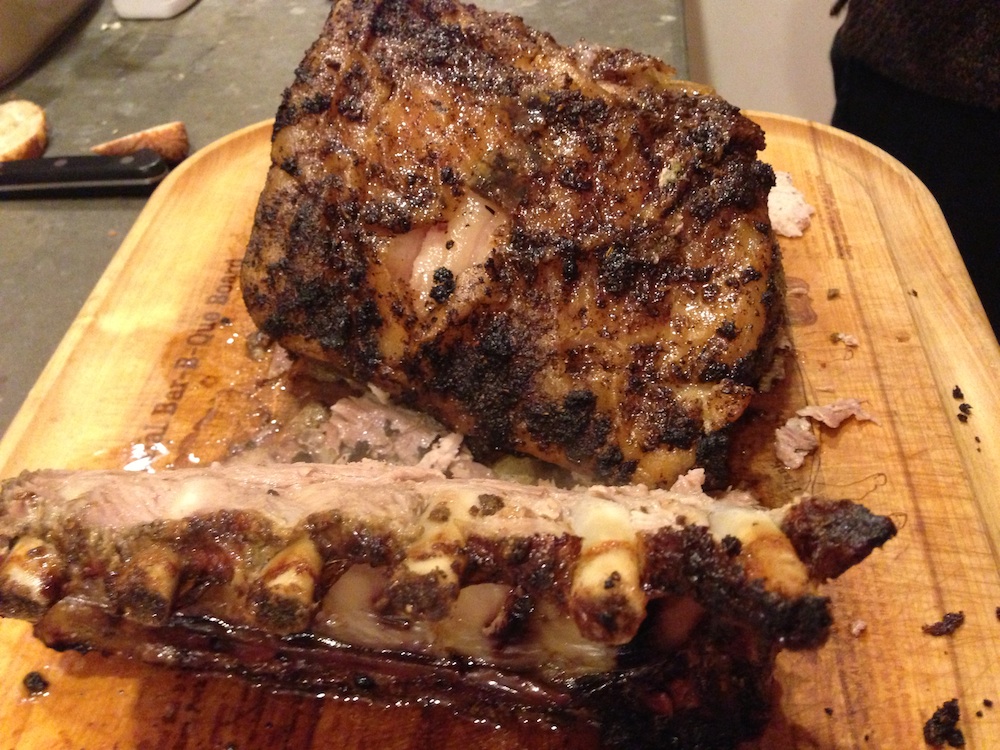
The roast itself had gone in the roasting pan backbone down, with the ribs sticking up, following Clark's instructions to roast it at 450° for 20 minutes, then at 350° for the remainder of the cooking time. We'd decided on pulling it when it reached 135°, then letting it rest for twenty minutes. I was the designated carver, and with some sound advice from the guys in attendance I sliced down under the ribs and against the backbone. This freed the roast completely and it plopped onto the cutting board in one piece, making it possible to simply slice the roast into what looked like boneless chops. As a bonus, I also sliced between the ribs and piled them on a side plate for those of us who like to have something to gnaw on.

Truly succulent, it was indeed a glorious achievement, one I'll definitely be proud to hear about in the future. And though I'm not totally over my fear—high-stakes occasions are always at least somewhat fraught—I'll definitely have more confidence the next time I try this type of high-wire act.

Fennel, Lemon and Herb Rub for Pork
Adapted from The New York Times

1 1/2 tsp. fennel seeds
Rosemary leaves from 2 bushy sprigs
5 garlic cloves, coarsely chopped
1/4 c. sage leaves and tender sprigs
Finely grated zest of 1 lemon
1 tsp. fennel pollen (optional)
1 Tbsp. coarse kosher salt
5 Tbsp. extra-virgin olive oil
1 tsp. cracked black pepper

Place fennel seeds in small dry skillet over medium heat until they are fragrant, about 1 minute. Keep moving them around the pan so they don't scorch—you're just trying to bring out the essential oils. Combine all ingredients in a blender and process until they make a paste. Rub all over pork roast* and allow to marinate in the fridge for at least 2 hours or overnight.

* If you're using a pork leg roast or rolled roast, you can untie it and rub it inside the roast as well. Then you can retie it or roast open-faced, either way.

** The USDA recently modified the cooking temperature for pork to 145°…we feel that's still a bit high, but you should use your own judgment.