Thursday, February 28, 2019

Lost Valley Farm Sold to Washington Buyer


Well, it's happened. Lost Valley Farm, the infamous factory farm dairy that in its first two years racked up more than 200 violations related to overflowing manure pits, leaking tanks of dead animals, over-application of manure that threatened area groundwater and drinking wells, and even failure to provide restroom facilities for employees, has been sold.

Cow stands in liquid manure at Lost Valley.

Who would be crazy enough to buy a facility that will require millions of dollars to clean up and more millions to install a new irrigation system? Apparently Cody Easterman of Easterday Farms of Pasco, Washington, a large potato and onion grower, who paid $66.9 million through a company called Canyon Farm LLC. (Easterman was contacted by phone but did not respond by the time of posting.)

With some 47 million gallons of liquid manure still remaining onsite—which one source estimated would fill 71 Olympic swimming pools—what is the draw that would make it attractive to a buyer like Easterman?

For one thing, the water rights.

"The irrigation rights for growing crops on the several thousand acres of land are in place, and very valuable," said Ivan Maluski, policy director for Friends of Family Farmers, an organization that had been involved in fighting against Lost Valley Farm since it was first proposed due to a lack of regulation and oversight on the part of the state. Though he added, "The water is for sustaining livestock and dairying year-round is still contested and not secure."

The site was originally the Boardman Tree Farm.

In an e-mail responding to questions I posed to the Oregon Department of Agriculture (ODA) about the sale, spokesperson Andrea Cantu-Schomus said that the ODA and the Oregon Department of Environmental Quality (DEQ) have signed what's called an "Order and Mutual Agreement" (OMA) with the federally appointed trustee for Lost Valley Farms, Randy Sugarman, that "ensures the wind-down and cleanup process for the facility."

"The priority of ODA, and our partner agencies DEQ and the Oregon Department of Justice (DOJ), was that the OMA fulfill three principles: accountability, no gaps in responsibility and effort, and achieving the state’s desired outcomes," Cantu-Schomus wrote in an e-mail. "We believe the signed OMA achieves those principles."

Aside from the cleanup of the manure and dead animals remaining on the property, the OMA also requires that the remaining cows—still numbering as many as 8,000, according to some reports—be removed from the facility. (An auction of the cows is part of a separate agreement with the trustee.) The agreement requires that Easterman must apply for a new CAFO (Confined Animal Feeding Operation) permit if he wants to reopen the dairy or, if he does not, that the dairy must be decommissioned "to the satisfaction of the ODA."

Emissions into air and water are problems for communities near industrial dairies.

A complicating factor for Easterman, if he decides to reopen the dairy or lease the facility to another operator, are SB 103 and SB 104, two bills before the legislature that seek a moratorium on approval of new dairy operations in the state and require establishment of regulations governing factory farm dairies that are already located, or that may want to locate, in Oregon.

Both bills apply to mega-dairies, that is, facilities with more than 700 cows that are confined without seasonal access to pasture, or a total of 2,500 cows—Lost Valley was originally permitted for 30,000 cows. The legislation would regulate these dairies as the industrial factories they are rather than treating them as traditional agricultural farms, and would require limits on toxic emissions to air and water, including groundwater. These bills would also require studies on the impacts to Oregon's small and mid-size dairies and on animal welfare and would close existing loopholes that allow excessive use of scarce groundwater, as well as establishing a course of action if a facility fails to meet state standards, as happened with Lost Valley Farm. (Follow the progress of the legislation in Your Food, Your Legislature postings here.)

The sale of Lost Valley makes the passage of these bills even more critical, according to Amy van Saun, a staff attorney for the Center for Food Safety.

"I think ODA realizes that Lost Valley was a giant problem, but the fixes they have suggested to the legislature at this point aren’t enough, in our minds, to fix the problem," van Saun wrote in an e-mail. "But [the ODA] realizes they need more oversight and are seeking it from legislature. The moratorium is all the more important now that once Lost Valley gets cleaned up, these owners may well want to restart dairy operations, and that could be within the year."

* * *

Read my series of posts outlining the long history of problems at Lost Valley Farm since it opened two years ago, including cows standing in manure from overflowing lagoons and a leak in a tank containing dead cows, plus massive groundwater pollution, lawsuits from the state of Oregon and the farm's creditors, and former owner Greg te Velde's own arrest for soliciting a prostitute and possession of methamphetamine in Benton County, Washington.

My article Big Milk, Big Issues for Local Communities reports on the issues mega-dairies pose to Oregon's air, water, environment and communities. You can also find out Why I'm Quitting Tillamook Cheese and read other coverage about factory farms in Oregon.

Sunday, February 17, 2019

Simple & Creamy: Mushroom chowder


In making the Choucroute Garnie featured in a recent post—it's an Alsation dish featuring sauerkraut braised for hours in chicken stock, with many meats added and then simmered some more—I apparently got a little over-excited estimating the number of potatoes that people might be hungry for. Then my husband and I got our wires crossed while grocery shopping and we ended up with an extra pound of cremini mushrooms.

To make a long story short, we had the aforementioned abundance of cooked potatoes and those mushrooms that were starting to look a little long in the tooth. Plus it coincided with our recent spate of late winter chilly temperatures hovering in the 20s and 30s. Always in the mood for a hearty soup—check out this 12-year collection of soup recipes if you don't believe me—I got the bright idea to make a mushroom chowder, albeit a vegetarian version since we're temporarily out of Dave's homemade bacon (a situation soon to be corrected).

To cut to the chase, this came together in about 40 minutes and was, frankly, the best mushroom soup I've had anywhere, including restaurants, that I can remember. (That opinion is backed up by those here who are not shy about criticism and not over-prone to praise, by the way.) And here's a wacky thought: If you should happen to leave out the potatoes, I'd even recommend it as a substitute if you've sworn off Campbell's cream of mushroom but still crave that comforting flavor.

Mushroom Chowder

4 Tbsp. butter
1 onion, chopped in 1/4" dice
3 cloves garlic, minced
1/2 c. celery, finely diced
1 lb. mushrooms, thinly sliced
6 oz. sour cream
3 Tbsp. flour
1/2 c. white wine
2 c. chicken stock
2-3 c. whole milk, depending on how thick you like your chowder
1/2 tsp. dried thyme
3 bay leaves
1 1/2 lb. potatoes chopped in 1/2" dice
Salt and pepper, to taste

In a large soup pot or Dutch oven, melt butter over medium heat.

Add onions and sauté until tender. Add celery and garlic and sauté until tender. Add mushrooms and sauté until tender.

Remove from heat and sprinkle flour over the mixture, stirring well to combine. Put back on medium heat and stir frequently to keep it from sticking, about 3 minutes. Add wine and stir, scraping any browned bits from the bottom of the pot, and allow to thicken slightly.

Stir in sour cream until smooth, then add chicken stock, milk, bay leaves, thyme and potatoes. Bring to a bare simmer. Reduce heat and simmer on low heat, just enough to keep it barely bubbling, for 30-45 minutes or until potatoes are tender. (As mentioned above, leftover boiled potatoes are entirely substitutable.)

If you have some excellent bacon (like Dave makes), start with 3-4 slices cut in 1/4" pieces. Place it in the heated pan before adding butter and sauté until it's cooked but not crisp, then continue with the rest of the recipe.

Saturday, February 16, 2019

Travels with Chili: A Fond Farewell


It may have been telling that a recent trip to Fraga Farmstead Creamery was taken in my husband's pickup rather than Chili, the intrepid Mini Clubman we bought 10 years ago, the first brand new car we'd ever owned.

A post way back then summed it up:

"Trumpets sounded, the crowd roared, a dog barked, clouds parted and, oh yeah, a baby cried. Y'know, the usual harbingers of a siginificant event in literature. In a workplace, a memo would have gone out and, befitting its importance, coffee and donuts would have been served in the conference room.

"In this case, we drove up to the house, parked, and pretty soon the neighbors started gathering, oohing and ahhing, opening doors and (if you're Mace, anyway) pushing buttons. Everyone had to sit in the driver's seat, watch the sunroof(s) slide back and forth, and close their eyes and breath in the new car smell.

"Pretty soon beer was being poured, wine bottles opened and a block party erupted that lasted into the late evening as kids played racecar driver in the front seat, complete with 'vroom vroom' sound effects. All of it a good sign of adventures sure to come."

And there were many of those. From Portland to Californiathe WallowasCanada, on summer camping trips and countless quick hops to area farms and coastal getaways, not to mention the more pedestrian errands that we ran every day. Our friends teased us whenever we went on trips together, saying that seeing us, the dogs and all our gear popping out of Chili was like was like the clown car at the circus.

Lately, though, there were signs that all was not well—a transmission failing, leaks here and there, check engine lights that, in order to get them to turn off, required an expensive infusion of cash. Plus we'd decided to downsize to one car, something that could serve as a road car, camping vehicle and city runabout, plus haul supplies for various house projects.

This last weekend the check engine light came on yet again, and we had to make the fateful decision. Emptying Chili of the grocery bags, road maps and collected detritus was a hard task, leaving it at the dealership even harder, with memories of so many happy times crowding around us. Our little red car, always the cutest in any lot or campground, will be sorely missed.

Check out our Travels with Chili.

Guest Essay: Goats Rule


My friend Jeffrey Hannan has had many past lives. An author, playwright and digital user experience manager, he lived on a farm as a child and gravitated to goats as his familiars. Which is why, whenever he visits Portland, it's a requirement that we stop by at least one spot where they gather, even if only through a pasture fence. His most recent appearance in Oregon entailed a road trip to the wilds of Gales Creek for a chat with Lise Bueschen-Monahan and her 100-or-so goats at Fraga Farmstead Creamery.

Goats rule.

At least in my private hierarchy of the animal kingdom. How, then, to resist an invitation to visit Steve Monahan and Lise Bueschen-Monahan’s Fraga Farmstead Creamery? Not possible.

Lise Bueschen-Monahan.

Kathleen Bauer and I bundled up and donned our farm boots one chilly afternoon in January. We climbed into her truck and headed 30 minutes west, to where the fringe of suburbanization meets wide open farmland. A bit further, to the south, before the road wants to rise into the Tillamook forest, lies a farm with a pond, a red barn and dense stand of pines trees.

Here a herd of 100-plus female goats roams a shady evergreen forest, rubbing themselves and their horns against the trunks of trees. They come running as a pack when Lise strides into the large open field and calls out to them: “Goaties!”

Some of Fraga Farm's goats.

Goats are curious looking things. Like most quadrupeds (and some humans), they have a big midsection supported by four slender appendages. Their heads are triangular. Their eyes are equal parts mischief and interrogation. They’re also set a bit too far apart, leaving us mere humanoids struggling to match their gaze.

They think nothing of strolling up and swarming around you, rubbing their thick bodies against your legs or chewing on your shoelaces as you stand in place to learn the story of the farm.

Goats like—they will often insist upon—your affection. They love to be scratched. However, they can be fickle creatures. They’re all too quick to divest you of their attention when they discern that fresh hay has been laid in the barn.

The farm's red barn and oak trees.

Lise is the goatherd of the family. She is aided by Franklin, a tall, amiable intern who, upon completion of his master’s degree, aims to establish a goat dairy when he returns to his native Ghana.

Lise’s husband Steve is the cheese maker. Together they create a small collection of superb goat milk cheeses—traditional chevre, camembert, feta, and an aged raw milk cheese akin to cheddar—as well as some insanely delicious goat milk caramels.

The quality of the product is not by accident. That’s why Kathleen and I were there: to uncover the method behind the magic.

Lise walking with her "goaties."

It was quiet time on the farm when we visited: a period of relatively little activity when milk production has waned and the busy-ness of kidding season has not yet begun. Kidding season lasts roughly from January through May. About 20 kids are born each year. Some of the does are kept as milkers; the rest of the kids are put up for adoption as pets.

In some industrial goat dairies, the moment kids are born they are taken from their mother and killed so that every drop of mother’s milk is reserved for commercial use. Not a drop, so to speak, is wasted. In contrast, when a kid is born at Fraga, both kid and mother are put in their own enclosure after birth to give them a chance to rest. The kids then nurse for about two months, at which point they are weaned and the mother’s remaining milk is used to make cheese.

This nurturing, natural method of raising goats leads to better cheese. Not to mention a healthy quality of life for the animal. It is fairly well documented that the commercial raising and slaughter of animals for meat and dairy is highly unnatural and traumatic. This trauma ultimately finds its way into the end product—be it meat, cheese, milk or butter.

Fraga Farm's chevre with honey.

“Everything is hormonal,” explains Lise. Birthing, feeding, weaning and milking all are driven by hormones, just as hormones drive interactions between human mothers and their children. When animals are dragged into slaughter or robbed of interaction with their parent or offspring from the moment they’re born, the animal’s normal hormonal processes are disrupted. Moreover, the cramped, unhealthy conditions in which many industrial food animals are raised adds a deeper degree of damage.

The natural, normal processes of grazing, birthing and weaning that take place at Fraga are antithetical to industrial methods. Fraga’s methods are emblematic of a larger food movement which strives to farm with the earth and its inhabitants instead of against it or in perceived domination of it.

The farm's camembert-style cheese.

The methods that small farmers like Lise and Stephen apply result in superior products with a higher cost of production. Unfortunately, the demand to keep retail prices as low as possible while maximizing profit means ethical trade-offs that holistic farmers are not willing to make.  As a result, small farmers face relentless competition from industrial farms and large retailers whose sole objective is to increase their own share of the consumer’s wallet.

When it comes to producing food or dairy, there is an uncomfortable symbiosis between man and animal: we are far more dependent upon them than they are on us. That said, a herd of animals—dairy goats, for instance—requires conscientious care if we’re going to right the current imbalance. These workers require and deserve our diligence and decency.

The same can be said of a bed of vegetables: by nurturing their growth through natural methods such as soil regeneration, which ensures a healthy mix of microbial magic, instead of creating land that’s been fertilized literally to death, the negative trends in industrial farming can be countered.

Farm intern Franklin intends to start a goat dairy in Ghana.

Whether those trends can be reversed is an entirely different argument. Even at a friendly sit-down at a wooden table in a farmhouse. After a tour of the farm and a lengthy visit with the herd in the barn, the three of us retreated to the farmhouse. Warmed by fresh coffee, farm-made cheese and bread, our degrees of optimism varied. What was agreed upon, though, is that many of us, when we buy food, have a choice: we can choose the cheaper industrial product or we can seek out humane and healthier alternatives.

This is the hard mission of Lise and countless other farmers in the bountiful Northwest: to create those options and stave off the inevitable demise wrought by big ag. It is also the work of Kathleen to provide exposure to these alternatives, to get people to understand where food comes from: to remember that we exist in a web of natural inter-relationships. If we are to eat well, and live well, we have to re-engage with the realities of our food supply.

With Lise and her goats, it's all about the love.

Food labeling, though, is an issue. (And a lengthy, head-spinning side topic.) What, after all, I wonder, is truly organic? What is “free-range”? These neat government labels, written by and for the benefit of commercial producers, do little to truly inform the public. They are guideposts that reveal nothing of the real methods of production behind them, but instead point us in directions we feel obliged to follow.

Are we being misled? This intentional ambiguity is a not just a crisis of conscience but a crisis of health: If the food we put in our mouths is grown in soil denuded of nutrients and nature’s complex, life-giving secrets, and if the animals we eat are abused in their service to us, what are we really putting into our bodies?

* * *

Sam (black), Marilyn (tan), and Jeff. La Mesa, CA, ca 1989.

Author's note: Sam and Marilyn hung out in the chicken enclosure, where they had a homemade house of wood where they slept at night, and a wooden picnic bench and table that they could hop around on. When I’d get home from work or school I’d let them out to run around the yard and climb the giant boulders on the property. Marilyn loved corn chips and a sip of white zinfandel, which perhaps, alas, contributed to her early demise.

Tuesday, February 12, 2019

Praising the Braise: Choucroute Garnie


It's not often I get to write, "As we drove through the rolling hills from Frankfurt across the German-French border, the towns grew increasingly smaller and older, the buildings more charming and fairy tale-like with stone and moss the predominant textures."

Braising the vegetables.

It was an incredibly long time ago, and our last through the French countryside, a road trip that took us from the Alsace region across to the Loire, then down through the Dordogne with a swing back up to Frankfurt. Our first stop was in an auberge in the tiny town of Riquewihr, one with a traditional Alsatian restaurant on the main floor and rooms for guests on the second floor.

Adding the bacon.

Coming down for dinner that night, we found we'd walked into a special evening featuring that most Alsatian of dishes, choucroute garnie. A long table ran down one side of the room, the length of it piled with the most sweetly fragrant sauerkraut, braised for hours in stock, bay leaves and juniper berries. On top of the sauerkraut were all kinds of sausages from the area, along with slices of smoked ham, whole pork chops and other meats, all of which had been cooked in the braised sauerkraut.

In goes the meat…getting there!

That choucroute (pron. shoo-CROOT) completely changed my attitude toward sauerkraut, which up to that point had always been a tart, vinegary-tasting accompaniment to my grandmother's cabbage rolls, which she called "hoblich" (probably a variation on Ukrainian "holopchi"), or my mother's sauerkraut with hot dogs, her attempt to pay homage to my father's German heritage. In this version, rinsed of most of the salt and sourness, then simmered until meltingly tender, even the most adamant of the sauerkraut averse will rave.

Choucroute Garnie
Loosely adapted from Time-Life Foods of World: Provincial France

6-8 lbs. sauerkraut
1 lb. bacon (optional)*
4 Tbsp. olive oil
2 med. onions, chopped fine
2 Tbsp. garlic, minced
2 c. carrots, cut in 1/4" rounds
1 tart apple, cored and chopped in 1/2" dice
6 c. chicken stock
2 c. dry white wine
1 Tbsp. salt
1/4 tsp. black pepper
8 sprigs parsley
3 bay leaves
20 juniper berries
2 lbs. uncooked sausages, like bratwurst
2 lbs. chicken thighs**
3 smoked pork chops
4 1/2" slices ham
Yukon gold potatoes

Preheat the oven to 325°.

Rinse the sauerkraut in several changes of water to get rid of excess salt and vinegar. (Homemade is best, but if that's not available, I like a good commercial brand like Bubbies, containing just cabbage, salt and water.) After rinsing, squeeze it vigorously to get out as much water as possible. Repeat. (Save the fermented juice for all kinds of uses…search for "uses for sauerkraut juice.")

In a heavy 9-qt. casserole or Dutch oven (I used Big Blue), heat the oil over medium heat. Add the onions, garlic and carrots and sauté for 10 min., stirring often to prevent sticking. Stir in the chopped apple and continue cooking for 2 or 3 min., then stir in the sauerkraut and combine thoroughly. Reduce the heat as low as possible, cover the pot and braise the vegetables for 15 min. Then add the chicken stock, wine, salt, pepper, parsley, bay leaves and juniper berries and stir to combine. Top with bacon, if using. Cover tightly, place on middle rack of the oven and braise for 3 hrs.

After the sauerkraut has braised for 3 hrs., prick the sausages 4 or 5 times and add to the casserole with the chicken thighs, pork chops and ham slices, burying them in the sauerkraut. Cover, return the pot to the oven and braise for 1 to 1 1/2 hrs.

Toward the end of the cooking time, heat a large pot of water till boiling, halve the potatoes and cook till tender.

To serve, transfer the sauerkraut to a deep, heated platter or serving dish, removing the bay leaves and as many of the juniper berries as you can. Mound the meat over the top. Serve with potatoes on the side.

* The last time I made this, I left out the bacon and it was much less fatty. The smoked pork chops and ham made up for any loss of smoky flavor.

** Duck legs or rabbit would also be great in this.

Friday, February 01, 2019

How an Oregon Rancher is Building Soil Health and a Robust Regional Food System


This is my second contribution to Civil Eats' monthly series of profiles of farmers and ranchers who are changing our food system for the benefit of our communities, our health and the environment.

Fourth-generation rancher Cory Carman
holistically manages 5,000-acres
which serve as a model for sustainable meat operations
in the Pacific Northwest.

When Cory Carman returned in 2003 to her family’s ranch in remote Wallowa County in eastern Oregon with a Stanford degree in public policy in hand and a stint on Capitol Hill under her belt, her intention was to stay for the summer, helping her uncle and grandmother with ranch work while she looked for her next job working on public policy. By that fall, though, it was obvious that if she left, the ranch wouldn’t be there for her to come back to.

“They were the only ones left on the ranch,” she said, recalling the heartbreaking specter of how hard her uncle and her grandmother, who was then in her 80s, had to work to barely scrape by. “I think I felt the weight of what they were trying to hold together, and I thought how unfair it was for me to expect that they could just keep it together until I came back someday.”

So she decided to stay.

Carman Ranch began as a few hundred acres Carman’s great-great-grandfather Jacob Weinhard—nephew to the legendary Northwest beer brewer Henry Weinhard—bought for his son Fritz in the early 1900s. Under Carman’s watch, the operation now spans 5,000 acres of grasslands, timbered rangeland, and irrigated valley ground nestled against the dramatic peaks of the Wallowa Mountains. Hawks, eagles, and wildlife greatly outnumber people in this isolated northeastern corner of the state, originally home to the Wal-lam-wat-kain (Wallowa) band of the Nez Perce tribe.

Distinct from most cattle operations in the U.S., Carman’s cattle are 100 percent grass-fed well as grass-finished. (The term “grass-fed” is not regulated, so it can mean that animals have only been briefly pastured before they’re sent to a factory feedlot to be finished.) The ranch primarily produces cattle and pigs, which it mostly markets to wholesale accounts, though it sells a lesser amount of meat as “cow shares”—or quarters of beef ranging from 120 to 180 pounds purchased directly by consumers.

Equally if not more important to Carman, however, is the focus on what she calls the “holistic management” of her land. This involves constantly moving the cattle and paying careful attention to the rate of growth of the animals and grasses. By this system, the steers select the forages they need to grow and gain weight, and the grasses get clipped, trampled down, and fertilized with manure, resulting in fields that are vibrant—they retain water, resist drought, contain abundant organic matter, which contributes nutrients and carbon, and are highly productive without the addition of fertilizer.

Amanda Oborne, vice president of food and farms at Ecotrust, a regional nonprofit organization working on social, economic, and environmental issues, said Carman inspired Ecotrust’s food system work by helping her understand the challenges of creating local beef and pork markets, the complexity of scaling an agricultural business with integrity, and the importance of grasslands and large grazing animals in fighting climate change through carbon drawdown.

Oborne remembers Carman walking her around the fields of the Zumwalt Prairie, a preserve owned by the Nature Conservancy that is on the western boundary of the ranch, and picking at blades of bunch grass as she explained how the native species create pockets of nutrition for migrating birds through the winter, and how the long, perennial roots scaffold a whole cathedral of structure and life under the soil.

“It’s Cory’s ability to tell these stories, to explain the flaws of the dominant system without imbuing judgement or animosity, and to partner across every divide—be it age, gender, class, political philosophy, or hometown—that makes her such an effective and innovative thought leader,” Oborne said.

Introducing Holistic Management

Within a year of returning to the ranch, Carman met and married her husband, Dave Flynn (the couple have since divorced), and started a family, which includes three children, Roan and twins Ione and Emmett.

With a fifth generation of the family living on the ranch, the challenge became not just figuring out how to maintain her family’s business and regenerate the land, but how to leave a viable legacy to pass on to her children.

“You don’t have a ranch so that you can sell it and retire; you have a ranch so you can pass it on—that’s sort of in the DNA,” Carman said. “It’s what gets priority, and [you] grow up knowing that there’s something more important than all of you as individuals.”

While Carman respects her family’s history and that of her neighbors, she is pursuing the inverse of the methods used on most of the nation’s cattle ranches since the middle of the last century—methods also used by her father, who died in a ranching accident when Carman was 14, and by her uncle who took over.

“It was the fertilizer era,” Carman noted of her uncle’s initial resistance to the idea of leaving forage in the pastures. “It’s like in those first few decades when fertilizer worked really, really well. You could just take everything off of the land that you could possibly grow and sell it—and then pour more fertilizer back on. And it worked. Until it didn’t.”

With an eye toward her legacy, Carman went to her uncle with the idea of raising grass-fed beef. “I will never forget what he told me,” she said. “He said, ‘Why don’t you do something people like? What about jerky?’”

The thing that she knew—and that her uncle didn’t—was that there were people in more urban areas who were willing to pay a premium for healthy food. “He had no context,” Carman said. “It’s a paradigm shift.”

Read the rest of the article to find out how Carman has begun to build a robust regional food economy with beef as the elegant nexus of the issues.

Read more of my articles for Civil Eats, including a profile of dairy farmer Jon Bansen, and an examination of the damage that factory farm dairies have done to communities in Oregon and around the country. Photos of Cory Carman copyright Nolan Calisch; photos of cattle and sign by John Valls; used courtesy of Carman Ranch.

Thursday, January 31, 2019

The Snack-Lover's Guide to Watching Sports


Okay, okay, I admit it. When it comes to sporting events, I'm just there for the food.

I come from a family of sports enthusiasts, and I'm definitely the odd one out. My mother loved football, especially her Oregon State Beavers. My youngest brother was a Green Bay Packer in scrimmages with his buddies in grade school before he switched to the Blazers' LeRoy Ellis in pick-up games in middle school.

Hummus? Easy peasy.

Me? I imagined beaming up to the Enterprise so I could explore strange new worlds with Mr. Spock.

So now when we're invited over to friends' homes to watch sports on a screen the size of a starship, I tend to ply the circuit around the snack table that's usually groaning under bowls of chips and dips, chili and even the odd pork shoulder.

Hot crab and artichoke dip.

Whether you're a sports fanatic or hoping that Elizabeth in "The Americans" targets you as her next victim…er…informant, here are some of my fave recipes for game day snackage, and a killer chili recipe for the big game or any time.
The following chili recipe makes enough to feed a crowd, so feel free to halve it for smaller gatherings.

Killer Beef Chili

For the sauce:
8 dried ancho chiles, seeded and torn into pieces
3 1/2 c. boiling water
2 bay leaves
1 Tbsp. cumin seeds
2 Tbsp. (6-8) garlic cloves
4 tsp. oregano
3 Tbsp. paprika (I use 1 Tbsp. smoked Spanish pimenton and 2 Tbsp. regular paprika)
1 Tbsp. sugar
1 Tbsp. salt
1 qt. roasted tomatoes

For the chili:
1 lb. dried beans (I used borlotti beans from Ayers Creek Farm)
3 Tbsp. olive oil
1 large onion, chopped in 1/2" dice
2 Tbsp. garlic, minced
1 Tbsp. dried oregano
4-5 lbs. beef chuck
Salt to taste

The day before making the chili, put the dried beans in a medium-sized pot. Cover with water by 2 inches and soak them overnight.

Preheat the oven to 300°.

Make the sauce, place the torn chiles in a heat-proof bowl and pour the boiling water over them. Soak for 30 min. until they are soft and pliable. Drain them, reserving the soaking water, and place them in the bowl of a food processor or blender. Add remaining ingredients and 1/2 c. soaking liquid and process till smooth, gradually adding the rest of the soaking water. If you have a larger processor, add the tomatoes or simply stir them together with the chile sauce in a large mixing bowl.

Heat a large Dutch oven over medium-high heat and add the oil. When it shimmers, add the chopped onions and sauté until tender. While the onions cook, slice the beef chuck into 1-inch pieces. Add the garlic to the onions and sauté briefly. Add the oregano, beef cubes and chile sauce. Stir to combine and place in the oven for 1 1/2 to 2 hrs. until the beans are tender and the meat is almost falling apart. Salt to taste.

Wednesday, January 30, 2019

Your Food, Your Legislature: 2019 Session Kicks Off with Big Issues on the Docket


On the first day of the 2019 Oregon legislative session, more than 1,500 bills were introduced, and there are likely to be at least twice that many by the time the session ends in five months. Here at Good Stuff NW I'll be reporting on the issues facing our legislators, particularly those bills that could affect our food system here in Oregon. Plans are afoot for monthly installments titled Your Food, Your Legislature, bringing you updates with background on, and the dirt from, the major players.

A bill banning aerial application of pesticides considered.

Among the top issues for our food system so far are bills that could ban or heavily limit aerial spraying of pesticides (HB 2493); a bill that seeks to assign responsibility to the patent-holder of genetically modified seeds for losses to a farmer's income due to contamination from genetically modified crops (SB 434); restrictions on the home use of neonicotinoid pesticides (HB 2619); and the proposed moratorium on current and future mega-dairies—factory farms that typically house thousands of cows in indoor facilities—until legislators establish regulations for these industrial facilities (SB 103 and SB 104).

Another big issue that's being pushed this session is the so-called "Clean Energy Jobs" bill (HB 2020), a cap-and-trade effort that seeks to, in the words of advocates, "put a limit and price on climate pollution from the largest polluters in the state" as well as "secure greenhouse gas reductions and reinvestment into communities across Oregon to create clean energy jobs and a thriving economy, especially in communities that need it most."

Wind turbines in the Columbia River Gorge.

An article in the Oregonian said that Oregon Governor Kate Brown, Senate President Peter Courtney and House Speaker Tina Kotek "are all in on putting a price on greenhouse gas emissions, and Oregon could become the second state after California with an economy-wide cap on such emissions. What remains to be negotiated is how many big emitters qualify for free emissions allowances under the law, and whether the program has any environmental integrity." Another big question is whether the new bill will broadly exempt agricultural sources like factory farms from the cap, as did a similar cap-and-trade bill that failed to pass two years ago.

Ivan Maluski, Policy Director for Friends of Family Farmers (FoFF), which conducted a series of "listening sessions" with farmers across the state, said that farmers expressed the need for legislators to do more to support Oregon's small and mid-size family farmers. "Small and mid-sized family farmers face significant challenges," Maluski said. He outlined the farmers' primary concerns as getting assistance in accessing land and capital, enabling access to small farm meat processing infrastructure, expanding opportunities for agritourism, and aiding farmers in improving water conservation efforts. Follow HB 2020.

On the issue of aerial spraying of pesticides, concerns around this practice—widely used on agricultural and public lands in Oregon—center on the damage cause by "off-target drift," that is, the tendency for these sprays to drift beyond the targeted areas, causing damage to nearby crops, waterways, wildlife and beneficial insects. Several environmental, agricultural and consumer groups can be expected to be involved in this legislation as it develops. Follow HB 2493.

Oregon taxpayers are on the hook for cleaning up escaped GE bentgrass.

The subject of what happens to a farmer who suffers losses when a crop is contaminated by genetically modified crops is an issue that the legislature has wrestled with in past sessions.

"I’ve had a front row seat to the damage caused by Roundup Ready GE bentgrass, which spreads easily on the wind and through water, infesting irrigation ditches and cross-pollinating with wild relatives," wrote Vale farmer Jerry Erstrom in an op-ed when a similar bill was before the 2017 legislature. "I am not opposed to genetically engineered crops, but as a farmer of some non-GE varieties, and after my experience with GE contamination in my alfalfa seed production, and with the GE creeping bentgrass escape, I am a supporter of making the right people accountable if crops are damaged."

 "The legislature tends to be crisis-oriented," said Maluski, indicating that FoFF will be actively involved with the Center for Food Safety and Our Family Farms Coalition as the bill moves through the legislative process.

"We shouldn't have to wait for a contamination incident before we put rules in place," he said, citing the appearance of an experimental variety of Monsanto's genetically modified wheat that appeared in an Oregon field in 2013. Follow SB 434.

Toxic emissions are just one problem with factory farm dairies.

Two bills, SB103 and SB104, are an effort to establish regulations governing factory farm dairies that are already located, or that may want to locate, in Oregon. Both bills apply to mega-dairies, that is, facilities with more than 700 cows that are confined without seasonal access to pasture, or 2,500 cows. The legislation would regulate these dairies as the industrial factories they are rather than treating them as traditional agricultural farms, and would require limits on toxic emissions to air and water, including groundwater. These bills would require studies on the impacts to Oregon's small and mid-size dairies and on animal welfare. They would also close existing loopholes that allow excessive use of scarce groundwater, and establish a course of action if a facility fails to meet state standards, as happened with Lost Valley Farm, a mega-dairy that piled up more than 200 violations in less than two years of operation and yet was still allowed to keep operating.

“Lost Valley showed us how horribly wrong things can go given our current laws,” said Amy van Saun, staff attorney at the Center for Food Safety in Portland, in an article in the Salem Statesman-Journal. If these bills pass, according to the article, factory farms "wouldn’t qualify for regulatory exemptions available to farmers under the state’s right-to-farm and other laws. That would allow local communities to have input into siting decisions and enact health and safety ordinances restricting or prohibiting air and water emissions," a problem that's occurred with other industrial agricultural operations looking to locate in Oregon.

Since it's still early days in this session, there will be more to come, and you can count on reading about the legislative sausage-making in future updates. Stay tuned!

Read more about the ongoing problems at Lost Valley Farm.

Monday, January 28, 2019

The Revolutionary Art of Home Economics


"If home is where the heart is and if we’re all drawn to home, why do we feel so unrooted? Tell me what your notion of home is. Tell me what it feels like. And tell me who’s there, how many times you’ve moved. Because there’s this vision, this heart movement, but what are our true stories?"

When Harriet Fasenfest discusses the art of radical homemaking, she's not talking about taking your macaroni and cheese to the next level with sphericalized balls of sriracha—though feel free to steal that idea for the next edition of Modernist Cuisine, Max—or starting your next dinner party with readings from Marie Kondo's latest tome.

No, Harriet is talking about, oh, upending the myth of capitalism as necessary for a democracy to function and exposing the patriarchal system that set it up and perpetuates it.

So, not what you'd call cocktail party chatter.

She's offering a series of five intriguing monthly classes titled The Revolutionary Art of Home Economics starting on Saturday, February 2, and continuing through Saturday, June 1, from 11 am to 1 pm at Leven Community Center in Northeast Portland. In the class description, Fasenfest describes the sessions as investigating the transfiguration of land and labor from resources within the home economy into services and products within the capitalized market economy. She said this hands-on, participatory experience "will range from the historical to the personal, from budget making, pie charts, essay assignments, and food storage systems, to a bit of jam making in the garden, with the aim of elevating not only our understanding of the revolutionary art of home economics but it’s capacity to restore our lives and the life of the planet to sanity, joy and repair."

I first met Harriet when we lived in Sellwood and she had leased the Bertie Lou Café in 1982, a neighborhood joint that had been in operation since the 1940s. A single mom with a two-year-old son and no restaurant experience on her resumé, she walked in and started making blintzes along with other breakfast favorites in the diminuitive space. Discovered by restaurant reviewer Karen Brooks soon after it opened, and whose rave about the tiny gem drew crowds—a virtually unknown phenomenon at the time—and garnered Fasenfest ardent fans who followed her when she opened Harriet's Eat Now Café in a different location in Sellwood, then to Harriet's café in Old Town's Skidmore Building.

A marriage and a move to Georgia introduced her to Habitat for Humanity's founders Millard and Linda Fuller, where Fasenfest became Millard's travel coordinator as well as the couple's neighbor.

"We’d go to hear Jimmy [Carter], and I gave Rosalyn Carter my tomato chutney," she said of the period. "[The Fullers] really inspired me in terms of their heart. I was much taken by this thing called the Christian witness, although I know it’s not reserved [just for] Christians."

The sudden death of her husband from mad cow disease upended her life and resulted in a move back to Portland to regroup. She connected with Christy Eugenis, who at the time was creating an event space called the North Star Ballroom in an Italian Renaissance-style Odd Fellows lodge in North Portland. Fasenfest became director of its Performance Salon Series, organizing events combining art and performance with social activism.

That focus on activism led Fasenfest to contemplate starting her own salon series when, by chance, she ran across a corner space in what was then the nascent Alberta Arts District.

"As an old restaurateur I thought, oh man, that spot’s so freaking cute," she said of the space that would house Groundswell Productions. Fasenfest's son, who at the time was going to PNCA, thought it would be a great place for student art shows. "I thought well, maybe I could have my office and they could do some art shows and I can continue mounting my salon series."

The last thing on her mind was starting another café, but at the time the street only had a couple of coffee shops, and offering coffee and pastries would supplement the income from the events. So she reluctantly jumped back into the food business.

"But I didn’t want to cook, I was done with it. I just wanted to address social issues," she said. "People would come and say, 'Oh, these are really great!' and I’d go, 'This is a think tank, not a coffee shop!' People were, like, 'What’s up with her?'"

Selling the café pushed her to start Preserve, teaching classes focused on reviving the lost art of home preservation in a storefront on Alberta, then in Fasenfest's Northeast Portland home. In 2010  Fasenfest published a book on what she had begun calling "householding," preferring that term to "homemaking" or "home economics." Titled "A Householder's Guide to the Universe," it took up the banner of progressive homemaking and urban farming as a way to confront the political, social and environmental issues facing the world.

The book precipitated a deep dive into the history of home economics and Fasenfest began the daunting task of unraveling the strands that she felt had led to the global problems caused by our current capitalist economy.

"What happened to us as a people?" she remembers asking herself. "What happened to our relationships? Why do we make choices? What about the system makes it harder for us to be connected to each other? How were all my skills  and knowledge replaced by industry?

"I could teach till the cows come home, but people are busy or they think it’s kind of a hobby," she said. "They really don’t have the fire in the belly to shift from their lives of consumers in the market economy and shift to the home economy."

Seeking answers to those questions led her to begin a second book, one which she describes as a curriculum for understanding how we got here, and how to work our way out of it. "One part is history, then there are skills, then there are essays," she said. "I’m wanting all of us together to slowly deconstruct what the tethers are, where our home is."

Using the new book as a guide, the new class series will cost $150 for the five sessions. Contact Fasenfest via e-mail for more information or to sign up, or go to the School of Home Economics page on Facebook.

All photos courtesy Harriet Fasenfest.

Friday, January 18, 2019

Game-Day Comfort: Beer Cheese Soup!


When I heard that a couple we know have an annual party on Super Bowl Sunday, I was shocked. You see, if there are any of our friends who seem completely unlikely to be putting on giant foam hats or wearing team scarves or jumping around pumping their fists in the air (covered or not in outsized foam rubber pointy fingers) shouting at the television, it's these two.

Pimento cheese on a Ritz.

So I was relieved when they admitted, after witnessing our shocked countenances (mouths agape), that it was really all about the food for the event. It conjured images of miniature hot dogs swimming in mahogany barbecue sauce, overflowing bowls of salt-encrusted potato chips with virtual vats of onion and clam dips at the ready, as well as the requisite pimento cheese dip to slather on crackers—Ritz, Triscuits or Wheat Thins, depending on your inclination.

All that salt was, of course, as anyone knows who has succumbed to the siren song of free pretzels at their neighborhood watering hole, intended to encourage the consumption of any liquid within reach, normally beer, for purposes of hydration. Naturally I volunteered to bring any and all of the consumables mentioned above to the festivities, since, being a person of dodgy acquaintance with sporting endeavors yet always johnny-on-the-spot for anything involving chips and dips, I was, as they say, all up-ons.

The recipe file reveals all.

The conversation happened to coincide with running across a recipe from my college days when I managed a soup kitchen—we called it a "coffeehouse" at the time—at the U of O that served a soup and bread lunch for a nominal sum five days a week, relying on a haphazard yet dogged cadre of volunteer cooks to prepare several gallons of the potage of their choice for the day's service. Most were a simple combination of stock, vegetables and protein, like Robert's French Onion Soup l'Abbe or Jane's Potage Parmentier—but one in particular stood out for its inclusion of beer.

Mike, the ostensible manager of the campus Koinonia House, had a family recipe for a beer cheese soup that her family was  crazy about and that she volunteered to make on a weekly basis, a guaranteed winner in my book. It also became a viral hit in those pre-viral days, and I commend it to you for any and all of your game-day gatherings. Rich, creamy, with that certain beer-y je ne sais quoi, it's best made a few hours or even a day ahead to allow the flavors to meld and the beer to mellow. Or heck, if you want, just whip it up a few minutes before guests arrive and let the li'l smokies flow.

Mike's Beer Cheese Soup

3/4 c. butter  (one and one-half sticks)
1/2 c. diced onions
2 cloves garlic, minced
1/2 c. diced celery
1/2 c. diced carrots
1/2 c. flour
5 c. chicken stock
1/4 c. parmesan cheese
1/2 tsp. dry mustard
6 oz. cheddar
1 12-oz. bottle (or can) of beer, preferably a lager or pilsner
Salt and pepper to taste

Melt butter in large saucepan or Dutch oven over medium heat. Sauté  onions until tender. Add garlic, celery and carrots and sauté until tender. Add flour and dry mustard, stirring to combine. Stir for two minutes to prevent sticking, then stir in stock and cook for five minutes. Blend in cheeses and beer, combining well, and simmer for 10 minutes, stirring occasionally to prevent scorching. Using a stick blender or working in batches with a blender, purée the soup. Season to taste with salt.

This is best made a few hours or, better yet, a day ahead and reheated, which allows the flavors to mellow. Serve with salad and a good artisan loaf.

Monday, January 14, 2019

Farm Bill 2018: Two Views


Months of "jockeying, hand wringing, and horse trading, largely behind closed doors" according to Oregon Congressman Earl Blumenauer, came to a close recently as the Farm Bill, the sweeping agriculture and nutrition legislation that comes up for renewal every five years, passed the House by a vote of 369 to 47. It was largely stripped of Republican demands for work requirements for people receiving food assistance through the Supplemental Nutrition Assistance Program (SNAP, formerly food stamps), which had stalled the bill for months.

Oregon Congressman Earl Blumenauer.

The bill that was passed largely continues the agricultural subsidies of previous bills, which are predominantly claimed by large corporate farms, and added a provision that said any member of an extended family who runs a "family farm" can annually receive $125,000 in subsidies ($250,000 if they are married) if they provide “active personal management only,” even from afar, according to an article from Taxpayers for Common Sense. This basically redefines a family farm as a managed operation where the manager doesn't even have to set foot on the farm in order to collect government subsidies, a clear boon to corporate-owned and industrial operations.

Blumenauer was one of three Democrats to oppose the bill, stating in a press release that it "pays too much to the wrong people to grow the wrong foods in the wrong places." He called it "a missed opportunity to make real improvements for farmers, the climate, and the food we eat every single day." The Oregon congressman has instead been pushing for what he calls the "Food and Farm Act," an alternative bill that comprehensively advances reforms on four principles: (1) focusing resources on those who need it most; (2) fostering innovation; (3) encouraging investments in people and the planet; and (4) ensuring access to healthy foods.

Clif Bar's Matthew Dillon.

A different view of the revised Farm Bill was presented by Matthew Dillon, senior director of agricultural policy and programs for Clif Bar & Company, in an op-ed he wrote for The Hill, a Washington, DC-based news outlet. Declaring that the bill as passed is a victory for the future of organic agriculture in the U.S., Dillon pointed to the fact that the bill "for the first time establishes permanent funding for organic research by authorizing $50 million in annual funding for the Organic Agriculture Research and Extension Initiative by the year 2023." The $50 million figure makes the program “baseline” or mandatory in the United States Department of Agriculture budget, creating more stability for organic researchers and farmers, he wrote.

"Demand for organic agriculture far outstrips supply, causing our country to import many organic crops that could be produced domestically," Dillon stated. "Capturing the more profitable value of organic production for American farmers is particularly important at a time when net farm incomes across the country have fallen down to the lowest level in 12 years, declining more than 14 percent this year, and showing little sign of turnaround."

Believing that support for organic research is critical in helping farmers transitioning to organic production, Dillon wrote that the guarantee of funding will aid farmers in keeping up with the most effective techniques for soil fertility and pest management. While he admitted that the farm bill will always have room for improvement, "this landmark new gain of stable funding for organic research is critical to the survival of organic farms and the expansion of organic acreage. It is good for rural communities, good for farmers, and good for the planet."

Blumenauer, for his part, takes both political parties and the Congress to task for its business-as-usual approach to the Farm Bill. "Every day that we continue the status quo, we delay improving and enriching communities, and helping families live healthier lives," he stated. "We can and must do better to help increase access to healthy food for all families.  This final bill fundamentally misses the mark on addressing critical reforms that communities across the country desperately need. Americans deserve a Farm Bill that works for them and their families—not corporate mega-farms. I will continue to lead the opposition to the current Farm Bill structure, fighting instead for a better outcome for all Americans."

Wednesday, January 02, 2019

Guest Essay: Ode to a Cabbage


I can't think of anyone I know who adores cabbage more than contributor Jim Dixon of Real Good Food, as evidenced by this essay, an updated version of one first published here in 2015. Whether fresh, sautéed, braised, pickled, fermented or fried, you'll still find it making an appearance on his table. Here he shares some history, as well as his favorite ways to prepare it. 

I love cabbage.

And I’m not talking about Savoy cabbage, the frilly version that’s been tarted up with a first name hinting of royalty. Or the other members of the Brassica oleracea family, including the various kales and collards, broccoli, kohlrabi, cauliflower, and Brussels sprouts, deliciously gorgeous as they are. Or the strangely compelling relatives from central Asia, original home of turnips, broccoli rabe, bok choy, tatsoi, and mizuna, all part of the Brassica rapa clan.

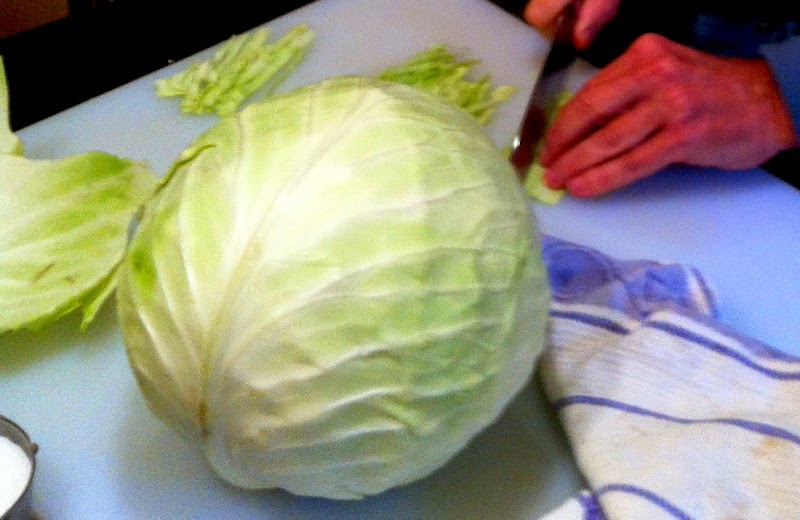
No, my heart belongs to the ordinary, everyday cabbage, its pale green leaves tightly bound into a waxy ball, the humble heads tucked coyly away in the corner of the produce section. It’s cheap, reliable, and flexible; who wouldn’t fall in love?

It doesn’t hurt that cabbage is good for me, lends itself to last-minute cooking, doesn’t cost much and grows, relatively speaking, in my own backyard.

Humankind’s relationship with Brassica started early. In his encyclopedic work Food: An Authoritative and Visual History and Dictionary of the Foods of the World, Waverley Root relates one ancient Greek belief of its origins: Dionysus, the god of wine, caught Lycurgus, the Edonian king, pulling up grapevines. While awaiting punishment, the king wept, and from his tears sprang cabbages.

An alternate myth has Jupiter sweating as he tries to explain contradictory oracles, and the cabbages sprout from his perspiration.

Those ancient Greeks might’ve been on to something. But given my devotion it seems more likely that Eros, the god of love, was involved.

Wild cabbages, resembling kale more than my beloved green globes, grew along the Mediterranean coast, and according to Harold McGee, in his book On Food and Cooking, the “salty, sunny habitat accounts for the thick, succulent, waxy leaves” that make cabbages so hardy. Domesticated about 2,500 years ago, cabbage spread across Europe.

Because it tolerates cold weather, cabbage became an important staple farther north, and we typically associate it with the hearty cuisines of climes damp and gray.

But the Romans, like me, loved cabbage, and they’re probably responsible for the selective cultivation that resulted in so many disparate variations. By encouraging an existing tendency for the curling leaves to form more tightly packed bunches, those early Italian farmers created today’s well-known “heading cabbages.”

Our name for these derives from the colloquial French word for head, caboche. Vegetable lore tells us that the Italian Catherine de’ Medici brought cabbage to France when she married fellow 14-year-old Henri de Valois, the Duke of Orleans and, eventually, King Henry II. History is silent as to whether she called him mon petit chou, or “my little cabbage.” But the endearment reflects the continuing French love of cabbage, from the choucroute of Alsace to the thick stew called gabure in the south.

Early cabbage fanciers also associated it with good health. Egyptians ate it with vinegar to prevent hangovers, Greeks dribbled cabbage juice into sore eyes, and Romans packed aching muscles with cabbage poultices. Herbalists today recommend cabbage for its anti-inflammatory effects, telling breastfeeding mothers to tuck a few bruised leaves into their bras for relief. It’s got lots of vitamins A, B, C, and E, and a study at Georgetown University showed how phytochemicals in cabbage might reduce cancer risks.

However, those same phytochemicals provide the frequently noted boardinghouse smell of overcooked cabbage, something that bothers others much more than it bothers me. Maybe I’m blinded, in an olfactory sense, by love, suffering from a cabbage-passion-induced anosmia. Or perhaps my approach to cooking mon petit chou reduces the breakdown of glucosinolates, the sulfur-containing compounds released when cabbage is boiled too long.

More likely, it’s the variety of cabbage. Brussels sprouts contain more of the healthful and stinky compounds than any of the other Brassicas. Heading cabbages, with their residual sugars, offer a sweeter love.

Farmers here in the Pacific Northwest harvest cabbage from mid-July through the end of December. Properly stored, it keeps for up to six months, so it’s theoretically possible to eat local cabbage all year. Prices vary, with conventionally grown cabbage usually less than a dollar per pound, organic about half again as much. Just before Christmas I bought an enormous head at a farmers’ market for only two dollars.

So, how do I love cabbage? Let me count the ways.
  1. I love it cooked in a little olive oil with onion. There’s a head of cabbage in the refrigerator and onions in the pantry most of the time, so I make this almost every week. But cabbage loves pork, and I love them together. So start with a little diced bacon, then sauté the onions and cabbage in the smoky fat. A dollop of crème fraîche makes both of these simple dishes unctuous and rich.
  2. A bed of shredded cabbage roasted under a chicken steals my heart.
  3. I love how the cabbage I add to my feeling-a-cold-coming chicken soup gives it enough substance to fill me up.
  4. I’m crazy for coleslaw, the green salad I turn to when winter’s lettuce comes wilted from a long truck ride north and again when the hot summer sun makes my garden’s leaves bolt and turn bitter.
  5. Je t’aime, choucroute braisée à l’Alsacienne: Julia Child kindled new passion for sauerkraut by teaching me to simmer it slowly for hours in crisp white wine.
  6. Marcella Hazan makes me cry, “cavolo sofegao, come sei bella,” with her Venetian-style smothered cabbage, another slow-cooked dish transformed with a splash of vinegar.
  7. Te amo cocido, tambien. While these one-pot Spanish stews often call for whole chickens, pigs’ trotters, veal shanks and a garden’s worth of vegetables, I make a simple version with just garbanzos, potatoes and cabbage.
  8. Louisiana-style smothered cabbage makes me ask, "how's ya mama and dem?"
Cabbage love comes in many other forms, and though the steady routine of our long-term relationship provides familiar comfort, I don’t want it to get stale. So I keep searching for new outlets for my passion, different ways to express my feelings, unexplored culinary territory where I can say, again and again, I love cabbage.