Showing posts with label mushrooms. Show all posts

Friday, October 11, 2019

Getting 'Shroomed: On the Mountain with Oregon's First Family of Fungi


"That's why we call it mushroom hunting, not mushroom picking."
- Jack Czarnecki on the rigors of foraging for mushrooms

The Czarnecki family is well on its way to becoming a mushroom foraging dynasty, with fungi running in their veins the way filaments of mycelia run under the forest floor. In 2012 I was privileged to meet Jack Czarnecki when I interviewed him for a story about Oregon truffles, then just beginning to be recognized as equals to their legendary cousins in France and Italy. Jack, the third generation of this restaurant family, migrated from his native Pennsylvania to Oregon so he could hunt mushrooms year round. Sensing my curiosity about his craft, he subsequently invited me to join him and his compatriots to climb in the legendary Trufflemobile on a hunt for their wiley prey.

Jack at Joe's Donut Shop on a previous hunt.

Jack, retired from restaurateuring as well as active mushroom hunting, has passed on the family's traditions to his sons Chris and Stefan. Chris, a chef, took over ownership of the Joel Palmer House in Dayton, assiduously maintaining its mushroom-centric focus while adding a more contemporary twist to its preparations. Stefan (top photo), who owns wine touring company Black Tie Tours, had announced he was taking a day away from that business to head up to Mt. Hood to hunt mushrooms for the restaurant, and I inquired if he might be able to squeeze in one additional passenger.

Dick Nelson, mushroom maven.

As with his father before him, we arranged to meet at Joe's Donuts in Sandy, a requisite stop for foragers to pay obeisance to the mountain gods for a successful hunt and a dandy place to get sustenance for what was sure to be a long day of clambering through brush and up and down hillsides. As we set out for the mountain, the shotgun position in the front seat next to Stefan was taken by his dad's longtime mushroom-hunting buddy Dick Nelson, as familiar with the spiderweb of rutted tracks leading to the best spots as was Jack. Much discussion ensued as to which spots might yield the best results, and a general plan was formulated.

White chanterelle emerging.

Our primary goal was to hunt matsutake mushrooms, prized for their distinctive spicy scent as well as their flavorful culinary properties. The "matsies" were just beginning to appear, pushing their way up out of the duff of the forest floor, often no more than a bump in the undergrowth or, at best, a glimpse of white through the needles. Second were porcinis, also considered a seasonal delicacy. Last but not least on the list were white chanterelles, cousins of the more ubiquitous gold-colored variety, and much more abundant than either the matsutakes or porcinis.

An early dusting of snow.

A dusting of snow covered the trees as we headed down the highway past Government Camp, turning off the main road to one of the secret spots euphemistically named for a distinctive feature like The Rocks or The Dock. A few favorite spots yielded a smattering of the targeted fungi, but it was our last stop, an anonymous wooded slope that I'd visited with Jack on a previous trip, that ended up yielding a small bonanza of matsutakes and a plethora of whites.

Dick finds the prized "matsi" of the day.

Fortunately I was with Dick, who would point with his walking stick—actually a mop handle he'd borrowed from his utility closet at home—at a slight mounded lump on the ground, suggesting I should brush aside some needles in case it might disguise a matsutake just popping up. Which it invariably would. These mushrooms need to be dug in their entirety rather than cut off at the base like the chanterelles, to reveal dusty, dry earth clinging to the base that, along with their distinctive aroma, is a telltale sign.

All told we gathered more than thirty pounds of mushrooms in five hours, most of which would be going to the Chris at the restaurant, but I was generously allowed to bring a few pounds home to roast and freeze for future dishes where I could relive the smell of the woods on our hunt, the bracing nip in the mountain air, and Dick's charming Mona Lisa smile.

Read more about this iconic Oregon family, including links to my articles on Oregon truffles and mushrooms. Top photo courtesy Stefan Czarnecki.

Sunday, February 17, 2019

Simple & Creamy: Mushroom chowder


In making the Choucroute Garnie featured in a recent post—it's an Alsation dish featuring sauerkraut braised for hours in chicken stock, with many meats added and then simmered some more—I apparently got a little over-excited estimating the number of potatoes that people might be hungry for. Then my husband and I got our wires crossed while grocery shopping and we ended up with an extra pound of cremini mushrooms.

To make a long story short, we had the aforementioned abundance of cooked potatoes and those mushrooms that were starting to look a little long in the tooth. Plus it coincided with our recent spate of late winter chilly temperatures hovering in the 20s and 30s. Always in the mood for a hearty soup—check out this 12-year collection of soup recipes if you don't believe me—I got the bright idea to make a mushroom chowder, albeit a vegetarian version since we're temporarily out of Dave's homemade bacon (a situation soon to be corrected).

To cut to the chase, this came together in about 40 minutes and was, frankly, the best mushroom soup I've had anywhere, including restaurants, that I can remember. (That opinion is backed up by those here who are not shy about criticism and not over-prone to praise, by the way.) And here's a wacky thought: If you should happen to leave out the potatoes, I'd even recommend it as a substitute if you've sworn off Campbell's cream of mushroom but still crave that comforting flavor.

Mushroom Chowder

4 Tbsp. butter
1 onion, chopped in 1/4" dice
3 cloves garlic, minced
1/2 c. celery, finely diced
1 lb. mushrooms, thinly sliced
6 oz. sour cream
3 Tbsp. flour
1/2 c. white wine
2 c. chicken stock
2-3 c. whole milk, depending on how thick you like your chowder
1/2 tsp. dried thyme
3 bay leaves
1 1/2 lb. potatoes chopped in 1/2" dice
Salt and pepper, to taste

In a large soup pot or Dutch oven, melt butter over medium heat.

Add onions and sauté until tender. Add celery and garlic and sauté until tender. Add mushrooms and sauté until tender.

Remove from heat and sprinkle flour over the mixture, stirring well to combine. Put back on medium heat and stir frequently to keep it from sticking, about 3 minutes. Add wine and stir, scraping any browned bits from the bottom of the pot, and allow to thicken slightly.

Stir in sour cream until smooth, then add chicken stock, milk, bay leaves, thyme and potatoes. Bring to a bare simmer. Reduce heat and simmer on low heat, just enough to keep it barely bubbling, for 30-45 minutes or until potatoes are tender. (As mentioned above, leftover boiled potatoes are entirely substitutable.)

If you have some excellent bacon (like Dave makes), start with 3-4 slices cut in 1/4" pieces. Place it in the heated pan before adding butter and sauté until it's cooked but not crisp, then continue with the rest of the recipe.

Friday, December 23, 2016

Travels with Chili: Overnight in Astoria (with Mushrooms)


Mention the word foraging. I dare you.

Chances are if I'm within earshot, I'll "lean in." And I don't mean that in a groovy,  women-in-corporate-boardrooms, outta-my-way-mister sort of way. I mean I'll literally walk over, shove my nose into the conversation and say, "Did I hear something about foraging? For what? Where? And can I come?"

Ranger Sam shows off an Amanita muscaria.

So by the time I got to the end of the sentence "I’m writing to see if you’d like to visit Astoria for a guided mushroom foraging trip…" I was already typing "yes" in reply to the e-mail from my friend Vicky Hastings, whose agency works with the Astoria-Warrenton tourism bureau.

You see, not only do I love hunting for mushrooms, I also adore Astoria. We've been there several times over the years and have watched it turn from a working port city on the Columbia into a great destination for day trips, overnight visits and vacations, all just a 90-minute scenic drive from Portland. Its dining scene has evolved from a few scattered cafés to one with several very good restaurants featuring local seafood, produce, breads, cheese and beer. And a new brewery seems to be popping up every few months to join ranks with the big kahuna that is Fort George Brewery.

The afternoon's haul.

Our first stop was at Fort Stevens State Park to meet Ranger Sam Gibson, a strapping young fellow with a big smile who was leading us on our foraging tour that day. Our group was small, just another couple and us, so we opted for the "off-road" tour that would give us more foraging time and less walking on trails to get to the more accessible—meaning more well-known and thus potentially picked-over—spots.

As we walked to a spot where Ranger Sam had found mushrooms in previous seasons, he gave us some historical background on the park, as well as pointing out some of the different varieties of mushrooms that we would be seeing during the afternoon. He said that the park staff had started offering foraging trips as a way to encourage people to discover its natural beauty during the winter months. (Contact the park office to arrange a tour, and check this guide for other foraging opportunities.)

Commodore Hotel lobby in Astoria.

Tramping up and down hillsides and gradually filling our bags with the large porcini mushrooms that were springing up out of the wet, moss and fern-covered forest floor, I was surprised when Ranger Sam mentioned that these densely forested hills were once barren sand dunes that had been planted with trees in the first half of the 1900s. Which is interesting, since Fort Stevens was originally constructed during the Civil War to protect the mouth of the Columbia River. Featuring eight gun batteries scattered across its more than 4,000 acres, those same trees have now grown to obscure the view of the Columbia from the batteries.

Lovell Taproom at Ft. George Brewery.

Saying goodbye to Ranger Sam back at the parking lot, we made the short drive into Astoria and our room for the night at the Commodore Hotel downtown. A restored 1925-era hotel that seeks to maintain its historic roots, it caters to modern guests with hipster amenities like beer on tap and an Ace Hotel-style lobby for communing. Rooms are updated with modern furniture and tiled bathrooms, but we were tipped off to a noise problem when we found packets of earplugs in the bedside table drawers—windows overlooking the street let in lots of light, but also lots of traffic noise, and the original wooden doors do nothing to keep out noise from the hallway.

IPA at Buoy Beer on the waterfront.

That said, Astoria's downtown district is bustling with activity and the hotel is within a few blocks of some terrific restaurants. We chose to go to Albatross & Co. across the street, chef Eric Bechard's intimate local watering hole-cum-oyster bar that has recently expanded its offerings to include a full dinner menu. Other dinner options nearby include the eclectically themed T. Paul's Urban Café, and Clemente's Cafe and Public House on the waterfront.

More casual dining can be had at any of the many brewpubs, including the aforementioned Fort George Brewery, as well as at Buoy Beer and Wet Dog Café, the taproom for Astoria Brewing Company. But a hidden gem we found this trip is the Lovell Taproom in the building next door to Fort George. An intimate pocket bar with a blazing fireplace, it often has special small-batch beers not found in the main brewpub next door.

Ordering at Street 14 Café.

The next morning we took the most direct route and checked out Street 14 Café, located on the first floor of the hotel. A comfortable cross between an espresso bar and an old-fashioned diner, the coffee is hot and strong and the food is affordable and delicious. If they could only get those well-seasoned waitresses with a coffee pot in one hand and a cigarette dangling from their lips, it would be the perfect throwback.

Monday, November 14, 2016

Oregon's Czarnecki Family: Four Generations of Mushroom Hunters


"My best memories growing up were foraging with the whole family, making a day of it," says Chris. "For us it’s always been about more than just putting food on the table. It’s getting out in the woods, being with nature."

The video above and the story that accompanies it, by writer Kerry Newberry for Travel Oregon, celebrates one of my favorite Oregon families, the Czarneckis. Jack (left), the patriarch of the clan, introduced me to mushroom foraging years ago, and I still relish a call to head up to Mt. Hood or over to the coast range to spend the day with this tireless man who sprints up and down Oregon's steep, forested hillsides like a deer.

Read more about my foraging adventures with him.

Thursday, October 27, 2016

Wild Chanterelles Mean Great Meals This Winter


I'm sure it comes as no surprise that I follow a few foragers on social media, people like Hank Shaw, Langdon Cook and Monica Wilde. I also have friends who forage professionally, like Jack Czarnecki and his sons Chris and Stefan, of the mushroom-centric Joel Palmer House in Dayton, Oregon. Then there are the myriad chefs, cooks and other folks I know who pull on their wellies and get out in inclement weather to hunt—not pick—our wild edibles.

So when I start seeing photos of wild-foraged chanterelles circulating around the ether, it gets my heart pining to head out into the woods myself with a basket and high hopes. I actually did get to do some foraging this last weekend at Fort Stevens State Park near Astoria on the Oregon coast, but it's more well known for its porcini mushrooms, or boletus edulis, than chanterelles, due to the mix of trees planted on its former sand dunes.

Not that I was complaining about the three pounds of boletes we found there, not at all. (I wouldn't want to tick off the mushroom gods, after all.)

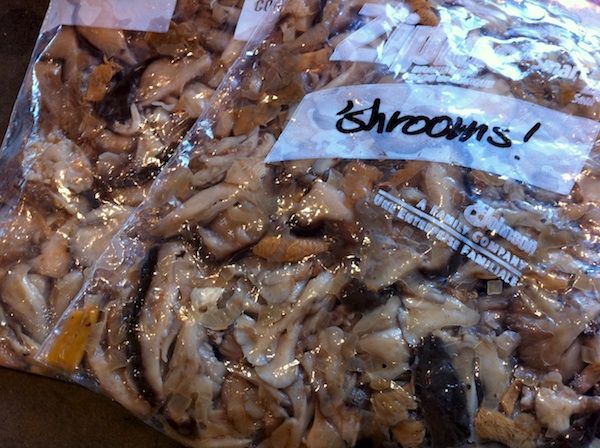
Luckily for Portland folk there are plenty of wild chanterelles available at local farmers' markets and stores—some even have special sale prices—so I've been able to stock up on those chanterelles in case I don't get out in the forest soon enough to catch them at their peak. An hour of roasting in the oven at 400°, draining off the juices a couple of times for the deliriously delicious mushroom stock that'll get used in risottos and chowders, and then popping the roasted mushrooms into zip-lock freezer bags. Then I'll have plenty of braises, soups and other delights to look forward to this winter.

So far we've had chanterelle quesadillas (thanks Kim Severson), a stunning mushroom chowder and last night a coq au vin with roasted yams that blew away any other chicken dish we've had lately. Fast, dead simple and so delicious, it was lucky that there were any leftovers for Dave to take to work for lunch today. Seriously, this is a company-worthy dinner, and would be more than adequate using regular mushrooms. But to send your guests into the stratosphere, invest in a pound of the wild things. You won't regret it.

Coq au Vin with Chanterelles and Roasted Garnet Yams

For the chicken:
3 Tbsp. olive oil
3 lbs. bone-in, skin-on chicken thighs (approx. 10)
1 onion, roughly chopped
4 cloves garlic, minced
1 lb. chanterelles or other mushrooms, roughly chopped or 1 cup pre-roasted mushrooms
1/2 tsp. dried thyme
2 tsp. dried basil
1 c. dry white wine
Salt to taste

For the yams:
4 medium-sized garnet yams

Preheat oven to 375°. Bring a medium pot of water to boil. Cut yams in quarters. When water boils put yams in boiling water, let it return to a boil and cook for 3 minutes. Remove and transfer to baking sheet, skin side down. Place in oven and roast for approx. 45 min. or until tender. Turn off oven until chicken is done and serve alongside.

While yams are baking, place a large skillet over medium-high heat and add oil. Heat until oil shimmers, then brown the thighs on both sides in batches, removing to a plate as they're browned. When thighs are browned, add onions to the fat in the pan and sauté until translucent. Add garlic and chanterelles and sauté until tender. Add herbs and stir in, then pour in wine. Put chicken thighs into the pan with the vegetables and wine. Bring to a boil, then reduce heat to a simmer. Cover and simmer 45 minutes. Add salt to taste. Serve.

Monday, September 28, 2015

Chanterelles: NW Forests, Golden Goodness


It's like an equation: Deep piles of Douglas fir needles plus cool Northwest rain equals…chanterelles! There's nothing like running across a patch of these unique and beautiful beauties while hiking in the woods, or even coming across piles of them in the produce section at your local market. Buttery, rich and tender, they're terrific plain or tossed with pasta. Contributor Jim Dixon of Real Good Food gets us started.

While the month's dry weather makes wandering through the forest looking for mushrooms very pleasant, some rain would make foraging more productive. But there are still plenty of chanterelles popping up, and if you don't find any in your favorite secret mushroom patch, head to the farmers market or a well-stocked produce department.

Funghi Trifolati

Trifolati means cooking in olive oil, garlic, and parsley, and mushrooms or funghi trifolati appear regularly on northern Italian antipasti tables. Mushrooms contain both fat and alcohol-soluble flavor compounds, so a splash of wine brings out even more mushroom-y goodness. And while it's not part of the Italian approach, starting off with a dry sauté concentrates the mushroom flavor and improves the texture dramatically.

I learned the method from an old mushroom-hunting guide called All That the Rain Promises, and More, and I always cook mushrooms like this:

Slice or tear the chanterelles into pieces and put them into a hot skillet, preferably cast iron, with nothing else. Keep the heat on medium-high, and within a few minutes the funghi will start releasing water (add a pinch of salt to help drive out the moisture). Cook, stirring frequently, until the water has almost disappeared; the time will depend on the moisture content. When the bottom of the pan starts to look dry, add a generous pour of extra virgin olive oil and a little chopped garlic.

Cook for a minute or two, then splash in a bit of white wine and let it cook down for another minute or two. Remove from the heat and add some chopped flat-leaf parsley and a few grinds of black pepper. If you're feeling Italian, eat these by themselves as an antipasto. Or spoon onto a slice of grilled bread, toss with a little pasta, or stir into scrambled eggs.

Read about one of my first mushroom hunts with Oregon mushroom guru Jack Czarnecki, and get links to more recipes at the bottom of the post.

Tuesday, June 10, 2014

With Mushrooms, It's All About the Hunt


When the caller ID on my phone says Jack Czarnecki, I don't wait for the second ring before I pick up. When he says to show up at his home in Dundee at 7 a.m. the next morning, I don't whine about having to leave our place at six in order to get there on time.

One of many mountain backroads.

When the mushrooms are calling from the places known among mushroom cognoscenti as The Green Gate or The Ditch in the Three Sisters Wilderness, part of the Deschutes National Forest in the Cascade mountains of Central Oregon, Jack will be there to answer. He and a couple of friends will climb into the Subaru wagon, dubbed the Trufflemobile, with its customized shelves to hold the baskets he hopes to fill. Then he'll drive for hours on winding tracks through the mountains to hunt them—it's called "hunting," not "picking," for a reason, he says—in the locations he's been checking for years.

Butter boletes, Boletus regius.

Some are little backwoods campgrounds—our prey, the boletes, particularly love to cluster around the outhouses, he notes—and others are simply stops on the single-lane, rock-strewn Forest Service roads, places that have proved their worth over the years. New spots, like one we happened upon on this trip, are found by "road hunting," creeping along in the car scanning likely-looking banks or pine groves for signs of mycelial activity. It could be a bump in the needle-strewn duff, or a dark crack in the dirt or even a suspicious rock, but each one will be stopped for, evaluated and poked to see if it relinquishes a prize.

Side benefits? Beautiful woods.

The hunting this spring has been sparse, and compared with previous trips there was very little fungal activity in the form of other mushroom species, not even "blow-outs" or old, decomposed patches. Even the much-grumbled-about "commercials," the mushroom hunters who swarm over the mountains and eke out a living selling their harvests to middle men who in turn sell to chefs and markets all over the country, have all but (temporarily) given up the area to pursue more plentiful "flushes" of mushrooms elsewhere.

After several hours of hiking up and down steep banks and through shaded groves we managed to find a couple of porcinis and a decent basket of the red-capped butter boletes, but the season hasn't yet revealed its full potential, if it ever will. But a chance to spend a day in the woods with Jack and his friends, with gorgeous weather and stunning views of my beloved Cascades? Priceless.

Read about previous mushrooming trips with Jack.

For more information on the commercial mushroom business, read Langdon Cook's excellent book, The Mushroom Hunters: On the Trail of an Underground America.

Wednesday, October 02, 2013

Into the Woods with Jack


I heard my e-mail inbox ping with an incoming message.

The subject line: "Sharoooooms!!!" It was from one of my favorite people, Jack Czarnecki, Oregon's master of fungi and maker of truffle oil. He was inviting me along to forage mushrooms with two of his most eagle-eyed compatriots, Dick, whom I'd met on a previous expedition, and Chris, who, like Dick, is a retired teacher. I've been on a few expeditions with Jack gathering these denizens of the forest deep, and it is always an educational, entertaining and thoroughly exhausting experience, since he moves like a bear up and down hills, tirelessly seeking his quarry.

First stop, Joe's Donuts.

Our quest this time was for matsutake mushrooms, highly sought-after for their distinctly spicy, sweet aroma. Jack said he loves them for the persistence of their flavor when cooked, unlike many mushrooms that tend to lose the intensity of their flavor when combined with other ingredients. We'd also be picking up white chanterelles, which flush in the same locations as the matsutakes. Both would be featured on upcoming menus at the Joel Palmer House, where Jack's son Chris has taken the helm, allowing his father to 'shroom at will.

Find the five matsutakes.

Since we were heading up on the flanks of Mt. Hood to various hunting grounds that he and his pals had explored before, we met up at Joe's Donut Shop in Sandy, a requisite stop to ask Wy'east's blessing for the hunt and to plot the day's traverse of the mountain. After consuming coffee and several of Joe's namesake pastries (I particularly liked the applesauce, though they've now got pumpkin on the list), we headed out, turning off onto a series of Forest Service roads to the first in a series of stops.

Out in the open.

Though there were jokes about blindfolds, Jack knows I'm completely befuddled once we get off the main highway. Plus the fact that he knows the narrow, rutted roads like the back of his hand and drives them accordingly. In the car he described the matsutake and its habits like it was a member of the family, complete with tales of chance meetings and great hunts past.

But once we stopped the car and got out, he was all business. He handed me a long-bladed knife, scoffing at the Swiss Army knife I'd brought as insufficient to dig out the deeply rooted matsutake. Since I'd never foraged for this particular mushroom, and the fact that it can at first look like a number of deadly amanita mushrooms, he took pains to show me how to properly identify it.

The telltale dusty root.

The matsutake, like many fungi that grow in the forests of the Pacific Northwest, are found in areas where there is deep, moist duff from the fir trees. Sometimes they're sticking up from the surface, but most often you'll spot one barely emerging from under a hat of fir needles, or even still beneath the surface, only given away by an oddly placed hump on the forest floor. The good news is, they tend to erupt in clumps, so once you see one breaking the surface it's good to scan the area for any cracks or clumps that indicate other matsus nearby.

Jack spotted some almost instantly, and said it was important to get the whole mushroom out, root and all. That's because the most important indicator of the matsutake is at the root end, where it will have an ashy, grey dust clinging to it. The second indicator is the sharply defined gills under the cap, which emit the distinctly spicy, sweet aroma this mushroom is known for.

A happy man.

After this lesson, Jack let me go off on my own, though I always kept in sight of one of the veteran foragers, not only because they had walkie-talkies, but because they always knew how to get back to the car, a crucial skill when you're wandering around in the wilderness. Fortified by Heidi's forager's lunch (huge cold-cut, cheese and onion on rye sandwiches and her signature giant chocolate chip cookies), and after making several stops that filled up the back of the Truffle-Mobile, Jack's trusty Subaru wagon, we headed back to town.

As big as my head!

The guys were particularly impressed by my find of not just one, but three huge cauliflower mushrooms (ahem), in addition to a not-too-shabby-for-a-beginner matsutake and chanterelle take. Summing up over the required dinner at SE Powell's Om Seafood—mushroomers are apparently big on talismans in the form of restaurants—Jack said that in all his years in Oregon, going on two decades now, this may be the best year he's seen for mushrooms of all sorts. It was theorized to be some combination of warm-but-not-too-hot days followed by rain but not-too-much rain (it's like talking to vineyard people) that caused the crazy flush of all kinds of hot mycorrhizal action.

Whatever the reason, it was a thrilling day, not only because of the amount of mushrooms taken, but because I got to be one of Jack's select crew, a compliment of the highest order. Thanks, Jack!

Tuesday, July 09, 2013

Mushrooms That Taste Like Bacon?


Mushrooms are said to have a "meaty" texture, which is why they are often used as a substitute for beef in hamburgers. Contributor Jim Dixon of RealGoodFood writes that they can also take on the flavor of bacon when roasted over a (real) wood fire.

When the sun is out, I want to cook outside. Summer in Portland is just too nice to spend time in the kitchen when I could be in the backyard. So I use my Weber as much as I can. If you don’t have some kind of grill, get a Weber kettle or the generic equivalent (look on Craigslist, they’re cheap). You also need a charcoal chimney (available everywhere) and real wood charcoal, preferably not mesquite, which I think burns too hot; True Value hardware stores or Whole Foods are the most reliable for hardwood charcoal, sometimes called lump fuel.

I don’t like gas grills, but they have their advocates. The chef and owner of Cochon and Peche (some of my New Orleans restaurant customers) said it best recently. Something along the lines of, “If you have a gas grill, the first thing is to get rid of it.” Gas grills will cook outside, but you can’t get the smoky flavor of a real wood fire, and you need it to make these.

Mushrooms That Taste Like Bacon

You’ll need a covered Weber-like grill to make these, and a cast iron skillet would be best, although any heat proof pan would work; it does need to fit into your grill but only cover about half of it. Thinly slice enough mushrooms to fill the skillet or pan pretty full (they’ll shrink). Drizzle with extra virgin olive oil, add a good amount of good salt (the Sicilian fine sea salt, for example) and some freshly ground pepper.

Light some hardwood charcoal in your chimney. When it’s burning, make a pile at one end of your grill so the skillet can sit on the grill grate without being directly over the fire. Did I mention that you’ll also need a chunk of actual hardwood, like the trimmings from a fruit tree (what I use) or a piece of oak? You can buy hardwood chunks for barbecue, and one of those would be fine. Put it on the grill grate over the fire, and put the skillet of mushrooms at the other side. Cover the grill; within a few minute you should see smoke coming out of the vent on the lid (make sure it’s open).

Cook the mushrooms for awhile. Check them every so often to make sure they’re not burning (get an oven mitt; that pan will be hot!). Cook until the mushrooms are shriveled up and a little crispy, maybe an hour, although your time might be vary because every fire is different. Remove the skillet without burning yourself, put it on a heatproof surface to cool a little, and eat the mushrooms like bacon.

Thursday, June 27, 2013

"You've Been 'Shroomed."


Jack Czarnecki loves to take newbs out and demonstrate the wonderful world of mushrooms, edible or not. And who better to introduce the subject than this bacteriologist-cum-restaurateur who moved to Oregon specifically because he could hunt his favorite fungi 365 days a year?

Mushroom pros on the prowl.

He goes out looking for the ones he can take back to his son Chris, who is the owner and chef at the legendary Joel Palmer House in Dayton, a shrine to mycelium that Jack and his wife Heidi opened in 1996. But he also picks up oddball specimens, like the creamy butter-yellow individual we ran across on a recent foray for porcinis and butter boletes. He said he'd never seen this particular mushroom before, indicating it would be duly noted and identified when he got back home to Dundee.

Dick scores the first porcini.

He describes finding his earthy prey like a series of shots of pure dopamine to his brain. "There's the five-minute mushroom," he said of the effect, when he gets discouraged, of finding the object of his quest.

"Then there's the 10-minute mushroom," either a nice specimen or a small patch. But a mother lode of hidden gems or, even better, an as-yet-undiscovered location that the "commercials," the foragers who sell to buyers who supply stores and restaurants, haven't found? That's anything from a two-hour high to a fix that'll last all day.

I actually found some, too!

"We're going to take you through the back door," he said when he invited me along on a recent trip to search out early summer porcinis (Boletus Rex-veris) and butter boletes (Boletus regius) (top photo). Visions of Alice in Wonderland filled my head, but having been out with Jack before on a hunt for the Oregon white truffles that lace his Oregon white truffle oil, I knew it would be a day of tromping in the woods and an education in the where, what, when, why and how of species I'd never encountered before.

At seven in the morning I parked Chili in the parking lot of a large box store in Salem and Jack drove up in his Subaru wagon, dubbed the Truffle-mobile, and introduced me to his mushrooming pal Dick, a retired teacher and fellow fungus addict who'd be coming with us this trip. We drove up the Santiam Pass to a series of locations in the Cascades that will, of course, remain undisclosed except to say that they were at elevations of 4,500 to 5,000 feet. Any threats of excommunication (or even execution) weren't necessary, since Jack pilots the dizzying web of gravel and cinder forest roads, some more like paths, of the backwoods like the familiar he is.

Porcinis hide in plain sight, in singles and pairs.

In the decade-plus that he and Dick have been hunting together, their favorite spots have been given descriptive names like The Rocks, The Ditch and The Mound, and we were going to hit most of them and more that day. These guys are relentless, barely stopping to eat lunch or have a cup of coffee during a 14-hour-day on the hunt for their elusive prey.

Each stop had the same pattern: stop the car, pile out with bags and knives and walk to some previously productive patches, sometimes scrambling down banks or hiking up hillsides to check the area. At first there don't seem to be any mushrooms in sight, just twigs and branches and leaves scattered across the ground, but as my eyes adjust to the landscape I start seeing beyond the litter and notice the bumps and eruptions that indicate the (potential) presence of a fungus.

Porcinis: more mature, left; less mature, right.

In the case of the porcinis, we'd look for patches of disturbed needles or tilted "lids" of litter. Tip the lid off or brush aside the detritus and it might be a fern pushing its way into the light or…wait…the brown-ish amber cap of a mushroom. Haha! Then it's brushing aside more duff and, using my pocket knife, slicing it off at the bottom of the stem.

The smaller,  less mature porcinis have more firm, dome-shaped caps with white, spongy-looking undersides, rather than the gilled mushrooms like button and portobello I'm familiar with from supermarkets. The caps of more mature porcinis grow broader and flatten out, the undersides getting a yellow tinge. Eventually the edges of the caps start curling up, the whole mushroom gets soft and spongy and the underside can become greenish-yellow and quite buggy.

Butter boletes.

Up to that past-its-prime point, however, in the second stage where the cape and stem are firm and the underside is yellow, the underside can be separated from the main body, which is used in sautés or duxelles. Jack mentioned that some people will dry the yellow undersides and crush it into powder, using it to bump up the mushroom flavor of recipes.

As with most hunting expeditions, there were many hours of searching interrupted by moments of excitement. The hours between were filled with stories of a particularly nice find from a previous trip, the time that Dick came back from a search to find a footprint he'd left in the dirt an hour earlier had sprouted a fully formed mushroom, or the trip where the very road we were on had sprouted a fine patch of mushrooms.

Half the haul, about 12 pounds.

After harvesting a big basket of porcinis, it was time to move on to the butter boletes, also known as royal bolete or red-capped butter bolete, a mushroom I'd never heard of. In its earlier stages it lurks underground in a perfectly edible state, and you'd never know it was there except for a handy, if fatal (for it), flaw. It tends to grow in patches, so a suspicious hump or crack in the dirt or litter on the ground might reveal a slightly more mature cousin, which results in a thorough search of the ground within a foot or so. At one point I found myself standing frozen on a particular spot, feeling like I could be missing a mother lode, thinking, "They're right under my feet!"

The sun was setting and, 30 pounds of mushrooms richer than we started out that morning, the two mushroom maestros were thinking it might be time to head home. And here, at last, is one location I can mention that won't get me in trouble: on the way home from (mumble mumble), I was informed it is long-standing tradition to stop in Mill City for pizza at Giovanni's Mountain Pizza. Really good, hand-thrown pizza with mega-toppings and lots of microbrews by the bottle, this place is a small town, way-under-the-radar cafe that, according to Jack and Dick, also has nice calzone, spaghetti and lasagne. It's a perfect way to toast a successful day getting 'shroomed.

Thursday, February 24, 2011

Magic Mushrooms


I love my little upright freezer. It allows me to buy berries with impunity, pulling them out on cold, rainy days when I desperately need a reminder that summer will, indeed, come again. And because I usually had my nose in a book when my mother was hauling out her big speckled enamel canner, all I have to do now is dump the roasted tomatoes from the grill into freezer bags and pull them out when pizza or pasta requires saucing.

On those nights when it's time for dinner (again???) and ideas are in short supply, I can open the door, survey the stocks, meats and sauces and come away with armloads of inspiration.

So when a couple of pounds of Springwater Farms'  gorgeous fresh mushrooms followed me home from the Hillsdale Farmers' Market, I tore them up, sautéed them with some shallots and white wine and spooned them into a couple of freezer bags. It's pretty much guaranteed that soon I'll open that door again and hear a whisper about ragu or risotto or chowder.

Wild Mushroom Duxelles

2 lbs. wild mushrooms
2 Tbsp. olive oil
2 shallots, minced
1/4 c. dry white wine or dry vermouth

Tear or slice mushrooms into bite-sized pieces. Heat oil in a skillet, add minced shallots and sauté briefly to warm them. Quickly add mushroom pieces and sauté until they release their juices and pans looks dry. Add wine and sauté till most of the moisture is evaporated. Allow to cool. Can be used immediately or put in freezer bags and frozen for later use.

Thursday, November 18, 2010

Wet and Wild


My friend Donald Kotler loves to grow vegetables for his café, Toast, in southeast Portland. What he can't grow himself, he'll sometimes contract with local farmers to grow for him or buy from farmers directly.

He's also a forager extraordinaire, and when he mentioned going out to hunt down some wily late-season chanterelles, it was all I could do not to drop to my knees and plead to go along. And, a couple of weeks later, head out we did on what turned out to be a drenchingly wet November day, with temperatures plummeting into the mid-40s.

One of the rosy-pink mystery mushrooms.

Since most of his favorite spots are three to four hours away and we both had to get back to town by mid-afternoon, Donald decided to head up the Gorge on the Washington side and see if we could find some likely locations. Turning off the highway past Camas, we drove up a forest road, pulling off to investigate a couple of spots that Donald said "didn't feel right" and then eventually parking at a gated side road that looked like it hadn't had much traffic of late.

Another mystery mushroom.

Mushroom hunting is akin to other types of hunting in that you basically charge off into the underbrush, over fallen trees and through thickets. The best places don't feature groomed trails or signage ("Mushroom picking 100 yards ahead" signs are rare), and you have to be prepared to climb steep hillsides, slide down muddy embankments or bushwhack your way through the underbrush that grows up out of the Doug fir duff where you'll find your prey.

The other key, particularly if you're like me and your sense of direction goes out the proverbial window when you're in the woods, is to go with someone who possesses an unerring sense of direction, i.e. who knows where they left the car. The only other gear required is a bag for your booty, should you find any, and a pocket knife for cutting the mushrooms, rather than yanking them up and potentially damaging the root that will sprout new mushrooms. An experienced guide with a well-thumbed guidebook is also valuable.

The haul, cleaned and drying out a bit.

We began on one side of the road and found several kinds of mushrooms, some small and brown (Donald calls them LBMs for Little Brown Mushrooms), others amber-colored and some with a rosey pink glow on top and white gills underneath. Like the other trips I've made to hunt fungi, at first I find myself overwhelmed by the sheer complexity of what I'm looking at, with fallen leaves, moss, fir needles and shrubbery competing for my attention. But then I'll see one mushroom, then a few more, and eventually I'm able to pick out the ones I want from the visual noise of the forest floor.

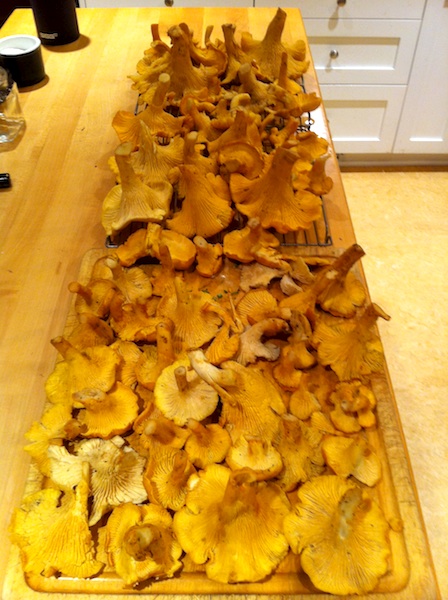
After crossing the road, we came on several patches of chanterelles that were, like us by this point, a bit soggy from the rain. But the thrill of finding first one, then another, then a few together was thrilling enough to keep us looking until we had four or so pounds between us, at which point we reluctantly agreed it was time to head back. I'm just hoping I'll remember where it was when the season rolls around next year, but even if I can't I'll know better where to look if I stumble across a place that, in Donald's words, feels right.

Find directions on how to roast mushrooms for freezing or use in other recipes like Wild Mushrooms with Pasta and White Wine Sauce, Mushroom Risotto with Truffle Shavings, Springwater Farm Cream of Mushroom Soup and Mushroom Quiche.

Wednesday, September 22, 2010

My Dream Café


If contributor Jim Dixon of RealGoodFood opened a café, I'd eat there on a regular basis. The atmosphere would be convivial, with lots of conversation and laughter. The staff would be friendly yet professional, long-time servers who know (and enjoy) their customers and love food. And the ingredients would be first-rate, with Italian olive oils, grains and beans instinctively combined with the freshest seasonal produce to make simple, satisfying fare.

While I’m not really thrilled with the rain (September is usually Oregon’s best month, sunny warm days and cool evenings), it does mean more mushrooms. Some old friends have a cabin near Trout Lake, and they recently brought us a big bag of white chanterelles from the slopes of Mt. Adams.

Chanterelles and Corn

I cook mushrooms using the dry saute method from Dave Arora's "All That the Rain Promises and More,"a handy guide for funghi lovers. Chanterelles split naturally from top to bottom, so after washing and picking out the fir needles, I tear them into 3-4 pieces, then toss into a dry skillet over medium heat.

The mushrooms will quickly begin to give up their moisture. Watch them closely, and when most of the liquid has cooked off, drizzle with extra virgin olive oil and cook for a few more minutes. A sprinkle of flor de sal and they’re ready to eat.

With these white chanterelles, I splashed a bit of white wine into the skillet and added a chopped shallot along with the olive oil.

I’d also picked up a few ears of fresh corn  at the farmers market, and while I hadn’t meant to combine them with the mushrooms, serendipity brought them together.

I cut the kernels from the cobs, tossed them in a skillet with olive oil and salt, and roasted the corn until nicely browned. Both the roasted corn and chanterelles were served as side dishes, but I couldn’t stop mixing them on my plate. The sweet corn and umami-rich mushrooms seem made for each other. While we should have chanterelles around for at least a few more weeks, fresh corn will be over soon, so pick up a few ears and celebrate the last gasp of our crappy summer.

Top photo from Langdon Cook's Fat of the Land, a terrific blog about foraging in the Northwest.

Thursday, April 01, 2010

In Season NW: Spring Sensations


Contributor Jim Dixon of RealGoodFood has a booth at the Portland Farmers' Market on Saturdays in the South Park Blocks (look for the large "Olive Oil" sign…that's him), so he's always up on what's in season and looking good. Plus he's a terrific cook and one who's willing to share his latest finds.

Pasta with Nettles and Maitakes

Both maitake mushrooms (above) and stinging nettle should be at the farmers market this time of year. They provide an alternative to the usual spring ingredients like fresh peas or asparagus. Maitakes are also called Hen of the Woods (Grifola frondosa for the mycologists), and the clusters of frond-like fungi can be simply broken up for cooking.

Start the pasta water first. Cook the nettles separately in boiling, salted water for a minute or two [be sure to handle with gloves when they're fresh…they're not called stinging nettles for nothing! - KAB], then squeeze out the water, chop coarsely, and set aside. Strain out debris and save the cooking water (also called nettle tea) and use it for soup.

Chop a couple of garlic cloves and sauté them briefly in olive oil with a pinch of sea salt. Add the mushrooms and cook for about 10 minutes on medium heat. Pour in a splash of white wine and let it cook down. Add the chopped nettles. Taste, add a little salt if necessary, and remove from the heat until the pasta is ready.

In the meantime you’ve cooked a pound of pasta (a short shape like orechiette or rigatoni works best) in salted water. Drain, reserving a bit of cooking water, and add the pasta and couple of spoonfuls of pasta water to the mushroom mix.

Add a cup or so of bread crumbs to a little olive oil in a skillet and cook for a few minutes, until they darken a bit. Stir into the pasta. Serve with good extra virgin olive oil and Parmigiano Reggiano.

Tuesday, January 19, 2010

Crustacean Celebration: Chowder-rific!


Can you say $2.99 to $3.99 per pound for cooked crab on sale?

Why so cheap? Well, crab season is winding down, and prices are falling at the store for this most precious of seasonal delights. In the spirit of getting it while the getting's good, we attended another crab feed with friends Denise and Keith the other night for an evening in their new garage and a rousing game of flip-cup. (Trust me, it's not a game you want to play in the house.)

Then last night, since my friend Norma Cravens of Springwater Farm had blessed me with her recipe for a crab and mushroom chowder and I wanted to try it before the crabs scuttled away till next season, I ran to the store and picked one up. Cooked and cleaned, of course.

With the recommended dash of dry sherry, this is a magnificent chowder, more stew than soup, and definitely guest-worthy with a crusty loaf and Caesar salad. Rich and luscious, it would be perfectly complemented by a smooth sauvigon blanc or bright French chardonnay.

All I can say is, "Thanks, Norma!"

Crab and Wild Mushroom Chowder
Adapted from Norma Cravens of Springwater Farm

2 tsp. unsalted butter or margarine
1 Tbsp. garlic, minced
1/2 c. yellow onion, finely chopped
1/4 c. celery, minced
1 leek, white part only, chopped fine
1 lb. fresh mushrooms, coarsely chopped
1 Tbsp. dry sherry
2 russet potatoes, diced into ½ cubes
4 c. chicken stock
2 Tbsp. arrowroot or cornstarch
1 tsp. freshly ground black pepper
1 Tbsp. sea salt, to taste
1 c. heavy cream (or Tofutti sour cream for the lactose-intolerant)
1 lb. or so fresh crab (meat from 1 med. crab works great)

Melt the butter in a large pot over medium heat. Sauté the garlic, onion, celery and leek in butter until the onion is translucent. Add the potatoes and sauté briefly. Add mushrooms and sauté till tender. Add the sherry and cook for 2 minutes longer.

Add the chicken stock, raise the heat to medium high and bring to a low boil. Blend the arrowroot with enough cold water to form a thick slurry. Slowly add the slurry to the stock while whisking gently, and return to a boil until the mixture begins to thicken slightly.

Reduce the heat and simmer until the potatoes are fork tender. This should take between 20 and 30 minutes. Stir in the salt, pepper and cream and return to a simmer. Remove from heat.

Divide the crabmeat into 8 heated bowls, then add the hot soup and serve.*

* I reserved the larger pieces of crab meat from the legs and claws and used them as a garnish for each bowl, sprinkled with finely chopped parsley.


Check out these other examples of the crabby-licious goodness that is the Crustacean Celebration at GoodStuffNW: pasta with crab and radicchio; hot artichoke and crab dip; crab crostini; killer crab cakes; Beach Cioppino and, of course, a crab feed.