Thursday, January 28, 2016

Superb Squash Risotto (at Last)


I don't have the engineering gene. I know this because, not only do I have several engineer-type friends who love nothing better than twiddling and fiddling and tweaking whatever their project of the day is, but I live with two people who have E-N-G-I-N-E-E-R spelled out in bold letters in their DNA.

Insanely beautiful, incredibly good.

My husband, for instance, decided he wanted to make sourdough bread. Not just any sourdough bread, mind you, but the perfect sourdough loaf. He harvested yeast from the bottom of a bottle of beer—Doggie Claws from Hair of the Dog, to be exact—and made his own sourdough starter. Then he spent, oh, about two years testing recipes from various sources, none of which gave him the result he was looking for but which we were obliged to consume. Fortunately some friends (bless you, Kathryn and Jeff) gave him the Tartine Bread book (and bless you, Chad Robertson), which in no time at all sent him into a baking-in-cast iron frenzy and supplied us with divine homemade bread thenceforth.

Of course, that didn't stop him. Oh, no. Since then he's experimented with various combinations of flours—all-purpose, whole wheat, barley, rye—from different places—Bob's Red Mill, Ayers Creek Farm, Camas Country Mill—to find out what effect they had on his loaves. He's tweaked the number of times he folds (not kneads) the dough, and how long it sits before he bakes it (currently at three days from start to finish).

I'm telling you, this is so beyond my patience level.

The sauté before adding liquid.

One example is squash risotto. Tried one recipe, it didn't really turn out the way I'd hoped, so I abandoned it. A year or so later, tried another one, was disappointed again. That pretty much ended my interest in experimenting.

Then one evening there were a couple of delicata squash that had been sitting on the counter and needed to be used, so I thought, well, why not. The skin of delicatas, as you probably know, aren't tough and can be eaten without peeling. So, remembering a beet risotto recipe that starts with raw beets, I whacked them into half-inch cubes and tried one…last…time.

A half hour or so later, I brought it to the table and…it was great!

And while it may not be a whiz-bang, James Beard-award-ready version, I think it's pretty darn good and meets my non-engineer standards for a one-dish, hearty and tasty meal. But those of you who do have that fiddly, twiddly, tweaky bent can feel free to have at it. I'm happy with it as is.

Delicata Squash and Kale Risotto

2 Tbsp. butter
3 Tbsp. olive oil
1 onion, chopped fine
3 cloves garlic, minced
2 delicata squash, seeded and cut in 1/2” cubes*
2 c. arborio rice
1/2 c. white wine
4-5 c. stock
2 c. kale or other leafy green (spinach, chard, arugula, etc.), sliced in thin strips (chiffonade)
1/2 c. Parmegiano Reggiano plus more for sprinkling

Heat oil and butter in deep skillet over medium-high heat. Add onion and sauté until tender. Add garlic and sauté briefly until fragrant. Add rice and sauté for a minute or two, then add squash and white wine. Stir until wine is absorbed, then start adding stock a ladle at a time, stirring often (though you don't have to stir it constantly). As each addition of stock is absorbed, add more until the rice is tender but still has a little crunch. Add greens and stir until it wilts. Add 1/2 c. cheese and stir. Serve.

* I also made this recipe using roasted, peeled and cubed Sibley squash and it was terrific, so feel free to sub in your favorite squash.

Wednesday, January 20, 2016

Need Winter Greens? Check Your Sidewalk!


It's the time of year when I'm longing for the appearance of spring greens like fiddleheads, nettles, miner's lettuce and the various sprouts of cruciferous vegetables known as raab or rabe. After all, on my dog walks through the neighborhood I'm seeing the first shoots of daffodils poking up through the dead leaves from last fall, and my daphne is already sporting pink heads of the blossoms that will be perfuming my front walk in short order.

Now my friend Katherine Deumling of Cook With What You Have has just reminded me that a great source of fresh greens is to be found by simply stepping out my front door. Better yet, they're free! Hairy bittercress, aka Cardamine hirsuta, is a member of the mustard family with the same peppery bite as its leafier cousins. The bane of gardeners and farmers alike, it can take over a raised bed in no time when its seed heads explode, giving it the moniker, or rather the much-cursed name, of pop weed.

A quick sweep around the yard revealed tons of the little buggers coming up in all the garden beds, with some more mature clumps like the ones above hanging out on some freshly turned flower beds.  To use in cooking, look for them in places you're sure haven't been sprayed with chemicals, and that are out of the reach of dogs who may have a yen to mark the spot for some reason. Bring them in, rinse them off and chop at will. Katherine recommends using them in deviled eggs, and says they're also terrific added to a salad, a sandwich or a quesadilla for a mustardy zing.

Brussels Sprouts? Burn 'em!


And no, I don't mean at the stake, though served with a nice steak might be just the ticket. Here contributor Jim Dixon of Real Good Food extolls both his love for this brassica and his penchant for getting a certain reaction.

Of all the Brassicas, Brussels sprouts caramelize the best (or maybe it's the Maillard reaction; food chemists can sort that out). When I want to cook sprouts, "burning" is my first choice. Cut them in halves or quarters lengthwise (I like quarters since they provide two flat surfaces). Use a heavy skillet, preferably cast iron, that's big enough to hold the sprouts in a single layer.

Heat enough extra virgin olive oil to cover the bottom of the skillet over medium high for a few minutes, then add the sprouts (include any bits of leaves that might come off when you're cutting them). Use tongs or your fingers (carefully!) to arrange them so a flat side is down, then cook for about 5 minutes. They start to color very quickly.

Turn them over and brown the other flat side for awhile, then go ahead and stir randomly every few minutes. When they're very brown or even slightly burnt looking, add a sliced red onion (or any onion, but I like red onions with sprouts) and a good pinch of salt. Turn the heat down a little and cook for another 10 minutes or so until the onion is soft.

At this point you have a few options. A drizzle of honey is a good one, especially if you also add something spicy (red pepper flake, a little cayenne, or hot sauce). A splash of Katz vinegar with honey or cane syrup provides the sweet-sour flavor of agrodolce. Whole grain mustard, using a fair amount, like a quarter cup, makes some of the best Brussels sprouts ever (let it cook for about 5 minutes at the very end). If you can find vincotto, drizzle a little over the sprouts; traditional balsamic vinegar is even better. You may never roast Brussels sprouts again.

Saturday, January 16, 2016

The Great Wapato Hunt, Revisited


My friend, author, forager and hunter extraordinaire, Hank Shaw, had wanted to come up to Oregon to forage for wapato, a wild tuber that is rare in his home territory of Northern California. Anthony Boutard at Ayers Creek Farm had mentioned he'd found arrowhead in the wetland on his farm, so I asked if Hank and I could come out on his next trip north. I posted about our expedition earlier. This is an excerpt from Hank's post.

Arrowhead, wapato, katniss, duck potato, sagittaria. This is a plant of a hundred names. And there is a reason for that. The various species of sagittaria live all over the world—and all are eaten by someone. What you call it depends on where you live. If you are not familiar with them, wapato is one of the finest wild “potatoes” you will ever eat.

Wapato, also called arrowhead for obvious reasons.

There are about 30 species of arrowhead worldwide. They are an aquatic species, growing in great clumps in swamps and alongside slow-moving steams or rivers. They need permanent, or near-permanent water, and grow tubers ranging from the size of a marble to the size of a goose’s egg. You mostly eat the tubers, but my friend Sam Thayer says the young shoots—before the leaves are fully unfurled—are delicious cooked like spinach and have the same sweetish, corn-like flavor as the tubers. If you can find them, you want Sagittaria latifolia, which has the largest tubers.

As you may have imagined, the plant gets one of its names from the leaves, which are shaped like an arrowhead.

Buried in the mud underneath these leaves are long, clumpy rhizomes that are the heart of the plant. As the season progresses, the plant sets tubers (actually corms, botanically speaking) that grow and sweeten until they hit their peak in fall. To collect them, you need to get wet. The ideal situation is what we had in Oregon last fall: My friend Kathleen and I were invited to a friend’s farm, and he pointed us to the wapato patches in the wetlands near his fields. The water was barely calf deep, which allowed us to wade in and reach down into the muck to feel for the tubers. This is a far more effective method than twisting your feet into the muck—but only if you are wearing waders. Thayer, a well-known hard case, prefers to strip down to shorts, jumping into chilly water and using his bare feet to do the job. I am shivering just thinking about it.

Wapato tubers, peeled.

Sam does this because in his spot, the tubers are often in waist-deep water—too deep to do the reach-down method Kathleen and I used. I’d do it that way, too, if I had to. Here in my part of California, wapato is rare. In fact, I’ve only found it in a few places here, mostly tucked into corners of the Delta, where the picture above was taken. I hear it grows in rice fields, but I’ve never seen it there.

One advantage while harvesting wapato is that the tasty tubers float. Yep, when you dislodge them, they float up to the surface, making your job a lot easier. If you get into them, you can gather in serious quantity, too. Kathleen and I got this bag of about 5 pounds of tubers in less than 1 hour, in a patch no bigger than a master bathroom.

Read the rest of Hank's post and get his recipe for fried arrowhead chips. Photos by Holly Heyser (top) and Hank Shaw (middle and bottom).

Thursday, January 14, 2016

Food News: USDA Features Two Portland Metro Farmers


The Cully neighborhood of Northeast Portland is a hotbed of urban experimentation, with new restaurants and bakeries popping up like proverbial weeds on Northeast 42nd Avenue, along with co-housing developments and small-scale urban agriculture. A recent article on the US Department of Agriculture blog profiled one farmer, Stacey Givens of The Side Yard Farm, who needed to expand crop production and extend her growing season so that she could offer more produce over a longer period to her roster of restaurant accounts.

The high tunnel at Side Yard Farm.

One answer to her quandary was to construct a high tunnel, a type of greenhouse with polyethylene walls and roof that heats up from the sun's solar radiation. Like any greenhouse structure, the heat generated warms plants and soil faster than heat can escape it. But, like most small farmers, the price of constructing such a structure was way beyond Givens' means. That was when a friend told her about a program through the USDA's Natural Resources Conservation Service (NRCS) that was geared to help small-scale farmers like her build high tunnels to expand their businesses.

The article quotes Kim Galland, NRCS district conservationist for Multnomah County, who said, "These high tunnels are producing food on a local basis for an area that has a metropolitan base, so it cuts down on the energy consumption of the region.

"It allows Stacey to plant earlier in the spring and later into the fall, while protecting her crops from frost. High tunnels allow farmers to get higher yields, better production, hit the market earlier and provide longer service to their customers—and it’s all being done on a small-scale urban farm."

Photo from USDA blog.

* * *


Another Oregon farmer was profiled recently on the USDA blog as one of the farmers who are realizing the benefits of improving the health and function of their soil through working with the USDA’s Natural Resources Conservation Service (NRCS).

An organic farmer and co-owner with his wife, Amy Benson, of Square Peg Farm in Forest Grove, Chris Roehm has always seen healthy soil as a prime goal of their farm, but he said they saw almost immediate results when they fine-tuned their existing system by integrating cattle and forage crops into their rotation.

"One of the components of our soil health management plan that we are happiest with is the integration of growing forage crops for grazing animals with our annual vegetable production," Roehm said in the article. He also noted that even their farmers' market customers noticed the increase in yield. "The first year after that foraged ground has been turned over is like magic, everything just flies up out of the ground, there are hardly any weeds, the bugs don’t know what to do; it’s really fantastic."

Monday, January 11, 2016

Crustacean Celebration: Crab Bouillabaisse


You can blame climate change for the reason Dungeness crab season was delayed this year. Domoic acid, a dangerous neurotoxin that can cause loss of short-term memory, seizures and sometimes even death, became a problem because of unusually warm ocean temperatures off the West Coast from Alaska to California. These warm waters caused a bloom of an algae called Pseudo-nitzschia, which produces the domoic acid, and while the toxin doesn't affect crabs, clams, anchovies and other fish, it does build up in their bodies when they feed.

It takes crabs a fair amount of time to purge the toxin from their systems once the algae bloom dies off. The Oregon Department of Fish and Wildlife declared Oregon's Dungeness to be safe for consumption as of January 4, 2016, nearly a month later than normal. One of my first responses, naturally, was to go out and buy one for myself. And since I'd been craving a fish stew, I decided to make my first ever bouillabaisse.

Since I'd never made one before, some research was in order. The first resource was my icon of home cook-friendly French cuisine, Ms. Julia Child. One of her recipes calls for making a court bouillon of fish heads, bones and trimmings and adding onions, leeks, tomatoes, herbs and seasonings, which is strained and then used to cook live lobsters—two!—white fish, some shellfish and an eel. Yes, an eel. Well.

I moved on to Jimmy—you may know him as James Beard, but we're very close—who spent a great deal of time with Julia and whose bouillabaisse recipe is a somewhat simplified version of hers.  Though I was impressed with his "soupe de poisson," which calls for taking a couple of pounds of fish (scales, bones and all), cooking it for about half an hour in water, then straining off the "juice"  and adding tomatoes and onions to it. He then throws in some vermicelli, saffron and…this is so Jimmy…Swiss cheese!

A couple of online checks and I had the basic outline of what I was going to do. All it took was a trip to the fish counter at the store, then picking up a couple of things that weren't in my vegetable bin at home, and within an hour of starting the process—thank heavens for having homemade fish stock in my freezer—we were sitting down to steaming bowls of this beautiful fish stew!

Easy Bouillabaisse

1/4 tsp. saffron
1 tsp. salt
2 Tbsp. olive oil
1 onion, chopped in 1/2" dice
2 small fennel bulbs or 1 large bulb, chopped
3 cloves garlic, minced
3 tomatoes, chopped in 1/2" dice
1 c. dry white wine
3 qts. fish stock
2 lbs. white fish (cod, tilapia, halibut, rockfish, etc.), sliced in 1" pieces
1 lb. clams
1/2 lb. mussels
1/2 lb. shrimp
1 Dungeness crab, cooked and meat picked from shell

Put saffron threads in mortar and pestle with salt and grind until the saffron is mostly powdered. Set aside.

Heat olive oil in large soup pot or Dutch oven over medium-high heat until it shimmers. Add onion and sauté till translucent. Add fennel and garlic and sauté till tender. Add ground saffron, tomatoes, white wine and stock. Bring to a boil, then immediately reduce to simmer for 20 minutes. Add fish, shellfish and crab. Bring to a boil, then reduce to simmer for 10 min.

For even more seriously great crab recipes, from crab cakes to chowders to pasta dishes, check out the Crustacean Celebration chronicles.

Discovering the Salish Sea: San Juan Island, Pt. 2


Water. I love it. Whether in it, on it or under it. My favorite summer activity growing up was going to the local swimming pool and spending as much time under the water as I could. Let the other kids chase their friends around the pool and splash—I was more interested in seeing what was going on beneath the surface, the quietness, the reflections of the sunlight dancing on every surface.

Yes, I was as happy as I look. (Hi, Kim!)

Which makes the San Juan Islands pretty much the perfect destination for a water-lover like me, with ferries chugging between small island-bound port towns and with water-based activities—kayaking, sailing, beachcombing, swimming, canoeing, you-name-it-they've-got-it—in abundance. So when I read that the media trip to explore the Salish Sea came with a choice of a kayaking expedition on its calm inland waterways, any other activities offered fell by the wayside.

We met Nate, the be-dreadlocked, smiling young tour guide from Discovery Sea Kayaks in Friday Harbor, and as he drove us to our launch site at San Juan County Park, he explained the route we'd be taking that day as well as procedures we'd need to follow. After hauling our boats down to the water, he paired us up, fitted us into our gear, adjusted the boat pedals and pushed us off. Freedom!

Paddling by the lighthouse at Lime Kiln Point.

Well, pretty much, anyway. The captain of our two-person kayak—I opted to sit up front—was family travel blogger Kimberly Tate, who ably piloted us out into the main channel as we headed south down the island to Lime Kiln Point State Park. As you can see from the photos, the day was spectacular…a not-too-warm, not-too-cool, virtually cloudless day with a very light breeze, perfect for paddling.

As we made our way to the park, Nate talked knowledgeably about the various creatures we saw, including seals and jellyfish, and the natural life of the island. He was impressively well-informed about the history of the place, from loggers and fishermen to the workers in the lime kilns that were visible from the water. He kept us on a steady pace, and three hours later when we pulled our kayaks back up on the beach, he estimated we'd paddled close to an incredible six miles that morning.

Perfect post-paddle spot, the Cask & Schooner.

After that, lunch was a necessity, and luckily for us it just so happened that the Cask and Schooner pub was just down the block from the Sea Quest storefront. Kim and I, exhausted but exhilerated, plopped down at a table and ordered pints of ice-cold microbrews, with which we toasted our intrepid-ness. The fish and chips were one of the better versions I've had in recent memory, though I'd have mowed through just about anything set before me after that morning of exertion.

The perfect capper to this day of outdoor water adventure was a whale-watching tour between San Juan Island and Port Townsend, the next destination on the trip. The Glacier Spirit, a mid-size boat with a comfy cabin and large windows, is part of the Puget Sound Express fleet owned by the Hanke family, who have been sailing the waters of the Salish Sea for three generations. Because it was a perfect, clear day, I spent most of the time on the wrap-around deck outside, the sunlight sparkling off the water.

Humpback whale diving.

These folks know the local whales' favorite hangouts, so it wasn't long before we saw our first whale gliding by. Regulations require that boats give the creatures a 200-yard berth and stay out of their path, as well as keeping a slow pace when they're within 400 yards—keeping the risk of any potential encounters to a minimum, as well as reducing engine noise that could disturb the whales' habitat.

During the three-hour tour (insert Gilligan's Island jokes here) we saw several whales spouting and, between sightings, the captain gave a running commentary on the habits and proclivities of the various types of whales that inhabit the area. As we neared our destination we had the great privilege of seeing two visiting humpback whales breaching, spouting and diving. And, despite the distance required, we were able to hear them breathing when they surfaced, a sight and a sound that brought tears to my eyes and is an experience I'll never forget. Such magnificent creatures.

Read the other posts in this series: San Juan Island, Pt. 1 and Port Townsend and Fort Worden.

Saturday, January 09, 2016

Farm Bulletin: Growing a Better Popcorn


I had always assumed that farmers either bought seed from seed companies or saved seed from their own crops, simply replanting them every year. It never occurred to me that farmers could actually develop their own crops by selecting for various characteristics like flavor and the ability to thrive in the field in winter. This essay by contributor Anthony Boutard of Ayers Creek Farm outlines his journey with one variety of corn to achieve a particular result—a perfect popcorn.

It came to us as "Pennsylvania Dutch Butter Flavored Popcorn," a dry mouthful by any measure, and one of numerous popcorn varieties we tried early in the corn project. We have found when seed house descriptions lovingly linger of the color of the kernel and its diminutive proportions, just around the corner disappointment also lingers. That is a certainty. A few years ago, Glass Gem corn was released with great fanfare. Rhapsodic descriptions of its immense and ancient beauty spilled forth. Our mailbox filled with forwarded links to the breathless description. Not a whisper about its flavor, though, and since then the hype has faded. The best we have heard is that it is not really bad. In contrast, the descriptions of the Pennsylvania Dutch Butter Flavored Popcorn made note of the buttery flavor, going so far as to assert that butter was wasted on it. That hooked us.

This year's harvest…that's alotta popcorn!

The first year we planted Pennsylvania Dutch Butter Flavored Popcorn we were immediately struck by what a mess it was, not just a plain, off-white kernel, but the ears were runty and malformed, a substantial proportion of kernels prone to silk cut, a defect which means they don't pop. The plants lodged—fell over—at the merest zephyr. Then there was the insanely long name. Linda Colwell helped us many a gloomy afternoon as we salvaged the early crops. The challenge posed by the litany of flaws could not distract us from the lovely flavor. Reminiscent of Osgood Fielding III* as he patiently hears out Daphne's long list flaws, no corn is perfect.

Amish Butter polenta, great with lamb (recipe).

With time, we have managed to eliminate most of the flaws in Pennsylvania Dutch Butter Flavored Popcorn. The geneticist Barbara McClintock describes the process as getting "a sense of the organism." Previously, we have described the process as developing a design brief. Once smitten, your focus shifts to teasing out certain qualities. The grower uncovers the genetic map walking down the row and observing each plant, cataloging the variation. One of the first flaws was easily eliminated by renaming it the not-quite-synonymous but much shorter "Amish Butter." From 38 letters down to an efficient eleven. Likewise, silk cut went rapidly from 38% to 11%, and now it is just a fraction of a percent. Slowly, other growers have followed suit on the name, some keeping the "flavored popcorn" as though it would clarify something.

Linda Colwell's Sibley squash tamales.

Early on, we also discovered is its fine quality as ground corn. Popcorn has the highest protein content of the corn types, and it makes perfect sense that this variety that happens to pop would make a good cornmeal for cooking up as polenta. The white polenta works well with fungi, cheese, lamb and seafood. It also makes a lovely hominy, superb in a seafood pozole. After the New Year, Linda came over with a selection of her expertly prepared Amish Butter tamales. Just as we have developed a sense of the organism, Linda has developed a keen sense of the ingredient. This is why we must leave out popcorn from its name, unless we are selling kernels for that purpose. No corn is perfect, but Amish Butter is damn close. Come to think of it, Jack Lemmon was pretty close to perfect as well.

* Osgood Fielding III (Character)
from Some Like It Hot (1959)

Osgood Fielding III (l, played by Joe E. Brown) and Daphne (played by Jack Lemmon)

Jerry: Oh no you don't! Osgood, I'm gonna level with you. We can't get married at all.
Osgood: Why not?
Jerry: Well, in the first place, I'm not a natural blonde.
Osgood: Doesn't matter.
Jerry: I smoke! I smoke all the time!
Osgood: I don't care.
Jerry: Well, I have a terrible past. For three years now, I've been living with a saxophone player.
Osgood: I forgive you.
Jerry: [tragically] I can never have children!
Osgood: We can adopt some.
Jerry: But you don't understand, Osgood! Ohh...
[Jerry finally gives up and pulls off his wig]
Jerry: [normal voice] I'm a man!
Osgood: [shrugs] Well, nobody's perfect!
[Jerry looks on with disbelief as Osgood continues smiling with indifference. Fade out]

Tuesday, January 05, 2016

Don't Fall for Fake Extra Virgin


If you saw or heard about the segment that the CBS program 60 Minutes aired last Sunday about extra virgin olive oil, you might have come away with the feeling that you can't trust anyone who sells the stuff to be telling the truth. Contributor Jim Dixon of Real Good Food is a guy who travels to Italy and knows the small producers who grow the olives and make the oils he carries. Here he adds more information to what you may have heard about the issue.

Another story about fake extra virgin olive oil aired on 60 Minutes this weekend. It implicated the Mafia so it was even more titillating than earlier reports. It's no secret that most of what's labeled "extra virgin olive oil" doesn't meet the commonly accepted definition of the highest grade of olive oil. When there's money to be made, there are people eager to defraud consumers to make it.

Jim Dixon of Real Good Food.

Tom Mueller, author of Extra Virginity: The Sublime and Scandalous World of Olive Oil, was featured in the piece and covered the issue best on his own website. He writes, "The world of Italian olive oil never ceases to confirm my best, and worst, suspicions. When I taste olive oil made by honest Italian growers and millers, I’m often amazed by its freshness and complexity—and even more amazed that they are still in business. The single-minded devotion of these food artisans, who built Italy’s culinary fame, is almost superhuman when you consider how consistently they’re being undercut by olive oil crooks, and abandoned by their own government. In fact, forces within the Italian government often help the crooks." Read the whole thing and his book to appreciate what the people who make real extra virgin olive oil face trying to make a living.

While the Mafia connection grabs the headlines, the real issue is the fact that it's perfectly legal to sell fake extra virgin here in the US. As much as 75% of the olive oil sold here labeled "extra virgin" is really refined olive oil blended with some virgin olive oil. And while Italy gets blamed most often (as Mueller points out, the Italians do more than other oil-producing countries to catch the cheaters, so they get the press), every country growing olives for oil does the same thing.

Seal of the California Olive Oil Council.

Indifferent producers make oil that doesn't taste good, the result of any number of defects ranging from bad fruit to poorly maintained presses. This oil is "rectified," or fixed, by an industrial refining  process that strips away the bad flavors. It also eliminates the good flavors and healthful attributes. The resulting neutral oil is blended with virgin olive oil and sold here as extra virgin. I wrote about olive oil standards years ago if you're interested in more details (I no longer recommend Bertolli oil as I did back then).

News like this always brings requests from consumers about choosing a real extra virgin oil. The 60 Minutes companion piece doesn't help much. The only way to distinguish real extra virgin in the supermarket is the California Olive Oil Council's seal [issued to California olive oils that pass its rigorous certification standards]. It guarantees the oil is really extra virgin. Your other choice is buying from a trusted vendor (like Real Good Food).

Please support the hard-working Italians who struggle against the odds to make amazing, delicious, true extra virgin olive oil.

Monday, December 28, 2015

When Everyone Else Goes Right…


No, this isn't about Hill vs. Don or Bernie. It's about perspective, and, from what I've seen so far, mine is pretty different from the pack. As background, Mattie John Bamman, the new editor for the Portland outpost of the restaurant-industry website Eater, sent the following request: "Would you be interested in sharing your dining opinions as part of Eater Portland's end-of-year coverage?"

Now, I met Mattie—yes, it is his real name and isn't short for Matthew (the reason he gives is that he had "hippie parents")—at a media lunch given by the wonderful Bette Sinclair. For whatever reason he decided to include me in this year's survey. Here are the questions and my answers. I'll include links so you can read what others felt was noteworthy.

What were your top restaurant standbys of 2015?
My husband and I don’t go out much because, frankly, dining out is way too expensive for us to do on any kind of regular basis, so I’m hopelessly out of date on the “hot list.” As a matter of fact, several of them will close before we ever get a chance to go to them. (Cases in point: June, Levant, Noisette.)


Nostrana's Cathy Whims (r) and one of her—and my—favorite farmers.

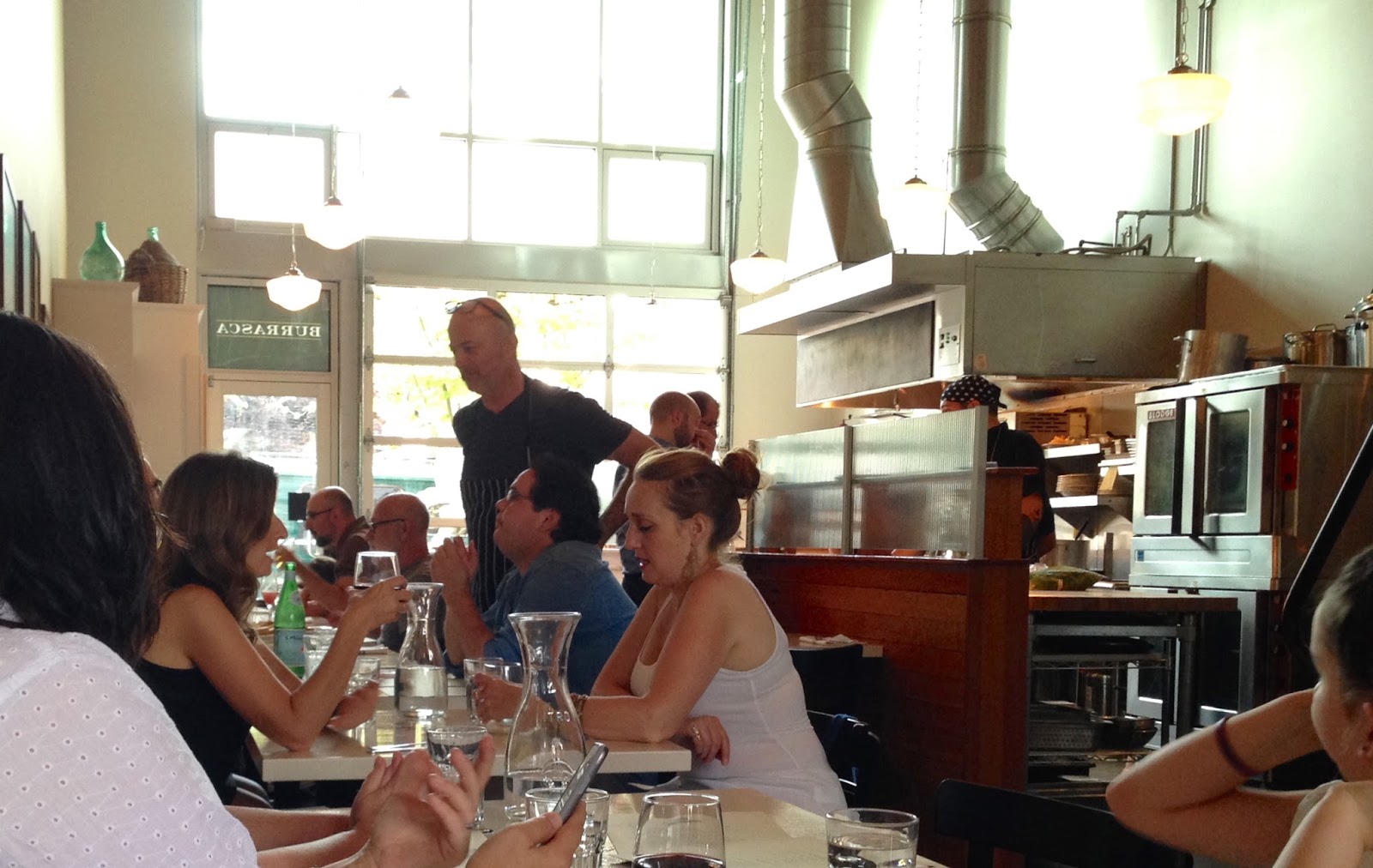
So our standbys are places that make the kind of food we love and source ingredients from local farms and farmers: Bar Avignon, Lovely’s Fifty-Fifty, Old Salt Marketplace, Nostrana, Lucca and Davenport. Tastebud has to be included even though it’s just opened (we’ve been twice) because Mark Doxtader and Sarah (of Lovely’s) are the god and goddess of woodfired pizza made with local ingredients. Burrasca has become a favorite on our hit parade, as well.  Read more.

What were the top restaurant newcomers of 2015?
Tastebud because of the reasons listed above (Mark Doxtader, right). Burrasca (top photo). Love their take on Florentine classics like ribollita, peasant food that uses the simplest ingredients like old bread, leftover beans and greens to make a bowl of comfort; pappa al pomodoro; the deeply intriguing combination of squid and kale that is inzimino.

I’m hoping they’ll find a source for the fourth stomach of a cow, the abomasum, so I can have the famous street food favorite of Florence called lampredotto. Read more.

Describe the 2015 Portland restaurant scene in one word.
Free-for-all. Read more.

What was the best dining neighborhood in 2015?
No place like NE: We live within walking distance of Alberta, Killingsworth, Cully, Williams and Mississippi. (Sarah Minnick of Lovely's Fifty-Fifty, left)

Cully has to be the up-and-comer. Read more.

What was the biggest dining surprise of 2015?
No idea.

What was your single best meal in 2015?
Overall, very few meals can match what we have at home on a regular basis, from roast chicken to braised beef neck to pig trotters in a pot of Ayers Creek Farm beans to steaks on the fire when we’re camping.

Ben Meyer (l) and Bill Hoyt.

Meals out, wonderful as they can be from any of the places listed above, become more special because I don’t have to cook them. Current crave is the beef tartare at Old Salt using beef from Bill Hoyt of Hawley Ranch in Cottage Grove. Read more.

What was the biggest restaurant grievance of 2015?
The focus on chefs and technique versus good food made simply using the best ingredients (preferably local). Read more.

What are your headline predictions for 2016?
No idea.

Saturday, December 26, 2015

Plenty of Persimmons? Make Cocktails!


Lately my life has been imitating the old saw about making lemonade when life gives you lemons. What's been interesting is that the lemonade I've been making has had a particularly alcoholic bent to it.

It started with a gift of green walnuts last summer, which are in the process of becoming an Italian liqueur called nocino. Then this fall my neighbors called to inquire whether we might want to come pick a few of the quince that were threatening to break several branches on their overburdened trees, which prompted me to chop up a few and throw them in a jar with vodka.

Drenched but pleased.

A few weeks later, my friend Kathryn called to see if I'd be interested in helping her harvest persimmons from her neighbor's tree across the street, which were just going to end up falling and making a stinky, slippery, insect-attracting mess on the road. These persimmons were the variety called fuyu, the squat, non-astringent variety with a slightly sweet, mild flavor that can be eaten out of hand, sliced into salads or served alongside, oh, say, a seared duck breast.

I arrived at Kathryn's just in time for a drenching downpour, despite which we managed to haul the ladder out and pick a bushel of the still-rock hard fruits. I suggested that might be enough for our needs, but, coming from generations of hardy Kentucky women, rain or no rain Kathryn insisted on filling up both fairly large baskets.

Sliced persimmons in vodka.

A little over two weeks later, the persimmons had just started to ripen to the point where they could be used. This gave me some time to do a few searches online, and I narrowed the options down to three: I'd make and freeze a purée for use in summer margaritas and a batch of sorbet; then thinly slice enough to fill a gallon jug which I'd top with vodka and decant in a month or so to make a liqueur for next fall.

The third intriguing option was to pack layers of the whole fruit into a gallon jar, covering each layer with cane sugar. The idea was for the moisture contained in the fruit to gradually melt the sugar, making a syrup as well as preserving the fruit itself. So with the purée in the freezer and the two gallon jars sitting on a shelf in the basement, all that was left was to wait until something (hopefully delicious) happened.

Persimmons packed in sugar.

Four weeks later, the magic had worked. I decanted the now-pale orange vodka from the sliced persimmons and put it in a jar that went back down in the basement. Then I poured off the syrup from the preserved fruit, sealing it into tubs that went into the freezer. Well, almost all of it went into the freezer. I kept a little out to make homemade fruit syrup soda for my nephew, similar to the rhubarb soda he'd so loved last spring. And of course Dave immediately put his name in to use a few ounces for cocktail experiments (see below), a request I'm always happy to oblige.

Being the magnanimous sort I am, and thinking maybe there was a chance another cocktail recipe might be forthcoming, I shared a bit of the syrup with my neighbor Bill. Within a few hours he'd texted back a recipe for a lovely rye-and-lemon concoction he called the Good Fuyu. We tried it alongside Dave's version of an Old Fashioned he dubbed Old Persimmon's Old Fashioned after the nickname that T.S. Eliot gave Ezra Pound.*

Not to brag, but now I have two excellent new cocktails to add to our growing list (and now so do you)!

Old Persimmon's Old Fashioned

2 oz. bourbon
3 tsp. persimmon syrup
Dash Angostura bitters
Dash orange bitters
Orange peel

Fill a cocktail mixing glass half-full of ice. Add all ingredients except orange peel to mixing glass and stir for 30 seconds. Strain into short rocks glass. Holding the orange peel skin-side down over the drink, twist and then drop into the liquid.

* * *

Good Fuyu

1.5 oz. rye
.75 oz. persimmon syrup
.5 oz. lemon juice
Dash Peychaud's bitters
Amarena cherry

Fill a cocktail mixing glass half-full of ice. Add all ingredients except cherry to mixing glass and stir for 30 seconds. Strain into short rocks glass. Add cherry.

* Apparently the two writers frequently corresponded by—gasp—handwritten letters and, inspired by  the Uncle Remus folk tales, Eliot referred to Pound as "Old Possum" while Pound dubbed Eliot "Brer Rabbit."

Tuesday, December 22, 2015

Great Gifting: A Gift That Keeps on Giving


It was my mother, the Queen of Christmas, who first suggested it, amazingly. She'd always seen gift certificates as cheating somehow—plus the loss of control over how it was spent irked her no end. So when she suggested that, rather than hours spent shopping for earrings or a sparkly pin or gloves or a scarf, she'd like us to give to a charity in her name, we heaved a sigh of relief. And we agreed that she could return the favor for us. Here are a few suggestions if your family feels the urge to do the same.

FoodCorps

When Lake Oswego native Curt Ellis made a movie with his college buddy and best friend Ian Cheney, he had no idea that, as a result, he'd be running a nationwide service organization that in its first five years has put 205 young people (and a few oldsters, too) out in the field to work with 600 local schools and 200,000 school-age kids, educating them about nutrition as well as building and tending school gardens and promoting local food in school cafeterias.

Cheney (l) and Ellis in King Corn.

That movie was King Corn, a documentary that followed Ellis and Cheney as they attempted to grow an acre of corn in the nation's heartland. In a recent conversation at their Portland office, Ellis said that as he and Cheney toured the country showing their film on college campuses, he was struck by how few opportunities the students had "to put their shoulder to the wheel and change their relationship to food." The question then became, he said, "how to create a pathway where [the students] were making a difference in our food system."

Coincidentally, at that same time President Obama had signed into law the Edward M. Kennedy Serve America Act, reauthorizing and expanding the Americorps service program. The signing of the act prompted Ellis and a group of friends to form a nonprofit corporation called FoodCorps, which applied for and received grant funding from Americorps, which now accounts for 20 percent of its budget.

Curt Ellis.

In addition to the direct impact that FoodCorps members have in schools, Ellis said that the organization seeks to build a cadre of leaders in the food movement, the success of which is borne out by the fact that every single one of its alumni have gone on to find work in related fields.

"I love what I get to do at FoodCorps," Ellis said. "Stories from the field are heartening—there's something magical about kids trying a food for the first time." On the effect FoodCorps has had on its members, he said, it helps them take an equity lens and learn about community organizing. "It's ultimately about promoting social justice, lifelong health and opportunity."

Additional opportunities

  • Zenger Farm An urban farm representing a unique partnership between the City of Portland and a non-profit organization that encompasses a six-acre working organic farm and a 16-acre wetland inside the city limits. An educational center, it also supports immigrant programs, tours, classes and a CSA.
  • Outgrowing Hunger This Portland-based organization (photo above) was formed to get healthy food to hungry people by transforming unused private, public and institutional land into neighborhood gardens.
  • Friends of Family Farmers Works to support small, family-scale Oregon farms and farmers to promote local, sustainable agriculture through education, legislation and the establishment of farmer networks.
  • Next Generation Nepal A friend's daughter works for this group in Nepal. It's attempting to stop child trafficking in that country by rescuing children, rehabilitating them and reconnecting them with their families, all in incredibly difficult conditions, lacking fuel, heat and clean water.
  • Architectural Heritage Center A nonprofit providing a resource for historic preservation through programs, tours and exhibits which help people appreciate and preserve older and historic buildings, neighborhoods, and traditional commercial areas.
Read this year's other Great Gifting posts: The Gift of Class(es); The Gift of Deliciousness and More Deliciousness, From Italy.

Saturday, December 19, 2015

Farm Bulletin: 4. Der schwer gefasste entschluss (Grave—Allegro) Muss es sein? Es muss sein!


Market farmers for 14 years at the Hillsdale Farmers Market, Anthony and Carol Boutard of Ayers Creek Farm have decided to end their tenure at the market on a high note. Tomorrow, Sunday, December 20, will be their last appearance at Hillsdale, and I highly encourage you to attend and wish them well. Regular readers, fear not, Anthony's piquant and estimable contributions to Good Stuff NW will continue as he and Carol move into their new incarnation.

As we contemplated our four final markets at Hillsdale, the mood of each corresponded uncannily to the notations on the four movements of Beethoven's final quartet, Opus 135. The cheerful return celebrating the autumn's harvest, the lively Thanksgiving market, the quiet, sedate holiday market with its singing and ambulations, and the final market marking the resolution of a weighty decision, something that must be, a mixed and contrary mood indicated: solemn—happy. Hence the cryptic Italian tempo markings on this quartet of market essays.

Without treading into the dangerous territory of translation or discerning the composer's meaning, the German notation indicates a calm resolution to a weighty decision, something that must be. Last March when we were contemplating the future, it became clear we had to decide if we would continue with an open air market into 2016. A blend of factors forced the discussion. Part business, the market's contribution to the farm's income has been slipping as other venues have expanded. We invested in a building that makes our farm more efficient and expanded the farm's capacity substantially, and we were not seeing promise of growth at Hillsdale. Part personal, we are in our 60s and the task of setting up and breaking down the stall is formidable. Especially in the summer when we have to remove everything from the van so we can make deliveries the next day. Although we use a lot of weight on the tent, twice this year the wind almost flipped it, reminding us that we are neither as strong nor as lithe as we were. The art of aging gracefully is accepting the need to change how we carry out our work. There is also an element of public policy at work. Farmers' markets are not grounded in the city's planning framework, restaurants and retail stores are. Like Peter Pan's home, no maturation or evolution is contemplated: "And Neverland will always be, the home of youth and joy and liberty, I'll never grow up, never grow up, never grow up, not me, not me, no sir, not me."

We discussed various options such as truncated schedule, hiring someone to staff the stall or finding an alternate venue. Ultimately, none of these options made sense to us, neither personally nor from a business perspective. Our resolution is that starting in January, we will sell directly from the farm on selected days. The first scheduled days are:
  • 9th and 10th of January, 2-5 pm
  • 13th and 14th of February, 2-5 pm
This decision allows us to retain the satisfaction of direct sales and yet meet the growing needs from our other customers. We are about 40 minutes west of Portland, so it is not a daunting trip. It will be a different experience, true, but we will do our best to make it a rewarding one as well. For example, instead of running out of berries, we can run out for berries. Instead of having to wait a week for cornmeal if we run out, you just have to wait for us to mill some more. Oh yes, and we will have calendars available in January.

Last week, Leah Scafe of LetUmEat posted an interview covering our reflections on becoming vendors at Hillsdale, and the changes ahead. As you all know, New Seasons and Food Front carry our berries and we we plan to test the waters on other crops we grow. In addition, Josh Alsberg, formerly of New Seasons and Food Front, is preparing to open the produce stall Rubinette Produce Market in the new Providore market that will open at NE 24th and Sandy in late January or early February 2016. Alsberg is keen to build on our long working relationship, and we are offering no resistance to his overtures.

It is new and unfamiliar territory for us.

Photo at top by Linda Colwell.

Thursday, December 17, 2015

Soup's On: Perfect Pot of Winter Warmth


For those of us who don't always have the funds to go out for dinner when we don't feel like cooking—or don't have the time to whip up a culinary feast for our hungry families—I highly suggest jumping off the plate and into the pot. In other words, think soup.

It's almost the perfect winter warmer. Its steaming heat warms the body and fills the belly, especially when you add beans, pasta, potatoes, rice or root vegetables. It's easy, usually taking no more than 30 minutes or so to go from start to finish. It satisfies a crowd, needing only a good loaf of bread and maybe some cheese or a green salad to make a meal. Seriously, it's hard to do better when you're feeding a family or, indeed, a table full of guests.

And I've been making a lot of soup lately, from a Thai-inflected curried squash soup to a Tuscan white bean soup to a split pea soup with bacon to a corn chowder. Though at my house we often call it "stewp" because it invariably turns out to be less brothy and more hearty.

The soup in the photo above was a complete improvisation. I was pressed for time to make dinner on a recent weeknight and was rummaging in the freezer for ingredients I might be able to thaw quickly. That's when I ran across a package of frozen chorizo sausage I'd bought from Don Felipe at the Portland Mercado. Hm. A start.

A bit of digging in the vegetable bin brought up some carrots and a couple of garnet yams, and I found a container of leftover black beans I'd made earlier in the week (though you could always use canned). Perfect.

And, like I said earlier, in just over a half hour we were sitting down to what may be my new favorite soup.

Chorizo, Black Bean and Yam Soup

2 Tbsp. vegetable oil
1 lb. fresh chorizo sausage*
1 onion, chopped
3 cloves garlic, chopped fine
3-4 c. cooked or canned black beans
2 large carrots, chopped in 1/4" dice
2 medium garnet yams, chopped in 1/2" dice
4-6 c. water, depending on how brothy you like your soup

Heat vegetable oil over medium-high heat in a large soup pot or Dutch oven. When it shimmers, add the chorizo and brown, breaking up with a spoon as it cooks. Add onion and garlic and sauté till tender. Add black beans, carrots, yams and water and bring to a boil, stirring to combine. Reduce heat to simmer and cook until carrots and yams are tender.

* I highly recommend Don Felipe's Tolucan-style red chorizo sausage, or you can make your own version with this simple recipe.

Guest Essay: A Lesson in Grace


My friend Daphne Bramham is a columnist at the Vancouver Sun in Vancouver, British Columbia. On a recent reporting trip to Cambodia she learned a simple lesson about want and need from a little Cambodian boy and his pencil.

A tiny boy with nothing would seem an unlikely teacher, just as Cambodia with its history of genocide and pain would be an odd place to learn a lesson in grace.

But four years ago, I did learn a lesson from a boy in a remote Cambodian village, where only days earlier flooding had washed out the dirt track that is known locally as a road.

Pencils and notebooks are precious things in subsistence farming communities. They cost money, and money is scarce. But without pencils and notebooks, children are hobbled in their learning. So, I’d spent the equivalent of a few dollars to buy a big bucket of pencils, a pencil sharpener for the school, and an armful of notebooks.

As I passed them out, children smiled shyly and said quiet thank yous in Khmer. I was sure that the tiny boy had been passed over. I tried to give him a pencil, but he shook his head. No.

Why not? Why wouldn’t he take one? My guide and translator from Plan International stepped up to help.

“I already have one,” the little boy said, pulling his new pencil from his pocket to show me. He was happy with one. It was his fair share.

I thought of him this Christmas season as I flipped through flyers, websites and magazines looking for gift suggestions and fretting about what to buy, whom to buy for (building manager, caretaker, newspaper delivery guy, the nephew’s girlfriend who I’ve never met?), and how much to spend.

It wasn’t solely altruistic either. I’ve been asked a few times what I want for Christmas, and I draw a blank. I don’t need anything, really. The few things that I really want (like less time at the computer and more time with people) are not things that anyone can buy.

But it is the season of giving. So, I keep flipping pages, searching websites and marching up and down crowded store aisles searching for that perfect something for the ones on my list.

In a culture of plenty, the recommended gift lists suggest that there is no limit to how much we should spend. Even stocking stuffers on many of the lists are no longer limited to things like oranges, nuts, candy, socks and dollar-store puzzles.

There are, of course, lists of “useful” gifts for those who have everything. Among those I’ve seen are: a $130 brass pen described as “super compact and sleek;” $200 pruners for that special gardener; a $1,000 stand-up mixer when the same version in a different colour is half the price; a $30 box of “vintage-style” fireplace matches; and a $50 box of popcorn with truffle salt.

I do pity harried parents searching frantically and often futilely for the must-have toy of the season that tops their children’s lists. But I pity more the parent who must explain why sometimes even if a child is very, very good, Santa can’t bring them what’s on their list.

Does anybody really need/want this stuff, or even some of the things that we buy?

Read the rest of Daphne's column.

Tuesday, December 15, 2015

Great Gifting: More Deliciousness, From Italy


As mentioned in the previous post, there's more than enough goodness to go around this time of year. But this one was too good not to add to the list.

Before I get to the "gift" part of this post, I have to tell you about the mind-blowing factoid I learned while sitting in on Jeff Bergman's presentation to the staff at Nostrana. He's the brand manager of Manicaretti Italian Food Importers in Oakland, California, and was there to educate the staff about just-pressed olive oils from Italy—called olio nuovo in the north and olio novello in the south—that had just been air-freighted in that day.

Cathy Whims (l) and Jeff Bergman.

What Jeff said that countered everything I'd heard was that this newly pressed oil, while it's freshest in its first three months, won't go bad.

"These oils don't go bad," he said as my jaw dropped. "They just settle and soften." Indeed, he said, up to about a year old or so, they will gradually lose that signature peppery quality of new oil and become what he called "a common oil" after the initial three-month period of peak freshness. That is, they remain usable as long as they're kept away from olive oil's three enemies: light, heat and air.

Jeff Bergman of Manicaretti.

My shock was apparent, and he laughed as we proceeded to the tasting portion, where the traditional blue cup of oil—which conceals the color to avoid prejudicing your judgment of the flavor—is held cupped in one hand while the other hand covers the top in order to warm the oil and trap the polyphenols that give the fresh oil its distinct flavor and aroma. After a few seconds you lift the hand covering the top and take a strong whiff. Then you take a sip and inhale it with some air, similar to the way wine tasters do, to aerate the wine and spray it all around the inside of your mouth. If you're not coughing from the pepperiness hitting the back of your throat, something Jeff said even experts sometimes do, swallow and breath out so you can get more of the aroma coming back through your nose.

The three oils we tasted, and here's where the gift part comes in, are all very limited in production, and Cathy Whims is not only using them to flavor dishes on her menu, she's offering them to the public until the supply runs out. They were all flown in under controlled conditions and are as fresh as you would get them in Italy itself, so they're well worth giving to your favorite Ital-ophile or food fan. You can pick them up at the front desk at Nostrana during business hours or, better yet, have a meal and try them from the menu!

Jeff's notes are as follows:
  • Capezzana Olio Nuovo 2015 Toscana This year's Capezzana is unlike any we have previously tasted. The aroma is of fresh-cut grass and almonds. It offers a buttery, mild, fruity beginning—grassy and green—that fills the mouth with a delicate flavor of herbs and green olive. On the finish, there is a spicy note in the back of the mouth that is ticklish, fun, and pleasing. Truly amazing. Suggested Use: Drizzle it all over hearty soups, fresh cheeses, or winter squash. 500ml $51
  • Gianfranco Becchina Olio Verde Novello 2015 Sicilia This extraordinary oil has a fresh, grassy nose with a hint of bay leaf, green apples, green bananas, green almonds (note the trend?) and fresh hay. The taste is buttery and dances in the mouth, and the finish is a spicy thrill—a clean, bright chili pepper without any bitterness or pungency. Suggested Use: Use in green salads with hearty, bitter greens such as kale and collard greens, as well as over steamed romanesco and brussels sprouts. Drizzle over fish and vegetables hot off the grill or over a traditional Sicilian caponata. 500 ml $47
  • Frescobaldi "Laudemio" First Pressing 2015 Toscana What a Tuscan olive oil! This is a sophisticated oil for the connoisseur, with a complex aroma of soft and loud notes held in equal balance. On the nose, there is a hint of cinnamon and eucalyptus. The taste is bitter, green, and spicy—like taking a healthy bite of a raw artichoke heart—and as tannic as a big structured wine. The color is unreal, like an emerald; the cut of the bottle emphasizes this jewel-like quality. Their best in many years. Suggested use: Drizzle on fettunta (toasted bread rubbed with garlic), over warm beans and chickpeas, broccoli and romanesco, or any bitter green salad. Pour generously over grilled meats such as a bistecca alla Fiorentina (grilled sliced T-bone steak). 250ml $35
Read this year's other Great Gifting posts: The Gift of DeliciousnessThe Gift of Class(es) and A Gift that Keeps on Giving.

Great Gifting: The Gift of Deliciousness


Oregon is a place full of growers, artisans and makers, especially when it comes to food. For those who aren’t lucky enough to live here, nothing can top a care package of Northwest-made goodies.

To follow on this year's theme of giving self-liquidating gifts, i.e. those that don't need displaying or dusting, this list of some of my favorite producers is just a start—and don’t forget locally roasted coffees, cheeses, cookies and more.

If you prefer to head out to the shops and hunt down your own gifts instead of shopping online, you can't do better than to make a beeline to a farmers' market near you and buy any of the myriads of delicious, homemade treats direct from the folks who made them.
  • Ayers Creek Farm Organic Preserves The best preserves I've ever had, period. Get some for yourself while you're at it. Also available at Vino Wine Shop, Pastaworks, City Market, Food Front Co-op and People's Co-op.
  • Meat Tubes from Old Salt Marketplace If you have someone on your list who loves meat products, or if you need a handy gift to take to a holiday party, call or e-mail these guys and order one of their gift "tubes" (above right) of responsibly sourced, handmade meats and accompaniments. I'm thinking of a couple of people I know who'd love one!
  • Willamette Valley Confectionery Old-fashioned peppermint bark and pate de fruit (made from fruit from local farms).
  • Quin Candy Handmade, small-batch candies with a modern twist.
  • Alma Chocolate Sarah Hart's chocolates, caramels and bon bons are unique, beautiful, delicious and handmade with care. 'Nuff said.
  • Cardamom Hills Trading Co. chutneys Sourcing from local farmers' markets make Sophie Rahman's chutneys so vividly flavorful that any of the commercial brands you may have tried pale by comparison.
  • Jacobsen Salt Co. Salt Harvested from Netarts Bay, I can't think of a cook on your list who wouldn't love some of this salt in their pantry.
  • Bee Local Honey Local bees making hyperlocal honeys.
  • Urban Cheesecraft DIY cheesemaking kits These little kits are perfect for any cheese lover on your list, and simple enough for the youngest!
Read part two of this post about getting some exclusive, small-batch fresh-pressed olive oils from Italy! And read the other posts in this year's Great Gifting series: The Gift of Class(es) and A Gift that Keeps on Giving.