Showing posts with label organic. Show all posts

Monday, November 25, 2019

Farm Bulletin: Response to a Reader


Under normal circumstances I don't post reader comments, but in this case I felt contributor Anthony Boutard's response to the question about short-straw grains, from his previous post about the durum wheat he grows at Ayers Creek Farm, was important to understanding the whole story.

A reader commented:

I read a book recently that said the short straw varieties were specifically developed for warm climates like Mexico and India where rust is a serious problem. In your climate I'm guessing it's a wash.

Anthony Boutard responded:

Often the second half of a story is left out to create a myth, this is especially true with respect to the “Green Revolution.”* Short-straw grains allow fungicidal sprays to penetrate into the planting more effectively, and that is one of the reasons they are favored. In the spring, spray buggies douse the field to control rust and tall plants would make it hard to get the penetration needed for effective control of the disease. Outside of organic systems, rust is managed by fungicides.

Pesticide spraying rig.

Tolerance for rusts in grains is genetic and I see no evidence that it is linked to straw length. Logically, it doesn’t make sense. Next spring, take a moment and see where the rust and other fungal diseases develop in the grain field. It is in the low areas where airflow is impeded. You can easily see the yellowing of the plants in these patches.

The problem with short-straw grains in an organic setting is the rain splashes soil and fungal inoculum onto the leaves and they take longer to dry out in the morning. Rust inoculum that blows into the field can thrive on the wet leaves and stems. Modern varieties are shin high, right in the splash zone. The durum, wheat and barley we grow are over waist high, so the foliage is well out of the splash zone. They do well in an organic setting. Bear in mind, these long-straw small grains have been grown successfully for eight millennia or more without employing a chemical arsenal. That is why we favor them.

Aerial spraying of pesticides.

The pernicious nature of spraying was driven home when we were planting melons and a neighbor sprayed his wheat field. As the buggy passed by, the brown ground spiders exited in a mass, crawling over our hands and legs. Thousands and thousands of refugees, an indelible moment, along with the chemical stench of the insecticide.

Unfortunately, pushing short-straw grain varieties that require heavy use of chemical inputs including fertilizers, fungicides, insecticides and herbicides have damaged the health of farmers and ecosystems, especially in countries such as India and Mexico with lax environment controls. The Bhopal disaster was the result of a factory producing carbaryl, the insecticide marketed as Sevin.

Read more about legislative attempts to regulate spraying of pesticides in Oregon.

* Top photo shows an agricultural worker spraying pesticide on a short straw variety in India. These varieties require heavy use of expensive industrial pesticides (note the worker is unprotected from the spray). Often the seeds were genetically modified patented varieties, so farmers could not save the seeds from their crops as they had for millenia, and were forced to buy new seed every year or face prosecution.

Thursday, May 31, 2018

Queener Farm: Restoring an Orchard, Sharing It Through a CSA


Community supported agriculture, or CSA, is a relationship between a buyer and a local, family farm. Most people think of a CSA subscription as a box of assorted seasonal vegetables that arrives on your doorstep or that is dropped off at designated site every week during the growing season. And there are plenty of those traditional types of CSAs here in Oregon, but we also have CSAs where you can essentially shop for your produce from a list that the farm provides. There are even CSAs for specific types of products, like flowers, meat, fish and fruit.

Jeannie Berg of Queener Farm in Scio.

Jeannie Berg, owner of Queener Farm in Scio, has an innovative CSA called the Heirloom Apple Club where subscribers choose between a sampler box, three to five pounds of several apple varieties grown at the farm and delivered in eight installments over the season, or a family box of a whopping 40 varieties in 15-pound increments over seven installments.

It all started when Berg, who'd worked as a political consultant and staff aide for many years in Oregon, decided that all those years in the trenches in Salem led her "to develop a strong desire to dig into the real dirt."

Ready for harvest.

Following that instinct, Berg leased land on a farm in the Willamette Valley near Salem in 2009 and began her education in the soil, learning about the critical role that biodiversity plays both in the soil and on the land, and how to bring that land back to productivity after it's been exhausted from the use of chemical inputs.

After five years growing vegetables and running a CSA on that property, she began looking for a farm of her own, eventually meeting the owners of a hundred-year-old orchard in Scio. On its 40 acres grew more than 2,000 trees producing 100 different types of apples, and while the owners had only used chemicals in moderation, according to Berg, "the trees still depended on them to fight off disease." Not only that, but "the insect life on the farm was short of beneficial insects and had a population of codling moths just waiting for the chance to multiply."

Applying what she'd learned at her first farm, Berg knew the only way to really understand which apple varieties would thrive in an organic system in the Willamette Valley was to remove the chemical inputs and see how each variety responded. Despite losing some trees, she persevered, bringing the land back to the way the original homesteaders had envisioned it in the 1880s, long before pesticides had even been imagined.

Now four years in, she and her farm partners have transitioned the orchard using organic practices, and they are expecting to receive their official organic certification this year.

"We’re seeing all the right insects return, the diseases almost completely disappear and the pests drastically diminish," Berg reports. "The orchard appears to be thanking us with a robust kind of health that makes friends wonder what sort of miracle fertilizer we sprayed. It’s amazing and wonderful to watch. The most exciting part is watching the trees as they bloom, leaf out and now begin to grow their abundant set of fruit. They are green and lush, they thrum with pollinators and predator insects. It all adds up to an orchard that feels vibrantly alive.”

Watch the amazing process of grafting one variety of apple onto a different variety.

Saturday, January 13, 2018

USDA to Revoke Organic Animal Welfare Rule


The video above shows what organic egg production looks like at one Oregon factory farm. Crowded into closed-in barns, with "outside access" limited to a roofed-in, screened, cement-floored patio with panels preventing the chickens from even seeing outside, is not what people imagine when they see the words "cage free" on the carton.

And it's about to get a lot worse unless you act now.

Factory farmed pigs.

The demand from consumers for organic products has caused that segment of the grocery industry to explode. It's caught the attention of large agribusiness, which has been seeing its portion of the market starting to decline.

A new rule, carefully developed over the last decade, setting consistent and humane animal welfare standards for organic production, was about to go into effect when the current administration delayed its implementation. Over the holidays, USDA Secretary Sonny Perdue announced he was going to completely withdraw the new rule from consideration, a step that corporate agribusiness has been pushing for.

The USDA's Agricultural Marketing Service (AMS) is accepting comments on its decision through Wednesday, January 17, so action is needed immediately. The Center for Food Safety has provided a simple form to submit a comment on this rule. It may sound alarmist, but the integrity of the organic label, including our health, and that of our communities and the environment, is at stake. I sincerely hope you consider signing it.

Friday, December 08, 2017

Food Heroes: Matthew Dillon, Seed Guy


It all goes back to growing up on his family's small farm in Nebraska just outside of Omaha. That four-acre farm, which his family called a "hobby farm," was where the Dillon family raised vegetables and kept a few cattle. Young Matthew and his siblings would harvest the vegetables from the fields, then carry them up and down the road that ran in front of their house that cut through the heart of Nebraska's rich agricultural land, selling armloads of the crops to their neighbors.

Matthew was a smart kid, and his boredom with school, which he refers to as "an 1890’s model of education," caused him to get a reputation as a rabble-rouser. "I’d definitely gotten in trouble for vandalism, smoking pot and all those things," he said. "That’s why I was getting in trouble—because I wasn’t challenged. I was totally bored."

Mount Michael Benedictine School.

So his parents plucked him out of public school and sent him to a nearby boarding school called Mount Michael Benedictine School. "It was competitive to get in, you had to start as a freshman, he said. "100 percent of students going off to college, 90 percent on scholarships, highest ACT and SAT scores in the state."

The monks also had a three-acre organic farm.

But compared to the vegetables his family grew, "the carrots and the produce were pretty crappy looking," he remembers thinking. "I guess this is good for the planet, but it doesn’t look very edible."

After graduating from Mount Michael, Dillon went to the University of California, studying the evolution of human consciousness through a special outdoor wilderness program on the impacts of the human psyche on ecosystems.

Then his father got sick. Cancer.

"He'd had an agricultural supply business, everything from veterinary health supplies to pesticides, you name it, the whole kit and caboodle," Dillon said.

Matthew dropped out of school to help his mother take care of his dad and worked to help pay the family's bills.

Platte River Valley in Nebraska.

"My dad was so healthy. Why is he, of all people, getting non-Hodgkins lymphoma?" he asked himself. "I started looking into it, and the Platte River Valley of Nebraska has this insanely high rate of non-Hodgkins lymphoma because of nitrates in the wells [from] pesticide runoff."

Dillon's father died shortly thereafter, and it began to dawn on him that the pesticides his father sold and that all the farmers in the area used might have contributed to not only his dad's disease, but to his own serious illness at the age of 12, eventually diagnosed as an endocrine disruption and after which he never grew again.

He became intrigued with agriculture. He got a job working on urban garden projects in and around Omaha, plus a side business running an electronics smuggling operation in Russia (read more about that here).

Working on the garden projects, "I realized that the only way I was going to be close to my dad again was if I started growing food," Dillon said. "The thing that he loved the most was that hobby farm. He liked that more than the business. He just liked growing food, he liked making food, [and] it became really clear to me that I needed to go and get my hands in the soil."

Touring a field study for the OSA.

An internship at an 18-acre organic farm in California's Anderson Valley introduced Dillon to an integrated approach to agriculture, where everything was different from the practices his family had used in Nebraska. But one thing struck him as odd: the seed on the organic farm came from the same sources as the seed that the conventional growers used back home.

"All of the inputs are different, our approach to caring for the soil is different, but the seed was the same," he said. Other than some heirloom seed from the Abundant Life Seed Foundation and the Seed Savers Exchange, which he said was beautiful but not agronomically strong, the bulk of the farm's seed came from conventional sources.

"Why is that?" Dillon wondered. "Where’s the organic seed?"

"So I got kind of obsessed, as I do, about the concept that you breed for the environment of intended use, and you breed for the management system of intended use," he said. "Organic environments and organic management systems were different."

That line of inquiry sent him up to Port Townsend, Washington, to the headquarters of Abundant Life, where he volunteered almost full time, eventually landing a spot on their board of directors. Having lost its executive director, the board asked Dillon to take the position as interim director, which led to his accepting the position of executive director.

And that's when the fire hit. A story in the Capital Press from August 8, 2003, summarized the damage:
"An early Monday morning fire in Port Townsend, Washington, that destroyed a landmark building, home to the oldest grocery store in the state, also destroyed Abundant Life Seed Foundation’s office, its extensive library and thousands of its seeds—hundreds of which were one-of-a-kind varieties. Matthew Dillon, executive director of the foundation, describes it as the loss of 29 years of collecting and stewarding germ plasm."
Reflecting on the effect of the devastating loss almost 15 years later, Dillon is sanguine.

At Wild Garden Seed in Philomath.

"By that time I’d met [Dr. John] Navazio and [Wild Garden Seed's Frank] Morton," he said. "All these guys who were saying, yeah, heirlooms are great and everything, but we can have the best heirlooms and we can start breeding in disease resistance and making these crops more workhorses and more robust. And that just intrigued me."

Dillon and the plant breeders and contract growers at Abundant Life had already started to improve some of the heirloom varieties, but their work wasn't without controversy, even within the organic community.

"We’d get angry letters, like 'how dare you not save the seed just as it is, how dare you make a cross or how dare you make a selection!'" he said, shaking his head. "It was intense.

"The whole thing was that heirlooms are not like these gifts handed down by the gods from Olympus to our grandparents. They evolved with those practices, intentionally or not."

Dillon feels that, in general, agricultural history hasn’t given credit to the farmer innovator, saying that farmers and gardeners have always riffed on what they find in their gardens and made selections based on their own preferences. He believes that's where we got the diversity of the heirloom and heritage seed that we find in catalogs and garden stores today.

"Our whole thing was the heirlooms of tomorrow," he said. "That’s all we were doing. In the long run, obviously, a lot of folks have embraced that and it’s become the focus of the alternative seed movement, going beyond heirlooms, still respecting conservation and the need for conservation."

Clif Bar Seed Matters initiative.

Out of the literal ashes of Abundant Life, Dillon founded the Organic Seed Alliance (OSA) with Navazio, a renowned plant geneticist, agroecologist, author and organic seed production specialist. With a belief that seed is part of our common cultural heritage—a living, natural resource that demands careful management to meet food needs now and into the future—the OSA's mission was to support the growing organic seed movement and advance what it calls "ethical seed solutions" to meet food and farming needs in a changing world.

Under Dillon's leadership the OSA educated thousands of farmers and other agricultural community members, conducted professional organic plant breeding and seed production research, and advocated for national policies strengthening organic seed systems.

But, as Dillon said, "I'm not a manager, I'm a start-up guy." Once the OSA was humming along with great people like Navazio, Micaela Colley, Kiki Hubbard and others in place, he said, "I was like, I’m done. I’m ready for something new."

In the field.

That new, shiny thing came in the unexpected form of a job with a candy bar—or what these days is called an "energy bar"—company, Clif Bar. After leaving OSA, Dillon did some consulting, and the Clif Bar Family Foundation was one of his first clients. He found it intriguing because, though only about 70 percent of the ingredients in Clif Bar products were organic, its founders, Gary Erickson and Kit Crawford, wanted to figure out how to get more organics into the system, which meant scaling up the growing organic industry, starting with seed.

"I would tell them things like, the organic movement needs to stop marketing ourselves as being grandma and grandpa’s farm and going back a hundred years," he said. "We’re not going back. We’re using the best scientific principles and practices for our production system to figure out how to move our production system forward. To do that you have to give the farmers better tools, you have to understand cover cropping better, you have to understand soil management better, there’s all of this investment you need to make."

Rather than taking the tack of much of the organic movement, like making investments in fighting GMOs and GMO labeling, Dillon's experience told him that not enough investment was being made in agricultural research. His mission from that point on was clear. "Let’s start with seed," he said. "Let’s focus on a seed initiative that improves organic seed, and then let’s see where we can go from there."

He began his work at the foundation in 2009 by founding the company's Seed Matters initiative, with a mission to improve the viability and availability of organic seed to provide more nutritious and productive crops. It would do this by conserving crop genetic diversity, promoting farmers’ roles as seed innovators and stewards, and by reinvigorating public seed research and education. It meant working with farmers, educators, researchers, nonprofits, public universities, community gardeners and seed advocates, as well as establishing graduate fellowships for students to enter the field of organic plant breeding.

A chance to move over to the company and effect what he perceives of as systemic change has placed Dillon in a critical role, as Clif Bar's Director of Agricultural Policy and Programs. For Clif Bar, he said, it was a question of looking at their agricultural supply chain, then figuring out how to make investments that will be good for their farmers but also be good for the company.

Again, for Dillon it goes back to his upbringing in the Midwest in the 1970s.

"What I love about [Clif Bar] is, you hear about companies that are triple bottom lines; Clif Bar was this five bottom line," he said. "They have people, planet, community, business and brands, and agriculture they put under community aspiration, and to me that was really cool.

"As a kid growing up in a rural community, I’d seen the farm crisis in Nebraska in the late 70s—farmers' suicides, consolidation. All of that was alive and crushingly apparent in my community. I was watching people lose farms, family members and friends losing farms in the late seventies and early eighties. So, to me, it was the idea that big ag comes in and extracts value out of communities. It’s systemic."

While Dillon openly admits that Clif Bar is far from perfect, he said that they know they have work to do.

"Because the question of any food company should be, how do our decisions either add value to communities, make communities more robust and healthy and resilient, or how do they detract from that?" he said.

Photo of Dillon at Wild Garden Seed by Shawn Linehan.

Friday, September 29, 2017

Guest Essay: USDA Refuses to Enact New Standards, Threatens Organic Integrity


With organic food becoming a bigger and bigger part of people's food budgets, factory farms are moving into organic in a big way. The problem is, they also want to bring their industrial practices—use of chemicals, monocropping and gigantic scale of production ("free range" chickens, above). The current administration's takeover of agricultural regulatory structures has meant that these industrial giants are now in control and looking to stop any changes that may cut into their profits. Matthew Dillon, director of agricultural policy and programs at Clif Bar, offers his take on why the organic industry is suing USDA for delaying the organic animal welfare rule.

Sam Walton once said, "If you don’t listen to your customers, someone else will." It’s an often-repeated axiom in the business world and points to how easy it is to lose consumers if you go deaf to their point of view. Today, the U.S. Department of Agriculture (USDA) is losing touch with its customers—the American public.

Matt Dillon of Clif Bar.

In the organic trade, the consumer has spoken often and spoken loudly. When the initial proposed organic rules were introduced nearly two decades ago, more than a quarter million consumers commented on the rules—an epic number in the days before one-click activism, and the most the Department of Agriculture had ever received to date. The USDA listened and amended the proposed rules based on this public input.

With their wallets and voices, the public continues to advocate for a strong and robust organic seal. Unfortunately, the USDA isn’t following the tradition of listening to its customers. In a 60-day period in spring 2017, the USDA received more than 45,000 positive public comments from farmers, consumers and food producers, agreeing with proposed rules to improve animal welfare, particularly increased pasture access for poultry. Its customers—the public—have spoken, but unfortunately, it seems, they have not been heard.

Pasture-raised chickens are part of a rotational grazing system in Scio, Oregon.

These animal welfare rules, known as the Organic Livestock and Poultry Production rule, have been carefully crafted over a 14-year process of listening to farmers, food companies, retailers, scientists, animal welfare advocates and consumers. They were reviewed, revised and reviewed some more before being finalized in 2016. These final rules were scheduled to go into effect in January 2017. However, the USDA has not followed the Administrative Procedure Act and has repeatedly and seemingly indefinitely delayed implementation, without appropriate public input.

Instead, USDA is listening to a few massive egg producers that want to increase sales into organic markets but not incur the costs of higher animal welfare standards. For this reason, the Organic Trade Association is suing the USDA for repeated delays of Organic Livestock and Poultry Production rule.

Organic, pasture-raised dairy cows at Jos L. Poland Dairy in Madras.

The company I work for, Clif Bar, doesn’t raise chickens or use eggs in our product. Our business is not directly impacted by organic poultry rules. So why are we joining the Organic Trade Association and the public chorus who have voiced their concern with the rules? It’s simple: The lack of rule-following by USDA threatens the very integrity and trust that differentiates the organic seal from every other food label. Organic customers want organic farming to continue having the highest standards—and they believe that the historical process of organic rule-making, which includes listening to the customer, needs to be maintained if the organic label is going to continue being a trusted standard.

The success of thousands of family organic farms and decades of hard work by consumers, farmers and food companies is at stake. While the organic community doesn’t always align on everything, we all agree that the future of feeding Americans with healthy, sustainable food requires a robust and trustworthy organic seal. The American public has spoken. USDA must heed Mr. Walton’s advice; if the USDA doesn’t listen to its customers, someone else will.

This essay is reposted from the New Hope Network.

Thursday, July 14, 2016

Oregon Dairy Farmer Tells Why He Went Organic


This is the story of Jon Bansen, a dairy farmer in Monmouth, Oregon, who grew up on the land his family had farmed for generations. In this short film by documentary filmmakers Rebecca and Fred Gerendasy of Cooking Up a Story, Bansen explains why he decided to transition from conventional agriculture, with what he calls its "lotions and potions," to farming and raising his dairy cows using organic methods.

He explains that, ironically, it's the way his grandfather farmed before the industry was taken over by big chemical companies. "That's the wonderful thing about organics," he says in the film. "It's about bringing biology back to our food instead of being about industry."

Watch part one of Bansen's story, "Organic Dairyman: A Family Tradition," and part three, "Birdhouses: Using Nature to Control a Farm Pest."

Thursday, January 14, 2016

Food News: USDA Features Two Portland Metro Farmers


The Cully neighborhood of Northeast Portland is a hotbed of urban experimentation, with new restaurants and bakeries popping up like proverbial weeds on Northeast 42nd Avenue, along with co-housing developments and small-scale urban agriculture. A recent article on the US Department of Agriculture blog profiled one farmer, Stacey Givens of The Side Yard Farm, who needed to expand crop production and extend her growing season so that she could offer more produce over a longer period to her roster of restaurant accounts.

The high tunnel at Side Yard Farm.

One answer to her quandary was to construct a high tunnel, a type of greenhouse with polyethylene walls and roof that heats up from the sun's solar radiation. Like any greenhouse structure, the heat generated warms plants and soil faster than heat can escape it. But, like most small farmers, the price of constructing such a structure was way beyond Givens' means. That was when a friend told her about a program through the USDA's Natural Resources Conservation Service (NRCS) that was geared to help small-scale farmers like her build high tunnels to expand their businesses.

The article quotes Kim Galland, NRCS district conservationist for Multnomah County, who said, "These high tunnels are producing food on a local basis for an area that has a metropolitan base, so it cuts down on the energy consumption of the region.

"It allows Stacey to plant earlier in the spring and later into the fall, while protecting her crops from frost. High tunnels allow farmers to get higher yields, better production, hit the market earlier and provide longer service to their customers—and it’s all being done on a small-scale urban farm."

Photo from USDA blog.

* * *


Another Oregon farmer was profiled recently on the USDA blog as one of the farmers who are realizing the benefits of improving the health and function of their soil through working with the USDA’s Natural Resources Conservation Service (NRCS).

An organic farmer and co-owner with his wife, Amy Benson, of Square Peg Farm in Forest Grove, Chris Roehm has always seen healthy soil as a prime goal of their farm, but he said they saw almost immediate results when they fine-tuned their existing system by integrating cattle and forage crops into their rotation.

"One of the components of our soil health management plan that we are happiest with is the integration of growing forage crops for grazing animals with our annual vegetable production," Roehm said in the article. He also noted that even their farmers' market customers noticed the increase in yield. "The first year after that foraged ground has been turned over is like magic, everything just flies up out of the ground, there are hardly any weeds, the bugs don’t know what to do; it’s really fantastic."

Saturday, August 15, 2015

Farm Bulletin: An Appreciation for the Starling


I've published more than 120 of Anthony Boutard's essays on Good Stuff NW since I first ran across his writing eight years ago. His keen observations of the creatures that inhabit Ayers Creek Farm along with him and his wife, Carol, and his appreciation for the complexity of their interactions on his organic farm are deep and profound, and provide the leitmotif of the themes I attempt to address here. This one is classic Anthony.

One of Rachel Carson's early articles for the American Naturalist Society was "How About Citizenship Papers for the Starling?" Loud, joyful and brash, these handsome birds are always looking for a party. Competent and improvisational songsters, but most of all they are engaging mimics. If a siren goes off at the firehouse, they will spend the next hour or two refining their siren call until, that is, a rooster crows, and then they are on that project. A tom quail calls, and an echo erupts from every idle starling. Around noontime, they descend on the bird bath in a group, splashing about until barely a drop remains, leaving a few flower petals and leaves afloat in the puddle. For some reason, they feel compelled to decorate their bath, as well as their nest, with pretty bits and fragrant herbs. Of course, when they bathe the noisy creatures squawk just like children enjoying a summer pool, then fly off as a group for some other diversion or entertainment.

Rachel Carson

Back in 1939, Carson was urging us to drop our animus for the bird and appreciate its pluck and value. Nothing has changed, starlings still bear the double burden of being an immigrant, and flying while black. In farming areas, the starling and the crow can be shot at will, any time of the year. Going back a half century, the starling was accused of spreading a lung disease, histoplasmosis, threatening an as yet unrealized public health crisis. Shortly after the E. coli and spinach episode in 2006, scientists at Ohio State Extension raised the public health banner against the starling once more, along with a cool million, to see if the bird causes food safety problems by spreading the diseases from feedlots. Apparently, they convinced enough people of the problem, and received another $2.3 million. For what it's worth, starlings are attracted to feedlots because they are primarily insectivores, and insects are provided there in abundance. Our filthy food production habit is their treasure.

Interestingly, the one case we recall where a flock of birds was implicated in an E. coli outbreak happened in English pea field in Alaska, and migrating Sand Hill Cranes were named as the culprit. But they are not reviled like the starling, so no snarling about a public health crisis due to cranes. The real problem was that the peas were machine harvested and no one checked the field beforehand. Machines do not not share our visceral reaction to animal feces, they plod along happily consuming the crop. Our displacement of humans with machines in the harvest of fruits and vegetables warrants more attention.

The common starling (Sturnus vulgaris).

In an odd way starlings and other wild creatures received good news this week. Following the 2006 spinach problem and other similar incidents, including strawberries and hazelnuts from Oregon, food safety wonks advised farmers that they should create lifeless zones around their farms to eliminate the possibility of wildlife bringing in E.coli, Salmonella and other food pathogens as a field contaminant. Remove trees and brush so birds can't roost or nest nearby, and animals can't hide. The mantra was that more scorched earth around the fields, the better, for nature is a devious enemy that never sleeps. In brief, it ended up that the research found no corresponding decrease in disease causing strains of Salmonella and E. coli associated with these measures. In fact, in some cases, an increase was detected. Diverse landscapes provide many advantages, and food safety may be one of them, but never overstated.

There are many birds that eat farmers' fruits, but it is the epicurean delight starlings take in finding a good patch of cherries or berries that farmers find particularly galling. The merry cacophony rubs their nerves the wrong way. But farmers are always stingy with credit. When we cultivate the soil, an army of starlings waddles behind the tractor gleaning every wireworm and cutworm available, sometimes carrying eight or ten grubs in their long yellow bills. They fly back to their nest, and return seemingly just moments later. If we are not exposing grubs for them, they are working the berry fields and orchard, again carrying back full bills of food. Watch their nest holes, and you will see them flying back and forth from sunup to dusk. Although they eat some fruit, insects and larvae are the staple of their diet.

The starlings are cavity nesters, and another one of the dire predictions made 50 years ago, repeated with the alacrity of a starling's mimicry, is the usurpation of other cavity nesters by these aliens. In our observations, flickers, starlings and kestrels share similar sized cavities, and they alternate sites from year to year. Swallows, chickadees, bluebirds and nuthatches use much smaller cavities than the starling. All of these cavity nesters have healthy populations in spite of this dastardly usurper. In fact, the alternation of nest sites may provide a valuable health function for the three larger birds. They belong to three different avian orders, and consequently host different parasites, mites and insects. The birds are probably following a similar practice to farmers who rotate crops from different plant families to reduce disease and insect problems.

Finally, one more endearing trait of the starling. Remember the petals and leaves in the birdbath? It is part of their courtship ritual. The male starling finds a suitable cavity and builds a nest of fine grass decorated with petals and fragrant leaves. Very much like the bower bird, his female suitors visit and decide whether he is of the salt. When a female accepts the proposition, they finish the nest together, do some other stuff and she lays her eggs.

Top photo of starlings and other birds by Anthony Boutard. Photos of the starling and Rachel Carson from Wikipedia.

Saturday, August 08, 2015

Farm Bulletin: The Dirt on Dirt


The human brain has a deep affinity for names. Soon we will start harvesting the nameless grape which we call a "grape with no name," what a surprise. A nod to both a song and a restaurant from decades past located on Commonwealth Pier in Boston. Run and staffed by descendants and family of Portuguese fishermen, the restaurant had no name, no sign and no menu. Enter the only blue doorway on the pier, and when it is your turn in the line, look for an opening among the long tables covered with checked oil cloth. Two choices for lunch, the day's seafood chowder and the day's fried seafood. It was the toughest choice ever put before us.

Our nameless grapes (green grapes in top photo, center), so named, elicit opposite reactions. At Higgins, Greg and Patrick gamely put it on the menu as a "grape with no name" whereas Josh and his staff at Food Front display them as "Boutard grapes." Despite our entreaties that food should be defined by how it falls on the palate, Josh told us a nameless grape is just too much for people to swallow. Heidi's son, Jack, calls them Anthony grapes. We will leave them nameless, but we appreciate the dedications.

Human brains have a similar affinity for measurements. One such measurement that draws the attention of farmers is soil pH. It is a number that comes with a decimal point. Attach a decimal point to any number and it immediately takes on a hypnotically greater significance than one without. It is also a logarithm, but that never grabs people to the same degree as a decimal. The other alluring quality of soil pH is that it can be changed simply and reliably if deemed not optimal, typically raised at little cost by the application of agricultural lime. Synthetic fertilizers tend to acidify the soil, reducing nutrient availability, and lime acts as an antacid of sorts, as well as providing the element calcium. Plop, plop, fizz, fizz…

Under certified organic agriculture, synthetic nutrient sources with their acidifying behavior, as well as synthetic disease and pest controls, are prohibited. Indigestion solved? Not if you consider pH alone. On occasion we have had our soil tested, and the test results always included the pH as a perfunctory service. The results are all over the map, from 4.9 to about 7.1. It is a labile character of the soil, shifting with the seasons and crops, and its measurement is generally not particularly informative. In an organically managed soil, the bacteria, fungi, microfauna and the crops themselves all influence pH. So our soil might be acidic enough to warrant adjusting in a synthetic regime, but not under organic management.

But what about the calcium? Don't we need to add lime anyway, and the pH will tell us how much is safe to add because excess lime can damage the soil and inhibit plant growth? There are six elements plants need in substantial quantities: nitrogen, phosphorus, potassium, sodium, calcium and sulphur. We have to amend our soils to maintain sufficient levels of these elements; this is especially important on a commercial farm where we are hauling into market substantial quantities of these elements in the form of food.

On an organic farm, calcium and sulphur are especially important because they are the building blocks for the plant's defenses against diseases and insects. Calcium is a key element for cell wall strength—most of the plant's calcium actually resides in its cell walls—and sulphur is a building block for the crop's internal chemical defenses. On a farm where the crops have external chemical defenses against disease and insects, that is, synthetic fungicides and insecticides applied by the farmer, the cultivator need only provide just enough calcium and sulphur for basic biological functions. Organic farms have spiders, dragonflies and a host of other predaceous arthropods helping to control the insect populations, as well as beneficial bacteria, yeast and fungi that ward off disease, but we need strong plants as well. Consequently, crops grown under organic management need more calcium and sulphur available in the soil, in fact nearing an excess under conventional nutrient interpretations.

As mentioned above, agricultural lime, calcium carbonate (CaCO3), is problematic as a calcium source. It can damage the soil's structure and chemistry. Although it is cheap, a 50# bag of lime costs about $4.15, it is not the best deal. Another good source is gypsum, but it does cost about 50% more, at $6.05 for a 50# bag. Even though it is nominally more expensive, we use gypsum exclusively, and never use lime. Generous applications of gypsum do not harm the soil, in fact the mineral improves the soil's texture, nor does it change the pH significantly. This is important because many fungi and bacteria thrive in certain pH levels, and changing the pH suddenly and significantly without a very good reason can alter the microbial ecology of the soil unproductively.

Gypsum is calcium sulphate (CaSO4). The best reason for using gypsum from the perspective of an organic grower is that you get both important elements, calcium and sulfur, and pay just 50% more. A very good a deal, especially when you factor in the costs of transportation and spreading the amendment. The other problem with lime is that the carbonate anion is at best valueless, possibly harmful, absent terrestrial indigestion; plants fix their own carbon from the air through photosynthesis so it is completely non-nutritive. We use gypsum for all our crops, annual and perennial, and buy more of it than any other amendment.

A cautionary note on gypsum sources. It is best to avoid recycled gypsum because some older wallboard contained trace amounts of mercury as an anti-fungal agent, or fungicides. The Organic Materials Review Institute (OMRI) tests and certifies materials used in organic agriculture. On bags of gypsum and other amendments, it is best to look for the statement "OMRI Approved" or "OMRI Listed." We also use a small bucketful of gypsum to mark yellow jacket nests so no one walks into them. We toss it over the hole and they dig their way out unharmed. They are valuable predators and scavengers, worth keeping so long as we know where they are.

Too often, organic agriculture is characterized in the negative, especially the absence of synthetic pesticides. Once you settle in as an organic farmer, success comes with managing the soil ecology so that you build strong crops that coexist with the benefits and the challenges that nature delivers. Book 18 of Pliny's Natural History is his discussion of farming. The book opens with a rambling plea regarding stewardship of the earth—he was no Homer or Sappho—but as you read it the fundamental spirit of organic agriculture is apparent. He laments the tendency of farmers to treat their fields like a battlefield, deploying poisons and other measures against nature. He urges us to farm in a manner that thanks nature for bringing us into world, and treats her as our benefactor in a shared enterprise with the full measure her creation. It is apt advice 2,000 years later.

Thursday, March 26, 2015

Make Your Own Dirt


Okay, I give. Yesterday I was out on a walk and I saw the neighbor's lilac bush starting to bloom. And another neighbor's dogwood popping out its little pink blossoms. So what can I do but throw up my hands and admit that spring has indeed sprung, despite the fact that it's still March, for heaven's sake.

As anyone knows who has lived here for any length of time, all it takes is a few days of temperatures hovering in the 60s and hints of sun peeking out from behind the clouds for Oregonians to put on their shorts and Crocs and head out into the garden. So with spring insisting that it's sticking around for the foreseeable future, I thought I'd share my friend David Kobos' recipe for making your own dirt!

David uses it as a seed starting mix and for potting soil, and swears it's not only cheaper than buying the stuff at the store but that it's miles better, too. He also makes his own organic fertilizers, and if his insanely prolific garden is any example, those work incredibly well, too. Many of the ingredients can be purchased at Naomi's Organic Farm Supply, Concentrates or other farm supply stores.

Seed Starting Mix
From David Kobos of Kobos Coffee (and so much more)

Use a 2-gallon bucket for measuring:
3 buckets peat moss
3 buckets steer manure
1/2 c. dolomite lime
1 bucket perlite
1 bucket vermiculite
2 c. organic fertilizer (see below)

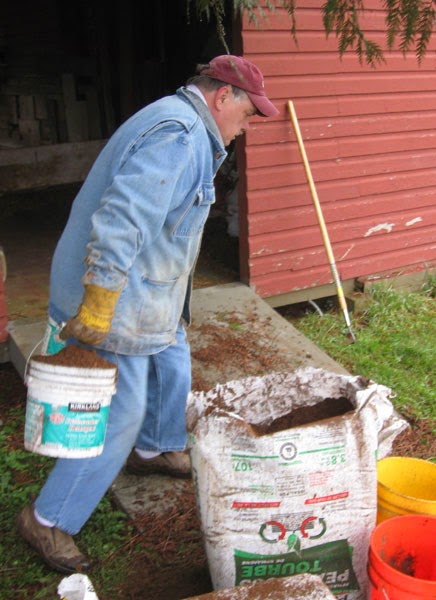
If not using sifted peat moss and steer manure, dump buckets onto 1/2" framed screen (photo, top) and sift by hand to remove debris. Add remaining ingredients and mix thoroughly using a shovel or garden hoe. Using bucket, dump into 50 lb. seed bags. Makes 2 1/2 cubic feet.

* * *

Organic Fertilizer Mixes
From David Kobos

Mix #1:
4 parts seed meal (cottonseed, soybean, linseed, etc.)
1 part dolomite lime
1 part ground phosphate rock (or 1/2 part bone meal)
1 part kelp meal

Mix #2:
1 part ground phosphate rock
1 part blood meal
1 part greensand

Read the original post here.

Tuesday, October 28, 2014

Oregon's GMO Labeling Battle: One Week to Go


First of all: please vote.

Second? Vote, dammit!

Okay, now that we have that out of the way: My family voted last week, as we usually do, sitting around the dining room table after dinner with the voter's pamphlet and our ballots, pointing at the ridiculous pictures ("Look, a pirate's running for Representative. Awesome!"), decoding the screamy endorsements then dropping our ballots off at the local public library. So now I'm going to jump into the fray and tell you why I voted for Measure 92 to require labeling of products containing genetically modified ingredients.

Luckily we only watch television shows online, so aren't subjected to the overwhelming barrage of ads talking about how the earth is going to spin backwards on its axis and life as we know it will end if the measure does or does not pass. (Though the barrage of ads for pharmaceuticals, cars and cleaning products have nearly the same deadening effect.) And since I'm not going to out my family members here, I'll just talk about my own reasons.

My first reason is, of course, a selfish one. I want to know what goes into the food I buy and feed my own family. For me, labeling will help me make decisions about which products I want to buy and which I'd rather not purchase. Labels like "certified organic" and certification from the Non-GMO Project help me to know what I'm thinking about buying, but getting those certifications is voluntary and costs a lot of money. Companies that don't want to disclose that information simply don't have to, hiding behind other labels like "natural" or "sustainable."

Now, my own feelings about what I feed my family shouldn't be the standard for the rest of the world (though everyone would be so much better off if they'd just listen to me), but, as is pointed out in a Washington Post article titled "The GMO Debate: 5 Things to Stop Arguing About," there's my concern that the use of genetically modified crops in agriculture has caused an increase of tsunami-like proportions in the use of pesticides, and that "we need to start building more transparency into our agricultural system so consumers can vote with their wallets for the kind of system they want to see." Amen.

Further, an article by Tom Philpott in Mother Jones magazine said that in a just-released paper published in the peer-reviewed Environmental Sciences Europe, by Chuck Benbrook, research professor at Washington State University's Center for Sustaining Agriculture and Natural Resources, "GMO technology 'drove up herbicide use by 527 million pounds, or about 11 percent, between 1996 (when [Monsanto’s] Roundup Ready crops first hit farm fields) and 2011.'" The article continues: “But then weeds started to develop resistance to Roundup, pushing farmers to apply higher per-acre rates. In 2002, farmers using Roundup Ready soybeans jacked up their Roundup application rates by 21 percent, triggering a 19 million pound overall increase in Roundup use."

And “by 2011, farms using Roundup Ready seeds were using 24 percent more herbicide than non-GMO farms planting the same crops," Benbrook is quoted as saying. By that time, "'in all three crops [corn, soy, and cotton], resistant weeds had fully kicked in,' Benbrook said, and farmers were responding both by ramping up use of Roundup and resorting to older, more toxic herbicides like 2,4-D."

All those pesticides don't just disappear in a puff of non-toxic smoke. They're seeping into the soil and the groundwater, washing into our rivers and streams, being blown by the wind and carried by birds, insects and passing traffic and ending up in the oceans. Not to mention that genetically modified crops can cross-pollinate with organic crops of the same species, potentially costing organic farmers their certification, as well as a loss of income from that contaminated crop.

If I can help to stem this tide of pesticides and other damages by filling my grocery bag with products that don't contain genetically modified organisms, then I'd like to do that. But first those products would have to be labeled, wouldn't they?

More reading:

"More Money, Fewer Facts: Final Week of Oregon's GMO Labeling Race" by Hannah Wallace truth-checks some claims being bandied about in commercials and materials.

Top photo from Oregon Right to Know.