Showing posts with label seeds. Show all posts

Tuesday, August 28, 2018

Farm Bulletin: From Tewksbury to Gaston


Why buy mustard at the store when you can easily make your own, especially if it's as ridiculously flavorful as the seeds grown by contributor Anthony Boutard at Ayers Creek Farm?


* * *


"He a good wit? Hang him, baboon. His wit's as thick as Tewksbury mustard."
Falstaff in Henry IV, Part II.

* * *

Since the Middle Ages, the most esteemed source of mustard was Tewksbury. Located in western England at the confluence of the Avon and Severn Rivers, with soils and a mild, maritime-influenced climate similar to ours. In his great book on salads, Acetaria (1699), Evelyn commends Tewksbury mustard as essential for competent dressing of salad greens. Today, most mustard is grown in in the provinces of Alberta and Saskatchewan, Canada, even those marketed as Dijon on the label. Dijon refers imprecisely to a Frenchy sort of method of preparation rather than the origin of the mustard seed itself; seeds from Canada also wind up in the distinctive yellow squeeze bottles for adorning the ball park hot dog.

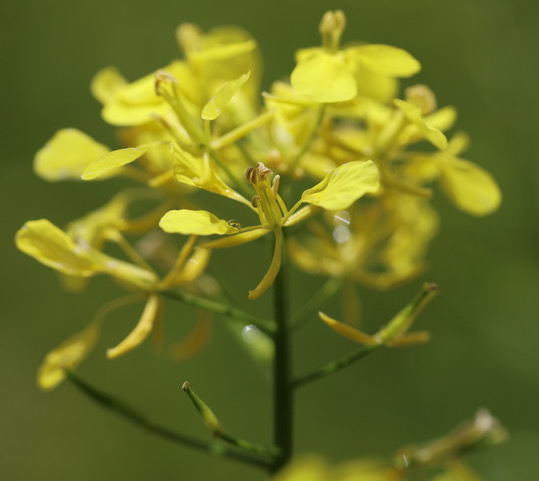
Ripening siliques of mustard. You can see where the other parts of the flower were attached at its base, the seed cavity just above that, and then the dark pollen tube extending up to the desiccated stigma. A wonderful, bristly package that perhaps only a botanist could appreciate?

The fruit of the mustard is a sort of pod called a silique. Unlike the pea and bean pod, the silique has an inner membrane called the replum. You may be familiar with the ornamental Lunaria or Honesty, where the replum looks like a silvery moon and shows up in dried flower arrangements. In the wild versions of the family, the silique explodes upon ripening, scattering the seeds into the fur or feathers of a passing creature. The small seeds of the western bittercress can be unpleasant when they fly into the eyes while you are working in the field. The explosive trait has been bred out of the domesticated members of the Brassicaceae. All this is worth noting because silique and replum are handy scrabble words. 

Mustard in flower. There are four sepals and four petals arranged in the form of a cross, so members of the family are sometimes called Crucifers, bearer of a cross, redolent with religious imagery. But Brassicaceae, derived from Pliny’s name for the cabbages, is now the accepted name of the family. Upon fertilization, the sepals, petals and stamens drop away, leaving the ovary which will develop into the silique.

Does it matter a whit that the mustard seed is grown at the headwaters of the Tualatin and Willamette Rivers, or for that matter at the confluence of the Avon and Severn? In Gaston and Tewksbury, the crop is sown in the late autumn and grows slowly through the winter, flowering in February and March, then maturing leisurely before the summer's heat. This growth cycle is very different from Alberta and Saskatchewan where the crop is sown in the spring and matures rapidly through the heat of the summer. You all can be the judge as to whether that substantial difference in growing conditions is reflected in the seeds’ culinary quality.  

Mustard drying in the field prior to harvest.

Simply grinding dry mustard seeds yields a very hot and harsh condiment. One afternoon, two Bavarian mustard makers from a convent were interviewed on the radio about their process. The sisters explained that after soaking the mustard seeds, they added a special mix of herbs and spices, refusing to divulge any further information that would compromise the secrets of their preparation. From our perspective as biologists, the proverbial cat was out of the bag. As with beans and grains, the process of soaking the seeds triggers the enzymatic breakdown of the stored starch components in the seed to simple sugars, yielding a sweeter preparation and softening its harsh character. Who cares about the secret herbs and spices; mustard is a noble spice without assistance, thank you.

Our preferred method of preparation is to rinse and then soak the seed in water for a few hours. We keep the seed moist for a day or so to start the germination process. We then place the seeds in a hot mix of rice wine vinegar, salt and a small dab of honey, and refrigerate when cool. Prepared in this manner, the seeds are good in salads, and added to various cooked dishes such as soups or stews at the last minute. You will notice that as the seeds soak, a thick mucilage develops on the outside of the seed, hence Falstaff's quip. This mucilage is an emulsifier, used for suspending oil in vinegar or water. We use the seeds as is, even on wieners.

After soaking the seeds, it is also possible to wet mill the mustard into a paste with some vinegar and salt, if that be your desire. Regardless, always reach for Authentic Gaston Mustard Seed for complete satisfaction.

Authentic Gaston Mustard Seed Condiment

Drain the water from the soaked mustard seeds and place in a small non-reactive bowl. In a small saucepan, heat enough rice vinegar to cover the seeds. A dab is about perfect for the honey, and big pinch for the salt. All a matter of to taste. Precision is not necessary.

Close-up photos of mustard by Anthony Boutard.

Sunday, April 29, 2018

On-Farm Seed Production, Part Four: 'Peace, No War' Corn


When I would go to the farmers' market or the grocery store, I browsed the vegetables on offer to find the one that I deemed worthy to take home to my table. I never wondered how it got there—I assumed the farmer planted seeds from a previous crop (or a seed packet) and the vegetable would grow reliably as it had in previous seasons. It never occurred to me that what I was looking at was the result of deliberate choices on the part of the farmer (or seed breeder) over many years. The following is the final part of an article that contributor Anthony Boutard wrote for Acres USA magazine outlining that patient process. (Read the other posts in the series.)

We fielded many inquiries about blue corn so we decided to try it. Despite the expressed interest, it sold poorly. Blue cornmeal looks like concrete mix, which is off-putting to most people, ending our blue corn moment. Among the blue ears, however, we found a single purple ear. It intrigued us so we decided to plant some of its kernels. Fourteen years later, black flour corn is our art project that arose from that chance purple ear.

Package label designed and produced by Anthony Boutard.

The design brief materialized as we noticed the wide range of purples that resulted from the initial planting. Using millo corvo (crow millet), the black corn of northern Spain, as our inspiration, we decided to draw out ears with such intensely purple kernels that they appeared black. At its simplest, the purple coloration seen from the outside of the kernel results from a red pericarp and blue pigments in the aleurone layer of the endosperm. Ears with a combination of red and purple kernels were removed from the breeding population because the red kernels lacked the blue pigments.

In addition to red pigments, a wide range of purples will show up in the pericarp. These colors are regulated by a complex of genes that also lead to different pigments in the stalk, silk, cobs and leaves. These pigments are water soluble, staining the hands during harvest, and can be used as dyes. Many different shades appear and, in the extreme, some plants produce so much pigment that photosynthesis is severely reduced. The plants are beautiful, though stunted, and fail to produce any kernels.

Early ripening is an essential element of the brief. Flour type corn ripens later than the flints—some of the initial purple ears didn’t ripen until mid-November. Our goal was to have the ears ripen by early October.

Evaluating the ears.

The challenge with the flour corns is that the meal is not richly flavored compared to the flint and popcorn types, thus not great as polenta or grits. The high level of anthocyanins associated with the purple coloration also confers a slight bitterness to the meal. There is not much point in a beautiful cornmeal if it doesn’t sell. Fortunately, sweetened recipes bring out the best in the purple meal. Think of bittersweet chocolate. Cornmeal cookies and cornmeal poundcake are delicious and attractive on the plate. The water-soluble anthocyanins are also pH indicators. In Oaxaca, tamales made from purple corn are a traditional part of the “Day of the Dead” celebration, and in Ecuador the corn is used to prepare a drink for the same celebration.

As a flour corn, it is suitable for masa. However, the costs of growing flour corn in our climate, combined with hand harvesting, makes our pricing unattractive to local tortilla makers. This flour corn will remain a small fraction of our corn production and sales, which is fine. It pays for itself and is fun to grow.

When we started this project 12 years ago, the French descriptor pièce noir (black object) came to mind, but over time the homonym ‘Peace, No War’ took root. Why not have a punctuation mark in a variety name? Moreover, the initials are also those of the Pacific Northwest, the region where we farm.

Conclusion

We still use our old Citroën 2CV around the farm. The design brief developed in the 1930s remains useful. That said, we must carefully maintain it or it will fall apart. Crop varieties are no different. They are subject to genetic entropy, the inexorable natural process that moves a crop from a highly ordered state to a less ordered state unless energy is devoted to keeping the genetics well ordered. In the cases of melon and chicory varieties described in previous installments, we had to restore a variety that had started to fall apart, adding a few flourishes of our own. With the corn (above) and tomatoes, we continue to trick them out, adding pigment through selection and pushing them to go a bit faster.

The process of shepherding a variety tailored to your preferences, the region and ground where you grow, and your customers, is a satisfying creative effort. As the design brief develops and evolves, you gain an intimacy with the crop that can never be captured by simply reading a catalogue entry. That said, the gardener or farmer also gains a deeper respect and appreciation for the effort that goes into producing that good variety they purchase from the seed catalogue.

Note: Each crop has its own protocol for seed production and I have refrained from getting into the specifics. The following books are excellent references on seed production:

Ashworth, Susan. 2002. Seed to Seed: Seed saving and growing techniques for vegetable gardeners. Decorah, Iowa: Seed Savers Exchange

Deppe, Carol. 1993. Breed Your Own Vegetable Varieties: The Gardeners and Farmers Guide to Plant Breeding and Seed Saving. Boston: Little, Brown and Co.

Read the other posts in the series. All photos by Anthony Boutard.

Monday, April 09, 2018

On-Farm Seed Production, Part Three: 'Astiana' Sauce Tomato


When I would go to the farmers' market or the grocery store, I browsed the vegetables on offer to find the one that I deemed worthy to take home to my table. I never wondered how it got there—I assumed the farmer planted seeds from a previous crop (or a seed packet) and the vegetable would grow reliably as it had in previous seasons. It never occurred to me that what I was looking at was the result of deliberate choices on the part of the farmer (or seed breeder) over many years. The following is the third part of an article that contributor Anthony Boutard wrote for Acres USA magazine outlining that patient process. (Read previous posts here.)

We did not sell tomatoes for years, avoiding the frenzied and irrational hustle to produce the first tomatoes in the market. We shun hoop-house culture and we were happy to avoid all the precious heirloom hype. That said, we grew up on home-canned tomato sauce and missed growing a high-quality sauce tomato. The varieties sold as ‘San Marzano,’ ‘Roma’ and ‘Amish Paste’ are poorly adapted to our latitude and the cool nights that attend the maritime climate of the Pacific Northwest.

Ten years ago, we purchased a few tomatoes labeled as local in Asti, a town in the Italian Piedmont that is close to the latitude of our farm. It was mid-October and we saw similar tomatoes in gardens throughout the area. The tomatoes were large at the base and tapered to a narrow top. They were pleated and distinctly green-shouldered. The seed cavities, or locules, were dry and had very few seeds. The skin was thick and the flesh highly acidic. Raw, the tomato was flat and uninteresting. When cooked the flavor opened up and was so outstanding, we reserved the 15 seeds they yielded and brought them home with us. Over time, we adapted this representative of a northern sauce tomato landrace to our farm and customers.

The characteristics described above were all important to the quality of the tomato. The large fruit with its hollow cavities meant that it held the field heat accumulated during the day well into our cool nights, extending its ripening hours. The green shoulders are an ancestral trait associated with heightened flavor. The tomato’s lycopene and pectin are concentrated in the skin and the adjacent tissue adhering to it, thus the pleated skin increases the amount of flavorful skin relative to a smooth tomato of the same dimensions. Pectin provides “mouth feel” and softens the acids present in the fruit, but generally get short shrift when we discuss tomato quality. For a sauce tomato, ample acidity is important for flavor and canning.

Our selection protocol for the tomato is based on the cooked flavor. For a given vine, if the first one or two fruits fully meet our visual criteria, we harvest and cook them. If the cooked tomato meets our standards for flavor, the seeds are reserved.

We harvest and sell the tomatoes over a six-week period, starting around Labor Day. Consequently, we select for late fruiting plants, not just early ones. However, we are careful to use only the first ones that ripen on a given plant. Tomatoes are typically self-pollinating, but as the season progresses they will shift to outcrossing, perhaps due to the depletion of trace minerals within the root zone. From our observations, tomato fruits that display a sharp increase in seeds are likely outcrossing. The shift from self-pollination to cross-pollination in response to the depletion of copper and boron has been documented in wheat and barley. Even where the outcrossing occurs within the same variety, the genetic reshuffling will produce unpredictable offspring.

When growing both a crop for sale and producing seeds for self-pollinating crops, it is tempting to sell the best at market, and harvest seed later assuming that self-pollination is a fixed characteristic. My advice is, don’t. Select for seed first and harvest crops later. If you want to produce seed for snap beans, mark the seed plants and do not touch them until the seed is ripe. If seed production is a lower priority, don’t bother trying.

Ten years after purchasing those tomatoes in Asti, sauce tomatoes are another signature crop for our farm. We now sell them as ‘Astianas’, a nod to the market where we encountered them. We sell them in bulk lugs specifically for sauce. Because they ripen during the cool days as autumn hastens, people are more willing to spend the time in the kitchen.

Read the other posts in the series.

Top photo by Anthony Boutard.

Monday, March 26, 2018

On-Farm Seed Production, Part Two: Arch Cape Chicory


When I would go to the farmers' market or the grocery store, I browsed the vegetables on offer to find the one that I deemed worthy to take home to my table. I never wondered how it got there—I assumed the farmer planted seeds from a previous crop (or a seed packet) and the vegetable would grow reliably as it had in previous seasons. It never occurred to me that what I was looking at was the result of deliberate choices on the part of the farmer (or seed breeder) over many years. The following is the second part of an article that contributor Anthony Boutard wrote for Acres USA magazine outlining that patient process. (Read the other posts in the series.)

Production of leaf or salad chicories, marketed as radicchio to give them an Italian burnish, are an important commercial crop in Italy and California. The producers rely on proprietary seed production. For example, the late Treviso chicory growers’ consortium cooperatively funds seed production for their storied Tardiva. This assures them the necessary consistency and reliability. That carefully produced seed is unavailable to other farmers.

'Arch Cape' chicories.

Stymied by the sharp decline in the consistency and quality of the publicly available seeds of the late Treviso type, with less than 10 percent of the resulting crop resembling the Italian version and the off-types often unsaleable, we either had to walk away from the crop or produce our own seed. Affection ruled the day. We decided to extract our own selection from the infuriatingly messy genetics enclosed in those seed packages.

Late winter chicory seed production is not for the impatient farmer. The crop is planted in the early summer, the new seeds are harvested midsummer a year later, in the summer of the following year those seeds are planted and in February of the next year the results are evaluated, a project of nearly three years. The necessary patience springs from enjoying a brightly colored chicory salad on a dreary February day.

Agapostemon virescens, a native ground nesting sweat bee working a chicory inflorescence. Chicory pollen, visible on the stamens an the bee’s hind leg, is white. 

We direct sow the raw chicory seed on beds rather than using starts. Our brief called for the development of a head in field-grown plants during the month of February. These were, in our experience, the most tender and least bitter relative to the later heads. Field harvest diverges from the Italian practice of lifting the roots from the field and forcing greens in muddy lagoons under shade cloth. Direct sowing and field harvest reduces labor costs.

The desired leaves are spoon shaped, sporting a red blade without any of the white venation typical of the early Treviso types. The white rib of the leaf must be sharply defined. We diverged from the classic Italian brief by allowing any red found in the thesaurus, from alizarin to wine, rather than a uniform shade, as well as a looser assemblage of the leaves conferring a more floral appearance. Our brief offers a more playful and informal salad “green” than the Italian standard without sacrificing quality. We joke that it is a digital food; you just can’t resist eating it with your fingers. It is equally good in a risotto or grilled.

Editing the first selection, which was done in early February, reduces that selection by about 10 percent.

For those wanting to follow our path and produce their own chicory seed, here are a couple of additional observations. Cichorium intybus is largely pollinated by native bees and it is important to cut down any flowering stalks of naturalized members of the species that grow in the neighborhood, commonly known as “blue sailors.” When selecting candidates for seed production, flag the best-looking plants just prior to harvesting. After harvest, remove the rest of the plants, leaving only the flagged selections. Selection is a reductive process, so you will need to revisit your selections several times to make sure they meet your brief. For example, we remove the flags if the plant shows any sign of hairiness, an unfortunate trait, or disease. For varieties where a tight head is selected, you may need to open the top of the head so the flowering stalk can emerge. On our farm, we leave the seed plants to flower in place, though you can transplant them if desired.

Label, designed and hand-cut by Anthony Boutard.

The seeds are found in the florets left after pollination. After they dry, we strip off the florets from the flower stalks and, when time permits, run them through a cheap, hand-cranked steel burr mill. The seed is then sieved and winnowed. The removal of the seed and cleaning are time-consuming and reserved for the winter months.

Later this winter, we will harvest heads produced by our third selection. We estimate that between 80 and 90 percent of the heads grown will be harvested and sold as a variety distinct to our farm.  In the field, the clusters of leaves remind us of travelers, their backs arched under their capes around the dying embers of fire on a rainy winter’s eve. A fanciful notion reinforced by the fact that the storm fronts delivering our winter rains pass over Arch Cape on the Pacific Coast, fodder for the naming our late winter salad chicory project ‘Arch Cape.'

Read the other posts in the series. All photos by Anthony Boutard.

Wednesday, March 21, 2018

On-Farm Seed Production, Part One: The Ave Bruma Melon Project


When I would go to the farmers' market or the grocery store, I browsed the vegetables on offer to find the one that I deemed worthy to take home to my table. I never wondered how it got there—I assumed the farmer planted seeds from a previous crop (or a seed packet) and the vegetable would grow reliably as it had in previous seasons. It never occurred to me that what I was looking at was the result of deliberate choices on the part of the farmer (or seed breeder) over many years. The following is the first part of an article that contributor Anthony Boutard wrote for Acres USA magazine outlining that patient process. (Read the other posts in the series.)

Ayers Creek Farm produces its own seed for a dozen crops, representing more than 30 individual varieties tailored to our farm’s environment and its customers. These projects are an important element of our farm’s identity. We continue to explore new variations and improvements on our favorite fruits and vegetables.

Anthony Boutard of Ayers Creek Farm.

As with cooking from scratch or customizing equipment, producing your own seed as a farmer or gardener should not be undertaken with saving money in mind. If that is the intent, the effort will disappoint. Refining a farm-based variety is a time-consuming effort that can span years. It is an on-going project; there is no fait accompli, no moment where you can relax and congratulate yourself on a job well done. In contrast, it is so simple to open a package and be done with it.

So why bother?

The reason we started producing our own seed varies with each crop.  Seed availability and quality are invariably factors. An affection for the crop and a clear idea of qualities desired as the project develops are essential. Finally, we want the variety to engage and please our customers; that’s the point of the enterprise, after all.

Affection

Affection is easy to evaluate; as the poets say just look to your heart. For example, we have never mustered sufficient affection to produce seed for onions or kale. We grow and sell them, happy to buy the seed. We leave it to others to invest their creative efforts on these crops. Late winter chicories, on the other hand, captivate us. We know we can grow a much better chicory from our own seed production than is available commercially. In their thrall, we have spent thousands of dollars and hundreds of hours shaping our own population. Most importantly, our customers share our esteem for these beautiful greens.

The farm's Citroën 2CV.

Affection is a single variable—either you have it or you don’t—sorting out the desired characteristics is a problem with a complex of variables. To guide us in that effort we have borrowed the concept of a “design brief” used by architects and engineers in shaping their projects.

A design brief lays out the desired functions and characteristics of a project. For example, by the end of WWI, the French lost a generation of male farmers, leaving their widows and children to manage the farms. The Citroën car company produced a design brief for a vehicle suitable for these farmers; drivers with more finesse than brawn. It called for a car capable of hauling four people and a 110-pound sack of potatoes, traveling 78 miles on a gallon of fuel, a suspension supple enough that a market basket of 144 eggs suffers no breakage on the trip from farm to market on rough, cobbled roads, and a soft removable top to accommodate bulky items such as a heifer or ewe. With respect to aesthetics, the brief specifically called for nothing more elaborate than an “umbrella with wheels.” The car that evolved from this brief was the Citroën 2CV, adored by millions of European farmers and students for several decades.

Carol Boutard in the field.

The design briefs we employ for our seed production follow a similar approach. Crops must contend with our general limitations. We use no crop protection; neither sprays against insects and diseases, nor structures such as hoop houses against the weather. Our soils are heavy silty clay loams and support robust populations of root-feeding symphylans. Our primary purchasers are restaurants. Once a dish is developed, they keep it on the menu for several weeks. We avoid niche or novelty crops prone to changes in fashion, favoring instead the refinement of familiar and well-established crops that have long harvest windows or storage life.

To illustrate how we build on this basic design brief for the production of crop varieties distinct to our farm, I provide four examples.

‘Ave Bruma’ Melon

Melons offered commercially in the U.S. are treated as perishable fruits. In Spain, Italy and through Central Asia a diverse cluster of melon varieties is selected for long-term storage at room temperature. Grown in the summer, they will hold in storage well into late winter. It is a style of fruit that has slipped out of fashion here, though we have many immigrant customers who recall the pleasure of eating these melons through the winter.

The tasting panel at Ava Gene's.

‘Valencia’ is a classic Spanish storage melon, with a history in the U.S. going back to Thomas Jefferson. Unfortunately, the seed available today is poorly maintained for the storage trait. In our 2013 planting, fewer than five percent held until Thanksgiving. The loss of storage life is an artifact of seed production; if you are simply selling seeds it is inconvenient to put the fruits into storage until January and then sell only those where the fruit doesn’t rot. That level of attention increases the cost of producing the seed substantially, as we know from experience.

Disappointed, we resolved to fix the problem using that handful of melons as our genetic base and restoring storage life to the variety. We named the project ‘Ave Bruma,' Latin for “behold the winter solstice.” We set out a brief calling for a quality melon lasting through the holidays with a hard, dark green wrinkled rind.

Melon seeds, sorted.

The seed from the surviving melons produced about 100 fruits that summer which remained in good condition until December. The brief called for a quality melon. A restaurant, Ava Gene’s of Portland, agreed to help us sort out the best-flavored fruits. We delivered the fruits without charge and they set aside the seed from the very best. Six melons stood out in their sampling. The seed from each fruit was kept separate to insure the planting included equal portions of each selection. We repeated the deal with the restaurant a second year, and of those fruits the staff selected 13 that were clearly superior. Now they buy the melons.

In four years, we have managed to extend the storage of Ave Bruma well into January, with just a small percentage going bad. With respect to flavor, the melon remains a work in progress. The flavor is good, sometimes sublime, but not as consistent as we desire, though some of the variation may be due to cultural considerations. A vine carrying too many fruits can lead to reduced flavor. Next year, we will spend more time thinning out the fruits as that may be an important factor in conjunction with genetics. Genetics are not a magic wand when it comes to flavor, good field management is essential as well.

Read the other posts in the series. Photos by Anthony Boutard (excepting the author's photo).

Friday, December 08, 2017

Food Heroes: Matthew Dillon, Seed Guy


It all goes back to growing up on his family's small farm in Nebraska just outside of Omaha. That four-acre farm, which his family called a "hobby farm," was where the Dillon family raised vegetables and kept a few cattle. Young Matthew and his siblings would harvest the vegetables from the fields, then carry them up and down the road that ran in front of their house that cut through the heart of Nebraska's rich agricultural land, selling armloads of the crops to their neighbors.

Matthew was a smart kid, and his boredom with school, which he refers to as "an 1890’s model of education," caused him to get a reputation as a rabble-rouser. "I’d definitely gotten in trouble for vandalism, smoking pot and all those things," he said. "That’s why I was getting in trouble—because I wasn’t challenged. I was totally bored."

Mount Michael Benedictine School.

So his parents plucked him out of public school and sent him to a nearby boarding school called Mount Michael Benedictine School. "It was competitive to get in, you had to start as a freshman, he said. "100 percent of students going off to college, 90 percent on scholarships, highest ACT and SAT scores in the state."

The monks also had a three-acre organic farm.

But compared to the vegetables his family grew, "the carrots and the produce were pretty crappy looking," he remembers thinking. "I guess this is good for the planet, but it doesn’t look very edible."

After graduating from Mount Michael, Dillon went to the University of California, studying the evolution of human consciousness through a special outdoor wilderness program on the impacts of the human psyche on ecosystems.

Then his father got sick. Cancer.

"He'd had an agricultural supply business, everything from veterinary health supplies to pesticides, you name it, the whole kit and caboodle," Dillon said.

Matthew dropped out of school to help his mother take care of his dad and worked to help pay the family's bills.

Platte River Valley in Nebraska.

"My dad was so healthy. Why is he, of all people, getting non-Hodgkins lymphoma?" he asked himself. "I started looking into it, and the Platte River Valley of Nebraska has this insanely high rate of non-Hodgkins lymphoma because of nitrates in the wells [from] pesticide runoff."

Dillon's father died shortly thereafter, and it began to dawn on him that the pesticides his father sold and that all the farmers in the area used might have contributed to not only his dad's disease, but to his own serious illness at the age of 12, eventually diagnosed as an endocrine disruption and after which he never grew again.

He became intrigued with agriculture. He got a job working on urban garden projects in and around Omaha, plus a side business running an electronics smuggling operation in Russia (read more about that here).

Working on the garden projects, "I realized that the only way I was going to be close to my dad again was if I started growing food," Dillon said. "The thing that he loved the most was that hobby farm. He liked that more than the business. He just liked growing food, he liked making food, [and] it became really clear to me that I needed to go and get my hands in the soil."

Touring a field study for the OSA.

An internship at an 18-acre organic farm in California's Anderson Valley introduced Dillon to an integrated approach to agriculture, where everything was different from the practices his family had used in Nebraska. But one thing struck him as odd: the seed on the organic farm came from the same sources as the seed that the conventional growers used back home.

"All of the inputs are different, our approach to caring for the soil is different, but the seed was the same," he said. Other than some heirloom seed from the Abundant Life Seed Foundation and the Seed Savers Exchange, which he said was beautiful but not agronomically strong, the bulk of the farm's seed came from conventional sources.

"Why is that?" Dillon wondered. "Where’s the organic seed?"

"So I got kind of obsessed, as I do, about the concept that you breed for the environment of intended use, and you breed for the management system of intended use," he said. "Organic environments and organic management systems were different."

That line of inquiry sent him up to Port Townsend, Washington, to the headquarters of Abundant Life, where he volunteered almost full time, eventually landing a spot on their board of directors. Having lost its executive director, the board asked Dillon to take the position as interim director, which led to his accepting the position of executive director.

And that's when the fire hit. A story in the Capital Press from August 8, 2003, summarized the damage:
"An early Monday morning fire in Port Townsend, Washington, that destroyed a landmark building, home to the oldest grocery store in the state, also destroyed Abundant Life Seed Foundation’s office, its extensive library and thousands of its seeds—hundreds of which were one-of-a-kind varieties. Matthew Dillon, executive director of the foundation, describes it as the loss of 29 years of collecting and stewarding germ plasm."
Reflecting on the effect of the devastating loss almost 15 years later, Dillon is sanguine.

At Wild Garden Seed in Philomath.

"By that time I’d met [Dr. John] Navazio and [Wild Garden Seed's Frank] Morton," he said. "All these guys who were saying, yeah, heirlooms are great and everything, but we can have the best heirlooms and we can start breeding in disease resistance and making these crops more workhorses and more robust. And that just intrigued me."

Dillon and the plant breeders and contract growers at Abundant Life had already started to improve some of the heirloom varieties, but their work wasn't without controversy, even within the organic community.

"We’d get angry letters, like 'how dare you not save the seed just as it is, how dare you make a cross or how dare you make a selection!'" he said, shaking his head. "It was intense.

"The whole thing was that heirlooms are not like these gifts handed down by the gods from Olympus to our grandparents. They evolved with those practices, intentionally or not."

Dillon feels that, in general, agricultural history hasn’t given credit to the farmer innovator, saying that farmers and gardeners have always riffed on what they find in their gardens and made selections based on their own preferences. He believes that's where we got the diversity of the heirloom and heritage seed that we find in catalogs and garden stores today.

"Our whole thing was the heirlooms of tomorrow," he said. "That’s all we were doing. In the long run, obviously, a lot of folks have embraced that and it’s become the focus of the alternative seed movement, going beyond heirlooms, still respecting conservation and the need for conservation."

Clif Bar Seed Matters initiative.

Out of the literal ashes of Abundant Life, Dillon founded the Organic Seed Alliance (OSA) with Navazio, a renowned plant geneticist, agroecologist, author and organic seed production specialist. With a belief that seed is part of our common cultural heritage—a living, natural resource that demands careful management to meet food needs now and into the future—the OSA's mission was to support the growing organic seed movement and advance what it calls "ethical seed solutions" to meet food and farming needs in a changing world.

Under Dillon's leadership the OSA educated thousands of farmers and other agricultural community members, conducted professional organic plant breeding and seed production research, and advocated for national policies strengthening organic seed systems.

But, as Dillon said, "I'm not a manager, I'm a start-up guy." Once the OSA was humming along with great people like Navazio, Micaela Colley, Kiki Hubbard and others in place, he said, "I was like, I’m done. I’m ready for something new."

In the field.

That new, shiny thing came in the unexpected form of a job with a candy bar—or what these days is called an "energy bar"—company, Clif Bar. After leaving OSA, Dillon did some consulting, and the Clif Bar Family Foundation was one of his first clients. He found it intriguing because, though only about 70 percent of the ingredients in Clif Bar products were organic, its founders, Gary Erickson and Kit Crawford, wanted to figure out how to get more organics into the system, which meant scaling up the growing organic industry, starting with seed.

"I would tell them things like, the organic movement needs to stop marketing ourselves as being grandma and grandpa’s farm and going back a hundred years," he said. "We’re not going back. We’re using the best scientific principles and practices for our production system to figure out how to move our production system forward. To do that you have to give the farmers better tools, you have to understand cover cropping better, you have to understand soil management better, there’s all of this investment you need to make."

Rather than taking the tack of much of the organic movement, like making investments in fighting GMOs and GMO labeling, Dillon's experience told him that not enough investment was being made in agricultural research. His mission from that point on was clear. "Let’s start with seed," he said. "Let’s focus on a seed initiative that improves organic seed, and then let’s see where we can go from there."

He began his work at the foundation in 2009 by founding the company's Seed Matters initiative, with a mission to improve the viability and availability of organic seed to provide more nutritious and productive crops. It would do this by conserving crop genetic diversity, promoting farmers’ roles as seed innovators and stewards, and by reinvigorating public seed research and education. It meant working with farmers, educators, researchers, nonprofits, public universities, community gardeners and seed advocates, as well as establishing graduate fellowships for students to enter the field of organic plant breeding.

A chance to move over to the company and effect what he perceives of as systemic change has placed Dillon in a critical role, as Clif Bar's Director of Agricultural Policy and Programs. For Clif Bar, he said, it was a question of looking at their agricultural supply chain, then figuring out how to make investments that will be good for their farmers but also be good for the company.

Again, for Dillon it goes back to his upbringing in the Midwest in the 1970s.

"What I love about [Clif Bar] is, you hear about companies that are triple bottom lines; Clif Bar was this five bottom line," he said. "They have people, planet, community, business and brands, and agriculture they put under community aspiration, and to me that was really cool.

"As a kid growing up in a rural community, I’d seen the farm crisis in Nebraska in the late 70s—farmers' suicides, consolidation. All of that was alive and crushingly apparent in my community. I was watching people lose farms, family members and friends losing farms in the late seventies and early eighties. So, to me, it was the idea that big ag comes in and extracts value out of communities. It’s systemic."

While Dillon openly admits that Clif Bar is far from perfect, he said that they know they have work to do.

"Because the question of any food company should be, how do our decisions either add value to communities, make communities more robust and healthy and resilient, or how do they detract from that?" he said.

Photo of Dillon at Wild Garden Seed by Shawn Linehan.

Friday, February 12, 2016

Farm Bulletin: Avoiding the "Tragedy of the Commons"


Lots of us think that farmers just stick seeds in the ground and wait until they're ready to harvest, maybe giving it a sprinkling of water now and again, then taking it to market where it's sold and ends up on our dinner table. As contributor Anthony Boutard of Ayers Creek Farm outlines below, it's a longer and much more laborious process from seed to harvest.

He went by "Starlight." Heavy in the shoulder, long in carriage and gentle in disposition. In the autumn, passersby would gather a handful of the tart, nameless pippins, descended from apple cores tossed from carriages decades before, and entice him to the fence line to stroke his big white face. This polled hereford bull passed his years in a shady pasture along Rannapo Creek laconically providing the raw ingredients for artificial insemination, the AI of the day. It was a lovely spot to idle, the stream banks washed yellow with marsh marigolds in the spring, followed by the lush green leaves of skunk cabbage through the summer, and then blue with asters into the late autumn. He wintered up at the complex of barns near the farmhouse, returning to his pasture following the courtship of the woodcocks and the spring peepers.

His owner, John Howden, was highly regarded for the quality of his herd and seminal sire, as well as the bull before Starlight. John's greater claim to fame, extending well beyond his lifetime, was in fact a well-bred and distinctive pepo. The "Howden" pumpkin (top photo) is still sold by seed houses across the country. It is the standard by which the Connecticut field pumpkin was and is measured. John spent the better part of a decade refining his pumpkin through careful selection. In the early 1970s, he applied for and received a Plant Variety Protection (PVP) for the pumpkin. If we recall properly, his son was an attorney who aided the process.

Granting of the PVP meant that John controlled the sale and marketing of the seeds for the pumpkin. He grew the pumpkins on his farm and sold the seed to Harris Seeds Company. Good seed farmers do not sit on their laurels, especially when their name is on the variety. Every year a large field of pumpkins was planted and only the best pumpkins were selected for their seed.

Passing the field on misty autumn mornings, John's 100 or so herefords would be seen grazing, in soft seasonal focus, on the culled pumpkins—squash and pumpkins have long been grown for winter livestock feed, which is probably how John entered the world of pepos. Around the same time, the progeny of his fruits from a year past would grow from Harris's catalog entry to decorate porches, schools and storefronts all across the country, many with a candle and a face lighting up the fall evenings. Many still do.

Controlling the seed, he controlled the seed quality.

There is a prevalent view that once a variety is developed and stable, no further work is needed—all you need to do is save a portion of seed each year and you are doing the Lord's work. Treating a variety as a common asset will work for a while. Nonetheless, without careful maintenance of the variety's traits the quality will deteriorate and it will lapse into a feral state. There is no invisible hand assuring that the variety will remain useful to the cultivator, in fact, just the opposite. Nor will calling a variety an "heirloom" inoculate it from the law of entropy, the tendency to drift from an ordered to a disordered state. That's nature.

This principle of genetic entropy was illustrated locally a few years ago under the banner "'Blue Lake' beans suffer the blues." The Oregonian quoted a letter from a Newberg resident who wasn't happy with her Blue Lake pole beans; I've had increasing problems in recent years with some of them being flat and stringy when mature…no plumping, so to speak. I thought I was doing something wrong, but a change in location and irrigation has not solved the problem. According to the article, many gardeners and farmers had encountered the same dismal results. As it happens, the producers of the Blue Lake pole bean seed let it "run down."

Without applying energy to keep the treasured traits in place, the bean drifted away towards a feral—low energy—state, producing the tough, stringy pod typical of its ancestors. Same as when you see a Queen Anne's Lace growing in the meadow, it is nothing more than a carrot that has drifted away from domestication, producing an ancestrally tough, stringy root and a feral disposition. Word is that a breeder is working on restoring the Blue Lake pole bean to its plump and fleshy reliability.

What happened to the Blue Lake pole bean and other older varieties that have declined in quality can be seen as a "Tragedy of the Commons." In a 1968 essay in the journal Science, Garrett Hardin proposed that common or shared ownership can lead to overexploitation of a resource without the corresponding investment to maintain its function and value. Despite the gnashing of teeth and lamentations over Monsanto and the consolidation of seed companies, the truth is there are thousands of crop varieties in public domain, the seed commons. Within that reservoir of diversity, there is no mechanism to truly reward careful stewardship of their quality. Every so often, a variety becomes the food pet of the moment, and the "puppy mill" mentality grips the heirloom seed industry as they overproduce seed, the variety's traits are compromised, and then the jaded food lovers move on to the next "thing."

As we have noted previously, the process of pushing a crop variety away from the feral brink, or teasing out traits for an improved variety, is expensive and time-consuming. Many of the crops we sell are the result of such an investment on our part, some requiring the better part of a decade in realization as well as thousands of dollars out-of-pocket. There is also a creative side to the effort; even with restoration, the breeder needs a clear understanding of the crop, "a feeling for the organism" in Barbara McClintock's words. At its core, the PVP recognizes the effort, money and creativity invested in a new variety, and provides a mechanism and time for the breeder to possibly recoup that investment. Unfortunately, it is not a farmer-friendly process.

The PVP acts much like a copyright as opposed to a patent. It is possible to patent plants or traits (utility), as well. Crops and livestock are really better seen as expressive works rather than inventions, per se. The traits of a plant are our alphabet or scale, and we try to select them in pleasing and useful combination. The PVP allows farmers to buy a protected lettuce variety and sell the lettuce. They can also produce seed for the protected so long as it is used to grow more lettuce on the farm, but not sold as seed. Research exemptions are included, as well as protection of the larger national interest.

As seed breeders and producers, we believe the Plant Variety Protection Act needs to be reworked to make it more accessible to farmers who draw out and protect useful traits in crops. In addition, independent seed producers and breeders need to look at the nonprofit American Society for Composers, Authors and Publishers (ASCAP) as model. Currently, the work and cash investment we carry out on the seeds we grow goes back into seed commons with nary a penny back to us for our effort. We are willing to let that happen, though we may seek PVP status for some of the varieties we have worked on in the future. As Howden's neighbors, we would help him out at calving time and scratch Starlight's ears occasionally, and in the process a shard of the gruff old farmer's breeding efforts infected us. Forty years hence, we are heartened to see the Howden pumpkin still in the seed catalogs, a testament to the benefits of the PVP he secured.

To see the fruits of this labor—beans, grains, flours, greens, preserves and more—visit Anthony and Carol at their farm store this weekend, Feb. 13-14, from 2-5 pm, 15219 SW Spring Hill Rd., Gaston.

Thursday, April 24, 2014

Missing the Mark on Molecular Breeding


Dr. John Navazio, a senior scientist with the Organic Seed Alliance and Organic Seed Research & Extension Specialist at Washington State University, is one of the nation's premier experts on plant breeding and seed production. I felt his comments on a widely circulated article in the Washington Post deserved reposting.

Re-posted from Organic Seed Alliance’s Seed Broadcast blog.

By Dr. John Navazio.

A recent Washington Post article by Adrian Higgins, titled “Trait by trait, plant scientists swiftly weed out bad seeds through marker-assisted breeding” (April 16, 2014), overstates the potential of marker-assisted selection (a molecular plant breeding method) and makes the dubious claim that it’s the most promising plant breeding method available today.

We agree that marker-assisted selection (MAS) has a role in crop improvement and has helped breeders for a quarter century understand the relationship between genes and plant traits. It is good basic research. But MAS is just one tool in a plant breeder’s toolbox, with clear limitations, which the article largely dismissed.

Amid this rush to the “trendy sphere of molecular breeding,” as Mr. Higgins put it, we are seeing a troubling de-emphasis on, and de-funding of, classical plant breeding that produces dynamic, genetically resilient crops across diverse—and changing—agricultural environments.

If the past century of agriculture has taught us anything, it’s that there are no silver-bullet solutions to complex problems, MAS included. The danger with this centralized, one-size-fits-all breeding approach is that it results in diminishing crop diversity, as well as the diversity of breeders representing different interests in creatively solving agricultural challenges at the regional level. These are the concerns voiced by Drs. Goodman and Tracy, two of today’s preeminent breeding theorists, who were given short shrift in Mr. Higgins’ article. In 2013, the Food and Agriculture Organization of the United Nations echoed this need for increased genetic diversity and decentralized breeding in creating the agricultural ecosystems of the future, while admonishing the “business-as-usual mindset.”

Classical breeding, rooted in field-based selection for the subtleties of a plant’s genetic response to environmental change, has proven to be highly effective for many traits that are more complex than can be discerned in a lab. Field-based selection can be practiced with limited resources and precision. Yet fewer funds are being directed to these breeding programs at our public institutions that for decades have delivered regionally adapted plant varieties to farmers and trained the next generation of breeders. We need to reprioritize classical breeding to help address our most pressing 21st century food and agriculture needs.

Photo at top from the Organic Seed Alliance blog.

Saturday, September 07, 2013

Farm Bulletin: A Handful of Seeds


It's a revelation to think of the fruit or vegetable you hold in your hand as a living seed packet, but that's just what contributor Anthony Boutard of Ayers Creek Farm points out in this week's essay.

People often ask us where they can buy seeds for our Astiana tomatoes. The fact is, you are buying seeds when you buy the fruits at the market. That is how we started with the tomato, just 15 seeds from a tomato purchased in the market of Asti, a town in the Piedmont of Italy. It is a representative of a cooking tomato landrace from the Po River Valley. The fruits are large, green-shouldered, pear-shaped and often pleated. A landrace is a population of fruits, vegetables or livestock that is shaped by the environment and culture of the region to which it belongs. Representatives of the race will vary from village to village, but they have similar qualities. These tomatoes are selected for the quality of their flavor and texture after their encounter with the stove.

We never use the word heirloom in reference to the varieties we grow. We dislike the term, and the last time it was used in this newsletter was to explain our dislike of the word best applied to fragile, inanimate objects handed down generation to generation. Beautiful Corn was written without using the word at all. Heirlooms are defined as named varieties that have been around for 25 years. Seeds are living plants, reshaped by their cultivators year-after-year, and landrace is the better term. It recognizes the living organisms are constantly changing and adapting to new environments and cultures, and this applies to their cultivators as well. The fact is, we have reshaped that tomato we purchased in Asti seven years ago, but we have carefully kept its fine cooking qualities foremost in our efforts.

Approximately 80% of the legumes, vegetables and grains we bring to market are grown from seeds we produce on the farm. Another 10% are grown from the seeds developed by Frank Morton at Wild Garden Seed in Philomath, about 60 miles south of Gaston. Producing our own seed allows us to draw out traits valuable for successful production in the Willamette Valley.

This month the Organic Seed Alliance will hold organic seed production workshops for farmers at Adaptive Seeds in Sweet Home on the 17th and at Ayers Creek on the 19th. Veteran seed producer John Navazio will lead the workshops. He is both practitioner and theoretician, an important source of information and inspiration to those of us who grow our own seed. Linda Colwell will prepare a lunch for the participants that will include the fruits, vegetables and grains we grow at the farm, underscoring the link between the seeds and food. It will be a fun day for all and we expect to learn a lot from Navazio.

Adopting the name Astiana for our tomato, we honor the long tradition of naming varieties after the location of their origin. This week, we will bring to the market a delightful, spicy grape called Canadice. It is a celibate variety from New York State research station in Geneva, New York. Until recently, they named all their varieties after places in New York; Candice is one of the Finger Lakes in western New York. Other varieties that we grow from that program with a New York tag include the grapes Interlaken, Sheridan and Steuben, and the plums Seneca and Stanley. Sadly, they have abandoned this tradition and now names are developed through "consumer testing." Two recent releases are called SnapDragon and RubyFrost. Perils of callow thinking.

Saturday, August 06, 2011

Farm Bulletin: Of Cabbages and Seed


I don't know about you, but I often find myself driving through rural areas past farms and fields, and unless it's some easily identifiable crop (like corn), or has a distinctive smell (like mint), I'm pretty clueless as to what the farmer is growing. In this bulletin, contributor Anthony Boutard of Ayers Creek Farm gives an idea of what we may be looking at.

Through the course of the year, we make several trips down the Willamette Valley to Sweet Creek Foods in Elmira. The trip takes us down the most beautiful part of the Willamette Valley. We have a choice of 99E or 99W, both slice through fertile farmland. Late last summer, we noticed a small cabbage field just south of Alder Swale outside of Amity. By the time we traveled down to make our preserves in late October, the cabbages had headed up nicely. Fifteen years ago, we might have assumed those cabbages would be shipped up to the Steinfeld's sauerkraut plant in Scappoose. However, in 2001, the company decamped to Illinois. The previous owners of our farm grew pickling cucumbers for the company, and one reason we own our farm now is the gradual withdrawal of Steinfeld's from Oregon in the late 1990s. 

Seed radishes interplanted with grass in Gaston.

At the end of March, we visited our friend Alice Doyle at Log House Plants in Cottage Grove. Alice has become the nation's leading expert on grafting tomatoes. As with other fruit crops, the grafter matches the tough, almost wild nature of a specially bred root stock, with a scion producing high quality fruit. New techniques have revived this old method of improving fruit grown as an annual, in particular, the development of a soft, silicone grafting clamp coupled with better characterized plants for root stock developed in the Netherlands and Israel. On the way back up 99W, we passed the cabbages and they were in full bloom. No cabbages had been harvested and field was carefully tended, indicating that the farmers were interested in something other than slaw or crocks of kraut.

Swathing cabbage stalks.

Passing the field in July, seed pods had formed and the plants were carefully staked to prevent the stalks from breaking. By now it was obvious that the field was planted as a seed crop. On Wednesday, another trip down the valley, and the stalks were cut and laid in rows, a process called swathing. This allows the seed to mature, cure and dry in the pod. Left on the plant, the pods would ripen, dry and shatter, spreading the seed in the field. Swathing makes the harvest of the seed manageable. Each plant produces about a half pound of seed. Our guess is that the seed crop is a valuable F1 hybrid. There are cabbages which do not produce viable pollen, called "male sterile" in the trade, and they are inter-planted with a pollen-producing variety. The resulting seed produced by the male sterile plants will be a controlled hybrid with carefully defined characteristics. The pollen bearing plants are removed from the field, leaving just those bearing the desired F1 hybrid seeds. The first male sterile cabbages were discovered in the 1940s. As with Alice's grafted tomatoes, carefully matching the characteristics of the pollen and seed bearing plants is important, and the heart of hybrid production.

Field of coriander in flower.

All through the southern Willamette Valley, there are seed house offices. The seed houses, headquartered in the Netherlands, Denmark, Canada and elsewhere, contract with growers to grow the crop. If you open a seed catalogue and order beet, spinach, chard, coriander, radish, or cabbage seed, chances are the seeds originated in the Willamette Valley. In particular, the valley is well suited to growing winter annuals. Just down the road from us, a farmer is growing a large field of French Breakfast radish seed (top photo). The pretty little cylindrical radishes are now in full flower. The field is growing two crops at once. Radish and grass seed were planted together, and when the radish seed is harvested the grass will continue to grow and produce a seed crop next year. Just south of Halsey, there are several large fields of coriander in full bloom, with the characteristic fragrance of cilantro, as it is also known.

Spinach raised for seed.

Radishes, cabbages and other members of the Brassica family, along with coriander, are insect pollinated. Spinach, chard and beets are wind pollinated, and are naturally dioecious, with pollen and seed borne on separate plants. If you pass a field with a distinct alternating pattern of a two or three rows of smaller plants, and ten to 15 rows of larger plants, it is probably one of these three crops. The larger plants produce the seed. This year, there are a lot of spinach seed fields planted in the valley. Hybrid seed corn, also wind pollinated, is planted with a similar alternating pattern. The plants destined to produce seed are detasseled. 

To keep the various varieties true to type, seed producers must isolate their fields from similar crops. The distance varies by crop and pollination method. To sort it all out, the normally secretive seed companies use a pinning map posted on the neutral ground of the local extension office. Seed production is a challenging and exacting form of industry. We produce a substantial amount of our own seed on the farm, and we will stress again that the reason is quality and variety choice, not economics. Buying seed is cheaper and easier, and we are grateful for the good seed breeders out there.

Photos by Anthony Boutard.

Saturday, November 21, 2009

Beet Beat: The Fight Begins in Earnest


Now that a federal judge has ruled against the process that the FDA used to deregulate the planting of genetically engineered (GE) Roundup Ready sugar beet seeds, industry giants like Monsanto that get their income from those seeds and the pesticides and chemicals those crops depend on are screaming mad.

In a recent report on NPR's business program, Marketplace, it's pointed out that more than half of the country's sugar comes from sugar beets, almost all of which are grown from Monsanto's Roundup Ready seeds. Luther Markwart of the American Sugar Beet Growers Association is quoted as saying "This is a food security issue. We need to make sure that we have a good, strong, viable domestic beet-sugar industry."

Reporter Mitchell Hartman also spoke with Oregon plant breeder and seedsman Frank Morton (left), who produces and sells organic seed for his Wild Garden Seed in Philomath, Oregon. Morton, one of the plaintiffs in the lawsuit, says it's also a food security issue for him and the other organic growers in the Willamette Valley where nearly all of the country's GE sugar beet seed is grown.

"If biotech traits show up in my seeds, then my seeds are worthless," Morton said of his beet and chard crops that are susceptible to cross-pollination from the GE beet pollen. "If my traits show up in conventional or biotech seeds, it's not a big deal to them, it does not destroy their value. It's an asymmetrical relationship we have here."

Judge Jeffrey White has ordered the FDA to produce an environmental impact statement which, the program says, could take years. And on December 4, the plaintiffs are going to ask the judge to issue a permanent injunction "to halt the sale and planting of GE sugarbeet seeds now and into the future, until the USDA does its job to protect consumers and farmers alike," said Zelig Golden, a lawyer with the Center for Food Safety.

The Marketplace report continues, "in a similar case, a judge banned Roundup Ready alfalfa; Monsanto's appealing that decision to the Supreme Court. If there's a ban on sugar beet planting nationwide, it's doubtful there's enough conventional seed in storage to lay in a crop next spring."

Rather than blaming the organic seed industry and farmers like Frank Morton, not to mention the courts, for this problem, maybe we need to look at the corporations that put us in this position in the first place.

Read the other posts in the series: The Beet Beat, In The Wind, The Wheels of Justice, The Wheels of Justice, Part 2.

Photo of Frank Morton by Mitch Lies for the Capital Press.

Friday, October 02, 2009

Beet Beat: The Wheels of Justice, Part 2


My mailbox, like yours, is often full of stuff I don't want and didn't ask for. But once in awhile something appears that makes me shout "Woo hoo!" and dance on the porch. (Fyi, after sixteen years my neighbors have become used to these displays.)

Today was such a day. When I opened the box and pulled out my copy of the Capital Press, an ag newspaper, who should be looking up at me with his big blue eyes but Frank Morton, plant whisperer and activist owner of Wild Garden Seed in Philomath, Oregon. I wrote a profile of Frank for Edible Portland magazine and was taken not only with his passion for plant breeding but his commitment to keeping our common biological heritage out of the hands of corporations.

So it wasn't surprising when he joined a consortium of organic-seed growers, organic farmers and environmental and consumer groups in suing the US Dept. of Agriculture (USDA) for deregulating the herbicide-tolerant "Roundup Ready" sugar beet seeds developed by Monsanto. Not only to protect his own organic beet and chard seed business from being contaminated from the pollen of the genetically engineered sugar beets also grown in the Willamette Valley, but also to safeguard the crops of organic farmers from the same potentially devastating contamination.

"This is not a political concern," he says in the article titled Organic Grower Inspires Beet Lawsuit. "I was concerned that contamination events would begin to occur that would make my seed worthless."

He initially was not inclined to file a lawsuit. As a member of the Willamette Valley Specialty Seed Association, he said he tried to bring up his concerns several times.

"I wanted to talk about this and talk about the impact of having genetically modified crops be a part of the specialy seed mix here in the valley," he is quoted as saying. "But no on wanted to talk about it. It was almost like it was an off-limits subject."

Now that a federal judge has issued a ruling against the USDA's deregulation process, the consortium is asking for an injunction banning new plantings until the environmental assessments are complete. Morton has little sympathy for the genetically modified sugar beet growers who are complaining the injunction would damage their businesses, saying it was obvious that the judge was going to rule against the USDA.

"They painted themselves into a corner with a spray paint can," Morton says. "If there is no beet sugar (next year), it's not my fault and it's not the judge's fault.

"I do feel vindicated," he said, "because everything I said to my fellow seedsmen, the judge has now agreed with."

The full text of the article is available at the Capital Press website, along with a companion article on the reaction of genetically modified sugar beet seed growers. Photo at top by Mitch Lies for the Capital Press.

Read the other posts in the series: The Beet Beat, In The Wind, The Fight Begins in Earnest and The Wheels of Justice.