Showing posts with label seed breeding. Show all posts

Sunday, April 29, 2018

On-Farm Seed Production, Part Four: 'Peace, No War' Corn


When I would go to the farmers' market or the grocery store, I browsed the vegetables on offer to find the one that I deemed worthy to take home to my table. I never wondered how it got there—I assumed the farmer planted seeds from a previous crop (or a seed packet) and the vegetable would grow reliably as it had in previous seasons. It never occurred to me that what I was looking at was the result of deliberate choices on the part of the farmer (or seed breeder) over many years. The following is the final part of an article that contributor Anthony Boutard wrote for Acres USA magazine outlining that patient process. (Read the other posts in the series.)

We fielded many inquiries about blue corn so we decided to try it. Despite the expressed interest, it sold poorly. Blue cornmeal looks like concrete mix, which is off-putting to most people, ending our blue corn moment. Among the blue ears, however, we found a single purple ear. It intrigued us so we decided to plant some of its kernels. Fourteen years later, black flour corn is our art project that arose from that chance purple ear.

Package label designed and produced by Anthony Boutard.

The design brief materialized as we noticed the wide range of purples that resulted from the initial planting. Using millo corvo (crow millet), the black corn of northern Spain, as our inspiration, we decided to draw out ears with such intensely purple kernels that they appeared black. At its simplest, the purple coloration seen from the outside of the kernel results from a red pericarp and blue pigments in the aleurone layer of the endosperm. Ears with a combination of red and purple kernels were removed from the breeding population because the red kernels lacked the blue pigments.

In addition to red pigments, a wide range of purples will show up in the pericarp. These colors are regulated by a complex of genes that also lead to different pigments in the stalk, silk, cobs and leaves. These pigments are water soluble, staining the hands during harvest, and can be used as dyes. Many different shades appear and, in the extreme, some plants produce so much pigment that photosynthesis is severely reduced. The plants are beautiful, though stunted, and fail to produce any kernels.

Early ripening is an essential element of the brief. Flour type corn ripens later than the flints—some of the initial purple ears didn’t ripen until mid-November. Our goal was to have the ears ripen by early October.

Evaluating the ears.

The challenge with the flour corns is that the meal is not richly flavored compared to the flint and popcorn types, thus not great as polenta or grits. The high level of anthocyanins associated with the purple coloration also confers a slight bitterness to the meal. There is not much point in a beautiful cornmeal if it doesn’t sell. Fortunately, sweetened recipes bring out the best in the purple meal. Think of bittersweet chocolate. Cornmeal cookies and cornmeal poundcake are delicious and attractive on the plate. The water-soluble anthocyanins are also pH indicators. In Oaxaca, tamales made from purple corn are a traditional part of the “Day of the Dead” celebration, and in Ecuador the corn is used to prepare a drink for the same celebration.

As a flour corn, it is suitable for masa. However, the costs of growing flour corn in our climate, combined with hand harvesting, makes our pricing unattractive to local tortilla makers. This flour corn will remain a small fraction of our corn production and sales, which is fine. It pays for itself and is fun to grow.

When we started this project 12 years ago, the French descriptor pièce noir (black object) came to mind, but over time the homonym ‘Peace, No War’ took root. Why not have a punctuation mark in a variety name? Moreover, the initials are also those of the Pacific Northwest, the region where we farm.

Conclusion

We still use our old Citroën 2CV around the farm. The design brief developed in the 1930s remains useful. That said, we must carefully maintain it or it will fall apart. Crop varieties are no different. They are subject to genetic entropy, the inexorable natural process that moves a crop from a highly ordered state to a less ordered state unless energy is devoted to keeping the genetics well ordered. In the cases of melon and chicory varieties described in previous installments, we had to restore a variety that had started to fall apart, adding a few flourishes of our own. With the corn (above) and tomatoes, we continue to trick them out, adding pigment through selection and pushing them to go a bit faster.

The process of shepherding a variety tailored to your preferences, the region and ground where you grow, and your customers, is a satisfying creative effort. As the design brief develops and evolves, you gain an intimacy with the crop that can never be captured by simply reading a catalogue entry. That said, the gardener or farmer also gains a deeper respect and appreciation for the effort that goes into producing that good variety they purchase from the seed catalogue.

Note: Each crop has its own protocol for seed production and I have refrained from getting into the specifics. The following books are excellent references on seed production:

Ashworth, Susan. 2002. Seed to Seed: Seed saving and growing techniques for vegetable gardeners. Decorah, Iowa: Seed Savers Exchange

Deppe, Carol. 1993. Breed Your Own Vegetable Varieties: The Gardeners and Farmers Guide to Plant Breeding and Seed Saving. Boston: Little, Brown and Co.

Read the other posts in the series. All photos by Anthony Boutard.

Monday, March 26, 2018

On-Farm Seed Production, Part Two: Arch Cape Chicory


When I would go to the farmers' market or the grocery store, I browsed the vegetables on offer to find the one that I deemed worthy to take home to my table. I never wondered how it got there—I assumed the farmer planted seeds from a previous crop (or a seed packet) and the vegetable would grow reliably as it had in previous seasons. It never occurred to me that what I was looking at was the result of deliberate choices on the part of the farmer (or seed breeder) over many years. The following is the second part of an article that contributor Anthony Boutard wrote for Acres USA magazine outlining that patient process. (Read the other posts in the series.)

Production of leaf or salad chicories, marketed as radicchio to give them an Italian burnish, are an important commercial crop in Italy and California. The producers rely on proprietary seed production. For example, the late Treviso chicory growers’ consortium cooperatively funds seed production for their storied Tardiva. This assures them the necessary consistency and reliability. That carefully produced seed is unavailable to other farmers.

'Arch Cape' chicories.

Stymied by the sharp decline in the consistency and quality of the publicly available seeds of the late Treviso type, with less than 10 percent of the resulting crop resembling the Italian version and the off-types often unsaleable, we either had to walk away from the crop or produce our own seed. Affection ruled the day. We decided to extract our own selection from the infuriatingly messy genetics enclosed in those seed packages.

Late winter chicory seed production is not for the impatient farmer. The crop is planted in the early summer, the new seeds are harvested midsummer a year later, in the summer of the following year those seeds are planted and in February of the next year the results are evaluated, a project of nearly three years. The necessary patience springs from enjoying a brightly colored chicory salad on a dreary February day.

Agapostemon virescens, a native ground nesting sweat bee working a chicory inflorescence. Chicory pollen, visible on the stamens an the bee’s hind leg, is white. 

We direct sow the raw chicory seed on beds rather than using starts. Our brief called for the development of a head in field-grown plants during the month of February. These were, in our experience, the most tender and least bitter relative to the later heads. Field harvest diverges from the Italian practice of lifting the roots from the field and forcing greens in muddy lagoons under shade cloth. Direct sowing and field harvest reduces labor costs.

The desired leaves are spoon shaped, sporting a red blade without any of the white venation typical of the early Treviso types. The white rib of the leaf must be sharply defined. We diverged from the classic Italian brief by allowing any red found in the thesaurus, from alizarin to wine, rather than a uniform shade, as well as a looser assemblage of the leaves conferring a more floral appearance. Our brief offers a more playful and informal salad “green” than the Italian standard without sacrificing quality. We joke that it is a digital food; you just can’t resist eating it with your fingers. It is equally good in a risotto or grilled.

Editing the first selection, which was done in early February, reduces that selection by about 10 percent.

For those wanting to follow our path and produce their own chicory seed, here are a couple of additional observations. Cichorium intybus is largely pollinated by native bees and it is important to cut down any flowering stalks of naturalized members of the species that grow in the neighborhood, commonly known as “blue sailors.” When selecting candidates for seed production, flag the best-looking plants just prior to harvesting. After harvest, remove the rest of the plants, leaving only the flagged selections. Selection is a reductive process, so you will need to revisit your selections several times to make sure they meet your brief. For example, we remove the flags if the plant shows any sign of hairiness, an unfortunate trait, or disease. For varieties where a tight head is selected, you may need to open the top of the head so the flowering stalk can emerge. On our farm, we leave the seed plants to flower in place, though you can transplant them if desired.

Label, designed and hand-cut by Anthony Boutard.

The seeds are found in the florets left after pollination. After they dry, we strip off the florets from the flower stalks and, when time permits, run them through a cheap, hand-cranked steel burr mill. The seed is then sieved and winnowed. The removal of the seed and cleaning are time-consuming and reserved for the winter months.

Later this winter, we will harvest heads produced by our third selection. We estimate that between 80 and 90 percent of the heads grown will be harvested and sold as a variety distinct to our farm.  In the field, the clusters of leaves remind us of travelers, their backs arched under their capes around the dying embers of fire on a rainy winter’s eve. A fanciful notion reinforced by the fact that the storm fronts delivering our winter rains pass over Arch Cape on the Pacific Coast, fodder for the naming our late winter salad chicory project ‘Arch Cape.'

Read the other posts in the series. All photos by Anthony Boutard.

Wednesday, March 21, 2018

On-Farm Seed Production, Part One: The Ave Bruma Melon Project


When I would go to the farmers' market or the grocery store, I browsed the vegetables on offer to find the one that I deemed worthy to take home to my table. I never wondered how it got there—I assumed the farmer planted seeds from a previous crop (or a seed packet) and the vegetable would grow reliably as it had in previous seasons. It never occurred to me that what I was looking at was the result of deliberate choices on the part of the farmer (or seed breeder) over many years. The following is the first part of an article that contributor Anthony Boutard wrote for Acres USA magazine outlining that patient process. (Read the other posts in the series.)

Ayers Creek Farm produces its own seed for a dozen crops, representing more than 30 individual varieties tailored to our farm’s environment and its customers. These projects are an important element of our farm’s identity. We continue to explore new variations and improvements on our favorite fruits and vegetables.

Anthony Boutard of Ayers Creek Farm.

As with cooking from scratch or customizing equipment, producing your own seed as a farmer or gardener should not be undertaken with saving money in mind. If that is the intent, the effort will disappoint. Refining a farm-based variety is a time-consuming effort that can span years. It is an on-going project; there is no fait accompli, no moment where you can relax and congratulate yourself on a job well done. In contrast, it is so simple to open a package and be done with it.

So why bother?

The reason we started producing our own seed varies with each crop.  Seed availability and quality are invariably factors. An affection for the crop and a clear idea of qualities desired as the project develops are essential. Finally, we want the variety to engage and please our customers; that’s the point of the enterprise, after all.

Affection

Affection is easy to evaluate; as the poets say just look to your heart. For example, we have never mustered sufficient affection to produce seed for onions or kale. We grow and sell them, happy to buy the seed. We leave it to others to invest their creative efforts on these crops. Late winter chicories, on the other hand, captivate us. We know we can grow a much better chicory from our own seed production than is available commercially. In their thrall, we have spent thousands of dollars and hundreds of hours shaping our own population. Most importantly, our customers share our esteem for these beautiful greens.

The farm's Citroën 2CV.

Affection is a single variable—either you have it or you don’t—sorting out the desired characteristics is a problem with a complex of variables. To guide us in that effort we have borrowed the concept of a “design brief” used by architects and engineers in shaping their projects.

A design brief lays out the desired functions and characteristics of a project. For example, by the end of WWI, the French lost a generation of male farmers, leaving their widows and children to manage the farms. The Citroën car company produced a design brief for a vehicle suitable for these farmers; drivers with more finesse than brawn. It called for a car capable of hauling four people and a 110-pound sack of potatoes, traveling 78 miles on a gallon of fuel, a suspension supple enough that a market basket of 144 eggs suffers no breakage on the trip from farm to market on rough, cobbled roads, and a soft removable top to accommodate bulky items such as a heifer or ewe. With respect to aesthetics, the brief specifically called for nothing more elaborate than an “umbrella with wheels.” The car that evolved from this brief was the Citroën 2CV, adored by millions of European farmers and students for several decades.

Carol Boutard in the field.

The design briefs we employ for our seed production follow a similar approach. Crops must contend with our general limitations. We use no crop protection; neither sprays against insects and diseases, nor structures such as hoop houses against the weather. Our soils are heavy silty clay loams and support robust populations of root-feeding symphylans. Our primary purchasers are restaurants. Once a dish is developed, they keep it on the menu for several weeks. We avoid niche or novelty crops prone to changes in fashion, favoring instead the refinement of familiar and well-established crops that have long harvest windows or storage life.

To illustrate how we build on this basic design brief for the production of crop varieties distinct to our farm, I provide four examples.

‘Ave Bruma’ Melon

Melons offered commercially in the U.S. are treated as perishable fruits. In Spain, Italy and through Central Asia a diverse cluster of melon varieties is selected for long-term storage at room temperature. Grown in the summer, they will hold in storage well into late winter. It is a style of fruit that has slipped out of fashion here, though we have many immigrant customers who recall the pleasure of eating these melons through the winter.

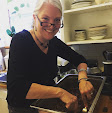
The tasting panel at Ava Gene's.

‘Valencia’ is a classic Spanish storage melon, with a history in the U.S. going back to Thomas Jefferson. Unfortunately, the seed available today is poorly maintained for the storage trait. In our 2013 planting, fewer than five percent held until Thanksgiving. The loss of storage life is an artifact of seed production; if you are simply selling seeds it is inconvenient to put the fruits into storage until January and then sell only those where the fruit doesn’t rot. That level of attention increases the cost of producing the seed substantially, as we know from experience.

Disappointed, we resolved to fix the problem using that handful of melons as our genetic base and restoring storage life to the variety. We named the project ‘Ave Bruma,' Latin for “behold the winter solstice.” We set out a brief calling for a quality melon lasting through the holidays with a hard, dark green wrinkled rind.

Melon seeds, sorted.

The seed from the surviving melons produced about 100 fruits that summer which remained in good condition until December. The brief called for a quality melon. A restaurant, Ava Gene’s of Portland, agreed to help us sort out the best-flavored fruits. We delivered the fruits without charge and they set aside the seed from the very best. Six melons stood out in their sampling. The seed from each fruit was kept separate to insure the planting included equal portions of each selection. We repeated the deal with the restaurant a second year, and of those fruits the staff selected 13 that were clearly superior. Now they buy the melons.

In four years, we have managed to extend the storage of Ave Bruma well into January, with just a small percentage going bad. With respect to flavor, the melon remains a work in progress. The flavor is good, sometimes sublime, but not as consistent as we desire, though some of the variation may be due to cultural considerations. A vine carrying too many fruits can lead to reduced flavor. Next year, we will spend more time thinning out the fruits as that may be an important factor in conjunction with genetics. Genetics are not a magic wand when it comes to flavor, good field management is essential as well.

Read the other posts in the series. Photos by Anthony Boutard (excepting the author's photo).

Thursday, April 24, 2014

Missing the Mark on Molecular Breeding


Dr. John Navazio, a senior scientist with the Organic Seed Alliance and Organic Seed Research & Extension Specialist at Washington State University, is one of the nation's premier experts on plant breeding and seed production. I felt his comments on a widely circulated article in the Washington Post deserved reposting.

Re-posted from Organic Seed Alliance’s Seed Broadcast blog.

By Dr. John Navazio.

A recent Washington Post article by Adrian Higgins, titled “Trait by trait, plant scientists swiftly weed out bad seeds through marker-assisted breeding” (April 16, 2014), overstates the potential of marker-assisted selection (a molecular plant breeding method) and makes the dubious claim that it’s the most promising plant breeding method available today.

We agree that marker-assisted selection (MAS) has a role in crop improvement and has helped breeders for a quarter century understand the relationship between genes and plant traits. It is good basic research. But MAS is just one tool in a plant breeder’s toolbox, with clear limitations, which the article largely dismissed.

Amid this rush to the “trendy sphere of molecular breeding,” as Mr. Higgins put it, we are seeing a troubling de-emphasis on, and de-funding of, classical plant breeding that produces dynamic, genetically resilient crops across diverse—and changing—agricultural environments.

If the past century of agriculture has taught us anything, it’s that there are no silver-bullet solutions to complex problems, MAS included. The danger with this centralized, one-size-fits-all breeding approach is that it results in diminishing crop diversity, as well as the diversity of breeders representing different interests in creatively solving agricultural challenges at the regional level. These are the concerns voiced by Drs. Goodman and Tracy, two of today’s preeminent breeding theorists, who were given short shrift in Mr. Higgins’ article. In 2013, the Food and Agriculture Organization of the United Nations echoed this need for increased genetic diversity and decentralized breeding in creating the agricultural ecosystems of the future, while admonishing the “business-as-usual mindset.”

Classical breeding, rooted in field-based selection for the subtleties of a plant’s genetic response to environmental change, has proven to be highly effective for many traits that are more complex than can be discerned in a lab. Field-based selection can be practiced with limited resources and precision. Yet fewer funds are being directed to these breeding programs at our public institutions that for decades have delivered regionally adapted plant varieties to farmers and trained the next generation of breeders. We need to reprioritize classical breeding to help address our most pressing 21st century food and agriculture needs.

Photo at top from the Organic Seed Alliance blog.