Showing posts with label squash. Show all posts

Saturday, November 09, 2019

Eventful: Fill Your Pantry & Winter Vegetable Sagra!


Spring has always been a favorite time of year, coming, as it does, at the end of a cold, damp season here in the Pacific Northwest. The warming temperatures, the first taste of the peppery greens emerging from the soil—it rings my chimes every time! And of course the abundance of summer can't be beat, starting with the region's justifiably renowned berries and the ensuing cavalcade of summer vegetables and fruits.

As colorful as it is delicious!

But I'm finding that, in the last couple of years, fall and winter have wangled their way into my heart, especially with the emergence of new, packed-with-flavor varieties that local farmers have adapted to our maritime climate, many of which can thrive in the field without row covers or hoop houses. I'm not just talking about beets and turnips here, either, but a whole plethora of chicories—bright red radicchio, speckled castelfranco, curly endive and escarole, and even an Italian outlier called puntarelle—with their slightly bitter bite, as well as new squash types that will make your old butternut blush, along with other upstarts like purple sprouting broccoli.

To celebrate this season of deliciousness and sample it first-hand, on Sunday, December 8th, Friends of Family Farmers and the Culinary Breeding Network are joining forces to once again to present the Fill Your Pantry and Winter Vegetable Sagra. Fill Your Pantry is a one-day community bulk-buying event encouraging you to stock your pantry for the winter with items from local farms such as storage vegetables, fruit, beans, pasture-raised meats, grains, canned goods, and other products. Take a look at the incredible list of products and sign up to pre-order. (Pre-ordering is encouraged, with orders to be picked up at the event. Farmers will bring a limited amount of product to sell at the event.)

Fill your pantry and your belly!

The Winter Vegetable Sagra—"sagra" being Italian for a rural festival—will have some of Portland's best-known chefs offering (free!) tastes of dishes featuring the many different varieties of winter vegetables being grown by Oregon farmers, along with cooking demonstrations and activities for kids. Not only that, and this speaks volumes to me, there's a cookbook swap where for every good quality cookbook you bring in, you can swap for another one of your choice!

It's all happening on December 8th from 11 a.m. to 3 p.m. at The Redd, Portland's hub for local food and farms, at 831 SE Salmon St. in Portland.  Past events have been not only a showcase of the vitality of our local food system, but an opportunity for the community to celebrate the bounty that is available to us year round.

Photos by Shawn Linehan Photography.

Saturday, October 12, 2019

In Season: Fall Has Fell? More Like Exploded!


Like many farmers I've talked with in the last couple of weeks, Josh Alsberg of Rubinette Produce seemed shell-shocked at how quickly summer has left the scene. "It fell off the cliff real fast," he said, recalling how our usual leisurely stroll from summer into fall seemed more like a bad writer's solution to tying up the loose ends of a messy script.

A high mountain pass, a hairpin curve, screeching brakes and a looping, slow-motion tumble into the canyon. (Like one person's summary of the voluminous Anna Karenina: "Anna. Train. Squish.")

Espelette peppers for a spicy hot sauce.

It's certainly not all doom and gloom, though. Alsberg emphasized that farmers' market shoppers will find that some peppers are still available, as are some local table grapes that weren't mush-ified by the cold rains, but you'd best catch them now or say sayonara until next year.

Josh's favorite apple, the Rubinette, of course!

What you will discover at farmers' markets are a panoply of apples and pears from local orchards, along with fresh ciders by the gallon. And, on October 19th at Providore Fine Foods, Alsberg is hosting a tasting of more than two dozen varieties of heritage, heirloom and hard-to-find apples—specially priced for the event—as well as local ciders and a variety of apple-y treats from Tim Healea at Little T American Baker. Another reason to go? Five percent of the day's sales will go to benefit the Sauvie Island Center, which provides local children with unique experiences that helps them make the connection between the food they eat, farming and the land.

Black futsu.

Look for squash to come on strong—Alsberg hates the term "winter squash," preferring instead the term "hard squash" to differentiate it from the softer-textured summer squash like zucchini, costata romanesco, crookneck and pattypan. He rattles off delicata, acorn and butternut as the more common exemplars of the hard squashes, but gets a gleam in his eye when he talks about his fondness for more unusual (and usually better-flavored) varieties like Black Futsu, Tetsukabuto, Gill's Golden Pippin and Robin's Koginut, an organic variety developed by rock star vegetable breeder Michael Mazourek of Cornell University.

If you're looking for the best flavor, it's always better to know your local grower, Alsberg believes. "When it's industrially grown the flavor goes out the window," he said. Big growers are looking for yield and an ability to sustain less-than-ideal shipping conditions; flavor is way down the list of their priorities, he says.

Castelfranco chicory.

Chicories are also going to be abundant, and you'll find local farms offering not just radicchio, escarole and frisée on farmers' market tables, but pale green-speckled-with-red heads of Castelfranco, the long green romaine-like Sugarloaf (known as Pan di Zucchero in Italy) and the pink-to-deep-rose Rosalba. Tardivo is another variety that's gaining popularity, with its long, thin, arching leaves and thick white ribs. (Alsberg claims to have created the hashtag #ChicoryIsTheNewKale, and who am I to argue?)

A good year for mushrooms!

Local mushrooms are going strong, plentiful enough that you can look for good pricing on chanterelles in the coming weeks. Persimmons are also looking plentiful, and you might begin to find pawpaws from a couple local farms. Pawpaws, also called the Indiana banana, are the largest edible fruit native to North America with a flavor that tastes like a cross between a mango and a banana, and breeders have been adapting them to the Northwest's maritime climate.

Purple sprouting broccoli.

When I exclaimed at the bunches of purple sprouting broccoli that I saw on his shelves, Alsberg launched into the glories of brassicas, saying that they're just beginning their season and should be abundant for the next few weeks. The bottom line is, don't mourn the passing of summer, because there's plenty to be excited about in the chilly days to come.

Providore Fine Foods, which includes purveyors Rubinette Produce, Pastaworks, Flying Fish, The Meat Monger, Little T American Baker and Hilary Horvath Flowers, is an advertiser on Good Stuff NW.

Tuesday, January 23, 2018

In Season: Eating Well in Winter


Despite what you think, true winter in the Pacific Northwest, at least as far as most of the country is concerned, is a fleeting thing. Yes, we may have a few freezes and snowstorms, but not like New England where snowplows—what are those, you might ask?—pile up banks of the stuff that last well into spring. And thank goodness we don't have the hurricanes, tornadoes and extreme flooding that many areas experience on a regular basis.

My six-foot-tall mother-in-law next to a snowbank in northern Maine.

Of course, with the unknowns brought on by climate change (and our denial of it), all of that could change in the future.

But this year, at least according to produce guy and self-described Fruit Monkey, Josh Alsberg of Rubinette Produce, we can look forward to spring things like nettles, wild mushrooms and fiddleheads, plus herbs like sorrel and chervil, to start appearing as early as March, a mere eight weeks away.

Until then? "Roots and citrus!" says Alsberg.

Beets, yes, but don't waste those greens!

By which he means colorful varieties of beets—red, gold and stripey Chioggia—as well as the knobby Gilfeather turnip, a half-rutabaga, half-turnip hybrid that is a favorite of local chefs, tracing its lineage to Gilfeather Farm in Wardsboro, Vermont. Rutabagas, turnips, celery root and storage potatoes will also be appearing on farmers' market tables over the next few weeks, as will onions, kohlrabi and locally grown white and purple daikon. Winter radishes will also be available, like the watermelon radishes from Black Locust Farm and black radishes from several farms, including Sauvie Island Organics.

There are plenty of seasonal greens available, too. Think mustard greens, cabbages, beet greens, kale, collards, local chicories and gorgeous, deep red heads of radicchio. Gathering Together Farm and Groundwork Organics are growing Kalettes, purple-green, rapini-like florets that are a hybrid of kale and brussels sprouts, with a flavor that shines when roasted or stir-fried.

On the citrus front, I have big bowls of tangerines and Meyer lemons sitting on my counter right now, as fragrant as any store-bought potpourri or essential oils (and not as toxic to pets) and they're edible, to boot! The Meyer lemons will be used for my yearly batch of preserved lemons, to be parceled out in savory dishes, relishes and salads over the next few months, and if I can manage to spare a few, maybe some lemon sorbet.

Alsberg is in hog heaven right now, gleeful at the prospect of citrus season. Several varieties of mandarin oranges and tangerines are beginning to appear, varieties like Shasta Gold, Murcott, Pixies and the teensy Kishu, with blood oranges, navel oranges and Cara Cara navel oranges rolling in now. He's also starting to see a rainbow of grapefruit on distributors' lists, and said that word on the street is that the white grapefruit called Mellow Gold is super juicy and sweeter than most. Pomegranates and kumquats have been in stores since Christmas, and we should be seeing local kiwis making an appearance soon.

Kabocha squash is a personal fave.

Winter squash is starting to clear out of his lists, but he said local growers should have plenty of kabocha, Kuri, butternut and acorn squash through mid-February. After that, though, he warns that the squash you see in stores will be from Mexico. "Enjoy them now" is his mantra. Look for recipes in my Squash Chronicles series.

Rubinette Produce is a vendor inside Providore Fine Foods, an advertiser on this blog. Josh gives his advice quarterly on what's coming in from local farms and what we can expect to see on store shelves.

Thursday, January 18, 2018

Squash Chronicles: Kabocha Glazed with White Miso and Maple Butter


It's all squash, all the time here at Good Stuff NW…or so you might surmise from the preponderance of Oscar-worthy starring roles that winter squash has been playing in this series of posts. My passion has been aided and abetted by the series of mouthwatering videos like the one above, produced by Lane Selman of the Culinary Breeding Network and the inimitable Chef Tim Wastell.

Squash season is still upon us, and you'll be finding these gorgeous orbs at local markets and greengrocers through February. Until then I'll be cramming as many of them into our dinner rotation as I can.

I'm particularly intrigued by the miso butter glaze that Tim demonstrates in the video above, since I've sworn to start exploring the possibilities of the fermented umami-bomb of miso in the coming year with the help of locally produced Jorinji misos. Get the recipe for the steamed kabocha glazed with white miso and maple above, and check out the rest of the Squash Chronicles.

Tuesday, December 26, 2017

Squash Chronicles: Black Futsu Salad with Radicchio


It's all squash, all the time here at Good Stuff NW…or so you might surmise from the preponderance of Oscar-worthy starring roles that winter squash has been playing in recent posts.

Much of the blame for this cucurbit-heavy obsession can be laid at the feet of the fellow in the video above, the estimable Chef Tim Wastell and his henchperson/enabler Lane Selman of the Culinary Breeding Network, I'm happy to share the results of their collaboration here.

Get the recipe for the Black Futsu Salad with Radicchio above, and check out the rest of the Squash Chronicles.

Tuesday, December 12, 2017

Squash Chronicles: Spaghetti Squash Cacio e Pepe


It's all squash, all the time here at Good Stuff NW…or so you might surmise from the preponderance of Oscar-worthy starring roles that winter squash has been playing in recent posts. Much of the blame for this cucurbit-heavy obsession can be laid at the feet of the fellow in the video above, the estimable Chef Tim Wastell and his henchperson/enabler Lane Selman of the Culinary Breeding Network.

Tim Wastell showing proper squash butchery technique.

A couple of years ago the pair held a Squash Party for which Tim concocted a mind-blowing squash ice cream that disrupted the comfy little niche I had created in my mind for winter squash. I came home and immediately made a winter squash sorbet and, damn him, it was stunning! It also began my quest for what else this herbaceous vine might be capable of.

Selman and Wastell recently held a Squash Sagra in which Wastell demonstrated squash butchery to a rapt audience. It's also where I learned of a series of videos of Tim making fabulously simple dishes using these much-maligned gourds. Filmed by my friend Jeremy Fenske, they are short and sweet and sure to inspire you. And, I hope, to blow apart that little niche you might have for this amazing food.

Get the recipe for Squash Cacio e Pepe. Find more squash recipes here.

Monday, December 04, 2017

Caponata with a Twist: Winter Squash!


'Tis the season for all kinds of squash-y deliciousness, and contributor Jim Dixon of Real Good Food has a great idea for a vegetarian main dish.

Using winter squash instead of eggplant for this Sicilian classic wasn't my idea, but it's a really good one. I've written before about my preference for the big, pumpkin-y Cucurbit varieties, and since they provide a lot of squash to eat, I'm always looking for another way to use them. But you can make this with any good winter squash. You'll want about three cups of cut up squash.

Cut the squash into roughly 3/4-inch chunks (if you have any leftover roasted squash, cut it into bite-sized pieces and add after cooking the other vegetables). Toss it into a skillet slicked with extra virgin olive oil and cook over medium heat. Chop and toss in a red onion, a couple of celery stalks, 2-3 cloves of garlic, a good handful of green olives, and a couple of tablespoons of whole capers. Add a good pinch of salt, too.

When the squash is tender (maybe 15 minutes), add a splash (2 tablespoons or so) of Katz Trio red wine vinegar, a healthy squirt of Three Brothers cane syrup (or a couple of tablespoons of sugar or honey), and about 2 tablespoons of tomato paste. Cook for another 5 minutes to let the flavors blend, then sprinkle with a few pinches of oregano. Drizzle with more extra virgin on the plate.

You can eat this warm as vegetable side, but I like it best at room temperature with good bread.

Thursday, November 30, 2017

Squash Sagra: Get Your Squash On This Weekend!


Quick quiz:
  1. When was the last time you ate squash? How was it prepared?
  2. When was the last time you bought a whole squash?
  3. How many varieties can you name (besides acorn and butternut)?
For answers to these and other squash-related questions, you should plan to attend the Squash Sagra, a festival devoted to all things squash this Sunday, December 3, from 11 am to 3 pm at The Redd on Southeast 9th and Salmon St.

Musquée de Provence.

The Sagra—local festival in Italian—is free and open to the public in conjunction with the annual Fill Your Pantry event hosted by Friends of Family Farmers. Local chefs will be handing out samples of squash dishes they've prepared, sharing recipes and discussing flavors and culinary uses of the diverse varieties of squash grown locally. Farmers will be offering a wide array of vegetables, beans and grains for purchase on-site, so there'll be something for everyone.

Kabocha squash.

You'll also have the opportunity to learn about the four categories of squash: sweet squash perfect for desserts, baked goods and pastries; simple squash that can be baked or steamed with no added ingredients; salad squash with their excellent flavor and texture when eaten raw; and saucy squash that are ideal for sauces, soups or curries. (See the Eat Winter Squash website for more info and photos.)

Black futsu.

There'll be a squash butchery booth where chef Tim Wastell will share pro tips and techniques for cutting up and storing the larger squash varieties. Uprising Seeds, Washington state's first 100% organic seed company, will be demonstrating a European seed oil press to make your own seed oils. There'll be a kids' play area for younger folk to taste samples of these delectable cucurbits and learn about how squash grow. And of course there's the ubiquitous Photo Booth where you can cuddle up to the cucurbit of your choice and take home a photo that'll prove your love.

"I've been wanting to do a sagra like this for a long time," said Lane Selman of the Culinary Breeding Network, one of the sponsors of the sagra. "Hopefully people will get really inspired and learn a lot about the different categories of squash that are grown in our area."

Get my recipes for squash soup, squash pie and squash risotto. Even squash sorbet (it's delicious, I promise)!

Top photo by Shawn Linehan featuring Lane Selman of the Culinary Breeding Network admiring a Doran Round Butternut squash from Adaptive Seeds Farm. 

Saturday, October 07, 2017

In Season: Falling in Love with Autumn


It's time for the fall edition of In Season, where I sit down to talk with Josh Alsberg of Rubinette Produce (above) about what we'll find cascading from local farms and spilling onto tables here in the Northwest.

"We're in that lovely time of year where it's apple season!" enthused Josh Alsberg, giving even more credence to his Fruit Monkey moniker on Twitter. "Honeycrisp starts it off," he continued, referring to the apple the New York Times dubbed The iPod of Apples on its release in 2006, though he cautions that prices may be higher this year because it's a "short year." That means there's a lower crop of apples than usual due to the icy, cold winter and late spring rains which made for a late bloom, then the intense summer heat that stressed the trees and emerging fruit.

Apples, apples, apples!

It's also partly cyclical, he said, since last year's apple crop was extremely robust and that usually means the following year's crop will be leaner. It also calls for store shoppers to be more alert, since produce buyers may be tempted to substitute foreign-grown fruit—say, New Zealand-grown Honeycrisps instead of locally grown—because of higher wholesale prices on local fruit.

Alsberg's favorite apples, which you'll find at farmers' markets and grocery stores that carry local fruit, include:
  • Rubinette, which he describes as "very juicy, robust, a nice balance of sweet and tart" and good for eating out of hand, sauce and baking.
  • Mountain Rose, also known as Hidden Rose or Airlie Red Flesh, has pink flesh and was discovered growing on a farm in Airlie, just north of Corvallis.
  • Crimson Crisp
  • Pinova, also called Piñata
  • Ashmead's Kernel
  • Elstar, which Alsberg swears tastes like marshmallow when it's baked.
  • Newtown Pippin
Most of the apples listed above will be available at least through the winter and into early spring from local orchards.

Seckel pears.

Pears are also beginning to trickle in from Northwest fruit growers, and Alsberg encourages people to look beyond the ubiquitous Bartlett for the following:
  • Taylor's Gold, for it's firm texture and sweet, juicy and fragrant qualities.
  • Bosc, which he says are fantastic for poaching in wine or other aromatics.
  • Comice for their creamy, sweet and fragrant nature.
  • Seckel and Forelle are small in size but big in flavor, and the Forelle has a "cinnamon-y essence" that is beguiling.
These pears should be around through the holidays.

Black Futsu squash.

Alsberg frowns when I mention winter squash, since he says there are so many locally grown varieties that are enjoyable right now, and highly recommends exploring outside the well-known butternut and acorn corral to find a new favorite for your family to enjoy:
  • Black Futsu is a small, bumpy, heavily ribbed Japanese squash with a nutty, fresh flavor and is one of his faves.
  • Red Kuri is in the Hubbard squash family, as is another variety called Blue Ballet.
  • Kabocha, like the Futsu, is a popular Japanese variety that has taken well to our Northwest climate.
  • Lower Salmon River is a large heritage variety from the Pacific Northwest.
  • Long Pie Pumpkin is rumored to be derived from a Native American variety from New England that was revived in the 1980s by legendary cucurbit aficionado John Navazio. As its name suggests, it is perfect for making pies.
  • Delicata is widely available and can be delicious, but Alsberg said that a few years ago the seed from one grower in Colorado crossed with something that caused the flavor to be bitter. Fortunately John Eveland of Gathering Together Farm in Philomath had saved his own seed and was able to grow it out and avoid the bitter curse. Alsberg said that most seed now is free of the bitterness, but buying from a local farmer is the best way to guarantee good flavor.
Other vegetables that will start making an appearance at Northwest farmers' markets are potatoes, which will be moving away from small fingerlings to the cured potatoes best for stewing and roasting. Also appearing will be the brassicas like kale, broccoli, spigarello and cauliflower, all of which will get sweeter as temperatures drop and the plants pump out sugars that act as antifreeze during cold weather.

A rainbow of carrots.

Carrots also become sugar-producing factories once the first frost hits, and Alsberg agrees with me that the best bet is to buy carrots with the greens still attached so you know they're fresh. (I've been disappointed with woody, cardboard-y, bitter "bulk carrots" one too many times.) You'll be seeing root vegetables taking pride of place on farmers' tables, too, so look for celeriac, radishes, turnips with their greens attached, not just for freshness but for the high nutrition value when the stems and greens are snipped off when you get them home and saved for tossing into sautés, soups and stews. Coming soon are fennel, leeks, cabbage—think slaw, sauerkraut and simmering—with brussels sprouts not far behind.

In a month or so Alsberg and I will be getting together again to put together suggestions in time for your holiday entertaining. I can't wait!

Monday, November 28, 2016

One (Big) Squash + Two Pie Recipes = Yum!


It just so happened that Thanksgiving this year coincided with the cooking of a giant—I am not exaggerating, it was a more-than-twenty-pounder prior to slaughter—Musquée de Provence squash. Though I fully intended to bake it at some point, it provided a lovely front porch decoration during Halloween with its bronzed, almost metallic-looking sheen, dramatic striated ribs and sculptured stem.

I'm a huge fan of buying whole squash, whether Hubbard or Sibley or the Northwest's own Lower Salmon River variety. And size is no deterrent (see above). All I needed was a sharp chef's knife and a sturdy cutting board—remember, these monsters are hollow inside, so you can insert the knife at the stem, push it all the way through the bottom, then with steady pressure push the knife down. I generally slice them into halves to clean them, then section them for roasting. (In a 400-degree oven the slices soften like butter, usually within an hour.)

The unroasted flesh of Cucurbita moschata (the Latin name of this squash; also called "Potiron Bronze de Montlhery"…ooh la la!) is quite sweet, and it has a lighter texture than its cousins the acorn and butternut squashes, but with a more intense flavor than either of those, and a gorgeous, red-orange color. Roasted, it maintains its sweetness and its color, which works well with a lime-inflected soup and is perfectly suited for desserts like pie or cheesecake.

I used about a quarter of the roasted squash for a soup, then froze the rest in three zip-lock freezer bags, knowing I'd pull out two of them for pies at Thanksgiving. I'd cobbled together a recipe from researching squash pies in books and online, but found that most squash pie recipes call for puréed pumpkin or butternut. The Musquée's flesh is much more moist, so I knew I needed to cut back on any added liquid.

The second recipe I tried was from a friend who is a professional baker here in Portland, a squash pie that came from a French chef she'd worked with who hated American food. "Hilariously enough," she said, "it's a variation on the recipe from the Libby's can!"

The recipes were almost identical, with only a couple of minor variations, and for the Musquée squash I think the recipe below works well. I can't wait to try it on other kinds of squash—helloooo Lower Salmon River, I'm talkin' to you—and taste the differences between them. And I'm pretty darn sure my family won't mind me using them as testers in the process.

Squash (Pumpkin) Pie

For the crust:
1 unbaked pie crust in a 9" pie pan (recipe here)
Egg white

For the filling:
3 c. roasted Musquée de Provence squash
2 eggs
2 egg yolks
1 1/2 tsp vanilla
1/4 c. brown sugar
1/4 c. granulated sugar
1/4 tsp. salt
1 1/2 tsp. ginger
1 1/2 tsp. cinnamon
1/2 tsp. nutmeg
1 c. heavy cream or whole milk

Preheat oven to 350°.

Purée squash in food processor until smooth. Pour into large mixing bowl. Add remaining ingredients and stir to combine.

Brush the bottom of the crust with a thin layer of egg white (I use my hands for this so I can feel if there are dry spots.) Pour squash mixture into the crust. Bake 1 hour. Test for doneness by inserting a sharp knife. If it doesn't come out clean, reduce heat to 300° and continue baking until set.

Monday, November 07, 2016

A Pot of Soup Will Carry Us Through


I don't know about you, but when I get stressed I crave comfort. And believe me, this election has me more than a little freaked out. Without getting all screamy about the politics of the race or the possibility that we could have a madman in the White House with the nuclear codes…um…uh…okay, stay on track…I'm planning on being glued to the coverage on election night with a big pot of soup on the stove and lots of Dave's awesome homemade sourdough on hand for sopping.

A musquée de Provence squash is made for soup.

Hey, it beats curling up in a ball in bed with the covers over my head and pretending it's all been a bad dream, right?

Truthfully, I'm looking forward to shouting and screaming and jumping up and down when the country votes to elect our first woman president. But since we still need to eat, here's a recipe for a curried squash soup that will calm and comfort, especially if you have a big loaf of artisan bread standing by for some sopping.

Election Night Curried Squash Soup

2 Tbsp. vegetable oil
1 onion, roughly chopped
3 cloves garlic, roughly chopped
2 tsp. curry powder
1 tsp.-1 Tbsp. harissa, depending on your heat tolerance, or 1/8 tsp. cayenne
1 13 1/2 oz. can coconut milk
2-4 c. water or chicken or vegetable stock (or a combination of the two)
4 c. roasted squash, cut in 1" cubes
1 kaffir lime leaf (optional)
Zest of 1/2 lime
Juice of 1/2 lime

In a large soup pot, heat oil until it shimmers. Add onion and sauté over medium heat until tender. Add garlic and heat until fragrant, about 30 seconds. Add curry powder and sauté for 1 minute. Add harissa, coconut milk, water and/or stock, squash, lime leaf, lime zest and juice. Stir to combine. Bring to a boil, then reduce heat to simmer for 30 minutes, stirring occasionally. Remove lime leaf and discard. Purée with immersion blender until smooth. (This can also be done in batches in a blender or food processor, but cool it slightly first or it'll explode all over the kitchen.)

Tuesday, November 01, 2016

Grate Your Winter Squash!


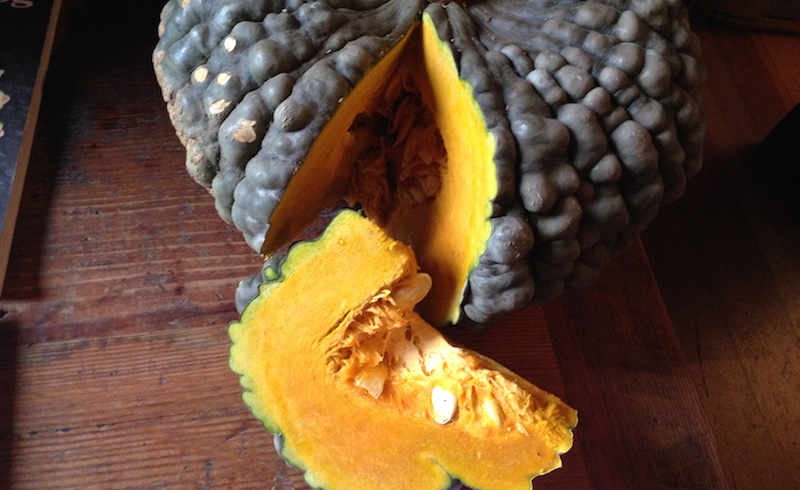
Being a winter squash fan myself, I can't get enough of these thick-skinned beauties when they begin appearing in the farmers' markets. The ubiquitous Hubbard and acorn squashes are okay, I guess, but I like to wait for the giant Sibley to turn from blue to peach as it cures, or admire the sculptural bronze beauty of a Musquée de Provence. Even a warty Marina di Chioggia, with its bumpy blue-green skin, makes a stunning centerpiece until its time to serve it. This week Jim Dixon of Real Good Food gives some suggestions for doing just that.

Grating winter squash is such a good way to take advantage of the abundance of squashes available in stores and at the farmers' markets right now. While smaller, thin-skinned squash like Delicatas can be cleaned, sliced and cooked without peeling, the bigger, pumpkin-y squashes require a bit more processing. These Cucurbita maxima (usually, but not always, the big ones; Delicatas and similar are C. pepo) need to be split with a big knife, cleaned of the seeds (save for roasting) and cut into manageable pieces. Even a smallish, three-to-four-pound squash gives you enough for a couple of meals.

So after you roast a few slices and make something like winter squash caponata, you'll probably have raw squash left over. Time to grate. While you can use a box grater, a food processor works much better. Besides being fast, the grating disk gives nice, uniform shreds. Try cooking a handful in hot olive oil until they get a little brown and eating with just good salt. I use it raw to make a celery root and squash remoulade; mixed with potatoes (or by itself), grated winter squash makes a great latke. And there's always fritters. You can freeze the grated raw squash, too.

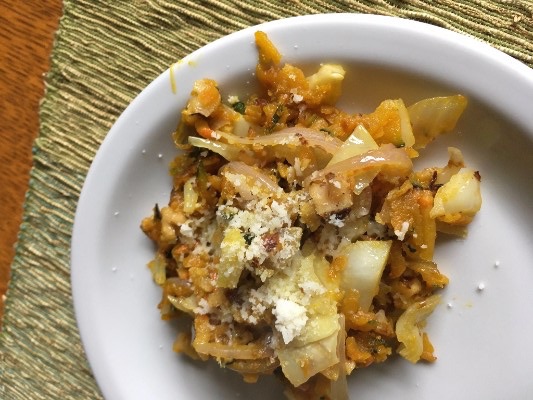
Winter Squash and Cabbage with Walnuts

I've made this using cubes of winter squash (cut about 1/2 inch, cook in oil until brown and slightly tender), but I like it better like this. To get started toast a handful of walnuts, chop coarsely, and set aside.

Cook a couple of cups of grated winter squash and a good pinch of salt in fairly hot olive oil until it starts to brown. Add a sliced red onion and a couple cloves of chopped garlic, cook until it softens, then add about a quarter head of chopped green cabbage. Sage and squash are a classic combination, so add 6-8 fresh sage leaves that you've chopped. When the vegetables are tender, remove the pan from the heat and stir in a tablespoon or two of Katz Trio red wine vinegar, the walnuts, and about 3 tablespoons of grated Parmigiano Reggiano. Grind some black pepper over it, too.

You can eat this as a vegetable side or toss it with some shaped pasta.

Wednesday, March 09, 2016

The "L" Word: Leftover Squash? You've Got a Party!


Confession time: I almost always make too much food. Instead of cooking for three, I somehow think I'm cooking for a dozen. And big eaters though we are—a pound of pasta barely feeds the three of us—when I roast a big, meltingly tender and delicious squash, there tends to be some left over. And I'm a real stickler (OK, some might say a Nazi) about not wasting food, so there are always bits and bobs of leftovers hanging around.

My best kitchen helper with the Sibley.

So the other afternoon, when we got an invitation to join my brother and his family for braised lamb shanks that evening, I volunteered to bring a nibble for sharing before dinner. With no time to go to the store, I was digging around in the fridge for ideas (what, you don't do that?) when I ran across some roasted Sibley squash we'd had a couple of nights before. Thinking that if a bean spread is good enough for Italians, if a chickpea dip is good enough for the Lebanese, then maybe a puréed squash dip might solve my evening's challenge.

I checked out a couple of resources online and found a New York Times recipe that sounded like a good place to start. Subbing in a couple of ingredients and adding a couple of others, I think it's a winner, garnering admiring "mmmmmms" and "yummmmms" from the crowd of critical tasters gathered around the counter. See what you think!

Roasted Squash Spread

2 c. roasted squash
2 green onions, light halves only, roughly chopped; finely chop the greens for garnish
1 clove garlic
1/4 c. roasted, unsalted peanuts
1/4 c. parmesan, grated
Dash of freshly grated nutmeg
2 Tbsp. olive oil
Salt to taste

Place roasted squash, whites of green onions, garlic, peanuts, parmesan and nutmeg in bowl of food processor. Pulse a few times to get ingredients broken up, then process while drizzling in the olive oil. Add more oil if necessary to get a fairly smooth, thick purée. Serve in small bowl showered with chopped green tops of green onions. Goes well with simple crackers, pita bread or pita chips.

Thursday, January 28, 2016

Superb Squash Risotto (at Last)


I don't have the engineering gene. I know this because, not only do I have several engineer-type friends who love nothing better than twiddling and fiddling and tweaking whatever their project of the day is, but I live with two people who have E-N-G-I-N-E-E-R spelled out in bold letters in their DNA.

Insanely beautiful, incredibly good.

My husband, for instance, decided he wanted to make sourdough bread. Not just any sourdough bread, mind you, but the perfect sourdough loaf. He harvested yeast from the bottom of a bottle of beer—Doggie Claws from Hair of the Dog, to be exact—and made his own sourdough starter. Then he spent, oh, about two years testing recipes from various sources, none of which gave him the result he was looking for but which we were obliged to consume. Fortunately some friends (bless you, Kathryn and Jeff) gave him the Tartine Bread book (and bless you, Chad Robertson), which in no time at all sent him into a baking-in-cast iron frenzy and supplied us with divine homemade bread thenceforth.

Of course, that didn't stop him. Oh, no. Since then he's experimented with various combinations of flours—all-purpose, whole wheat, barley, rye—from different places—Bob's Red Mill, Ayers Creek Farm, Camas Country Mill—to find out what effect they had on his loaves. He's tweaked the number of times he folds (not kneads) the dough, and how long it sits before he bakes it (currently at three days from start to finish).

I'm telling you, this is so beyond my patience level.

The sauté before adding liquid.

One example is squash risotto. Tried one recipe, it didn't really turn out the way I'd hoped, so I abandoned it. A year or so later, tried another one, was disappointed again. That pretty much ended my interest in experimenting.

Then one evening there were a couple of delicata squash that had been sitting on the counter and needed to be used, so I thought, well, why not. The skin of delicatas, as you probably know, aren't tough and can be eaten without peeling. So, remembering a beet risotto recipe that starts with raw beets, I whacked them into half-inch cubes and tried one…last…time.

A half hour or so later, I brought it to the table and…it was great!

And while it may not be a whiz-bang, James Beard-award-ready version, I think it's pretty darn good and meets my non-engineer standards for a one-dish, hearty and tasty meal. But those of you who do have that fiddly, twiddly, tweaky bent can feel free to have at it. I'm happy with it as is.

Delicata Squash and Kale Risotto

2 Tbsp. butter
3 Tbsp. olive oil
1 onion, chopped fine
3 cloves garlic, minced
2 delicata squash, seeded and cut in 1/2” cubes*
2 c. arborio rice
1/2 c. white wine
4-5 c. stock
2 c. kale or other leafy green (spinach, chard, arugula, etc.), sliced in thin strips (chiffonade)
1/2 c. Parmegiano Reggiano plus more for sprinkling

Heat oil and butter in deep skillet over medium-high heat. Add onion and sauté until tender. Add garlic and sauté briefly until fragrant. Add rice and sauté for a minute or two, then add squash and white wine. Stir until wine is absorbed, then start adding stock a ladle at a time, stirring often (though you don't have to stir it constantly). As each addition of stock is absorbed, add more until the rice is tender but still has a little crunch. Add greens and stir until it wilts. Add 1/2 c. cheese and stir. Serve.

* I also made this recipe using roasted, peeled and cubed Sibley squash and it was terrific, so feel free to sub in your favorite squash.

Thursday, November 19, 2015

Two Soups Double Your Winter Comfort


I grew up in a time of convenience, when to make a cake all you had to do was open a box, crack an egg and add water. It was like magic, guaranteed to turn out perfectly every time. It was also long before I thought to read the ingredients in the tiny print on the labels and wonder what those multisyllabic words meant. During our courtship, Dave wooed me with his lunches of grilled cheese sandwiches alongside a bowl of canned condensed tomato soup—when getting fancy meant making it with milk instead of water.

Coffeehouse flyer and recipes.

But there was a period in college when I was drafted to run a coffeehouse-cum-soup kitchen on campus, coordinating volunteers to make the day's featured soup. Most were made from scratch, and I still have the collection of recipes ranging from Mike's beer cheese soup to Jane's "potage parmentier" to Robert's killer French onion soup. One I didn't get, despite much begging and pleading, was Dr. Coleman's secret recipe for split pea soup. Lusciously thick, with a spicy heat that left a warm glow, he always brought a huge pot of it into the kitchen already made, so I couldn't even sneak a glimpse of the ingredients.

Curried coconut squash soup.

What that early experience taught me was that soup recipes can take myriad forms, from one with an ingredient list the length of your arm, dozens of steps and hours of chopping and simmering to something that can be thrown together in a few minutes from whatever's in the pantry and the vegetable bin.

Have a couple of potatoes, an onion, a couple of cups of milk and some canned clams or frozen corn or shrimp? Chowder! A couple of carrots, onion, garlic, canned beans and tomatoes? You've got the makings for minestrone!

Here are a couple of soups I've made this past week that are perfect for warming up chilly winter evenings. I usually just slice some of Dave's homemade sourdough and call it a meal, but you can get official and make a salad to serve with it if that makes you feel better. Call the neighbors over if you're in the mood, since adding more stock or water or a few more ingredients can stretch it to feed a crowd!

Tuscan White Bean Soup with Sage

1 lb. dried white beans (cannelini, borlotti or any small to medium-sized white bean)
2 Tbsp. olive oil
1 onion, roughly chopped
3 cloves garlic, roughly chopped
1 Tbsp. fresh sage leaves or 1 1/2 tsp. dried
6-8 c. water or chicken or vegetable stock (or a combination of the two)
Salt to taste

Put dried white beans in a pot and cover with water by 1 inch. Soak overnight or for several hours. Drain.

In a large soup pot, heat oil until it shimmers. Add onion and sauté over medium heat until tender. Add garlic and heat until fragrant, but don't brown it. Add stock, sage leaves and drained beans. Bring to a boil, then reduce heat to simmer for at least two hours or until beans are tender, adding more water if the beans absorb too much of the liquid. Add salt to taste. It can be served at this point, but I like to purée it with an immersion blender until it's smooth. (This can also be done in batches in a blender or food processor, but cool it slightly first or it'll explode all over the kitchen.)

Options: Chop a head of kale and stir it in to wilt at the end of cooking the beans, though this probably means you wouldn't want to purée it. Add a chunk of bacon or ham when you add the stock, (removing if you decide to purée the soup), then shred it and add back to the soup before serving.

* * *

Curried Coconut Squash Soup

2 Tbsp. vegetable oil
1 onion, roughly chopped
3 cloves garlic, roughly chopped
2 tsp. curry powder
1/8 tsp. ground cayenne
1 13 1/2 oz. can coconut milk
2-4 c. water or chicken or vegetable stock (or a combination of the two)
4 c. roasted squash, cut in 1" cubes
1 kaffir lime leaf (optional)
Zest of 1/2 lime
Juice of 1/2 lime

In a large soup pot, heat oil until it shimmers. Add onion and sauté over medium heat until tender. Add garlic and heat until fragrant, about 30 seconds. Add curry powder and sauté for 1 minute. Add cayenne, coconut milk, water and/or stock, squash, lime leaf, lime zest and juice. Stir to combine. Bring to a boil, then reduce heat to simmer for 30 minutes, stirring occasionally. Remove lime leaf and discard. Purée with immersion blender until smooth. (This can also be done in batches in a blender or food processor, but cool it slightly first or it'll explode all over the kitchen.)

 Here's one attempt to replicate that split pea soup, though adding white pepper may be the secret to the heat. Check out these recipes if you're inspired to start your own soup saga.

Saturday, January 10, 2015

Winter Soup to Warm Your Bones


Contributor Jim Dixon's annual olive oil garage sale is an institution among aficionados of good cooking and good eating in town. In the tradition of his beloved New Orleans, he always offers a lagniappe, or a little something extra, to his Real Good Food customers, usually something warming to drink and a cup of his famous "garage sale soup."

Garbanzo, Farro & Squash Soup

Soak about a cup each of garbanzos and farro together in plenty of water overnight. Drain, add enough water to cover, stir in some salt, and simmer for an hour—longer is even better—or until the beans are tender. Cut up the rest of the ingredients while the beans and farro cook.

Chop an onion, 3-4 stalks of celery and a few cloves of garlic. Chiffonade a bunch of collard greens (leave the center stalk attached; it'll cook enough to get tender).

While I like to use one of the big, pumpkin-y squashes (Cucurbita maxima, like kabocha or Hubbard), for this, almost any winter squash would work. Cut it in half, pick out the seeds (roast them with olive oil and salt for about 25 minutes) then grate the raw pieces (and leave the skin on, even with the gnarly-looking kabochas). It’s easiest in the food processor, but a box grater works, too. You want about 2 cups worth.

Add the grated squash, onion, celery, garlic and collards to the pot. Add a large can of diced tomatoes (or the tomatoes you roasted and froze last summer). Sprinkle in a good handful of Pantellerian oregano, pour in plenty of good olive oil, taste for salt and let the soup simmer for a couple of hours if you can. Soup always tastes best with long, slow cooking.

Just before serving taste it again; if it seems to need a little something, add a splash of Katz Gravenstein apple cider vinegar [good quality regular cider vinegar works, too. - KB]. Drizzle with more oil at the table, and a pinch of Parmigiano would be good, too.

Monday, December 15, 2014

Classic with a Twist: Winter Squash Caponata


I've been on a tear with squash lately, so contributor Jim Dixon's most recent post fits the bill perfectly. Check his Real Good Food website to get the latest on his expanded holiday warehouse hours!

Winter Squash Caponata


Using winter squash instead of eggplant for this Sicilian classic wasn't my idea, but it's a really good one. I've written before about my preference for the big, pumpkin-y Cucurbit varieties, and since they provide a lot of squash to eat, I'm always looking for another way to use them. But you can make this with any good winter squash. You'll want about 3 cups of cut up squash.


Cut the squash into roughly 3/4 inch chunks (and always save the seeds; roast with olive oil and salt). Toss it into a skillet slicked with extra virgin olive oil and cook over medium heat. Toss in a chopped red onion, a couple of celery stalks, 2-3 cloves of garlic, a good handful of chopped green olives, and a couple of tablespoons of capers (from Pantelleria, of course). Add a good pinch of salt, too.


When the squash is tender (maybe 15 minutes), add a splash (2 tablespoons or so) of Katz Trio red wine vinegar, a healthy squirt of Three Brothers cane syrup (or a couple of tablespoons of sugar or honey), and about 2 tablespoons of tomato paste. Cook for another 5 minutes to let the flavors blend, then sprinkle with a few pinches of Pantellerian oregano. Drizzle with more extra virgin on the plate.


You can eat this warm as vegetable side, but I like it best at room temperature with good bread.

Monday, December 08, 2014

Move Over, Ice Cream: Squash Sorbet Steals the Spotlight


The Portland food boom continues: we're already famous for our beverages like beer, coffee, tea and wine—OK, sodas and drinking vinegars, too—our chefs, restaurants and food carts are second to none, and there seems to be a recent explosion of nouveau ice cream parlors out-weirding each other with crazy (and sometimes very unappealing-sounding) flavors like bone marrow, avocado, blood pudding and, because it is Portland, after all, bacon.

When I saw squash ice cream on the roster at a recent Squash Party—hosted by Lane Selman and Alex Stone of the Culinary Breeding Network to taste new and unusual varieties of cucurbits—you could say I was a bit skeptical. But then two things convinced me to give it a chance: that it was concocted by Tim Wastell of Firehouse restaurant, a guy as dedicated to field-to-table dining as anyone in the city, and that it was made from one of Ayers Creek Farm's astonishing and deeply flavorful Musquée de Provence squashes (above left).

Creamy, sweet and luscious, it was all I could ask from an ice cream, particularly since it was served on a pumpkin seed sablé, a type of French biscuit that was made just for the tasting by Linda Colwell. I came home and told Dave about it, thinking he might be up for attempting a sorbet, since due to his lactose-intolerance he's been whipping up some mighty fine examples in his ice cream maker. We also happened to have one of those same Musquée pumpkins that I'd picked up from the market the week before, and I had a feeling it might just match well with the cranberry tart I was planning on taking to Thanksgiving dinner.

Right on all counts—the rich sweetness of the sorbet melded perfectly with the tart cranberry-orange of the tart—we're now intent on doing some further experimenting in the less-traveled roads of sorbet-making. I'll keep you posted.

Musquée de Provence Squash Sorbet

2 lbs. Musquée de Provence squash or other sweet-fleshed squash
1 1/4 c. simple syrup
1/4 c. orange juice
1 tbsp. lemon juice

To make the squash puree:

Preheat oven to 400°.

Cut squash in half and scoop out seeds. Cut the squash into 1/2” slices and place on a parchment-lined baking tray. Place in oven and bake until the squash is fork tender, about an hour. Remove the squash from the oven and set aside to cool. 

Once squash is cool, scoop out the flesh from the skin and purée in a food processor.

To make the simple syrup:

While the squash is baking, in a medium saucepan combine 1 1/2 c. sugar and 1 1/2 c. water. Heat briefly over low heat, stirring until sugar dissolves completely. Set aside to cool.

To make the sorbet:

In a blender, blend 2 cups of squash purée with simple syrup, lemon and orange juices until smooth. Freeze in an ice cream machine according to manufacturer's instructions. Store in the freezer.