Showing posts with label farro. Show all posts

Saturday, January 10, 2015

Winter Soup to Warm Your Bones


Contributor Jim Dixon's annual olive oil garage sale is an institution among aficionados of good cooking and good eating in town. In the tradition of his beloved New Orleans, he always offers a lagniappe, or a little something extra, to his Real Good Food customers, usually something warming to drink and a cup of his famous "garage sale soup."

Garbanzo, Farro & Squash Soup

Soak about a cup each of garbanzos and farro together in plenty of water overnight. Drain, add enough water to cover, stir in some salt, and simmer for an hour—longer is even better—or until the beans are tender. Cut up the rest of the ingredients while the beans and farro cook.

Chop an onion, 3-4 stalks of celery and a few cloves of garlic. Chiffonade a bunch of collard greens (leave the center stalk attached; it'll cook enough to get tender).

While I like to use one of the big, pumpkin-y squashes (Cucurbita maxima, like kabocha or Hubbard), for this, almost any winter squash would work. Cut it in half, pick out the seeds (roast them with olive oil and salt for about 25 minutes) then grate the raw pieces (and leave the skin on, even with the gnarly-looking kabochas). It’s easiest in the food processor, but a box grater works, too. You want about 2 cups worth.

Add the grated squash, onion, celery, garlic and collards to the pot. Add a large can of diced tomatoes (or the tomatoes you roasted and froze last summer). Sprinkle in a good handful of Pantellerian oregano, pour in plenty of good olive oil, taste for salt and let the soup simmer for a couple of hours if you can. Soup always tastes best with long, slow cooking.

Just before serving taste it again; if it seems to need a little something, add a splash of Katz Gravenstein apple cider vinegar [good quality regular cider vinegar works, too. - KB]. Drizzle with more oil at the table, and a pinch of Parmigiano would be good, too.

Monday, February 13, 2012

Fungi and Farro? Far Out!


It's been deadline city on a couple of stories for FoodDay, so I apologize for the dearth of posts this last week. But fortunately contributor Jim Dixon of RealGoodFood is still recounting his travels in Italy, so we can all be the beneficiaries of the delicious knowledge he gained there. And if you can, get some of the Pantellerian oregano he brought back…it is some of the most amazing oregano I've ever had!

It’s been almost three months since we were on Pantelleria, but I always have a little bit of the island in my kitchen. And since we went mushroom hunting while we were there, using Pantellerian flavors with mushrooms seemed right.

Farro con Funghi Pantesco

Soak and cook a couple of cups of the Bluebird Grain Farms farro. [Other farro is fine, too, but Bluebird is a small NW farm with fantastic products. - KAB] While the grain is simmering, slice a pound of mushrooms, several cloves of garlic, and a couple of anchovies (preferably salt-packed). Cook the mushrooms in a dry skillet over medium heat; they’ll give up their liquid, and when it’s almost completely cooked off, add enough extra virgin olive oil to cover the bottom of the pan.

Add the garlic, anchovies, a few big pinches of Pantellerian oregano, and a couple of tablespoons or so of capers. (You can buy salt-packed capers at New Seasons or order the Pantellerian capers from Gustiamo…if you do, get the salt-packed anchovies from them, too.) Add the cooked farro, simmer together for awhile, and eat.

Photo of Pantellerian Boletus and Agaricus Delicius from FlourishNourish.

Monday, July 25, 2011

In a Pickle About Dinner?


I am in awe of contributor Jim Dixon of RealGoodFood for so many reasons…he works hard, he has a fabulous garden, he's a terrific writer and he makes good food from whatever fresh ingredients are at hand. Oh, yeah, and he's a genuinely nice guy. Here's a cold grain salad of his that I'm going to be making this summer to go with grilled meats or to have all by itself.

The weeks I do the farmers' market are long. I’m at the day job all week, and then my days off are consumed by getting ready and actually being at the market. But I love the seeing my regular customers and meeting new ones, the folks who haven’t discovered how good real extra virgin olive oil can be. So despite feeling a bit ragged, I really don’t mind.

However, I’m writing this Sunday evening, and I have another long day tomorrow. All of which is rationalizing why what follows may not really qualify as a recipe. But it does taste good.

Sort of Pickled Farro Salad

I had some assorted vegetables from Groundwork Organics in the refrigerator and I needed to come up with something for dinner. I cut up a few radishes, red and daikon, a carrot, cucumber and a bit of green cabbage (smallish, bite-sized pieces). It all went in a bowl, and I poured in some Katz late harvest Zinfandel vinegar (the Zinfandel, Sauvignon Blanc, and Viognier Honey all have what Italians call agrodolce, a sweet and sour flavor). A healthy pinch of flor de sal, a quick stir, and I set the bowl aside for a couple of hours for a sort of quick pickle.

Just before dinner, I tossed the vinegared vegetables with a bit of leftover cooked farro and a substantial drizzle of extra virgin olive oil. Quite tasty.

See the RealGoodFood website for his upcoming PSU market dates.

Wednesday, May 18, 2011

Salad Smackdown: Farro Tabbouleh


A friend put it succinctly when she said that she was itching to shed "the bourbon and blanket lifestyle" we've all adopted (whether in real life or just psychologically) in order to cope with a record-setting wet, cold spring.

For me this means not only switching my wardrobe to t-shirts and sandals, but putting away the soup pots and starting to think outside the Dutch oven. And what are the shorts and sandals of the table but hearty salads made with the fresh greens spilling off of farmers' market tables and popping out of raised beds.

The Italian parsley I planted last year has come back with a vengeance, and the mint I dug up, potted and shared with the neighbors is happily doing what it does best and spreading all over the place once again. And because I was moved to buy some farro recently, I decided to see what it would be like in a tabbouleh-type of salad.

Tossed with some spring onions and garlic and tossed with a lemony vinaigrette, it's a great side dish as is, but would be great with chopped tomatoes and cucumbers when they come along, and the addition of fresh slices of mozzarella alongside would make a nice lunch. For summer barbecues it'll be a perfect light grain dish to go with whole roasted chicken hot off the Weber.

OK, weather, I'm ready for summer now. Bring it on!

Farro Tabbouleh with Lemony Mustard Vinaigrette

For the vinaigrette:
1/2 c. olive oil
6 Tbsp. lemon juice
1 Tbsp. Dijon mustard
1 clove garlic, crushed
1/2 tsp. dried oregano
Salt and pepper to taste

For the salad:
3 c. cooked farro
1 c. coarsely chopped fresh mint leaves
1 c. coarsely chopped fresh Italian parsley
1/2 c. diced spring onions, including greens
Salt to taste

To make the vinaigrette, take any tightly lidded container (I often use a leftover [clean] salsa container), put all the ingredients into it, put on the lid and shake like the dickens over the sink, in case, as once happened, the lid wasn't as tight as I thought and I ended up dressing the kitchen instead of the salad. Can be made ahead; stores well for several days in the fridge.

Put 2 cups uncooked farro in the bottom of a large saucepan and cover with 2-3" of water. Bring to a boil, reduce heat to simmer and cook for 20 minutes, adding water if it gets too dry, until farro is cooked through but still has a nice resistance when you bite into it…don't let it get mushy. Drain and rinse in cold water to cool. Transfer to large mixing bowl, add remaining ingredients and enough dressing to moisten. Combine and, if time allows, let it sit for an hour or so for flavors to meld. Serve at room temperature.

Try this Farro and Pecorino Salad for another take on this great grain!

Tuesday, February 22, 2011

A Dish You Won't Rue


The deeply flavorful, dark brown roux that is the base of much of Cajun cooking is something I hadn't yet atttempted, but after reading this recipe from contributor Jim Dixon of RealGoodFood, I had to jump in with both feet. It was a revelatory experience!

Farro “Gumbo”

Just to be perfectly clear: this is not what anyone from Louisiana would call gumbo. While that gumbo has centuries of history and still generates passionate disagreement about what form of the thick, spicy brown stew is real gumbo, my ersatz version only borrows from the basic approach to gumbo-making. I started from this, John Besh writing about making roux in his cookbook, My New Orleans:

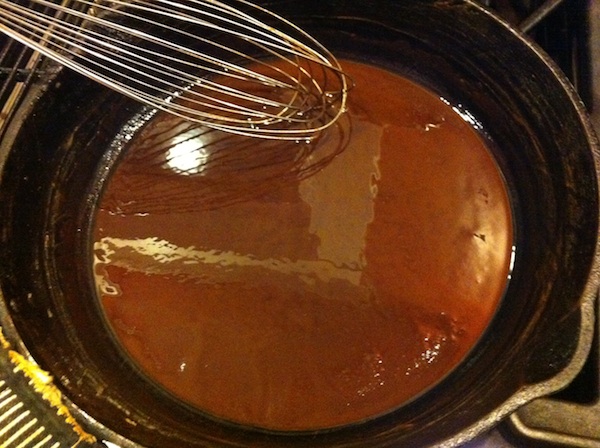
“I always heat the oil first and whisk the flour into the hot oil. Not only does this speed up the process; it yields that deep, dark chocolate-colored gumbo I love. I always add the onions first to the dark roux, holding back the rest of the vegetables until the onion caramelizes. Otherwise, the water in the vegetables will keep the onion from browning and releasing its sweet juices.”

So I made my roux, heating some extra virgin olive oil* in a cast iron skillet, then adding an equal amount of flour (white whole wheat, a whole grain flour made from soft white wheat). I stirred the roux over medium heat, and after about 15 minutes I started to get the chocolate brown Besh describes.

(Donald Link’s cookbook, Real Cajun,offers more good advice about roux. Use a whisk to make sure no flour sticks to the skillet and burns, since that will spoil the roux. Watch the heat, and stir carefully. Link says roux isn’t called Cajun napalm without good reason; splash a dab on yourself and you will be burned. His last words of caution: roux left untended can catch fire.)

I added half a chopped onion and cooked it for another 10 minutes or so, then chopped bell pepper** and celery (roughly the same amount as the onion) and cooked for a few minutes more. Next into the pot: a quarter head of green cabbage***, roughly chopped, a healthy dash of Cajun seasoning, and a bit more cooking.

I’d already soaked and cooked a pot of Bluebird farro (right), and I spooned the grain and most of the cooking liquid into the skillet, roughly as much in volume as the roux-vegetable mix. I added a little file powder (ground sassafras), too.

I knew the already thick stew would get thicker, so I added about a cup of water, turned the burner down to simmer, put the lid on, and let it cook for about 45 minutes, checking regularly and adding a bit more water when necessary to keep it from sticking. Then I spooned into a bowl, sprinkled on a little more file, and splashed on the Crystal (Tabasco-like hot sauce).

* I used 1/4 c. each of olive oil and unbleached flour and it seemed to be the perfect amount.
** There was a poblano pepper in the fridge, so that substituted for the bell pepper.
*** I used the equivalent amount of lacinato kale, which I'm sure Jim would not begrudge me, and about 1/2 lb. of frozen Trader Joe's shrimp.

Monday, January 24, 2011

How Do I Love Thee?


Who doesn't love little fried cakes? Contributor Jim Dixon of Real Good Food has been cataloging the many and varied forms that fritter love can take, and shares another one of them here.

As you may know, I like to make little fried things I call fritters, usually with some kind of vegetable. Sometimes I’ll cook the vegetable just to make the fritters, but more often I use whatever leftovers I have around.

This batch began as roasted sweet potatoes and parsnips, but would work with just sweet potatoes (either orange or white-fleshed, cooked just to make fritters) or any other combination of root vegetables. Roasting concentrates and caramelizes the sugars in the sweet potatoes, so the leftovers would be my first choice. The farro is a nice addition, but could also be left out.

Roasted Sweet Potato, Parsnip and Farro Fritters

Combine a cup or so of coarsely mashed leftover roasted sweet potatoes and parsnips with chopped shallot, a half cup of cooked farro, a pinch of sea salt and a quarter cup of freshly grated Parmigiano Reggiano. Break an egg in to the mix and stir, then add a quarter cup or so of good bread crumbs. The mixture should hold together in a spoon; you can add another egg if too dry, more breadcrumbs if too wet.

Use enough extra virgin olive oil to coat the bottom of a heavy skillet; heat until the oil begins to ripple. Use a pair of spoons to form walnut-size fritters. Slip carefully into  the oil and flatten gently. Cook until brown (these brown more quickly because of the sugars in the sweet potatoes, so watch them), then turn and cook the other side. Sprinkle with flor de sal and eat hot. Makes about 8-10 fritters.

Sunday, November 08, 2009

Staying Warm in Winter


Winter is coming, as evidenced by the recent plummeting temperatures and lashing rains. Contributor Jim Dixon of RealGoodFood is fighting back with hearty soups made from grains and root veggies, and he shares a recipe here. You can find him and a wide selection of imported grains, beans, Katz vinegars and Italian olive oils on Mondays from 5 till 7 at Activspace, 833 SE Main #111 in the inner courtyard (and cash or checks only, please).

The weekend’s storm definitely felt like winter, and I made a big pot of soup to keep warm. You could cook the beans and farro in the soup, but it will take longer.

Farro and Bean Soup with Kale, Squash, and Celery Root

Soak a cup or more of Bluebird Grain Farms farro overnight, then simmer in salted water for about an hour. Cook a cup or more of Haricot Farms red beans (I combine the beans, unsoaked, with water, salt, and olive oil in a clay bean pot, then bake at about 200° until done, usually a few hours).

Start by making an Italian-style sofrito. Cook a chopped onion in extra virgin olive oil for a few minutes, then add chopped celery and cook a bit longer, then carrots and cook a little more. Add a little salt and water (several cups or more) and bring to a gentle boil.

Peel and cube a celery root, add to pot. Ditto a smallish butternut squash (or half a bigger one). Chiffonade a bunch of cavalo nero (aka lacinato kale) by cutting the leaves into thin strips. Add to pot. Chop half a head of green cabbage, into the pot as well. Add more water to cover, if necessary, and simmer gently for an hour or so.

Add the cooked farro and beans, check the salt and add more if needed. Stir in a cup or so of polenta (Ayers Creek is the best. They'll be back at the Hillsdale Farmers Market on Sunday, Nov. 15. Check the website to find out what they'll be bringing.). Simmer for another 30 minutes or longer.

Serve with grated Parmigiano Reggiano.

Saturday, October 24, 2009

Theme and Variation


It's certainly happened to me. We'll go over to a friend's home, as once happened, and she'll serve polenta with a mushroom ragu. I make polenta. I make mushroom ragu. But I'd never put them together before. It's one of those "D'oh!" moments where I just want to slap myself. Fortunately, I'm not the only one, as contributor Jim Dixon of Real Good Food shares below.

I’m not sure why I hadn’t tried this combination before, but it’s going into the regular rotation.

Farro and Sugo

For the farro:

Soak a couple of cups of Bluebird Grain Farms farro overnight, then simmer in salted water for at least 45 minutes (longer seems to be better) until it’s tender (or as tender as it gets, which is a little al dente). [If using a different brand, it can become tender in as little as 30-40 minutes. You can always make it ahead of time and warm it before serving. - KAB]

Make a batch of beef sugo, either the short rib version below or the variation with chuck (what I used this weekend). Pork shoulder would also work. Dish some of the sugo over the farro.

For the short rib sugo:

In a good sized pot (I use a cast iron Dutch oven), brown about a pound and half of short ribs in a little olive oil. Add some salt, an onion, some celery, and carrot, all chopped into medium dice, and cook for a few more minutes. (Or use beef chuck, aka stew meat.)

Add about a half bottle of decent red wine, shot of espresso (or half cup of strong coffee), cover, and stick into a 200° oven for about 3 hours.

Remove the short ribs from the pot, let cool, and pick the meat off the bones. You can reduce the braising liquid if you like, but it’s not absolutely necessary. Chop the meat coarsely and return to the pot, adding a large can of ground or diced tomatoes. Simmer for another 20 minutes or so, adjusting the salt if necessary.

(For my chuck version, I cooked a chopped onion in olive oil, added 3 salt-packed anchovies after cleaning and dicing, then the shot of espresso. Let that cook a few minutes, added the tomato, then the beef.)

Tuesday, June 02, 2009

Great Grain


With the weather creeping toward summerlike, I'm thinking more about cool salads and picnics in a park, not to mention easy but impressive side dishes I can take to potluck dinners. This recipe for farro salad fits all those categories, and is perfect for any vegetarians in the crowd. And yes, I've posted this recipe before, but it's just so good I have to share it again.

Farro & Pecorino Salad
From Luan Schooler

1 c. whole grain Farro
Salted water
4 oz. good aged pecorino, cut into little cubes
1 c. halved cherry tomatoes
1/4 c. oil-cured olives, pitted & chopped roughly
A handful of basil leaves
6 tablespoons (more or less) of good, full flavored olive oil
Salt and fresh cracked pepper to taste

Cook the farro in the salted water at a bare simmer until just tender. Drain well and spread on a baking sheet to cool (or, if you're in a hurry, run under cold water and drain thoroughly). Gently combine the farro, cheese, tomatoes and olives. Drizzle with olive oil—start with about 4 tablespoons, let it sit a few minutes, taste and add some more if it seems dry. Tear basil leaves and fold into salad, then season with salt and pepper to taste.

Tuesday, March 03, 2009

If It's Good Enough for the Roman Legions...


I've posted about the grain known as farro before, but in a recent e-mail Jim Dixon of RealGoodFood reminded me how much I like this wheat, once a staple of the Roman Legions.

My basic approach to picking products to sell is whether it’s something I want to eat a lot of. So I’ve added farro to the inventory list. Also known as emmer, a type of wheat, farro (Triticum dicoccon) is an ancient grain from the Fertile Crescent. Once common across the Near East (the Egyptions made both beer and bread from it), it’s now mostly grown only in the mountain region of Tuscany known as the Garfagnana. But Bluebird Grain Farms in Winthrop, Washington, grows certified organic farro, and that’s where I’m getting it. I’ll be selling pints and half pints for $5 and $3 (a pint of farro weighs just under a pound).

Farro cooks up a little like wheat berries (it is, after all, a form of wheat). I get the best results soaking the berries overnight, then cooking in plenty of water for about 40 minutes. Once cooked, farro combines nicely with vegetables in composed salads, gives soups some substantial heft or tastes great with a little olive oil and salt. In places like Lucca, farro and beans frequently end up together, often with sausage.

Farro e Fagiole Con Salsicce

Soak a cup or more of farro in plenty of water overnight. Drain and simmer in 2 quarts of salted water for about 40 minutes or until tender.

Combine a cup or more of borlotti beans (aka cranberry, preferably from Ayers Creek Farm, but pintos will do in a pinch) with 3-4 cups of water, a good pinch of salt (at least a teaspoon), and a healthy glug of olive oil in a ceramic bean pot (or any ovenproof vessel, although some Italians think that beans cooked in metal pots “aren’t worth eating”). Cook in a 200° oven for a couple of hours, maybe longer, until they’re done (depends on how old the beans are...if you start to smell them, check the water and add enough to keep them barely covered).

Chop a medium onion and a couple of garlic cloves, then cook in olive oil until translucent (don’t let the garlic get brown). Add a 14 oz can of pureed or ground tomatoes, or about half of a small can of tomato paste and a cup or so of water. Add the cooked beans and farro. Serve with sausages.

Find Jim most Tuesdays from 4:30 to 6:30 at Activspace, 833 SE Main on the corner of SE 9th and Main on the ground floor. Currently he's also having what he's calling a "Mr-President-have-pity-on-the-working-man sale" with major markdowns on many of his imported olive oils.

Friday, June 22, 2007

Far-Out Farro!

I love to read about new food ideas (I can hear you saying, "Oh, really? I'd never have guessed!") and I'm always cutting recipes out of newspapers and magazines. But on a daily basis I tend to rummage through the same old bag of tricks to come up with solutions for meals. It's when guests are coming over that I'll look for something new and exciting, a side dish or dessert that will light up a meal and make the evening shine.

This was exactly the case when I read my friend Luan's blog about a salad that used a grain I'd heard of but had never tried, a variety of wheat called farro in Italy and known as emmer wheat here. It sounded like it might be just the thing to have with the grilled salmon filets we were planning to have that evening, and a nice summery alternative to the usual risotto or potatoes that we'd (yawn) usually have.

Extremely simple to prepare, it only takes about 10 minutes to cook the farro in boiling water till it's slightly al dente. While that's cooking, it's easy to chop the olives, cube the cheese and halve the tomatoes. Then toss those with the cooled farro (I ran it under cold water), a little olive oil, salt and pepper and torn basil leaves, and it's ready for the table. Perfetto!
I can tell this is going to be the new go-to side for our summer entertaining, and the leftovers are wonderful for that I-don't-have-time-to-cook quick lunch or dinner. Download the recipe from the Foster & Dobbs website here.