
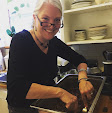

It's time for the fall edition of In Season, where I sit down to talk with Josh Alsberg of Rubinette Produce (above) about what we'll find cascading from local farms and spilling onto tables here in the Northwest.
"We're in that lovely time of year where it's apple season!" enthused Josh Alsberg, giving even more credence to his Fruit Monkey moniker on Twitter. "Honeycrisp starts it off," he continued, referring to the apple the New York Times dubbed The iPod of Apples on its release in 2006, though he cautions that prices may be higher this year because it's a "short year." That means there's a lower crop of apples than usual due to the icy, cold winter and late spring rains which made for a late bloom, then the intense summer heat that stressed the trees and emerging fruit.
 Apples, apples, apples!
It's also partly cyclical, he said, since last year's apple crop was extremely robust and that usually means the following year's crop will be leaner. It also calls for store shoppers to be more alert, since produce buyers may be tempted to substitute foreign-grown fruit—say, New Zealand-grown Honeycrisps instead of locally grown—because of higher wholesale prices on local fruit.
Alsberg's favorite apples, which you'll find at farmers' markets and grocery stores that carry local fruit, include:
- Rubinette, which he describes as "very juicy, robust, a nice balance of sweet and tart" and good for eating out of hand, sauce and baking.
- Mountain Rose, also known as Hidden Rose or Airlie Red Flesh, has pink flesh and was discovered growing on a farm in Airlie, just north of Corvallis.
- Crimson Crisp
- Pinova, also called Piñata
- Ashmead's Kernel
- Elstar, which Alsberg swears tastes like marshmallow when it's baked.
- Newtown Pippin

Seckel pears.
Pears are also beginning to trickle in from Northwest fruit growers, and Alsberg encourages people to look beyond the ubiquitous Bartlett for the following:
- Taylor's Gold, for it's firm texture and sweet, juicy and fragrant qualities.
- Bosc, which he says are fantastic for poaching in wine or other aromatics.
- Comice for their creamy, sweet and fragrant nature.
- Seckel and Forelle are small in size but big in flavor, and the Forelle has a "cinnamon-y essence" that is beguiling.

Alsberg frowns when I mention winter squash, since he says there are so many locally grown varieties that are enjoyable right now, and highly recommends exploring outside the well-known butternut and acorn corral to find a new favorite for your family to enjoy:
- Black Futsu is a small, bumpy, heavily ribbed Japanese squash with a nutty, fresh flavor and is one of his faves.
- Red Kuri is in the Hubbard squash family, as is another variety called Blue Ballet.
- Kabocha, like the Futsu, is a popular Japanese variety that has taken well to our Northwest climate.
- Lower Salmon River is a large heritage variety from the Pacific Northwest.
- Long Pie Pumpkin is rumored to be derived from a Native American variety from New England that was revived in the 1980s by legendary cucurbit aficionado John Navazio. As its name suggests, it is perfect for making pies.
- Delicata is widely available and can be delicious, but Alsberg said that a few years ago the seed from one grower in Colorado crossed with something that caused the flavor to be bitter. Fortunately John Eveland of Gathering Together Farm in Philomath had saved his own seed and was able to grow it out and avoid the bitter curse. Alsberg said that most seed now is free of the bitterness, but buying from a local farmer is the best way to guarantee good flavor.

A rainbow of carrots.
Carrots also become sugar-producing factories once the first frost hits, and Alsberg agrees with me that the best bet is to buy carrots with the greens still attached so you know they're fresh. (I've been disappointed with woody, cardboard-y, bitter "bulk carrots" one too many times.) You'll be seeing root vegetables taking pride of place on farmers' tables, too, so look for celeriac, radishes, turnips with their greens attached, not just for freshness but for the high nutrition value when the stems and greens are snipped off when you get them home and saved for tossing into sautés, soups and stews. Coming soon are fennel, leeks, cabbage—think slaw, sauerkraut and simmering—with brussels sprouts not far behind.
In a month or so Alsberg and I will be getting together again to put together suggestions in time for your holiday entertaining. I can't wait!


 Posts
Posts

