Monday, September 30, 2013

Livin' in the Blurbs: Kicking Off Fall in Style


Chef Kathryn LaSusa Yeomans of The Farmer's Feast and farmer Roger Konka kick off another season of their field-to-pop-up dinners, raved by none other than GQ food critic Alan Richman as "a glorification of farm, field, woods and wild" in a review of one of their events last year. This dinner, titled "Sunday Supper Revival," focuses on fall, with wild mushrooms, corn, pork and huckleberries all picked, foraged or raised by Konka and his family at Springwater Farm, with a scattering of other ingredients from local producers. They've also landed a new location, at Tabor Bread on SE Hawthorne, and the dinner will feature its breads, as well. Incredibly affordable, incredibly delicious…what more could you ask?

Details: The Farmer's Feast Sunday Supper Revival. Sun., Oct. 6, 6 pm; $35 per person, excluding beverages & gratuity. Local wine & beer will be offered. Reservations required via e-mail or phone at
503-734-4329. Event at Tabor Bread, 5051 SE Hawthorne Blvd.

* * *

Fall is festival time in the Northwest, celebrating all things artisan from local beers to charcuterie and all manner of handmade foodstuffs. One of the biggies the last few years has been The Wedge, Portland's paen to our rich dairy culture (pun intended) that benefits the Oregon Cheese Guild, which helps promote and support our exceptional cheesemakers. This year's festival features no fewer than 30 specialty and artisan cheesemakers, craft breweries and food producers from across the Northwest who are coming together to celebrate cheese. Sample, sip and support these local artisans!

Details: The Wedge, Portland's Celebration of Local Cheese. Sat., Oct. 5, Noon-5 pm; $5 donation suggested. Event at the Green Dragon Bistro and Brew Pub and environs, 928 SE 9th St. 503-616-4443.

* * *

Good event spaces in Northeast Portland are hard to come by. The ones that are available can be too small or too cavernous or a little down-at-the-heels. Which is why I was pleased to come across the Red Rose Ballroom, a 4,600 square foot ballroom built in 1925 that has been renovated and reopened as a creative events space in the last couple of weeks. It's big enough for large events, but doesn't feel too big for smaller events, and the wood floor had me feeling like waltzing. Check it out!

Details: Red Rose Ballroom, 1829 NE Alberta St. 415-285-1285.

Top photo by Kathryn LaSusa Yeomans. Cheese photo by Tami Parr of Pacific NW Cheese.

Sunday, September 29, 2013

Farm Bulletin: Investing in the Future


Last week marked the end of our 12th summer season at Hillsdale Farmers' Market. As that market closed at 1:00, we didn't even make it to autumn, very much in keeping with the season's diffident and hasty character. Ah, Summer 2013, we hardly knew ye, good riddance.

We will return to the market on the 17th of November for the winter season. In the meantime, we have to harvest our russets, squash, ash gourds, storage grapes, pumpkin seeds, beans, corn, plant wheat, garlic, favas, and maybe naked barley if time permits. In addition, putting the farm to bed for winter is a huge undertaking. All this we have to shoehorn into the dry days between the rain squalls.

Breaking ground for the new shed.

Each year the farm gets physically more demanding even as graying temples accompany less supple muscles. Not just ours, staff's as well. As Maxwell Anderson's lyrics for September Song remind us, "the days grow short when you reach September." Last winter we realized that we had a choice. We could wind down the operation to bare essentials or make better use of our shortening days. As the farm remains an engaging and unfinished project, we decided to pursue the latter course.

Over the past 12 years, the enterprise called Ayers Creek Farm has operated out of a 200-square-foot space called the bean room, three shipping containers, two open air hose bibs, a greenhouse of scrap wood covered with fraying plastic, the spare room in our office building and our home kitchen. Lean and frugal in terms of dollars invested, the toll was exacted from our time and muscles. At some point, what was once pluck and resourcefulness becomes a stupid waste of time and a lid on the enterprise. Always moving something to get to something else, dreaming of a third hose bib.

Almost done.

A significant capital investment was needed to keep going and now we operate out of a new building we have named the "harvest shed"  or El Palacio del Maíz (top photo). It consolidates harvest activities in a bright, clean building painted in the colors of our corn. Since its completion in late July, we have been amazed at how much easier it has made our work. Washing crates and vegetables in our sink with its long trunk, we mutter to ourselves "you couldn't have done that with a mere smear hose." With that sink alone, oh best beloved, there is another decade in these old fools.

The early closing of last Sunday's market underscored how hazardous the Hillsdale site is when the wind blows. Anticipating unsettled weather, we had our winter weights—about 500 pounds in all—holding down our tent and even then we didn't feel secure. Luckily no one was hurt, but there were a lot of dispirited and frustrated farmers. Like our farm, the market has operated in a lean and frugal manner, and it is time for the community to decide whether they are happy with the status quo or should invest in something better. Since the market moved to that site, we have asked for a permanent system of anchors in the pavement so vendors can secure the tents without weights. The site also needs a system of simple wind baffles at the top of the western slope. These two modest improvements would make the market substantially safer for vendors and customers.

During its second summer season in 2003, Hillsdale's first market manager, Hallie Mittleman, asked if we would participate in a winter market. We agreed to the experiment and have been showing up in fair weather and foul for eleven years. The winter farmers have proven themselves and now it is time for the community to provide a more stable venue for the market. Pavement anchors and wind baffles are an essential first step, but they don't secure the future. We urge a bigger vision, that Hillsdale once again lead the city in providing a covered market. Nothing fancy, there is elegance in a highly functional structure. Many other communities provide shelter for their markets; designs ripe for borrowing abound. New fabrics and designs can provide a light, airy and economical shelter. And there is plenty of space in the community.

When the Hillsdale Market opened, Trevor Baird was its most eligible bachelor, now he has three children and a touch of presumably unrelated gray. Children not even contemplated that opening year now give careful measure as to whether they prefer Candice or Jupiter grapes this week, lobby for the Amish Butter popcorn and polish off whole pints of Chesters before passing the buskers. Children who shyly shadowed their parents are now in medical school. There is a bit Hillsdale Farmers' Market in a lot of people. We hope the market will find a way to mature with its loyal farmers and shoppers, and not pose a challenge we have to or want to abandon. There is a huge amount of talent and knowledge among you, and you need to talk among yourselves about how to improve the market. Farmers can figure out how to fill the market, the larger community needs to figure out how to improve it.

We look forward to seeing you all in November. Over the next month and a half, we will be working hard to make it another excellent winter season.

Saturday, September 28, 2013

Travels with Chili: Whidbey Island Idyll, Pt. 1


I love islands. As someone who's grown up on those vast tracts of land commonly called continents, islands have always held a certain fascination, surrounded by water, fixed and yet somehow seeming to float in their liquid surroundings.

Walker and Kitty ready to ride.

So when an offer came for a chance to explore Whidbey and Camano islands, located on the northern border of Washington's Puget Sound, I couldn't have been more excited. We'd traveled to many of their northerly neighbors in the San Juans, as well as the Gulf Islands off the coast of Canada's Vancouver Island, but had never made it to Whidbey. And we could visit my friend, prolific travel and food writer Sue Frause, on her native ground and meet her husband, Farmer Bob. Who wouldn't jump at the chance?

Farmer Bob making French fries.

We piled our gear and the dogs into Chili and left Portland around nine a.m. on a Saturday morning, expecting the trip to take around four hours, including the ferry ride from the charmingly named town of Mukilteo. Much to our surprise we sailed right through the dreaded Tacoma-Seattle Bottleneck, arriving just in time to drive onto the ferry for the 20-minute ride to the island, the whole trip taking only three and a half hours.

The Inn at Langley overlooks Saratoga Passage.

Our first stop was at Sue and Bob's farmhouse on the edge of Langley on the southern end of the island. We parked Chili next to the barn Bob built from scratch (with his amazing shortwave radio room upstairs) and alongside the prodigious vegetable garden he planted next to it. They welcomed us into their home in the best way possible, with the smell of bacon frying and the promise of BLTs to come. Plus Sue had convinced Bob to make his famous French fries, and there was plum pie for dessert. Talk about the perfect hosts!

Mmmm…cushy!

Stuffed with wonderful food and great conversation, we drove the few blocks into town to check into our room at the Inn at Langley and figure out how we could possibly burn off enough calories to make room for the six-course dinner at the inn's restaurant that evening. Right in the center of town, the inn, with its Japanese-meets-Northwest aesthetic, is perched overlooking Saratoga Passage, with a long public walkway for strolling or idling along the water's edge.

Useless Bay Coffee Co.

The rooms are warm and comfortable, and many have decks looking out over the water. Thought was obviously given to maximizing both the view and privacy from each room, since in the waterfront rooms on the upper levels the large windows can be left unshuttered even at night. Our room was a designated dog-friendly room, each pet given a bowl and a special Inn at Langley bed, which they vastly preferred to the ones we brought from home. (More on traveling with pets in a future post.)

Black cod, béarnaise, summer squash.

Taking them out for a stroll around town while Dave rested, it was clear that while Langley does cater to the tourist crowd with gift shops and island logo-wear, it's still a place where people need to get their groceries—the Star Store is stuffed with wine, produce, a deli and regular and organic dry goods galore—and coffee, locally roasted at Useless Bay Coffee Company.

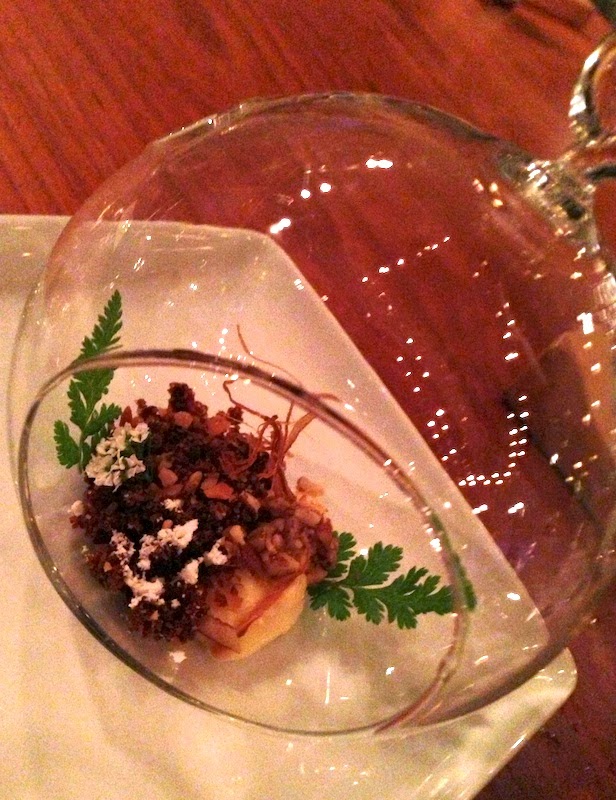
Terrarium…delicious!

Chef Matt Costello (top photo, introducing the evening's menu) has helmed the inn's restaurant since leaving Tom Douglas's Seattle empire ten years ago. His inspiration comes from what he said is "the transition point between the forest and the sea where excitement happens." His dinners feature Northwest ingredients, including a lot of foraged items like devil's club shoots, horsetails, sea lettuces and rose hips, as well as produce he and his wife grow on five acres of land they farm just outside of town. Costello said it's all aimed at giving his guests "a sense of where they're eating."

A fair amount of modernist technique appears in his cooking, but it isn't the focus of the menu. Instead, he scatters it throughout the meal to concentrate a flavor here or a texture there. Above all, the dishes show a great deal of joy, and even whimsy, in their preparation, exemplified by the little terrariums in glass globes that floated above the big central table through most of the meal until Costello cut them down and set them in front of us. The "forest and earth" course!

He said it's all in an effort to bring guests into a community, making it a richer experience than words on a menu and food coming out of the kitchen. I know I felt it and, from the bubbling conversation around the table during the evening and exchanging of stories afterward, other guests that night did, too.

Read the other posts in this series: Whidbey Island Idyll, Pt. 2, about Greenbank Farm and Camano Island Coffee Roasters, and Pt. 3, Cama Beach on Camano Island.

Friday, September 27, 2013

Still Life, Transylvania


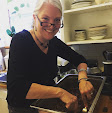
My friend Linda is in Transylvania, revisiting old friends from previous travels and, because she is the kind of warm and compassionate person who draws wonderful people to her, making many new ones. She sent me this country still life from her current trip.

You can read about her previous trip involving a village gathering to slaughter a pig and how to make rose hip jam.

Monday, September 23, 2013

Can Portland Outgrow Hunger?


Portland is, without question, among the cities at the forefront of the local food movement in the United States. Wherever I travel, whether across the country or even to outside of it, people have heard of our vibrant food culture. They're floored by the number of farmers' markets we have (more than 60 during peak harvest season), our thriving artisan food scene, the overwhelming number of restaurants featuring field-to-plate menus and the number of supermarkets purchasing produce and artisan foods from local sources.

Where we're still challenged is in providing access to fresh, local food to those people on the margins of our economy, who don't have the budget or the experience to make it a part of their diets. We've made some inroads by providing SNAP (food stamp) recipients with matching funds for purchasing farmers' market produce as well as access to CSA shares. Local non-profits like Zenger Farm, Growing Gardens, Grow Portland and others are committed to educating the public and providing garden space and access to food to low-income and immigrant communities.

A new local organization, Outgrowing Hunger, is joining the effort to get healthy food to hungry people by transforming unused private, public and institutional land into neighborhood gardens. It's already brought neighbors together to turn two locations in Portland's Rosewood neighborhood into productive gardens, providing those who help in the garden a share of whatever is ripe that day, often several meals worth of fresh produce for each family.

On Saturday, Oct. 26, Outgrowing Hunger is partnering with Slow Food Portland to host an inaugural fundraising event, a harvest dinner cooked by local chefs from produce grown on its projects. It'll be a chance to not only have a terrific dinner, but also to learn about the difficulties and opportunities of serving hungry people and how your support for a wide range of community-based garden projects can make a lasting difference.

Details: Harvest Dinner Fundraiser for Outgrowing Hunger. Sat., Oct. 26, 3-7 pm; tickets $25, available online. Event at Neighborhoods Community Garden, 835 SE 162nd Ave.

Saturday, September 21, 2013

Jammin' with Peaches


My mother grew up in a tiny ranching town at the foot of the Blue Mountains in Eastern Oregon where winters were long and stores were few. Which meant that any fruits or vegetables that grew in their garden or that they could buy from local farmers were canned or preserved for the cold months. During my childhood she'd haul out the old blue and white-speckled canner and "put up" jars of cherries, peaches and jams that would line the shelves of the pantry, releasing the sweet flavor of summer on frigid winter mornings.

I never caught the canning bug from her, but every once in awhile even I'm tempted to preserve a little summery goodness in glowing glass jars. Though instead of lining my pantry they go in the freezer until a piece of bread or bowl of ice cream calls for some adornment. This year's stunning peach crop deserved to be enshrined in jars and celebrated on special occasions, so I did a little research and made the following freezer jam. I think my mother would be pleased.

Peach Freezer Jam

4 lbs. peaches
2 c. sugar (add more if you like sweeter jams)
1/4 c. lemon juice

Place three salad plates in the freezer—these will be used to test the jam to make sure it's jelled.

Peel and dice the peaches. Place in large pot or Dutch oven. Pour sugar and lemon juice over the top, stir briefly and let it sit on the counter for 1-2 hrs. This will allow the peaches to macerate, releasing some of their juices. Then mash the peaches until they're the consistency you like. (I prefer mine a little chunky.) Over medium-high heat, bring the fruit to a boil then reduce to a simmer, stirring often to prevent sticking. Cook for 30 minutes. Pull the first plate out of the freezer and spoon a small amount onto the plate. Let it sit for a minute, then test it with your finger. If it has formed a skin and doesn't seem too runny, it's done. If not, cook for another ten minutes and test again. Repeat until it suits your taste. (I like mine a little runny, the better to soak into a warm piece of toast or melt into a bowl of ice cream.)

Bring a shallow pot of water to boil on the stove and put the caps and screw-on lids in it. Boil for 1 minute to sterilize them. Spoon the cooked jam into clean, dry glass jars, leaving about 1/4 inch at the top. Cap and screw on lids. Allow to cool and then put them in the freezer.

Get more peachy recipes: Bourbon Peach Sorbet, Peach Cobbler.

Friday, September 13, 2013

Local Growler Makes Good


My husband is a beer guy. Yes, he loves his smoked meat, his Webers (grill and smoker), his bread, his sourdough starter and his cast iron Lodge pans. He's converting from briquets to wood, from buying bacon to curing his own, from expensive imported pancetta to better-tasting stuff that comes from our basement.

On its first outing to Pfriem in Hood River.

But more than those homely, not to mention exceedingly delicious, pursuits, he has always been, and no doubt always will be, a devotée of the hoppy and malted. His dresser drawers overfloweth with t-shirts from pubs far and wide, and perhaps one of the happiest days of his life was when my brother asked to store his kegerator in our basement. (It has since been permanently gifted to us. O happy day!)

This makes it pretty easy to come up with some beer-related thingamabob for a birthday or holiday gift. Since he's not a knickknack sort, it has to be more-or-less useful (shirts and glassware qualify), but there's only so much shelf and drawer space available. So just before last Father's Day, when I was browsing around my online pastures and ran across a reference to local, handmade ceramic growlers, a big "BINGO!" lit up above my head.

Earthy salt-fired effect.

The Portland Growler Company, begun by production potters Chris Lyon and Brett Binford of Mudshark Studios, makes its beautiful and entirely functional growlers from local clay that is slip cast and glazed in a range of earthy colors with several handle designs. (I chose the sprocket for its steampunk-ish chic.)

The ceramic, of course, is much heavier than the typical glass growler, but has the benefit of allowing you to pre-chill the full growler in the fridge, perfect for keeping the contents cold for a longer period for outdoor occasions or transporting to farflung destinations. It also pours easily with a minimum of dripping, a good thing since, around here at least, wasting good beer is a sin.

So if you've got a beer aficionado in your circle, or if you are one yourself, this makes a perfect, and surprisingly affordable, gift. Especially if you fill it beforehand or, as we did, make it part of a field trip to Hood River and the Pfriem brewery to get it filled.

Top photo from Portland Growler Company.

Tuesday, September 10, 2013

Get Your Pickle On!


Fermentation: 1. The chemical breakdown of a substance by bacteria, yeasts, or other microorganisms, typically involving effervescence and the giving off of heat. 2. The process of fermentation involved in the making of beer, wine and liquor, in which sugars are converted to ethyl alcohol.


 3. (archaic
) Agitation; excitement.

The inimitable David Barber of Picklopolis.

There is perhaps no place on the planet that is more pickle-crazy than Portland right now. And I don't mean in a self-consciously Portlandia-esque sort of way. I mean now now. It's the height of harvest season, and if you don't pickle it, freeze it or preserve it in the next few weeks, it's gonna be gone, baby, gone.

Samples galore!

Cherries, peaches, tomatoes, cabbage and all manner of cucurbits are headed for a brine of one kind or another, which, at least in this neck of the woods, calls for a festival where proud picklers of all persuasions can gather and show off their perspicacity and skills at preservation. The Portland Fermentation Festival is also a place where those of us still a bit too shy to try this preservation technique can get tips and tricks from experienced pros and home fermenters, and get a taste of their favorite fixin's.

And we're not just talking dills here…there will be examples of sauerkraut, miso, kefir, kimchi, hard cider, mead and much more, all for just $10. Kick in another ten and you can attend the tasting as well as a lecture by master fermentarian Sandor Ellix Katz, author of Wild Fermentation, The Art of Fermentation and The Revolution Will Not Be Microwaved.

You might just go home with more than a pickle in your pocket.

Details: Fourth Annual Portland Fermentation Festival. Wed., Oct. 23, 6:30-9 pm; $10 for tasting; $20 includes tasting and a 6 pm lecture by Sandor Katz. Tickets available online starting Oct. 10 as well as at the event. At Ecotrust's Billy Frank Jr. Conference Center in the Pearl, 721 NW 9th Ave. Info at 503-724-2980.

Photo at top of pickles by master pickler Kevin Gibson of Evoe.

Sunday, September 08, 2013

Varying the Morning Routine


Like contributor Jim Dixon of Real Good Food, I have a morning routine…dogs, coffee, breakfast. Recently he decided to do something little different for the breakfast portion.

I eat the same breakfast most days. I make an espresso in my Francis Francis machine with Andrea Spella’s amazing coffee, pour a glass of OJ (I switched to the relatively spendy Columbia Gorge Organics stuff a few years ago after reading about “flavor packs”) and spread some old-school Adam’s crunchy peanut butter on a couple of slices of toast (preferably Great Harvest’s Dakota bread).

But I do like some eggs every now and then. Usually I just fry them over easy in extra virgin olive oil, but I last week I had some leftover cooked bacon and was thinking about Judy Rodgers' breadcrumb eggs. This is what happened next.

Eggs with Toast and Bacon

I think everybody should have breadcrumbs in the pantry all the time, and if you take the last couple of slices from that loaf getting stale, leave them out on the counter until they’re totally dry and grind them in your food processor, you’ll be on your way to having your own stash.

Gently heat some olive oil in a skillet, add a tablespoon of breadcrumbs for each egg and let them brown. Chop a slice or two of cooked bacon into fairly small, breadcrumbish-sized bits and add to the pan. When they start to sizzle, scrape the crumbs and bacon into rough circles and break the eggs onto them.

You can do the eggs sunny side up, but I like mine over easy. Cook 'em how you like 'em, hopefully with runny yolks, and eat.

Photo from Culinate.com.

Saturday, September 07, 2013

Farm Bulletin: A Handful of Seeds


It's a revelation to think of the fruit or vegetable you hold in your hand as a living seed packet, but that's just what contributor Anthony Boutard of Ayers Creek Farm points out in this week's essay.

People often ask us where they can buy seeds for our Astiana tomatoes. The fact is, you are buying seeds when you buy the fruits at the market. That is how we started with the tomato, just 15 seeds from a tomato purchased in the market of Asti, a town in the Piedmont of Italy. It is a representative of a cooking tomato landrace from the Po River Valley. The fruits are large, green-shouldered, pear-shaped and often pleated. A landrace is a population of fruits, vegetables or livestock that is shaped by the environment and culture of the region to which it belongs. Representatives of the race will vary from village to village, but they have similar qualities. These tomatoes are selected for the quality of their flavor and texture after their encounter with the stove.

We never use the word heirloom in reference to the varieties we grow. We dislike the term, and the last time it was used in this newsletter was to explain our dislike of the word best applied to fragile, inanimate objects handed down generation to generation. Beautiful Corn was written without using the word at all. Heirlooms are defined as named varieties that have been around for 25 years. Seeds are living plants, reshaped by their cultivators year-after-year, and landrace is the better term. It recognizes the living organisms are constantly changing and adapting to new environments and cultures, and this applies to their cultivators as well. The fact is, we have reshaped that tomato we purchased in Asti seven years ago, but we have carefully kept its fine cooking qualities foremost in our efforts.

Approximately 80% of the legumes, vegetables and grains we bring to market are grown from seeds we produce on the farm. Another 10% are grown from the seeds developed by Frank Morton at Wild Garden Seed in Philomath, about 60 miles south of Gaston. Producing our own seed allows us to draw out traits valuable for successful production in the Willamette Valley.

This month the Organic Seed Alliance will hold organic seed production workshops for farmers at Adaptive Seeds in Sweet Home on the 17th and at Ayers Creek on the 19th. Veteran seed producer John Navazio will lead the workshops. He is both practitioner and theoretician, an important source of information and inspiration to those of us who grow our own seed. Linda Colwell will prepare a lunch for the participants that will include the fruits, vegetables and grains we grow at the farm, underscoring the link between the seeds and food. It will be a fun day for all and we expect to learn a lot from Navazio.

Adopting the name Astiana for our tomato, we honor the long tradition of naming varieties after the location of their origin. This week, we will bring to the market a delightful, spicy grape called Canadice. It is a celibate variety from New York State research station in Geneva, New York. Until recently, they named all their varieties after places in New York; Candice is one of the Finger Lakes in western New York. Other varieties that we grow from that program with a New York tag include the grapes Interlaken, Sheridan and Steuben, and the plums Seneca and Stanley. Sadly, they have abandoned this tradition and now names are developed through "consumer testing." Two recent releases are called SnapDragon and RubyFrost. Perils of callow thinking.

Thursday, September 05, 2013

Peach Sorbet with a Kick


I'm going to say it, and I don't care who hears me. The year 2013 is going to go down in history as one of the greatest vintages the Northwest has ever seen.

What? No, I'm not talking about grapes, silly. I'm talking about peaches. The juicy orbs I've been slicing and baking and slurping up this year have been stunningly flavorful, memorably so. It doesn't matter whether they're Sweet Sue, Red Haven or John Henry, or from old line orchardists like Baird Family Orchards in Dayton or newer ones, like Columbia Blossom in Mosier.

Nary…I love that word, so old-timey…a week has gone by since the beginning of August that I haven't dashed to the farmers' market or to the store to get more. Whether ready to eat right then and there or needing a couple of days to ripen completely, they've rested on the kitchen counter, perfuming the whole house with their sweet, peachy scent. Aaaaahhhhhh!

Pies and cobblers have been made aplenty, and Kevin Gibson's peach and purslane salad at Evoe (above left) was a revelation, but one of our favorite peachy desserts has been a peach and bourbon sorbet that has ended more than a few meals with a sweet bang. Soft, perfumey and with just a kiss of bourbon that underlines and deepens the peachiness rather than overwhelming it, this one is worth saving. Especially in a vintage as good as this year's.

Peach Bourbon Sorbet

3 lbs. peaches
Juice of 1/2 lime
1 c. sugar
2 Tbsp. bourbon

Pit and quarter whole peaches, leaving skins on, and place in food processor with lime juice and sugar. Process until it's a fine purée. Pour it into a fine mesh sieve (in batches if necessary) over a large mixing bowl and, using a wooden spoon, stir and press the purée through the sieve. (This step is super easy and not time-consuming, so don't let it put you off.) Stir in the bourbon, then place a piece of plastic wrap directly on the surface of the purée. (This keeps it from oxidizing and turning brown.) Place the bowl in the refrigerator for 2-3 hours to chill completely. Put chilled purée in ice cream maker and process according to directions. Place in container in freezer for 2-3 hours, then serve.

Tuesday, September 03, 2013

Taking the Cure: Home-Smoked Bacon


There are very few things that draw me like a moth to a flame like the smell of smoked meat. I've been known to wander around the neighborhood, my nose in the air, tracking the smell of cooking meat as it wafts on the breeze until I locate the source of the intoxicating aroma. Even my dogs start looking at me askance as we cross streets willy-nilly, though their puzzlement is likely a fraction of the muttering from other pedestrians I'd occasionally (and even literally) run into.

Fresh pork belly.

Bacon was high on the list of favorite smoked meats, and I'd sampled all kinds from Trader Joe's to Gartner's, and quizzed friends on their favorite sources. Then Dave found a smoker on Craigslist and got a yen to try making it himself, with, yes, lots of encouragement from me. That first batch, one slab weighing five pounds, was a smashing success, earning accolades from family and friends alike. Which, of course, encouraged him to make more, increasing the amount each time.

The experience of working with the smoker, and the resulting briskets, ribs (flat and rolled) and smoked albacore has begun pulling him away from briquets and into the realm of wood. He's now got sources for cherry, apple, hickory, oak and maple, with bags of same stashed alongside the smoker in the garage.

Cured belly ready for the smoker.

Today's batch of bacon—briquets providing the primary heat source, with chunks of dry apple wood soaked in water providing the smoke—was the biggest yet. Two full bellies weighing just shy of twenty pounds total, cured for a week in the fridge (details here) then smoked for a little over three hours. Which resulted in around 16 1/2 lbs. of finished bacon. Once they cool down, we'll slice them into one-pound chunks, then throw them in zip-lock freezer bags, except for a bit we may need for a completely homemade BLT or perhaps some carbonara.

Seriously, if you've been thinking about making your own bacon and you can get your hands on a smoker (I repeat: Craigslist), this is so easy to do and, as long as you follow the directions for the curing, a complete cakewalk. Your family and friends will thank you!

Saturday, August 31, 2013

Farm Bulletin: Dropping the F-Bomb


No no no, not that f-bomb, the other one that gets bandied about whenever August's heat begins to be mitigated by temperatures in the mid-70s. Though it's hard to argue when that word is dropped by contributor Anthony Boutard of Ayers Creek Farm, since his partner, Ma Nature, is pretty much the decider when it comes to changing the seasons.

This weekend marks the sartorial end of summer, and we have had this feeling for a couple of weeks that autumn is close at her shoulder. It is almost as if the fruit is racing to beat the changing weather. As if to underscore this point, we sent our goodbye Chester note to the produce managers and stopped delivering the blackberries on Thursday because the fruit is too fragile to sit in a store display.

Au revoir, Chesters…

This is the earliest end to the Chester season in the 12 years we have been selling fresh market fruit, and the first time that it has fallen in August. We will have some at the market tomorrow, but treat them with care as they are very thin-skinned. Just as autumn leaves change color when the chlorophyll disappears, as the acids and pectins fade from the fruit different flavors come to the fore, and you might discern a hint of resin in the fruit. It is there in the fragrance as well.

Auf wiedersehen, frikeh…

Just as the swallows have departed the farm, the frikeh is gone, too. If time permits, we will grind some corn and start hauling in preserves again. We will have a lot of Astiana tomatoes for those who want to start putting some up for winter. Tomatillos, beets, onions and potatoes will join the cucumbers, garlic and shallots in the mix. The stone fruit will be represented by Prune d'Agen and Mirabelles. The pulses are the chickpeas.

Dean, and grape guy, Harvey Lee Price.

The grape of the moment is Price. We regard it as the Chester of the grapes. This berry came out of the breeding program at Virginia Polytechnic Institute. The grape has a complex and obscure lineage, perhaps with a bit of scuppernong or some other muscadine among its genes given its southern ancestry. The grape is named after Harvey Lee Price who was the Dean of Agriculture at the institute from 1908 to 1945. The flavor is complex and the delicate crunchy seeds have a delicious spicy flavor, so don't hesitate to chew them. As those who attended the ramble know, it is also a first class juice grape. Like Chester, Price is of its own kind—there is no confusing it with other grapes.

We will also have some seedless grapes on hand as well, including Jupiter and Interlaken. Along with Price and the plums, good fruit for the kids to take to school, or to nibble on as they ponder their first homework lessons. And let's hope summer keeps autumn at bay for a while longer.

Tuesday, August 27, 2013

In Season NW: Taking Full Advantage


I'm kind of getting the gist of this zombie apocalypse that seems to be the meme of the moment.

What? You haven't heard of millions of the undead rising from their graves from…fill in the blank here…radiation, a rogue virus, too much TV, whatever, to attack and, usually, eat the brains of uninfected humans who then become zombies themselves. This army of the undead then threatens to take over the world unless, and here comes the kicker, some plucky someone or group of same stops them. Yay for Earth!

Carbonara with padrons? Delicious!

The reason I'm getting that "imminent apocalypse" twinge is because almost everyone I know seems infected by the need to can, preserve, pickle, dehydrate, freeze or otherwise squirrel away every last fish, tomato, peach, mushroom, pepper or meat they meet. The number of people I know who have bought hot water-bath canners, dehydrators, kraut crocks and pressure canners is positively mind-boggling.

Tomato bean salad.

I'm finding it kind of intimidating, if you must know. I mean, I've done my fair share of syrup-making, tomato roasting and pig-butchering, but this mad dash to preserve every last shred of summer is a little obsessive. I can only imagine what it must be like for folks who don't have the wherewithal to do any or even a little.

Niçoise, anyone?

So here's my point: I'm putting out a call to simply enjoy the fruits (or peppers or tomatoes or corn) of the season right now, at their peak of ripeness and freshness. Of course you can preserve to your heart's content if you're able, but really, the best way to enjoy the richness of the harvest is, not surprisingly, right when it's harvested.

Stuffed poblano egg casserole.

To that end, I've been throwing padrons from Viridian Farms into carbonara, green beans into salads, tomatoes into pasta and shallots into salad dressings. Basil from the garden has gone into pesto, peppers have been stuffed and baked into an egg casserole and albacore loins have been grilled till they're black and blue. As Dean Martin once crooned, it's the stuff memories are made of, and the memories I'll be calling up when the rains return this winter. Not to mention those that I'll be looking forward to remaking next harvest season.

Get the recipes for the tomato tart (top photo), carbonara (throw the padrons in after the bacon has rendered its fat) and the tomato and green bean salad.

Monday, August 26, 2013

Introducing the…Pisco-rinha? Pisco-rita?


"When in doubt, punt." - John Heisman

It was my fault, so hopefully I can claim some of the credit, too. We'd been jonesing for caipirinhas after watching a video of cachaça expert Dragos Axinte of Novo Fogo mix up one of Brazil's signature cocktails. Dave was particularly keen to try his method of slicing a lime so as to extract the maximum amount of juice during muddling.

We had the limes, the sugar and the fermented sugar cane spirit the Brazilians call cachaça. Or at least I thought that's what was in the tall, clear bottle in the liquor cabinet until I pulled it out and realized it was actually pisco, the brandy distilled from grapes in the winemaking regions of Peru and Chile. Rats!

Rather than giving up on having a cool, refreshing lime drink from the southern hemisphere, we thought, well, heck, why not just sub in the pisco for the cachaça and see what happens? If it's terrible, we can just shrug our shoulders and pour it down the sink with no one the wiser.

Fortunately, that was not the case, and we can now claim it as a house variation on a classic. That's not so bad, is it? And yes, we do have cachaça on the shopping list for our next trip to the liquor store.

Pisco-rinha

1 heaping Tbsp. superfine sugar
1/2 lime
2 oz. pisco

Trim ends off lime so white rind is gone. Cut lengthwise and remove pith from center. Slice almost all the way through perpendicular to axis of lime, rind toward flesh, leaving flesh side intact. Slice diagonally a couple of times, again, not slicing through. Cut in half, perpendicular to axis and put in glass flesh side up.

Put sugar over lime. Muddle gently, squeezing out all the juice you can. Put into shaker. Fill with ice. Add the pisco. Shake. Pour with ice into the glass.

Saturday, August 24, 2013

Farm Bulletin: The Call of Community


To be part of a community is crucial to farmers, both for economic and personal reasons. Contributor Anthony Boutard of Ayers Creek Farm outlines a few examples of both.

For years, we have strongly suspected that Tito was once a dog model who finally chucked the fast life and, after a streak of hard luck, wound up in the Newberg pound where we met him. The chief bit of evidence of his former life was a spread on urban picnics in the New York Times fashion supplement. The dog in the Open Bar picnic (top photo) is sitting on a $495 Luxembourg bench with an open bag of chips next to him, and looks just like our lovable cur, except he lacks Tito's black toenails. There were also some chips left uneaten, very un-Tito. But you can never trust digital photos completely, maybe they added the chips later or he was more disciplined in his modeling days.

Regardless of his past, Tito's modeling chops can be seen in this month's issue of Cucina Italiana (left, behind Carol), where he appears with the Cameron Winery's Jackson. The article is about a special tradition we have enjoyed since Cathy Whims and David West opened Nostrana, the farmers' dinner. Every October, Cathy and David invite a group of us for dinner and we meander our way through their menu and wine list. They, along with the staff at the restaurant, make it a fun and relaxed evening for the gang that spends most of it time at the back door. Nostrana is a comfortable place for a farmer at either door, and that is due to the respect Cathy and David have for our ilk.

We deliver to a variety of restaurants in addition to Nostrana. Each place has its own culture and expression of generosity. A container of tart cherry ice cream from Lovely's, a bit of cured pork from Greg Higgins, a jar of miso from Chef Naoko or a pastry with our plums from Giana at Roman Candle, these gestures all make the effort a little bit easier and fun. Good restaurants also make us better farmers by drawing us into the process. For example, the incomparable Borlotto Lamon is one of Cathy's contributions.

When we first moved to the farm and settled into the double-wide trailer at Ayers Creek, we decided we would be there for a long, long time so, heeding Malvina Reynolds' advice, we planted an apple tree and a couple of grape vines. One was Interlaken and the other was sold as "Sweet Seduction." We hated the silly name. In grapes as in other fruits, the character of the grape is defined by the blend of acids in the fruit as opposed to simple sugars. We felt if cute was needed, then "Acid Assignation" would be a more apt name.

When we decided to scale up our table grape production, we retained the late Lon Rombaugh to give us advice on varieties to plant. We mentioned Sweet Seduction as one variety we would plant. Almost two years ago, we enjoyed a early autumn dinner in the Hungry Gardener's yard and had some time to visit with Lon. That evening, he told us the grape we were growing had been mislabeled, was not Sweet Seduction, and he would get back in touch with us with the correct name. We were glad to be rid of a name better suited to chocolates or lingerie than fruit. Winter descended and Lon died too young. You can call it what ever you want, but for us it is now a grape with no name, a bittersweet remembrance of an inquisitive and kind fruit grower who we were lucky to have known as an advisor and friend.