Showing posts with label Kendra Kimbirauskas. Show all posts

Wednesday, February 24, 2016

Pig Errands: Pick Up, Butcher, Make Stock


Not many husbands get to say, as mine did recently, that their wives are running "pig errands." In that case, I was heading to Mt. Angel in Dave's pickup to fetch the half pig I'd ordered from Kendra Kimbirauskas (above, with her pigs) and her husband, Ivan Maluski, of Shimanek Bridge Farm in Scio.

Bungied and secure for the trip to Portland.

Waiting for me at Mt. Angel Meat Company was owner Eric Fietz, and while he finished a call I got to play with a feral kitten who'd discovered that a meat processing plant was a fine place to hang out. (Eric said he'd been working on taming the black-and-white cutie so he could find it a home, so let him know…) One of his butchers, a big burly guy, came walking out cradling my 125-lb. half as if it was a tiny baby and kindly loaded it in the back of the truck.

It's our fourth half pig in as many years, and I've slowly been learning the basics of butchery with help from Melinda Casady at Portland's Culinary Workshop. She was tied up with classes, though, so I called Ben Meyer of Old Salt Marketplace, hoping he could spare some time to help out, and he graciously agreed, even offering to hang the carcass in his walk-in for a couple of days until we butchered it.

The craftsman at his bench. Thanks, Chris!

The day came, along with a text from Ben saying that he'd come down with a fever and needed to change plans. With visions dancing in my head of me driving around the city with a half pig in the back of the truck, looking for someone to help cut and wrap it—yes, I can be a drama queen—Ben offered to see if his head butcher, Chris Carter, could step in.

Chops for days!

Spending a couple of hours in a freezing walk-in may not be most folks' idea of a good time, but watching a whiz like Chris work through a carcass is pretty awe-inspiring, and getting a few tips on deboning a belly and skinning cuts without mangling the meat was well worth it. (The right kind of knife and making sure it's well-sharpened are a great place to start.)
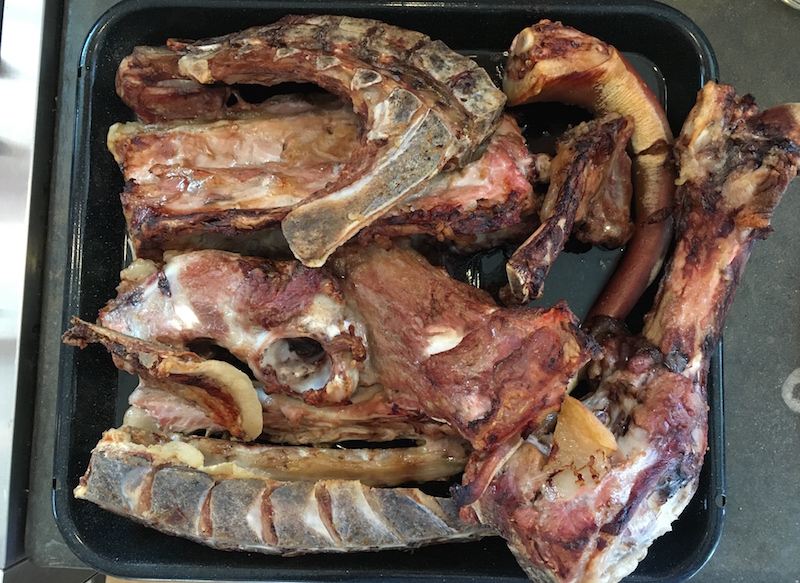
Bones roasted and ready for the pot.

Two hours later we were done, and I was on my way with my pig packed in nice white paper packages in a chest cooler. Of the 125-pound carcass, only the skin, less than five pounds, wasn't used—bones, fat, trim, leaf lard and meat all came home. If you're interested in the particulars, Kendra charges $3.50 per pound for the hanging carcass (after the internal organs are removed); the processing fee I paid to Mt. Angel was $32.50; and Chris's butchering fee was $50.

Just add water!

Frozen immediately after butchering, the meat will last a year, until we buy our next pig. We'll make stock (popularly known as "bone broth") after roasting the bones, and we'll use the leaf lard for baking after it's rendered. The trim meat goes into the grinder along with some of the fat to make bulk sausage, and any remaining fat will be rendered and used in frying and cooking. I call it a pretty darn good deal for a year's worth of very fine eating.

Pork Stock ("Bone Broth")

Bones from half pig, including backbone, tail, etc.
1 large onion, roughly chopped
2 ribs celery, roughly chopped
2 carrots, roughly chopped
2 bay leaves

Preheat oven to 400°.

Thaw bones, if frozen, and place on large sheet roasting pan. Place pan on middle shelf of the oven and roast for 1 hour. Remove from oven and place bones in stock pot big enough to cover bones with water. Add onions, carrots, celery and bay leaves to the pot, then fill the pot with cold water to cover the bones. Bring to a low boil, then reduce heat to lowest setting and simmer for 12 to 24 hours, occasionally removing scum that may rise to the top. Cool and strain. Freeze in containers. Keeps for up to a year.

Monday, November 16, 2015

Veteran Faces a New Battle, This Time at Home


Recently my friend Kendra Kimbirauskas wrote about a farmer, Hubert Brumett, she met as part of her work as CEO of the Socially Responsible Agriculture Project. A farmer herself near the small town of Scio in the Willamette Valley, she understood not only the heartbreak of Hubert's situation, but also the danger he and his neighbors face from the siting of a factory hog operation next to his land. And though Hubert lives in Indiana, the same thing could happen here, since Oregon has not set any setback distances for CAFOs at the current time.

At the end of a dusty Indiana lane, set back in woods, is a little white home. On the porch swing next to the front door is where World War II veteran, Hubert Brumett, slowly rocks forward and back while enjoying the fresh air and the sounds of a world he has known his whole life.

Not a lot has changed about the house over the years. But beyond the front porch, the times and the landscape are shifting quickly—and in ways Hubert never would have dreamed.

Hubert was just a boy in 1939 when he left his family’s Indiana farm and enlisted in the U.S. Army.

“We used to call ourselves men,” he says with a smile. “But we were all nothing more than just kids.”

During his time in the military, Hubert found himself far from the Indiana countryside, stationed in New Guinea, The Philippines and Okinawa. His job was to guard B-24 bombers from enemy sniper fire.

He credits his surviving the war to the fact that he was injured in a jeep accident. It took him out of action for four months. When Hubert returned to his unit, he didn’t recognize some of the faces—and familiar ones were missing. That’s when he found out many of the boys he was stationed with had been killed.

“If I would have been with them, I’d have been killed, too,” he says.

After the war, Hubert was discharged and he returned to the Jackson County, Indiana, farm that his father bought. Hubert built a house there in 1957, and it has been his home ever since. Even at 94, he still lives there independently.  And after a lifetime of farming, working and raising a family, Hubert looked forward to living quietly in his little piece of paradise.

That all changed last year.

Hubert’s world came under fire when he learned that a local hog company proposed construction of an industrial-scale concentrated animal feeding operation, or CAFO, that would house some 4,000 hogs and produce more than 1 million gallons of manure just 557 feet from his front door.

No stranger to farming, Hubert couldn’t understand why a hog operation of this scale could be built virtually on top of his house. It didn’t make sense. Aren’t there rules that require a facility that size to be a certain distance from the nearest neighbor, he wondered?

The disappointing answer was no.

“I’ve never seen anything like it,” says Hubert. “You’d think they’d have some rules—some limits on where they could build theses hog barns. But there aren’t any rules and they don’t care.”

Right now, Indiana law allows for a new CAFO to be sited within 400 feet of a neighboring residence. In Jackson County, a variance allows for new livestock operations to site just 300 feet from a neighboring home. Including Hubert’s, 485 homes are located within a 3-mile radius of the proposed Jackson County hog operation.

The CAFO operator has no plans of living anywhere near the facility, opting to live in town several miles away from the operation. And it’s no mystery why.

Industrial hog CAFOs confine thousands of animals inside cramped, artificially lit and mechanically ventilated buildings. Massive amounts of manure are collected in giant pits, untreated and decomposing. And while there, it releases over 160 gases toxic to people and animals. Gases like hydrogen sulfide, ammonia, carbon monoxide, carbon dioxide and methane rise from the pit to create a toxic atmosphere. So dangerous, in fact, that gigantic fans are installed to blow the gases out of the barns and into the surrounding area.

The fear? If the fans fail, the hogs will die.

But hogs are not the only ones to suffer potential injury from the fumes.

Hubert lives with Chronic Obstructive Pulmonary Disease. COPD is a disease that makes it difficult to breath and it requires Hubert to use an oxygen tank. His doctor recently wrote a letter offering up her opinion that the particulate matter and gases from the planned hog operation would be debilitating to Hubert’s health. Hubert’s family fears that if the hog operation is built, they will have no other choice but to move him to a nursing home.

“It just breaks my heart to see this,” says Hubert’s daughter-in-law, Brenda Brumett. “He fought for his country. He worked hard. He raised his children. Give him the dignity to live on his own land the way he wants to live.”

Showing no sign of giving up his home and his independence, the Army veteran says there’s only one thing to do.

“All we can do is fight it.”

Hubert’s neighbors—over 100 families who many are farmers themselves—banded together to support Hubert and challenge building of the proposed industrial livestock operation. They have formed a group called Help Us Build Ethical Rural Trust, or HUBERT.

For more information about Hubert or to help him in his fight, please visit his Go Fund Me page. Learn more about other veteran farmers, including Mickey Clayton of Dot Ranch in Oregon.

Friday, October 09, 2015

Food News: Bees Win One, Spanish Hotline, Factory Manager Appointed to Board of Ag


In a groundbreaking ruling, the U.S. 9th Circuit Court of Appeals overturned the federal Environmental Protection Agency's (EPA) approval of a pesticide, sulfoxaflor, because the approval was "based on flawed and limited information." In an article in the Los Angeles Times, it said that "initial studies showed the insecticide was highly toxic to honey bees" and quotes one of the three-judge panel as writing that "bees are essential to pollinate important crops and in recent years have been dying at alarming rates."

The lawsuit challenging its approval was brought by a consortium of beekeepers and beekeeping organizations, which were represented by Earthjustice, an environmental group. The pesticide, a neonicotinoid made by Dow Agrosciences and sold under the brand names Closer and Transform, was registered for use on lettuce in California in 2014, but because the approval by the EPA was national, the ruling revokes its use nationwide.

The article quotes the ruling as concluding "given the precariousness of bee populations, leaving the EPA’s registration of sulfoxaflor in place risks more potential environmental harm than vacating it."

* * *


A toll-free hotline has been established in Oregon to help Spanish-speaking workers report mistreatment in the workplace, according to an article in The Oregonian by work life reporter George Rede. Part of the U.S. Department of Labor's Employment Education and Outreach alliance, EMPLEO (Spanish for employment) is "a program designed to help workers cut through red tape with a single phone call."

The article says that "in Oregon, workers are especially vulnerable in construction, restaurants and forestry jobs involving tree-planting and thinning" and quotes Juan Coria, deputy regional administrator of the Labor Department's Wage and Hour Division office in San Francisco, as saying "we're seeing a lot of workers being exploited because they are unaware of their rights and resources."

The number? 1-877-552-AYUDA, Spanish for "help."

* * *


In a move that feels to Oregon's family farmers like a kick in the teeth, Governor Kate Brown has deliberately overlooked them in favor of appointing the manager of a powerful out-of-state factory farm to the State Board of Agriculture. The board, which advises the Oregon Department of Agriculture (ODA) on policy issues, also develops recommendations on key agricultural issues, and provides advocacy of the state's agriculture industry in general.

Marty Myers, the governor's appointee, is general manager of Threemile Canyon Farms LLC (photo above), which opened a plant in Boardman on the Columbia River in 2001 and has been "at the center of several controversies, including labor violations and allegations of animal abuse," according to an article in the Capitol Press by Kendra Kimbirauskas.

Kimbirauskas said the plant in Boardman, which supplies milk to Tillamook Cheese, is licensed to expand to 90,000 cows in a concentrated animal feeding operation (CAFO), and that in 2005 it revealed it released 5.6 million pounds of ammonia into the air each year, a byproduct of decomposing liquefied manure. As a result, Threemile Canyon has been accused by the U.S. Forest Service as being "one of [the] two major sources of acid rain and haze in the Columbia Gorge."

So why did Governor Brown choose Myers to the 10-member Board of Agriculture rather than Jon Bansen, a 4th-generation dairyman in Monmouth, who also applied for the appointment? We may never know, because, as Kimbirauskas points out, the appointment process "allows the Department of Agriculture and the governor’s office to work in secrecy to secure the appointment of their preference without any public scrutiny. Further, the Board of Agriculture is exempt from Oregon Government Ethics requirements that public officials provide statements of economic interest to ensure financial conflicts of interest are disclosed and addressed."

With small to mid-size family farmers comprising close to 85% of Oregon's farm ownership, it seems Gov. Brown could have made a different choice.

Tuesday, October 07, 2014

Oregon's "Real Food" Revolutionaries


When an editor asks if I'll write a story for his magazine and then says it can be on any topic I choose, well, that's an offer I can't refuse. Here's my story for this month's issue of Willamette Living titled "Oregon's 'Real Food' Revolutionaries (Just Don't Call Them Foodies)."

Rarely a week goes by when someone in the national media, whether it's the New York Times, CNN, even The Tonight Show's Jimmy Fallon, mentions the amazing food to be found in Portland, Oregon. Chefs, restaurants, doughnut shops, vegan delis, food carts, gluten-free bakeries and the growth of what's being called a "food culture" have found fertile soil in the Northwest corner of Oregon. Just a decade ago it would have been an oxymoron to put the words "Portland" and "food scene" in the same sentence. No longer.

Eamon Molloy (l), Hillsdale Farmers' Market manager.

But what's been missed by the national spotlight and gushing reviews is the true food revolution that's been building in the Northwest, one that will outlast the tourists and the hype. It's one waged by grassroots folks who would laugh at being called "foodies" but who are leading the way in changing the foundation of our local food system from one dependent on big box stores, national chains and agricultural conglomerates to one that is developing pathways for the small farmer and artisan producer to make a connection with the consumer, one that focuses on accessible, sustainable and affordable local food.

Read about five of these “real food” revolutionaries talking about why they do what they do and what they hope to accomplish.

Top photo: Kendra Kimbirauskas of Goat Mountain Pastured Meats in Scio.

Thursday, June 14, 2012

Supermarket Pork: Not Cheap at Any Price


In the second installment of my interview for Food Farmer Earth, Kendra Kimbirauskas of Goat Mountain Pastured Meats explains the costs that we all pay, in our health, in damage to the environment, in our tax dollars subsidizing big corporations, for conventionally raised pork.

What is it really costing us to feed our families, and which would you rather put on your table?

Watch Part One: A Passion for Pigs.

Wednesday, June 13, 2012

Food Farmer Earth: A Passion for Pigs


It's no secret that I love the farmers, food producers and chefs of the Northwest. So when Rebecca and Fred Gerendasy of Cooking Up a Story asked me if I'd be interested in working with them on their new series called Food Farmer Earth they barely had time to finish making the offer before I said, "I'm in!" This interview with passionate pastured meat rancher Kendra Kimbirauskas is the first of the stories I worked on in the capacity of producer, and the first of many you'll be seeing on GoodStuffNW.

Kendra Kimbirauskas (left, with her "bacon maker" LV) grew up on a small farm in the Midwest watching her parents working long hours to make ends meet. With an intimate knowledge of the day-to-day struggles farmers face, after college she became an activist on the issues affecting small farms, working on factory farm issues in Iowa.

Baby pigs napping in their pasture.

While there, she also spent time at Niman Ranch, working with a co-op that supplies pork to Chipotle restaurants. The experience of raising pigs outdoors on pasture resonated with her and in 2006 she decided that it was time to "walk her talk." Putting her beliefs into action, she and her husband, Ivan Maluski, started a small, organic farm on a few acres in Colton, Oregon.

Gretel and her brood.

At Goat Mountain Pastured Meats they raise goats, whose milk Ivan uses to make cheese, along with chickens, horses, pigs and two rescued oxen. They are committed to farming in a way that provides high quality, healthy and affordable organic food while protecting the biodiversity of the land and its water. 

Read the rest of Kendra's story and consider subscribing to future Food Farmer Earth posts! Also, Kendra explains what it really costs to raise pork conventionally in Supermarket Pork: Not Cheap at Any Price.