Showing posts with label neonicotinoids. Show all posts

Thursday, March 31, 2016

Food News: A Climate Solution; Herbicides in Wines; Neonicotinoid Pesticide Ban


Instead of fearing carbon, a Yale University lecturer is suggesting we farm it. In his recent book with the brain-numbing title The Carbon Farming Solution: A Global Toolkit of Perennial Crops and Regenerative Agriculture Practices for Climate Change Mitigation and Food Security, author Eric Toensmeier describes a system of "carbon farming" that is being developed in Veracruz, Mexico.

In an article about the book on GreenBiz.com, Toensmeier writes about an effort initiated by Ricardo Romero, a former cattleman who became concerned about the degradation of his pastureland from traditional ranching practices. He started a small cooperative called Las Cañadas which is demonstrating that a combination of methods like planting native trees, reintroducing cattle—a technique called silvopasture—as well as managed grazing, fodder banks and planting certain perennial crops, can feed people, build more fertile soils and contribute to ecosystem health without forcing communities to radically change their diets.

While not claiming that this is a turn-key solution to climate change, he posits that it is a step in the right direction and, if adopted globally along with a massive reduction in fossil fuel emissions, could contribute substantially to changing our current situation.

* * *


Before you toast the end of climate change as described above—it is, after all, just being modeled on a small scale—you might want to know that the herbicide glyphosate, the active ingredient in Monsanto's Roundup and recently declared a "probable carcinogen" by the World Health Organization, has been found in random testing of 10 California wines.

A study, initiated by the group Moms Across America after 14 brands of German beer were found to have traces of the herbicide, and described in an article in the Digital Journal, found that that the wines, including some organic wines, had residues that exceeded the limit of .1 micrograms per liter allowed for drinking water.

"Using the Microbe Inotech Lab of St.Louis, Missouri…a total of 10 different wines from large and small vineyards in the Napa Valley, Sonoma and Mendocino counties in California were tested. According to the final report, the contamination of conventional wine was 28 times higher than organic wine."

The article goes on to state that "wine growers on conventional farms say that glyphosates are probably in the manure and/or fertilizers they use from animals fed genetically modified grains" and that "one big concern is for the folks who buy organic products, expecting to get what they are paying for." It says that the organic wine was probably contaminated by overspray, or "drift," from neighboring farms using the herbicide.

Cheers!

* * *


Efforts to ban neonicotinoid pesticides, the systemic neorotoxin linked to global bee die-offs, got a boost last week from the state of Maryland, according to an article in the Washington Post. Governor Larry Hogan, a Republican, is expected to sign legislation passed by both houses of the state legislature to "ban stores from selling products laced with neonicotinoids to homeowners who tend to lather too much [of the pesticide] on trees and gardens."

Maryland's ban only applies to non-commercial uses of the pesticide, leaving "farmers and professionals who better understand how to apply them in a way that poses a lesser threat to bees…exempted by the law when it takes effect in 2018." Anyone who remembers the 2013 poisoning of more than 50,000 bees in Oregon by a commercial landscape company may disagree with this assumption.

Of this move by Maryland, Aimée Code of the Xerces Society, a national organization that promotes invertebrate conservation, said, "This is a great step forward to curb the use of chemicals that are causing dramatic harm in the environment."

Last year the Portland City Council banned pesticides containing neonicotinoids on city-owned property despite heavy pressure from industry lobbyists, though the pesticide is still widely available from suppliers and nurseries for use by commercial companies and private individuals. Wholesale nurseries routinely apply it on bedding plants used in commercial landscaping and for home gardens.

Here in the Northwest, Code said that while large nurseries often sell plants that are bred to "look pretty" but are often treated with pesticides because they are more susceptible to pests, smaller nurseries stock more native plants that aren't as vulnerable to local pests. In a win-win for pollinators and gardeners, she said that "our native bees prefer native plants" because they have higher levels of the pollen and nectar the bees are seeking.

So when you're out shopping for plants for your gardens, ask your local garden center if the plants you're interested in were treated with neonicotinoids, and consider purchasing native plants. Our bees will thank you!

Photo of bumblebee by Beth Nakamura for the Oregonian.

Friday, February 05, 2016

Food News: Campbell's Labels GMOs, USDA Drops Grass-Fed Standards, EPA Indicts Neonicotinoids


In what might be considered a tipping point in the battle over labeling genetically modified organisms (GMOs) in food products, Reuters reported that the Campbell's Soup Company "will label all its U.S. products for the presence of ingredients derived from genetically modified organisms." The company went a step further, announcing that it will break ranks with its peers and withdraw from any efforts to prevent such labeling.

In a press release on the company's website, Campbell's states that "it is necessary for the federal government to provide a national standard for labeling requirements to better inform consumers about this issue. The company will advocate for federal legislation that would require all foods and beverages regulated by the Food and Drug Administration (FDA) and the U.S. Department of Agriculture (USDA) to be clearly and simply labeled for GMOs. Campbell is also supportive of a national standard for non-GMO claims made on food packaging."

While a timeline to begin labeling its products has not been announced, it has prepared labels that will be used to comply with Vermont's recent passage of a GMO labeling law that will take effect in July 2016. The company said that if a national standard for labeling is not enacted quickly, "it was prepared to label all its U.S. products for the presence of ingredients that were derived from GMOs and would seek guidance from the FDA and approval by the USDA."

* * *


If you find yourself standing in front of your market's butcher case trying to decide between a grass fed steak and one from a cow that was raised conventionally, your decision has just become much more fraught.

The National Sustainable Agriculture Coalition reported that a battle between two federal agencies has led to the revocation of the standard for labeling grass fed meat. The USDA's Agricultural Marketing Service (AMS) "rescinded the labeling standard for grass fed meat, which was developed over the course of four years and finalized in 2006 with the support of national farm and consumer organizations."

This is a result of an internal turf battle that erupted between the AMS and the USDA's Food Safety Inspection Service (FSIS) over an internal legal decision that the AMS did not have the legal authority to establish the standard in the first place, instead declaring that the authority to make the decision rested solely with the FSIS.

This leaves farmers and meat producers to either revert to a previous, less rigorous grass fed meat standard or to develop one on their own, which could lead to a mish-mash of competing standards and claims, leaving the consumer to have to figure out which producer is telling the real story.

"Meat labeling just became even more confusing for farmers and consumers," Ferd Hoefner, policy director for the NSAC, is quoted as saying. "USDA is revoking a label standard that had widespread farm and consumer support. Actions such as this take us into a Wild West situation, where anything goes and both farmers and consumers lose."

* * *


The Xerces Society reports that an Environmental Protection Agency (EPA) report has found that one widely used neonicotinoid insecticide, imidacloprid, is a threat to pollinators. A preliminary risk assessment states that this neonicotinoid "potentially poses risk to hives when the pesticide comes in contact with certain crops that attract pollinators" even when used in legal applications.

Neonicotinoid insecticides affect the central nervous systems of insects, causing paralysis and death, and have been linked to colony collapse disorder in bees. The insecticides were at the center of the deaths of 50,000 bees in Oregon when blooming linden trees were sprayed with the insecticide, and have been implicated in subsequent large bee kills.

Addressing the effect of neonicotinoids on bees, Lori Ann Bund of the Center for Biological Diversity said in an article in the Oregonian that "bees who are exposed to even tiny levels experience hits to their neurological function. They can't find they way back to the hive, they have less foraging success, they can't communicate effectively, and they can't fight off wasps. Those are the impacts that are really significant on the population scale."

The Xerces Society, while noting some significant problems with parts of the EPA assessment, said that "the EPA’s preliminary assessment recognizes significant risks from the legal use of imidacloprid. If these risks are to be reversed, the EPA must suspend the use of imidacloprid until we know if and how it can be used without threatening bees and other pollinators."

Campbell's photos from Reuters and Campbell's Soup Co. Photo of cattle from USDA.

Friday, October 09, 2015

Food News: Bees Win One, Spanish Hotline, Factory Manager Appointed to Board of Ag


In a groundbreaking ruling, the U.S. 9th Circuit Court of Appeals overturned the federal Environmental Protection Agency's (EPA) approval of a pesticide, sulfoxaflor, because the approval was "based on flawed and limited information." In an article in the Los Angeles Times, it said that "initial studies showed the insecticide was highly toxic to honey bees" and quotes one of the three-judge panel as writing that "bees are essential to pollinate important crops and in recent years have been dying at alarming rates."

The lawsuit challenging its approval was brought by a consortium of beekeepers and beekeeping organizations, which were represented by Earthjustice, an environmental group. The pesticide, a neonicotinoid made by Dow Agrosciences and sold under the brand names Closer and Transform, was registered for use on lettuce in California in 2014, but because the approval by the EPA was national, the ruling revokes its use nationwide.

The article quotes the ruling as concluding "given the precariousness of bee populations, leaving the EPA’s registration of sulfoxaflor in place risks more potential environmental harm than vacating it."

* * *


A toll-free hotline has been established in Oregon to help Spanish-speaking workers report mistreatment in the workplace, according to an article in The Oregonian by work life reporter George Rede. Part of the U.S. Department of Labor's Employment Education and Outreach alliance, EMPLEO (Spanish for employment) is "a program designed to help workers cut through red tape with a single phone call."

The article says that "in Oregon, workers are especially vulnerable in construction, restaurants and forestry jobs involving tree-planting and thinning" and quotes Juan Coria, deputy regional administrator of the Labor Department's Wage and Hour Division office in San Francisco, as saying "we're seeing a lot of workers being exploited because they are unaware of their rights and resources."

The number? 1-877-552-AYUDA, Spanish for "help."

* * *


In a move that feels to Oregon's family farmers like a kick in the teeth, Governor Kate Brown has deliberately overlooked them in favor of appointing the manager of a powerful out-of-state factory farm to the State Board of Agriculture. The board, which advises the Oregon Department of Agriculture (ODA) on policy issues, also develops recommendations on key agricultural issues, and provides advocacy of the state's agriculture industry in general.

Marty Myers, the governor's appointee, is general manager of Threemile Canyon Farms LLC (photo above), which opened a plant in Boardman on the Columbia River in 2001 and has been "at the center of several controversies, including labor violations and allegations of animal abuse," according to an article in the Capitol Press by Kendra Kimbirauskas.

Kimbirauskas said the plant in Boardman, which supplies milk to Tillamook Cheese, is licensed to expand to 90,000 cows in a concentrated animal feeding operation (CAFO), and that in 2005 it revealed it released 5.6 million pounds of ammonia into the air each year, a byproduct of decomposing liquefied manure. As a result, Threemile Canyon has been accused by the U.S. Forest Service as being "one of [the] two major sources of acid rain and haze in the Columbia Gorge."

So why did Governor Brown choose Myers to the 10-member Board of Agriculture rather than Jon Bansen, a 4th-generation dairyman in Monmouth, who also applied for the appointment? We may never know, because, as Kimbirauskas points out, the appointment process "allows the Department of Agriculture and the governor’s office to work in secrecy to secure the appointment of their preference without any public scrutiny. Further, the Board of Agriculture is exempt from Oregon Government Ethics requirements that public officials provide statements of economic interest to ensure financial conflicts of interest are disclosed and addressed."

With small to mid-size family farmers comprising close to 85% of Oregon's farm ownership, it seems Gov. Brown could have made a different choice.

Tuesday, June 16, 2015

Why Celebrate Pollinators?


Oranges. Vegetables. Flowers. Nuts. None of these everyday items we take for granted would exist without the pollinators that make it possible for these plants to reproduce.

A bumblebee collecting pollen.

To put it in perspective, it's been estimated that pollinators are responsible for one out of three bites of food we humans eat. This week, June 15 through 21, is National Pollinator Week, a few days to appreciate these creatures and the huge part they play not only in our survival, but that of the planet. Responsible for the reproduction of 85% of the flowering plants around the world, they're critical for pollinating the plants that become food or habitat for other species. In addition, they themselves are a source of food for many birds and other wildlife.

Just who are these guys that we barely notice? Pollinators include bees, butterflies, moths, hummingbirds, some bats, some beetles, flies and wasps. Here are some simple steps that you can take to show your appreciation:
  • Plant native milkweed to help create monarch butterfly habitat.
  • Buy organic products whenever possible and talk with farmers at the farmers' market about what they do to create pesticide-free, flower-rich habitat on their farms.
  • When buying nursery plants for your garden, look for labels that say they haven't been treated with bee-killing pesticides like neonicotinoids.
For more information on pollinators, check out the Xerces Society, an organization dedicated to researching and the protecting pollinators and other invertebrates. Read more about the dangers of neonicotinoid pesticides.

Friday, April 11, 2014

Ask Before You Buy: Bee-Friendly Plants Might Kill Instead


There's a lot of buzz about the importance of pollinators to our food system and a big push for home gardeners to include more bee-friendly plants. Some of your neighbors, like mine, might be looking to get their yards officially certified as officially bug-friendly habitats. So it's time to start making lists of the plants and seeds we need, then head to the nursery, right?

Well, pause a moment in that list-making, friends, because what you may not be aware of is that some of those lovely plants at the nursery labeled as "bee friendly" might actually be harmful or even toxic to pollinators. Remember last year when a Wilsonville landscaping company sprayed dozens of blooming linden trees, killing more than 50,000 bumblebees? The insecticide they used to spray the trees—apparently without reading the instructions, which strictly forbade using it on trees in bloom and which the company was subsequently fined a bit more than $2,800, about a nickel a bee—is one that is often used on landscaping plants.

Called a neonicotinoid, or "neonic" (pron. NEE-oh-nick), it's a systemic chemical that's absorbed by the plant and dispersed through the plant tissues, including pollen and nectar. Developed to target nerve impulses in insects and other invertebrates, neonicotinoids are deemed "safe" since harm to humans and other mammals is minimal. However, neonicotinoids are toxic to bees and many other beneficial insects and can linger in the soil for months or even years, where they can be picked up by the next season’s plants.

Even when used according to printed instructions, the concentration of neonicotinoids in garden products can be dozens of times greater than the amounts found on farm crops. This means that bees can be exposed to lethal doses of neonicotinoids in gardens. Even if bees are not killed outright, smaller, nonlethal doses can impact their health, causing bumblebee colonies to grow more slowly, produce fewer queens and impair honeybees' ability to fly, navigate and forage for food.

Only one nursery in the Portland area, Garden Fever on NE Fremont, has pulled all pesticides containing this group of chemicals from its shelves. At any of the other garden stores it's important to ask staff people if the plant you're buying has been treated with systemic pesticides at the wholesale nursery or grower, or if that grower uses neonicotinoids in spray form or as granules (since they can travel through the air or linger in soil). If the staff doesn't know or isn't sure, you can call the distributor, but your best bet would be to buy organic plants and starts to be sure.

Above all, according to Mace Vaughan, Pollinator Program Director at the Xerces Society, "folks should be looking for alternatives to pesticides, which means using no long-lived neonics and learning how to apply the least harmful methods." He highly recommends consulting Metro's Natural Gardening website. (Download Metro's natural gardening guide.)

If you want to take that a step further and get active in the effort to classify neonicotinoid pesticides as "restricted use" in Oregon—which would mandate that any commercial use (e.g. at a greenhouse) requires a trained applicator—you should contact your state representative. As it stands now, Vaughan says, "if I owned a nursery in this state, my 11-year-old daughter could go out and spray everything with neonics. Common sense dictates that trained applicators should be the only ones do this, which dovetails with the new law (HB4139) passed in the last legislative session requiring that trained applicators learn about bee protection."

For more information on neonicotinoids and their use, download the Xerces Society's brochure, Protecting Bees from Neonicotinoid Insecticides in Your Garden.

Top photo: buff-tailed bumblebee (bombus terrestris) by Alvesgaspar from Wikimedia Commons.

Friday, July 12, 2013

The Buzz: Banning the Bee-Killers


Fifty thousand bees killed in a Wilsonville parking lot. Millions of bees killed in a single event in Canada. All laid to the use pesticides containing a group of chemicals called neonicotinoids, which are used in many commercial sprays and can even be purchased in most hardware stores and nurseries under various trade names.

Today Oregon Congressman Earl Blumenauer joined Xerces Society executive director Scott Hoffman Black in introducing the Save American Pollinators Act. The legislation suspends the registration of any neonicotinoid for use in seed treatment, soil application or foliar treatment on bee-attractive plants until the Environmental Protection Agency reviews these chemicals and makes a new determination about their proper application and safe use.

The fact that neonicotinoids are known to kill pollinators like bees and other beneficial insects is not news. The European Union banned neonicotinoids earlier this year, noting the chemicals, which attack the insects' nervous systems, could be directly related to falling bee numbers. Neonicotinoids were originally thought to be a "silver bullet" pesticide because they are absorbed into the plant tissues, meaning they aren't washed off by rain and they remain in the tissue for a significant period after application.

Unfortunately for the insects that depend on the plants for their survival, the chemicals are also found in the flower nectar and pollen when the plant blooms. The University of Minnesota’s Dr. Marla Spivak, a leading global authority on bee health, said that in addition, neonicotinoids "are long-lasting in soil and they readily move into water. If the Oregon event is an indication of what is happening more widely, we will begin to see catastrophic threats to food security and the pollination of wild plants."

The announcement of the Save the Pollinators Act was announced in Portland, Oregon, at Garden Fever, a local nursery that has pulled all products containing neonicotinoids from their shelves.

* * *

Meet Representative Earl Blumenauer and express your support for the Save the Pollinators Act at the Sabin Neighborhood Bee-Friendly Garden Tour, an event to celebrate bee-friendly gardening with a tour of neighborhood backyards and gardens. It's also a great way to learn more about how to make your yard and garden more friendly to pollinators!

Details: Sabin Neighborhood Bee-Friendly Garden Tour. Sun., July 14, 11 am-3 pm. Rep. Blumenauer will kick off the tour at 11:15 am at the garden of Diane Benson, 3926 NE 11th Ave. Call 503-232-6639, ext. 102, for information about the event.

More information on the killing of 50,000 bees in Wilsonville.

Top photo from the Xerces Society. Bumble bee photo by Motoya Nakamura for The Oregonian.

Friday, June 21, 2013

The Buzz: Dead and Dying Bees Still Being Found


In a press release, Rich Hatfield, a biologist with the Xerces Society, estimated that over 50,000 bumble bees were killed in the Wilsonville tragedy, a number that represents more than 300 wild colonies.

“Each of those colonies could have produced multiple new queens that would have gone on to establish new colonies next year," he said. "This makes the event particularly catastrophic.”

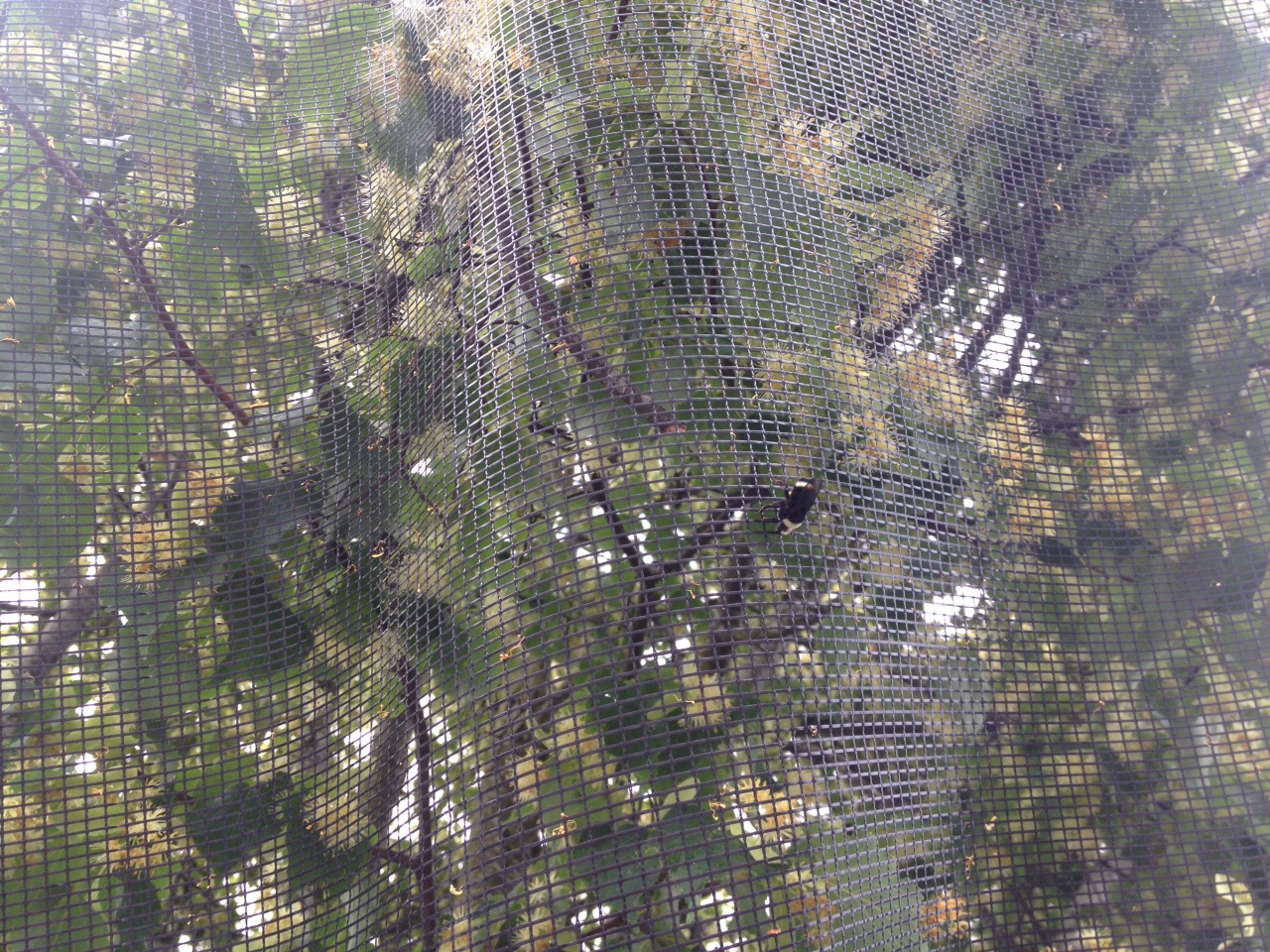
Volunteers making nets to wrap trees.

An earlier report stated that the Oregon Department of Agriculture (ODA) confirmed that the bee deaths were caused by the bees coming into contact with dinotefuran, the active ingredient in the pesticide Safari, made by the Valent Corporation. A neonicotinoid, it contains a powerful neurotoxin that, according to the instructions, should never be applied to a blooming tree full of pollinators as it was in the case of the linden trees in Wilsonville.

The city of Wilsonville, along with staff from the Xerces Society and the ODA, have been working feverishly to cover the trees with nets to keep the bees from coming into contact with the poison. Workers estimate that all 50 trees should be covered by the end of the day on Friday.


Update: 7 am, 6/24/13 Mace Vaughan, Pollinator Program Dir. for the Xerces Society, posted on the Xerces Facebook page: ""By 5 pm on Friday (June 21), the City of Wilsonville, with help from boom trucks and crews from at least four nearby cities, the Oregon Dept. of Agriculture and Xerces Society had covered all 55 poisoned trees in netting. Amazing!! We cannot thank the City of Wilsonville enough for their rapid response!"

Read the first report in this series: "City Steps in to Save Bees"

Video and photos courtesy Mace Vaughan, Pollinator Program Dir., Xerces Society.

The Buzz: City Steps in to Save Bees


The City of Wilsonville and the Xerces Society are wrapping 50 linden trees in netting to help save bees from the misapplication of the pesticide Safari, a powerful neonicotinoid made by the Valent Corporation, that has killed more than 25,000 bees so far in this one event.

Wrapping trees with protective netting.

The landscaping company that did the spraying, which has yet to be named, sprayed the 30-foot trees while they were in full bloom, a use specifically prohibited by the instructions that come with the pesticide. No legal action has been initiated as of today, but the city and the Xerces Society are in discussions with the property owners and the property manager, Elliot & Associates.

Neonicotinoids, a class of neuro-active insecticides chemically related to nicotine, are still legal in the United States, but have been banned in Europe due to evidence of a connection to honey-bee colony collapse disorder.

Xerces Society staff helps with netting.

Ironically, this tragic occurrence coincided with the beginning of National Pollinator Week, meant to "raise awareness about the importance of bees, birds and other pollinator species to agriculture, forest and grassland environments and other ecosystems," according to Agriculture Secretary Tom Vilsack.

Xerces Society Executive Director Scott Black, in an interview, said that to prevent future events like this, "we need to take action to protect native pollinators" from "the use and over use of toxic insecticides."


Update: Noon, 6/21/13 The Oregon Department of Agriculture (ODA) confirmed in a press release that the bumblebees were poisoned by dinotefuran, the active ingredient in Safari, the neonicotinoid sprayed on the trees. According to the press release, "ODA continues its active investigation of the incident to determine if the pesticide application was in violation of state and federal pesticide regulations."


Update: 3 pm, 6/21/13 Rich Hatfield, biologist for the Xerces Society, now estimates that more than 50,000 bees were poisoned in Wilsonville in the largest mass bumblebee death on record. (Read the post.)

Read the second report in this series: "Dead and Dying Bees Still Being Found"

Photos by Mace Vaughan, Pollinator Program Director of the Xerces Society.