

A community coming together over the preparation of food is an ancient tradition, one that can connect us to our roots and to each other. The Oregon version of the Italian festival known as the Maialata, or slaughtering of the pigs, brought chefs, farmers and producers together in a day-long sharing of skills, stories and the bounty of the season.
It came as a surprise when Cathy Whims, Portland chef, owner of two of the city’s most fabled Italian restaurants, Genoa (now closed) and Nostrana, and six-time finalist for the prestigious James Beard Award, admitted that early in her career it was the cuisine of France that captured her heart.

“I think a lot of cooks early in their careers are really drawn to French cuisine because everybody tells you that it’s the height of gastronomic whatever,” she said. “Which is ironic because I was working at Genoa, which was supposed to be an Italian restaurant, though it had a lot of French influence.”
Eventually she bought the restaurant and became the de facto wine buyer, meeting Italian wine distributors who would invariably invite her to come stay at their wineries.
“And I was like, a place to stay in Italy, that sounds pretty good,” she said. “So at that point I really started traveling to Italy a lot.”

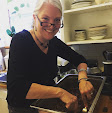
Butcher Rob Roy shows how to skin a pig's head.
It was then that she fell in love with the very simple, pared down treatment of ingredients that is the hallmark of traditional Italian cuisine. Attending classes taught by legendary Italian cookbook author and teacher Marcella Hazan, whom Whims considers one of her two mentors, along with author and teacher Madeleine Kamman, set her on the path she still finds intriguing today.
“The more I traveled, the more I realized that you could travel three kilometers and a dish that you thought you knew could be completely different,” she said. “It was an endless opportunity for learning and I was really attracted to that.”

On one of those trips, to Le Vigne di Zamo winery in Friuli in the north of Italy, Whims heard about a traditional celebration called the Maialata (pron. my-uh-LAH-tuh). Held on the first new moon after the first full moon, usually in late January or February, and coinciding with the time when the pigs—“maiale” in Italian—are ready to be slaughtered, the community comes together for a day-long event to butchering the pigs and make sausages, salami and cure all the pork for the coming year. They then gather and have a feast, which usually lasts most of the the night, to celebrate and give thanks for the bounty that will carry them through the winter.
It was a celebration that she felt would fit perfectly with the emerging culture of food in the Northwest, but it took two years before the elements would fall into place to make it possible. Nostrana had been doing all its own butchery since its inception, but it wasn’t until she thought of Rudy Marchesi at Montinore Estate in Forest Grove that she had a partner to help realize her dream of bringing the Maialata to Oregon.
“He has such a beautiful, old world sensibility,” she said of Marchesi’s biodynamic approach to winemaking and food. “He makes his own cheeses, he makes his own salami. I told him about it and he got really excited and said we should do it at Montinore.”
The first two celebrations were ticketed events where the public could observe the butchering of a pig and participate in making sausages and ravioli alongside well-known Portland chefs, then sit down for a multicourse feast accompanied by Marchesi’s Montinore wines. They were hugely successful, but weren’t living up to the spirit of the Maialata that Whims had envisioned.
“I just thought it was like the commercialization of Christmas or something,” Whims said. “It took away the whole spirit.”
So for this year’s Maialata, held on January 18 at Montinore, she went back to the theme of the original festival that she’d heard about from her friends in Friuli: a gathering of a community.
“I thought, why don’t we do it with colleagues and other people who are interested in food,” she said. “One of the hardest things about being a chef is that you’re in your restaurant and you don’t get to interact with other chefs. We all have something to learn from each other.
“I just wanted the spirit to be that of sharing and not worrying about promoting this event to sell it. It just took a real load off of it, I think, and brought it back to what it really should be.”
In that spirit, two pigs were raised just for the festival, one a black-and-white Hampshire from a Forest Grove firefighter and friend of Marchesi’s, Steve Statelman, who got into raising pigs, in his words, “as a midlife crisis of sorts, but it was more productive and cheaper than buying a Porsche and getting a 20-year-old girlfriend.”
The other pig, a Berkshire and Duroc cross, came from Wolfgang Ortloff and his wife Susan at Worden Hill Farm in the Dundee Hills and had been fed on apples from Baird Family Orchards and Briar Rose Creamery whey, both Dundee producers.
The butchery itself was handled by Nostrana’s in-house butcher, Rob Roy, and Camas Davis of the Portland Meat Collective. They narrated the steps involved in breaking down a carcass to the crowd of their peers who had gathered around them. At one point, Roy was demonstrating how to skin the head for porchetta di testa, an Italian specialty made from the meat of the head wrapped in its scalp and ears. When Roy started the process from the back of the head instead of the front, Davis exclaimed, “I never thought of doing it that way!”
“It’s like he sneezed his face off,” Roy joked.
Whims then took over the pasta-making portion of the event. She demonstrated making a bowl-shaped well in the center of a mound of flour, then pouring water into the well and whisking the water into the flour while maintaining the bowl shape. A natural teacher, she guided her colleagues into kneading and rolling out the dough, then pressing it through the wires of a chitarra, a traditional pasta-making implement, to make the spaghetti alla chitarra, a pasta she’d learned to make on her recent trip to Rustichella d’Abruzzo, one of Italy’s premier pasta producers.
As Whims and her colleagues adjourned to the subterranean wine cellar lit by a dozen flickering candelabras, everyone dug into the food they’d helped prepare that day. Was it the successful Maialata , the gathering of a community, that Whims had envisioned?
Judging by the flood of photos and videos that began appearing on her colleagues’ Instagram, Twitter and Facebook pages, the spirit of the Maialata was alive and well and spreading its message into the broader community.


 Posts
Posts

