Showing posts with label montinore estate winery. Show all posts

Monday, February 09, 2015

The Maialata: Building Community by Celebrating the Pig


A community coming together over the preparation of food is an ancient tradition, one that can connect us to our roots and to each other. The Oregon version of the Italian festival known as the Maialata, or slaughtering of the pigs, brought chefs, farmers and producers together in a day-long sharing of skills, stories and the bounty of the season.

It came as a surprise when Cathy Whims, Portland chef, owner of two of the city’s most fabled Italian restaurants, Genoa (now closed) and Nostrana, and six-time finalist for the prestigious James Beard Award, admitted that early in her career it was the cuisine of France that captured her heart.

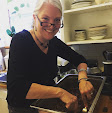
Demonstrating making pasta by hand.

“I think a lot of cooks early in their careers are really drawn to French cuisine because everybody tells you that it’s the height of gastronomic whatever,” she said. “Which is ironic because I was working at Genoa, which was supposed to be an Italian restaurant, though it had a lot of French influence.”

Eventually she bought the restaurant and became the de facto wine buyer, meeting Italian wine distributors who would invariably invite her to come stay at their wineries.

“And I was like, a place to stay in Italy, that sounds pretty good,” she said. “So at that point I really started traveling to Italy a lot.”

Butcher Rob Roy shows how to skin a pig's head.

It was then that she fell in love with the very simple, pared down treatment of ingredients that is the hallmark of traditional Italian cuisine. Attending classes taught by legendary Italian cookbook author and teacher Marcella Hazan, whom Whims considers one of her two mentors, along with author and teacher Madeleine Kamman, set her on the path she still finds intriguing today.

“The more I traveled, the more I realized that you could travel three kilometers and a dish that you thought you knew could be completely different,” she said. “It was an endless opportunity for learning and I was really attracted to that.”

Rolling out and shaping the pasta.

On one of those trips, to Le Vigne di Zamo winery in Friuli in the north of Italy, Whims heard about a traditional celebration called the Maialata (pron. my-uh-LAH-tuh). Held on the first new moon after the first full moon, usually in late January or February, and coinciding with the time when the pigs—“maiale” in Italian—are ready to be slaughtered, the community comes together for a day-long event to butchering the pigs and make sausages, salami and cure all the pork for the coming year. They then gather and have a feast, which usually lasts most of the the night, to celebrate and give thanks for the bounty that will carry them through the winter.

It was a celebration that she felt would fit perfectly with the emerging culture of food in the Northwest, but it took two years before the elements would fall into place to make it possible. Nostrana had been doing all its own butchery since its inception, but it wasn’t until she thought of Rudy Marchesi at Montinore Estate in Forest Grove that she had a partner to help realize her dream of bringing the Maialata to Oregon.

“He has such a beautiful, old world sensibility,” she said of Marchesi’s biodynamic approach to winemaking and food. “He makes his own cheeses, he makes his own salami. I told him about it and he got really excited and said we should do it at Montinore.”

The first two celebrations were ticketed events where the public could observe the butchering of a pig and participate in making sausages and ravioli alongside well-known Portland chefs, then sit down for a multicourse feast accompanied by Marchesi’s Montinore wines. They were hugely successful, but weren’t living up to the spirit of the Maialata that Whims had envisioned.

“I just thought it was like the commercialization of Christmas or something,” Whims said. “It took away the whole spirit.”

So for this year’s Maialata, held on January 18 at Montinore, she went back to the theme of the original festival that she’d heard about from her friends in Friuli: a gathering of a community.

“I thought, why don’t we do it with colleagues and other people who are interested in food,” she said. “One of the hardest things about being a chef is that you’re in your restaurant and you don’t get to interact with other chefs. We all have something to learn from each other.

“I just wanted the spirit to be that of sharing and not worrying about promoting this event to sell it. It just took a real load off of it, I think, and brought it back to what it really should be.”

In that spirit, two pigs were raised just for the festival, one a black-and-white Hampshire from a Forest Grove firefighter and friend of Marchesi’s, Steve Statelman, who got into raising pigs, in his words, “as a midlife crisis of sorts, but it was more productive and cheaper than buying a Porsche and getting a 20-year-old girlfriend.”

The other pig, a Berkshire and Duroc cross, came from Wolfgang Ortloff and his wife Susan at Worden Hill Farm in the Dundee Hills and had been fed on apples from Baird Family Orchards and Briar Rose Creamery whey, both Dundee producers.

The butchery itself was handled by Nostrana’s in-house butcher, Rob Roy, and Camas Davis of the Portland Meat Collective. They narrated the steps involved in breaking down a carcass to the crowd of their peers who had gathered around them. At one point, Roy was demonstrating how to skin the head for porchetta di testa, an Italian specialty made from the meat of the head wrapped in its scalp and ears. When Roy started the process from the back of the head instead of the front, Davis exclaimed, “I never thought of doing it that way!”

“It’s like he sneezed his face off,” Roy joked.

Whims then took over the pasta-making portion of the event. She demonstrated making a bowl-shaped well in the center of a mound of flour, then pouring water into the well and whisking the water into the flour while maintaining the bowl shape. A natural teacher, she guided her colleagues into kneading and rolling out the dough, then pressing it through the wires of a chitarra, a traditional pasta-making implement, to make the spaghetti alla chitarra, a pasta she’d learned to make on her recent trip to Rustichella d’Abruzzo, one of Italy’s premier pasta producers.

As Whims and her colleagues adjourned to the subterranean wine cellar lit by a dozen flickering candelabras, everyone dug into the food they’d helped prepare that day. Was it the successful Maialata , the gathering of a community, that Whims had envisioned?

Judging by the flood of photos and videos that began appearing on her colleagues’ Instagram, Twitter and Facebook pages, the spirit of the Maialata was alive and well and spreading its message into the broader community.

Thursday, August 18, 2011

Stuffing Myself for a Good Cause


Field to table. Farm to table. Plate and pitchfork. Outstanding in the field.

The table awaits.

I've been hearing those phrases everywhere this summer, and they pretty much all mean dining outdoors under the stars, feasting on fresh-from-the-farm produce and meats prepared by local chefs dedicated to seasonal cuisine. It goes without saying they're served with locally produced wines from some of the state's premier winemakers. Some of these events happen on actual working farms, some on restaurant patios, others on private lawns or at wineries.

Dinner in progress.

They're generally not cheap, costing anywhere from $100 to more than $200 per plate, serving from a dozen to a hundred folks at a time. Some are benefits for charity, others are for-profit businesses. But all of them have a interest in spreading the gospel of local food and celebrating the region's bounty.

Wood oven-baked fig and fennel seed flatbread.

Me? I'd never been to one, so when Zenger Farm asked me to attend their first-ever Farm Supper, I jumped at the chance. And not only because I knew the food would be fantastic, prepared by my friend, chef and Zenger board member Linda Colwell and the inimitable Mark Doxtader of Tastebud, with wine poured by Ben Thomas of Montinore Estate. It's because proceeds from the dinner, which totalled nearly $3,000, would go toward Zenger's work educating youth and adults about where good food comes from.

Corn spoonbread.

I arrived to find Mark hunkered over his brick oven, pulling out the perfectly browned fig and fennel flatbread and bubbling roasted peaches and cherries that would start the dinner. These paired perfectly with Ancient Heritage Dairy's Adelle cheese with its delicate ooze and creamy center, and the crisp pinot gris and Müller-Thurgau that Ben was pouring.

Tomato zucchini gratin.

There was a brief tour of the farm, which offered sweeping views over well-tended fields down to the green wetland, all of 16 acres along the Springwater Corridor. Then the twenty or so guests were seated on wooden benches lining an elegantly appointed table next to the farm's barn. The four, yes, four wine glasses looked really promising, and the first course of a bright pink Eastern European-inspired sour cherry soup (top photo) with Montinore's slightly dry, strikingly delicious gevurztraminer had me closing my eyes and sighing with pleasure.

Full plates, happy diners.

The second, main course was an explosion of summer on a plate with…get this…a large meatball-sized lamb kebab, wood oven-roasted corn spoon bread , a tomato-zucchini gratin and a frikeh, beet, carrot and purslane salad. Crazy! That was washed down with two of Montinore's premier reds, their Parsons’ Ridge and Graham’s Block 7 pinots, both insanely good, matching especially well with the smoke from Mark's oven.

Panna cotta with blackberry coulis.

I was already groaning when the dessert, softly oblique cylinders of panna cotta topped with Chester blackberries, came dancing out on sweet pastel-colored glass plates. As the sun was setting, Ben couldn't help but offer Montinore's completely over-the-top ruby port and watch as the whole crew swooned.

Tired but happy chefs.

To say the evening couldn't have been better would be true, but knowing that it benefitted this unique educational community center made it stellar. I'd highly encourage you to check their calendar for upcoming dinners and events that help support this great organization.

Monday, August 01, 2011

Growing Food, Building Community


Growing up in a largely rural state like Oregon, you'd think people would be all been there, done that about where our food comes from. I was lucky growing up with relatives who were cattle ranchers and allowed their crazy-about-horses city girl niece to go on cattle drives and hang out at the ranch during vacations. At least it gave me some idea of the work involved in producing the food that appeared on our family table.

Students on a farm tour at Zenger Farm.

But here in DIY Portland there are kids (and many adults) who couldn't tell you what a brussels sprout plant looks like, or point to the part of a live chicken that hides the drumstick. It's not a stretch to say that the closest a lot of city folk get to actual farm animals is a petting zoo at the pumpkin patch.

The wetland at Zenger Farm.

Fortunately we have a place like Zenger Farm, a unique partnership between the City of Portland and a non-profit organization that encompasses a six-acre working organic farm and a 16-acre wetland inside the city limits. Originally owned in the 19th century by Jacob Johnson, a sawmill operator and Johnson Creek's namesake, a portion of the original 320-acre property was bought by Ulrich Zenger, a dairy farmer and proprietor of Mount Scott Dairy. His son, Ulrich Zenger, Jr., sold the land to the City of Portland in order to protect it from commercial development and preserve the Johnson Creek Basin and Watershed.

Greenhouse at Zenger Farm.

Currently it's a working urban farm with a CSA, and sells its produce at area farmers' markets as well as to local restaurants. It also coordinates matching money for food stamp recipients to be able to buy, cook and eat local foods and is piloting an innovative SNAP (food stamp) CSA model program. Recently Zenger added Furey Field, a 5-acre community garden space adjacent to the farm that will become 1,000 new garden plots for low-income households in the surrounding Lents and Powellhurst-Gilbert neighborhoods.

As if all that weren't enough, it also holds public workshops and summer camps to teach young people and adults that healthy food comes from healthy soil, which can be anywhere—even in the city. And all of the money raised by all of these activities goes right back into programming, making it a truly worthy endeavor.

To celebrate all this work, and just because its a great time of year to be outside on the farm, Zenger is holding two Farmhouse Suppers on August 13 and 14 at the farm. Intimate, with only 20 people each evening and dinner provided by the estimable Mark Doxtader of Tastebud and wines made by Ben Thomas of Montinore Estate Winery, it should be a summer night to remember.

Come if you can and, if you can't, be sure to plan a visit to Zenger Farm for a tour of the amazing work they're doing on our behalf. It'll make you even more proud of your city!

Details: Farmhouse Suppers at Zenger Farm. Aug. 13 and 14, 5:30 pm; tickets $100, reservations required. Zenger Farm, 11741 SE Foster Rd. 503-282-4245.