Sunday, April 29, 2018

On-Farm Seed Production, Part Four: 'Peace, No War' Corn


When I would go to the farmers' market or the grocery store, I browsed the vegetables on offer to find the one that I deemed worthy to take home to my table. I never wondered how it got there—I assumed the farmer planted seeds from a previous crop (or a seed packet) and the vegetable would grow reliably as it had in previous seasons. It never occurred to me that what I was looking at was the result of deliberate choices on the part of the farmer (or seed breeder) over many years. The following is the final part of an article that contributor Anthony Boutard wrote for Acres USA magazine outlining that patient process. (Read the other posts in the series.)

We fielded many inquiries about blue corn so we decided to try it. Despite the expressed interest, it sold poorly. Blue cornmeal looks like concrete mix, which is off-putting to most people, ending our blue corn moment. Among the blue ears, however, we found a single purple ear. It intrigued us so we decided to plant some of its kernels. Fourteen years later, black flour corn is our art project that arose from that chance purple ear.

Package label designed and produced by Anthony Boutard.

The design brief materialized as we noticed the wide range of purples that resulted from the initial planting. Using millo corvo (crow millet), the black corn of northern Spain, as our inspiration, we decided to draw out ears with such intensely purple kernels that they appeared black. At its simplest, the purple coloration seen from the outside of the kernel results from a red pericarp and blue pigments in the aleurone layer of the endosperm. Ears with a combination of red and purple kernels were removed from the breeding population because the red kernels lacked the blue pigments.

In addition to red pigments, a wide range of purples will show up in the pericarp. These colors are regulated by a complex of genes that also lead to different pigments in the stalk, silk, cobs and leaves. These pigments are water soluble, staining the hands during harvest, and can be used as dyes. Many different shades appear and, in the extreme, some plants produce so much pigment that photosynthesis is severely reduced. The plants are beautiful, though stunted, and fail to produce any kernels.

Early ripening is an essential element of the brief. Flour type corn ripens later than the flints—some of the initial purple ears didn’t ripen until mid-November. Our goal was to have the ears ripen by early October.

Evaluating the ears.

The challenge with the flour corns is that the meal is not richly flavored compared to the flint and popcorn types, thus not great as polenta or grits. The high level of anthocyanins associated with the purple coloration also confers a slight bitterness to the meal. There is not much point in a beautiful cornmeal if it doesn’t sell. Fortunately, sweetened recipes bring out the best in the purple meal. Think of bittersweet chocolate. Cornmeal cookies and cornmeal poundcake are delicious and attractive on the plate. The water-soluble anthocyanins are also pH indicators. In Oaxaca, tamales made from purple corn are a traditional part of the “Day of the Dead” celebration, and in Ecuador the corn is used to prepare a drink for the same celebration.

As a flour corn, it is suitable for masa. However, the costs of growing flour corn in our climate, combined with hand harvesting, makes our pricing unattractive to local tortilla makers. This flour corn will remain a small fraction of our corn production and sales, which is fine. It pays for itself and is fun to grow.

When we started this project 12 years ago, the French descriptor pièce noir (black object) came to mind, but over time the homonym ‘Peace, No War’ took root. Why not have a punctuation mark in a variety name? Moreover, the initials are also those of the Pacific Northwest, the region where we farm.

Conclusion

We still use our old Citroën 2CV around the farm. The design brief developed in the 1930s remains useful. That said, we must carefully maintain it or it will fall apart. Crop varieties are no different. They are subject to genetic entropy, the inexorable natural process that moves a crop from a highly ordered state to a less ordered state unless energy is devoted to keeping the genetics well ordered. In the cases of melon and chicory varieties described in previous installments, we had to restore a variety that had started to fall apart, adding a few flourishes of our own. With the corn (above) and tomatoes, we continue to trick them out, adding pigment through selection and pushing them to go a bit faster.

The process of shepherding a variety tailored to your preferences, the region and ground where you grow, and your customers, is a satisfying creative effort. As the design brief develops and evolves, you gain an intimacy with the crop that can never be captured by simply reading a catalogue entry. That said, the gardener or farmer also gains a deeper respect and appreciation for the effort that goes into producing that good variety they purchase from the seed catalogue.

Note: Each crop has its own protocol for seed production and I have refrained from getting into the specifics. The following books are excellent references on seed production:

Ashworth, Susan. 2002. Seed to Seed: Seed saving and growing techniques for vegetable gardeners. Decorah, Iowa: Seed Savers Exchange

Deppe, Carol. 1993. Breed Your Own Vegetable Varieties: The Gardeners and Farmers Guide to Plant Breeding and Seed Saving. Boston: Little, Brown and Co.

Read the other posts in the series. All photos by Anthony Boutard.

Friday, April 27, 2018

Lost Valley Farm Declares Bankruptcy, Halting Sale


There's just no end to the drama at Lost Valley Farm in Boardman, Oregon's second-largest factory farm dairy.

Today the farm's cows—estimates range from just over 11,000 to as many as 19,000—were scheduled to be auctioned to pay off the $60 million in loans owner Greg te Velde owed to Rabobank, a Dutch agricultural lender. In mid-April a Morrow County judge issued a preliminary injunction preventing te Velde from interfering with the auction, according to an article by the Associated Press, though the injunction left open a loophole that could be used to forestall the liquidation of the herd.

Advertisement for auction.

So late Thursday night, just hours before Friday's auction was to begin, te Velde crawled though that loophole by filing for Chapter 11 bankruptcy protection, a move that stops all foreclosure actions by the farm's creditors. An article in the Capital Press reports that the filing also encompasses te Velde's California dairy operations, Pacific Rim Dairy in Corcoran and GJ te Velde Dairy in Tipton.

"Together, the dairies have more than 40,000 cattle that are listed as potential 'hazard property' that poses a safety threat or requires immediate attention" wrote Capital Press reporter Mateusz Perkowski. "Te Velde’s companies owe between $100 million and $500 million to [nearly] 1,000 creditors and have between $100 million and $500 million in assets, according to the bankruptcy petition."

Cow standing in manure from overflowing lagoon.

One of the creditors te Velde is leaving in the lurch is Morrow County, which county Deputy Assessor Patricia Hughes said is owed more than $360,000 in back taxes.

The Oregon Department of Agriculture (ODA), in a direct message on Twitter, said that it "will continue to monitor Lost Valley Farm weekly by conducting inspections of the facility. ODA will also continue to assess compliance of the stipulated judgement and all of the CAFO Permit conditions. "

I also reached out to Tillamook, which is a major purchaser of the milk produced by Lost Valley. It had not responded by the time of posting, so stay tuned for updates as more information comes in.

* * *

UPDATE: The Salem Statesman-Journal reports that Wym Mathews, in charge of compliance for factory farms at the ODA, told the paper that Lost Valley had been issued two notices of noncompliance for violations of the dairy’s wastewater permit, including manure spills, despite a stipulated agreement settling a lawsuit the state had brought against the dairy for previous violations.

"Te Velde’s Chapter 11 bankruptcy petition, filed April 26 in California, provides an automatic stay of time during which judgments, collection activities, foreclosures and repossessions are suspended and may not be pursued," the article states. "Oregon officials could not say whether it also prevents enforcement of the stipulated judgement. Under the judgment, Oregon has the right to revoke the dairy’s wastewater permit if te Velde does not comply with its terms."

In a subsequent interview, reported in the same article, Matthews appeared to change his story, saying only one notice had been issued, and that "there have been no other enforcement actions taken against the dairy since the settlement."

"'It was a big mistake to give this facility a permit, and ODA should have closed it down months ago after it became clear how badly it was being managed,'" said Ivan Maluski, policy director for Friends of Family Farmers, who was interviewed for the article.

 "'There were so many warning signs that ODA and other decision makers either overlooked or ignored,' Maluski said. 'Where is the accountability? What steps are being taken by ODA and the Governor to make sure this kind of thing won't happen again?'"

Read the series of posts outlining the long history of problems at Lost Valley since it opened just a year ago, including cows standing in manure from overflowing lagoons and a leak in a tank containing dead cows, as well as groundwater pollution, lawsuits from the state of Oregon and creditors, and te Velde's own arrest for soliciting a prostitute and possession of methamphetamine in Benton County, Washington.

My article Big Milk, Big Issues for Local Communities reports on the issues mega-dairies pose to Oregon's air, water, environment and communities. You can also find out Why I'm Quitting Tillamook Cheese and read other coverage about factory farms in Oregon.

Top photo from Google Maps. Photo of cows standing in manure obtained via a public records request by Friends of Family Farmers.

Thursday, April 26, 2018

Eats Shoots and Leaves


A panda walks into a bar. He orders a sandwich, eats it, then draws a gun and fires two shots in the air. "Why? Why are you behaving in this strange, un-panda-like fashion?" asks the confused waiter, as the panda walks towards the exit. The panda produces a badly punctuated wildlife manual and tosses it over his shoulder.

"I'm a panda," he says, at the door. "Look it up."

The waiter turns to the relevant entry and, sure enough, finds an explanation. "Panda. Large black-and-white bear-like mammal, native to China. Eats, shoots and leaves."

An old joke, but one that has relevance to this spring season, and not because we'll find pandas behaving badly. It's due to the plethora of spring shoots like raab and rapini, yes, but also other sweet tendrils like those of fava beans and peas.

Go to the farmers' market and just behind the explosions of fresh flower arrangements you'll often see a rickety old card table mounded with green bundles of bok choy, pea shoots and other lesser-known but delicious spring greens like culantro, sawtooth herb and unusual mint varieties. You'll also find that the prices are often less than at larger stands and the quality is always superb.

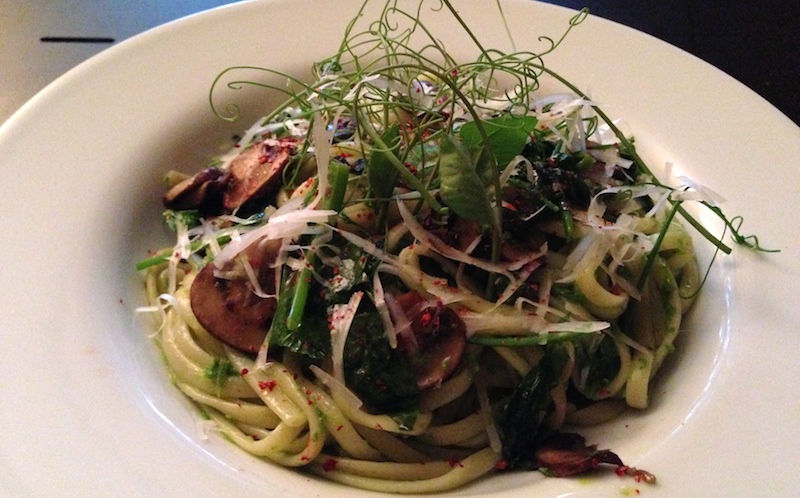
On my last trip to the market I brought back a huge bunch of pea shoots, with their fine, twisty tendrils and blossoms just beginning to color, so a spring pesto was called for. Plus there was enough left over to chop and sauté the remaining half bunch and toss it with some mushrooms and spectacular purple asparagus.

Pasta with Pea Shoot Pesto, Asparagus and Mushrooms

For the pesto:
1 lb. pasta (I like fettucine or linguine for this recipe)
1 large bunch pea shoots
Olive oil
1 large clove garlic, minced
2 Tbsp. pine nuts
1/4 c. parmesan, grated
Salt to taste

For the pasta:
3 anchovy filets (optional)
1/2 lb. asparagus spears, sliced in 1" lengths
1/4 lb. mushrooms
1/4 tsp. dried hot red peppers, like cayenne, seeded and ground

Put a large pot of water on to boil. While it heats, make the pesto.

Slice the bunch of pea shoots into 2” lengths, reserving a few tendrils for garnishing the final dish. Take the pieces from the bottom half (the thicker stems) and place them in a blender with the garlic and pine nuts. Drizzle in some olive oil, turn on the blender and continue drizzling just until it makes a smooth purée. Pour into small mixing bowl and stir in cheese and salt to taste.

When the water boils, add the pasta to the pot and cook till al dente. While the pasta cooks, heat 2 Tbsp. olive oil in a large skillet over medium heat. When it shimmers, add the anchovies, if using, and mash them with the back of a spoon until they dissolve (1 min. or so). Add the cayenne, mushrooms and asparagus and sauté until the vegetables are tender but still crunchy. Add the remaining chopped pea shoots and sauté till wilted.

Drain the pasta, add the pesto and toss until thoroughly combined. Top with pea shoot mixture and garnish with reserved tendrils. Additional grated parmesan can be served alongside.

Get the excellent and grammatically witty tome containing the panda joke, Eats Shoots & Leaves, The Zero Tolerance Approach to Punctuation by British writer Lynne Truss.

Saturday, April 21, 2018

Earth Day, 2018: Celebrate with the Bees!


What better way to celebrate Earth Day than with a tale of the simple joy brought to people by bees? The following essay  by Mace Vaughan, who co-directs the Xerces Society's Pollinator Conservation Program, was published here in 2015, and is just as relevant today as it was then.

In the summer of 2009, my family and I moved into a house across from the Sabin Elementary School in northeast Portland, Oregon. Our daughter started kindergarten at the school that fall. Sporadically, as other school parents learned of my work in pollinator conservation, they would ask me if I’d ever seen the “tickle bees.” I would respond with a polite “no,” unsure what they meant. Still, as the question continued to come up through the December holidays and into the late, wet winter, my curiosity grew. Everyone seemed to know about the tickle bees.

And then St. Patrick’s Day arrived. The sun shone and it was warm for a March afternoon. I sat in our dining room, working from home and enjoying the sounds of kids playing in the schoolyard across the street from our house. Every so often I would sneak a peek across the street to see if our daughter was running around, and that was when I spotted a boy, all alone, kneeling on the ground as he tried to catch something. He grabbed and lunged, attempting to seize it from the air. In that moment, it all came clear to me.

I waited until the kids had cleared out of the field, closed my computer, and walked across the street. And there, to my amazement, were the tickle bees of Sabin Elementary. Not tens, not hundreds, but thousands of gentle, ground-nesting bees were emerging all across the two-acre field. I was standing in a giant aggregation of mining bees, which turned out to be at least two species of the genus Andrena—christened the “tickle bees” by the students of Sabin.

For the next two months I watched as more and more bees emerged from the ground. Scattered across baseball diamonds, the bare dirt under park benches, and all across the soccer pitch were mounds of soil the bees had excavated from underground. They seemed to deepen their tunnels mostly at night; walking across the grounds in the morning you would see freshly dug dirt hiding the holes underneath. By the afternoon, the dirt was pushed aside as the females emerged to fly to the flowering maple trees, dandelions, and cherry and plum trees around the neighborhood. On an especially warm day, you couldn’t run across the field without bumping into these amazing insects.

As someone who has worked hard to convince people worldwide that insects are not a bunch of biting, stinging, crop-killing animals, but rather the drivers of healthy ecosystems, I was touched by the reception these bees received. For the two months the bees were active, parents and students regularly approached me with questions. I helped dozens of people discover what, for them, was a whole new world of ephemeral bees, with their golden stores of food and developing brood buried below soccer and kickball games.

Tickle bees are not unusual or uncommon. Every spring we receive calls at the office starting in early March from people wondering about the bees that are showing up in their lawns, whether they are safe, or just wanting to know what they are. Across the rest of the country, as spring comes on after this harsh winter, look for holes in the ground and bees flying. If you want to find your own tickle bees, go out on a warm spring day and watch sunny, south-facing slopes around your neighborhood. You might find your own aggregation of mining bees.

As for Sabin, five years later the tickle bees are going strong. As kids get older, they may lose interest. But each spring, a new group of kindergartners gets to meet the tickle bees and share something unique that their older classmates have cherished for years.

Watch an interview with Mace talking about the tickle bees of Sabin School.

Thursday, April 19, 2018

Farm Bulletin: Owlets Growing Up


An update on the great horned owl family at Ayers Creek Farm from contributor Anthony Boutard reveals the function of their striking facial disk in helping to locate prey.

Here are the young owls at day 73 minus (top photo; click for larger version). Notably, the adults are raising three young, so they are hunting over many long hours, leaving the young unguarded. You can see the difference in size reflecting the different ages of the birds.

They are developing their immature plumage, including that which defines their facial disk. The disk is important to the owls’ hearing, channelling and amplifying even the softest rustle made by their prey as it moves in the undergrowth and leaf litter. The ears are at the edge of the disk, in line with the eyes. Unlike the barn owl which mostly hunts on the wing over open ground, great horned owls employ a perch-and-pounce method. They will sit perfectly still on a branch, hunched over, “watching” the ground with their ears. The owl has the element of surprise as its prey can’t see the bird, and the soft plumage of the owl means it pounces without a sound.

Great horned owls are by nature nocturnal hunters, but when raising young they are hunting even when roosting during the day to avoid garnering the attention of crows and other noisy objectors to their presence. Late in the afternoon last week, [Carol's sister] Sylvia asked to see the young. I was a bit tired and grumpy, and opined sourly that she would see nothing so late in the day. As we looked at the snag trying to pick out the young, both adults returned to the redoubt with prey at the same time. So much for a promised dull moment.

Read the first owl post of 2018. Read more and see Anthony's fantastic photos from previous years.

Wednesday, April 18, 2018

Farm Life: Spring Tinged with Hope, Sadness


I don't know about you, but in spring my social media feeds are full of babies…tiny goats scampering after their mothers, calves with melting brown eyes, lambs a mere few minutes old wobbling to their feet. For farmers it means long nights with no sleep, searching in the dark for mothers that may have strayed to an isolated corner of a field to give birth and bottle-feeding any babies rejected by their mothers, at the same time as rejoicing at the new life they bring to the farm. The following is by Kate McLean of Longest Acres Farm in central Vermont, whose Instagram post (top photo) stopped me in my tracks with its heartbreaking clarity and simultaneous sense of anguish and hope. Farmers like this who care so deeply for their animals are why I love what I do.

I lost my favorite ewe Saturday morning. Just cold and dead with no hint of explanation. She left two little daughters; Fiona and Fanny. I wished I had known she would die that night.

I wished I had been able to thank her for her six years of service to the farm. For her eight lambs. But more, I’m grateful I didn’t find her dying. I know that’s spineless. But I hate finding dying animals. Then the farmer is always torn in calculation: What can I do? What could a vet do? What would a vet cost? How much is this animal worth in $? How much is this animal worth to my heart? Can the farm shoulder this expense? It’s an abjectly shitty calculation and I hate making it.

So I’m always grateful when the animal spares me the anguish (again, I know, spineless). I’m always grateful when an animal is allowed the dignity of a quiet death in the middle of the night without the indignation of my intrusion, of my calculations. We had a funeral pyre for her that afternoon (as there ain’t much burying in frozen April ground such as this). We will honor her memory by taking damn good care of the lambs she left us, who are now bleating for their next bottle, so I must be off.

Posted with permission from Longest Acres Farm.

Monday, April 16, 2018

Spring Lamb Means Get Out the Braising Pot!


We had a writer friend from San Francisco visiting for the weekend, and while we'd made plans to go out for dinner Saturday night—note of thanks to Nancy and Randy at Bar Avignon for a fabulous evening—his flight wasn't getting in until late Friday evening, so I volunteered (make that begged) to make dinner that night. Fortunately for us he's an ominivore, so my suggestion of braised lamb shanks was more than acceptable.

Jeff makes a new friend in Oregon.

The original version of this braised dish was created for a big ol' lamb shoulder by my friend Michel, but there was no reason it couldn't be adapted for lamb shanks, too. It's been known among our circle for being the lamb recipe that converts lamb-haters to lamb-lovers—you know who you are, so don't make me name names—and I've heard reliable reports that it's successfully converted others to the ranks of the lamb-loving, as well.

The lamb itself makes a difference, of course, the fresher and more local the better, and there are several farms in the area that raised sheep on pasture, which are your best bets for good meat of any kind. (See the Oregon Pasture Network Product Guide to find a farmer near you.) But it's my belief that the unusual combination of spices like cardamom and cumin and poblano and red peppers takes it to another level entirely. The lamb can definitely stand up to the strong flavors they impart, and the aroma while its cooking is intoxicating, whetting everyone's appetites in advance of the meal.

Fall-off-the-bone tender, I've served it with polenta made from the coarsely ground Amish Butter corn from Ayers Creek Farm, but this time I decided to try pairing it with the farm's parched green wheat (formerly known as frikeh) simmered until it was tender then sautéed with onions, garlic and carrots. Turned out to be a great idea, since the smoky flavor of the grain complemented the lamb and spices perfectly.

Leftovers are rare, but if that should occur I can highly recommend shredding any remaining meat, adding a cup or two of roasted tomatoes and serving over pasta as a lamb ragu. And a reminder: I always love to hear back from you if you make this dish, especially if you have tweaks to make it better, so please leave feedback in the comments below. Enjoy!

Braised Lamb Shanks with Cardamom and Peppers

This lamb recipe is terrific braised and served the same day, but for a real treat make it a day ahead and put it in the refrigerator overnight. Holding it for a day gives the flavors a chance to meld deliciously, and it's easy to remove the bones and solidified fat before reheating.

4-lbs. lamb shanks (or shoulder roast)
3 Tbsp. olive oil
2 c. chopped onion
1 red bell pepper, coarsely chopped
2 pasilla, ancho or poblano pepper, coarsely chopped
4 cloves garlic, crushed
2 tsp. cardamom pods, crushed, using only the small seeds inside
2 tsp. cumin seeds
1/4 c. dried currants, coarsely chopped
1 c. chicken stock
2 c. roasted tomatoes (approx. one 15-oz. can)
Zest of 1 lemon

Preheat oven to 325 degrees.

Salt and pepper shanks and set aside.

Heat oil in large braising pot or Dutch overn. Add garlic and onion and sauté until tender. Add peppers and sauté until softened. Add cumin and cardamom seeds to the vegetables and sauté briefly. Add canned tomatoes, stock and currants and stir to combine. Place the shanks in a single layer in the pot, if possible, so they are mostly covered. Cover braising pot and place in middle of preheated oven. Braise for at least 3 hours.

Remove lamb from pot and separate the meat from the bones (bones can be discarded or, preferably, composted). Cover and hold in deep, pre-warmed serving platter or bowl. Skim fat from liquid in pan and bring to boil to reduce slightly. Season to taste with additional salt, if needed, and pour over lamb. Sprinkle with lemon zest and serve.

Find more of Michel's outstanding recipes, including her crab cakes, cherry corn salsa and Napa cabbage slaw.

Tuesday, April 10, 2018

In Season: Tender Young Things


I noticed it a few weeks ago. Little yellow buds had appeard on the forsythia outside my kitchen window, one of the first signs that spring was, indeed, on its way. So I quickly made an appointment to sit down with veggie guy Josh Alsberg at Rubinette Produce to get the skinny on what farmers would be bringing in from their fields.

He led off with a recitation of a prodigious list of brassica inflorescences—sometimes labeled raab, rapini and rabe—that would be trooping through his doors and appearing on farmers' market tables around the area: kale, collard, chard, cabbage, bok choy, spigarello, turnip and brussels sprouts, among others. He noted that these tender green flowering shoots get their sweet flavor from the sugars that the plants pump out to ward off damage from frosty temperatures in early spring, protecting the seeds that will develop after the buds flower.

We agreed that the best way to prepare these shoots is to simply sauté them in olive oil and a showering of salt just before serving, though adding a couple of cloves of garlic or bacon wouldn't be a bad idea. But they're also appropriate when combined in stir fries, soups, stews, pastas, grains and beans.

"Spring bulby things" was the next category, which included spring radishes and early turnips like the Japanese Hakurei variety. He recommends consuming the radishes raw with unsalted butter, but both the radishes and turnips can be sautéed or roasted, as well. Alsberg didn't have to add an admonishment to use the greens from both, since I'm dedicated to sautéeing the tender greens from the turnips or making pesto from the tiny radish greens.

A pro tip if you're picking up radishes and turnips from a supermarket—which might be bringing them in from a faraway conventional farm—is to smell them first, he said. If they smell chemical-ly or off, "don't eat 'em," adding it's best to "follow your nose" when it comes to fresh vegetables.

Alsberg's also getting spring onions and garlic from local foraging companies, and emphasizes it's appropriate to use the whole plant after trimming off the roots, and that they're best added at the end of cooking to preserve their fresh, delicate taste. Washington asparagus is starting to appear, though you'll have to get to the farmers' market early (which counts me out) to get the small amounts coming in from Oregon growers. The season for Oregon asparagus won't really get going until later this month and into May.

Salad greens like arugula and watercress are beginning to flood in from the fields as the weather warms and should be around for the rest of the spring months. Alsberg encourages buying watercress in bunches rather than bags, since most of the bagged version are "upland cress," which is a different genus. Black Locust Farm in Boring, Oregon, part of the Headwaters Farm incubator project, is growing a Persian, or crinkled, variety that Alsberg is excited about.

Mustards, including mizuna, and mache are appearing, as is baby spinach. The babies will soon be followed by adult bunches in a matter of weeks, which you always want to buy from organic growers, since a recent report found "conventionally grown spinach has more pesticide residues by weight than all other produce tested."

Alsberg effuses over the "luxurious, beany flavor" of fava shoots (above, right), so you may have to fight him off at the farmers' market when he's there, as well as pea shoots, which he describes as the essence of spring with their "mellow, green, pea flavor." Look for lettuces to start coming in from local farms in late April and May.

And what about local strawberries, you might ask? They'll be dribbling in from hoop houses starting in mid-April, with the full-on flood starting around Mother's Day in mid-May.

As regards strawberry varieties, his advice on our precious Hood strawberries, known for their delicate and perishable natures, is to "take the whole pint and shove them in your face, stems and all."  Albions are wonderful for slicing into salads and fresh with desserts; Seascapes, not quite as sweet as Albions or Hoods but full-flavored and robust, are good for cooking; and Shuksan, which are touted as combining the best of Hoods and Seascapes, are excellent for both cooking and eating out of hand.

Pro tip: In his humble opinion, the best strawberries come from Deep Roots Farm between Corvallis and Albany. "Everybody should always be buying their berries from Deep Roots." So there you go. Happy spring!

Monday, April 09, 2018

On-Farm Seed Production, Part Three: 'Astiana' Sauce Tomato


When I would go to the farmers' market or the grocery store, I browsed the vegetables on offer to find the one that I deemed worthy to take home to my table. I never wondered how it got there—I assumed the farmer planted seeds from a previous crop (or a seed packet) and the vegetable would grow reliably as it had in previous seasons. It never occurred to me that what I was looking at was the result of deliberate choices on the part of the farmer (or seed breeder) over many years. The following is the third part of an article that contributor Anthony Boutard wrote for Acres USA magazine outlining that patient process. (Read previous posts here.)

We did not sell tomatoes for years, avoiding the frenzied and irrational hustle to produce the first tomatoes in the market. We shun hoop-house culture and we were happy to avoid all the precious heirloom hype. That said, we grew up on home-canned tomato sauce and missed growing a high-quality sauce tomato. The varieties sold as ‘San Marzano,’ ‘Roma’ and ‘Amish Paste’ are poorly adapted to our latitude and the cool nights that attend the maritime climate of the Pacific Northwest.

Ten years ago, we purchased a few tomatoes labeled as local in Asti, a town in the Italian Piedmont that is close to the latitude of our farm. It was mid-October and we saw similar tomatoes in gardens throughout the area. The tomatoes were large at the base and tapered to a narrow top. They were pleated and distinctly green-shouldered. The seed cavities, or locules, were dry and had very few seeds. The skin was thick and the flesh highly acidic. Raw, the tomato was flat and uninteresting. When cooked the flavor opened up and was so outstanding, we reserved the 15 seeds they yielded and brought them home with us. Over time, we adapted this representative of a northern sauce tomato landrace to our farm and customers.

The characteristics described above were all important to the quality of the tomato. The large fruit with its hollow cavities meant that it held the field heat accumulated during the day well into our cool nights, extending its ripening hours. The green shoulders are an ancestral trait associated with heightened flavor. The tomato’s lycopene and pectin are concentrated in the skin and the adjacent tissue adhering to it, thus the pleated skin increases the amount of flavorful skin relative to a smooth tomato of the same dimensions. Pectin provides “mouth feel” and softens the acids present in the fruit, but generally get short shrift when we discuss tomato quality. For a sauce tomato, ample acidity is important for flavor and canning.

Our selection protocol for the tomato is based on the cooked flavor. For a given vine, if the first one or two fruits fully meet our visual criteria, we harvest and cook them. If the cooked tomato meets our standards for flavor, the seeds are reserved.

We harvest and sell the tomatoes over a six-week period, starting around Labor Day. Consequently, we select for late fruiting plants, not just early ones. However, we are careful to use only the first ones that ripen on a given plant. Tomatoes are typically self-pollinating, but as the season progresses they will shift to outcrossing, perhaps due to the depletion of trace minerals within the root zone. From our observations, tomato fruits that display a sharp increase in seeds are likely outcrossing. The shift from self-pollination to cross-pollination in response to the depletion of copper and boron has been documented in wheat and barley. Even where the outcrossing occurs within the same variety, the genetic reshuffling will produce unpredictable offspring.

When growing both a crop for sale and producing seeds for self-pollinating crops, it is tempting to sell the best at market, and harvest seed later assuming that self-pollination is a fixed characteristic. My advice is, don’t. Select for seed first and harvest crops later. If you want to produce seed for snap beans, mark the seed plants and do not touch them until the seed is ripe. If seed production is a lower priority, don’t bother trying.

Ten years after purchasing those tomatoes in Asti, sauce tomatoes are another signature crop for our farm. We now sell them as ‘Astianas’, a nod to the market where we encountered them. We sell them in bulk lugs specifically for sauce. Because they ripen during the cool days as autumn hastens, people are more willing to spend the time in the kitchen.

Read the other posts in the series.

Top photo by Anthony Boutard.

Thursday, April 05, 2018

Lost Valley Defaults on Loans, Cows Will Be Sold


A recent report in the East Oregonian newspaper indicated that Rabobank, a Dutch agricultural lender, reported that Greg te Velde, owner of Lost Valley Farm, had defaulted on part of $60 million in loans for the Boardman dairy and two other dairies te Velde owns in California. "John Top, owner of Toppenish Livestock, said they will begin preparing next week for the auction, which is scheduled for April 27," the article stated. "However, according to a preliminary injunction filed in Morrow County, te Velde has not given the auctioneer permission to enter the dairy."

Today (Thursday, 4/5/17) I was able to reach Cody Buckendorf, Operations Manager at Toppenish Livestock, who said that that the auction company had been given access to the property and an on-site auction was going ahead on Friday, April 27th. He said that their first day on the property to process cows prior to auction was yesterday, (Wednesday, April 5), and that the bank was estimating there would be as many as 19,000 cows auctioned. When questioned about the conditions he observed at the dairy, he said that, contrary to the photos taken by the inspector that led to its shutdown (photo, above), "it was one of the cleanest dairies I've seen."

Reached by phone, Andrea Cantu-Schomus, Director of Communications for the Oregon Department of Agriculture (ODA), said that within days of te Velde agreeing to a stipulated judgement by Multnomah County Circuit Judge Stephen Bushong that the dairy limit wastewater production to 65,000 gallons a day and ensure its manure lagoons have enough capacity to handle water from storms, the problems documented by ODA inspectors "had been rectified."

She added that as long as Lost Valley is running a Confined Animal Feeding Operation (CAFO) under Oregon Administrative Rules, the ODA will be enforcing the CAFO permit and following the guidelines of the stipulated judgement, which includes weekly inspections by ODA inspectors.

Read my coverage of the problems at Lost Valley Farm that led to the auction. My article Big Milk, Big Issues for Local Communities reports on the issues mega-dairies pose to Oregon's air, water, environment and communities. You can also find out Why I'm Quitting Tillamook Cheese and read other coverage about factory farms in Oregon. Photo obtained via a public records request by Friends of Family Farmers.

Monday, April 02, 2018

Farm Bulletin: The Owls of Ayers Creek Farm


Contributor Anthony Boutard has written often over the years about the owls that inhabit the land that he and Carol tend in the Wapato Valley just west of Portland. Valued residents, these nocturnal predators serve to exercise some population control over the various mice, voles and other creatures that love the crops from this acreage as much as its human fans.

Twenty years ago, when we settled on the farm, there was a great horned owl that we would flush from time to time. As we got to know the place, we would watch the young on an old Douglas fir snag. Owls do not build a nest, but find a suitable location where they can lay an egg. As that snag disintegrated, the owl moved to an old red-tailed hawk nest high in a living fir. That nest was occupied for several years until a wind storm knocked the top out of another fir, and they took over that redoubt. I cannot say for certain that the pair of owls we see today are the same as those we saw 20 years ago, but they can lead long lives if they can find a secure place to live. Spooky the Owl at the Boston Museum of Science lived to 38, allowing me to bring Caroline to see the same bird I had marveled at when I was a child.

Fortuitously, in her new nest location we could observe her from our bedroom. As the owls prepare to raise a clutch they become vocally amorous, indicating that the female is going to settle on the nest. This year, she started brooding in the early morning hours of the 4th of February. The laying of the second egg was unobserved, but probably happened about ten days later. The female will sit on the nest continuously for nearly two months keeping the eggs, and later the chicks, warm. The male will provide her food during her brooding.

Last year, the owls raised a brood, but the chicks never made it to fledging. I am not sure what happened, but it is a wonder any owlet survives as they leap from the nest while unable to fly. If they land to close to the ground or are too exposed, they are a fine morsel for a variety of predators and scavengers. A few years ago, the owls raised three chicks, but the third was developmentally challenged. It was never able to fly properly but lived well into the following spring. I suspect it met its demise at the talons of a migrating Coopers hawk or goshawk.

I have been watching to see when the chicks would show themselves. That happened on Thursday. The chicks were just big enough and the weather mild enough, that the owl could take a much needed stretch atop the snag. For a couple more weeks, that is as far as she will venture from the chicks. Today, I had a moment to set up the camera. Here is a photo of the two chicks and the female.

Read Anthony's posts, accompanied by his wonderful photographs, about previous broods of the farm's great horned owls.

Photo by Anthony Boutard.

Friday, March 30, 2018

An Oregon Dairyman Reclaims the Pasture


Meet Jon Bansen, a pasture-based dairyman in Oregon's Willamette Valley, in this profile I wrote for Civil Eats' Farmer of the Month series.

Fourth-generation farmer Jon Bansen translates complex grazing production systems into common-sense farm wisdom.

In the U.S., the dairy industry is a tough business for organic and conventional producers alike, with plunging prices and changing consumer demand leading to a spate of farm shutdowns and even farmer suicides. And in Oregon, where dairy is big business—accounting for 10 percent of the state’s agriculture income in 2016—the story is much the same.

But Jon Bansen, who has farmed since 1991 at Double J Jerseys, an organic dairy farm in Monmouth, Oregon, has throughout his career bucked conventional wisdom and demonstrated the promise of his practices. Now he’s convincing others to follow suit.

Bansen and his wife Juli bought their farm in 1991 and named it Double J Jerseys, then earned organic certification in 2000. In 2017, he switched to full-time grass feed for his herd of 200 cows and 150 young female cows, called heifers. He convinced his brother Bob, who owns a dairy in Yamhill, to convert to organic. His brother Pete followed suit soon after. (“He’s a slow learner, that’s all I can say,” Bansen joked.)

He’s someone who prefers to lead by example, which has earned him the respect of a broad range of the region’s farmers and ranchers, as well as its agricultural agencies and nonprofits.

“Jon is an articulate spokesperson for organic dairy in Oregon and beyond,” said Chris Schreiner, executive director of Oregon Tilth, an organic certifying organization. “His passion for organic dairy and pasture-based systems is contagious, and he does a great job of translating complex grazing production systems into common-sense farmer wisdom. His personal experience … is a compelling case for other dairy farmers to consider.”

George Siemon, one of the founders of Organic Valley, the dairy co-operative for which Bansen produces 100 percent grass-fed milk under Organic Valley’s “Grassmilk” brand, believes the switch to 100 percent grass is a direction that Bansen has been moving in all along.

“He’s just refined and refined and refined his organic methods,” said Siemon, admitting that Bansen is one of his favorite farmers. “He’s transformed his whole farm. It’s a great case when the marketplace is rewarding him for getting better and better at what he does and what he likes to do.”

Deep Roots in Dairy Farming

Dairy farming is baked into Bansen’s DNA, with roots tracing all the way back to his great-grandfather, who emigrated from Denmark in the late 1800s, settling in a community of Danes in Northern California. His grandfather followed in the early 1900s, hiring out his milking skills to other farmers until he saved enough to buy his own small farm near the bucolic coastal town of Ferndale in Humboldt County.

Bansen was about 10 years old when his father and their family left the home farm to strike out on their own in Oregon’s Willamette Valley. They bought land in the tiny, blink-and-you’ll-miss-it town of Yamhill, about an hour southwest of Portland.

A typical farm kid, Bansen and his seven siblings were all expected to help with the chores. “You fed calves before you went to school, and you came home and dinked around the house eating for awhile until you heard Dad’s voice beller at you that it was time to get back to work,” Bansen recalled. “I was a little envious of kids that lived in town and got to ride their bikes on pavement. That sounded pretty sexy to me.”

After studying biology in college in Nebraska and getting married soon after graduating, Bansen and his wife worked on his dad’s Yamhill farm for five years and then began talking about getting a place of their own. They found property not far away outside the sleepy town of Monmouth. It had the nutritionally rich, green pastures Bansen knew were ideal for dairy cows, fed by the coastal mists that drift over the Coast Range from the nearby Pacific Ocean.

One day, a few years after they’d started Double J Jerseys, a man knocked on their door. He said he was from a small organic dairy co-op in Wisconsin that was looking to expand nationally. He wondered if Double J would be interested in transitioning to organic production, mentioning that the co-op could guarantee a stable price for their milk.

It turned out that the stranger was Siemon, a self-described “long-haired hippie” who’d heard about Bansen through word of mouth. “He was reasonably skeptical,” recalls Siemon. “He wanted to make sure it was a valid market before he committed, because it’s such a big commitment to go all the way with organic dairy.”

For his part, Bansen worried that there wasn’t an established agricultural infrastructure to support the transition, not to mention the maintenance of an organic farm. “I was worried about finding enough organic grain,” he said.

On the other hand, however, the young couple needed the money an organic certification might bring. “We had $30,000 to our name and we were more than half a million dollars in debt” from borrowing to start the farm, Bansen said.

After much research and soul-searching, they decided to accept Siemon’s offer and started the transition process. It helped that his cousin Dan had transitioned one of his farms to organic not long before and that generations of his family before him had run pasture-based dairies.

“My grandfather, he was an organic dairy farmer, he just didn’t know what it was called,” Bansen said. “There were no antibiotics, no hormones, no pesticides. You fed your cows in the fields.”

The Organic Learning Curve

During the Bansens’ first organic years, they had to figure out ways to eliminate antibiotics, hormones, and pesticides—all of which Bansen views as “crutches” to deal with management issues.

To prevent coccidiosis, a condition baby cows develop when they don’t receive enough milk and are forced to live in overcrowded conditions, for example, Bansen fed his calves plenty of milk and made sure they had enough space.

To prevent cows from contracting mastitis, an infection of the mammary system, he changed the farm’s milking methods.

Another learning curve had to do with figuring out the balance of grain to forage (i.e., edible plants). Originally Bansen fed each of his cows 20 pounds of grain per day, but after switching to organic sources of grain, he was able to reduce that to four or five pounds a day. This switch cut down grain and transportation costs dramatically.

He also had to learn to manage the plants in the fields in order to produce the healthiest grazing material possible. Since the transition to organic, Double J has grown to nearly 600 acres, a combination of pastures for the milking cows, fields for growing the grass and forage he stores for winter, when it’s too cold and wet to keep the animals outdoors.

“It’s not a machine; it’s a constant dance between what you’re planting and growing and the weather patterns and how the cows are reacting to it,” said Bansen. “There’s science involved in it, but it’s more of an art form.”

Read the rest of the article and find out why Bansen made the decision to transition to a grass diet for his cows, and why he's "sick of farmers bitching about the price of milk and going down to Walmart to buy groceries and taking their kids out to McDonald’s. You have no right to bitch about what’s going on in your marketplace if you’re not supporting that same marketplace."

Wednesday, March 28, 2018

Spring Thing: Maple Bread Pudding with Nancy Harmon Jenkins


It's Easter weekend and I can't think of anything more appropriate than my friend Nancy Harmon Jenkins's super-easy maple bread pudding, especially if you use the first of the season's local eggs from a farmer who raises her chickens on pasture. (A trip to the farmers' market on Saturday morning would be awesome!)

Get the recipe here and make it for brunch served with yogurt, or drizzled with warm syrup and a dollop of whipped cream for dessert after your ham dinner. What could be more perfect? Thanks, Nancy!

Monday, March 26, 2018

On-Farm Seed Production, Part Two: Arch Cape Chicory


When I would go to the farmers' market or the grocery store, I browsed the vegetables on offer to find the one that I deemed worthy to take home to my table. I never wondered how it got there—I assumed the farmer planted seeds from a previous crop (or a seed packet) and the vegetable would grow reliably as it had in previous seasons. It never occurred to me that what I was looking at was the result of deliberate choices on the part of the farmer (or seed breeder) over many years. The following is the second part of an article that contributor Anthony Boutard wrote for Acres USA magazine outlining that patient process. (Read the other posts in the series.)

Production of leaf or salad chicories, marketed as radicchio to give them an Italian burnish, are an important commercial crop in Italy and California. The producers rely on proprietary seed production. For example, the late Treviso chicory growers’ consortium cooperatively funds seed production for their storied Tardiva. This assures them the necessary consistency and reliability. That carefully produced seed is unavailable to other farmers.

'Arch Cape' chicories.

Stymied by the sharp decline in the consistency and quality of the publicly available seeds of the late Treviso type, with less than 10 percent of the resulting crop resembling the Italian version and the off-types often unsaleable, we either had to walk away from the crop or produce our own seed. Affection ruled the day. We decided to extract our own selection from the infuriatingly messy genetics enclosed in those seed packages.

Late winter chicory seed production is not for the impatient farmer. The crop is planted in the early summer, the new seeds are harvested midsummer a year later, in the summer of the following year those seeds are planted and in February of the next year the results are evaluated, a project of nearly three years. The necessary patience springs from enjoying a brightly colored chicory salad on a dreary February day.

Agapostemon virescens, a native ground nesting sweat bee working a chicory inflorescence. Chicory pollen, visible on the stamens an the bee’s hind leg, is white. 

We direct sow the raw chicory seed on beds rather than using starts. Our brief called for the development of a head in field-grown plants during the month of February. These were, in our experience, the most tender and least bitter relative to the later heads. Field harvest diverges from the Italian practice of lifting the roots from the field and forcing greens in muddy lagoons under shade cloth. Direct sowing and field harvest reduces labor costs.

The desired leaves are spoon shaped, sporting a red blade without any of the white venation typical of the early Treviso types. The white rib of the leaf must be sharply defined. We diverged from the classic Italian brief by allowing any red found in the thesaurus, from alizarin to wine, rather than a uniform shade, as well as a looser assemblage of the leaves conferring a more floral appearance. Our brief offers a more playful and informal salad “green” than the Italian standard without sacrificing quality. We joke that it is a digital food; you just can’t resist eating it with your fingers. It is equally good in a risotto or grilled.

Editing the first selection, which was done in early February, reduces that selection by about 10 percent.

For those wanting to follow our path and produce their own chicory seed, here are a couple of additional observations. Cichorium intybus is largely pollinated by native bees and it is important to cut down any flowering stalks of naturalized members of the species that grow in the neighborhood, commonly known as “blue sailors.” When selecting candidates for seed production, flag the best-looking plants just prior to harvesting. After harvest, remove the rest of the plants, leaving only the flagged selections. Selection is a reductive process, so you will need to revisit your selections several times to make sure they meet your brief. For example, we remove the flags if the plant shows any sign of hairiness, an unfortunate trait, or disease. For varieties where a tight head is selected, you may need to open the top of the head so the flowering stalk can emerge. On our farm, we leave the seed plants to flower in place, though you can transplant them if desired.

Label, designed and hand-cut by Anthony Boutard.

The seeds are found in the florets left after pollination. After they dry, we strip off the florets from the flower stalks and, when time permits, run them through a cheap, hand-cranked steel burr mill. The seed is then sieved and winnowed. The removal of the seed and cleaning are time-consuming and reserved for the winter months.

Later this winter, we will harvest heads produced by our third selection. We estimate that between 80 and 90 percent of the heads grown will be harvested and sold as a variety distinct to our farm.  In the field, the clusters of leaves remind us of travelers, their backs arched under their capes around the dying embers of fire on a rainy winter’s eve. A fanciful notion reinforced by the fact that the storm fronts delivering our winter rains pass over Arch Cape on the Pacific Coast, fodder for the naming our late winter salad chicory project ‘Arch Cape.'

Read the other posts in the series. All photos by Anthony Boutard.

Sunday, March 25, 2018

Best Breakfast? Make Dave's Best Biscuits!


It is a rare weekend morning when my husband isn't warming up the oven and pulling out flour from the pantry to bake something for breakfast. This is in addition, of course, to his every-two-weeks sourdough bread production schedule.

What can I say? The guy is a baking fanatic, always searching for the next masterpiece to add to his repertoire.

One of his specialties is scones, which I've shared here before, and which he makes whether he's here at home or we're out camping along a mountain stream. But another recipe he's nailed is for feather-light biscuits that rise in layers like stacked parchment paper, and are perfect slathered with big pats of butter and drizzled with honey.

With spring break upon us and kids milling about looking for something to occupy them, it seems like the perfect time to call the young 'uns into the kitchen for a baking project. Little ones can pull up a chair to stand on and help, while the older ones might want to try it on their own while you enjoy another cup of coffee at the counter.

Dave's Best Biscuits

2 1/4 c. (285 grams) all-purpose flour
3/4 tsp. (4-5g) salt
1 tsp. (18g) sugar
4 tsp. (19g) baking powder
1/3 c. (75g) very cold butter
1 c. (225g) very cold milk

Preheat oven to 450°.

Place flour, salt, sugar and baking powder in food processor and pulse for a few seconds to combine.

Cut butter into small pieces and add to food processor. Pulse half a dozen times and check the size of the butter pieces. Repeat if necessary until the butter is in pieces roughly the size of peas.

Put flour mixture in a mixing bowl and add the cold milk. Toss together gently until barely combined. As soon as the dough holds together, turn it out on a lightly floured counter. Gently "knead" the dough a few strokes until it is a mostly a cohesive ball. (The fewer kneads the better.)

Pat the dough with your hands into a rectangle 1/2-3/4 inch thick, depending on how tall you like your biscuits. Cut into 2 inch circles (you should get ~6), and place on a parchment-lined cookie sheet or sheet pan. Leftover dough can be gently patted out and recut into biscuits.


Bake at 450° for 8-10 minutes. Butter and eat while still warm.

Friday, March 23, 2018

Cows Living in Filth at Mega-Dairy While State Allows It to Continue Supplying Milk


This post summarizes media coverage involving incidents at Lost Valley Farm, one of two mega-dairies in the Boardman area that supply milk to the Tillamook County Creamery Association (TCCA) for its dairy products, including Tillamook cheese. A list of the source articles is listed at the bottom of the post.

Even before it opened, the Boardman-area mega-dairy known as Lost Valley Farm, owned by Greg te Velde of Tipton, California, was skirting state regulations by starting construction of the dairy without  having the proper permits in hand.

An article in the Salem Statesman Journal reported that "Oregon regulators approved te Velde’s Lost Valley Farm in March [2017], despite formal objections from a dozen state and national health and environment organizations that raised concerns about air and water pollution, water use and health impacts on nearby communities."

According to an article in the Capital Press, in its first year of operation alone, it:
  • Was sued by Daritech, a dairy equipment manufacturer, in federal court for allegedly failing to pay in a timely fashion more than $340,000 for the installation of equipment.
  • Was sued by IRZ Consulting for not fully paying for labor, equipment, materials and other services related to the construction and improvement of real estate.
  • Was sued by Laser Land Leveling, Inc., which sought to recover $1.4 million for labor, materials and other services. (The suit was settled out of court.)
  • Did not report as required on wastewater from the dairy that had overflowed into a pit not authorized for storage.
  • Did not maintain adequate lagoon storage capacity to deal with runoff in case of a storm.
  • Did not report as required that  liquid and solid manure had discharged from a tank, flowing into areas unauthorized for waste storage.
  • Was issued three notices of non-compliance with its CAFO permit between late June and late November of [2017], which required corrective actions.
Then the Statesman-Journal reported that te Velde had been convicted in July of 2017 of "careless driving contributing to an accident" after he hit an Oregon Department of Transportation truck on Interstate 84 in Hood River County and was fined $450. The same article reported that te Velde was arrested in August in a Tri-Counties, Washington, prostitution sting on charges of patronizing a prostitute and possessing methamphetamine. He was booked into the Benton County jail and subsequently released on bail.

At the time of his arrest in the prostitution sting, the same article reports, the Tillamook creamery, which processes the milk from Lost Valley and another mega-dairy in Boardman for most of its dairy products, issued a statement saying "we were extremely disappointed to learn of these allegations, and they very clearly go against the values and behaviors we hold true at the Tillamook Creamery Association." The article quotes Tillamook as stating that "the staff that we’ve worked closely with at Lost Valley are hard-working and dedicated to supplying high-quality milk, and we recognize that the alleged personal actions of one individual should not tarnish the professional reputation of everyone involved in the operation. That said, we expect the Lost Valley Farm organization to respond swiftly, responsibly and with a high degree of accountability in regards to this situation."

Lost Valley's problems didn't end there.

In February of 2018, the Capital Press reported that the State of Oregon had slapped Lost Valley with a $10,640 fine for allegedly discharging waste in violation of permit conditions, an amount that many critics called a slap on the wrist considering the number of violations found and the four citations the facility had been issued. Then in late February, the state decided to sue the mega-dairy for "repeatedly endangered nearby drinking water by violating environmental laws" and saying it should be shut down immediately, according to an article in the Statesman-Journal.

The Oregonian reported that "in the state’s lawsuit, inspectors said that te Velde and [Lost Valley manager] Love stored waste and wastewater in areas not permitted for it; never completed building all the required lagoons and other facilities to store it; the existing facilities regularly overflowed when it rained; they removed parts from a storage tank after agreeing not to; and the container that held dead animal bodies leaked."

Love and te Velde issued a dramatic written response to the state's lawsuit, which the Statesman-Journal reported as saying "the injunction would put them out of business, forcing them to lay off 70 workers, euthanize their cows, lose a $4 million per month milk contract, and default on local creditors."

The article continued: "'The department’s order would have significant ramifications to the local community where the dairy is located,' te Velde [wrote]. 'Many of our employees are Latino and rely on the dairy to support their family.'"

The Tillamook creamery, for its part, is reported to have said in an e-mail to the Statesman-Journal at the end of February that "based on a number of recent factors that indicate deterioration of the Lost Valley operation, Tillamook has initiated the process to terminate our contract with Lost Valley Farm."

Despite this, as of the end of March, Tillamook was still buying milk from the dairy, according to an article in The Oregonian, which also contained photos taken by an Oregon Department of Agriculture (ODA) inspector showing the horrendous living conditions of the cows at the dairy. The article quotes a spokeswoman for Tillamook as saying "it is better for the cows and environment to keep a relationship with the dairy."

Also in late March the State of Oregon announced it had reached a settlement with Lost Valley to allow it continue operating. An article announcing the settlement said that "under the new agreement, Lost Valley can generate up to 65,000 gallons of wastewater per day compared with the 514,000 the dairy estimated it would need. It also must comply with other terms of its permit, such as notifying the state if there is a wastewater or manure spill. And the dairy must remove 24.4 million gallons of liquid manure from its overloaded storage facilities by summer, so that it can avoid polluting local water sources during a heavy rainstorm."

Reactions to the settlement were swift.

"The state’s settlement barely requires more than compliance with the permit already in place—it’s a status quo deal that lets Lost Valley off the hook. The Governor and ODA should have continued seeking to close the operation, which they should never have approved in the first place,' said Tarah Heinzen, staff attorney with Food & Water Watch, in a press release issued by a coalition of farm, environmental and animal welfare organizations.

"If ODA refuses to use its authority to stop factory farms with repeated and serious violations, Oregon clearly needs stronger water and air pollution laws to bar such irresponsible proposals in the first place,” said Scott Beckstead, rural affairs director for the Humane Society of the United States. “For example, Oregon does not require air pollution permits or monitoring at factory farms, and legislation to establish air quality protections from the industry failed last year."

Amy Van Saun of the Center for Food Safety said in the press release that the organization was extremely disappointed in the state for not using its authority to prevent this factory dairy from coming in. "And now that disappointment continues with a weak settlement despite numerous, disturbing permit violations that endanger public health and the environment. We warned ODA and the Governor that this would happen, especially with an operation of this enormous size, and business-as-usual is not an acceptable response."

In the settlement, weekly inspections by the state to insure compliance were agreed to for a period of one year. If Lost Valley complies for that period, it will be allowed to return to operating under its original permit. Specifics have not been made available as to how te Velde and Lost Valley would rectify the violations outlined in the lawsuit and meet the new conditions for waste limits and removal while maintaining the same number of cows at the facility.

* * *

UPDATE: Lost Valley's owner, California businessman Greg te Velde, has been drawing water from a protected aquifer in the Boardman area, with the tacit permission of Oregon Governor Kate Brown, her staff and the directors of at least three state agencies, according to a damning article in The Salem Statesman-Journal posted on March 23rd.

It says te Velde "moved ahead without the necessary permits, using a loophole in Oregon law to pull water out of an underground aquifer that’s been off limits to new wells for 42 years, alarming neighboring farmers who say their water supplies are now at risk." The paper said it has documents showing that Brown and state officials "knew the dairy would fall back on the loophole if a proposed water trade was challenged."

The article said that te Velde drilled three wells into the aquifer that is used for drinking water by area residents. The aquifer, which local residents use for drinking water, was designated a Groundwater Management Area (GWMA), so named because nitrate concentrations in many area groundwater samples exceed the federal safe drinking water standard.

When state officials found out about the illegal wells, te Velde agreed to truck in water, but the newspaper reports that "records show he brought in little water. Instead, Water Resources officials discovered months later that te Velde actually drew most of the water from one of the wells, claiming an exemption for watering stock — just as the earlier memos among the governor's staff and state agencies had predicted.

"And when ordered to install a monitoring device on the well, te Velde put in one with an unauthorized reset button, according to Water Resources officials. Now, the state's water officials say they have no idea how much water the dairy is taking out of the aquifer."

* * *

UPDATE: A recent report in the East Oregonian newspaper indicated that Rabobank, a Dutch agricultural lender, claimed that Greg te Velde, owner of Lost Valley Farm, had defaulted on part of $60 million in loans for the Boardman dairy and two other dairies te Velde owns in California. "John Top, owner of Toppenish Livestock, said they will begin preparing next week for the auction, which is scheduled for April 27," the article stated. "However, according to a preliminary injunction filed in Morrow County, te Velde has not given the auctioneer permission to enter the dairy."

Today (Thursday, 4/5/17) I was able to reach Cody Buckendorf, Operations Manager at Toppenish Livestock, who said that an on-site auction was going ahead on Friday, April 27th, and that the auction company had been given access to the property. He said that their first day on the property to process cows prior to auction was yesterday, (Wednesday, April 5), and that the bank was estimating there would be 19,000 cows auctioned. When questioned about the conditions he observed at the dairy, he said that, contrary to the photos taken by the inspector that led to its shutdown (photos, above), "it was one of the cleanest dairies I've seen." Read the full post.

Read my article on Big Milk, Big Issues for Local Communities about the issues mega-dairies pose to Oregon's air, water, environment and communities, as well as Why I'm Quitting Tillamook Cheese and other coverage about factory farms in Oregon. Photos obtained via a public records request by Friends of Family Farmers which shared them with media outlets. 

Source materials as follows:
State officials let mega-dairy use loophole to tap endangered Oregon aquifer
Lost Valley Farm dairy may have to auction herd