Showing posts with label butchering. Show all posts

Saturday, September 17, 2016

Lamb Raised Right: Braised Lamb with Fava Beans


When I first started this writing gig I had no idea of the opportunities I'd get to meet amazing, caring, thoughtful people who've dedicated their lives to providing their families and communities with food that is, as Slow Food likes to put it, "good, clean and fair." In terms of meat animals like cattle, sheep, pigs and chickens, it means that they've been raised humanely, on pasture, where they can live with other animals, feeling the soil under their feet and the sun on their backs. These farmers feed their animals none of the genetically modified corn and soy that most conventionally raised animals are raised on.

Really, it's exactly the picture of the farm that we all carry around with us from the stories read to us as children.

Les and her dogs at Jo-Le Farms.

Why am I so convinced that pasture-raised meat is better? Well, everyone's heard the phrase "you are what you eat" when it comes to junk food versus healthy foods. But I heard a phrase a few years ago that goes "you are what you eat eats," and it kind of blew my mind. In other words, if the animals we eat have a diet of the food that they are intended to consume—found in healthy pastures—rather than commodity grains laced with antibiotics and chemicals, then it follows that they'll be healthier animals and the meat and milk they provide will be healthier for us to eat.

Ben Meyer butchering lamb.

Not to mention that raising animals on pasture is better for the environment and actually sequesters carbon in the soil rather than contributing to climate change or groundwater pollution from waste products. (Read Nicolette Hahn Niman's Defending Beef: The Case for Sustainable Meat Production for more on the subject.)

And when it comes time to die, the larger animals are either killed in their pastures instantly with a swift shot behind the ear, or trucked a short distance to a humane processing facility where they aren't waiting in fear, listening to the panicked sounds of other animals.

It had been awhile since I'd bought a lamb (really a nearly-year-old sheep) because I hadn't found a farmer nearby who had pasture-raised sheep available. But when I visited my friends Kendra and Ivan at Shimanek Bridge Farm, who raise cattle, pigs, chickens and turkeys on pasture, they introduced me to their neighbors, Les Carter and her husband Jon of Jo-Le Farms, who raise—get this—pastured sheep!

Meat from one lamb.

Les mentioned that they'd be slaughtering a few of their sheep in the near future, and I nearly jumped into her arms. She promised to call when it was time, and a couple of weeks later she contacted me to let me know when they'd be available. I then called my friend Ben Meyer of Old Salt Marketplace to see if he'd help me butcher it, a process I prefer because I get to decide whether I get chops versus racks and bone-in or boneless roasts.

Animals like goats and lambs are generally small enough to carry in the back of my Mini Clubman, Chili, so I pulled up in front of Ben's place and he graciously carried it inside for me. An hour or so later I walked out with a cooler-full of cut and wrapped chops, ribs, shanks and roasts, and I saved out a big bone-in shoulder roast for our first lamb dinner in some time.

Braised lamb with favas.

Braised lamb is the easily one of my favorite ways to cook and eat a lamb roast, though I've had several grilled boneless leg roasts that run a close second. Braising is also one of the easiest methods for cooking lamb, since all you have to do is add some vegetables and liquid to the lamb in a pot and cover it for two or three hours in the oven. The lamb slowly melts into fall-off-the-bone tender chunks, the liquid and meat juices meld into gravy and the vegetables and any herbs give it a marvelous depth. I added a pound of fava beans from Ayers Creek Farm, a cup or so of tomatoes I'd just roasted, and that night we sat down to our first lamb dinner in quite some time.

And now there are so many more lamby meals to look forward to this winter, thanks to the hard work of Les and Jon. I can't wait!

Braised Lamb with Fava Beans

1 lb. fava beans, soaked overnight
4-5 lb. bone-in lamb shoulder
3 Tbsp. olive oil
1 yellow onion, roughly chopped
3 large carrots, quartered and cut crosswise in 1/2" pieces
3 large cloves garlic, smashed
3 large bay leaves
5 sprigs of fresh thyme or oregano
6 c. chicken or lamb stock
1 Tbsp. salt plus more to taste

Preheat oven to 375°.

Heat olive oil in large Dutch oven over medium-high heat until it shimmers. Add onion and sauté, stirring occasionally, until it is tender. Add carrots and garlic and sauté until tender. Add lamb, bay leaves, herbs, salt, fava beans and stock. Cover and place in oven. Check every half hour or so to make sure there is still liquid; if it has all been absorbed, add water or stock. Braise for 2-3 hours until meat is ready to fall off the bone.

Remove meat, bay leaves and any stems from herb sprigs. Cut or pull the meat off the bones and chop into serving-sized pieces. Place in serving bowl and ladle beans, vegetables and gravy over it. Serve with hunks of artisan bread for sopping up the juices.

Check here for more recipes for lamb, then read farmer Les's recipes.

Wednesday, February 24, 2016

Pig Errands: Pick Up, Butcher, Make Stock


Not many husbands get to say, as mine did recently, that their wives are running "pig errands." In that case, I was heading to Mt. Angel in Dave's pickup to fetch the half pig I'd ordered from Kendra Kimbirauskas (above, with her pigs) and her husband, Ivan Maluski, of Shimanek Bridge Farm in Scio.

Bungied and secure for the trip to Portland.

Waiting for me at Mt. Angel Meat Company was owner Eric Fietz, and while he finished a call I got to play with a feral kitten who'd discovered that a meat processing plant was a fine place to hang out. (Eric said he'd been working on taming the black-and-white cutie so he could find it a home, so let him know…) One of his butchers, a big burly guy, came walking out cradling my 125-lb. half as if it was a tiny baby and kindly loaded it in the back of the truck.

It's our fourth half pig in as many years, and I've slowly been learning the basics of butchery with help from Melinda Casady at Portland's Culinary Workshop. She was tied up with classes, though, so I called Ben Meyer of Old Salt Marketplace, hoping he could spare some time to help out, and he graciously agreed, even offering to hang the carcass in his walk-in for a couple of days until we butchered it.

The craftsman at his bench. Thanks, Chris!

The day came, along with a text from Ben saying that he'd come down with a fever and needed to change plans. With visions dancing in my head of me driving around the city with a half pig in the back of the truck, looking for someone to help cut and wrap it—yes, I can be a drama queen—Ben offered to see if his head butcher, Chris Carter, could step in.

Chops for days!

Spending a couple of hours in a freezing walk-in may not be most folks' idea of a good time, but watching a whiz like Chris work through a carcass is pretty awe-inspiring, and getting a few tips on deboning a belly and skinning cuts without mangling the meat was well worth it. (The right kind of knife and making sure it's well-sharpened are a great place to start.)

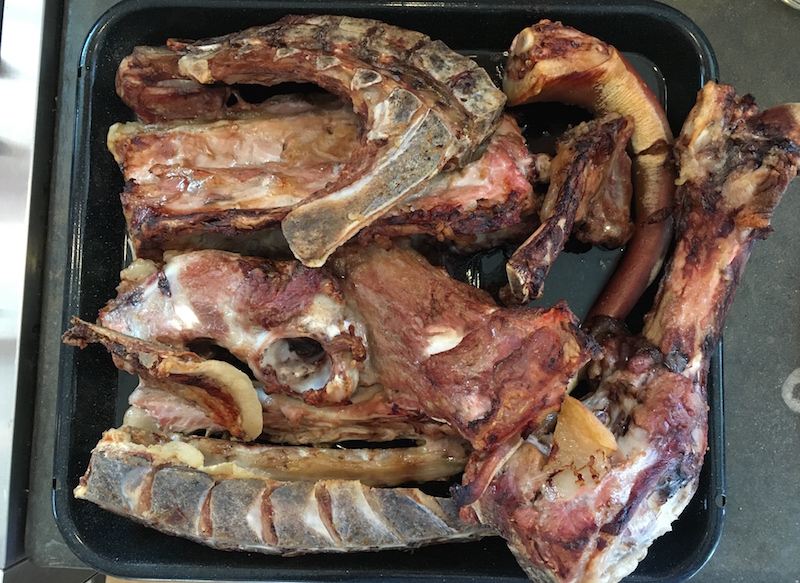
Bones roasted and ready for the pot.

Two hours later we were done, and I was on my way with my pig packed in nice white paper packages in a chest cooler. Of the 125-pound carcass, only the skin, less than five pounds, wasn't used—bones, fat, trim, leaf lard and meat all came home. If you're interested in the particulars, Kendra charges $3.50 per pound for the hanging carcass (after the internal organs are removed); the processing fee I paid to Mt. Angel was $32.50; and Chris's butchering fee was $50.

Just add water!

Frozen immediately after butchering, the meat will last a year, until we buy our next pig. We'll make stock (popularly known as "bone broth") after roasting the bones, and we'll use the leaf lard for baking after it's rendered. The trim meat goes into the grinder along with some of the fat to make bulk sausage, and any remaining fat will be rendered and used in frying and cooking. I call it a pretty darn good deal for a year's worth of very fine eating.

Pork Stock ("Bone Broth")

Bones from half pig, including backbone, tail, etc.
1 large onion, roughly chopped
2 ribs celery, roughly chopped
2 carrots, roughly chopped
2 bay leaves

Preheat oven to 400°.

Thaw bones, if frozen, and place on large sheet roasting pan. Place pan on middle shelf of the oven and roast for 1 hour. Remove from oven and place bones in stock pot big enough to cover bones with water. Add onions, carrots, celery and bay leaves to the pot, then fill the pot with cold water to cover the bones. Bring to a low boil, then reduce heat to lowest setting and simmer for 12 to 24 hours, occasionally removing scum that may rise to the top. Cool and strain. Freeze in containers. Keeps for up to a year.

Tuesday, April 07, 2015

Livin' in the Blurbs: Farm Restaurant, Butchery Classes and Doing Good for Local Kids


That 100-mile diet that was all the rage a few years ago? So passé! At one farm in Oregon's mid-valley you can dine on food that comes from 100 feet away.

In 2003, farmers John Eveland and Sally Brewer of Gathering Together Farm opened what they thought was just going to be a farm stand selling their organically grown produce along with pastries, soups and salads. But demand was so great that they eventually opened for lunch, dinners and Saturday breakfast, hiring Chef J.C. Mersmann and bringing in locally grown meat and products from other neighbors.

They've just opened the restaurant for the spring season, with lunches Tuesday through Friday and dinners Thursday through Saturday. And keep your eyes peeled for their summer wine dinners, which are said to be some of the finest, not to mention freshest, dining available in the state.

Details: Restaurant at Gathering Together Farm. Lunch Tues.-Fri., 11 am-2 pm; Dinner Thurs.-Sat., 5:30-9 pm; Breakfast Sat., 9 am-2 pm. 25159 Grange Hall Rd., Philomath. 541-929-4270.

* * *

There's no better way to understand more about the meat you eat than to take a butchery class, and we're lucky to have several places where you can learn how animals are raised, how to break down a whole carcass and then how to make use of every single part to feed your family. Listed below are three places that have regular butchery classes, teaching everything from how to fillet a fish, to breaking down a chicken or rabbit, to butchering a lamb, goat or pig. Check out their classes online, or take a gander at the calendar on the left. From personal experience, I guarantee it'll be an eye-opening and meaningful, not to mention delicious, way to get closer to your food source.
  • Old Salt Marketplace just released its spring and summer schedule of classes. 5027 NE 42nd Ave. 971-255-0167.
  • Portland Meat Collective has a full lineup of classes for all kinds of butchery. At Elder Hall, 3929 NE MLK Jr. Blvd. 503-347-5540.
  • Portland's Culinary Workshop features butchery classes with a turducken class at the holidays. 807 N Russell St. 503-512-0447.
* * *

Every parent knows how hard it is to keep teenagers interested and engaged during their high school years. It's even harder when kids come from challenging backgrounds. The Portland Kitchen is a free, comprehensive culinary program for urban kids from disadvantaged families, empowering them to graduate high school with job skills and improved eating habits. A friend of the program has pledged to match donations between now and May 15, dollar for dollar up to a total of $25,000, an amount critical for it to move into its third year of serving area youth. If you can, please consider helping them reach their goal.

Monday, December 29, 2014

Why I Butcher My Own Meat


My fascination with butchery began decades ago with the humble chicken, though the exact details of the experience are lost to the mists of time. Was it in college in a fit of DIY enthusiasm? Or when I was living on my own? Or perhaps as a young married person, when I realized that buying a whole chicken was a lot cheaper pound-for-pound than its already-segmented version? In any case, somehow, somewhere, from a live person or on TV, I learned how to cut up a whole chicken into its component parts.

Meeting my meat.

It was a satisfying achievement, much like learning how to change a tire or install a rheostat, one of those things adults (and real cooks) do. Learning to feel the joint in the leg between the thigh and drumstick, that little indentation that, when sliced, cleaves with almost no resistance into two perfect parts. A wonderful skill, both mechanical and edible.

I never had a problem with the "yuck" factor, not being the squeamish sort when it came to blood, though that's rarely a problem with properly slaughtered animals. My decision was reinforced when news came out that the best-quality commercial chickens appeared whole in the butcher case, and that the trays of parts often came from carcasses where some portion of the bird might have been damaged from a defect or mishandling.

Who needs roses?

Butchering a larger animal never occured to me. Growing up, my family was inclined to frequent steakhouses more than hunting blinds, my father not being the outdoorsy type and only going hunting when he felt he couldn't refuse a customer's invitation. My mother wasn't interested in dealing with plucking or cooking whatever game he brought home, since the birds were often peppered with buckshot and she had no clue how to cook deer or elk.

It wasn't until I became a food writer that I felt obliged to follow an animal from its pasture to my plate, and to experience what it means to take the life of a living creature. Recounted in a series of posts called Thinking of Eating, I met a young pig named Roger and watched as he grew up, was killed in his pasture at the farm and then taken to the place where I was going to be taught how to butcher him.

Two-rib chops, anyone?

Under the tutelage of master butcher Melinda Casady (top photo), I was initially overwhelmed and then profoundly amazed as she led me through the process of breaking down a nearly one hundred pound carcass into large, manageable chunks called primals using just a bone saw, knives and some muscle. Like the chicken, there were anatomical clues to dividing the large hunks into the roasts, steaks, ribs and other pieces that would end up in the braising pot, smoker or meat grinder.

A better pot of beans.

One of the best things about it was being able to make my own decisions about how large the roasts should be, whether I wanted lots of chops or if I should leave a chunk for a rib roast—boned or bone-in—plus getting to save all the bones for roasting and making into stock. Even the trotters were saved and tied for throwing into a pot of beans. Talk about snout-to-tail and using every part! It made me feel like I was really getting my money's worth, again much like cutting up my own chicken, making stock from the carcass and picking off the cooked meat for salad, tacos or chicken pot pie.

Happy freezer.

In the years since, I've butchered two other half pigs and a couple of lambs and watched a chef break down a goat. I'm convinced that if you care about how your meat is raised, whether from an ethical, environmental or quality standpoint, there's no better way to guarantee you're getting what you want than to buy it intact and butcher it yourself, especially if you buy direct from a farmer. Not many of us can do this 100 percent of the time, of course, but in my experience, it's cheaper pound-for-pound than buying pieces of similar quality meat at the butcher's counter in the store, and you get so much more for your money.

There are many local farmers who sell sustainably raised (as well as pastured) meat directly to consumers, and it's possible to buy chickens, ducks, pigs, cattle and goats in the local area. Most can supply either whole, half or portions of larger animals, and are happy to refer you to a packing plant that will butcher the animal for you. In the last couple of years Portland meat-eaters have seen several butchers start offering classes that can lead neophytes through the process of butchering. Some of those are listed in the calendar in the left-hand column.

Thursday, June 05, 2014

Ben Meyer: Making Sustainable Meat Accessible


Ever since the first time I met Ben Meyer, I've wanted to write a story about his passion for local food systems. Today you can read my story about him in The Oregonian.

The first thing to note about Ben Meyer is not his polite Midwestern manners, his oh-so-Portland uniform of stocking cap, flannel shirt and scruffy beard or that he's opened two restaurants in what were then—and still are, to some extent—underserved areas of the city. It's not even that he's been interviewed by the likes of Forbes and the Wall Street Journal wanting to hear about the local pasture-raised beef and pork he features on his menus and in the butcher case.

The key to Meyer is that this evangelist for whole animal butchery, whose walk-in is chock-full of large cuts of dry-aged beef, some as old as 80 days, spent 10 years as a vegan. Growing up in northern Indiana, he said all he knew was industrial agriculture.

"I grew up surrounded by hogs and soy and corn in the Midwest—northeastern Indiana—and basically saw nothing but factory farms, never thought there was anything different," he said.

Already politically active, he became a vegan because he didn't want to support a food system he saw as intrinsically unhealthy for himself, the environment or society. A move to an organic farm on the lush agricultural land of Washington's Vashon Island was eye-opening, and his preconceived notion of what a healthy food system looked like was blown out of the water.

Read the rest of the article, titled "At Old Salt Marketplace, chef Ben Meyer makes whole animal butchery his primary mission," to find out what turned Meyer from a full-time vegan to an evangelist for sustainable, accessible local food systems.

Tuesday, February 11, 2014

A Pig Named Roger: Learning to Butcher


Two years ago I met a pig named Roger. This is the second in a series of three videos that was filmed at that time. Here are the initial paragraphs of my post about the butchering.

I arrived at Portland's Culinary Workshop (PCW), where I would be butchering my half of Roger, about thirty minutes before Clare was to arrive with him and her half of Don. I walked in to find the tables set up for the butchering along with the various knives and saws we'd be using to do the job. In the spirit of the day, there were also two tubs set up to hold the butchered meat, one labeled "Roger" and the other, "Don."

A hands-on cooking school started by my neighbor, Susana Holloway, and her friend, Melinda Casady (left), both former culinary school instructors, PCW seemed the perfect place for this part of the process. Especially because Melinda, nicknamed "The Mistress of Meat," loves to teach people how to cut up whole animals or, to use the term of art, "break down" carcasses.

The halves of Roger and Don had been hanging in Clare's shed at the farm to chill overnight, and when she drove up they were cool as cucumbers, wrapped in plastic sheeting in the back of her truck. She'd stopped at a friend's winery on the way in and weighed the halves, with my half of Roger coming in at 96 pounds, making his live weight close to 320 pounds. Quite the pig.

Read the rest of the post at: Thinking of Eating: The Meat of the Matter.

Watch the other video in the series, Getting to Know My Food and Celebrating a Life Given.

Monday, May 21, 2012

Master of Meat: Dario Cecchini


My profile of storied Italian butcher Dario Cecchini and his recent trip to Portland appears in this week's FoodDay section of the Oregonian.

Cecchini said of this shot, "Two pig."

There was so much to this story that I couldn't squeeze into the article, so I hope to post about it in the future. But for now, you can read what I think of as Part One: "Portland Butchers Learn from an Italian Master of the Craft."

Sunday, October 02, 2011

Thinking of Eating: The Meat of the Matter


I arrived at Portland's Culinary Workshop (PCW), where I would be butchering my half of Roger, about thirty minutes before Clare was to arrive with him and her half of Don. I walked in to find the tables set up for the butchering along with the various knives and saws we'd be using to do the job. In the spirit of the day, there were also two tubs set up to hold the butchered meat, one labeled "Roger" and the other, "Don."

Melinda Casady, Mistress of Meat.

A hands-on cooking school started by my neighbor, Susana Holloway, and her friend, Melinda Casady (left), both former culinary school instructors, PCW seemed the perfect place for this part of the process. Especially because Melinda, nicknamed "The Mistress of Meat," loves to teach people how to cut up whole animals or, to use the term of art, "break down" carcasses.

Roger's tub.

The halves of Roger and Don had been hanging in Clare's shed at the farm to chill overnight, and when she drove up they were cool as cucumbers, wrapped in plastic sheeting in the back of her truck. She'd stopped at a friend's winery on the way in and weighed the halves, with my half of Roger coming in at 96 pounds, making his live weight close to 320 pounds. Quite the pig.

Just getting started.

We carried the carcasses in and laid them on the tables—end to end it was about five feet of pig to cut up—and Melinda discussed with each of us the different ways we could cut up our pig. Did we want lots of chops and steaks? Or would we rather have more roasts? Big or small? Bone in or out? What about the ribs? Did we want whole racks?

Can't wait to throw these on the grill!

Some decisions were easy…we're more roast types than steaks, but a nice chop is good once in awhile, too. Some decisions we left until we saw what the actual cuts were like, made easier because the breaking down involves cutting the animal into large sections called primals, then sectioning each primal into smaller and smaller pieces. It also involves finding and cutting out glands and other non-edible bits, and I was glad for Melinda's expertise with that particular chore.

I gotta get me a hacksaw.

There was very little waste, even from a pig that big, since I was planning on making stock from the bones and making sausage with the inevitable collection of scraps of meat and fat. While I was secretly relieved that I'd decided not to keep the head because it would be too recognizable as Roger, I was also a little sad I wouldn't get to make scrapple again.

Getting a little rummy.

While I won't go into the blow-by-blow on breaking down a carcass, it was fascinating to see how much a pig's anatomy resembled our own, and how the different joints are connected. Emotionally it wasn't hard to do, probably because the carcass didn't look like Roger any more (the head thing again), and I was focusing on the job at hand, trying not to slice myself up in the process. It was all kind of geeky in a messy, sweaty sort of way and as we got down to the last few cuts, after four hours or so of work, I was getting really exhausted.

Wrapped and ready.

When the wrapping and packaging were finally done, we opened beers and a bottle of wine and toasted, first, Roger and Don for the wonderful meals they'd provide, then ourselves and Melinda for a job well done. Roger is now resting comfortably in our freezer, and I can't wait to have our first dinner featuring him.

Read the other posts in this series: Roger and Me, Roger Grows Up, Saying Goodbye, The Day Finally Comes and Pasture to Plate.

Tuesday, March 29, 2011

Class Cut-Up


When my neighbor Susana first announced that she and a friend were going to start a cooking school, I was understandably excited. After all, both women are professional chefs with years of experience teaching at two of Portland's best culinary schools. Knowing them, I expected they'd offer a bit more than the run-of-the-mill, watch-and-nosh classes you find locally, maybe even allowing folks to (gasp) actually get their hands dirty.

I should have known better.

In their first month of operation the newly launched Portland's Culinary Workshop offered classes on sushi, Brazilian cuisine, knife skills, Asian dumplings, how to break down a chicken, making meals with raw foods, making baby food, pastas and sauces, as well as butchering pig and lamb. And that's just for starters. These gals are bent on having fun with class titles like "Mind Your Meat Mistress," "Gettin' Saucy in the Kitchen" and "Sexy Couples Class." With side trips that include watching your instructor debone a chicken. Blindfolded. How cool is that?

Melinda Casady (top photo), the mistress in the title of the meat class and no slouch with a meat saw, led a recent class on breaking down a whole lamb into its component parts. I was a little disappointed it came without the head on (upper left), but when Melinda had us grab knives and hack saws and have a go at the carcass (taking turns, of course), I was all in (right).

In approximately 90 minutes we had dismembered…I mean butchered…the entire lamb (left), learning how to debone the leg roasts, whack some fine shanks, pare out the ribs into lovely lamby lollipops and save all the meaty scraps for ground lamb and stew.

Not bad for a couple of hours on a Saturday, especially considering we got to divvy up the meat we'd just butchered and bring it home for some mighty fine eating (and bragging).

Details: Portland's Culinary Workshop, 807 N Russell St. 503-512-0447.