
Showing posts with label Food Farmer Earth. Show all posts
Showing posts with label Food Farmer Earth. Show all posts
Thursday, July 14, 2016
Oregon Dairy Farmer Tells Why He Went Organic
This is the story of Jon Bansen, a dairy farmer in Monmouth, Oregon, who grew up on the land his family had farmed for generations. In this short film by documentary filmmakers Rebecca and Fred Gerendasy of Cooking Up a Story, Bansen explains why he decided to transition from conventional agriculture, with what he calls its "lotions and potions," to farming and raising his dairy cows using organic methods.
He explains that, ironically, it's the way his grandfather farmed before the industry was taken over by big chemical companies. "That's the wonderful thing about organics," he says in the film. "It's about bringing biology back to our food instead of being about industry."
Watch part one of Bansen's story, "Organic Dairyman: A Family Tradition," and part three, "Birdhouses: Using Nature to Control a Farm Pest."

Tuesday, February 18, 2014
A Pig Named Roger: Celebrating a Life Given
Two years ago I met a pig named Roger. This is the last in a series of three videos that was filmed at that time. Here are the initial paragraphs of my post about the meal that celebrated his life.
The very first post in this series started with a question: Can I eat an animal I've played tag with?
At first it was merely an interesting notion. I'd buy half a pig from my friend Clare at Big Table Farm, something I'd been wanting to do for some time. But I didn't want to simply wait for the time, some months hence, when she'd call to say my half was butchered and ready to pick up from the packing house. I wanted to meet this pig named Roger, and trace his life from his pasture to my plate.

Roasted bones for stock.
I didn't have an agenda in mind. This wouldn't be an attempt to follow the already well-trodden path of other food writers like Michael Pollan or Barbara Kingsolver. I didn't want to hammer home points about whatever-vores, 100-mile diets or the evils of corporate agriculture. It was simply a documentation of my experience, with no expectations of a major life change ("I'll never be able to look a pork chop in the eye again…") or revelation ("Roger came to me in a dream one night…").
Read the rest of the post, Thinking of Eating: Pasture to Plate.
Watch the other videos in the series, Getting to Know My Food and Learning to Butcher.
Tuesday, February 11, 2014
A Pig Named Roger: Learning to Butcher
Two years ago I met a pig named Roger. This is the second in a series of three videos that was filmed at that time. Here are the initial paragraphs of my post about the butchering.
I arrived at Portland's Culinary Workshop (PCW), where I would be butchering my half of Roger, about thirty minutes before Clare was to arrive with him and her half of Don. I walked in to find the tables set up for the butchering along with the various knives and saws we'd be using to do the job. In the spirit of the day, there were also two tubs set up to hold the butchered meat, one labeled "Roger" and the other, "Don."


Read the rest of the post at: Thinking of Eating: The Meat of the Matter.
Watch the other video in the series, Getting to Know My Food and Celebrating a Life Given.
Tuesday, February 04, 2014
A Pig Named Roger: Getting to Know My Food
Two years ago I met a pig named Roger. This is the first in a series of three videos that was filmed at that time. Here are the initial paragraphs of my first post about the project.
Can I eat an animal I've played tag with?
It's a question I've been struggling with since committing to buy half a pig from my friend Clare Carver at Big Table Farm. Twice a year for the last several years, Clare has bought two organically-certified weaner pigs from her friends Amy Benson and Chris Roehm at Square Peg Farm, and I'd promised myself that someday I'd get one.
This spring she got two Berkshire Cross pigs, a heritage breed known to thrive on pasture and whose meat is darker and far more flavorful than store-bought. Named Don and Roger after two of the main characters from the TV series Madmen, they're being raised inside an electrified tape corral on grass pasture. The corral is moved every few weeks in a process called rotational grazing, an especially good idea since young pigs like to root around, roll and generally tear up the ground. Their diet consists of grass, organic grain, occasional treats of the farm's organic eggs and scraps and vegetable trimmings from the kitchen.
Clare doesn't believe in moving her animals off the farm for slaughter because of the stress it puts on them and the effect that can have on the quality of the meat (see previous story here). So when Don and Roger reach 270 pounds or so they'll be killed in their pasture on the farm.
Read the rest of the post at: Thinking of Eating: Roger and Me.
Watch the other videos in the series, Learning to Butcher and Celebrating a Life Given.
Wednesday, March 13, 2013
Food Farmer Earth: Hydroponics + Aquaculture = Aquaponics
In my interview for Food Farmer Earth with Ann Forsthoefel of Aqua Annie, she explains why growing plants and fish together is a sensible way to produce food.
Growing up, Ann Forsthoefel’s family owned a small, three-acre parcel of land that supplied most of the family’s food. She joked that her mother invented permaculture, the au courant term for caring for the land and the animals, insects and plants that live on it, because it was the only way she knew how to farm in the days before corporate agriculture took over the food system.
Now, her home on a standard city lot in Portland has more raised beds and chicken runs than lawn, and she started a CSA (community supported agriculture) for her neighbors during the growing season. There’s also the burbling sound of water, but instead of a typical backyard water feature, it was coming from structures filled with flourishing plants fed by water pumped from nearby fish tanks, even on a cold day in late winter.
It’s obvious she’s excited by aquaponics, the growing of plants fed by nutrients from fish, which in turn provide a source of food when they reach maturity.
“There are so few inputs compared to growing crops in the soil,” she said. With her gardens, she’s constantly building up the soil that is depleted at the end of each growing season. The beauty of aquaponics, she said, is that there isn’t that constant work because the fish are giving nutrients to the plants.
Read the rest of the article.
This week's kitchen segment, naturally enough, is a recipe for Southern Fried Catfish and Hushpuppies. To get regular updates on local producers featured on Food Farmer Earth, consider a free subscription.
Thursday, March 07, 2013
Food Farmer Earth: Winter's Cold Sweetens Crops
Part two of my interview for Food Farmer Earth with Tom DeNoble of DeNoble's Farm Fresh Produce answers the question of why so many vegetables seem to taste sweeter in the winter months. Turns out there's a scientific explanation…thank goodness it wasn't all just in my head!
Watch part one, Winter Farming Bitter and Sweet.
In this week's kitchen segment, author and teacher Diane Morgan makes an easy and delicious recipe, Microbrew-Braised Rutabagas. To get regular updates on local producers featured on Food Farmer Earth, consider a free subscription.
Wednesday, March 06, 2013
Food Farmer Earth: Winter Farming Bitter & Sweet
My interview for Food Farmer Earth with Tom DeNoble of DeNoble's Farm Fresh Produce was a real privilege. I've wanted to do a story about what it takes to farm in winter, and I knew Tom would tell it like it is.
When it comes to farming through the winter months, Tom DeNoble of DeNoble’s Farm Fresh Produce in Tillamook is no romantic.
“Winter farming is a big gamble,” he said. “It’s like rolling the dice every year.”
But give him a choice between a height-of-summer carrot and one pulled out of the ground in January, and it’s no contest. He’ll choose the winter carrot every time. According to him, the quality of winter vegetables is just as good or even better than in the summer, though they may not be quite as pretty.
That’s because cold temperatures cause the plants to produce sugars that act as antifreeze, making them taste sweeter. And because they’re also growing more slowly, they develop more intense flavors.
Read the rest of the interview.
Watch part two, Winter's Cold Sweetens Crops. In this week's kitchen segment, author and teacher Diane Morgan makes an easy and delicious recipe, Microbrew-Braised Rutabagas. To get regular updates on local producers featured on Food Farmer Earth, consider a free subscription.
Thursday, February 28, 2013
Food Farmer Earth: Hash Around the World
In part two of my interview for Food Farmer Earth with Clark Haass of Hashcapades, he talks about the history of hash, and what makes it such a ubiquitous dish.
Watch part one of this interview, Hash + Escapade = Hashcapade. In this week's kitchen segment, the multi-talented Michele Knaus shares her recipe for a classic Red Flannel Hash with Corned Beef. To get regular updates on local producers featured on Food Farmer Earth, consider a free subscription.
Wednesday, February 27, 2013
Food Farmer Earth: Hash + Escapade = Hashcapade!
I was drooling all over myself doing this interview with Clark Haass for Food Farmer Earth, not just because he's bright, handsome and well-spoken, but because the dude can (and did) whip up a mighty fine plate of hash.
Clark Haass is bent on world domination, but not in the evil-overlord, bwa-ha-ha sense. He wants to bring the world to the table over a heaping plate of hash.

It may have something to do with growing up in a family of six kids, where his mom took a break during the summer to go to art school, leaving his dad in charge of the tribe. Clark became known for what he called his “gourmet cinnamon toast,” recalling that later on his dad also taught him to cut up a chicken and make dinner.

Of his first efforts, he said, “It was good but it didn’t have the right combination of spices.” Single-mindedly, he kept working at it, substituting smoked salmon for the trout and adding crême fraiche, dill and half sweet potatoes, half white potatoes to achieve the the dish he’d imagined.
Read the rest of the story.
Watch part two of this interview, Hash Around the World. In this week's kitchen segment, the multi-talented Michele Knaus shares her recipe for a classic Red Flannel Hash with Corned Beef. To get regular updates on local producers featured on Food Farmer Earth, consider a free subscription.
Thursday, January 31, 2013
Food Farmer Earth: Teaching From the Source
"We're two generations removed from stay-at-home moms. We don't have home economics in schools any more. Where do people learn to cook?" Kathryn LaSusa-Yeomans asks.
Her answer, as she explains in my interview with her for Food Farmer Earth, was to start a business she calls The Farmer's Feast, teaching free cooking classes at area farmers' markets.
Watch part one of the interview, Anatomy of a Pop-up Restaurant. In this week's kitchen segment, Kathryn shows how incredibly simple it is to make a basic risotto. To get regular updates on local producers featured on Food Farmer Earth, consider a free subscription.
Wednesday, January 30, 2013
Food Farmer Earth: Anatomy of a Pop-up Restaurant
In this interview for Food Farmer Earth, I talk with Kathryn LaSusa-Yeomans of The Farmer's Feast, who dissects the elements that go into making her incredibly successful pop-up restaurant experiences.
“What’s a pop-up?”
It’s the question that Kathryn LaSusa Yeomans gets asked the most about her recent venture. A seasoned chef who early in her career trained with the likes of Lidia Bastianich and Diana Kennedy, Yeomans worked in restaurants in her home state of New York and in her adopted home in Portland, Oregon.
At a certain point, though, she needed to break free of the constraints of restaurant kitchens to pursue her dream of teaching people to cook using market-fresh, seasonal ingredients. With the birth of her own company, The Farmer’s Feast, she started doing cooking classes at area farmers’ markets, as well as for Roger Konka’s Springwater Farm, demonstrating how to cook with his foraged greens and mushrooms.
It was Konka who first suggested selling food as well as doing demonstrations, and it wasn’t long before there was talk of holding dinners for their growing throng of fans. They’d been renting space in a local restaurant for their commissary kitchen, and the owner was enthusiastic about having them use the place for dinners on nights when the restaurant was closed.
Read the rest of the article.
Watch part two of the interview with Kathryn, Teaching From the Source. In this week's kitchen segment, Kathryn shows how incredibly simple it is to make a basic risotto. To get regular updates on local producers featured on Food Farmer Earth, consider a free subscription.
Wednesday, January 16, 2013
Food Farmer Earth: Making Raven & Rose
In my interview for Food Farmer Earth with Lisa Mygrant, she relates her journey from a home where fresh food played a central role to starting her own restaurant where sustainably raised, local ingredients are a prominent feature.
Lisa Mygrant admits that buying a 7,000 square foot, high-profile historic building in the center of downtown Portland was a larger project than she’d envisioned for her first restaurant.
“Terrifying,” she said when asked how it felt when the deal went through. “But really exciting. It was an amazing opportunity and such a special building.”

She described the menu for Raven and Rose as “American farmhouse cooking with a nod to the British Isles.” The goal for the kitchen and the bar would be to source ingredients as much as possible from local and sustainable sources.
“It’s really important for us to have direct relationships with farmers,” she said, emphasizing that it isn’t a marketing angle but something she feels passionately about because of the way she was raised.
Read the rest of the article.
In part two of this interview, Mygrant explains why sustainability and buying from local suppliers is at the foundation of her restaurant. Get an easy recipe for Ham and Cheese Sandwich with Ale-Braised Onions from Raven and Rose chef David Padberg, then get tips from master bartender Dave Shenaut on "How to Make an Irish Coffee." To get regular updates on local producers featured on Food Farmer Earth, consider a free subscription.
Thursday, December 27, 2012
Food Farmer Earth: Whiskeys, Brandies, Liqueurs
In part two of my interview for Food Farmer Earth with distiller Sebastian Degens of Stone Barn Brandyworks, he describes the different distillation processes he uses to make his signature whiskeys, brandies and liqueurs.
Watch part one of this interview, "Distilling the Essence of Fruit." Get tips from Raven and Rose master bartender Dave Shenaut on "How to Make an Irish Coffee." To get regular updates on local producers featured on Food Farmer Earth, consider a free subscription.
Food Farmer Earth: Distilling the Essence of Fruit
In this interview for Food Farmer Earth, I spoke with distiller Sebastian Degens of Stone Barn Brandyworks to find out how he makes his amazing brandies, whiskeys and fruit liqueurs.
“Yeast never sleeps,” said Sebastian Degens. Which is a good thing, since Degens and his wife, Erika, depend on it to ferment the fruit and grain mashes they distill at their Stone Barn Brandyworks in Portland, Oregon.
As a child, Degens grew up in Germany with distilled spirits like eau de vie and schnapps in the house. He eventually moved to the United States, getting interested in trying to make his own spirits when a Swiss friend, who’d grown up with similar European spirits, mentioned a desire to learn how they were made.
Their research led Degens to attend a three-day intensive workshop in Chicago at Kothe Distilling Technologies, a manufacturer of stills. On returning home, he and Erika started bicycling around various neighborhoods, looking for a small, affordable place that had enough room for the equipment they’d need to start their business.
Read the rest of the article.
Watch the second part of my interview with Degens, "The World of Distilled Spirits." Get tips from Raven and Rose master bartender Dave Shenaut on "How to Make an Irish Coffee." To get regular updates on local producers featured on Food Farmer Earth, consider a free subscription.
Wednesday, December 19, 2012
Food Farmer Earth: An American Baker in Portland
In this interview for Food Farmer Earth, Tim Healea explains how his little t american baker got its name, and says that even after baking tens of thousands of loaves, the magic of bread still bowls him over.
Tim Healea, renowned for the quality of the breads that he makes at his little t american baker in Portland, Oregon, said he never dreamed he’d have a career in the food business, much less own his own bakery. As a matter of fact, he calls his discovery of his passion for bread a complete accident.

Growing up the Pacific Northwest, Healea had always wanted to work in the magazine business. So when he graduated from college with a degree in journalism, he went to work at a magazine in New York City.
“I started as an editor for a trade publisher that did magazines for restaurants and retail,” he said. “And I hated it. It was a corporate desk job and it just wasn’t me.”

The finished product.
Thinking he might prefer working with food, he quit the magazine to give culinary school a try. It was there that he ran across "Breads from the La Brea Bakery," Nancy Silverton’s landmark book on artisan bread. He started baking using her recipes and fell in love.
Read the rest of Tim's story.
This week's recipe is for an easy holiday soda bread. Get regular updates on this series about our local food scene by subscribing.
Thursday, November 29, 2012
Food Farmer Earth: Growing Healthy Kids
Childhood obesity, diabetes and other health problems can seem intractable when presented as numbers in a news story. But a visit to a local child care center that is educating kids and families about healthy diets and local foods shows a different perspective. My interview for Food Farmer Earth explains how big changes can come from small gestures…like a phone call.
Head Start began as an eight-week demonstration project in 1965 to help break the cycle of poverty, providing preschool children of low-income families with a comprehensive program to meet their emotional, social, health, nutritional and psychological needs. Since then it has become the nation’s largest federally funded early child care and education program for children zero to five years old.
Good nutrition has always been a focus of the program, but many of the children in Head Start programs don’t have access to fresh, local foods at home. Discussing this fact a couple of years ago, Dr. Betty Izumi of Portland State University and Dawn Barberis of Mt. Hood Community College’s Head Start program came up with the idea for the Harvest for Healthy Kids project.
Based on farm-to-school food programs that were being piloted around the country, it would not only bring healthier foods into the Head Start food service program, it would educate children about fresh fruits and vegetables by engaging the children in activities centered around a featured food.
One recent week the featured vegetable was carrots.
“The children are cooking with carrots and doing carrot art activities,” said Dr. Izumi. “They’re reading books about carrots and gardening and doing planting activities. The program is unique in that the featured food is really being integrated into the rhythm of the Head Start day.”
Read the rest of the article.
Learn more about the farmer who grows vegetables for Harvest for Healthy Kids in Growing Carrots: Red, Yellow, Purple and Orange. This week's recipe is for easy Rutabaga Carrot Ginger Soup. Get regular updates on this series about our local food scene by subscribing.
Tuesday, November 20, 2012
Food Farmer Earth: Time for Wine!
Normally I only post videos from Food Farmer Earth if I've worked on them, but in this case I have to make an exception for an incredibly informative video with, dare I say it, a potentially breakout performance starring my brother, Bruce Bauer, of Portland's best wine shop, Vino, on SE 28th. (Though I may be just a teensy bit biased.)
Enjoy!
Thursday, November 08, 2012
Food Farmer Earth: Meditation on Winter Fields
GoodStuffNW contributor Anthony Boutard's lyrical, thoughtful writing is based on years of observation, noting and photographing the effects of weather and season on his land.

Watch part one, A Farmer's Sensibility.
Get this week's recipe for easy street-style enchiladas with adobo sauce. Get regular updates on this series about our local food scene by subscribing.
Photo by Anthony Boutard.
Food Farmer Earth: A Farmer's Sensibility
In my interview for FoodFarmerEarth with Gaston farmer—and GoodStuffNW contributor—Anthony Boutard, he allows as how farming, for him, isn't just crop yields and calculations. There's also a place for whimsy, experimentation and even an aesthetic sensibility.
 The son of a renowned Massachusetts botanist, Anthony Boutard was raised with the rich aromas of the earth and an appreciation for the changes in the natural world that come with the turning of the seasons. Educated as a forester, he came out West to work with a new organization, 1000 Friends of Oregon, dedicated to preserving a balance between urban and rural life.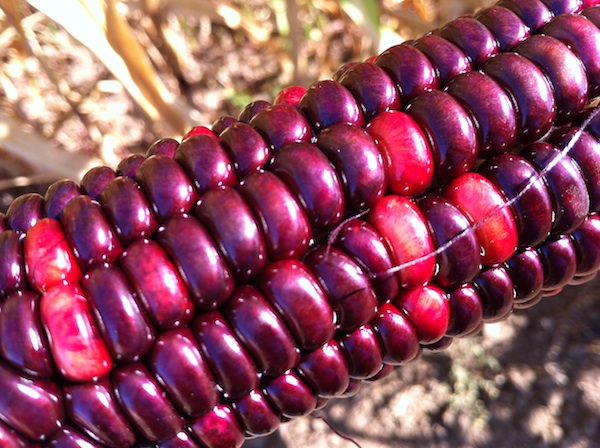
“If you’ve got one and a half million people who are potential customers, it makes it a little more workable than if you were 350 miles away,” he said of their choice, adding that it wasn’t all cold calculation. “It just had a good feel to it.”
Read the rest of Anthony's story.
Watch part two of this interview, Meditation on Winter Fields. This week's recipe is for easy street-style enchiladas with adobo sauce. Get regular updates on this series about our local food scene by subscribing.
Thursday, October 25, 2012
Food Farmer Earth: A Basque Pepper Primer
In this interview for Food Farmer Earth, I get the deets on the dizzying array of Basque peppers that Manuel Recio grows at Viridian Farms in Grand Island. He and his wife, Leslie Lukas-Recio, sell many of these mostly sweet members of the capsicum family at their stall at the Portland Farmers' Market at PSU, but you can also find them on the menus of A-list restaurants around the country.
Watch the first part of this interview, A Passion for Peppers. This week's recipe is for easy homemade tamales. You can get regular updates on this series about our local food scene by subscribing.
Subscribe to:
Posts (Atom)


 Posts
Posts

