Showing posts with label Big Table Farm. Show all posts

Friday, September 15, 2017

Setting a Big Table: Oregon Wine Comes of Age


In a recent edition of the New York Times, wine editor Eric Asimov waxes poetic about Oregon wine, saying that "Oregon is right now the single most exciting winemaking area in the United States," that "nowhere else does the level of quality seem so high, the perspectives so diverse or the experimentation so fierce as it is in Oregon right now." He goes on to extoll several of our best winemakers, especially Brian Marcy and Clare Carver of Big Table Farm. Here's an article I wrote about them seven years ago. Nice that Mr. Asimov has caught up!

* * *

Clementine, the Catahoula leopard hound, has been anxious since dawn, not wanting to be too far from her owner, Clare Carver of Big Table Farm. Clare has been moody for the last couple of days. Even Clare’s husband, Brian, has been giving his wife a wide berth. When Clare goes up to the hill pasture to sit with her pigs, Picnic and Pancake, Clementine stations herself with a good view of the road. She knows something is coming, something that is making Clare sad, and she wants to be ready.

Clare Carver sits in the pen with her pigs, scratching their backs when they lean their 300-pound bodies against her, snorting and squinting in the bright sunlight. Like a couple of big dogs, they dash off to play with each other or to chase something in the bushes or to root through the grass in the pasture, but eventually they come back to get more attention from Clare. She's raised them from tiny weaner pigs, and today is their last day.

An inspired painter whose subjects are the cows, horses, chickens, goats, pigs, old trucks and tractors that populate the farm she owns with her husband, Brian Marcy, in Williams Canyon outside Gaston, Oregon,she also has a large vegetable garden that supplies most of the couple’s food and the large farm dinners they host for people who buy the wines Brian makes under the Big Table Farm label.

Growing up in a large Catholic family (she has eight brothers and sisters), Clare heard stories about the farm in upstate New York that her parents had bought in the late 50s. They sold the farm when Clare was seven and moved their large family to the suburbs of Valley Forge, Pennsylvania.

She carried those tales of the farm with her into her career as an advertising art director for an East Coast ad agency, and one day a consultant for the agency told her, “You need to go out and see the world. You shouldn’t be doing this because your life is going to look exactly the same in ten years as it does now.”


“It was a complete wake-up call,” Clare said. She sold all her belongings and moved to San Francisco to start her own business. Shortly after the move she began dating Brian, who was transitioning to making wine after working for several years as a beer brewer.

“With beer, the whole goal is to take varying inputs and make the same product year in and year out without considering season or ingredients,” she said. “In wine it’s just the opposite, where people expect the product to be affected by season and ingredients. It felt more creative to him.”

Their move to Oregon was prompted, oddly enough, by a season spent harvesting grapes in Australia.

“It was a really romantic time for us and we started looking around at the land,” she said. “Honestly, that was the first time it started to creep into our consciousness that we could have a farm as well as have a winery.”

Their requirements for their farm were fairly simple: It had to be within an hour of a big city so Clare could continue her graphic design business, it needed to be located in a wine-producing area so Brian could be a consulting winemaker while developing their vineyard and, of course, it had to be within their budget.

The farm they found in 2006 fit their list to a T: Close to Portland, it was in the middle of a burgeoning wine region. It had perfect southeast facing hills and a charming Victorian farmhouse. Their bid was accepted.

“We didn’t really know anything about farming, and we read ‘The Omnivore’s Dilemma’ by Michael Pollan when we were closing on the property,” Clare said. “It totally changed the way we thought we were going to set up our farm.”

While the book is mostly about what Pollan believes is the broken food system in the United States, where people are disconnected from the sources of their food, he also writes about a visit to Polyface Farm in the Shenandoah Valley and farmer Joel Salatin. Salatin calls himself a “grass farmer” and believes in rotating the animals on the land to keep the soil and the plants, and thus the people who eat the animals and plants, healthy.

With Salatin’s principles in mind, they’re transforming the nearly ruined hillsides and pastures of their Big Table Farm to an organic, balanced system. Brian made a trailer, called the “chicken bus,” to transport their laying chickens from one area to the next. Goats clear blackberries and scrub, watched over by a “guard llama” who challenges any predators who get too close. The cows, pigs and Clare’s beloved draft horses are confined by electrified tape that can be easily moved when the pasture needs a break from grazing.

When Salatain made a trip to Oregon, she asked him about organic feed, an important part of the system at their farm.

Salatin’s answer? “People can handle nudists and they can handle Buddhists, but they can’t handle nudist Buddhists.

“What he was saying is that people can handle the concept of pasture, they can get their head around that. But when you start talking about pasture and then you start talking about organic feed, they hold their heads and scream.”

She told Salatin that while that might be the case in his home state of Virginia, she felt that Northwesterners were able to handle that kind of information. Like the fact that she flat out refuses to send any of her animals to processing facilities to be slaughtered.

“The primary reason is because of the stress on the animal,” she said. “The stress and the adrenaline that goes through the animal changes the meat, and there’s hard science behind that.”

Take pigs, she said. They’re very smart and sensitive, so when they’re put into a truck for the first time in their life, it’s terribly stressful. And a pig’s sense of smell is even keener than a dog’s.

“Can you imagine what a processing center smells like to a pig?” she asked. “It makes my hair stand up just to think about it. Those poor animals.”

Because strict federal regulations require any meat that is sold to the public has to be processed in a USDA-approved facility, the meat from her pasture-slaughtered pigs can’t be sold in supermarkets or at farmers' markets. This is despite the growing demand for just the kind of pasture-raised meat she and other small-scale farmers in the region are producing.

With small processing plants closing down because of the recession, it’s hard for small producers to get their animals into larger slaughter facilities. With just a handful of USDA-approved mobile slaughter trucks in the entire Northwest, there isn’t one available for Clare’s farm.

Which brings us back to Clementine standing watch and Clare waiting with her pigs in their hillside pasture. When the truck from Frontier Custom Cutting finally pulls into the driveway in the late morning, Clemmie starts barking. She won’t stop until it leaves.

Richard, a burly man wearing orange rubber overalls and carrying a black rifle, walks up the hill. While Clare distracts Picnic with some fresh eggs, Richard puts the rifle behind Pancake’s ear and pulls the trigger. Then he walks over to Picnic munching on her egg and does the same.

Clare feels it’s the most respectful way to kill them.

“The bullet goes right to the spinal cord, but their heart is still pumping, so they’re essentially brain dead,” she said. “It’s a little violent but it doesn’t last very long. That part is the part I hate to watch, but dying is dying and it’s not pretty. It is what it is.

“I really hope when it’s my time I get afforded a respectful, quick death,” she added. “That’s what I would want. So I do the best I can for my animals in that sense.”

And each time she allows herself to feel the loss.

“It’s the way you feel when a human dies. They’re gone…really gone,” she said. ”I go out to their pasture the next day and I’m like, oh, they’re gone. It’s a reminder of how much power we have and how careful we have to be of that power, that we just created and took this life.

An observer could note that, in the way they run their farm and raise their animals, she and Brian haven’t chosen an easy route. And, like the move to Oregon and buying the land, it’s all been done without a business plan.

“If we had a business plan some things might be smoother for us,” Clare said. “But, like anything in life, it’s like, ‘Well, I’m going up that hill and maybe I’m not going to take the straightest path. But maybe I’m going to see some things I didn’t expect if I don’t have an exact map of how I’m going to get there.

“Sure, if we had a business plan we might get to the top of the hill faster,” she continued, “but we’re still going up there because we have the same goals and that hasn’t changed. Or if it does, we talk about it and we change it together.”

Asked about the best part of their lives on Big Table Farm, she thought for a moment, then answered.

“Almost every morning when I do chores I look around and this incredibly deep sense of satisfaction strikes me,” she said. “Being deeply happy with this path we’re on now.”

Top photo by Amanda Lucier for the New York Times.

Sunday, November 17, 2013

Stewing Hen Comes Home to Roost


It was a few months ago that I picked up the beef I'd ordered from Clare at Big Table Farm. She was reorganizing the white-wrapped chunks of meat in her freezer and said, "Here, take this, too." It was a vacuum-packed stewing hen, one of the laying hens that had been culled from the farm's free-ranging flock.

I brought it home with the beef and put it all away in the freezer. It would be there whenever I opened the door, and I'd think, "I should really do something with that." Then I'd grab the loaf of bread or jar of freezer jam or piece of lamb or pork or beef I'd come for and shut the door on that poor hen, forgetting about her until the next time the freezer door would open.

Last week I retrieved a roast from the icy depths and grabbed the hen, too, knowing that thawing the bird would force me to deal with it. I'd read that stewing hens were literally tough old birds and were best when braised over low, slow heat. Plus they were rumored to produce a flavorful broth, which we go through like water around here, especially in the winter months.

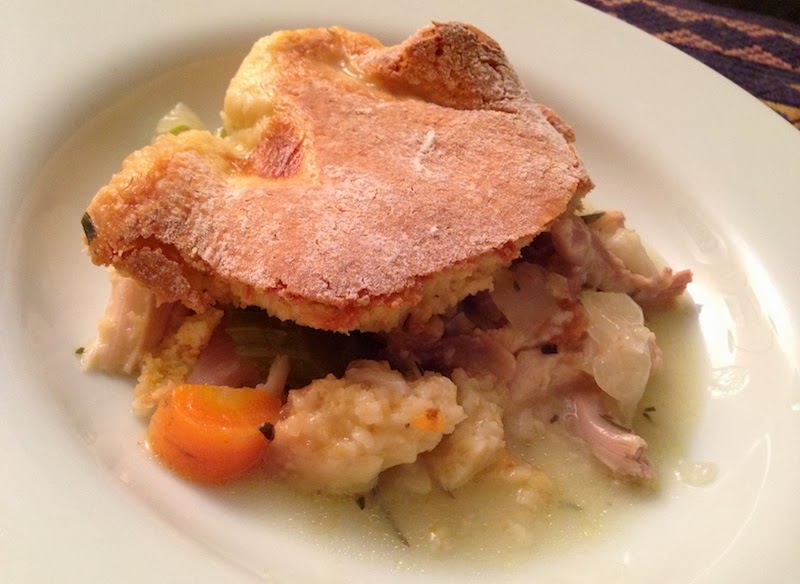
My plan became to make a stock from the whole chicken, then tear the meat off the bones when it was done and make one of my very favorite comfort foods, a golden-crusted chicken pot pie. A couple of hours later the house was filled with the aroma of chicken stock and baking pastry, and I knew my first experience with an old hen wouldn't be my last.

Chicken Pot Pie

For the stock:
1 stewing hen
Water

For the filling:
2 Tbsp. olive oil
1 onion, chopped into 1/4" dice
3 cloves garlic, minced fine
3 carrots, quartered and cut into 1/4" slices
3 stalks celery, cut into 1/4" slices
1 c. peas (optional)
2 Tbsp. butter or margarine
2 Tbsp. flour
2 1/2 c. chicken stock
Meat from stewing hen (above) or 3 c. cooked chicken
Salt to taste

For the crust:
1 1/2 c. flour, plus more for rolling out dough

1 c. cornmeal

1 1/2 tsp. baking powder
1/4 tsp. baking soda
1 tsp. salt
4 Tbsp. (1/2 stick) butter or margarine, frozen, cut into large pieces
1 egg, beaten

3/4 c. buttermilk or milk

Preheat oven to 450°.

Place whole chicken in large pot and cover with water. Bring to just boiling over high heat, then reduce to low simmer until chicken is cooked through, about 1 hr. Remove chicken from broth and cool until you can comfortably remove the meat from the bones. Bones and skin can be returned to the broth and simmered for another hour.

Heat oil in a large skillet, add onions and sauté till tender. Add garlic and sauté briefly to warm, then add rest of vegetables. Sauté till tender and set aside.

Melt butter in medium saucepan over medium heat. Remove from heat and stir in flour until there are no lumps visible. Return to heat and cook the roux until it loses the raw flour flavor. Pour in stock, stirring constantly until it thickens.

Put the cooked vegetables in a 9" by 12" baking dish, then scatter the chicken meat over the top of the vegetables. Pour in the thickened stock.

Put flour, cornmeal, baking powder, baking soda and salt in food processor and pulse to combine. Add butter or margarine and pulse until the flour mixture resembles cornmeal. Add egg and milk and process until thoroughly combined. Generously flour the area where you'll roll out the dough, then remove the sticky dough from the processor with a spatula onto the floured area. With floured hands, press out the dough into a roughly rectangular shape, then using a floured rolling pin, gently roll out the dough until it's the size of your baking dish. Gently pick up the dough and place it on top of the chicken and vegetables. (Don't worry if it doesn't fit perfectly.)

Place the dish on the middle rack of the oven and bake at 450° for ten minutes, then reduce heat to 350° and continue baking for 25 min. until crust is browned and filling is bubbly.

Saturday, October 12, 2013

A Fine Vintage? Only Time Will Tell


Harvest 2013 is winding down. The last of the grapes are picked and heading into the wineries to be sorted, crushed and made into…well, whatever the winemakers decide they'll be. This photo of the final white grapes from the Wirtz vineyard is by my friend Clare Carver of Big Table Farm.

Of this vintage, she said, "We are in the final weeks of harvest now. It has been a 'tough harvest,' not for lack of quality in the fruit, only because it hit hard and fast and required quick and flexible movements on the part of the whole team in the winery and the picking crews.

"Fruit had to be picked and processed at a moment's notice, as mother nature was particularly fickle this year. Though with all that I think the wines will be beautiful and elegant," she wrote, then added the usual winemaker's caution, "but of course only time will tell."

Friday, May 24, 2013

Big Table Farm: Crowdsourcing a Winery


Call it a 21st century barn raising. Winemakers Brian Marcy and Clare Carver of Big Table Farm are not known for doing things in the traditional manner, from the way they farm to the wines they make. So it didn't come as a surprise when they announced that they were turning to friends and fans to help finance their new winery, to be built on their farm in Gaston.

You see, Brian and Clare believe in growing and producing what they love to eat and drink, from the eggs their chickens lay to the pork from their pigs to the award-winning white, red and rosé wines that they serve on their table and offer to their buyers. It's a hard-won and not-very-lucrative life, which doesn't always neatly fit the forms used by big banks and lending institutions, but their passion shines through in the quality of their labors.

And it's not just their exuberant fans who think so…Big Table Farm wines have received high scores from the biggest noses in the wine world, from Robert Parker's Wine Advocate to Wine and Spirits magazine to Stephen Tanzer's International Wine Cellar.

To accomplish the next step in their dream of making their own wines on their own land, they've created a Founder's Circle for folks who want to help. For a donation of $1,700, Founders will receive a six-pack of magnums from the 2012 vintage and an invitation to a Big Table Farm Feast in July of 2014 to celebrate. To me, that sounds like a dream worth investing in.

Photo of rainbow and magnums by Clare Carver.

Friday, December 07, 2012

Meeting My Meat: Portioning Petunia


I'm not big on rituals. Though I certainly grew up on them, from going to church on Sundays to having tuna casserole on Fridays to going out in the woods in December and cutting our own Christmas trees—the plural because there was the formal tree in the living room and a second, smaller tree in the family room that my brothers and I would decorate with our own homemade ornaments.

Chillaxing in the garage.

But to get back to the point, it looks like I'm launching into a ritual of my own these days. You may remember the series of posts from 2011, "Thinking of Eating: Roger and Me," where I committed to buying half a pig from Big Table Farm and following it from piglet to plate, including attending the slaughter, doing the butchering myself and then recording the meals that were made from the various cuts.

I did less of that last step than planned, but the meat fed my family (and many friends) well for a year or so. It was always referred to as "Roger" as in "We're throwing some Roger on the grill, want to come over?" (I remember some giggling but never being turned down.)

Butchering head to head.

When Clare announced she'd brought two more piglets onto her farm last spring, my friend Linda and I immediately signed on for one of them. Named Rose and Petunia, the piglets fed on the lush grass of the farm supplemented with organic corn, no-soy organic grain and spent chestnuts from a gluten-free brewery. They were switched to chestnuts for the last two months. By late November, just after Thanksgiving, they'd reached their finish weight of more than 300 pounds.

Working the ribs.

Rose and Petunia's last day was spent in the pasture where they'd lived their entire lives, basking in a rare blast of winter sunshine on a bed of fresh hay. The pasture kill that evening was swift and painless, delivered by Richard with his rifle. His knife worked in long, skilled strokes to remove the skin, then he expertly gutted and halved them, saving the head, trotters, kidneys, heart and liver for us to process later.

We transported our halves to Ayers Creek Farm, hanging them in the garage overnight to cool. In the morning, armed with knives and a saw, we began the process of breaking down each half into three large sections called primals, which were in turn cut into roasts, chops and the smaller bits that would be made into bacon, sausages and stew meat.

The head ready to make into scrapple.

As we women butchered, the menfolk worked in the kitchen grinding the scraps of meat and fat to make into sausage. The head went into the oven to roast very slowly until it was fall-apart tender, with the brilliant idea of combining it with Ayers Creek polenta to make scrapple.

Since this was the second time I'd stood in front of half a carcass with a knife in my hand, I found it was a little easier to know where to start. It helped that Linda had done this several times and could guide me back if I lost my way. The first task after cutting the primals was to get the shoulder meat to the kitchen for the sausage, and after that was separating the belly from the ribs and divining the perfect ratio of rib roasts to chops.

Fresh belly, left; bacon-to-be, right.

While we butchered, a cut-and-wrap operation was set up in the garage. Keeping the meat cool during this process wasn't an issue, since the temperature in the Wapato Valley that day hovered in the high 40s to low 50s. Fortunately some bourbon was poured to keep the blood flowing to our fingers. Once we'd worked our way through the leg roasts and Petunia was all wrapped and stowed in our coolers, we went inside to warm up, have dinner and recount our labors over several glasses of Big Table Farm wine.

Petunia, or at least my half of her, is now resting comfortably in the freezer. Dave has smoked the nine pounds of bacon we got from some of the belly meat. The thicker end of the belly we're saving to use for braising and big pots of beans, the jowl will be cured and made into guanciale and there's much discussion over what to do with the rest of the meat in the coming months. And, as with Roger last year, this year we'll be talking about having Petunia for dinner.

To watch an expert butcher break down half a pig and narrate the process, watch this series of short videos from Food Farmer Earth. To take a hands-on class that teaches how to butcher a pig, check the schedule at Portland's Culinary Workshop or Portland Meat Collective. To buy a pasture-raised pig for your freezer, contact Kendra at Goat Mountain Pastured Meats.

Thursday, November 15, 2012

New Series: Hug a Farmer!


Whaddaya think? A whole series demonstrating how to properly hug a farmer?

This particular hug is with one of my favorite farmers—also a graphic designer, horsewoman, blogger, photographer, winemaker—Clare Carver of Big Table Farm.

Photo by Jeremy Fenske.

Thursday, October 11, 2012

Harvest 2012: One More Shot


This is a fantastic shot by Clare Carver of Big Table Farm showing the grapes coming out of the destemmer and falling into the bin where they'll start the fermentation process. A lot of the wine she and Brian make is whole-cluster, meaning the grapes are left on the stems to get as much of the flavor of the whole fruit as possible, but some of the grapes go through the process above, as well.

So much to learn!

Wednesday, October 10, 2012

The Wines Are Coming! The Wines Are Coming!


Bumper-to-bumper traffic, congestion, crazy drivers, flaring tempers. Sounds like the Terwilliger curves around 5 o'clock, right?

Pinot noir grapes from Sunnyside Vineyard.

Well, commuters, you can be comforted knowing you're not the only ones feeling the pain of too much traffic in too few lanes. The normally idyllic backroads of Oregon wine country, from NE Gun Club Road to the Dayton Cutoff and beyond, are clogged with hundreds of old rattle-traps loaded to the point of collapse with grapes destined for wineries big and small, up and down the valley.

Pinot gris straight from the vines.

The harvest this year is rumored to be one of the best since the fabled '08 vintage, maybe even as good as the best the state has ever seen. The long, dry Indian summer with its warm days and cool nights has been ideal in the region's vineyards. Winemakers and vineyard managers, the folks who control the levers of the harvest as far as how the vines are groomed and when the grapes are ready, have had the pleasure of actually letting the fruit hang until it's reached its moment of perfection, without the pressure of impending rain or frost.

How much is ten tons of grapes? 37 bins, sorted in one day!

For the third year in a row, Brian Marcy and Clare Carver of Big Table Farm allowed me to come out and help sort the grapes that'll be going into their 2012 pinot noir and pinot gris wines. In previous years, vigilance was required to spot mold hiding in the tightly-packed clusters. And this year there was almost no damage from birds, which caused a huge problem two years ago (compare the photos above with those from 2010).

The beautiful Lucy Hoffman applying some gentle pigeage.

In both those years, the conveyor belt carrying the fruit had to be slowed way down so we could better see any flaws, and we ended up tossing out copious amounts of fruit. This year the grape clusters were gorgeous and the belt whizzed by, since all we had to do was pick out leaves and debris. (I even got to save a praying mantis that had somehow fallen into the bin.)

Thanks, Clare, for a great day!

It was a pleasure to grab a cluster and chomp down, letting the fruit explode in my mouth. Standing on the line was also much nicer this harvest, too, with the warm-but-not-hot sun on my back and the yellow jackets few and far between.

I can't wait to taste of the wines from this vintage when it's released next year, having experienced how luscious the fruit was. Knowing the talent of the winemakers we've got around here, I'm guessing it'll be legendary.

Thursday, June 21, 2012

Food Wisdoms: What It Takes to Make An Egg


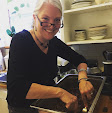
Spending a moment at the sink with farmer and artist Clare Carver of Big Table Farm gave me a whole new appreciation for those eggs I so casually crack into a bowl.

Watch the longer interview I did with Clare for Food Farmer Earth.

Wednesday, June 20, 2012

Food Farmer Earth: Which Came First, The Chicken or the Farm?


In this interview for Food Farmer Earth, I talk with farmer and artist Clare Carver of Big Table Farm. To find out about this series of interviews with local food producers, and to get some terrific recipes featuring the ingredients discussed, consider a free subscription. This week's recipe: a Dungeness crab and green garlic quiche.

Eggs aren’t just for breakfast at Big Table Farm.

Eggs, and the chickens that lay them, are a critical part of an integrated system that sustains the land and the couple who farm it, Clare Carver and her husband, winemaker Brian Marcy. The birds are also a frequent subject of Clare’s paintings, a living part of the landscape from which she draws her inspiration.

Carver was raised on her family’s farm, but at the age of 7 she moved to the city with her family. She took to riding horses at a nearby stable and participated in 4-H activities through grade school and in high school. Carver also started painting, often finding inspiration in the natural environments that surrounded her.

Now, as she and her husband live and work on Big Table Farm in Gaston, Oregon, Carver’s canvas largely focuses on the farm animals she raises, including her chickens and even their eggs—the latter more of a challenge, as she explains in this video.

Read the rest of Clare's story. Spend a moment at the sink with Clare as she washes eggs and talks about what it takes to produce them.

Thursday, May 17, 2012

The Untold History of Milk Production


If you hear about raw milk, it's almost always portrayed as a fringe product consumed by wacko hippies who are just asking to get sick.

In this video from a new series about local farmers and cooks called Food Farmer Earth, farmer Mike Guebert of Terra Farma Naturals in Corbett reviews the history of milk production in this country. From its roots in small farm-based dairies to its current state as a highly processed commodity with a hugely influential political lobby promoting it, I found his take on the subject riveting.

In Oregon, raw milk can only be bought on the farm that produces it. And if you're considering consume raw milk, the best advice I've heard came from Clare Carver of Big Table Farm, a customer of Champoeg Creamery (see link below). She said, "If you're going to buy raw milk, go to the farm and ask to see their operation." Asking questions is the key: find out what the cows eat, how they're treated and how clean the farmer's process is.

Which, come to think of it, isn't a bad idea when it comes to the milk we buy in the store.

You can also read about another small farmer, Charlotte Smith of Champoeg Creamery, who produces raw milk in St. Paul.

Sunday, April 22, 2012

Horses. Camera. Action!


My friend Dana is taking a film class and one of her first assignments was to make a 10-minute film. As an avid horsewoman, she naturally decided to make a film about her favorite subject. Which prompted me to introduce her to Clare Carver of Big Table Farm. The rest, as they say, is (film) history.

Sunday, April 15, 2012

Speed the Plow


Blue skies and a wide green field beckoned hundreds of visitors yesterday to watch teams of gorgeous draft horses turning over perfect rows of black earth for the 46th Annual Farm Fest in McMinnville.

There were Percherons, Clydesdales, Belgians and Shires, along with lesser-known breeds like Halflingers and Fjords, as well as a team or two of mules. They were harnessed to comparatively delicate-looking plows steered by men and women who walked in the furrows they dug, directing their teams with whistles, calls and an occasional pull on the lines.

The sweat dripping off both horses and handlers showed how hard this work was, despite their methodical speed and the undulating waves of turned earth left in their wake. Each team was competing to plow a 50 by 150 foot section, which would take about three hours, with prizes awarded based on the straightness of the furrows and the performance of the team.

There won't be another chance to see these magnificent beasts (equine or human) demonstrating their skills until next year, but mark your calendar for early next April…you can even combine it with wine tasting or a picnic and make it the perfect day trip!

Photo at top of Clare Carver of Big Table Farm driving Huston and Hummer, her team of Halflingers, in this year's competition.

Wednesday, February 22, 2012

Eggs the Color of Clementines


They're baaaaaaaaack!

It was a happy day yesterday when I went out to Big Table Farm in Gaston to pick up eggs from my friend Clare Carver…we've had to make do with store-bought (organic) eggs that can't hold a candle to the flavor and freshness of these pasture-raised beauties (left, with the "chicken bus" that Clare's husband, Brian Marcy, made).

Trying to describe the yolk from the egg she'd just poached, Clare held up a clementine next to it and said it was the closest she could come to matching its color. Creamy and rich, with a sweetness from the new grass in their pasture, these needed nothing but a pat of butter to cook them and a little salt sprinkled over the top. Heaven!

Sunday, November 13, 2011

Thinking of Eating: Pasture to Plate


The very first post in this series started with a question: Can I eat an animal I've played tag with?

At first it was merely an interesting notion. I'd buy half a pig from my friend Clare at Big Table Farm, something I'd been wanting to do for some time. But I didn't want to simply wait for the time, some months hence, when she'd call to say my half was butchered and ready to pick up from the packing house. I wanted to meet this pig named Roger, and trace his life from his pasture to my plate.

Roasted bones for stock.

I didn't have an agenda in mind. This wouldn't be an attempt to follow the already well-trodden path of other food writers like Michael Pollan or Barbara Kingsolver. I didn't want to hammer home points about whatever-vores, 100-mile diets or the evils of corporate agriculture. It was simply a documentation of my experience, with no expectations of a major life change ("I'll never be able to look a pork chop in the eye again…") or revelation ("Roger came to me in a dream one night…").

The hardest part, as might be expected, had been the moments just before and after Roger was killed in his pasture. The butchering was an exhausting but fascinating process on its own, with 96 pounds of meat to parse. And when it came to cooking this pig I'd met, it was similarly freighted with both emotion and practicality.

Big Table Farm eggs, Roger bacon and cornmeal scrapple.

I'd decided our first dinner featuring Roger wouldn't be a big party, just a quiet family dinner at home. I'd chosen pork chops as our entrée, a simple cut simply seasoned with a smear of olive oil, salt and pepper, the better to taste the flavor of the meat itself. Dave got the grill going, I had a beet risotto simmering on the stove and a green salad with seared figs ready. A bottle of Big Table Farm pinot was opened.

Dave brought the chops in from the grill, and as they rested on their platter, perfuming the air with their meaty scent, we set the table and poured the wine. Each of us chose our chop, I held up my glass and we toasted Roger, thanking him for his good life and for giving us this meal, as well as for what would surely be many other good meals to come. The first bite was succulent and porky, mild and just a bit smoky, certainly one of the best pork chops I'd ever tasted.

Making sausage is fun.

As we ate, I thought of Roger in his field, playing with Don in the long grass of his pasture and sitting under the spray from the hose, enjoying the respite from the day's heat. I remembered him laying in the grass, his face contented as I scratched him behind the ears. That is the face I carry with me, one I am truly thankful I got to know.

In the weeks since that dinner, we've made bacon and sausage, smoked a fresh ham and made pork stock for ramen. We've referred to it as Roger bacon or Roger sausage, in the same way I remember a friend every time I use the gift she gave me. And while that may sound trite or even macabre, it feels oddly natural. We've shared these experiences, and this food, with our larger community of family and friends. And isn't that what it should be all about?

I'll be sharing the recipes with you in coming posts, and hope that you'll enjoy his continuing story. To him I say, thank you, Roger, you were a good pig.

Read the other posts in this series: Roger and Me, Roger Grows Up, Saying Goodbye, The Day Finally Comes and The Meat of the Matter.

Friday, October 28, 2011

I Worked the Line


When someone talks about ten tons of something, what does that mean, exactly? Well, yesterday I found out.

Clare loving on her grapes.

This is the second year I've helped sort the grapes that Clare and Brian turn into their Big Table Farm wines. The task involves standing next to a conveyor belt for several hours as clusters of grapes, picked from their vines that morning, are brought to a winery and dumped from the big plastic field crates onto the belt. Sorters pick out and toss clusters that show signs of rot or mold and any leaves or sticks that they find. If there are just a few grapes on a cluster that are bad, it's permissible to pull those few off.

The clusters can range from plump and solid with hardly any rot to slimy and squishy and mildewed from top to bottom. The tricky ones are mildewed on the inside, so it's important to turn each cluster over and look really closely for any signs of fuzz or browning, then check inside to see if just a few are bad or if the whole cluster is a loss. And that's while keeping an eye on the other clusters that are whizzing by on the belt.

Unsorted pinot gris clusters.

One thing I learned is that when winemakers taste their grapes, there's none of this washing them off and delicately picking off one grape at time. A cluster is grabbed right off the line, chomped into, chewed and swallowed to get the taste of the whole cluster. After all, one grape by itself may be extra sweet or not ripe, and won't give a sense of the whole, so it's important to do this several times for each batch. And hopefully without also consuming the spiders, earwigs or other critters that call these clusters home.

The crew at table.

Each full field crate weighs about half a ton, and yesterday we were doing about one-and-a-half to (maybe) two tons per hour. That includes loading the crates onto the sorting machine, sorting the grapes, taking the crate off the machine and rinsing it off while another crate is loaded on. Sometimes there's a pause to switch out crates on the other end when they get full. Or to switch from destemming the clusters to letting whole clusters go through for a different kind of fermentation.

But otherwise it's several hours of standing, working, talking, laughing and occasionally doing some badly needed stretching. When you're done you're sticky, sweaty and tired all over. There's usually an amazing meal served someplace in there, too, which is always highly anticipated and immensely satisfying. And do I feel lucky to be able to help? Oh, yeah.

For a quick view of the harvest in action (and some great photos), check out the Big Table Farm blog.

Sunday, October 02, 2011

Thinking of Eating: The Meat of the Matter


I arrived at Portland's Culinary Workshop (PCW), where I would be butchering my half of Roger, about thirty minutes before Clare was to arrive with him and her half of Don. I walked in to find the tables set up for the butchering along with the various knives and saws we'd be using to do the job. In the spirit of the day, there were also two tubs set up to hold the butchered meat, one labeled "Roger" and the other, "Don."

Melinda Casady, Mistress of Meat.

A hands-on cooking school started by my neighbor, Susana Holloway, and her friend, Melinda Casady (left), both former culinary school instructors, PCW seemed the perfect place for this part of the process. Especially because Melinda, nicknamed "The Mistress of Meat," loves to teach people how to cut up whole animals or, to use the term of art, "break down" carcasses.

Roger's tub.

The halves of Roger and Don had been hanging in Clare's shed at the farm to chill overnight, and when she drove up they were cool as cucumbers, wrapped in plastic sheeting in the back of her truck. She'd stopped at a friend's winery on the way in and weighed the halves, with my half of Roger coming in at 96 pounds, making his live weight close to 320 pounds. Quite the pig.

Just getting started.

We carried the carcasses in and laid them on the tables—end to end it was about five feet of pig to cut up—and Melinda discussed with each of us the different ways we could cut up our pig. Did we want lots of chops and steaks? Or would we rather have more roasts? Big or small? Bone in or out? What about the ribs? Did we want whole racks?

Can't wait to throw these on the grill!

Some decisions were easy…we're more roast types than steaks, but a nice chop is good once in awhile, too. Some decisions we left until we saw what the actual cuts were like, made easier because the breaking down involves cutting the animal into large sections called primals, then sectioning each primal into smaller and smaller pieces. It also involves finding and cutting out glands and other non-edible bits, and I was glad for Melinda's expertise with that particular chore.

I gotta get me a hacksaw.

There was very little waste, even from a pig that big, since I was planning on making stock from the bones and making sausage with the inevitable collection of scraps of meat and fat. While I was secretly relieved that I'd decided not to keep the head because it would be too recognizable as Roger, I was also a little sad I wouldn't get to make scrapple again.

Getting a little rummy.

While I won't go into the blow-by-blow on breaking down a carcass, it was fascinating to see how much a pig's anatomy resembled our own, and how the different joints are connected. Emotionally it wasn't hard to do, probably because the carcass didn't look like Roger any more (the head thing again), and I was focusing on the job at hand, trying not to slice myself up in the process. It was all kind of geeky in a messy, sweaty sort of way and as we got down to the last few cuts, after four hours or so of work, I was getting really exhausted.

Wrapped and ready.

When the wrapping and packaging were finally done, we opened beers and a bottle of wine and toasted, first, Roger and Don for the wonderful meals they'd provide, then ourselves and Melinda for a job well done. Roger is now resting comfortably in our freezer, and I can't wait to have our first dinner featuring him.

Read the other posts in this series: Roger and Me, Roger Grows Up, Saying Goodbye, The Day Finally Comes and Pasture to Plate.