Showing posts with label Petunia. Show all posts
Tuesday, March 05, 2013
Spare But Not Skimpy: Chinese Braised Spare Ribs
It's no surprise I would find a package of spare ribs in the freezer that'd been packed in there over a year ago, the very last remnant of Roger the pig. I mean, there are dust bunnies in our house that could be considered "vintage." And there was the time our son finally got tall enough to see the top of the fridge and I caught Dave frantically signalling him to not say anything about the quarter-inch of dust he could see there. The boy couldn't help himself, of course, and my response was to hand him a sponge…funny how he's never remarked on it since.
Montinore Estate's verjus…awesome!
Anyway, back to the spare ribs. When they thawed out I found a teensy bit of freezer burn on one corner, but otherwise they looked fine. After cutting off the little burn and figuring neither the weather outside nor the age of the ribs merited the traditional barbecue treatment, I remembered a dish we'd had recently that featured braised spare ribs.
A little research yielded a few recipes that gave me an idea of ingredients and timing, so I cobbled together what sounded good and what I could fill in with ingredients from the pantry. The brilliant part, if I do say so myself, was substituting verjus for the stock or wine called for in the other recipes. Its mild, slightly vinegary flavor seemed, at least to my mind, to go with that sweet-sour taste I love in Asian dishes.
It turned out to be a door-buster of a dish, the succulent meat not quite falling off the bone, and definitely fit for guests when I make it again (and I definitely will). In fact, if I'm not mistaken, there are some spare ribs from Petunia out in the freezer someplace. I'll just have to dig them out.
Chinese-style Braised Pork Spare Ribs
1 1/4 c. verjus, white wine or rice wine
1/3 c soy sauce
1/4 c hoisin
6 cloves garlic
1/2 onion, coarsely chopped
2 whole dried hot red peppers
1/2 tsp. ground coriander
1/2 tsp. ground cumin
2 lb spare ribs
Cilantro, finely chopped, for garnish
Preheat oven to 300°.
Put all ingredients except spare ribs in medium sized Dutch oven over medium heat and bring to a boil, stirring to combine. Add spare ribs and return to a boil. Cover and place in oven for 1 1/2 hrs.
Remove from oven and pour off juices into skillet, leaving ribs in covered pot to stay warm. Bring juices to a boil and reduce by half or until it thickens to a sauce-like consistency. Skim off fat (I used my glass fat separator). Put ribs in serving bowl and pour sauce over top. Garnish with chopped cilantro.
Labels:
Petunia,
pork,
recipe,
roger and me,
spare ribs,
verjus
Monday, February 25, 2013
The Joys of Butchering
Last night we totally ignored the Oscars. Not intentionally, or in protest over the annual Sturm und Drang that churns up every year, dominating everything for weeks ahead of the event.
It was because our neighbors are planning to remodel their kitchen and I'd highly recommended the contractor who did ours. This, of course, necessitated a viewing of his handiwork and a discussion of the process involved in what is often a fraught undertaking. Which, in turn, provided the opportunity to suggest a live demonstration in the form of drinks and dinner the next weekend.
The drool-inducing standing rib roast.
It had been awhile since we'd pulled some Petunia out of the freezer, and grilled chops were sounding pretty tempting. So the day before the dinner I opened the freezer and pulled out three white paper packages labeled "2 Rib Chops." Now, it had been a little over two months since Linda and I had done the butchering, and I was a little foggy on some of the finer details of the decisions I'd made.
Assuming that the packages contained two chops each, I figured six would more than feed five people, so I set them out to start thawing. A few hours later I peeled off the paper and the plastic wrap and discovered that, instead of the six inch-and-a-half thick chops I expected, there were three humongous three-inch thick pieces, more like three small roasts (top photo).
Portioning Petunia.
That's when the memory rushed back of that long, cold day on the back porch at Ayers Creek Farm, working through the carcass and deciding what cuts to make, choices that would determine so many future meals. I remembered looking at the gorgeous section of the primal containing the backbone and the ribs, and the decision to cut one long five-rib roast (above left), destined to be the star of our Christmas dinner, and several double-rib chops.
The reasoning behind the double chops was two-fold: first, the way the backbone was constructed, it was easier to slice between every two ribs rather than every rib and, second, those huge chops would be singularly impressive to pull out for dinner sometime. And that's what I'm gradually learning is the true joy of butchering my own meat: I'm not only getting familiar with the structure of an animal, I get to make choices as to how it's divided, which then gives more choices for how to prepare it. Combined with the fact that I know exactly who raised the animal, what it was fed and where it was raised, as well as knowing that my money is going to support a small family farmer in my area who produces a sustainably and responsibly raised animal.
Though he'd never grilled pork chops that size, Dave decided to treat them like a pork roast, searing them over the coals, then pushing the coals to the side and roasting the chops over indirect heat. Moist, tender and luscious, these were chops that more than did right by the pig they came from. Thank you again, Petunia!
Photo of Petunia by Clare Carver.
Labels:
Petunia,
pork,
pork chops,
small farmers
Wednesday, January 09, 2013
On the High Wire with a Big Hunk of Meat
I've always had a certain fear of large hunks of animal flesh.
I know, I know…you're thinking, "But Kathleen, weren't you just butchering half of a pig (your second) just a couple of weeks ago? Wazzup?"
Herb marinade ingredients.
So I guess I should modify my phobia: my fear is cooking a large hunk of animal flesh and ruining it. And there's nothing like eight-plus pounds of gorgeous standing rib pork roast to make my knees start knocking. Add in the fact that it was the main course for Christmas dinner with company and you've got the makings for a world-class disaster, one I'd never hear the end of.
"Remember the time you practically burned down the kitchen and ruined Christmas dinner?" The words echoed in my head.
All dressed and ready.
Then there was the fact that I'd decided to use a recipe for a fennel, lemon and herb marinade I'd read in the New York Times. Problem was, Melissa Clark, whose recipes I like and trust, had used it on a crown roast, not a standing rib. So aside from the rub itself, all her other sage advice about how to make it the crowning achievement (no pun intended) of the dinner was pretty much useless.
I nevertheless forged ahead, pulled the roast out of the freezer in plenty of time for it to thaw, made the rub and got it marinating on Christmas morning. Dinner was scheduled for evening—we're not mid-day holiday diners—and I made sure I had a couple of instant-read thermometers that actually worked.
Coming off the bone.
With the size of the roast, I was estimating two or two-and-a-half hours. It was originally going to go on the grill, another holiday tradition, but the weather was awful (bone-chilling cold and rain) and Dave was threatening to come down with a cold. So into the oven it was going. Our guests came, we drank and snacked and I checked the temperature starting about 90 minutes in.
The carving…whew!
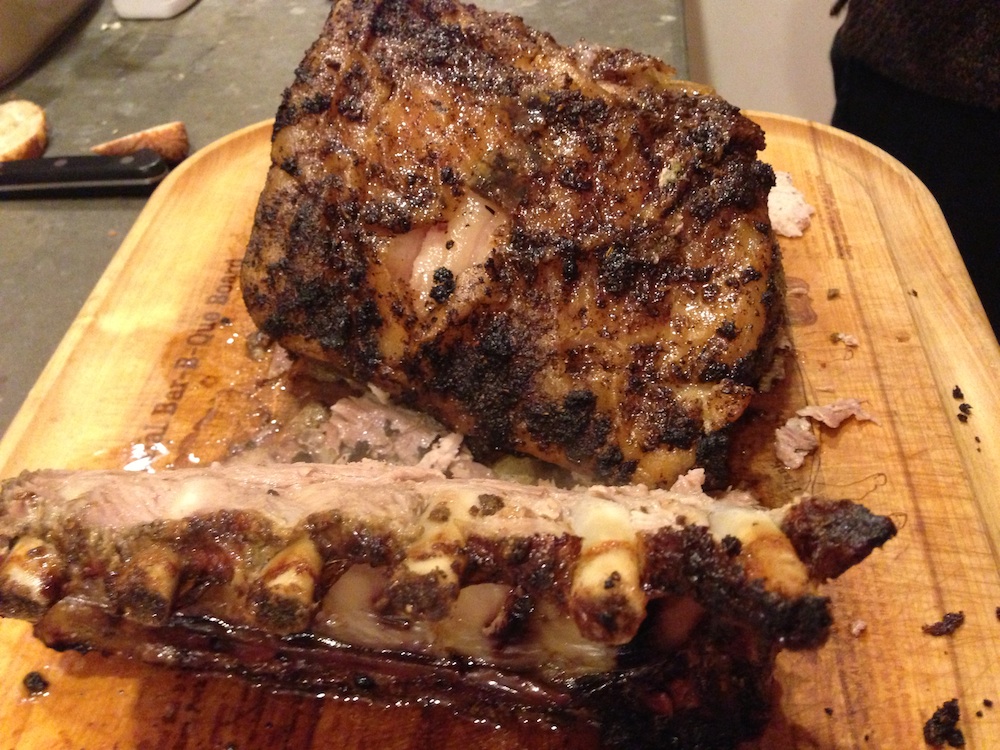
The roast itself had gone in the roasting pan backbone down, with the ribs sticking up, following Clark's instructions to roast it at 450° for 20 minutes, then at 350° for the remainder of the cooking time. We'd decided on pulling it when it reached 135°, then letting it rest for twenty minutes. I was the designated carver, and with some sound advice from the guys in attendance I sliced down under the ribs and against the backbone. This freed the roast completely and it plopped onto the cutting board in one piece, making it possible to simply slice the roast into what looked like boneless chops. As a bonus, I also sliced between the ribs and piled them on a side plate for those of us who like to have something to gnaw on.
Truly succulent, it was indeed a glorious achievement, one I'll definitely be proud to hear about in the future. And though I'm not totally over my fear—high-stakes occasions are always at least somewhat fraught—I'll definitely have more confidence the next time I try this type of high-wire act.
Fennel, Lemon and Herb Rub for Pork
Adapted from The New York Times
1 1/2 tsp. fennel seeds
Rosemary leaves from 2 bushy sprigs
5 garlic cloves, coarsely chopped
1/4 c. sage leaves and tender sprigs
Finely grated zest of 1 lemon
1 tsp. fennel pollen (optional)
1 Tbsp. coarse kosher salt
5 Tbsp. extra-virgin olive oil
1 tsp. cracked black pepper
Place fennel seeds in small dry skillet over medium heat until they are fragrant, about 1 minute. Keep moving them around the pan so they don't scorch—you're just trying to bring out the essential oils. Combine all ingredients in a blender and process until they make a paste. Rub all over pork roast* and allow to marinate in the fridge for at least 2 hours or overnight.
* If you're using a pork leg roast or rolled roast, you can untie it and rub it inside the roast as well. Then you can retie it or roast open-faced, either way.
** The USDA recently modified the cooking temperature for pork to 145°…we feel that's still a bit high, but you should use your own judgment.
Labels:
marinade,
Melissa Clark,
New York Times,
Petunia,
pork,
pork roast,
recipe,
standing rib
Friday, December 07, 2012
Meeting My Meat: Portioning Petunia
I'm not big on rituals. Though I certainly grew up on them, from going to church on Sundays to having tuna casserole on Fridays to going out in the woods in December and cutting our own Christmas trees—the plural because there was the formal tree in the living room and a second, smaller tree in the family room that my brothers and I would decorate with our own homemade ornaments.
Chillaxing in the garage.
But to get back to the point, it looks like I'm launching into a ritual of my own these days. You may remember the series of posts from 2011, "Thinking of Eating: Roger and Me," where I committed to buying half a pig from Big Table Farm and following it from piglet to plate, including attending the slaughter, doing the butchering myself and then recording the meals that were made from the various cuts.
I did less of that last step than planned, but the meat fed my family (and many friends) well for a year or so. It was always referred to as "Roger" as in "We're throwing some Roger on the grill, want to come over?" (I remember some giggling but never being turned down.)
Butchering head to head.
When Clare announced she'd brought two more piglets onto her farm last spring, my friend Linda and I immediately signed on for one of them. Named Rose and Petunia, the piglets fed on the lush grass of the farm supplemented with organic corn, no-soy organic grain and spent chestnuts from a gluten-free brewery. They were switched to chestnuts for the last two months. By late November, just after Thanksgiving, they'd reached their finish weight of more than 300 pounds.
Working the ribs.Rose and Petunia's last day was spent in the pasture where they'd lived their entire lives, basking in a rare blast of winter sunshine on a bed of fresh hay. The pasture kill that evening was swift and painless, delivered by Richard with his rifle. His knife worked in long, skilled strokes to remove the skin, then he expertly gutted and halved them, saving the head, trotters, kidneys, heart and liver for us to process later.
We transported our halves to Ayers Creek Farm, hanging them in the garage overnight to cool. In the morning, armed with knives and a saw, we began the process of breaking down each half into three large sections called primals, which were in turn cut into roasts, chops and the smaller bits that would be made into bacon, sausages and stew meat.
The head ready to make into scrapple.
As we women butchered, the menfolk worked in the kitchen grinding the scraps of meat and fat to make into sausage. The head went into the oven to roast very slowly until it was fall-apart tender, with the brilliant idea of combining it with Ayers Creek polenta to make scrapple.
Since this was the second time I'd stood in front of half a carcass with a knife in my hand, I found it was a little easier to know where to start. It helped that Linda had done this several times and could guide me back if I lost my way. The first task after cutting the primals was to get the shoulder meat to the kitchen for the sausage, and after that was separating the belly from the ribs and divining the perfect ratio of rib roasts to chops.
Fresh belly, left; bacon-to-be, right.
While we butchered, a cut-and-wrap operation was set up in the garage. Keeping the meat cool during this process wasn't an issue, since the temperature in the Wapato Valley that day hovered in the high 40s to low 50s. Fortunately some bourbon was poured to keep the blood flowing to our fingers. Once we'd worked our way through the leg roasts and Petunia was all wrapped and stowed in our coolers, we went inside to warm up, have dinner and recount our labors over several glasses of Big Table Farm wine.
Petunia, or at least my half of her, is now resting comfortably in the freezer. Dave has smoked the nine pounds of bacon we got from some of the belly meat. The thicker end of the belly we're saving to use for braising and big pots of beans, the jowl will be cured and made into guanciale and there's much discussion over what to do with the rest of the meat in the coming months. And, as with Roger last year, this year we'll be talking about having Petunia for dinner.
To watch an expert butcher break down half a pig and narrate the process, watch this series of short videos from Food Farmer Earth. To take a hands-on class that teaches how to butcher a pig, check the schedule at Portland's Culinary Workshop or Portland Meat Collective. To buy a pasture-raised pig for your freezer, contact Kendra at Goat Mountain Pastured Meats.
Labels:
Ayers Creek,
Big Table Farm,
Clare Carver,
linda colwell,
Meeting My Meat,
Petunia
Subscribe to:
Posts (Atom)