Monday, April 13, 2015

The Perfect Dressing for Your Early Spring Greens


I know it's unfashionable to use the adverb "literally." But I have been hungering for spring. Literally. I was seeing those first shoots of rapini in my dreams—literally—and imagining the whorls of fiddleheads, spears of asparagus and nettle leaves that were soon to make an appearance on my plate.

Violets…in January?

Spring was apparently as anxious as I was to make her debut on our Northwest stage, and I was shocked to discover, in mid-January, miner's lettuce popping out of the ground on parking strips and the scent of violets in the air. By mid-February all hell had broken loose and those earlier scofflaws were joined by rogue daffodils bobbing their yellow heads on sunny slopes and heady clouds of perfume from daphne and witch hazel drifting by on my walks through the neighborhood.

Can you blame my stomach for getting a little rumbly?

Daffodils in February…call 911!
It's a climate emergency!

So when just before Easter my friend Michel, source of much goodness on our table, mentioned that her new favorite brunch was poached eggs on kale dressed with a cherry tomato vinaigrette with Reggiano, I heard a little "ping" in my head. Not just about the poached eggs on kale, which sounded heavenly, but the cherry tomato vinaigrette that had somehow hit just the right note in my spring greens-obsessed brain.

With my nephew bringing his parents over for a brunch-and-Easter egg-fueled extravaganza, I thought Michel's creation might just make a delicious and colorful counterpoint to some bright green asparagus spears. Served alongside a garden-herb-and-cheese-stoked frittata, my craving was satisfied. For the moment.

Michel's Cherry Tomato and Sherry Vinaigrette

1-1 1/2 c. cherry tomatoes, chopped in 1/4" dice
1 Tbsp. olive oil
Splash of sherry vinegar (adjust to taste)
Sea salt to taste
Pepper to taste

In a small mixing bowl combine ingredients and allow to macerate for an hour or so on the counter. Toss with your favorite sturdy greens like kale, asparagus, rapini, etc.

Sunday, April 12, 2015

A Great Man, and a Lifelong Friend, Has Passed


Episcopalians are party people. At least that's the impression I got growing up in Redmond, part of the Diocese of Eastern Oregon, which takes up two-thirds of the eastern side of the state of Oregon.

That impression came from the frequent gatherings of their church friends that my parents convened at our home. Now I know that might conjure visions of polite ladies in white gloves sitting primly in straight-backed chairs sipping tea, but, let me tell you, these were anything but.

Rusty at our wedding reception.

Wine flowed, plates of food were passed, loud arguments (but not angry—it was the 60s, after all) erupted and much laughter was heard from my hiding spot at the bottom of the stairs, where I would crack the door, the better to eavesdrop on the adults' conversations. Always at the center was Rusty, known to the rest of the world as the Reverend (and eventually Bishop) Rustin R. Kimsey, and his wife, Gretchen.

St. Alban's Episcopal Church in Redmond was his first assignment, and though he would go on to pastor churches in Baker City and The Dalles, Rusty—not Father Kimsey, Rev. Kimsey or any other honorifics, just call him Rusty, if you don't mind—was always challenging his own and other's beliefs.

Rusty and Gretchen.

In a piece in the Bend Bulletin from January 7, 1967, titled "The Servant Church," the young rector asked, "What is the role or purpose of the Church in society?

"Jesus’ primary mission his life was to serve mankind….There are times when the Church neglects this basic calling to serve mankind. Too often Christianity becomes a comfortably institutional bureaucracy and neglects its service to others. Too often the Church becomes so mindful of the 'housekeeping' within that it forgets the deep needs of those outside its doors….It is most evident that the roads of peace and brotherhood must still be paved with compassion, understanding, justice and, most of all, love."

The chapel at Cove.

His questioning was reflected in his passion for the small Episcopal summer camp in Cove, in far Eastern Oregon, where the children of the diocese spent glorious days swimming in the local geothermal pool and going on trail rides in the hills. Amid the rolling green cattle pastures of that valley he invited some of the most controversial voices of the Episcopal church of the day to its sprawling lawn, including James Pike, Bishop of California, who in the early 1960s was a proponent of ordination of women, racial desegregation, and the acceptance of LGBT people within mainline churches, who narrowly avoided being branded a heretic. These family retreats also featured the theologian Bishop John Shelby Spong and anti-apartheid activist and eventual Nobel Prize-winner, and Rusty's close friend, Bishop Desmond Tutu.

Years later Rusty would officiate at our wedding, unconcerned about the fact that we were, as the quaint turn of phrase at the time had it, "living in sin" or that we had, in another dated phrase, a "mixed marriage," i.e. Episcopalian/Catholic. And despite our mostly non-churchgoing ways, he was always there when we needed him, to baptise our son or to perform the funeral services when my parents died.

An influential figure nationally, willing to speak out on issues and question entrenched beliefs, he was also a great friend and mentor, always ready to gather you in his arms for a hug.  After contracting a drug-resistant form of E. Coli while being treated for cancer, he died in his home in The Dalles on the evening of April 10, 2015.

Top photo: Rusty (right, in shirtsleeves) leaning in to make a point with Archbishop of Canterbury George Carey and Bishop John Chien of Taiwan in 1992. Episcopal News Service photo by Bob Stockfield.

Friday, April 10, 2015

Guest Essay: Seeing


We've all watched the videos of people walking and texting, the ones where the texter falls into a fountain or splats into some wet cement. I see it around me when neighbors walk by, absorbed in their phones when they're walking their dogs or, worse, strolling with their children, missing the opportunity for connection. My friend, journalist, hunter, forager and author Hank Shaw, recently published an essay on this phenomenon, and has given me permission to post an excerpt. I encourage you to click through to read the entire piece.

I went for a walk today, and found myself surrounded by zombies.

One of the places where I wander around to read nature’s news also happens to be a spot that on any given sunny weekend is choked with walkers, runners and bikers. On those rare weekends when I venture out into this, I feel oddly out of place, like those people who stand still in Times Square while being photographed in time lapse: a rock in a raging torrent of humanity.

This is not to say that I sit motionless on a bench like some octogenarian feeding pigeons. I actually do end up walking five miles or so on a given day, but it can often take me several hours because, well, to read the signs of the natural world you must slow yourself down. Slowing down: A concept so alien to most modern Americans that they view it as a sign of weakness. On the contrary, an overly regimented life is one empty of wonder. And wonder is no weakness.

I honestly have no real way of gauging the inner lives of those earnest exercisers around me, but their exterior isn’t pretty. At best their eyes appear vacant, their minds focused on whatever it is they are listening to on their headphones. At worst they look like the damned in a Hieronymus Bosch painting.

As I walk through this bustle, noting the comings and goings of flowers and fruits and leaves, checking to see what schedule life seems to be taking this year, I am almost never noticed, even though I might be picking up pine nuts off the ground or collecting seeds or elderberries or mustard greens in full view of the good people of the path. I used to think everyone just thought I was a crazy homeless person and were consciously avoiding eye contact. That does still happen, but I’ve learned to recognize the difference between that and those who truly don’t register my existence.

This obliviousness fascinates me. Why, if you are so intent on whatever it is blaring itself into your skull, are you out in nature at all? Wouldn’t a treadmill suffice?

Of course it won’t. I was once a runner. A competitive one, even. So fast there was no possible way I could truly appreciate my surroundings. But I did, or at least I told myself I did. Nature exerts a sort of osmotic pressure on us all, seeping into those who lack nature within themselves even if ignored, much the way a salt brine works in meat. Even something as simple as sun on your head and a breeze in your face makes a world of difference.

Yet to me, a forager, they all still seem zombies. The difference is one of degree, I suppose, a sliding scale ending with the wild animals who live along this path. As intimate as I am with nature, my life does not depend on it the way a squirrel or goose or scrub jay’s does. For those of us who slow down and take the time to really look at their surroundings, we at least get to borrow that sight a wild thing possesses permanently — a sight the cyclist or runner can never attain (at least while they’re hurtling through nature rather than looking at it).

So what, exactly, did I see? (read the rest of the essay)

Photo of ithuriel's spear by Hank Shaw.

Tuesday, April 07, 2015

Livin' in the Blurbs: Farm Restaurant, Butchery Classes and Doing Good for Local Kids


That 100-mile diet that was all the rage a few years ago? So passé! At one farm in Oregon's mid-valley you can dine on food that comes from 100 feet away.

In 2003, farmers John Eveland and Sally Brewer of Gathering Together Farm opened what they thought was just going to be a farm stand selling their organically grown produce along with pastries, soups and salads. But demand was so great that they eventually opened for lunch, dinners and Saturday breakfast, hiring Chef J.C. Mersmann and bringing in locally grown meat and products from other neighbors.

They've just opened the restaurant for the spring season, with lunches Tuesday through Friday and dinners Thursday through Saturday. And keep your eyes peeled for their summer wine dinners, which are said to be some of the finest, not to mention freshest, dining available in the state.

Details: Restaurant at Gathering Together Farm. Lunch Tues.-Fri., 11 am-2 pm; Dinner Thurs.-Sat., 5:30-9 pm; Breakfast Sat., 9 am-2 pm. 25159 Grange Hall Rd., Philomath. 541-929-4270.

* * *

There's no better way to understand more about the meat you eat than to take a butchery class, and we're lucky to have several places where you can learn how animals are raised, how to break down a whole carcass and then how to make use of every single part to feed your family. Listed below are three places that have regular butchery classes, teaching everything from how to fillet a fish, to breaking down a chicken or rabbit, to butchering a lamb, goat or pig. Check out their classes online, or take a gander at the calendar on the left. From personal experience, I guarantee it'll be an eye-opening and meaningful, not to mention delicious, way to get closer to your food source.
  • Old Salt Marketplace just released its spring and summer schedule of classes. 5027 NE 42nd Ave. 971-255-0167.
  • Portland Meat Collective has a full lineup of classes for all kinds of butchery. At Elder Hall, 3929 NE MLK Jr. Blvd. 503-347-5540.
  • Portland's Culinary Workshop features butchery classes with a turducken class at the holidays. 807 N Russell St. 503-512-0447.
* * *

Every parent knows how hard it is to keep teenagers interested and engaged during their high school years. It's even harder when kids come from challenging backgrounds. The Portland Kitchen is a free, comprehensive culinary program for urban kids from disadvantaged families, empowering them to graduate high school with job skills and improved eating habits. A friend of the program has pledged to match donations between now and May 15, dollar for dollar up to a total of $25,000, an amount critical for it to move into its third year of serving area youth. If you can, please consider helping them reach their goal.

Saturday, April 04, 2015

Nettlesome Topic? Nettles, Of Course.


One of the first signs of spring in the Willamette Valley is the appearance of nettles, which pop up on farmers' market tables with signs labeled "Don't Touch! Ask farmer for assistance." Jim Dixon of Real Good Food is a big fan, and he links to several recipes here.

Stinging Nettles

Tiny glass-like needles, each with a bulbous base filled with chemical irritants, cover the leaves of stinging nettles. The lightest touch shatters them and unleashes a poisonous brew of neurotransmitters, histamines and formic acid, the same acid that makes bee stings and ant bites so painful. The smart thing is to avoid stinging nettles altogether.

Unless you want to eat them, that is.

Roasted nettles.

Heat neutralizes their sting, and when cooked, nettles have a robust, almost meaty flavor. The leaves are high in calcium and iron, and studies have confirmed their effectiveness as an anti-inflammatory, a use that goes back to ancient Greece.

While nettle greens can be used in any recipe that calls for spinach, one of my favorite way to eat them is an adaptation of a recipe from Faith Willinger’s Red, White, and Greens: The Italian Way with Vegetables cookbook. Called subrich (soo-brick) in the Piemontese dialect of northern Italy, these are basically little eggy fritters. If the mint has come up in my garden, I make nettle and mint fritters, but you can use the same recipe without the mint. Nettles are also good roasted, cooked with caramelized onions and za'atar, or sautéed with thinly sliced garlic and finished with cream.

Nettles with onions and za'atar.

Stinging nettles (Urtica dioica) grow throughout North America, but are especially abundant in the wet coastal forests of the Pacific Northwest. Anyone who’s inadvertently stumbled into a patch remembers what they look like, and it’s easy (if painful) to test a leaf to make sure it stings. Bring along an experienced forager if it’s your first time out nettle-gathering, make sure you have good gloves and don’t eat the leaves if the nettles have flowered or gone to seed. After that point, they develop bits of calcium carbonate which may cause urinary-tract irritation. You can often find nettles at the Portland Farmers Market (check with Roger and Norma at Springwater Farms) and sometimes at New Seasons Market.

More nettle recipes? Sure! Try this nettle flan, or how about a pork leg roast with nettle pesto stuffing? Oh, and this spring leek and nettle tart is to die for!

Thursday, April 02, 2015

Easy-Peel Farm Fresh Hard-Boiled Eggs…Really!


With Easter weekend coming up and farm-fresh eggs rolling into farmers' markets this weekend, the idea of dyeing some incredibly delicious, plucked-from-the-nest eggs for that Easter egg hunt sounds like a great idea, doesn't it?

But wait, you think, aren't fresh eggs unbelievably hard to peel without half the white sticking to the shells?

Peeling hard-boiled fresh eggs can be easy!

The answer is that they can be if you try to cook fresh eggs as you would the regular ones from the store, which might be as much as a month old. But if you take advantage of the technique I picked up a couple of years ago that make the shells practically fall off in your hands, you'll have incredibly beautiful, pristine eggs to use for post-Easter deviled eggs or for shredding on tender spears of blanched asparagus.

Seriously, give this technique a try…you won't have to be embarrassed at serving tasteless, conventionally grown hard-boiled eggs again!

Hard-Boiled Fresh Eggs

  1. Make sure your eggs are at room temperature (very important!). This will reduce cracking when submerging them in boiling water.
  2. Bring a pot of water to boil over high heat.
  3. Slowly lower the eggs into the boiling water.
  4. When boiling resumes, set timer for 15 minutes and reduce heat to keep water at a low boil.
  5. When timer goes off, drain eggs and submerge in ice bath until chilled, then peel.

Get my recipes for Spanish-style Deviled Eggs and Curried Mustard Deviled Eggs.

Saturday, March 28, 2015

Cook Your Way Through China, Region by Region


Growing up in Central Oregon, there wasn't much of a dining scene outside of steaks, burgers and baked potatoes. The one shining light for me was Stockton's New China Café, where my parents would take us occasionally. Looking back on it, the menu was no doubt Americanized to fit the tastes of small-town America. But to me, the fried rice, chow mein, chop suey and egg foo young were wondrously exotic, tastes and textures that came from far beyond the boundaries of my small world.

From that initial taste of broader culinary horizons, I've had ample opportunity to sample other Chinese regional specialties, but I've never been comfortable enough, or felt my pantry was stocked well enough, to really dive into making genuine Chinese delicacies here at home. But now my chance may have come in a series of classes being offered by the Northwest China Council.

As part of its 2015 program on “Food in China,” the China Council is teaming up with Susana Holloway of Portland’s Culinary Workshop to offer a series of quarterly cooking classes, each featuring the specialties of China's four main culinary regions. Even better, each of these hands-on classes will be followed by a dinner featuring the dishes the class has made.
Beijing and Northern Regions
Sun., April 12, 3-6 pm
Pork and spiced vegetable dumplings with a vinegar/soy dipping sauce
Lotus root and ginger salad
Fish braised in rice wine and black mushrooms
Warm silken tofu in a sweet ginger syrup

Shanghai and Eastern Regions
Sun., July 12, 3-6 pm
Pork stuffed bitter melon with black bean sauce
Prawns stir-fried in green tea
Chinese broccoli (Gai Lan) with bamboo shoots
Red bean sesame balls

Sichuan and Western Regions
Sun., Oct. 11, 3-6 pm
Garlic chive cakes
Spiced pork and mung bean noodles
Long Beans with shredded bamboo in chili oil
Fried wonton stuffed with sweetened Asian pear

Guangzhou and Southern Regions
Sun., Jan. 10, 3-6 pm
Stir-fried minced duck in lettuce cups
Chilled chicken and egg noodle salad with a tangy peanut dressing
Congee with Pork, herbs and egg
Coconut and lemon pudding

Details: Food in China: Four Regional Cuisines of China is a series of hands-on cooking classes sponsored by the NW China Council. $80 per class with preregistration. Classes held at Portland's Culinary Workshop, 807 N. Russel St. 503-512-0447.

Thursday, March 26, 2015

Make Your Own Dirt


Okay, I give. Yesterday I was out on a walk and I saw the neighbor's lilac bush starting to bloom. And another neighbor's dogwood popping out its little pink blossoms. So what can I do but throw up my hands and admit that spring has indeed sprung, despite the fact that it's still March, for heaven's sake.

As anyone knows who has lived here for any length of time, all it takes is a few days of temperatures hovering in the 60s and hints of sun peeking out from behind the clouds for Oregonians to put on their shorts and Crocs and head out into the garden. So with spring insisting that it's sticking around for the foreseeable future, I thought I'd share my friend David Kobos' recipe for making your own dirt!

David uses it as a seed starting mix and for potting soil, and swears it's not only cheaper than buying the stuff at the store but that it's miles better, too. He also makes his own organic fertilizers, and if his insanely prolific garden is any example, those work incredibly well, too. Many of the ingredients can be purchased at Naomi's Organic Farm Supply, Concentrates or other farm supply stores.

Seed Starting Mix
From David Kobos of Kobos Coffee (and so much more)

Use a 2-gallon bucket for measuring:
3 buckets peat moss
3 buckets steer manure
1/2 c. dolomite lime
1 bucket perlite
1 bucket vermiculite
2 c. organic fertilizer (see below)

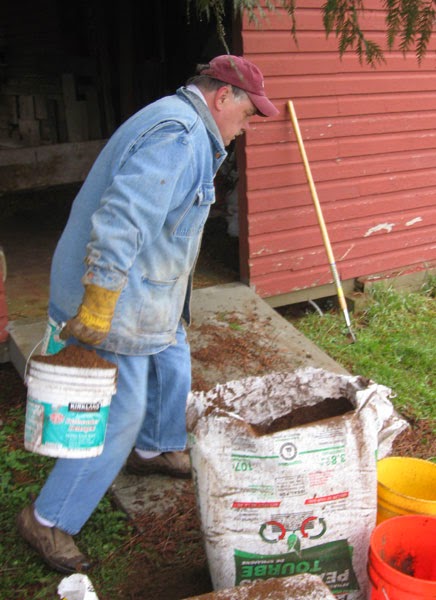
If not using sifted peat moss and steer manure, dump buckets onto 1/2" framed screen (photo, top) and sift by hand to remove debris. Add remaining ingredients and mix thoroughly using a shovel or garden hoe. Using bucket, dump into 50 lb. seed bags. Makes 2 1/2 cubic feet.

* * *

Organic Fertilizer Mixes
From David Kobos

Mix #1:
4 parts seed meal (cottonseed, soybean, linseed, etc.)
1 part dolomite lime
1 part ground phosphate rock (or 1/2 part bone meal)
1 part kelp meal

Mix #2:
1 part ground phosphate rock
1 part blood meal
1 part greensand

Read the original post here.

Wednesday, March 25, 2015

Squash Party!


I was fortunate to be invited to this event, charmingly called a Squash Party, by Lane Selman of the Culinary Breeding Network. As the video relates, it was a gathering of seed breeders, farmers, produce buyers and chefs to taste varieties of lesser-known squash that are being grown for their unique flavor profiles.

Musquée de Provence.

The aim of the network is to provide consumers with more delicious choices for their tables, not just with squash but with all kinds of produce like tomatoes, peppers, carrots, potatoes…you name it, it's being grown. And if the squash presented looks delicious in the video—including Chef Tim Wastell's squash ice cream paired with Linda Colwell's pumpkin seed sablé—in person it was fabulous.

Keep up the good work!

See my previous post about the Variety Showcase that Lane organized…more photos of gorgeous produce!

Monday, March 23, 2015

Budget Cuts: Braised Beef Neck Roast


They used to be called "butcher's cuts" or "butcher's favorites" because they were the unglamorous, but often very tasty, cuts of meat that wouldn't sell in the case and that the butcher would take home to feed his family. Steaks, chops and big roasts were the grill-friendly, oven roast-able and far prettier cuts. Stew meat, fatty beef chuck or pork shoulder roasts were considered the bottom of the barrel, needing long, slow braising and mostly used to make chili or stews of various kinds.

Searing the neck roast.

Back in the day you'd never see flank steak, hanger steak, bavette or skirt steak in the meat case at the supermarket. But if you did, they'd be dirt cheap…and I mean a couple of dollars a pound at most. Sometime in the late 90s the meat industry realized that these cuts might be worth some money and started marketing them to chefs. A case in point was the "Denver steak" that, instead of being ground into hamburger and sold for $2.99 a pound, could be cooked like a steak and served to a restaurant patron for many times more. (See "Slicing Meat So You Pay More.")

So it is with some hesitation that I share my latest find, lest it become the next victim of the Denver steak syndrome.

Ready to go in the oven.

Neck meat, whether from a pig, lamb or cow, could be called the latest butcher's cut to garner space on restaurant menus. Sometimes lumped in with offal or thrown out as scrap, this bony cut has plenty of meat on it and becomes shreddy and tender with long, slow cooking. I first saw it a couple of months ago in the meat case at Old Salt Marketplace, a beautifully aged piece of grass-fed beef from Hawley Ranch that was priced at—get this—five bucks a pound.

Yes, I gasped, too.

Five hours later, bones removed…perfect!

Recently I brought home a four-pound hunk of neck, put it in the oven with a simple braising sauce and pulled it out five hours later—it could have been pulled out at three, but I wanted it at that seriously falling-apart stage—and served it to some pretty impressed guests. And there was enough left over to mix in with some pasta later in the week.

But please, could you do me a favor and keep this one quiet?

Braised Beef Neck Roast

3 Tbsp. vegetable oil
Salt and pepper
4 lbs. beef neck, bone in
1 onion, roughly chopped
4 cloves garlic, roughly chopped
1 Tbsp. pimenton dulce or piment d'Espelette
1 Tbsp. dried oregano
1 tsp. dried basil
1/2 tsp. dried thyme
2 c. red wine
3 c. roasted or canned tomatoes
A dozen or so oil-cured olives
2 bay leaves

Preheat oven to 325°.

Generously salt and pepper roast on all sides. Heat oil in Dutch oven over medium-high heat until it shimmers. Add roast and sear well on all surfaces. Remove from pan.

Add onions and garlic to fat in pan and sauté over medium heat until translucent, scraping up any browned bits from meat. Add pimenton and dried spices and stir into onions, then stir in wine, tomatoes, olives and bay leaves. Bring to a simmer and return the roast to the pan. Bring to a simmer, cover tightly and transfer to the oven. Roast for 3 to 5 hours, turning the roast every hour to make sure all sides are evenly cooked (if the roast is completely submerged in the braising liquid, don't worry about this step).

When the roast is done, you can skim off the fat floating on the surface with a spoon (optional). Tear off the meat remaining on the bone and remove the bones and the bay leaves from the liquid. Chop any large pieces of meat into smaller chunks and serve. Goes well with roasted root vegetables, sautéed greens and/or polenta. I also made a quick gremolata of the carrot greens processed with some garlic, lemon peel, salt and olive oil.

Wednesday, March 18, 2015

Your Food, Your Legislature: The Good, the Bad and the Ugly


The following is an edited version of an original report that was published on the Friends of Family Farmers' Muckboots in the Capitol blog. The numbered title of each bill (in bold) is linked to an overview on the state website.

The Good

House Bill (HB) 3239: The "Aggie Bonds" bill was introduced with bipartisan co-sponsorship on February 27. It builds on 2013’s Beginning and Expanding Farmer Lending Program (aka Aggie Bonds) by expanding the definition of "lender" to include both NW Farm Credit Services and what are called seller-carried financing contracts, when a landowner agrees to carry the loan for the beginning farmer. This bill will help provide lower interest loans for qualifying beginning farmers.

HB 2446: The raw milk advertising bill would repeal the Oregon Department of Agriculture’s (ODA’s) ban on advertising legally available raw milk. Oregon allows small batch raw milk production if it is sold directly to consumers on-farm, but prohibits advertising of this legally available farm product, which severely limits farmers' ability to reach consumers.

The ODA had been directing some farmers to remove information about raw milk from their website, threatening them with penalties. Cast Iron Farm in McMinnville sued the ODA with help from the Institute for Justice, arguing that the advertising ban was an unconstitutional restriction on the First Amendment right of free speech. ODA settled the suit and agreed to not enforce the ban and introduced HB 2446 to repeal it.

The Good and Bad

Senate Bill (SB) 341: Similar to laws on the books in over 20 other states, this bill would protect agritourism providers—farmers and ranchers—from lawsuits and legal liability when customers come onto their property and are injured through no fault of the owners. This is based on the customer's presumed acceptance of the "inherent risks" of being on a farm or ranch.

The bill requires posting of clear signs, inspection of equipment and other steps to ensure baseline safety standards are being met. The goal is to help support agritourism activities in Oregon, which can be an important "value-added" source of income for farms, and it includes actives like U-Pick, harvest-your-own, pumpkin patches and educational activities.

On the "bad" side, this bill was firmly opposed by the powerful Oregon Trail Lawyers Association during the committee hearing. That means there will be a lot of extra work to do to ensure it gets a full public hearing rather than the lower-level "informational hearing" it received, and a committee vote.

HB 2674 and HB 2675: These two bills would give the ODA authority to set up "control areas" and other designations to keep genetically engineered (GE) crops from contaminating non-GE crops. The bills would also require that ODA gather information on the use of genetic engineering in agriculture in Oregon to fill in substantial data gaps that make responsible management difficult.

The bill got a generally cool reception from the House Rural Communities, Land Use and Water Committee, including from legislators who voted for a bill in 2013 that put ‘exclusive regulatory power’ over GE crops in the hands of the state, while preventing local communities from enacting their own GE regulations. The committee chair announced he would form a ‘work group’ to see if any ideas from the legislation can garner enough support to move forward and pass the committee.

The Ugly

SB 25: This bill would exempt a number of counties in Oregon from the statewide land use planning system, including requirements for citizen involvement and protecting farmland from development. This could lead to a loss of valuable farmland and make it harder for farmers to compete for land against developers and other interests when land prices are driven up. The bill received a hearing in the Senate Environment and Natural Resources Committee on February 23.

HB 2449: This bill would extend the sunset on bioenergy tax credits and amend a number of the credits. The Oregon Department of Energy has proposed a significant reduction in the amount of tax credit that would be available to animal manure digesters. These tax credits have primarily benefited large factory farms, providing an unnecessary and costly taxpayer subsidy for these operations in the name of "green energy."

Unfortunately, this proposed change has not gone unnoticed by the the large-scale dairy operations that benefit most from the current tax credit. Several amendments to keep the tax credit high for manure digesters have been proposed and, if adopted, may not only support existing factory-scale farms that have significant manure management and air pollution problems, but would amount to a taxpayer handout for new large-scale factory farms that may want to set up shop in Oregon as long as they install a manure digester.

On March 5, the House Energy and Environment Committee heard testimony on this bill, which Friends of Family Farmers, among others, supports as written without the amendments.

Click here for more information on the bills that are coming up before the Legislature this session. Find your legislators and let them know what you think. And stay tuned for further updates as the 2015 session progresses!

Read the other posts in this series, Opening Salvos, The Personal Gets Political and The Fight Takes Shape and Hanging in the Balance.

Photos: Evan and Rachel of Boondockers Farm; raw milk from Cast Iron Farm; manure digester from Farm Energy Images.

Stuffed Peppers: Inspiration from Virgin Territory


Great cookbooks are more than just the sum of the recipes they contain. Gorgeous photos and recipes can stimulate both the mind and appetite. The stories an author shares can introduce exciting new cultures and ideas, not to mention information about ingredients both familiar and new. And the recipes themselves often teach me new cooking techniques or ways of combining flavors that I hadn't thought of before.

The best do all of the above, and provide the opportunity for me to go off on my own tangents depending on what I have in my pantry or what's in season.

In the category of the best, I would place the new cookbook Virgin Territory: Exploring the World of Olive Oil by Nancy Harmon Jenkins. Though I have to admit that I'm a little jealous that this Maine native who grew up to become a leading authority on olive oil and the Mediterranean diet now lives on a 25-acre olive farm in Tuscany where she and her family produce their own olive oil.

I met the author recently at a reception at the invitation of Cathy Whims of Nostrana, where Nancy told the story of the book while guests were served dishes based on recipes featured in it. One, though, a nettle and spinach flan that the kitchen was inspired to create, was served as an entremet. It celebrated both the spirit of the book and the freshest spring things from our area. It was smooth, bright—obviously I'm still thinking of it—and knee-bucklingly good. Carol Boutard of Ayers Creek Farm was sitting opposite me and I had to laugh as our eyes rolled back in our heads at its incredible deliciousness.

A couple of days later I was paging through the book and came across Nancy's recipe for Eastern Mediterranean Stuffed Peppers with bulgur, tomatoes and spices that would give it a rich Moroccan scent. I didn't have any bulgur on hand, but I did have some of Ayers Creek Farm's frikeh that I'd thoughtfully stashed in the freezer. But then I looked at the cover of the book and there was another roasted stuffed pepper pictured, though this was stuffed with anchovies, tomatoes and capers, meant for serving as an appetizer.

Hm.

Stuffed Peppers with Frikeh, Tomatoes and Anchovies
Loosely adapted from Virgin Territory by Nancy Harmon Jenkins

1/2 lb. frikeh, barley, farro, bulgur or rice
3 Tbsp. olive oil, plus additional for drizzling
1 onion, chopped fine
1 large fennel bulb, chopped fine
4 cloves garlic, minced
1 2-oz. tin anchovies, or 8 salted anchovy fillets, rinsed
10 oil-cured black olives, chopped fine
1 pint assorted cherry tomatoes
3 Tbsp. capers
1 tsp. paprika, pimenton or piment basquaise
4 medium sweet peppers, halved, seeded and membranes removed
1 c. boiling water
3 oz. fresh chèvre
Pepper

Place grain (whichever you choose) in medium pot. Add water to cover by 2”. Bring to boil and reduce heat to simmer for ten minutes. Check occasionally to make sure water hasn’t been completely absorbed; add more if necessary. When grain is al dente, drain in colander and rinse with cold water.

While grain cooks, heat olive oil in large skillet over medium-high heat. When it shimmers, add onion and sauté till translucent. Move onion to edges of pan and add anchovies in center, chopping them until they dissolve. Stir into onions. Add fennel and garlic and sauté till tender.

Preheat oven to 350°.

Put onion mixture into large bowl. Add cooked grain, olives, tomatoes, capers and paprika and combine. Stuff mixture into pepper halves, top with thin slice of chevre, a grinding of pepper and a drizzle of olive oil.

Grease a 9” by 11” glass baking dish with olive oil and pour in boiling water to a depth of 1/2”. Add peppers skin-side down. Bake at 350° for 1 hour.

Monday, March 16, 2015

B Corp Certification for Hopworks Brewery


On the eve of its seventh anniversary, Hopworks Urban Brewery, the only all-organic brewery in Oregon—and one of the few in the U.S.—has also become the first brewery in the Northwest to achieve B Corp Certification. It's only the seventh brewery in the world to earn the designation for using the "power of business to solve social and environmental problems."

Owner Christian Ettinger.

Oregon is fortunate to have 47 businesses so designated, out of more than 1,000 certified businesses in 60 industries in 34 countries. In other words, for a single state, we're doing quite well. In its application for certification, Hopworks detailed its practices, such as using "USDA Certified Organic and Salmon-Safe Certified ingredients in beer, giving of 1% of Powell brew pub pint sales to local charitable organizations, providing organic and local pub fare, maintaining 100% carbon neutral operations and a zero-waste initiative."

But wait, there's more: the brewery has installed a system to drastically cut its use of water. At a current rate of 3.39 gallons of water to produce a gallon of beer, it's using less than half the industry average.

I think we can all raise a glass to that achievement and toast founder Christian Ettinger and his crew for their efforts. We'd expect no less!

Quick Hits: Mekong Bistro, Casba Mediterranean Cafe


Mekong Bistro claims to be Portland's only Cambodian restaurant, and I'm willing to bite. From a brief visit at happy hour—midweek that means from 3 to 6 p.m., perfect for those able to get their drink on early—the cocktail and beer specials are good and the snackage is abundant. But if you want to order some plates to share off the main menu, you'll be amply rewarded with authentic, intensely flavored treats not found on other menus, and nowhere are they executed any better.

That's because the owner's mother, Saroeun Khut, who fled Cambodia with her children after her husband was killed by the Khmer Rouge, is in the kitchen recreating the food of the country she left behind. Take, for instance, Ah-mok, catfish steamed in a banana leaf boat with coconut and lemon grass (top photo). The leaf, folded just so, its prow fastened with a peg to contain the luscious juices of the fish, arrives with slices of cooling cucumber sided with an umami-bomb of a dipping sauce.

Another must-have is the Angel Chicken Wings (above left), painstakingly deboned and stuffed-to-bursting with ground pork, silver noodles, onions and carrot served with a sweet and sour sauce. (Be afraid, Pok Pok, be very afraid.) Myself, I'm going back for the somlaw maju kreoung, called watercress soup on the  menu, a brilliant green broth of greens and beef redolent of tamarind and kaffir lime.

If you go, while the menu also features some Thai-inflected items like pad thai, ask to be pointed in the direction of the Cambodian specials like the chicken salad called nyum that I've heard is also, well, yummy. You'll be in for a rare trip through a Cambodia long gone.

Details: Mekong Bistro, 8200 NE Siskiyou St. 503-265-8972.

* * *

A lot of big cities have great little ethnic restaurants scattered in the downtown core, sandwiched in teeny spaces between office buildings, serving lunch to office workers who don't have time or money for big two-martini (or these days, a single glass of wine) spreads at noontime. Portland has suffered from a dearth of these places, particularly lately with downtown rents skyrocketing, forcing many small businesses out of the central downtown area. One little gem I found recently is Casba Mediterranean Cafe in Old Town across from the NW Natural Gas building.

A clean, tidy spot, it has brightly colored walls with beautifully patterned Middle Eastern tiles and large windows that let the light from the street spill in. Its menu features a good selection of Mediterranean specialties like hummus, falafel, tabbouleh, kabobs, shawarma and gyros, all excellent and exceedingly affordable. A must-have is the Moroccan mint tea, delivered to your table on a silver tray set with a silver teapot, your hand protected from its warm handle by a robed fellow sporting a tarboosh, a type of fez.

Good homemade food, honeyed tea served on a silver tray, all for a song? This is my kind of place.

Details: Casba Mediterranean Cafe, 201 NW Davis St. 971-544-0875.

Thursday, March 12, 2015

Southern Style: Succulent Shrimp and Grits


My friend Kathryn is a Southern gal through and through. The lilt of the Kentucky hills is still there in her voice, despite growing up moving all over the world as an Army brat, then living in Saudi Arabia as a young woman and finally settling on the West Coast. Her mom still lives not too far from the family's place on Spencer Ridge, playing a mean guitar, manicuring her lawn with a hatchet and making what are rumored to be some of the finest biscuits on the planet.

Kathryn often returns from her trips there with souvenirs like a several-pound whole Southern ham or bags of White Lily flour stashed in her luggage, which must make the drug-sniffing dogs think twice about their careers and the TSA agents scratch their heads. Booty from a recent trip home included bags of Weisenberger Mills stone-ground white grits, "milled from NON gmo White Grits grown in Hardin Co. Ky at the Rogers Farm," one precious bag of which she graciously brought as a hostess gift when they came for a catch-up dinner at our house. Lucky me!

And lucky again because it gave me an excuse to ask Kathryn for the recipe for the shrimp and grits we'd had at her home on a previous occasion. It's not written down, of course, one of those family recipes that's "a bit of this, a handful of that," but she patiently walked me through the process, putting up with my "how much?" questions.

After two attempts I'm still working on perfecting the grits—apparently Sean Brock of season two of the excellent The Mind of a Chef series says to soak them overnight before cooking—but the shrimp in its roasted tomato sauce more than makes up for any of my indiscretions on the grits end of things.

Shrimp and Grits
Adapted from Kathryn Madison

3 Tbsp. olive oil
1 onion, chopped fine
2-3 tsp. red pepper flakes, depending on your fondness for heat
6 green onions, chopped
4 cloves garlic, minced
1 qt. roasted tomatoes
1/2 c. white wine
1/2 lb. (or more) large fresh shrimp, shelled with tails on
1/2 c. parsley, chopped fine
Salt to taste

Heat olive oil over medium-high heat in deep-sided skillet. When it shimmers, add yellow onion and red pepper flakes to skillet and sauté until the onion becomes translucent. Add green onions and garlic and sauté until green onions wilt. Add roasted tomatoes and white wine, reduce heat and simmer for one hour.

Make grits according to package directions. Just before serving, add shrimp and parsley to tomato sauce and simmer until shrimp is cooked, about 5 minutes or so. Add salt to taste. Serve over grits.

Saturday, March 07, 2015

Harissa How-To


I've never been a big fan of ketchup, even as a kid. On French fries I prefer aioli, and condiments like chutney, sriracha and harissa ring my chimes way more than the sugary sweetness of Heinz. Contributor Jim Dixon of Real Good Food shares his recipe for making your own harissa, a version I guarantee is going to beat the pants off anything you'll find in a squeeze bottle.

Cauliflower, Chickpea and Harissa

Harissa, the North African condiment sometimes called Tunisian ketchup, provides a smoky-sweet chile flavor that's particularly good with vegetables. While some of the commercial brands can be very hot, you can adjust the chile heat to suit your palate if you make it yourself.

You'll need a couple of roasted red bell peppers, blackened skin and most of the seeds removed, a few cloves of garlic, a half cup or so of mild or hot chile powder (or dried chiles that you've soaked and drained; there are a lot of recipes online), about a quarter cup of extra virgin olive oil and a teaspoon or so each of ground coriander and caraway (you'll have to grind the caraway yourself, or at least crush the seeds in a mortar and pestle). Combine everything with a good pinch of salt in the food processor until it forms a smooth paste. This makes about a pint, but it stores in the refrigerator for a few weeks.

Chop a head of cauliflower (I include the leaves and core; just chop into smaller bits) and cook it in a heavy skillet with enough extra virgin olive oil to cover the bottom. Add some salt and cook over medium high heat until it's starting to brown, maybe 15 minutes. Add a chopped red onion, cook for another 5 minutes, then add a couple of cups of cooked chickpeas (aka garbanzos or ceci). Stir in a healthy dollop of your harissa, squeeze half a lemon over the whole thing and eat warm or at room temperature.

Wednesday, March 04, 2015

Is a CSA Right For You?


This year my family is considering subscribing to a share in a CSA, the acronym for Community Supported Agriculture, which means buying a share in a season's worth of produce from a farm. Though it can get a little confusing, especially here in the Portland area, where there are "CSAs" for everything from produce to meat to fish to cheese to olive oil.

The sheer number of CSAs available is daunting, from the traditional type where you pick up a box (your "share") from a designated drop-off spot, to delivered-to-your-door boxes to ones where you can designate exactly what produce you want. To help wade through the choices, I asked my friend Katherine Deumling of Cook with What You Have, who has worked with area farms on their CSA programs and developed an online Seasonal Recipe Collection for using seasonal produce, to help us out. (Scroll to the bottom of this post for information on the first-ever CSA Share Fair coming up on Mar. 21.)

Why join a CSA?

Joining a classic CSA gives you a window onto a farm and what it takes to grow the delicious variety of things that you'll receive in your share each week. The farmer chooses what's best that week and relieves you of most of your decision-making, though some CSAs give members a bit of choice. I actually love not having to make any decisions about what produce I'm getting because then I can concentrate on being creative with what I receive.

CSA farmers in our region tend to grow a staggering variety of produce and typify the saying, "What grows together, goes together!" Belonging to a CSA has expanded my repertoire and introduced me to vegetables I would unlikely have picked up at the farmers' market, though some people are not so keen on the "no-choice" bit. My online Seasonal Recipe Collection comes in handy, since the recipes are sorted by vegetable and there is a thorough introduction for each vegetable.

I also subscribe to a CSA because it helps me budget, and when you calculate out the cost of CSA by the week it is quite reasonable. I pay up front or in a few installments, and then supplement from the farmers' market or the store with fruits or occasional vegetables I'm not getting in my CSA—like asparagus, artichokes and a few other things that aren't typically found in a CSA. If I know I'll be getting my gorgeous box of produce each week, I won't be tempted to buy other things, to make the most what I've already paid for.

What are the different kinds of CSAs?

Some CSAs focus exclusively on produce, some also include fruit like blueberries, strawberries, rhubarb, apples, pears, quince and so forth. Some give you the option to add an extra Salad Share for those who love salad greens; others might give the option to add eggs, honey, flowers or meat. Some CSA farms work together with other area farms to offer such a wide array. And then there are exclusive meat and fish CSAs as well.

There are so many local farms offering CSAs. What should I consider before joining a CSA?

Generally, if you want super-delicious produce and can't always make it to a farmers' market, a CSA is for you. If you like to cook or want to cook more and are typically home most nights of the week, a CSA is definitely for you. If, on the other hand, you travel a lot or are out a lot at night, you'll struggle to keep up with the produce.

Think about the size of your household and your family members' eating habits to decide if a CSA is a good idea or not—do you all like vegetables or are open to trying them? How much do you think you'll eat? You might start with a half share (most farms offer two different-size shares) and see how that works, setting yourself up for success rather than the guilt of wasting some. Also consider if the pick-up site is convenient (some CSAs deliver to your door as well). But make sure you think about the logistics of picking up your share—make a plan with a friend or neighbor, either to share the CSA or both do it so you can alternate doing the pick up. This is great community-building in and of itself, and you can also share ideas of what to do with less familiar produce.

Does a CSA subscription make sense for a single person?

It very much depends on the person—if you are a vegetable lover and like to cook and entertain, by all means. If I were single I would buy a CSA but I do cook and eat more vegetables than almost anyone I know! And again, consider a half-share or splitting it with a neighbor or friend.

I'm afraid I'd be paying for produce I can't use or my family won't eat, and I know nothing about rutabagas or kohlrabi. What should I do?

This is an important factor to consider carefully. As I noted earlier, I have vastly expanded my appreciation of certain vegetables (rutabagas being at the top of that list) by becoming a CSA member and I've enjoyed that. There are a handful good cooking techniques and methods—think grated vegetable pancakes, like latkes—that are a critical to successful CSA cooking. In fact I added a grated rutabaga to fried rice the other night and it was delicious! And if you occasionally share an extra kohlrabi with a neighbor (I have definitely done that, too) the benefits of the flavor, nutrition and connection to your place and those growing our food may well trump the "kohlrabi hardship"!

I don't drive. How would I pick up my share?

I pick up my share by bike and it works well. Most CSA shares will fit into two typical panniers. Some CSAs have pick-ups at companies or farmers' markets so you might inquire if your place of work is linked up with a CSA farm or ask them if they might consider it. Colombia Sportswear, Intel, various Providence sites, Good Samaritan Hospital, Ecotrust and probably many others have CSA drops.

If you want to find out more about local CSAs and get help finding the perfect CSA for your needs, the CSA Share Fair on March 21st is for you! Thirty local CSA farmers will be there and it features a farmer matchmaking service so you can find the right CSA for you. In addition there's a cookbook swap, chef demos and activities for kids, and it's all free from 10 am-2 pm at the Redd building, 831 SE Salmon St.

If you can't make it to the Share Fair, there's a listing of metro-area CSAs at the Portland Area CSA Coalition, and a listing of Northwest (and national) CSAs at Local Harvest.