Monday, February 24, 2014

Hate Sauerkraut? You'll Love Choucroute!


It's not often I get to write, "As we drove through the rolling hills from Frankfurt across the German-French border, the towns grew increasingly smaller and older, the buildings more charming and fairy tale-like with stone and moss the predominant textures."

Braising the vegetables.

It was an incredibly long time ago, and our last through the French countryside, a road trip that took us from the Alsace region across to the Loire, then down through the Dordogne with a swing back up to Frankfurt. Our first stop was in an auberge in the tiny town of Riquewihr, one with a traditional Alsatian restaurant on the main floor and rooms for guests on the second floor.

Adding the bacon.

Coming down for dinner that night, we found we'd walked into a special evening featuring that most Alsatian of dishes, choucroute garnie. A long table ran down one side of the room, the length of it piled with the most sweetly fragrant sauerkraut, braised for hours in stock, bay leaves and juniper berries. On top of the sauerkraut were all kinds of sausages from the area, along with slices of smoked ham, whole pork chops and other meats, all of which had been cooked in the braised sauerkraut.

In goes the meat…getting there!

That choucroute (pron. shoo-CROOT) completely changed my attitude toward sauerkraut, which up to that point had always been a tart, vinegary-tasting accompaniment to my grandmother's cabbage rolls, which she called "hoblich" (probably a variation on Ukrainian "holopchi"), or my mother's sauerkraut with hot dogs, her attempt to pay homage to my father's German heritage. In this version, rinsed of most of the salt and sourness, then simmered until meltingly tender, even the most adamant of the sauerkraut averse will rave.

Choucroute Garnie
Loosely adapted from Time-Life Foods of World: Provincial France

6 lbs. sauerkraut
1 lb. bacon
4 Tbsp. olive oil
2 med. onions, chopped fine
1 Tbsp. garlic, minced
2 c. carrots, cut in 1/4" rounds
1 tart apple, cored and chopped in 1/2" dice
6 c. chicken stock
2 c. dry white wine
1 Tbsp. salt
1/4 tsp. black pepper
8 sprigs parsley
3 bay leaves
17 juniper berries
2 lbs. uncooked sausages, like bratwurst
2 lbs. chicken thighs**
3 smoked pork chops or several slices smoked ham
Yukon gold potatoes

Preheat the oven to 325°.

Rinse the sauerkraut in several changes of water to get rid of excess salt and vinegar. (I've used both house-made sauerkraut from Old Salt and a good commercial brand like Bubbies, containing just cabbage, salt and water.) After rinsing, squeeze it vigorously to get out as much water as possible.

In a heavy 9-qt. casserole or Dutch oven (I used Big Blue), heat the oil over medium heat. Add the onions, garlic and carrots and sauté for 10 min., stirring often to prevent sticking. Stir in the chopped apple and continue cooking for 2 or 3 min., then stir in the sauerkraut and combine thoroughly. Reduce the heat as low as possible, cover the pot and braise the vegetables for 15 min. Then add the chicken stock, wine, salt, pepper, parsley, bay leaves and juniper berries and stir to combine. Lay the bacon on top of the sauerkraut. Cover tightly, place on middle rack of the oven and braise for 3 hrs.

After the sauerkraut has braised for 3 hrs., prick the sausages 4 or 5 times and add to the casserole with the chicken thighs, burying them in the sauerkraut. Cover, return the pot to the oven and braise for 30 mins. Add the pork chops to the sauerkraut and continue braising for 45 minutes.

Toward the end of the cooking time, heat a large pot of water till boiling, halve the potatoes and cook till tender.

To serve, transfer the sauerkraut to a deep, heated platter or serving dish, removing the bay leaves and as many of the juniper berries as you can. Mound the meat over the top. Serve with potatoes on the side.

* Duck legs or rabbit would also be great in this.

Thursday, February 20, 2014

Livin' in the Blurbs: Moving Our Food System Forward


Like the pairings of Astaire and Rogers; Crosby, Stills, Nash and Young; and Key and Peele, there's a beautiful affinity that happens when farmers and chefs get together. On Monday, March 3, the Farmer-Chef Connection will be holding an all-day conference to further the conversation between food buyers and growers in the Northwest. This year the day is organized around five-minute, TED-style talks called  "FED" talks (get it?), featuring some of the area's best known food movers and shakers:
  • Gabe Rosen and Kina Voelz, Biwa: “Health Insurance and Wages in a Small Restaurant”
  • Frank Morton, Wild Garden Seed: “Plant Patents on Common Vegetables”
  • Samantha Bakall, Oregonian Food & Dining Reporter: “Waste Not, Want Yes: Beyond Farm-to-Table in the City Where the Dream of the ‘90s is Still Alive”
  • Alice Busch, Emergency Management Coordinator at Multnomah County Department of Human Services: “Dining Through Disaster”
  • Cory Carman, Carman Ranch: “The Steakholders in Sustainable Beef”
  • Dayna McErlean, DOC, Yakuza, and Nonna: “Successfully Broke”
  • Lyf Gildersleeve, Flying Fish Company: “Traceable Trash Fish”
Details: Farmer-Chef Connection. Mon., Mar. 3, 8:30 am-5 pm; $39 with preregistration online. Event at Western Forestry Center, 4033 SW Canyon Rd.

* * *

Portland is a place where more and more people are starting to ask the question "Where does my food come from?" And, no, I'm not talking about that episode of Portlandia where the chicken being served in a restaurant is named Colin. It has more to do with a desire to eat healthy, local food and avoid pesticides, GMOs and big carbon footprints, to support accessibility, community and quality in our food choices. Perhaps no one exemplifies that ethos on the purveyor side than Ben Meyer of Grain and Gristle and Old Salt Marketplace. In a recent article in Forbes magazine on Portland's leading food entrepreneurs, Meyer discusses his strategies for selling the highest quality, sustainably produced meat and produce for an affordable price, plus providing all of his employees with a living wage and health care. His restaurants are places where not just his neighbors, but the farmers and ranchers he works with, can afford to eat in his restaurants. His new project is The Descendants Dinner Series, bringing together pioneering chefs of the Northwest's farm-to-table movement with outstanding area farmers and some lucky young chefs in what are sure to make delicious, as well as stimulating, evenings.

Details: The Descendants Dinner Series. Beginning Mon., Mar. 10, 6:30 pm; $100 includes beverage pairings. Reservations required. Old Salt Marketplace, 5027 NE 42nd Ave. 971-255-0167.

* * *

Like so many modern conveniences like the internet, e-mail and artisan cheeses, it's funny how you don't realize what you've been missing until one day it comes into your life and you're, like, "Wow, how did I ever get along without it?" Until Friends of Family Farmers (FoFF) was organized to foster family farmers whose approach agriculture respected the land, treated animals humanely and sustained local communities, small farmers had very little support in advancing issues that affected them or a way to network with other farmers who shared their concerns. In addition to promoting legislation that helped ease restrictions on farm-direct sales and marketing, FoFF has been involved in efforts to ban growing canola in the Willamette Valley, started public education evenings called "InFARMation (and Beer)" to bring the public into the discussion about the direction of the state's agriculture and been involved in a myriad of other efforts. They're currently in the middle of a series of 20 Listening Sessions around the state designed to bring together farmers and ranchers to talk about the great parts of, as well as the barriers to, farming successfully in Oregon, where they can brainstorm solutions and help define the future of agricultural policy in Oregon. Upcoming sessions in the metro area are:
  • Thurs., Mar. 6, Redland Grange, 18131 S Fischers Mill Road, Oregon City, 7-9pm. Please RSVP here.
  • Mon., Mar. 10, Kennedy School, 5736 NE 33rd Avenue, Portland, 7-9pm. Please RSVP here.
Details: Listening Sessions with Friend of Family Farmers. Full statewide schedule here.

Top photo from New Seasons Market. Bottom photo from Friends of Family Farmers.

Tuesday, February 18, 2014

A Pig Named Roger: Celebrating a Life Given


Two years ago I met a pig named Roger. This is the last in a series of three videos that was filmed at that time. Here are the initial paragraphs of my post about the meal that celebrated his life.

The very first post in this series started with a question: Can I eat an animal I've played tag with?

At first it was merely an interesting notion. I'd buy half a pig from my friend Clare at Big Table Farm, something I'd been wanting to do for some time. But I didn't want to simply wait for the time, some months hence, when she'd call to say my half was butchered and ready to pick up from the packing house. I wanted to meet this pig named Roger, and trace his life from his pasture to my plate.

Roasted bones for stock.

I didn't have an agenda in mind. This wouldn't be an attempt to follow the already well-trodden path of other food writers like Michael Pollan or Barbara Kingsolver. I didn't want to hammer home points about whatever-vores, 100-mile diets or the evils of corporate agriculture. It was simply a documentation of my experience, with no expectations of a major life change ("I'll never be able to look a pork chop in the eye again…") or revelation ("Roger came to me in a dream one night…").

Read the rest of the post, Thinking of Eating: Pasture to Plate.

Watch the other videos in the series, Getting to Know My Food and Learning to Butcher.

Quick Hits: Cyril's, NobleONI, Davenport


My comfort zone isn't hard to find. Smart, friendly, low-maintenance people are definitely in that zone and qualify as nearly instant friends, the kind you meet and say, "I like you!" That pretty much fits the description of my kind of restaurant, too, where you walk in for the first time and a staff person smiles and greets you. Where you sit down and instantly feel taken care of, and when the food comes it isn't pretentious or priced beyond reason.

A place I've taken to lately is Cyril's at Clay Pigeon Winery, where Sasha Davies, renowned cheese maven and author of two books on the subject, opened a cheese shop-cum-café with her partner Michael Claypool, a winemaker. The big square-ish room has a scattering of beautiful wooden tables and chairs, the large windows on the street serve double duty spilling light into the space and providing bar seating, while the cheese counter and kitchen fill one corner.

Involtini di melanzane, a recent "Fixe" entrée.

The lunch menu is a well-curated selection of salads and sandwiches, with a killer macaroni and cheese (top photo) and a special called "The Fixe," a three-course lunch—salad, seasonal main and either dessert or wine—for $15. On the website, Sasha explains that Cyril's was named after her paternal grandfather, admitting that while she didn't know him well, "I simply remember that I liked how it felt to be around him…I am hopeful that [Cyril's] will have that magical quality that makes people simply enjoy being there." I do!

Details: Cyril's at Clay Pigeon Winery, 815 SE Oak St. 503-206-7862.

* * *


The Oregon College of Art and Craft (OCAC) has been sitting on its hillside in southwest Portland as long as I can remember. Designed by famed local architect John Storrs, known for other Oregon landmark properties like Salishan and the World Forestry Center, and landscape architect Barbara Fealy, the campus has Storrs' signature Northwest Coast-meets-Asian style and is studded with sculptures and artwork on its forested campus.

Find the oni (above)? There he is (left)!

Tucked into the landscape is the college's café, serving students, faculty and the public since it opened in the early 1980s. It was a hidden gem, known for its deliciously simple salads, soups and homemade breads, frequented by a community of cognoscenti. In 2012 the couple who had operated the café for 30 years decided to retire and the college started a search for someone to rejuvenate it. They eventually decided on Leather Storrs, son of the campus architect and owner of his own restaurant in town, Noble Rot.

I visited the newly renamed NobleONI Café as a guest of the college the other day, and its freshened paint and rearranged space reflect the freshening that's happening on the menu. Right now it's open for lunch and brunch in the cozy dining room anchored by a classic Bruce West sculpted fireplace, but as soon as the weather cooperates the favored tables on the patio will open. Look for the signature rustic soups, salads and breads to be joined by housemade meats like porchetta. Rumored are an expansion of brunch, as well as dinner hours and a second patio to let more folks enjoy the warm breezes and the fabled Storrs family hospitality.

Details: NobleONI Café, 8245 SW Barnes Rd. 503-297-5544.

* * *


Long-time readers of Good Stuff NW know that I love Kevin Gibson's cooking, to the point of calling his former place of employment, Evoe at Pastaworks, the best restaurant in Portland. Absolutely market fresh, no one else in town made local and seasonal ingredients sing the way that Gibson could. His light touch, without the need for snazzy foams, whiz-bang gadgets or tricky executions, enhanced the intrinsic flavors locked in prosaic vegetables like delicata squash, artichokes and grapefruit. Not that he didn't debut some exotic, but still local, produce like padron peppers or glacier lettuce—which later took off with chefs around the country—because of his long-standing relationships with some of the areas best specialty farmers.

So I was more than excited when he was finally able to open his own place with a real, though still visually accessible, kitchen with more than a mandoline, a plug-in griddle and an electric oven. A recent early evening at Davenport—named after the town, not the furniture—proved that he's well on his way to repeating, and no doubt besting, the success and accompanying accolades he achieved at Evoe.

The scallops, delicately seared but still pink in the center, were as exquisite as before, this time arranged on a bed of fennel, cucumber and celery slaw with grapefruit sections and dots of pink peppercorns. Salt cod fritters were crispy-crunchy on the outside, creamy smooth on the inside with a Seville orange aioli that required restraint when it came to not licking up the remnant left on the plate. Radicchio salad, wedges of crisp chicory with a drizzle of anchovy dressing under a shower of hard-boiled egg and tiny croutons, was a variation on a Caesar that I would have eaten while Rome burned behind me.

Classic cocktails and the wine list, selected and poured by the unassailable talent of Kurt Heilemann (right), matched the menu selections perfectly. One caveat: the prices here are a bit more than you were used to paying at Evoe, and the tab can add up quickly. My recommendation? Order a couple of plates each with your wine and make plans to return for more soon. It's only gonna get better.

Details: Davenport, 2215 E Burnside St. 503-236-8747.

Saturday, February 15, 2014

Farm Bulletin: Indicators of Spring


Here in the city we're seeing the green spears of daffodil leaves poking up from the dirt, and my red sorrel is unfurling in the raised bed. Out at Ayers Creek Farm, contributor Anthony Boutard sees other signs that the turning of the season is at hand.

The large predators are often described as indicator species by ecologists. On the 1st of February, around 2:30 pm, our great horned owl laid her first egg and settled in for a month of broodiness. Last weekend she was dusted with snow, and now her plumage will have to shed the rain. Don't feel badly for her. She would be out in the snow and rain anyway, and her mate is keeping her well fed as she sits on the eggs and later keeps their chicks warm.

The second egg was likely laid around Wednesday of this week, judging by the amorous sweet nothings we heard a bit earlier. Otherwise, they discuss more prosaic matters and keep track of one another sotto voce all night long; her voice is low and soft, his moves about the savannah and is higher and sharper with an urgent edge. In about four weeks, we will see the first downy face poke out from under its mother's wing.

For us, the owls are an indicator species with a different twist; the incubation of the eggs indicates it time for us to attend to matters close at home as well. Even though 2013 was, in the technical jargon of farmers, a real stinker at every turn, we always know the next season will be the best ever, our version of the Big Rock Candy Mountains, otherwise why would we bother. Machinery needs maintenance and repairs, perennial crops need pruning and fertilizing, buildings need sprucing up, and the early crops, chickpeas and favas, need planting as soon as the opportunity presents itself. The nesting boxes for the birds need cleaning and we are putting up a new development for the kestrels on the south side of the property. More on that interesting project later.

Consequently, tomorrow will be the last time until July that I load up the van for the Hillsdale Farmers' Market this season. I will have corn in its various forms, sweet and Virginian potatoes, soft red wheat kernels, adzukis, onions, squash, ash gourds, preserves, cayennes and plenty of horseradish.

We return to the market on the 6th of July. This year, our annual farm ramble will take place the Sunday, the 5th of October. It is about time for a harvest season ramble, and a good opportunity for you all to see our new harvest shed, as well as the many other changes that are afoot for 2014.

Photos by Anthony Boutard from 2012. 

Tuesday, February 11, 2014

What's Cookin' at Good Keuken


"I remind them that cooking traces itself to the dirt. We telescope into a place, learn what sort of agriculture the soil supports, what evolves through the season, and who historically inhabited the place. Suddenly there is a different clarity at the moment the fire is under the skillet."
- Robert Reynolds

It's not easy to carry on the work of a legend, but that's just what Blake van Roekel (below left) is doing at Good Keuken (pron. COOK-in). Robert Reynolds, a chef and educator who'd cooked his way through some of the best kitchens on at least two continents, settled in Portland and opened The Chef Studio to work one-on-one with students, passing on his passion for local food. Van Roekel had been one of those students, eventually spending five years under Reynolds' tutelage, later becoming the heir to his mission when he died in 2012.

She opened Good Keuken in an intimate space behind Ben Meyers' Old Salt Marketplace, part of Meyers' vision to make the building a center for the surrounding community to gather, eat and learn. Opening with consumer-friendly cooking classes for the general public, van Roekel recently took the next step in achieving her vision with the addition of Chef David Padberg (below right) as Chef Instructor and Director of Curriculum.

With a resumé remarkably similar to Reynolds', Padberg began his career cooking his way through Europe, absorbing cuisines and techniques that helped refine his own approach. Moving to Portland, he was blown away by the region's vast bounty of fresh ingredients. An avid forager and gardener, he built relationships with a network of the area's best farmers and ranchers, rising to run kitchens at some of the city's best restaurants.

Also a dynamite writer and teacher, he's intent on sharing his passion for the seasonality of ingredients, teaching how to obtain and use the best of a region's ingredients in a hands-on culinary education. In rewriting Reynolds' curriculum, he said his goal is to make a more direct connection to the farm, focusing not so much on history as technique, teaching the art of cooking and the principles of taste by increasing the layers of students' experiences.

Other efforts taking shape at Good Keuken include yanking culinary education outside the confines of the kitchen with Get Dirty Farm Tours, a first-in-Oregon tour company where chefs and food lovers—the "farm-curious"—can connect with farmers who are using sustainable, ecologically sound practices. Plus there are the continuing classes in everything from modernist cuisine to butchery with some of the area's best chefs, and opportunities to meet-and-greet with cookbook authors and teachers.

Sounds like a solid next step in Portland's culinary evolution, one Robert Reynolds would have been proud to be part of.

Details: Good Keuken, 5031 NE 42nd Ave. 503-753-1655.

Photos: Collage at top and Blake van Roekel from Good Keuken; David Padberg by Jeremy Fenske.

A Pig Named Roger: Learning to Butcher


Two years ago I met a pig named Roger. This is the second in a series of three videos that was filmed at that time. Here are the initial paragraphs of my post about the butchering.

I arrived at Portland's Culinary Workshop (PCW), where I would be butchering my half of Roger, about thirty minutes before Clare was to arrive with him and her half of Don. I walked in to find the tables set up for the butchering along with the various knives and saws we'd be using to do the job. In the spirit of the day, there were also two tubs set up to hold the butchered meat, one labeled "Roger" and the other, "Don."

A hands-on cooking school started by my neighbor, Susana Holloway, and her friend, Melinda Casady (left), both former culinary school instructors, PCW seemed the perfect place for this part of the process. Especially because Melinda, nicknamed "The Mistress of Meat," loves to teach people how to cut up whole animals or, to use the term of art, "break down" carcasses.

The halves of Roger and Don had been hanging in Clare's shed at the farm to chill overnight, and when she drove up they were cool as cucumbers, wrapped in plastic sheeting in the back of her truck. She'd stopped at a friend's winery on the way in and weighed the halves, with my half of Roger coming in at 96 pounds, making his live weight close to 320 pounds. Quite the pig.

Read the rest of the post at: Thinking of Eating: The Meat of the Matter.

Watch the other video in the series, Getting to Know My Food and Celebrating a Life Given.

Saturday, February 08, 2014

Farm Bulletin: The Owl Lays Her Egg


The female great horned owl that has made a nest and laid her eggs in the top of an old snag at Ayers Creek Farm has come back to raise another clutch of eggs. The nest is about 40 feet off the ground in a cluster of evergreens 100 yards from contributor Anthony Boutard's back door and, as before, he's set up his binoculars on a tripod near the house to monitor her progress.

Last Saturday, getting a jump on the groundhog, our great horned owl laid her first egg around 2:30 pm. It is two weeks earlier than in recent years, when she has shown a preference for Valentine's Day. She certainly picked a tough year to start early.

Here she is, stuck like glue on her egg, getting plastered with snow and freezing rain. The rain blurs her a bit, but she is tucked into the top of the snag and you can see her ear tufts keeping track of me and the camera. Sometime later this week, she will likely lay a second egg.

Friday, February 07, 2014

Beet Risotto and Beet Greens Make a Meal


With evening temperatures dipping down into the low 20s during a recent cold snap, it was even too cold for an intrepid griller like Dave to light up the Weber. I mean, he's out there every Christmas roasting a bird on the fire, but this cold was chilling even his New England roots. I'd just picked up some boneless pork chops on sale in the butcher's case, so it was time to give pan-roasting* a try. Plus turning on the oven would help heat the house and give our chugging, decrepit furnace a break.

Beet risotto in process.

I was walking by the produce bins on the way to the cash register thinking I'd pick up some potatoes and kale to complete the meal when I spied big bunches of beets for $2.99. The best part was that the leaves and stems weren't in the usual sad, tattered state, but were waving at me like a traffic flagger to slow down and look.

Sautéing the greens.

Beets and greens meant I could have dinner on the table for a total of $12, a great deal to feed three adults. With rice in the pantry and chicken stock in the freezer for a beet risotto, and the greens sautéed to make a bed for the chops, a little over an hour later we were sitting down to a dinner fit for company. The nearly iridescent color of the risotto nicely played off the greens and chops, but even without the pork this would make a great meal all by itself, and make it an even better deal!

Beet Risotto

2 Tbsp. butter or margarine
3 Tbsp. olive oil
1/2 onion, chopped fine
3 cloves garlic, minced
2 c. arborio or carnaroli rice
3 med. red beets, chopped in 1/2" dice
5 c. chicken stock
Salt to taste
Parmesan

Heat butter or margarine in large saucepan or deep skillet over medium heat. When it melts, add onion and sauté until translucent. Add garlic and stir to heat, then add rice. Sauté for 2 minutes, then add beets and a ladle of stock. Stir until liquid is absorbed, then add another ladle of stock. Repeat, stirring frequently to keep it from sticking, until the rice is creamy but still has a slight crunch, about 20 minutes or so. Add salt to your taste and serve with parmesan in a bowl for sprinkling.

* * *

Beet Greens

2 Tbsp. olive oil
2 garlic cloves, minced
1 bunch beet greens and stems
Salt to taste

Separate stems from greens. Chop stems into 1/4" slices. Chop greens into 1/2" slices.

Heat oil in large skillet over medium-low heat. When it shimmers, add garlic and sauté briefly to heat. Add stem pieces and sauté until tender. Add greens and sauté until wilted. Salt to taste and serve.

* Basic method here, though I'm still working on it.

Tuesday, February 04, 2014

A Pig Named Roger: Getting to Know My Food


Two years ago I met a pig named Roger. This is the first in a series of three videos that was filmed at that time. Here are the initial paragraphs of my first post about the project.

 Can I eat an animal I've played tag with?

It's a question I've been struggling with since committing to buy half a pig from my friend Clare Carver at Big Table Farm. Twice a year for the last several years, Clare has bought two organically-certified weaner pigs from her friends Amy Benson and Chris Roehm at Square Peg Farm, and I'd promised myself that someday I'd get one.

This spring she got two Berkshire Cross pigs, a heritage breed known to thrive on pasture and whose meat is darker and far more flavorful than store-bought. Named Don and Roger after two of the main characters from the TV series Madmen, they're being raised inside an electrified tape corral on grass pasture. The corral is moved every few weeks in a process called rotational grazing, an especially good idea since young pigs like to root around, roll and generally tear up the ground. Their diet consists of grass, organic grain, occasional treats of the farm's organic eggs and scraps and vegetable trimmings from the kitchen.

Clare doesn't believe in moving her animals off the farm for slaughter because of the stress it puts on them and the effect that can have on the quality of the meat (see previous story here). So when Don and Roger reach 270 pounds or so they'll be killed in their pasture on the farm.

Read the rest of the post at: Thinking of Eating: Roger and Me.

Watch the other videos in the series, Learning to Butcher and Celebrating a Life Given.

Saturday, February 01, 2014

Farm Bulletin: Groundhog Day and Cecil's Birthday


Meeting friends' parents is always delightful, not to mention revealing. And I would dearly love to have met Cecil Boutard, Horticultural Director of the Berkshire Botanical Garden, father of contributor Anthony Boutard of Ayers Creek Farm.

"Once upon a time in Spain there was a little bull and his name was Ferdinand. All the other bulls he lived with would run and butt their heads together, but not Ferdinand. He liked to sit just quietly and smell the flowers."

At work.

Munro Leaf's story of Ferdinand was first read to me by Mrs. Angelini, the first grade teacher at the Plain School in Stockbridge, Massachusetts. The story of a gentle pacifist who loved to sit among the flowers was neither odd nor unfamiliar; my father was a Ferdinand by every measure, and to his very soul.

Born to a family of engineers on Groundhog Day, Cecil Roy Boutard was the odd duck among them, the one who loved beauty without the need to disassemble or understand it. Saturday mornings as I was growing up, he would make bread in the company of Milton Cross and the Metropolitan Opera, serene in the Italian or German maelstrom unfolding on the radio. Most of all, he loved flowers. His three children were fortunate to live a life surrounded by such beauty. He was a fine teacher, as well.

On the first of July, 2010, he carefully planted his summer tubs, hanging baskets and window boxes and that evening sat down next to mother, just quietly, his job done. A graceful way to exit after 94 years.

"And for all I know he is sitting there still, under his favorite cork tree, smelling flowers just quietly. He is very happy. The end."

Saturday, January 25, 2014

The Bread Baker's Bagels


Having conquered the art of making the perfect sourdough boule, Dave decided to get back to the first challenge he set himself: making the perfect baguette. He was sitting at the computer, grazing the various recipes on the internet, when a litany of "What? Sugar? Screw you!" and "Glaze? They put glaze their baguettes? Augh!"

(Just so you know, the words "screw" and "augh" should be replaced with a common four-letter invective for fornication.)

Boiling the bagels.

A similar stream of curses flowed when he was researching bagel recipes, especially those that called for milk to be added to the dough. Flour, water, salt and yeast—or sourdough starter—are, to him, pretty much all that is necessary for most breads. Time, too, is a key ingredient, and I'm constantly shuffling the contents of our refrigerator to make room for bowls of bread (or in this case, baking sheets of bagels) to sit overnight to develop their flavor.

The recipe below is written in his own inimitable style, with instructions and notes. It was his second attempt at making bagels, the first batch somewhat lacking in proper bagel texture and that perfect round shape. This effort was much more rewarding and will probably serve as the basis for future bagel-y goodness. I'll keep you posted on how his baguette efforts turn out.

Dave's Bagels
Adapted from Peter Reinhart's The Bread Baker's Apprentice.

The day before you're going to bake the bagels, make a sponge:
1 tsp. instant yeast.
18 oz. unbleached high-gluten or bread flour (I used King Arthur bread flour)
20 oz. water, room temperature

In a mixing bowl, stir the yeast into the flour. Add the water and stir until you have a smooth batter, kind of like a thick pancake batter.

Cover the bowl with plastic wrap. Let it rise for two or so hours at room temperature until it's almost doubled in size and is foamy and bubbly.

Move on to the dough:
1/2 tsp. instant yeast.
17 oz. unbleached high-gluten or bread flour
2-3/4 tsp. salt
2 tsp. malt powder

Stir the yeast into the sponge. Add 13.5 ounces of the flour and all of the salt and malt. Stir until it forms a ball. Slowly add the rest of the flour to stiffen the dough. (Note that I initially put the mixture into the bowl of the stand mixer, but the dough was too stiff and was straining the mixer, so I dumped everything onto the unfloured counter and kneaded by hand.)

Knead for 10 minutes. This is very stiff dough. Reinhart says the dough "should feel satiny and pliable but not be tacky." I just kneaded until my hands got tired and I got bored, about 10 minutes. Divide the dough into 4-1/2 ounce pieces. Roll the pieces into balls. Reinhart has a process for this. Cover the balls and let them rest about 20 minutes.

Line two baking sheets with parchment and mist lightly with oil.

After the rest, form the bagels using one of two methods:
(1) Roll each ball into an eight-inch rope, wrap the rope around the base of your fingers and press the ends together, or
(2) Poke a hole in the ball with your thumb and gradually stretch the hole to about 1 1/2 inches in diameter. I used the second method. In either case, the bagel should be fairly uniform in thickness.

Put the shaped bagels 2 inches apart on the baking sheets, spray with a little oil, cover with plastic wrap and leave them at room temperature for about 20 minutes. After that time, drop one into a bowl of room-temperature water. If it floats within 10 seconds, it's ready to go into the refrigerator. If not, dry the test bagel off and put it back on the sheet and let the bagels rest for 10 minutes or so until one passes the float test. When a bagel passes the test, dry it off, put it back on the baking sheet and put the covered baking sheets into the refrigerator.

Baking:
1 Tbsp. baking soda
Cornmeal or semolina for dusting

The next day, heat the oven to 500 degrees and boil some water in a container wide enough to comfortably float three or four bagels at once. Add 1 tablespoon baking soda to the boiling water.

Remove the baking sheets from the refrigerator. Gently drop three or four bagels into the boiling water for 1 minute. Flip the bagels to boil on the other side for 1 minute. While you're boiling the bagels, dust the parchment-lined baking sheets with the cornmeal or semolina. When the bagels have boiled, remove them with a slotted spoon and place them on the dusted baking sheets.

This is what Reinhart instructs next:
Put the two baking sheets on two racks in the middle of the oven. Bake for five minutes. Swap each baking sheet to the other shelf. Rotate each baking sheet so what was in front is now in back. Lower the temperature to 450 and bake for another five minutes or until the bagels are light golden brown. Remove the bagels and cool them on a rack for 15 minutes before eating.

This method makes perfectly good bagels, but if you look at them from the side they are a little flat on the side that rested on the baking sheet.

That's why there's a bagel board (Thanks, Elisha!). There are lots of websites that talk about these, but basically, they consist of a flat surface covered with burlap on one side. The bagel board is wet. The bagels are placed on it and put into the oven for a brief time, then are flipped onto a baking tile to finish baking. This allows the top side of the bagel to expand when first put into the oven, while the bottom side remains moist from the wet burlap. When the bagel is flipped, the side that was on the bottom now can expand and become rounded.

I made three bagel boards out of Doug fir (websites call for cedar or pine), cut to 4 by 13 1/2 inches, just long enough to stick over the edge of the baking tile to make it easier to flip. I found some burlap at a local store and washed it--don't do this in a washing machine, because the stuff starts to fall apart. Also, some of the fibers seemed to stick to the bagel's surface. (Maybe there's special bagel burlap?) So I tacked a white cotton kitchen towel over the burlap, which seemed to work.

The baking process is a little different from Reinhart's:
Preheat the oven containing a baking tile to 500 degrees. Boil the bagels as above. Wet the bagel boards thoroughly.

Place the bagels on the bagel boards. Place the bagel boards on the tile in the oven, leaving space on one end of the tile that is the width of a bagel board to allow room for flipping. Bake for three minutes.

Flip the bagels from the first bagel board onto the tile and remove the bagel board. Flip the next board's bagels onto the space left by the first board, etc. until all the bagels are flipped and no bagel boards remain in the oven. Reduce the temperature to 450 degrees and bake another seven minutes or until the bagels are light golden brown.

Wednesday, January 22, 2014

Livin' in the Blurbs: Eatin' and Meetin'


If you haven't been to one of Chef Kathryn Yeoman's Farmer's Feast pop-up dinners, then you've just plain been missing out. I mean, if a famous food writer from GQ magazine called her food "a glorification of farm, field, woods and wild" and dubbed it the "most delightful meal" he had in the city, then you should seriously get your mouth over there. This Saturday, Jan. 25, she and Roger Konka, the farmer in the event's title, are hosting an Oregon Truffle Dinner consisting of seven courses of local, foraged and farm-grown deliciousness featuring that rarest of fungi, the truffle. And not just any truffles, but gosh-darn Oregon truffles of the black and white varieties, some of the most fragrant, earthy, divine truffles to be found on the planet. For just $65 for the meal, with wine available by the bottle or glass, it promises to be an evening to remember.

ps: If this supper is sold out, there's a Valentine's Day dinner for $50 per person at the same place on Feb. 14…just sayin'.

Details: Oregon Truffle Dinner from the Farmer's Feast. Sat., Jan. 25, 7 pm; $65, reservations required. E-mail with your name, phone number and the number in your party, or phone 503-734-4329. Event at Tabor Bread, 5051 SE Hawthorne Blvd.

* * *

The Beaverton Farmers Market, a long-time supporter of Good Stuff NW, is debuting its winter market season on the first of February. In addition to the plethora of winter vegetables, there'll be plenty of fresh greens courtesy of the latest in hoop-house technology. Plus lots of warm and cozy prepared food and drinks from regular vendors like Bruce, whose legendary coffee drinks will be found at Pony Espresso, and Big O's delicious pizza will fill you up and warm you while your pie bakes in their wood-fired mobile oven. This truly community-based farmers' market is always a fun and flavorful stop, and makes a nice outing on a Saturday.

Details: Beaverton Farmers Market Winter Market. First and third Saturdays of Feb., Mar. and April from 10 am-1:30 pm. On SW Hall Blvd between 3rd and 5th Sts. 503-643-5345.

* * *

The future of food will be discussed at the second annual FoodWorx conference on Feb. 4th. Aimed primarily at starting conversations about how we consume our food—whether at home, in restaurants or even how much is wasted in the process—it's centered around 20-minute TED-style presentations. Focused on the four topic areas of society, health, environment and economics and addressed by food scene movers and shakers, both local and national, it's sure to be a thought-provoking day.

Details: FoodWorx Conference. Tues., Feb. 4, 8:30 am-4:30 pm; ticket prices start at $99 ($79 for students) and are available online. Event at Gerding Theatre at the Armory, 128 NW 11th Ave. 503-213-3700.

Monday, January 20, 2014

Raw or Braised? The Kale Debate Rages On


I know of very few people who are more dedicated to the regular consumption of brassicas than contributor Jim Dixon of Real Good Food. In this essay he takes on raw kale lovers, staking out his ground on the side of long, slow cooking.

I have too many cookbooks, but that doesn’t stop me from buying more. David Tanis’ new one, One Good Dish, just arrived, and one of the first things I read as I thumbed the pages was his recipe for kale (top photo). Sorry to all the kale salad lovers, but I’m with Tanis; the leafy greens from these hardy Brassicas taste best after long cooking.

Then I saw “fried bread in the Iberian manner,” Spanish-style migas made from dry bread, another thing I make fairly often. And polentina, a Tuscan vegetable soup thickened with a spoonful of corn meal. The recipes in One Good Dish resonate because they’re just like the food I make every day. Maybe there’s some confirmation bias involved, but this is a book you could cook from for a long time.

Here are my versions of long-cooked kale and Iberian fried bread.

Braised Greens

I cook either cavolo nero (aka Tuscan kale) or collard greens every week, and I always braise them with onion, olive oil, salt, and water. They’re so good I don’t think I need to try anything else (unless it's this). The secret ingredient is time; the greens are best if cooked for at least 45 minutes.

Chop an onion and start cooking it in enough extra virgin olive oil to cover the bottom of your pan (anything with a decent lid will be fine). While the onion cooks, chiffonade a bunch of greens: roll half the bunch into a tight bundle and cut into quarter inch slices. It isn’t necessary to cut out the central stalk since you’re going to cook them until they’re tender.

Add the greens to the onion along with some salt and about a half cup of water. Cover and reduce heat to simmer. Check after 20 minutes, and add water if needed to keep the bottom of the pot covered (I’ve burned greens more than once; sometimes you can save them and just say they’re “caramelized). Let them simmer for at least 45 minutes, longer is okay (but check for water). Drizzle with a bit of fresh extra virgin at the table.

Migas

Like Tanis, I usually have some kind of old bread in the kitchen. After a few days of fresh bread and toast, I cut the rest of the loaf into rough cubes and leave it out to get dry (a much better outcome than finding a moldy slice in the bag). For migas, I’ll use it after a day or so, but even older, really hard bread can be revived by sprinkling with a couple of tablespoons of water (let it sit for 15 minutes before frying).

Use enough extra virgin olive oil to cover the bottom of a heavy skillet; heat it over a medium flame until it shimmers, then add the bread and fry gently until it’s nicely browned. Add some chopped onion and a little garlic if you like, and the rest depends on what’s at hand.

Migas are leftover food for me, so I’ll pull out whatever bits and pieces I have tucked in the refrigerator. Spanish-style chorizo, the dry cured salami version, is classic, and any kind of cured pork can fill in. Don’t have any? Use leftover chicken, diced bacon, or just leave it out. (For other ideas: migas with ham, eggplant migas.)

I always have cabbage, so I’ll chop a little and add it to the skillet. Peppers are good, too. Let everything cook together and get a little crispy, then splash in a a tablespoon or so of good vinegar (Katz, of course) and finish with a a few shakes of the smoky Spanish paprika called pimenton. Top with an fried egg or two if you like.

Saturday, January 18, 2014

Farm Bulletin: Counting the Fruits of Their Labor


In all the hoopla over farm-to-table eating and 100-mile diets, very little is ever said about the lives of the laborers who actually do the work to bring all that goodness to market. Contributor Anthony Boutard of Ayers Creek Farm gives a behind-the-rows glimpse of that world.

For several years, our 15-acre berry field produced approximately 15% of the nation's organic blackberries. We sold roughly 200,000 pounds of berries annually to Cascadian Farm, and they were packaged and sold all across the country. The organic sector has grown tremendously since then, and today our production would fall several zeros on the right of the decimal point, but it was significant at the time. As our field aged, we decided to shift the focus of our farm. Nonetheless, those first seven years taught us a lot about farming and working with a large staff.

About 18 months ago, two blueberry growers had shipments of their blueberries blocked until they admitted they violated labor laws and signed consent judgements. As a relatively small direct sales farm operation, it is tempting to brush off the case as a matter affecting only big farmers, an event beyond our ken. On the other hand, the case represented a terrible miscarriage of justice from a farmer's perspective. Preventing the sale of a perishable crop and using its very perishability to exact a binding confession is wrong, and fortunately, as reported in the Oregonian yesterday, a U.S. Magistrate has sided with the growers with respect to the consent judgement.

During our Cascadian seasons, we had a large staff harvesting fruit. Consistent with the law, we paid staff a price per pound of fruit picked or minimum wage, whichever was greater. Harvesting berries is skilled work and there is a great disparity between the fastest and slowest pickers. Two of our very best berry harvesters, Gregorio and Leticia, would typically bring in 300 to 350 pounds of berries a day early in the season. Gregorio was 80 years old, and Leticia was 22. Both of them picked with an easy precision, just like the finest typists their fingers moved without a wasted motion or mistake. On the other end of the spectrum, we had pickers who struggled to bring in 150 pounds during the same period, and a good number who never reached 100 pounds. The slowest staff always earned minimum wage, whereas the fastest would earn well over $20 per hour, especially early in the season.

The complaint against the blueberry growers asserted that they allowed "ghost workers." This was determined by the average the picking staff harvested in a month and people who picked more than the average were assumed to be assisted by another worker who was not submitting their own harvest tickets. Reading the paper, we were struck by the fact that Gregorio and Letica, both highly skilled solo pickers, who would have been considered by the Department of Labor as two or three people under the agency's formula. There was nothing ghostly about their skill. Treating harvesting of fruits and vegetables as unskilled work where everyone should pick at the same rate because any idiot can pick a berry or apple, the assumption behind the purely statistical investigation, degrades the workers' value. It is also a gross misuse of statistics.

It is true that in any larger harvest operation, there will be some "ghost workers." Often a brother, sister or spouse will help if they don't have work one day. When there are 100 people in the field, an out-of-place person is not easy to discern, especially a close relative. There are also compelling ghosts. We had one couple who would pick together for an hour before the husband, who drove his wife to the farm, would leave to work at a nursery up the road. Another man drove his wife to work and slept in the car until noon or so because he worked as custodian cleaning offices all night, and after waking he would help her haul her flats of berries out of the field. A mother of one of our staff would show up at 11:30 a.m., sell tamales and tacos from the back of her car, and then help her son for an hour or so. No one was gaming the system; it was the way the agricultural families helped each other.

One year, we had to harvest the field on Labor Day because of rain expected later in the week, and so many family members who had the day off came to help each other that we were done by 9:30 in the morning. That day, there were more ghosts than staff, but the family member on the payroll was paid for every berry brought to the scale and punched on their ticket; there was nothing spectral about the dollars they earned. They got the job done early and enjoyed the rest of Labor Day together.

There are real problems with growers shorting and mistreating their harvest staff, but growers should retain the right to challenge the evidence brought against them, especially evidence as flimsy and tenuous as the statistical models employed by the Department of Labor. Maybe the blueberry growers in this case are bad actors, however, as farmers who have faced similar challenges in the field, we believe a reasonable doubt exists and a day in court is warranted. Just as there are bad and sloppy farmers, there are bad and sloppy inspectors.  Inspectors wield tremendous power and it takes a great deal of discipline to keep an inspection from cascading into an adversarial encounter. When a farmer has been up and dealing with a host of problems since the break of day, seeing a fresh, perky suit show up late in the morning during the busiest part of the season, coffee in hand, for an unannounced inspection foretells a missed lunch and a ruined afternoon. Equanimity can be elusive.

Running any sort of farm is challenging and the shrinking availability of labor and the perils of dealing with the thicket of state and federal laws convinced us to shift how we farmed. The way the field operates today is more cerebral than sensuous, gone are the sounds of laughter and exchange of gossip, the tinny transistor radios, the rhythmic calling of the weight and the click as the tally card is punched and the dense fragrance 20,000 pounds of Chesters loaded on the big flatbed, ready to go to the processor in Salem. We harbor no nostalgia, but retain a healthy respect for those who farm as we did seven years ago. It is a hard business, and they deserve fair treatment by government agencies.

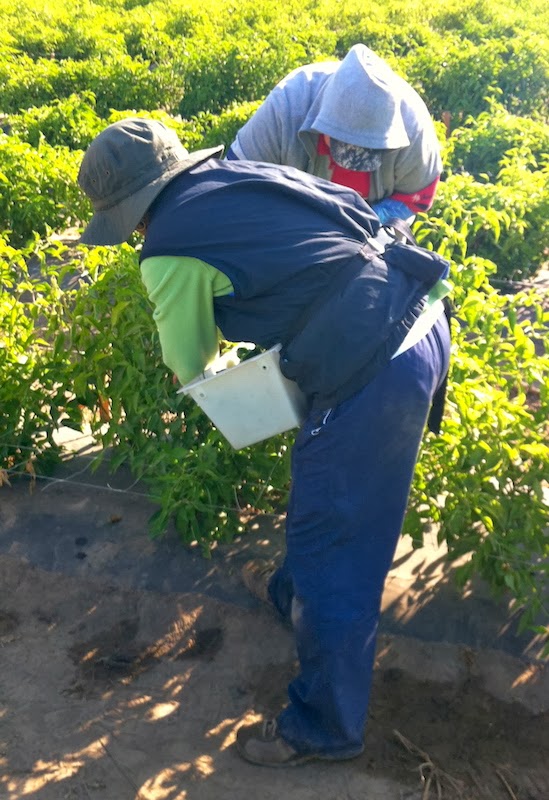
Photos: workers harvesting padron peppers at Viridian Farms, top and bottom; upper left, cutting wheat for frikeh at Ayers Creek Farm; harvesting greens for market at Foxglove Farm.

Friday, January 17, 2014

Artisan Profile: Ancient Heritage Dairy


Excerpted from an article I wrote for The Oregonian:

Editor's note: In 2007, Oregonian reporter Leslie Cole profiled Paul and Kathy Obringer of Ancient Heritage Dairy in Scio. Just one year after starting their creamery, their sheep's milk cheeses were beginning to attract attention in Portland and customers were flocking to their booths at local farmers markets. This is the story of their evolution from those beginnings.

Kathy and Paul Obringer were ready to take the next step. It was 2009, and the lease was up on the farm they had rented in Scio, where they had established their tiny Ancient Heritage Dairy, producing sheep and cow's milk cheeses from their own animals. With recipes Kathy had developed based on the bloomy rind Chaource cheese of France, and with romantic names like Valentine, Adelle and Hannah, the couple felt they were at the point where they could move beyond their mom-and-pop roots and evolve into a small business.

Some of the creamery's flock.

The elderly owner of the property, while interested in selling it, was asking $100,000 over market value. Paul was getting fed up with the toll that the wet Willamette Valley weather was taking on the his sheep, the muddy pastures making it hard to keep them clean and healthy. Plus there was the yearly chore of lambing on damp, cold winter's nights that were hard on the ewes and their fragile newborns, not to mention the Obringers themselves, who had to go out at all hours to bring them into the shelter of the barn.

Neil (left) and Hank (right).

Paul said they were in the truck one day looking at property when Hank, his then teenage son who had been Kathy's assistant cheese maker since he was a boy of 12, suggested looking in Central Oregon.

"It was Hank's idea, he said it," Paul recalled. "I'd never said it because (although) I knew I liked it, I thought it was too much of a stretch for them. But then Hank said, 'Let's try it.' and Kathy said, 'Let's do it.' And I said, 'Great!' "

Willow, an aged cheese.

Soon after that they found 84 acres available outside of Madras, 65 of them irrigated, That would provide the ideal dry climate for raising the sheep and growing the alfalfa to feed them. With Kathy's name on the contract, because she was a woman business owner, they easily qualified for a Farm Service Agency (FSA) loan.

Kathy's blue apron hangs in the creamery.

At the same time, they'd met Tony Arnerich, a former Portland restaurateur-turned-investment advisor, who was looking to invest in what he felt was the emerging artisan food culture of Oregon. Tony's son Nick, who was working at Thomas Keller's famed French Laundry in California's Napa Valley, had mentioned a cheese from a Portland creamery that the restaurant was serving.

"When he called that was the connection," Arnerich said, and he immediately went to the farmers' market to try it.

"I've been a food person all my life," he said. "And this guy made world-class cheese. Period."

Shortly after that, he and Paul began talking about Tony's firm, Arnerich Massena, providing expansion capital for the move to the new property.

Read the rest of the article here.

Saturday, January 11, 2014

Canned Salmon, Then and Now


Canned salmon was one of the odder foods that my mother would, on occasion, serve for dinner. I can't say "cook" or "prepare" for dinner because, really, she just opened the can and dumped it out in a bowl. There it would sit, the cylindrical, fishy flesh still stamped with the rings from the can, sitting in a puddle of its juices.

I remember she actually liked it…it may have been one of those food memories from WWII, when a can of salmon, along with other foods like Spam and margarine, were considered an exotic treat in the small town in Eastern Oregon where she grew up. Her three children, on the other hand, mostly poked at it, trying to extricate the bones that were hiding somewhere in the cold flesh, nibbling just enough of it to qualify the diner for dessert.

These days, luckily, a tin of salmon can be a treat, especially when it's packed in its own juices. Just look on the label (above left) and if all you see on the ingredient list is salmon and salt—with no water or oil added—then you know it was packed fresh. It was just such a can that I was given as part of a swag bag at the Tribal Food Summit last week, a sample of wild pink salmon caught and processed by the Swinomish Fish Company in LaConner, Washington.

But what to do with it?

Something simple, for sure, to be able to appreciate the flavor of the salmon. I was originally thinking of a variation on a favorite recipe for pasta with tuna and lemon, but when I was pulling out the book containing the recipe, I also spied local author Diane Morgan's gorgeous book, Salmon (right), and pulled that out, too. Intrigued by her pasta recipe calling for an olive-mustard butter, I ended up combining those elements with the other recipe.

Turns out that capers, lemon, mustard and olives play quite well with tinned salmon. I only wish I could have made it for my mom.

Salmon Pasta with Mustard, Capers and Olives

1 lb. dried pasta
3 Tbsp. olive oil
1/2 yellow onion
3 shallots
1 c. roughly chopped Castelvetrano olives (kalamata or oil-cured olives would also work well)
1 Tbsp. stone-ground or Dijon mustard
2-3 Tbsp. capers
1/2 tsp. red pepper flakes or a pinch of cayenne
1 Tbsp. lemon zest
1/2 lemon, juiced
4-6 oz. canned salmon, flaked, or leftover roasted salmon
Salt to taste, if needed
Parmesan

Bring large pot of water to a boil. Add pasta and cook till al dente.

While pasta cooks, heat oil in large skillet. When the oil shimmers, add onions and shallots and sauté till tender. Mix in olives, mustard, capers and red pepper flakes. Sauté briefly. Just before pasta is done, add lemon zest, lemon juice and salmon and combine. Keep over very low heat while you drain the pasta. Put pasta in serving bowl, add salmon mixture and toss to combine. Taste for salt, and add more if needed. Sprinkle with parmesan, with more parmesan in a bowl on the table.