
Showing posts with label Cascadian Farm. Show all posts
Saturday, January 18, 2014
Farm Bulletin: Counting the Fruits of Their Labor
In all the hoopla over farm-to-table eating and 100-mile diets, very little is ever said about the lives of the laborers who actually do the work to bring all that goodness to market. Contributor Anthony Boutard of Ayers Creek Farm gives a behind-the-rows glimpse of that world.
For several years, our 15-acre berry field produced approximately 15% of the nation's organic blackberries. We sold roughly 200,000 pounds of berries annually to Cascadian Farm, and they were packaged and sold all across the country. The organic sector has grown tremendously since then, and today our production would fall several zeros on the right of the decimal point, but it was significant at the time. As our field aged, we decided to shift the focus of our farm. Nonetheless, those first seven years taught us a lot about farming and working with a large staff.
About 18 months ago, two blueberry growers had shipments of their blueberries blocked until they admitted they violated labor laws and signed consent judgements. As a relatively small direct sales farm operation, it is tempting to brush off the case as a matter affecting only big farmers, an event beyond our ken. On the other hand, the case represented a terrible miscarriage of justice from a farmer's perspective. Preventing the sale of a perishable crop and using its very perishability to exact a binding confession is wrong, and fortunately, as reported in the Oregonian yesterday, a U.S. Magistrate has sided with the growers with respect to the consent judgement.
During our Cascadian seasons, we had a large staff harvesting fruit. Consistent with the law, we paid staff a price per pound of fruit picked or minimum wage, whichever was greater. Harvesting berries is skilled work and there is a great disparity between the fastest and slowest pickers. Two of our very best berry harvesters, Gregorio and Leticia, would typically bring in 300 to 350 pounds of berries a day early in the season. Gregorio was 80 years old, and Leticia was 22. Both of them picked with an easy precision, just like the finest typists their fingers moved without a wasted motion or mistake. On the other end of the spectrum, we had pickers who struggled to bring in 150 pounds during the same period, and a good number who never reached 100 pounds. The slowest staff always earned minimum wage, whereas the fastest would earn well over $20 per hour, especially early in the season.
The complaint against the blueberry growers asserted that they allowed "ghost workers." This was determined by the average the picking staff harvested in a month and people who picked more than the average were assumed to be assisted by another worker who was not submitting their own harvest tickets. Reading the paper, we were struck by the fact that Gregorio and Letica, both highly skilled solo pickers, who would have been considered by the Department of Labor as two or three people under the agency's formula. There was nothing ghostly about their skill. Treating harvesting of fruits and vegetables as unskilled work where everyone should pick at the same rate because any idiot can pick a berry or apple, the assumption behind the purely statistical investigation, degrades the workers' value. It is also a gross misuse of statistics.
It is true that in any larger harvest operation, there will be some "ghost workers." Often a brother, sister or spouse will help if they don't have work one day. When there are 100 people in the field, an out-of-place person is not easy to discern, especially a close relative. There are also compelling ghosts. We had one couple who would pick together for an hour before the husband, who drove his wife to the farm, would leave to work at a nursery up the road. Another man drove his wife to work and slept in the car until noon or so because he worked as custodian cleaning offices all night, and after waking he would help her haul her flats of berries out of the field. A mother of one of our staff would show up at 11:30 a.m., sell tamales and tacos from the back of her car, and then help her son for an hour or so. No one was gaming the system; it was the way the agricultural families helped each other.
One year, we had to harvest the field on Labor Day because of rain expected later in the week, and so many family members who had the day off came to help each other that we were done by 9:30 in the morning. That day, there were more ghosts than staff, but the family member on the payroll was paid for every berry brought to the scale and punched on their ticket; there was nothing spectral about the dollars they earned. They got the job done early and enjoyed the rest of Labor Day together.
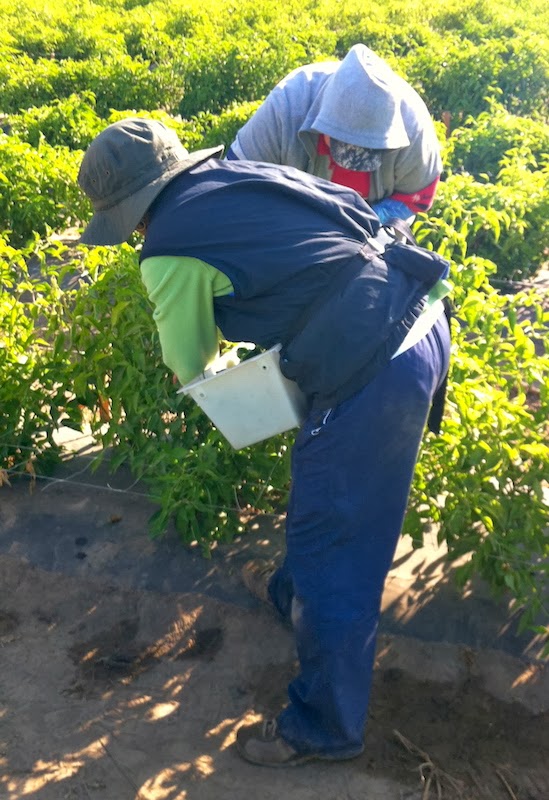
There are real problems with growers shorting and mistreating their harvest staff, but growers should retain the right to challenge the evidence brought against them, especially evidence as flimsy and tenuous as the statistical models employed by the Department of Labor. Maybe the blueberry growers in this case are bad actors, however, as farmers who have faced similar challenges in the field, we believe a reasonable doubt exists and a day in court is warranted. Just as there are bad and sloppy farmers, there are bad and sloppy inspectors. Inspectors wield tremendous power and it takes a great deal of discipline to keep an inspection from cascading into an adversarial encounter. When a farmer has been up and dealing with a host of problems since the break of day, seeing a fresh, perky suit show up late in the morning during the busiest part of the season, coffee in hand, for an unannounced inspection foretells a missed lunch and a ruined afternoon. Equanimity can be elusive.
Running any sort of farm is challenging and the shrinking availability of labor and the perils of dealing with the thicket of state and federal laws convinced us to shift how we farmed. The way the field operates today is more cerebral than sensuous, gone are the sounds of laughter and exchange of gossip, the tinny transistor radios, the rhythmic calling of the weight and the click as the tally card is punched and the dense fragrance 20,000 pounds of Chesters loaded on the big flatbed, ready to go to the processor in Salem. We harbor no nostalgia, but retain a healthy respect for those who farm as we did seven years ago. It is a hard business, and they deserve fair treatment by government agencies.
Photos: workers harvesting padron peppers at Viridian Farms, top and bottom; upper left, cutting wheat for frikeh at Ayers Creek Farm; harvesting greens for market at Foxglove Farm.
Labels:
Anthony Boutard,
Ayers Creek,
Cascadian Farm,
farmworkers
Friday, July 04, 2008
Farm Bulletin: Wasted Energy and Currants

Anthony Boutard pooh-poohs the experts and shares his practical experience with us this week. Carol and Anthony are more than happy to share their advice in person when you visit the Ayers Creek stall at the Hillsdale Farmers' Market every Sunday from 10 am till 2 pm.
Raspberries and Loganberries
Certain tedious tasks, such as laying out berries side-by-side on every available cookie sheet you own, survive as evidence of virtue flying in the face of practicality. For the life of us, we cannot understand the endurance of the cookie sheet thing, though endure it does. The "berry experts" persist in recommending the pointless cookie tray task. Every year it is carefully detailed in Food Day and other food publications, regaling us with the awesome precision required, and often presenting it as the brilliant idea of the author's mother, an heirloom task worth every second of the dreadful tedium.
Here is the original and unrivaled "Ayers Creek Farm Method" of freezing organically grown fruit or, as it is known in the trade, Methode de Parresseux. Take the berries home and, without so much as a glance at the fruit, immediately put the hallock or flat in the freezer. A day or two later when berries are fully frozen and you feel like a spot of work (but not too much), take out the hallocks and give them a gentle squeeze while pouring the berries into an air tight container. They will be perfectly frozen as individual berries. Even delicate, late season fruit will freeze perfectly.
Should you wash berries? That is a personal matter. If you are compelled to wash all fruits and vegetables, fine, wash them. However, we fail to see how you can effectively wash a berry. Bear in mind that doctors and nurses are advised to scrub their hands for 15 seconds with hot water and soap. No one has ever explained to us how pouring some cold or lukewarm water over berries will disinfect them, or remove pesticides. In fact, pesticides are applied using a spreader/sticker to make sure they stay on the plant. Once again, washing fruits is a personal matter, based more in culture than science.
Red and Black CurrantsRegarding red currants, in the 5 July, 2002, Dining Out section of the New York Times, Kay Rentshler made the following observation: "At Danube on Hudson Street, Mario Lothinger likes red currants for their sharp tones with fish...He also marinates raw scallops in red currant juice: the acid in the currants poaches the scallops lightly and sets off their sweetness." Since reading that, we have made ceviche with red currant juice when the fresh berries are available. What Rentshler leaves out is the wonderful pink color the juice gives the fish. If you enjoy ceviche, try using red currant juice in the place of the lime.
Red currants can be preserved in brandy, vodka, or vinegar. The liquid will turn a beautiful red color and take on the flavor of the currant. They also freeze well.
The stem, or strig, of the currant is bitter and should be removed before processing the fruit. Some people detach the berries using a fork. Fine for small amounts, a couple pints or so. Several years ago we asked Joe Bennett, our fieldman from Cascadian Farm, how they remove the stems on a commercial scale. (For a short time Cascadian produced a currant preserve.) Joe told us to freeze them with the strigs attached and, when frozen, roll them on a flat surface with our hands. The strigs break off easily from the frozen berries without making a mess. Wearing neoprene gloves, we roll them on a screen and the stems drop through the screen. Works well.
Through the nine seasons we had a contract with Cascadian Farm, it was always a delight to work with Joe. Although we no longer sell to the company, Joe still stops by for preserves, beans and conversation. Our red currant remains his favorite. We love to linger in the vegetable plot and talk about beans, sweet potatoes and other vegetables. Joe did his field research in Central America and is very knowledgeable about fruits and vegetables that originate from that region, such as beans, sweet potatoes and corn. And we could never have made red currant preserves commercially by just forking berries.
Subscribe to:
Posts (Atom)


