Showing posts with label black currants. Show all posts

Sunday, June 26, 2016

Blackcurrants For "Cassis de Gaston"


Blackcurrant season jumps out at me when I least expect it. This year it was mid-June when I asked Anthony and Carol Boutard of Ayers Creek Farm in Gaston to reserve a flat of their amazing organic blackcurrants for me. A couple of years ago I wanted to make some black currant liqueur, hoping it might turn out half as seductive as that made by their farm chef and my friend, Linda Colwell, who had served me some of the luscious liquid she had infused using those selfsame currants.

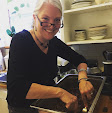
Chopping the currants.

It being the first time I'd experimented with the stuff, I infused two pints of crushed currants into a bottle of vodka, let it sit in our basement for a month, filtered out the solids, then added sugar to taste. After a few more months (I really forget how many) of hanging out in our basement, I tasted it and, as my husband would say, holy cow-ledo! Smooth, port-like, the color of dark red velvet and tasting deeply of currants, this was nothing like the bottles of commercial Creme de Cassis I'd bought from the store.

Infusing vodka with currants.

I got the call from Gaston that they were picking their blackcurrants this week, so if you want to make some liqueur this summer you need to head to your farmers' market or a produce purveyor that carries local produce. If liqueur isn't your jam you can make preserves, but you'll need to move quickly since this fleeting summer fruit is not going to wait.

Blackcurrant Liqueur, or "Cassis de Gaston"

As mentioned above, the first year I bought two pints of currants and infused one bottle of vodka with them. This year I'm using eight pints and infusing three liters of vodka, equal to four single bottles. In a month I'll let you know how it turns out!

2 pints blackcurrants
1 750-ml bottle vodka (I use Monopolowa)
Sugar to taste

Clean currants and pull off any large stems. Working in batches, place the currants in a food processor and pulse five or six times until they are chopped but not puréed. Put the chopped currants into a clean glass container and add the vodka, stirring to combine. Cover and put in a cool, dark place (I put it in the basement) for one month.

After a month, filter the mixture through a sieve, pressing out as much liquid as possible, then dispose of the solids in your compost. A general rule of thumb is to add sugar in an amount that is 20% of the weight (not the volume) of the liquid, but you can adjust to your taste. Put it back in the (washed) glass container for a few additional months to allow the flavors to combine and the vodka to mellow. Taste occasionally until it suits you.

This is wonderful by itself as an after-dinner drink or when drizzled on ice cream. It can also be combined with a dry white wine (2 Tbsp. of cassis to 6 oz. of chilled white wine) to make the drink called Kir, or use the same proportions to make a Kir Royale, substituting champagne for the white wine.

Friday, July 04, 2008

Farm Bulletin: Wasted Energy and Currants


Anthony Boutard pooh-poohs the experts and shares his practical experience with us this week. Carol and Anthony are more than happy to share their advice in person when you visit the Ayers Creek stall at the Hillsdale Farmers' Market every Sunday from 10 am till 2 pm.

Raspberries and Loganberries
Certain tedious tasks, such as laying out berries side-by-side on every available cookie sheet you own, survive as evidence of virtue flying in the face of practicality. For the life of us, we cannot understand the endurance of the cookie sheet thing, though endure it does. The "berry experts" persist in recommending the pointless cookie tray task. Every year it is carefully detailed in Food Day and other food publications, regaling us with the awesome precision required, and often presenting it as the brilliant idea of the author's mother, an heirloom task worth every second of the dreadful tedium.

Here is the original and unrivaled "Ayers Creek Farm Method" of freezing organically grown fruit or, as it is known in the trade, Methode de Parresseux. Take the berries home and, without so much as a glance at the fruit, immediately put the hallock or flat in the freezer. A day or two later when berries are fully frozen and you feel like a spot of work (but not too much), take out the hallocks and give them a gentle squeeze while pouring the berries into an air tight container. They will be perfectly frozen as individual berries. Even delicate, late season fruit will freeze perfectly.

Should you wash berries? That is a personal matter. If you are compelled to wash all fruits and vegetables, fine, wash them. However, we fail to see how you can effectively wash a berry. Bear in mind that doctors and nurses are advised to scrub their hands for 15 seconds with hot water and soap. No one has ever explained to us how pouring some cold or lukewarm water over berries will disinfect them, or remove pesticides. In fact, pesticides are applied using a spreader/sticker to make sure they stay on the plant. Once again, washing fruits is a personal matter, based more in culture than science.

Red and Black Currants
Regarding red currants, in the 5 July, 2002, Dining Out section of the New York Times, Kay Rentshler made the following observation: "At Danube on Hudson Street, Mario Lothinger likes red currants for their sharp tones with fish...He also marinates raw scallops in red currant juice: the acid in the currants poaches the scallops lightly and sets off their sweetness." Since reading that, we have made ceviche with red currant juice when the fresh berries are available. What Rentshler leaves out is the wonderful pink color the juice gives the fish. If you enjoy ceviche, try using red currant juice in the place of the lime.

Red currants can be preserved in brandy, vodka, or vinegar. The liquid will turn a beautiful red color and take on the flavor of the currant. They also freeze well.

The stem, or strig, of the currant is bitter and should be removed before processing the fruit. Some people detach the berries using a fork. Fine for small amounts, a couple pints or so. Several years ago we asked Joe Bennett, our fieldman from Cascadian Farm, how they remove the stems on a commercial scale. (For a short time Cascadian produced a currant preserve.) Joe told us to freeze them with the strigs attached and, when frozen, roll them on a flat surface with our hands. The strigs break off easily from the frozen berries without making a mess. Wearing neoprene gloves, we roll them on a screen and the stems drop through the screen. Works well.

Through the nine seasons we had a contract with Cascadian Farm, it was always a delight to work with Joe. Although we no longer sell to the company, Joe still stops by for preserves, beans and conversation. Our red currant remains his favorite. We love to linger in the vegetable plot and talk about beans, sweet potatoes and other vegetables. Joe did his field research in Central America and is very knowledgeable about fruits and vegetables that originate from that region, such as beans, sweet potatoes and corn. And we could never have made red currant preserves commercially by just forking berries.