Friday, November 01, 2013

Travels with Chili: Whidbey Island Idyll, Pt. 2


Mention living on an island and what springs to mind is an existence far from the concerns of busy mainlanders, a place where everyday cares and concerns take a back seat to quiet and contemplation. While it is impossible not to appreciate, and even meditate on, the deep green beauty that is the northern end of Washington's Puget Sound, there is much happening of a consequential nature on these islands, too.

Greenbank Farm

North of Langley, past Holmes Harbor and through fields dotted with yet-to-be-sheared sheep, near the narrow waist of the long body that is Whidbey Island, is a cluster of old-style red buildings known collectively as Greenbank Farm. Originally more than 500 acres of prime agricultural and forest land, it had evolved from an ancient gathering place for Native Americans to a dairy farm and, by the middle of the last century, to the largest loganberry farm in the country. In the mid-1970s it was acquired by Chateau Ste. Michelle as part of a larger business deal, and by the 90s was slated to be sold off to develop 400 homesites.

Horrified locals rallied to save the historic farm and buildings, and in 1997 a unique con­sor­tium con­sist­ing of the county, the Nature Con­ser­vancy and the Port of Coupeville pur­chased the prop­erty, renaming it Greenbank Farm after the small community nearby. The mission of the farm was focused on four areas: agriculture, natural resource stewardship, economic development and recreation, outlined in an ambitious Master Site Plan developed in 2009.

Go there now and  you'll find the original barn from 1904 that contains farm offices, a large event space and the startlingly delicious pies and pastries of Whidbey Pies. Next door are newer buildings built to mimic the architectural style of the barn and housing art galleries, a wine shop and a cheese shop.

It's also the home of an innovative farmer training program called the Organic Farm School, a 7 1/2-month-long hands-on course that teaches aspir­ing farm­ers the tech­ni­cal and busi­ness skills needed to run a small-scale organic farm. And it doesn't stop there…the school offers mentoring, networking and placement for its students, as well as teaching students how to develop an individualized business plan and giving them practical help with financing.

* * *

Camano Island Coffee Roasters


By the time he was in his early 30s, Jeff Ericson was a multimillionaire businessman in Arizona. Despite this early success, he was also unhappy, realizing that all that money hadn't brought the satisfaction he desired. Added to that was his weight—well over 400 pounds—and the life-threatening toll it was taking on his body. Looking to get healthy, as well as to rekindle the passion for business he'd experienced earlier in his life, he decided to start over on Camano Island, which he'd run across on a business trip to Washington State.

Serendipitously, about the same time he was starting Camano Island Coffee Roasters, he read an article about an organization called Agros International in Seattle. Dedicated to social and economic justice in Central America, it purchases agricultural land and provides microloans to families caught in the cycle of poverty, giving them the tools to become self-reliant. Attracted to this model, Ericson decided partner with Agros and buy his organic, fair-trade, shade-grown coffee beans from their farmers.

Now involved in more than 40 villages and having worked with 25,000 farmers, Ericson has become an evangelist for socially responsible business and how it can affect real change in people's lives while serving the bottom line. And he's not just talking about the poor farmers that he's met. He's heard from his customers that his coffee has changed their lives, too. As he says in the video above, "Change can happen with every cup of coffee."

Read the other posts in this series: Whidbey Island Idyll, Pt. 1, about the town of Langley, and Pt. 3, Cama Beach on Camano Island. Photo of Greenbank Farm at top ©RoseAnn Alspektor.

Wednesday, October 23, 2013

The Norman Chronicles: Braising Saddles


Butchering your own meat can be intimidating, especially if, like me, you're not all that familiar with the traditional cuts and where they come from. The fun part is looking at it from the perspective of how you want to cook it, then making your decisions based on whether you like roasts or chops, or bone-in or boned-and-tied chunks for grilling or braising.

The saddle, for instance (left, held by Melinda at Portland's Culinary Workshop). As its name implies, it's the section of the back where you'd think a saddle would go, and it kind of looks like one. Containing the loins and the lower end of the ribs, you can cut chops and loin roasts from it, but I decided to cut it straight down the backbone and have a large, bony chunk of roast to braise.

Some folks might recoil in horror over braising this piece of meat rather than boning out the roasts and loins, but lamb loins are fairly small strips of meat, and I was already cutting chops from the upper end of the ribs.

See what I mean about getting to make decisions based on how you plan to cook it? Plus how cool does that backbone look sitting in the pot?

Michel's Braised Lamb

This lamb recipe is terrific braised and served the same day, but for a real treat make it a day ahead and put it in the refrigerator overnight. Holding it for a day gives the flavors a chance to meld deliciously, and it's easy to remove the solidified fat and the bones before reheating. Served with polenta (I used Ayers Creek Farm Amish Butter polenta), this is so good it's made converts of friends who say they don't like lamb.

1 4-lb. lamb roast (shoulder, saddle, etc.)
1 med. onion, coarsely chopped
1 med. red bell pepper, coarsely chopped
1 pasilla, ancho or poblano pepper, coarsely chopped
4 cloves garlic, sliced
2 tsp. cardamom pods, crushed, using just seeds inside
2 tsp. cumin seeds
1/2 c. prunes, coarsely chopped
1 c. chicken stock
15 oz. can diced tomatoes (approx. 2 cups)
Zest of 1 lemon

Preheat oven to 325 degrees.

In medium hot braising pot, brown shoulder in olive ol; salt and pepper each side. After first side of lamb is browned, add cumin and cardamom seeds to the oil around the lamb and briefly stir to toast. Add garlic and onion, stir until golden. Add peppers and stir until softened. Add canned tomatoes, stock and prunes and stir. Cover braising pot and place in middle of preheated oven. Simmer in oven at least 3 hours.

Remove lamb from pot. Cover and hold on heated platter. Skim fat from liquid in pan and bring to boil to reduce. Season to taste and pour over lamb.

Read the other posts in The Norman Chronicles: Getting to Shepherd's Pie, Shanks and Hearts and Neck and Neck.

The View from My Upstairs Window


I promise I'll get back to writing soon, but in the meantime I'm enjoying this spectacular fall weather. Hope you are, too!

Friday, October 18, 2013

Gratuitous Friday Cuteness


Pander: verb 1. to act as a pander; to provide gratification for others' desires. Especially: "pander to the basest emotions." noun 2. Pimp.

Like a great meal occasionally calls for a touch of sweetness to cap it off, some weeks need a bit of the same to draw them to a suitable close. And there are few things sweeter than a passel of sleepy six-week-old Corgi puppies.

And no worries, they're all spoken for, so you don't have to worry about definition number two, above.

Tuesday, October 15, 2013

Livin' in the Blurbs: Oregon's Uniqueness Exemplified


Health care is a big topic these days in many sectors, not just in Congress, and many Portland restaurateurs are taking the unusual step of providing health care their employees, including servers, kitchen staff and dishwashers. Businesses of 50 or fewer employees are not required to do so by the Affordable Health Care Act, so providing this vital access costs small employers a great deal. Local restaurant owners Gabe Rosen and Kina Voelz of Biwa have debuted the innovative practice of adding a 5% "Health and Wellness" service charge on guests' checks, with a card accompanying it explaining that the money goes into a fund to pay for health insurance for all of the staff, as well as bonuses for the cooks and dishwashers. The response from customers has been universally positive, as has been the response from staff, some of whom have never been able to afford health care before or have put off surgeries due to the expense. Happy and healthy employees committed to a place that cares about them—now that's a good business model.

Details: Biwa, 215 SE 9th Ave.. on the corner of SE 9th and Ash. 503-239-8830.

* * *

Draft horses, working breeds almost lost to the mechanization of farming, are experiencing a resurgence of interest, not just from preservationists and horse breeders, but from young farmers who are integrating them back onto the land. Seen as less expensive and easier on the land than trucks and tractors, they're also used as part of a rotational system of fertilizing and renewing pastures. Oregon is a hotbed of the return of plowing with teams of horses, and you can see these gorgeous creatures doing the work they were bred to do at Heiser Farms' Draft Horse and Mule Plowing Demonstration on Sat., Oct. 26. Some of the best teams in the area will be making an appearance and the farm store and farm activities will be running, so it should be a great day to get out in the country.

Details: Heiser Farms' Draft Horse and Mule Plowing Demonstration. Sat., Oct. 26, 10 am-2 pm; free. Heiser Farms, 21425 SE Grand Island Loop, Dayton. Map.

* * *

When Ben Meyer first started his restaurant-cum-beer parlor Grain & Gristle on NE Prescott, he wanted the menu and pricing to be modest and accessible to we average Joes and Janes. That ethic of accessibility has gone several steps further with his new establishment, Old Salt Marketplace, a combination restaurant, bar and butcher shop. Designed to serve the diverse communities and incomes of its neighborhood, think of it as Laurelhurst Market for the rest of us. Imagine delicious food, simple wood beam construction and affordable prices, and you've got the vibe. Along with its own farmers' market set up on Thursday evenings in the parking lot, it also boasts a cooking school, Good Keuken, owned by Blake van Roekel, formerly of Robert Reynolds' Chef Studio. Offering classes on a wide range of topics from urban foraging to butchering to baking holiday cookies, she's about to debut an innovative series of classes with top Portland chefs, all priced to sell.

Details: Good Keuken, 5031 NE 42nd Ave. 503-753-1655.

Sunday, October 13, 2013

The Norman Chronicles: Getting to Shepherd's Pie


When a friend offered me one of her sheep that was going to be slaughtered this fall, I couldn't have said yes fast enough. After all, it had been born in April in the pasture she rented from a neighbor and had been raised almost exclusively on pasture grass and hay, supplemented with a little grain.

Norman as a baby.

I'd first met the lamb, named Norman, when he was born into the small herd my friend had. His mother was a big ewe and there was every indication little Norman would be large, too, since he grew much faster than the other lambs born at the same time. Very tame and with melting brown eyes, he always stood to be scratched behind the ears while the other sheep crowded in to get the hay my friend, Kim, and I would throw out.

Kim had hoped to find a reasonably priced mobile slaughter unit to do the job, since Norman was more family pet than livestock and her husband, though he's a hunter who had done a lot of field dressing of deer and elk, was particularly fond of him and didn't want to have to do the kill. Unfortunately no one could come out to do it in a reasonable amount of time, and it was left to her husband to manage the task himself.

Norman grazing in his pasture with his pals in the group on the right.

I offered to help, since at six months old Norman was fully grown, weighing in at around 200 pounds, a lot for one person to manage in a steep, uneven pasture. When we went out to the pasture, a pile of grain was poured on the ground and Norman eagerly started munching away at our feet. A shot to the back of the head dropped him instantly—he literally didn't know what hit him—and the last few beats of his heart pumped the blood out of his body through a slit made in the artery in his neck.

Lest I sound like a cold-hearted so-and-so, for me the moment of the kill is always fraught. I always hope the end is quick, painless and without struggle, which, in the three kills I've attended, has been the case. All of the animals were killed in the pasture they were born and raised in, with (or by) people they trusted, not trucked hundreds of miles to a processing plant to die with strangers in a strange place. Which, from my perspective, makes their pasture a much more humane place to end their lives, both for the lack of stress to the animals and, because hormones are released into the muscles when animals experience stress,  how it affects the final quality of the meat.

Dry-aging in Kitchen Cru's walk-in.

Norman was gutted and loaded into a wagon, then hauled to a pine tree in an upper pasture near the house. We hung the now-100-or-so-pound carcass from a device called a gambrel, a ratcheted device that was slung over a branch, that could hoist the animal to make skinning easier. As Kim's husband worked, I held it steady and smelled the lamb-y aroma coming from the still-warm meat.

Melinda ready to rock.

Clad in a game bag, a giant stretchy sock to protect the carcass, then wrapped in a plastic sheet and bungied in the back of our truck, I drove down the freeway feeling a little conspicuous, but no one honked or pointed or, worse, called the cops. Norman was destined to hang for five days in the walk-in at Michael Madigan's Kitchen Cru, the only place, for various reasons from USDA regulations to the start of deer season, that I could find for a pasture-slaughtered lamb his size.

Grinding trim pieces for ground lamb.

Dry aging, or hanging, in a cool (below 40°) environment helps the natural enzymes in the meat start to break it down without spoiling it. As the cell structure breaks down, it causes the meat to become more tender and the flavor to become richer and more intense, according the John Neumeister of Cattail Creek Lamb, who was kind enough to advise a newbie on the particulars of dry aging.

Layering on the mashed potatoes for a classic shepherd's pie.

Now weighing about 75 to 80 pounds—dry-aging causes a carcass to lose moisture, approximately 15 to 20% of its weight—Norman traveled to Portland's Culinary Workshop where co-owner Melinda Casady and her array of butchering skills and tools made quick work of breaking down the carcass into its component parts. I chose to leave most in large, braisable chunks with a few roasts and chops, leaving the legs on the bone for special occasions, and hoping Dave can cure and smoke the breasts for bacon.

Packed in a cooler and transported to the freezer in our garage, Norman will be the subject of many toasts at many meals this winter. Thank you, Norman.

Shepherd's Pie with Ground Lamb

For the potatoes:
2 lbs. whole potatoes
4 Tbsp. butter or margarine
1/4 c. milk
 Salt to taste

For the filling:
2 lbs. ground lamb
1 onion, chopped into dice
3 cloves garlic, minced
3 medium carrots, diced
1 c. chicken broth
1 c. frozen peas
1 tsp. dried thyme or tarragon
Salt to taste

Preheat oven to 400°.

Peel the potatoes if you prefer, then chop into 1/2" dice. (I used Yukon golds so didn't bother peeling them.) Put in medium-sized pot, cover with water and bring to boil over high heat. When water boils, reduce to low and simmer until potatoes are tender, about 20 mins.

While potatoes cook, heat large sauté pan over medium heat, add ground lamb and brown. When browned, drain off all but 2 Tbsp. of fat. Add onion, garlic and carrots to lamb and sauté till tender. Add chicken broth, peas and herbs and bring to a simmer, cooking for a couple of minutes. Season to taste with salt, then remove from heat while you mash the potatoes.

When potatoes are tender, drain them and add butter or margarine and milk. Mash with potato masher until smooth and thoroughly combined. Salt to taste.

Put lamb mixture in 9 by 12-inch baking dish and smooth the surface. Drop mashed potatoes onto the top of the lamb in dollops, spreading the potatoes out with the back of a spoon or spatula to completely seal in the lamb. Place baking dish in oven and bake for 25 minutes until potatoes begin to brown. If desired, you can then briefly place the baking dish under the broiler to crisp the top further, but it's not necessary.

Read the other posts in The Norman Chronicles: Braising Saddles, Shanks and Hearts and Neck and Neck.

Read about a lamb butchering class I took from Melinda in Class Cut-Up. Thanks also to Hank Shaw of Hunter Angler Gardener Cook and Ron Muise of Fearann Kisha for their help and advice.

Saturday, October 12, 2013

A Fine Vintage? Only Time Will Tell


Harvest 2013 is winding down. The last of the grapes are picked and heading into the wineries to be sorted, crushed and made into…well, whatever the winemakers decide they'll be. This photo of the final white grapes from the Wirtz vineyard is by my friend Clare Carver of Big Table Farm.

Of this vintage, she said, "We are in the final weeks of harvest now. It has been a 'tough harvest,' not for lack of quality in the fruit, only because it hit hard and fast and required quick and flexible movements on the part of the whole team in the winery and the picking crews.

"Fruit had to be picked and processed at a moment's notice, as mother nature was particularly fickle this year. Though with all that I think the wines will be beautiful and elegant," she wrote, then added the usual winemaker's caution, "but of course only time will tell."

Wednesday, October 09, 2013

Kevin Gibson Gets a Place of His Own!


I don't normally write about the latest-and-greatest restaurant news, since there are other places that do that job and do it well (Eater, Portland Monthly, Portland Food & Drink, et al.). But there was one piece of news today that deserves trumpeting here, and that is word that Kevin Gibson, co-owner and former chef at Castagna and the magician behind the back-to-basics Evoe—under Gibson's hand the best restaurant in Portland according to GoodStuffNW—is soon to open his own place.

Woohoo!

According to Eater's Erin DeJesus, it'll be located in the former June restaurant space on East Burnside, undergoing a slight makeover before a targeted November opening. With Gibson's longstanding relationships with local farmers and a well-honed knowledge of how to make ingredients shine with the least amount of fussiness, this is going to be one of those places that defines local eating. Can't wait!

Read a profile of Gibson I wrote for NW Palate magazine.

Monday, October 07, 2013

Honey Cookbook Gives Recipes and Insights into Bees


"Throughout my childhood, happiness was honey for breakfast. And when oatmeal wasn't on the menu I slurped at honey combined with melted butter dripping from the nooks and crannies on a toasted English muffin and washed it down with honey-sweetened hot tea diluted with milk." - Marie Simmons, "Taste of Honey"

Marie Simmons, author of more than 20 books on subjects like figs, rice, eggs and muffins, said the best part of writing her latest book, "Taste of Honey: The Definitive Guide to Tasting and Cooking with 40 Varietals," wasn't getting to try dozens of different types from all over the world. It was learning about the insects that produce it and how they turn the nectar from flowers into this ubiquitous sweetener.

A fan of honey for as long as she can remember, before writing the book she already had a collection of six or seven different honeys. During her research, those few jars became what she now calls a "library" of more than 100 jars that she keeps alphabetized on shelves in her Eugene garage.

Read the rest of the article and get the recipes in "Oregon cookbook author Marie Simmons delves deep into honey."

Saturday, October 05, 2013

Still Life, Transylvania


My friend Linda is traveling in Transylvania. She sent this photo and said "this is fresh sheep's cheese ready to brine. Just in from the dairy."

See Linda's other photo from her travels.

Friday, October 04, 2013

Method to My Madness


I go a little crazy this time of year. I feel the chill in the air, hear the leaves crunching underfoot and piling a little deeper every day, and it makes me feel like grabbing what little is left of summer and saving it for the cold, damp days to come. Especially when I hear that Anthony and Carol at Ayers Creek Farm are starting to bring in their astiana tomatoes.

For the last three years I've roasted and grilled dozens of pounds of them, let them cool, then bagged them in zip-lock freezer bags and tossed them in the freezer. The roasting concentrates their already deep flavor, and using them in a pasta sauce or for braising a pot roast is like adding the taste of a late summer day to whatever I'm cooking.

The method is simple, the time spent well worth it. And if you make enough, it'll make summer last till next summer comes around again.

Roasted Tomatoes

Preheat oven to 400°. Chop tomatoes into large chunks, about 2" across. Place in shallow roasting pan and place the pan on a rack in the middle of the oven. Roast for one hour or until tomatoes are tender and some are starting to brown on the edges.

Scoop from pan into large mixing bowl and allow to cool. Remove skins if you want (they should just slip off), then ladle into quart freezer bags. Freeze and use all winter!

For grilling method, see Tomatoes Galore.

Wednesday, October 02, 2013

Into the Woods with Jack


I heard my e-mail inbox ping with an incoming message.

The subject line: "Sharoooooms!!!" It was from one of my favorite people, Jack Czarnecki, Oregon's master of fungi and maker of truffle oil. He was inviting me along to forage mushrooms with two of his most eagle-eyed compatriots, Dick, whom I'd met on a previous expedition, and Chris, who, like Dick, is a retired teacher. I've been on a few expeditions with Jack gathering these denizens of the forest deep, and it is always an educational, entertaining and thoroughly exhausting experience, since he moves like a bear up and down hills, tirelessly seeking his quarry.

First stop, Joe's Donuts.

Our quest this time was for matsutake mushrooms, highly sought-after for their distinctly spicy, sweet aroma. Jack said he loves them for the persistence of their flavor when cooked, unlike many mushrooms that tend to lose the intensity of their flavor when combined with other ingredients. We'd also be picking up white chanterelles, which flush in the same locations as the matsutakes. Both would be featured on upcoming menus at the Joel Palmer House, where Jack's son Chris has taken the helm, allowing his father to 'shroom at will.

Find the five matsutakes.

Since we were heading up on the flanks of Mt. Hood to various hunting grounds that he and his pals had explored before, we met up at Joe's Donut Shop in Sandy, a requisite stop to ask Wy'east's blessing for the hunt and to plot the day's traverse of the mountain. After consuming coffee and several of Joe's namesake pastries (I particularly liked the applesauce, though they've now got pumpkin on the list), we headed out, turning off onto a series of Forest Service roads to the first in a series of stops.

Out in the open.

Though there were jokes about blindfolds, Jack knows I'm completely befuddled once we get off the main highway. Plus the fact that he knows the narrow, rutted roads like the back of his hand and drives them accordingly. In the car he described the matsutake and its habits like it was a member of the family, complete with tales of chance meetings and great hunts past.

But once we stopped the car and got out, he was all business. He handed me a long-bladed knife, scoffing at the Swiss Army knife I'd brought as insufficient to dig out the deeply rooted matsutake. Since I'd never foraged for this particular mushroom, and the fact that it can at first look like a number of deadly amanita mushrooms, he took pains to show me how to properly identify it.

The telltale dusty root.

The matsutake, like many fungi that grow in the forests of the Pacific Northwest, are found in areas where there is deep, moist duff from the fir trees. Sometimes they're sticking up from the surface, but most often you'll spot one barely emerging from under a hat of fir needles, or even still beneath the surface, only given away by an oddly placed hump on the forest floor. The good news is, they tend to erupt in clumps, so once you see one breaking the surface it's good to scan the area for any cracks or clumps that indicate other matsus nearby.

Jack spotted some almost instantly, and said it was important to get the whole mushroom out, root and all. That's because the most important indicator of the matsutake is at the root end, where it will have an ashy, grey dust clinging to it. The second indicator is the sharply defined gills under the cap, which emit the distinctly spicy, sweet aroma this mushroom is known for.

A happy man.

After this lesson, Jack let me go off on my own, though I always kept in sight of one of the veteran foragers, not only because they had walkie-talkies, but because they always knew how to get back to the car, a crucial skill when you're wandering around in the wilderness. Fortified by Heidi's forager's lunch (huge cold-cut, cheese and onion on rye sandwiches and her signature giant chocolate chip cookies), and after making several stops that filled up the back of the Truffle-Mobile, Jack's trusty Subaru wagon, we headed back to town.

As big as my head!

The guys were particularly impressed by my find of not just one, but three huge cauliflower mushrooms (ahem), in addition to a not-too-shabby-for-a-beginner matsutake and chanterelle take. Summing up over the required dinner at SE Powell's Om Seafood—mushroomers are apparently big on talismans in the form of restaurants—Jack said that in all his years in Oregon, going on two decades now, this may be the best year he's seen for mushrooms of all sorts. It was theorized to be some combination of warm-but-not-too-hot days followed by rain but not-too-much rain (it's like talking to vineyard people) that caused the crazy flush of all kinds of hot mycorrhizal action.

Whatever the reason, it was a thrilling day, not only because of the amount of mushrooms taken, but because I got to be one of Jack's select crew, a compliment of the highest order. Thanks, Jack!

Monday, September 30, 2013

Livin' in the Blurbs: Kicking Off Fall in Style


Chef Kathryn LaSusa Yeomans of The Farmer's Feast and farmer Roger Konka kick off another season of their field-to-pop-up dinners, raved by none other than GQ food critic Alan Richman as "a glorification of farm, field, woods and wild" in a review of one of their events last year. This dinner, titled "Sunday Supper Revival," focuses on fall, with wild mushrooms, corn, pork and huckleberries all picked, foraged or raised by Konka and his family at Springwater Farm, with a scattering of other ingredients from local producers. They've also landed a new location, at Tabor Bread on SE Hawthorne, and the dinner will feature its breads, as well. Incredibly affordable, incredibly delicious…what more could you ask?

Details: The Farmer's Feast Sunday Supper Revival. Sun., Oct. 6, 6 pm; $35 per person, excluding beverages & gratuity. Local wine & beer will be offered. Reservations required via e-mail or phone at
503-734-4329. Event at Tabor Bread, 5051 SE Hawthorne Blvd.

* * *

Fall is festival time in the Northwest, celebrating all things artisan from local beers to charcuterie and all manner of handmade foodstuffs. One of the biggies the last few years has been The Wedge, Portland's paen to our rich dairy culture (pun intended) that benefits the Oregon Cheese Guild, which helps promote and support our exceptional cheesemakers. This year's festival features no fewer than 30 specialty and artisan cheesemakers, craft breweries and food producers from across the Northwest who are coming together to celebrate cheese. Sample, sip and support these local artisans!

Details: The Wedge, Portland's Celebration of Local Cheese. Sat., Oct. 5, Noon-5 pm; $5 donation suggested. Event at the Green Dragon Bistro and Brew Pub and environs, 928 SE 9th St. 503-616-4443.

* * *

Good event spaces in Northeast Portland are hard to come by. The ones that are available can be too small or too cavernous or a little down-at-the-heels. Which is why I was pleased to come across the Red Rose Ballroom, a 4,600 square foot ballroom built in 1925 that has been renovated and reopened as a creative events space in the last couple of weeks. It's big enough for large events, but doesn't feel too big for smaller events, and the wood floor had me feeling like waltzing. Check it out!

Details: Red Rose Ballroom, 1829 NE Alberta St. 415-285-1285.

Top photo by Kathryn LaSusa Yeomans. Cheese photo by Tami Parr of Pacific NW Cheese.

Sunday, September 29, 2013

Farm Bulletin: Investing in the Future


Last week marked the end of our 12th summer season at Hillsdale Farmers' Market. As that market closed at 1:00, we didn't even make it to autumn, very much in keeping with the season's diffident and hasty character. Ah, Summer 2013, we hardly knew ye, good riddance.

We will return to the market on the 17th of November for the winter season. In the meantime, we have to harvest our russets, squash, ash gourds, storage grapes, pumpkin seeds, beans, corn, plant wheat, garlic, favas, and maybe naked barley if time permits. In addition, putting the farm to bed for winter is a huge undertaking. All this we have to shoehorn into the dry days between the rain squalls.

Breaking ground for the new shed.

Each year the farm gets physically more demanding even as graying temples accompany less supple muscles. Not just ours, staff's as well. As Maxwell Anderson's lyrics for September Song remind us, "the days grow short when you reach September." Last winter we realized that we had a choice. We could wind down the operation to bare essentials or make better use of our shortening days. As the farm remains an engaging and unfinished project, we decided to pursue the latter course.

Over the past 12 years, the enterprise called Ayers Creek Farm has operated out of a 200-square-foot space called the bean room, three shipping containers, two open air hose bibs, a greenhouse of scrap wood covered with fraying plastic, the spare room in our office building and our home kitchen. Lean and frugal in terms of dollars invested, the toll was exacted from our time and muscles. At some point, what was once pluck and resourcefulness becomes a stupid waste of time and a lid on the enterprise. Always moving something to get to something else, dreaming of a third hose bib.

Almost done.

A significant capital investment was needed to keep going and now we operate out of a new building we have named the "harvest shed"  or El Palacio del Maíz (top photo). It consolidates harvest activities in a bright, clean building painted in the colors of our corn. Since its completion in late July, we have been amazed at how much easier it has made our work. Washing crates and vegetables in our sink with its long trunk, we mutter to ourselves "you couldn't have done that with a mere smear hose." With that sink alone, oh best beloved, there is another decade in these old fools.

The early closing of last Sunday's market underscored how hazardous the Hillsdale site is when the wind blows. Anticipating unsettled weather, we had our winter weights—about 500 pounds in all—holding down our tent and even then we didn't feel secure. Luckily no one was hurt, but there were a lot of dispirited and frustrated farmers. Like our farm, the market has operated in a lean and frugal manner, and it is time for the community to decide whether they are happy with the status quo or should invest in something better. Since the market moved to that site, we have asked for a permanent system of anchors in the pavement so vendors can secure the tents without weights. The site also needs a system of simple wind baffles at the top of the western slope. These two modest improvements would make the market substantially safer for vendors and customers.

During its second summer season in 2003, Hillsdale's first market manager, Hallie Mittleman, asked if we would participate in a winter market. We agreed to the experiment and have been showing up in fair weather and foul for eleven years. The winter farmers have proven themselves and now it is time for the community to provide a more stable venue for the market. Pavement anchors and wind baffles are an essential first step, but they don't secure the future. We urge a bigger vision, that Hillsdale once again lead the city in providing a covered market. Nothing fancy, there is elegance in a highly functional structure. Many other communities provide shelter for their markets; designs ripe for borrowing abound. New fabrics and designs can provide a light, airy and economical shelter. And there is plenty of space in the community.

When the Hillsdale Market opened, Trevor Baird was its most eligible bachelor, now he has three children and a touch of presumably unrelated gray. Children not even contemplated that opening year now give careful measure as to whether they prefer Candice or Jupiter grapes this week, lobby for the Amish Butter popcorn and polish off whole pints of Chesters before passing the buskers. Children who shyly shadowed their parents are now in medical school. There is a bit Hillsdale Farmers' Market in a lot of people. We hope the market will find a way to mature with its loyal farmers and shoppers, and not pose a challenge we have to or want to abandon. There is a huge amount of talent and knowledge among you, and you need to talk among yourselves about how to improve the market. Farmers can figure out how to fill the market, the larger community needs to figure out how to improve it.

We look forward to seeing you all in November. Over the next month and a half, we will be working hard to make it another excellent winter season.

Saturday, September 28, 2013

Travels with Chili: Whidbey Island Idyll, Pt. 1


I love islands. As someone who's grown up on those vast tracts of land commonly called continents, islands have always held a certain fascination, surrounded by water, fixed and yet somehow seeming to float in their liquid surroundings.

Walker and Kitty ready to ride.

So when an offer came for a chance to explore Whidbey and Camano islands, located on the northern border of Washington's Puget Sound, I couldn't have been more excited. We'd traveled to many of their northerly neighbors in the San Juans, as well as the Gulf Islands off the coast of Canada's Vancouver Island, but had never made it to Whidbey. And we could visit my friend, prolific travel and food writer Sue Frause, on her native ground and meet her husband, Farmer Bob. Who wouldn't jump at the chance?

Farmer Bob making French fries.

We piled our gear and the dogs into Chili and left Portland around nine a.m. on a Saturday morning, expecting the trip to take around four hours, including the ferry ride from the charmingly named town of Mukilteo. Much to our surprise we sailed right through the dreaded Tacoma-Seattle Bottleneck, arriving just in time to drive onto the ferry for the 20-minute ride to the island, the whole trip taking only three and a half hours.

The Inn at Langley overlooks Saratoga Passage.

Our first stop was at Sue and Bob's farmhouse on the edge of Langley on the southern end of the island. We parked Chili next to the barn Bob built from scratch (with his amazing shortwave radio room upstairs) and alongside the prodigious vegetable garden he planted next to it. They welcomed us into their home in the best way possible, with the smell of bacon frying and the promise of BLTs to come. Plus Sue had convinced Bob to make his famous French fries, and there was plum pie for dessert. Talk about the perfect hosts!

Mmmm…cushy!

Stuffed with wonderful food and great conversation, we drove the few blocks into town to check into our room at the Inn at Langley and figure out how we could possibly burn off enough calories to make room for the six-course dinner at the inn's restaurant that evening. Right in the center of town, the inn, with its Japanese-meets-Northwest aesthetic, is perched overlooking Saratoga Passage, with a long public walkway for strolling or idling along the water's edge.

Useless Bay Coffee Co.

The rooms are warm and comfortable, and many have decks looking out over the water. Thought was obviously given to maximizing both the view and privacy from each room, since in the waterfront rooms on the upper levels the large windows can be left unshuttered even at night. Our room was a designated dog-friendly room, each pet given a bowl and a special Inn at Langley bed, which they vastly preferred to the ones we brought from home. (More on traveling with pets in a future post.)

Black cod, béarnaise, summer squash.

Taking them out for a stroll around town while Dave rested, it was clear that while Langley does cater to the tourist crowd with gift shops and island logo-wear, it's still a place where people need to get their groceries—the Star Store is stuffed with wine, produce, a deli and regular and organic dry goods galore—and coffee, locally roasted at Useless Bay Coffee Company.

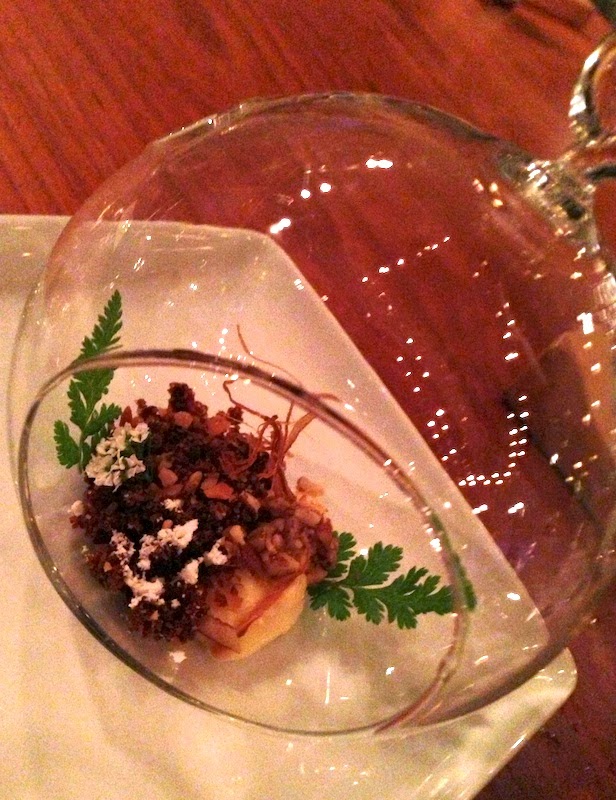
Terrarium…delicious!

Chef Matt Costello (top photo, introducing the evening's menu) has helmed the inn's restaurant since leaving Tom Douglas's Seattle empire ten years ago. His inspiration comes from what he said is "the transition point between the forest and the sea where excitement happens." His dinners feature Northwest ingredients, including a lot of foraged items like devil's club shoots, horsetails, sea lettuces and rose hips, as well as produce he and his wife grow on five acres of land they farm just outside of town. Costello said it's all aimed at giving his guests "a sense of where they're eating."

A fair amount of modernist technique appears in his cooking, but it isn't the focus of the menu. Instead, he scatters it throughout the meal to concentrate a flavor here or a texture there. Above all, the dishes show a great deal of joy, and even whimsy, in their preparation, exemplified by the little terrariums in glass globes that floated above the big central table through most of the meal until Costello cut them down and set them in front of us. The "forest and earth" course!

He said it's all in an effort to bring guests into a community, making it a richer experience than words on a menu and food coming out of the kitchen. I know I felt it and, from the bubbling conversation around the table during the evening and exchanging of stories afterward, other guests that night did, too.

Read the other posts in this series: Whidbey Island Idyll, Pt. 2, about Greenbank Farm and Camano Island Coffee Roasters, and Pt. 3, Cama Beach on Camano Island.

Friday, September 27, 2013

Still Life, Transylvania


My friend Linda is in Transylvania, revisiting old friends from previous travels and, because she is the kind of warm and compassionate person who draws wonderful people to her, making many new ones. She sent me this country still life from her current trip.

You can read about her previous trip involving a village gathering to slaughter a pig and how to make rose hip jam.