Showing posts with label Camano Island. Show all posts

Tuesday, January 07, 2014

Travels with Chili: Cama Beach on Camano Island


As a kid I loved going to summer camp, a few days away from home spent in an old Episcopal Church retreat center in Eastern Oregon. Days were filled with swimming at the natural hot springs pool in town—diving for rocks in the deep end was the main activity—and art activities in the ancient crafts cabin taught by an equally ancient, and very sweet, woman who'd taught children to weave gimp lanyards and glaze copper jewelry since my mother went to the camp as a child.

The setting. The cabins are on the point of land jutting into the water in the upper left.

The original cabins, small and unadorned except for rows of cots for the campers, had the sweet smell of old wood and fresh air, a scent memory I was reminded of when we toured Cama Beach State Park on Camano Island. The cabins there, 24 of them set in double rows along a stretch of beach on the Saratoga Passage, were no doubt made from trees logged on the property. The wood-paneled interiors were spartan, but with beds instead of camp cots, and furnished with a dining table, refrigerator and microwave oven.

Cubbies and thumbtacks in the office.

The park was originally a fishing resort in the 1930s, though the beach had been fished for centuries before that by the island's Native American population, and the old office building still had the cubbyholes and complicated colored thumbtack system that served to keep track of the renters. It also featured a historical collection from its heyday as a vacation spot for Seattle families along with natural history displays, including a whale jawbone.

A cabin interior.

No cars are allowed at the beach cabins, so campers and their supplies are shuttled by bus from the Welcome Center at the park's entrance. The Center, a concession to modern needs, was designed to fit in with the older style of the cabins and is set on a bluff overlooking the beach. It has a café and a small store in case campers need a break from the rustic cabins (or a box of matches), and also features a large hall for events.

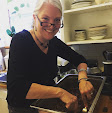
Main boat dude Shane Bishop, the Cama Beach manager.

The Center for Wooden Boats is located on the shore near the cabins, with classes on toy boat building for kids and with boats of all stripes available to rent. There are also various historical boats on display, some that belong to the center and some that are being restored for clients. Which means that if you're a boat nerd, this is the place to go to get inside info on building and caring for wooden watercraft, or if you have a yen to stroke the hull of a 100-year-old Maine canoe.

And if the park itself feels like you're stepping back to a simpler time, it's easy to hop in your car and visit the other attractions of Camano Island, or drive over the dramatic bridge at Deception Pass and go on a day tour of Whidbey Island.

The peace and quiet of cabin life with a soupçon of modernity on the side? Sign me up!

(Map to drive the four hours from Portland here.)

Read the other posts in this series: Whidbey Island Idyll, Pt. 1, about the town of Langley, and Whidbey Island Idyll, Pt. 2, about Greenbank Farm and Camano Island Coffee Roasters.

Friday, November 01, 2013

Travels with Chili: Whidbey Island Idyll, Pt. 2


Mention living on an island and what springs to mind is an existence far from the concerns of busy mainlanders, a place where everyday cares and concerns take a back seat to quiet and contemplation. While it is impossible not to appreciate, and even meditate on, the deep green beauty that is the northern end of Washington's Puget Sound, there is much happening of a consequential nature on these islands, too.

Greenbank Farm

North of Langley, past Holmes Harbor and through fields dotted with yet-to-be-sheared sheep, near the narrow waist of the long body that is Whidbey Island, is a cluster of old-style red buildings known collectively as Greenbank Farm. Originally more than 500 acres of prime agricultural and forest land, it had evolved from an ancient gathering place for Native Americans to a dairy farm and, by the middle of the last century, to the largest loganberry farm in the country. In the mid-1970s it was acquired by Chateau Ste. Michelle as part of a larger business deal, and by the 90s was slated to be sold off to develop 400 homesites.

Horrified locals rallied to save the historic farm and buildings, and in 1997 a unique con­sor­tium con­sist­ing of the county, the Nature Con­ser­vancy and the Port of Coupeville pur­chased the prop­erty, renaming it Greenbank Farm after the small community nearby. The mission of the farm was focused on four areas: agriculture, natural resource stewardship, economic development and recreation, outlined in an ambitious Master Site Plan developed in 2009.

Go there now and  you'll find the original barn from 1904 that contains farm offices, a large event space and the startlingly delicious pies and pastries of Whidbey Pies. Next door are newer buildings built to mimic the architectural style of the barn and housing art galleries, a wine shop and a cheese shop.

It's also the home of an innovative farmer training program called the Organic Farm School, a 7 1/2-month-long hands-on course that teaches aspir­ing farm­ers the tech­ni­cal and busi­ness skills needed to run a small-scale organic farm. And it doesn't stop there…the school offers mentoring, networking and placement for its students, as well as teaching students how to develop an individualized business plan and giving them practical help with financing.

* * *

Camano Island Coffee Roasters


By the time he was in his early 30s, Jeff Ericson was a multimillionaire businessman in Arizona. Despite this early success, he was also unhappy, realizing that all that money hadn't brought the satisfaction he desired. Added to that was his weight—well over 400 pounds—and the life-threatening toll it was taking on his body. Looking to get healthy, as well as to rekindle the passion for business he'd experienced earlier in his life, he decided to start over on Camano Island, which he'd run across on a business trip to Washington State.

Serendipitously, about the same time he was starting Camano Island Coffee Roasters, he read an article about an organization called Agros International in Seattle. Dedicated to social and economic justice in Central America, it purchases agricultural land and provides microloans to families caught in the cycle of poverty, giving them the tools to become self-reliant. Attracted to this model, Ericson decided partner with Agros and buy his organic, fair-trade, shade-grown coffee beans from their farmers.

Now involved in more than 40 villages and having worked with 25,000 farmers, Ericson has become an evangelist for socially responsible business and how it can affect real change in people's lives while serving the bottom line. And he's not just talking about the poor farmers that he's met. He's heard from his customers that his coffee has changed their lives, too. As he says in the video above, "Change can happen with every cup of coffee."

Read the other posts in this series: Whidbey Island Idyll, Pt. 1, about the town of Langley, and Pt. 3, Cama Beach on Camano Island. Photo of Greenbank Farm at top ©RoseAnn Alspektor.