Wednesday, January 30, 2019

Your Food, Your Legislature: 2019 Session Kicks Off with Big Issues on the Docket


On the first day of the 2019 Oregon legislative session, more than 1,500 bills were introduced, and there are likely to be at least twice that many by the time the session ends in five months. Here at Good Stuff NW I'll be reporting on the issues facing our legislators, particularly those bills that could affect our food system here in Oregon. Plans are afoot for monthly installments titled Your Food, Your Legislature, bringing you updates with background on, and the dirt from, the major players.

A bill banning aerial application of pesticides considered.

Among the top issues for our food system so far are bills that could ban or heavily limit aerial spraying of pesticides (HB 2493); a bill that seeks to assign responsibility to the patent-holder of genetically modified seeds for losses to a farmer's income due to contamination from genetically modified crops (SB 434); restrictions on the home use of neonicotinoid pesticides (HB 2619); and the proposed moratorium on current and future mega-dairies—factory farms that typically house thousands of cows in indoor facilities—until legislators establish regulations for these industrial facilities (SB 103 and SB 104).

Another big issue that's being pushed this session is the so-called "Clean Energy Jobs" bill (HB 2020), a cap-and-trade effort that seeks to, in the words of advocates, "put a limit and price on climate pollution from the largest polluters in the state" as well as "secure greenhouse gas reductions and reinvestment into communities across Oregon to create clean energy jobs and a thriving economy, especially in communities that need it most."

Wind turbines in the Columbia River Gorge.

An article in the Oregonian said that Oregon Governor Kate Brown, Senate President Peter Courtney and House Speaker Tina Kotek "are all in on putting a price on greenhouse gas emissions, and Oregon could become the second state after California with an economy-wide cap on such emissions. What remains to be negotiated is how many big emitters qualify for free emissions allowances under the law, and whether the program has any environmental integrity." Another big question is whether the new bill will broadly exempt agricultural sources like factory farms from the cap, as did a similar cap-and-trade bill that failed to pass two years ago.

Ivan Maluski, Policy Director for Friends of Family Farmers (FoFF), which conducted a series of "listening sessions" with farmers across the state, said that farmers expressed the need for legislators to do more to support Oregon's small and mid-size family farmers. "Small and mid-sized family farmers face significant challenges," Maluski said. He outlined the farmers' primary concerns as getting assistance in accessing land and capital, enabling access to small farm meat processing infrastructure, expanding opportunities for agritourism, and aiding farmers in improving water conservation efforts. Follow HB 2020.

On the issue of aerial spraying of pesticides, concerns around this practice—widely used on agricultural and public lands in Oregon—center on the damage cause by "off-target drift," that is, the tendency for these sprays to drift beyond the targeted areas, causing damage to nearby crops, waterways, wildlife and beneficial insects. Several environmental, agricultural and consumer groups can be expected to be involved in this legislation as it develops. Follow HB 2493.

Oregon taxpayers are on the hook for cleaning up escaped GE bentgrass.

The subject of what happens to a farmer who suffers losses when a crop is contaminated by genetically modified crops is an issue that the legislature has wrestled with in past sessions.

"I’ve had a front row seat to the damage caused by Roundup Ready GE bentgrass, which spreads easily on the wind and through water, infesting irrigation ditches and cross-pollinating with wild relatives," wrote Vale farmer Jerry Erstrom in an op-ed when a similar bill was before the 2017 legislature. "I am not opposed to genetically engineered crops, but as a farmer of some non-GE varieties, and after my experience with GE contamination in my alfalfa seed production, and with the GE creeping bentgrass escape, I am a supporter of making the right people accountable if crops are damaged."

 "The legislature tends to be crisis-oriented," said Maluski, indicating that FoFF will be actively involved with the Center for Food Safety and Our Family Farms Coalition as the bill moves through the legislative process.

"We shouldn't have to wait for a contamination incident before we put rules in place," he said, citing the appearance of an experimental variety of Monsanto's genetically modified wheat that appeared in an Oregon field in 2013. Follow SB 434.

Toxic emissions are just one problem with factory farm dairies.

Two bills, SB103 and SB104, are an effort to establish regulations governing factory farm dairies that are already located, or that may want to locate, in Oregon. Both bills apply to mega-dairies, that is, facilities with more than 700 cows that are confined without seasonal access to pasture, or 2,500 cows. The legislation would regulate these dairies as the industrial factories they are rather than treating them as traditional agricultural farms, and would require limits on toxic emissions to air and water, including groundwater. These bills would require studies on the impacts to Oregon's small and mid-size dairies and on animal welfare. They would also close existing loopholes that allow excessive use of scarce groundwater, and establish a course of action if a facility fails to meet state standards, as happened with Lost Valley Farm, a mega-dairy that piled up more than 200 violations in less than two years of operation and yet was still allowed to keep operating.

“Lost Valley showed us how horribly wrong things can go given our current laws,” said Amy van Saun, staff attorney at the Center for Food Safety in Portland, in an article in the Salem Statesman-Journal. If these bills pass, according to the article, factory farms "wouldn’t qualify for regulatory exemptions available to farmers under the state’s right-to-farm and other laws. That would allow local communities to have input into siting decisions and enact health and safety ordinances restricting or prohibiting air and water emissions," a problem that's occurred with other industrial agricultural operations looking to locate in Oregon.

Since it's still early days in this session, there will be more to come, and you can count on reading about the legislative sausage-making in future updates. Stay tuned!

Read more about the ongoing problems at Lost Valley Farm.

Monday, January 28, 2019

The Revolutionary Art of Home Economics


"If home is where the heart is and if we’re all drawn to home, why do we feel so unrooted? Tell me what your notion of home is. Tell me what it feels like. And tell me who’s there, how many times you’ve moved. Because there’s this vision, this heart movement, but what are our true stories?"

When Harriet Fasenfest discusses the art of radical homemaking, she's not talking about taking your macaroni and cheese to the next level with sphericalized balls of sriracha—though feel free to steal that idea for the next edition of Modernist Cuisine, Max—or starting your next dinner party with readings from Marie Kondo's latest tome.

No, Harriet is talking about, oh, upending the myth of capitalism as necessary for a democracy to function and exposing the patriarchal system that set it up and perpetuates it.

So, not what you'd call cocktail party chatter.

She's offering a series of five intriguing monthly classes titled The Revolutionary Art of Home Economics starting on Saturday, February 2, and continuing through Saturday, June 1, from 11 am to 1 pm at Leven Community Center in Northeast Portland. In the class description, Fasenfest describes the sessions as investigating the transfiguration of land and labor from resources within the home economy into services and products within the capitalized market economy. She said this hands-on, participatory experience "will range from the historical to the personal, from budget making, pie charts, essay assignments, and food storage systems, to a bit of jam making in the garden, with the aim of elevating not only our understanding of the revolutionary art of home economics but it’s capacity to restore our lives and the life of the planet to sanity, joy and repair."

I first met Harriet when we lived in Sellwood and she had leased the Bertie Lou Café in 1982, a neighborhood joint that had been in operation since the 1940s. A single mom with a two-year-old son and no restaurant experience on her resumé, she walked in and started making blintzes along with other breakfast favorites in the diminuitive space. Discovered by restaurant reviewer Karen Brooks soon after it opened, and whose rave about the tiny gem drew crowds—a virtually unknown phenomenon at the time—and garnered Fasenfest ardent fans who followed her when she opened Harriet's Eat Now Café in a different location in Sellwood, then to Harriet's café in Old Town's Skidmore Building.

A marriage and a move to Georgia introduced her to Habitat for Humanity's founders Millard and Linda Fuller, where Fasenfest became Millard's travel coordinator as well as the couple's neighbor.

"We’d go to hear Jimmy [Carter], and I gave Rosalyn Carter my tomato chutney," she said of the period. "[The Fullers] really inspired me in terms of their heart. I was much taken by this thing called the Christian witness, although I know it’s not reserved [just for] Christians."

The sudden death of her husband from mad cow disease upended her life and resulted in a move back to Portland to regroup. She connected with Christy Eugenis, who at the time was creating an event space called the North Star Ballroom in an Italian Renaissance-style Odd Fellows lodge in North Portland. Fasenfest became director of its Performance Salon Series, organizing events combining art and performance with social activism.

That focus on activism led Fasenfest to contemplate starting her own salon series when, by chance, she ran across a corner space in what was then the nascent Alberta Arts District.

"As an old restaurateur I thought, oh man, that spot’s so freaking cute," she said of the space that would house Groundswell Productions. Fasenfest's son, who at the time was going to PNCA, thought it would be a great place for student art shows. "I thought well, maybe I could have my office and they could do some art shows and I can continue mounting my salon series."

The last thing on her mind was starting another café, but at the time the street only had a couple of coffee shops, and offering coffee and pastries would supplement the income from the events. So she reluctantly jumped back into the food business.

"But I didn’t want to cook, I was done with it. I just wanted to address social issues," she said. "People would come and say, 'Oh, these are really great!' and I’d go, 'This is a think tank, not a coffee shop!' People were, like, 'What’s up with her?'"

Selling the café pushed her to start Preserve, teaching classes focused on reviving the lost art of home preservation in a storefront on Alberta, then in Fasenfest's Northeast Portland home. In 2010  Fasenfest published a book on what she had begun calling "householding," preferring that term to "homemaking" or "home economics." Titled "A Householder's Guide to the Universe," it took up the banner of progressive homemaking and urban farming as a way to confront the political, social and environmental issues facing the world.

The book precipitated a deep dive into the history of home economics and Fasenfest began the daunting task of unraveling the strands that she felt had led to the global problems caused by our current capitalist economy.

"What happened to us as a people?" she remembers asking herself. "What happened to our relationships? Why do we make choices? What about the system makes it harder for us to be connected to each other? How were all my skills  and knowledge replaced by industry?

"I could teach till the cows come home, but people are busy or they think it’s kind of a hobby," she said. "They really don’t have the fire in the belly to shift from their lives of consumers in the market economy and shift to the home economy."

Seeking answers to those questions led her to begin a second book, one which she describes as a curriculum for understanding how we got here, and how to work our way out of it. "One part is history, then there are skills, then there are essays," she said. "I’m wanting all of us together to slowly deconstruct what the tethers are, where our home is."

Using the new book as a guide, the new class series will cost $150 for the five sessions. Contact Fasenfest via e-mail for more information or to sign up, or go to the School of Home Economics page on Facebook.

All photos courtesy Harriet Fasenfest.

Friday, January 18, 2019

Game-Day Comfort: Beer Cheese Soup!


When I heard that a couple we know have an annual party on Super Bowl Sunday, I was shocked. You see, if there are any of our friends who seem completely unlikely to be putting on giant foam hats or wearing team scarves or jumping around pumping their fists in the air (covered or not in outsized foam rubber pointy fingers) shouting at the television, it's these two.

Pimento cheese on a Ritz.

So I was relieved when they admitted, after witnessing our shocked countenances (mouths agape), that it was really all about the food for the event. It conjured images of miniature hot dogs swimming in mahogany barbecue sauce, overflowing bowls of salt-encrusted potato chips with virtual vats of onion and clam dips at the ready, as well as the requisite pimento cheese dip to slather on crackers—Ritz, Triscuits or Wheat Thins, depending on your inclination.

All that salt was, of course, as anyone knows who has succumbed to the siren song of free pretzels at their neighborhood watering hole, intended to encourage the consumption of any liquid within reach, normally beer, for purposes of hydration. Naturally I volunteered to bring any and all of the consumables mentioned above to the festivities, since, being a person of dodgy acquaintance with sporting endeavors yet always johnny-on-the-spot for anything involving chips and dips, I was, as they say, all up-ons.

The recipe file reveals all.

The conversation happened to coincide with running across a recipe from my college days when I managed a soup kitchen—we called it a "coffeehouse" at the time—at the U of O that served a soup and bread lunch for a nominal sum five days a week, relying on a haphazard yet dogged cadre of volunteer cooks to prepare several gallons of the potage of their choice for the day's service. Most were a simple combination of stock, vegetables and protein, like Robert's French Onion Soup l'Abbe or Jane's Potage Parmentier—but one in particular stood out for its inclusion of beer.

Mike, the ostensible manager of the campus Koinonia House, had a family recipe for a beer cheese soup that her family was  crazy about and that she volunteered to make on a weekly basis, a guaranteed winner in my book. It also became a viral hit in those pre-viral days, and I commend it to you for any and all of your game-day gatherings. Rich, creamy, with that certain beer-y je ne sais quoi, it's best made a few hours or even a day ahead to allow the flavors to meld and the beer to mellow. Or heck, if you want, just whip it up a few minutes before guests arrive and let the li'l smokies flow.

Mike's Beer Cheese Soup

3/4 c. butter  (one and one-half sticks)
1/2 c. diced onions
2 cloves garlic, minced
1/2 c. diced celery
1/2 c. diced carrots
1/2 c. flour
5 c. chicken stock
1/4 c. parmesan cheese
1/2 tsp. dry mustard
6 oz. cheddar
1 12-oz. bottle (or can) of beer, preferably a lager or pilsner
Salt and pepper to taste

Melt butter in large saucepan or Dutch oven over medium heat. Sauté  onions until tender. Add garlic, celery and carrots and sauté until tender. Add flour and dry mustard, stirring to combine. Stir for two minutes to prevent sticking, then stir in stock and cook for five minutes. Blend in cheeses and beer, combining well, and simmer for 10 minutes, stirring occasionally to prevent scorching. Using a stick blender or working in batches with a blender, purée the soup. Season to taste with salt.

This is best made a few hours or, better yet, a day ahead and reheated, which allows the flavors to mellow. Serve with salad and a good artisan loaf.

Monday, January 14, 2019

Farm Bill 2018: Two Views


Months of "jockeying, hand wringing, and horse trading, largely behind closed doors" according to Oregon Congressman Earl Blumenauer, came to a close recently as the Farm Bill, the sweeping agriculture and nutrition legislation that comes up for renewal every five years, passed the House by a vote of 369 to 47. It was largely stripped of Republican demands for work requirements for people receiving food assistance through the Supplemental Nutrition Assistance Program (SNAP, formerly food stamps), which had stalled the bill for months.

Oregon Congressman Earl Blumenauer.

The bill that was passed largely continues the agricultural subsidies of previous bills, which are predominantly claimed by large corporate farms, and added a provision that said any member of an extended family who runs a "family farm" can annually receive $125,000 in subsidies ($250,000 if they are married) if they provide “active personal management only,” even from afar, according to an article from Taxpayers for Common Sense. This basically redefines a family farm as a managed operation where the manager doesn't even have to set foot on the farm in order to collect government subsidies, a clear boon to corporate-owned and industrial operations.

Blumenauer was one of three Democrats to oppose the bill, stating in a press release that it "pays too much to the wrong people to grow the wrong foods in the wrong places." He called it "a missed opportunity to make real improvements for farmers, the climate, and the food we eat every single day." The Oregon congressman has instead been pushing for what he calls the "Food and Farm Act," an alternative bill that comprehensively advances reforms on four principles: (1) focusing resources on those who need it most; (2) fostering innovation; (3) encouraging investments in people and the planet; and (4) ensuring access to healthy foods.

Clif Bar's Matthew Dillon.

A different view of the revised Farm Bill was presented by Matthew Dillon, senior director of agricultural policy and programs for Clif Bar & Company, in an op-ed he wrote for The Hill, a Washington, DC-based news outlet. Declaring that the bill as passed is a victory for the future of organic agriculture in the U.S., Dillon pointed to the fact that the bill "for the first time establishes permanent funding for organic research by authorizing $50 million in annual funding for the Organic Agriculture Research and Extension Initiative by the year 2023." The $50 million figure makes the program “baseline” or mandatory in the United States Department of Agriculture budget, creating more stability for organic researchers and farmers, he wrote.

"Demand for organic agriculture far outstrips supply, causing our country to import many organic crops that could be produced domestically," Dillon stated. "Capturing the more profitable value of organic production for American farmers is particularly important at a time when net farm incomes across the country have fallen down to the lowest level in 12 years, declining more than 14 percent this year, and showing little sign of turnaround."

Believing that support for organic research is critical in helping farmers transitioning to organic production, Dillon wrote that the guarantee of funding will aid farmers in keeping up with the most effective techniques for soil fertility and pest management. While he admitted that the farm bill will always have room for improvement, "this landmark new gain of stable funding for organic research is critical to the survival of organic farms and the expansion of organic acreage. It is good for rural communities, good for farmers, and good for the planet."

Blumenauer, for his part, takes both political parties and the Congress to task for its business-as-usual approach to the Farm Bill. "Every day that we continue the status quo, we delay improving and enriching communities, and helping families live healthier lives," he stated. "We can and must do better to help increase access to healthy food for all families.  This final bill fundamentally misses the mark on addressing critical reforms that communities across the country desperately need. Americans deserve a Farm Bill that works for them and their families—not corporate mega-farms. I will continue to lead the opposition to the current Farm Bill structure, fighting instead for a better outcome for all Americans."

Wednesday, January 02, 2019

Guest Essay: Ode to a Cabbage


I can't think of anyone I know who adores cabbage more than contributor Jim Dixon of Real Good Food, as evidenced by this essay, an updated version of one first published here in 2015. Whether fresh, sautéed, braised, pickled, fermented or fried, you'll still find it making an appearance on his table. Here he shares some history, as well as his favorite ways to prepare it. 

I love cabbage.

And I’m not talking about Savoy cabbage, the frilly version that’s been tarted up with a first name hinting of royalty. Or the other members of the Brassica oleracea family, including the various kales and collards, broccoli, kohlrabi, cauliflower, and Brussels sprouts, deliciously gorgeous as they are. Or the strangely compelling relatives from central Asia, original home of turnips, broccoli rabe, bok choy, tatsoi, and mizuna, all part of the Brassica rapa clan.

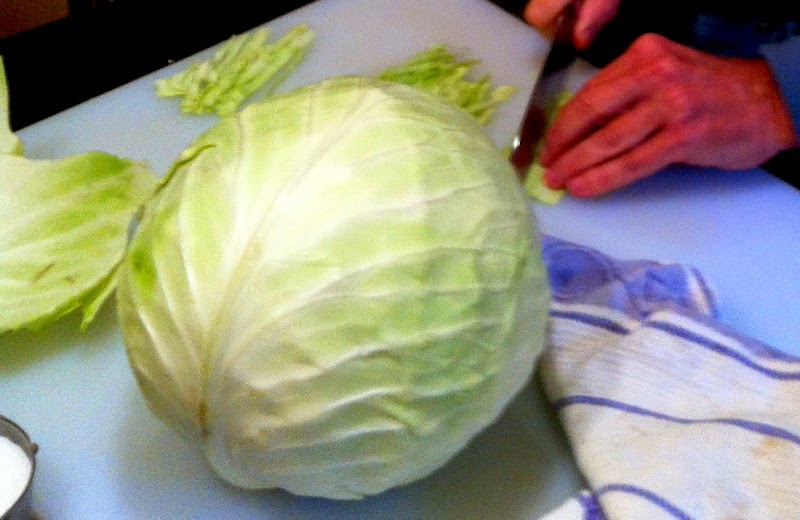
No, my heart belongs to the ordinary, everyday cabbage, its pale green leaves tightly bound into a waxy ball, the humble heads tucked coyly away in the corner of the produce section. It’s cheap, reliable, and flexible; who wouldn’t fall in love?

It doesn’t hurt that cabbage is good for me, lends itself to last-minute cooking, doesn’t cost much and grows, relatively speaking, in my own backyard.

Humankind’s relationship with Brassica started early. In his encyclopedic work Food: An Authoritative and Visual History and Dictionary of the Foods of the World, Waverley Root relates one ancient Greek belief of its origins: Dionysus, the god of wine, caught Lycurgus, the Edonian king, pulling up grapevines. While awaiting punishment, the king wept, and from his tears sprang cabbages.

An alternate myth has Jupiter sweating as he tries to explain contradictory oracles, and the cabbages sprout from his perspiration.

Those ancient Greeks might’ve been on to something. But given my devotion it seems more likely that Eros, the god of love, was involved.

Wild cabbages, resembling kale more than my beloved green globes, grew along the Mediterranean coast, and according to Harold McGee, in his book On Food and Cooking, the “salty, sunny habitat accounts for the thick, succulent, waxy leaves” that make cabbages so hardy. Domesticated about 2,500 years ago, cabbage spread across Europe.

Because it tolerates cold weather, cabbage became an important staple farther north, and we typically associate it with the hearty cuisines of climes damp and gray.

But the Romans, like me, loved cabbage, and they’re probably responsible for the selective cultivation that resulted in so many disparate variations. By encouraging an existing tendency for the curling leaves to form more tightly packed bunches, those early Italian farmers created today’s well-known “heading cabbages.”

Our name for these derives from the colloquial French word for head, caboche. Vegetable lore tells us that the Italian Catherine de’ Medici brought cabbage to France when she married fellow 14-year-old Henri de Valois, the Duke of Orleans and, eventually, King Henry II. History is silent as to whether she called him mon petit chou, or “my little cabbage.” But the endearment reflects the continuing French love of cabbage, from the choucroute of Alsace to the thick stew called gabure in the south.

Early cabbage fanciers also associated it with good health. Egyptians ate it with vinegar to prevent hangovers, Greeks dribbled cabbage juice into sore eyes, and Romans packed aching muscles with cabbage poultices. Herbalists today recommend cabbage for its anti-inflammatory effects, telling breastfeeding mothers to tuck a few bruised leaves into their bras for relief. It’s got lots of vitamins A, B, C, and E, and a study at Georgetown University showed how phytochemicals in cabbage might reduce cancer risks.

However, those same phytochemicals provide the frequently noted boardinghouse smell of overcooked cabbage, something that bothers others much more than it bothers me. Maybe I’m blinded, in an olfactory sense, by love, suffering from a cabbage-passion-induced anosmia. Or perhaps my approach to cooking mon petit chou reduces the breakdown of glucosinolates, the sulfur-containing compounds released when cabbage is boiled too long.

More likely, it’s the variety of cabbage. Brussels sprouts contain more of the healthful and stinky compounds than any of the other Brassicas. Heading cabbages, with their residual sugars, offer a sweeter love.

Farmers here in the Pacific Northwest harvest cabbage from mid-July through the end of December. Properly stored, it keeps for up to six months, so it’s theoretically possible to eat local cabbage all year. Prices vary, with conventionally grown cabbage usually less than a dollar per pound, organic about half again as much. Just before Christmas I bought an enormous head at a farmers’ market for only two dollars.

So, how do I love cabbage? Let me count the ways.
  1. I love it cooked in a little olive oil with onion. There’s a head of cabbage in the refrigerator and onions in the pantry most of the time, so I make this almost every week. But cabbage loves pork, and I love them together. So start with a little diced bacon, then sauté the onions and cabbage in the smoky fat. A dollop of crème fraîche makes both of these simple dishes unctuous and rich.
  2. A bed of shredded cabbage roasted under a chicken steals my heart.
  3. I love how the cabbage I add to my feeling-a-cold-coming chicken soup gives it enough substance to fill me up.
  4. I’m crazy for coleslaw, the green salad I turn to when winter’s lettuce comes wilted from a long truck ride north and again when the hot summer sun makes my garden’s leaves bolt and turn bitter.
  5. Je t’aime, choucroute braisée à l’Alsacienne: Julia Child kindled new passion for sauerkraut by teaching me to simmer it slowly for hours in crisp white wine.
  6. Marcella Hazan makes me cry, “cavolo sofegao, come sei bella,” with her Venetian-style smothered cabbage, another slow-cooked dish transformed with a splash of vinegar.
  7. Te amo cocido, tambien. While these one-pot Spanish stews often call for whole chickens, pigs’ trotters, veal shanks and a garden’s worth of vegetables, I make a simple version with just garbanzos, potatoes and cabbage.
  8. Louisiana-style smothered cabbage makes me ask, "how's ya mama and dem?"
Cabbage love comes in many other forms, and though the steady routine of our long-term relationship provides familiar comfort, I don’t want it to get stale. So I keep searching for new outlets for my passion, different ways to express my feelings, unexplored culinary territory where I can say, again and again, I love cabbage.

Sunday, December 30, 2018

Rave-Worthy Party Dip in Ten Minutes? Yes, It's Hummus


In my view, hummus is one of those intensely flavorful, iconic cultural touchstones that has been bastardized beyond recognition. Just think of the little plastic containers you see in the grocery store of roasted pepper hummus, artichoke hummus and—I swear I'm not making this up—Thai coconut curry hummus.

Linda Dalal Sawaya, local Portland artist, writer and author of Alice's Kitchen: Traditional Lebanese Cooking, a collection of recipes handed down from her Lebanese mother and grandmother, describes her family's "Hommus" this way:

"Our family loves hommus bi tahini best when it is tangy, the way Mama and Sitto made it. We garnish it with a liitle olive oil. In Lebanon, pomegranate seeds, whole garbanzo beans, and a drizzle of olive oil might be the garnish. Chopped fresh mint and olive oil also make a lovely garnish."

Sublime made from scratch with quality ingredients.

With her recipe, she describes her mother—fans of the pesto scene in the recent documentary Salt, Fat, Acid, Heat with Samin Nosrat, take note—mashing garbanzo beans by hand the traditional way.

Back when I was in college, hummus was the barely edible, dry stuff you brought to parties in college because it was widely available and a cheap way to feed your friends. I'd give my own efforts an "okay" rating back then and, even at that, it was way better than most of the stuff sold at even the most effete grocery stores, which ranged from chemical-tasting to having that certain je-ne-sais-quoi cardboard flavor. Even here in Portland, there are still very few who make a decent version, outside of Middle-Eastern restaurants like Ya Hala or Hoda's, both of which also make their own pita bread.

Soak overnight, drain, cook. Easy!

Later, my yearnings for truly good homemade hummus were granted with a recipe that my parents brought back from their pre-retirement sojourn in Liberia (yes, in Africa) where they met several Lebanese couples who were teachers at the college my parents worked for. My mother, being a discerning sort and knowing a good thing when she tasted it, begged a couple of recipes from them that she shared on their return home.

Ever since, our lives and the success of many a gathering have been aided and abetted by her ingenuity. I hope you agree her efforts weren't in vain.

Hummus

This is best made from dried chickpeas (garbanzo beans) that have been soaked overnight, drained and then cooked in fresh water for an hour or so until tender. For the best flavor, I highly recommend Ayers Creek Farm's organic Tualatin Chick Peas, available at Rubinette Produce. The following recipe makes approximately three cups of hummus.

Taratoor sauce:
2 small garlic cloves
1/2 c. tahini paste (sesame butter)
1/4 c. lemon juice
1/2 tsp. salt

Hummus:
1 15-oz. can garbanzo beans or 2 c. cooked chickpeas
2 tsp. salt
3 garlic cloves
1/4 c. lemon juice
1/4 c. water

You can make this in one step by placing all the ingredients in the food processor and processing till it all turns to a smooth consistency. Garnish with a drizzle of olive oil and a sprinkling of paprika (or better yet, Spanish pimenton) or the traditional sumac.

The taratoor by itself makes a terrific sauce for pork or meats, or drizzle it over rice or vegetables, or as a dipping sauce with appetizers like stuffed grape leaves.

Friday, December 21, 2018

Drinking In the Holiday Cheer: Four Faves!


During the holiday season my parents would invariably designate one evening before Christmas to invite friends over for an open house. My mom, a dedicated holiday baker, used the occasion to haul out all the fruitcakes she'd made—one packed with whole nuts and citron barely held together with batter, an applesauce bread studded with nuts and raisins, another cakey version that had been wrapped in brandy-soaked cloth—plus cookies filled with jam, pinwheels stuffed with dates, and her signature Nanaimo bars that I'd eat by the dozen, all displayed on holiday-themed platters.

Classic set for a classic holiday cocktail.

My dad made sure the bar was well-stocked, but his main task was to dig out the Tom & Jerry set from the basement and pull out the recipe card from the file, dog-eared, faded and stained from literally decades of Christmas parties past. On the day of the party, as Mom ran around the house in a frenzy, inspecting (and often redoing) my lackadaisical dusting and vacuuming, fussing over the table decorations of carefully arranged boughs studded with shiny glass Christmas ornaments, and my dad would start making the batter for his Tom & Jerrys.

A hot toddy hits the spot on a winter night.

I don't remember any of their friends making this classic holiday drink, but it was a staple at our house growing up. Dad, who in my memory almost never spent time in the kitchen, would carefully separate the egg whites from the yolks, beat the whites into glossy peaks, then gradually fold in the yolks that had been beaten with powdered sugar and whipping cream. I was particularly fascinated with the teensy brown glass bottles of cinnamon and clove oil that had no doubt been around for years, since the batter only required a drop of each to flavor it. He'd dip a toothpick into the little bottle and pull it out, a shimmering drop of oil clinging to it, and ever so carefully let it drip into the batter.

The Bloody Monkey makes the most of winter citrus.

By this point Mom would have vanished upstairs to get dressed and put on lipstick—bright red—to match her holly-trimmed holiday apron, and Dad would be mixing the rum and brandy and putting the kettle on for topping off the cups. It's memories like these that, whenever the holidays roll around and the cold starts to creep in through the cracks around our doors and windows, you'll find me heading down to the basement to dig out our own Tom & Jerry set, start whipping egg whites and inviting the neighbors over.

Cola de Mono is a Chilean holiday fave.

Over the years I've collected a few recipes for holiday cocktails, and now seemed like a good opportunity to share them with you. Enjoy, and start making memories for you and yours!

My Dad’s Tom & Jerrys

For the batter:
6 eggs
Pinch of cream of tartar
1 lb. powdered sugar
1 drop oil of cinnamon*
1 drop oil of clove*
1/2 c. whipping cream

For each drink:
1 jigger (1.5 oz.) brandy
1/2 jigger (.75 oz.) rum
2 Tbsp. batter
Boiling water
Dash of fresh-ground nutmeg

Separate eggs, putting yolks into large mixing bowl and whites into another bowl large enough to whip them in. Add cream of tartar to whites and whip into stiff peaks.

Beat egg yolks to combine and add cinnamon oil, clove oil and whipping cream. Beat, gradually adding powdered sugar till the mixture is thick and smooth. Add whipped egg white and slowly fold them into each other till you have a smooth, light batter.

To make drinks, put brandy, rum and batter into each cup (ours are 6-oz. cups), fill with boiling water and stir. Top with a sprinkle of ground nutmeg. For the kids, make Clyde & Harrys—simply leave out the alcohol and combine the batter and hot water and stir, topping with the nutmeg.

* Oils available at many natural foods stores. Just make sure they're food grade.

* * *

Ann and Chad's Hot Toddies

1 slice lemon, 1/8" thick
1 cinnamon stick
3 whole cloves
Pinch of fresh ground nutmeg
1 1/2 oz. whiskey (your choice)
2 oz. boiling water
1 tsp. honey

Place lemon in bottom of a mug or heat-resistant cup. With a muddler or the back of a spoon, crush the lemon gently to release its juices. Add the remaining ingredients and stir to combine.

* * *

Rodrigo's Cola de Mono (Tail of a Monkey)

This is a traditional Chilean Christmas drink, usually served cold. Best made a couple of days ahead.

3 qts. whole milk
4 c. of sugar
Peel of an orange (about 1" wide by 2" long)
4 cloves
A pinch of nutmeg
1 stick of cinnamon
2 Tbsp. freshly ground coffee
1 tsp. vanilla extract
1 qt. Aguardiente*, grappa** or pisco

Boil milk with sugar, orange skin, cloves, cinnamon and nutmeg.  Once the milk has come to a boil, remove from stove and add the coffee and vanilla extract and stir constantly for about 5 to ten minutes or until the coffee dissolves as much as possible.

Once the mixture is cold, filter it (paper filters work best) or use a really fine colander with a paper towel. Add the spirit and pour into bottles with tight lids. Place in refrigerator and let it sit for a couple of days before serving. It will keep for a couple of weeks in the fridge.

Shake well before opening. Serve cold, over ice if desired (though not traditional). Can be garnished with a cinnamon stick or a sprinkle of cinnamon if desired.

* Aguardiente is a denomination of spirits that can range from vodka to sugar cane based, so the name is given not because of the source, but the alcohol content, which can be upwards of 120 proof alcohol. In Chile, Aguardiente is made from grapes and the alcohol content is usually somewhere between 45-55% (above 55% is illegal). Because aguardiente is a very generic term and the actual product and alcohol content varies from region to region, I suggest using a grape spirit such as grappa or pisco, preferably between 45-50% alcohol.

** Grappa, like champagne, is a spirit produced from grapes and can only be called grappa if it complies with certain requirements, such as being produced in a certain region of Italy. That’s why substituting it with a grape-based spirit like pisco can lower the cost considerably.

* * *

Keith's Bloody Monkey

This variation on a Monkey Gland, but uses fresh winter citrus. Makes one cocktail.

1.5 oz. gin
1.5 oz. blood orange juice, strained of pulp
1 tsp. grenadine
1/2 tsp Pernod

Add all ingredients to cocktail shaker. Add ice till shaker is 3/4 full. Shake vigorously for 20-30 seconds. Strain into a cocktail glass. Garnish with slice of blood orange.

Thursday, December 20, 2018

Mega-Dairy Moratorium Demanded by Farm & Consumer Groups


A coalition of more than a dozen local, state and national organizations, including Friends of Family Farmers (FoFF), the Center for Animal Law Studies (CALS) and the Center for Food Safety (CFS) have called on state legislators in Salem to stop any further expansion of new or existing mega-dairies in Oregon until the state can guarantee protections for its people, animals, and the environment from the industrial-scale impacts of factory farm mega-dairies.

Waste from a mega-dairy can equal that of a small city.

According to the coalition's press release, "Oregon’s inadequate oversight of mega-dairies has become clear over the past two years, since the state ignored red flags and widespread public opposition to authorize operation of Lost Valley Farm, which was permitted to confine 30,000 cows. Lost Valley has since racked up nearly 200 permit violations and has had problems ranging from overflowing mortality and waste management facilities to a lack of clean water and restrooms for workers. As a result, the state is now fighting to shut the mega-dairy down. However, Oregon’s insufficient laws do not protect the state’s air and water, setting a standard so low that thousands of animals are raised in extreme confinement and family-scale dairies are forced out of business."

Cow laying in waste at Lost Valley Farm.

As documented extensively on Good Stuff NW, Lost Valley Farm has ignored or flagrantly violated permit regulations from the start, beginning construction on the massive facility without the required permits from the Oregon Department of Agriculture (ODA). Instead of shutting down the industrial facility until it went through proper permitting channels, the ODA gave Lost Valley the go-ahead to develop the facility. This is despite the facility—which is sited on a federally designated Groundwater Management Area (GWMA)—never completing construction of the required manure lagoons to protect the area's groundwater.

Cow standing in waste at Threemile Canyon Farms.

The legislature's track record on setting limits for these facilities has been lax at best, negligent at worst. Last year the legislature's Senate Committee on Environment and Natural Resources killed a bill, SB 197, that would have begun the process of setting up basic regulations on air contaminant emissions (like ammonia) from these  mega-dairies. Contaminants are not monitored or regulated due to a loophole in Oregon law that exempts these factory farms from any requirement to monitor, report or reduce air pollution associated with the manure from the tens of thousands of animals they keep.

Waste at mega-dairies is often kept in large open-air lagoons.

On its Facebook page, the Center for Animal Law Studies posted that, speaking on behalf of Humane Voters Oregon, Lewis & Clark Law School Professor Rajesh Reddy joined the growing chorus calling for a moratorium on new and expanded mega-dairies in the state. As quoted in the Statesman Journal newspaper, Professor Reddy addressed the documented cruelty at such farms: “The cows are more often subject to extreme confinement, without access to pasture, and are more likely to be treated like machines instead of living things. The pictures from Lost Valley Farm, of highly confined cows standing knee-deep in manure, show us where that can lead.”

Ivan Maluski, Policy Director of FoFF, is quoted in the coalition release as saying: “The state’s inadequate handling of the Lost Valley debacle, along with the catastrophic decline in Oregon’s small and mid-sized dairy farms, make clear that we need a time-out from new or expanded mega-dairies until it we have stronger environmental, animal welfare, public health, and family farm protections in place.”

For more information on mega-dairies in Oregon, read my article for Civil Eats, "Big Milk Brings Big Issues for Local Communities" as well as my post on Tillamook Cheese's connection to these factory farms, "Why I'm Quitting Tillamook Cheese." Read my full reporting on Threemile Canyon and Lost Valley mega-dairies.

Wednesday, December 19, 2018

Farm Bulletin: A Sense of the Organism


In the introduction of contributor Anthony Boutard's book on corn (link below), he remembers that "since childhood, I have enjoyed sweet corn from the garden. Eating fresh corn on the cob is a sensual pleasure that takes the sad edge off of the dwindling days of summer and, when I was a boy, the bittersweet start of school." Later, he and his wife, Carol, journeyed to Italy's Piedmont where they discovered what looked like Indian corn to their Western eyes, yet the Italians ground it into their famous polenta. It started them on their corn odyssey.

In 2009, we planted some corn seed given to us by someone who brought them back from Cuzco, Peru. As part of my research in writing Beautiful Corn, we planted a great many sorts that year with little regard to cross-pollination as they would not be used for seed production. The geneticist Barbara McClintock stressed the importance of developing the "sense of the organism” in her work with corn. It was sage advice. Sometimes we read a book on a crop and can’t help feeling the person lacks that sense—perhaps the information is delivered second-hand or third-hand. The Peruvian was planted in a block that included the first generation of what has become the Peace, No War flour corn; a single, chance ear of purple-colored corn in a block of blue corn that piqued our curiosity. We still have that ear with its missing kernels (top photo). We kept the chance ear planting upwind to avoid cross-pollination.

A massive branched ear.

The Peruvian plants were massive, some with a distinct purple zig-zagging stem. Multiple ears were born on long branches. Some we had to support them with fenceposts. The nodes above the ground produced aerial roots covered with a thick exudate. This August, a paper was published explaining how these exudates attract microbial communities that fix atmospheric nitrogen. They studied a variety from Oaxaca, but the gummy roots looked just like those we saw. This relationship may account for the corn's extravagance. Though for all of its vegetative drama, the Peruvian corn produced just a few ears with kernels. It was the only time we grew the Peruvian sort.

The "Esmé ear."

During that time, a friend brought Esmé Hennessy to the farm. Esmé is a botanical illustrator specializing in orchids who moved from South Africa to Portland where her son lived. She agreed to produce some illustrations for the book, so we delivered a box of ears to her house. Captivated by the odd Peruvian ear, she drew it first.

October 2018, nine years later in the Peace, No War planting, staff found a small ear strikingly similar to the ear Esmé drew. Some pollen from the Peruvian plants must have been caught in a contrarian zephyr or an eddy as the morning sun warmed the earth. Not the most elegant ear, nor as mature, but it shows how traits, such as the oddly colored kernels, can linger unexpressed in the genome. Bear in mind, we have been relentless in our quest for the darkest ear possible. We look for purple in the stem, foliage, cob, silk and kernel. At its extreme, the heavy pigmentation is a deleterious trait as the plant cannot photosynthesize adequately. As we have repeatedly said, Peace, No War is more art than agronomics. Despite the rigorous selection, the Peruvian kernel traits remained somewhere in the breeding population.

The "Esmé ear" returns.

Early on in our work with the chance ear population, just a couple dozen ears met our standards, now hundreds do. Nonetheless, off-types continue to appear because we emphasize two traits—early ripening and a high anthocyanin content. The reappearance of the traits in the peculiar ear that grabbed Esmé’s eye reminded us of other traits the Peruvian may have brought to the corn. As it happens, some other traits such as prop roots, zigzagging stalks, long ear stalks and other odds and ends may have come with those grains of pollen. Staff also brought in another variant we saw in the 2009 collection, flinty kernels with a bird’s egg mottling. That one had mature kernels so it may prompt the “Eggshell" art project, if we have space to tuck it in somewhere.

Aerial roots with exudates.

In all three lines of corn we currently maintain at the farm there is a genetic effervescence that makes them interesting. Sometimes the tassels have scattered kernels on them, sometimes the ears terminate with a small tassel. Some are so beautiful they would make a great ornamental. Geneticists apply the terms "dominant" and “recessive" to traits, though working with various crops we are happier thinking in terms of “loud” and “quiet.”

Reno Sweeney’s serenade to Billy Crocker, Public Enemy Number 13 starts “At words poetic, I’m so pathetic, that I have always found it best, instead of getting ' m off my chest, to let 'em rest unexpressed." Just as because a trait is unexpressed or quiet, as with Reno's sentiments, it does not mean it is absent; it is just silent at the moment. The intensely dark purple pigments of Peace, No War were unexpressed in the chance ear. Somewhere in next year's seed crop, some of the Peruvian traits may linger once more unexpressed. We will keep our eyes open. We see a similar quiet/loud expression in the other crops we grow for seed. Some a bit wilder, some a bit more demure.

All photos courtesy Anthony Boutard.

Thursday, December 13, 2018

An Unexpected Accolade


My friends and family know better than to go to a farmers' market or food event with me, because I'll end up seeing people I know and chatting about "the latest this or did you hear that" until they want to pull their hair out and run screaming from the scene. Just the other day a friend and I were wandering through the Eat Oregon Now event, a pre-Christmas show of local producers and makers showcasing their food and food-related wares.

I got in a conversation with Lyf Gildersleeve about his essay on seafood trade wars and we got talking about the farm bill that was about to be voted on—my friend had wisely wandered off by this point—when he pulled out a little booklet from Earl Blumenauer. Titled "The Fight for Food: Why You Deserve a Better Farm Bill," it distills the complexities of this massive piece of legislation down into bite-sized pieces easily digestible for we normal folk.

It begins: "The Farm Bill is a law that helps determine: what we eat; how and where it's grown; and how we take care of the land it's grown in" with the purpose "to provide adequate food for the country, ensure fair prices for farmers and consumers, and protect the land." It then segues into a description of how it got from this original simple premise to "become distorted and distracted…giving too much to the wrong people to grow the wrong food in the wrong places." (You can get your own copy for a donation of $3.)

My point? In the back of the booklet is a collection of publications where you can learn more, listing books by acclaimed authors Dan Barber, Michael Pollan, Anna Lappé and Mark Bittman, along with websites like Civil Eats, Slow Food, the Food & Environment Reporting Network and the National Sustainable Agriculture Coalition blog.

The last item on the list? Good Stuff NW, the very blog you are reading right now. To say I was blown away to have it included on this list of some of the most important food folks in the country is the understatement of the decade. Holy moly!

What can I say but thanks, Earl, I'm honored. And here's to carrying on the fight for good food!

Saturday, December 08, 2018

Party Favor: Quick White Bean Spread


Part of the reason for starting this effort twelve years ago was to have a place I could use to remember recipes I've made over the years. It's obviously grown beyond simply being a personal reference library, but it's still super useful when I need to quickly access my mom's grilled shrimp appetizer or that hot crab dip that never quite got copied into my card file.

One recipe that I keep going to the search bar to look for—that's what that little window on the left above the masthead is for—is an incredibly simple white bean spread that I came across eons ago from a source that's been lost to the mists of time. The problem is, I've never written it up here, but I keep thinking I have, so round and round I go in the little gerbil wheel of my brain. (Sorry, is that TMI…?)

It's handy for impromptu moments when the neighbors drop by for a glass of wine or friends ask you to bring an appetizer and you're running behind, since it whizzes up in the food processor in about five minutes. All you need to have on hand is a can of cannelini beans, capers and a clove of garlic and you're set—the raves that ensue will be crazily out of proportion to the work involved, but no one needs to know that besides you.

Herewith is the official, posted recipe so I never have to dash around the kitchen rummaging through files to find that recipe card ever again:

Tuscan-style White Bean Spread with Capers

1 15-oz. can cannelini beans, drained (or use 2 c. cooked white beans)
1 medium clove garlic
1/2 tsp. salt, plus more to taste
1 tsp. dried thyme
1 1/2 Tbsp. lemon juice
3 Tbsp. olive oil
1 Tbsp. capers
1-2 Tbsp. parsley, minced (optional)

Put beans, garlic, salt, thyme, lemon juice and olive oil in food processor and process until smooth. Using a spatula, scoop bean purée into medium-sized bowl and add capers and parsley. Stir to combine and adjust salt. Serve with bread or crackers.

Makes about two cups. (Can be doubled.)

Wednesday, December 05, 2018

Guest Essay: Seafood Trade Wars


Lyf Gildersleeve, owner of Flying Fish Company, a sustainable seafood retailer in Providore Fine Foods, is a second-generation fishmonger and a vocal advocate for national fisheries policy. This is a guest post he wrote for the Marine Fish Conservation Network, a coalition of fishermen, conservationists, scientists and citizens around a mission to conserve and revitalize wild ocean fisheries.

In a time when government deregulation is rampant and environmental protections are getting tossed out the window, the U.S. has a seafood trade deficit that could be improving—that is, if American consumers are willing learn about where their food is coming from, and if consumers are willing to pay a fair price for seafood harvested and produced in the U.S.

Most of Oregon's fish are exported rather than consumed domestically.

Currently we import over 90 percent of the seafood we consume in America. More than 50 percent of those imports are farm-raised in unsustainable environmental conditions. Only two percent of these imports get tested for toxic residuals. That means that in 2015, 5.4 billion pounds of seafood entered our distribution channels without being tested for toxic chemicals. Most of the imported produce and seafood rejected in these random border inspections was cited for the appearance of potentially dangerous adulteration, including the presence of pathogens, illegal pesticides, chemicals and other sanitary violations. In addition, foreign seafood was more likely to be mislabeled and/or have slave labor involved at some point in the process of catching, harvesting, and growing it.

Along our own coastlines, fishermen are coming back to port hauling boatloads of seafood. Much of this seafood is getting purchased by foreign buyers and shipped overseas to consumers in Asia, while Americans are happy to import and consume cheap foreign seafood. This equation isn’t helping our coastal communities or the national economy.

Oregon albacore is exported for processing then shipped back to U.S.

Some of the seafood being landed by domestic fishermen is frozen after harvest, then shipped to China to be defrosted, filleted, packaged, frozen again, then shipped back to the U.S. to be sold to domestic consumers. This processing in China is cheaper than processing in the U.S. because of lower labor costs, with no import taxes on the products coming back in to the U.S.—until now. And, of course, the real cost of these products doesn’t include the carbon footprint of shipping products halfway around the world and back.

There are mixed opinions about the effects of the Trump administration’s trade wars with China. Recently there was a 25 percent tax slapped on seafood exports and a 10 percent tax on imported seafood products from China. Some seafood industries, including those in Alaska and Maine, have been negatively affected by import taxes. The export taxes have increased the cost to foreign buyers, which has decreased sales significantly due to higher costs with the new taxes.

Oregon anchovies are mostly exported but may be under threat from overfishing.

Some organizations state that the trade wars will lower seafood consumption in the United States because it will ultimately make those cheap sources of seafood more expensive. In my opinion, the price of cheap, imported seafood does need to increase. If the price of imported seafood and domestic seafood was more comparable, then consumers would take a harder look at their purchasing decisions. I believe that we all want to make good choices for the ocean, though sometimes we simply can’t afford expensive seafood.

In the seafood sector, cheap, imported products coming from overseas without import taxes are competing with our domestically caught seafood, which is far superior in quality and nutrition. Domestic seafood products also help financially support our domestic coastal communities and working waterfronts. Due to low wages nationally, some people have little choice but to purchase cheap food, which is why there's so much artificially low-priced imported seafood.

Oregon Dungeness, pink shrimp and albacore are MSC certified as sustainable.

In order to lower their costs and keep profits high, producers cut corners: slave labor, illegal ingredients, antibiotics, hormones, etc., are all consequences of these cost-cutting efforts. All these have negative effects on the environment, our health and that of our communities. It’s similar to U.S. agricultural policy, where our government has subsidies to help farmers who grow genetically modified corn, soy and wheat. These subsidies keep prices low for the consumer, creating an artificial price tag that makes certified organic food seem expensive. [Organic crops are not subsidized like conventional agriculture. - KB] This is the same equation in domestic versus foreign seafood—one is artificially priced lower.

It follows that subsidies make the price tag lower on the face of it, but we are still paying for them on the back end through our taxes. This artificial pricing doesn’t accurately reflect the actual cost of those goods when consumers buy them. When consumers see the price tag on local, organic, or farmers’ market items, they think it’s expensive; however, the real costs of commodity food would be more if the subsidies were not in place and the environmental impacts were included in the cost of the goods.

We have a choice every day to either make this world a better or a worse place in which to live. Some products are produced in sustainable ways for the environment and for our bodies, and some products are produced in ways that harm our bodies and the environment, the people, and the communities in which we live. I encourage you to be mindful of the food choices you make at the grocery store, restaurant and throughout your daily actions.

As a collective community I believe these choices will lead to consumers recognizing the value and nutrition of domestically produced fish. The new demand will absorb the excess production that once went to foreign buyers.

Eat domestic, support your local fishermen, and feed your body good food!

Read more about Oregon's sustainable fisheries and their importance to the state's economy.

Praising the Braise: Grass-fed Short Ribs Long on Flavor


I was in my usual zoned-out state at the grocery store the other day picking up a few necessities—coffee, pasta, milk—and trying to decide what to make for dinner. Walking past the butcher case, I saw chuck roast for $6.99 per pound from Oregon Country Beef, a co-op of ranchers that, despite the name, sources its beef from well beyond Oregon's borders, including ranches in Washington, Idaho, Nevada and California.

Oregon Country Beef cattle finished in a feedlot.

According to the company, the co-op's cattle start their lives on pasture and are raised on rangeland for most of their first 14 to 18 months,* then are shipped to a feedlot for "finishing" on a diet of non-GMO wheat, barley and potatoes (photo, left), a four-month process that fattens cattle to increase their weight before slaughter.

Carman Ranch cattle live their lives on pasture.

Then I saw there was a special on—be still my heart—short ribs for just a buck more per pound. Even better, they were from Carman Ranch, a grass-based ranch in Oregon's Wallowa County where Cory Carman raises cattle on the land that's been in her family for more than 100 years. Her cattle spend their entire lives right up to the point of slaughter on its broad pastures at the base of the Wallowa Mountains (photo, right), and the regenerative practices she champions sequesters carbon in the soil and produces more nutrient-dense, leaner meat.

While I commend the fact that the chuck roast came from cattle raised on non-GMO feed, those short ribs were singing their green-green-grass-of-home song. I brought four pounds home, sautéed a base of vegetables—call it mirepoix (French), sofrito (Spanish), soffritto (Italian) or even włoszczyzna (Polish)—then added roasted tomatoes and red wine along with the short ribs. Ninety minutes later this ultimate comfort food dinner was meltingly tender, and looked (and tasted) stunning served alongside my friend Kathryn's saffron rice.

Red Wine and Tomato-Braised Short Ribs

3 Tbsp. olive oil
1 onion, chopped in 1/2" dice
3 stalks celery, cut diagonally into 1/4" slices
3 medium carrots, halved and cut in 1/2" slices
3 large cloves garlic, minced
4 c. roasted tomatoes
2 c. robust red wine
4 lbs. short ribs
3 bay leaves
1 Tbsp. fresh rosemary, stemmed and minced
1 tsp. dried oregano
1/2 tsp. dried thyme
Salt to taste

Heat olive oil over medium-high heat in large braising pot or Dutch oven. When it shimmers, add onions and sauté until translucent, then add celery, carrots and garlic and sauté until tender. Add tomatoes and red wine and bring to a simmer. Add short ribs and herbs, bring to a boil, then reduce heat to simmer for 90 minutes to two hours until meat is very tender and almost falling off the bones. Add salt to taste and serve over saffron rice or with boiled or mashed potatoes.

* Conventionally raised cattle—those that are born and live on pasture for their first few months and are then moved to feedlots where they're typically fed a diet of GMO corn and soy laced with antibiotics and sometimes growth hormones—are generally slaughtered at one year to 18 months old, depending on their weight.

Photo of Oregon Country Beef cattle at a feedlot from Newport Avenue Market in Bend. Photo of Carman Ranch cattle from its website.