Showing posts with label fisheries. Show all posts

Wednesday, December 05, 2018

Guest Essay: Seafood Trade Wars


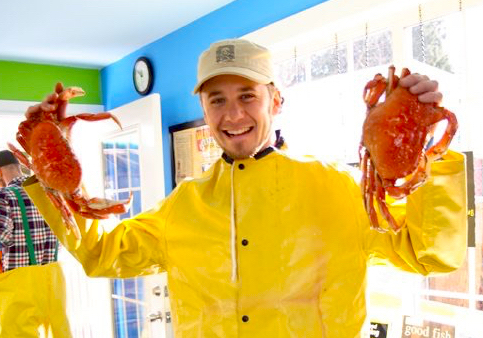
Lyf Gildersleeve, owner of Flying Fish Company, a sustainable seafood retailer in Providore Fine Foods, is a second-generation fishmonger and a vocal advocate for national fisheries policy. This is a guest post he wrote for the Marine Fish Conservation Network, a coalition of fishermen, conservationists, scientists and citizens around a mission to conserve and revitalize wild ocean fisheries.

In a time when government deregulation is rampant and environmental protections are getting tossed out the window, the U.S. has a seafood trade deficit that could be improving—that is, if American consumers are willing learn about where their food is coming from, and if consumers are willing to pay a fair price for seafood harvested and produced in the U.S.

Most of Oregon's fish are exported rather than consumed domestically.

Currently we import over 90 percent of the seafood we consume in America. More than 50 percent of those imports are farm-raised in unsustainable environmental conditions. Only two percent of these imports get tested for toxic residuals. That means that in 2015, 5.4 billion pounds of seafood entered our distribution channels without being tested for toxic chemicals. Most of the imported produce and seafood rejected in these random border inspections was cited for the appearance of potentially dangerous adulteration, including the presence of pathogens, illegal pesticides, chemicals and other sanitary violations. In addition, foreign seafood was more likely to be mislabeled and/or have slave labor involved at some point in the process of catching, harvesting, and growing it.

Along our own coastlines, fishermen are coming back to port hauling boatloads of seafood. Much of this seafood is getting purchased by foreign buyers and shipped overseas to consumers in Asia, while Americans are happy to import and consume cheap foreign seafood. This equation isn’t helping our coastal communities or the national economy.

Oregon albacore is exported for processing then shipped back to U.S.

Some of the seafood being landed by domestic fishermen is frozen after harvest, then shipped to China to be defrosted, filleted, packaged, frozen again, then shipped back to the U.S. to be sold to domestic consumers. This processing in China is cheaper than processing in the U.S. because of lower labor costs, with no import taxes on the products coming back in to the U.S.—until now. And, of course, the real cost of these products doesn’t include the carbon footprint of shipping products halfway around the world and back.

There are mixed opinions about the effects of the Trump administration’s trade wars with China. Recently there was a 25 percent tax slapped on seafood exports and a 10 percent tax on imported seafood products from China. Some seafood industries, including those in Alaska and Maine, have been negatively affected by import taxes. The export taxes have increased the cost to foreign buyers, which has decreased sales significantly due to higher costs with the new taxes.

Oregon anchovies are mostly exported but may be under threat from overfishing.

Some organizations state that the trade wars will lower seafood consumption in the United States because it will ultimately make those cheap sources of seafood more expensive. In my opinion, the price of cheap, imported seafood does need to increase. If the price of imported seafood and domestic seafood was more comparable, then consumers would take a harder look at their purchasing decisions. I believe that we all want to make good choices for the ocean, though sometimes we simply can’t afford expensive seafood.

In the seafood sector, cheap, imported products coming from overseas without import taxes are competing with our domestically caught seafood, which is far superior in quality and nutrition. Domestic seafood products also help financially support our domestic coastal communities and working waterfronts. Due to low wages nationally, some people have little choice but to purchase cheap food, which is why there's so much artificially low-priced imported seafood.

Oregon Dungeness, pink shrimp and albacore are MSC certified as sustainable.

In order to lower their costs and keep profits high, producers cut corners: slave labor, illegal ingredients, antibiotics, hormones, etc., are all consequences of these cost-cutting efforts. All these have negative effects on the environment, our health and that of our communities. It’s similar to U.S. agricultural policy, where our government has subsidies to help farmers who grow genetically modified corn, soy and wheat. These subsidies keep prices low for the consumer, creating an artificial price tag that makes certified organic food seem expensive. [Organic crops are not subsidized like conventional agriculture. - KB] This is the same equation in domestic versus foreign seafood—one is artificially priced lower.

It follows that subsidies make the price tag lower on the face of it, but we are still paying for them on the back end through our taxes. This artificial pricing doesn’t accurately reflect the actual cost of those goods when consumers buy them. When consumers see the price tag on local, organic, or farmers’ market items, they think it’s expensive; however, the real costs of commodity food would be more if the subsidies were not in place and the environmental impacts were included in the cost of the goods.

We have a choice every day to either make this world a better or a worse place in which to live. Some products are produced in sustainable ways for the environment and for our bodies, and some products are produced in ways that harm our bodies and the environment, the people, and the communities in which we live. I encourage you to be mindful of the food choices you make at the grocery store, restaurant and throughout your daily actions.

As a collective community I believe these choices will lead to consumers recognizing the value and nutrition of domestically produced fish. The new demand will absorb the excess production that once went to foreign buyers.

Eat domestic, support your local fishermen, and feed your body good food!

Read more about Oregon's sustainable fisheries and their importance to the state's economy.

Monday, December 18, 2017

Crabby Politics Put Dungeness Crab Fishery at Risk


Lyf Gildersleeve (above), owner of Flying Fish, a sustainable seafood retailer in Providore Fine Foods, is a second-generation fishmonger and a vocal advocate for national fisheries policy. Two bills before Congress right now, H.R. 200 and H.R. 3588, weaken America’s key fishing law, the Magnuson-Stevens Fishery Conservation and Management Act (MSA). At the end of Lyf's report is a link to contact your congressional representatives, which I urge you to do.

Fisheries policy has a responsibility to be sustainable, that is, to ensure that future generations will have access to the same resources we’ve had the luxury of taking for granted. Fisheries policy also has a responsibility to the people who make a living from the fisheries, whether directly at sea or indirectly at market. Policy needs to provide safety nets for fishermen, working waterfronts and the communities within the fishing industry. Policy must evolve and adapt to a changing industry, climate change and market needs.

Since its inception over 40 years ago, bipartisan support has been the hallmark of the Magnuson-Stevens Fishery Conservation and Management Act (MSA). The MSA is the federal fisheries law which creates safeguards to protect our fisheries and the communities supported by them. Unfortunately, the current political climate in Washington DC does not give equal consideration to both sides of the equation with regard to the MSA and its much-needed reauthorization.

The west coast’s Dungeness crab season similarly requires a two-sided approach: one side that considers consumer options, the other which considers fishery and ecosystem issues. Fortunately for the health of the fishery, and unfortunately for the fishermen and the consumer in Oregon, bipartisan considerations delayed the 2017-18 season.

In fisheries policy on a broad scale and in Dungeness crab practice locally, the equation is thrown out of balance when only one side of the equation is considered. A one-sided approach has potentially dangerous effects to both the environment and the livelihood of the communities dependent on the ocean.

As with most fish, objectives for the Dungeness crab consumer boil down to two things: safety and value. This year, the Oregon Dungeness crab season was delayed because the crabs had not reached market size. This was unfortunate for the crab fishing fleet, but it was a safeguard to protect the ecosystem and the consumer. Hard decisions always require trade-offs, but if the decisions account for all sides of the equation, then we can stand strongly and confidently. If all sides are not considered, somebody will get an unfair treatment, whether that's the fishery or the people whose livelihoods depend on it.

Total allowable catch quotas have long existed to sustain fisheries, including the Dungeness crab, for future generations. Sadly, the current bill to reauthorize the MSA, H.R. 200, introduced by Republican Congressman Don Young from Alaska, emphasizes “increasing flexibility”—i.e. it guts accountability in favor of the bottom line.

Pushing this version of the Magnuson-Stevens Act insults the spirit and legacy of the act, which has set the standard for fisheries policy worldwide. It weakens America’s key fishing law—it’s bad for fish, it’s bad for oceans, and it’s bad for coastal communities. It creates very real potential for overfishing and the not-very-long term instability of fishing communities.

Last week, the House Committee on Natural Resources voted in favor of legislation sponsored by Congressman Young (H.R. 200), and his Republican colleague from Louisiana, Garret Graves, who is promoting H.R. 3588, the Red Snapper Act, that wholly undermine the MSA. These two bills disable the science-based data on total allowable catch quotas, and the euphemistic “flexibility” disempowers the law that has allowed several fishery stocks to rebuild from the verge of collapse.

We have a chance—and an obligation—to learn from the tragic overfishing that depleted stocks on the East coast and around the world. These failed policies have decimated the wild Atlantic salmon to levels of extinction, and the populations of several ground fish across the east are so low they can’t rebuilt. The already troubled red snapper, an icon of the Gulf Coast, stands to suffer the same fate in light of Congressman Graves’ bill.

The panel’s top Democrat, Raul Grijalva of Arizona, had this to say: “Ocean management is about sustainable use and enjoyment, not just making environmentalists unhappy. Like most of the bills advanced by the leadership of this committee, this bill is extreme and has no future in the Senate. Until my counterparts decide to take the issues in our jurisdiction more seriously, we’re going to keep wasting time on unpopular bills that have no chance of becoming law.”

While this is certainly encouraging—and from a Congressman from the desert, no less—we still need to apply pressure and call, write, email, tweet our elected officials. These disastrous bills have reached the Senate, which has a chance to stand up to such indecency.

We can do better. We have the power. Do it for the environment. Do it for the fishermen and communities whose livelihood depends on a healthy ocean. Do it for your grandchildren. Defend the ocean and the important part it plays in all of our lives. Contact your Senators and tell them to vote NO to H.R. 200 and H.R. 3588.

In Oregon:
Top photo courtesy Flying Fish.

Saturday, April 30, 2016

Mr. Gildersleeve Goes to Washington


Last week, Pew Charitable Trusts convened a meeting in Washington, DC, for the 40th anniversary of the Magnuson-Stevens Act (MSA), a bipartisan law created to regulate and protect fisheries, enacted on April 13, 1976. Lyf Gildersleeve, owner of Flying Fish, a sustainable seafood retailer in the Providore Fine Foods space on NE Sandy Boulevard, was invited to attend. At the end of his report is a link to contact your congressional representatives, which I urge you to do.

There seems to be consensus, particularly among West Coast officials, that the MSA has been successful. The work to maintain it is constant and always evolving, but we’re fortunate to still benefit from such a great piece of legislation.

The 1996 and 2006 reauthorizations added new provisions which strengthened the MSA and gave it some teeth in addressing overfishing, rebuilding stocks and reducing bycatch. These provisions created on-the-water components beyond the letter of the law—often unpopular smaller quotas, new marine-protected areas and gear restrictions for bycatch reduction and habitat protection. These tough decisions certainly affect fishermen, fishing communities and many other components of the fishing industry, but they’re critical to maintain the overall sustainability of the resource.

Atlantic stripers at The Wharf in Washington, DC.

But the goal—and the good news—is that the MSA’s provisions have allowed stocks to rebuild, causing fishing quotas to start rising again, too. As well, the untargeted fish, often forage fish important in the food chain that feed the prized fishes, remain in the ocean. In short, sustainable fisheries policy enables sustainable business in coastal communities.

The North Pacific Fisheries Management Council (NPFMC), one of eight regional councils to come about because of MSA, has likewise adapted their policy to reflect an ecosystem-based approach, rather than a focus on individual species. This approach accounts for the all the components in the fishery’s web, rather than a single focus that has no regard for the effect it has elsewhere. It’s a relatively new approach, and NPFMC is the only regional council using this kind of management strategy.

It’s a West Coast success story to be sure, but unfortunately not all management areas in the United States yield the same successful results.

East Coast councils have continually struggled to rebuild stocks. They’ve implemented rebuilding programs that include conservation areas and lowered annual catch limits, but stocks have yet to recover. It’s the typical story of overfishing beyond a level of sustainability, and now too few fish remain to adequately reproduce and rebuild the population.

In the South, states like Texas, Louisiana, Alabama and Florida remain locked in a huge allocation battle for red snapper. The fishery has faced tremendous pressure as a staple Southern dish, and thus stocks are weak. The resultant smaller quotas must be split between commercial, recreational, and charter boat fishermen.

Oregon delegation (l to r): Lyf Gildersleeve, Flying Fish; Bob Rees, Assoc. of NW Steelheaders; Paul Engelmeyer, Audobon Society Portland.

Issues also exist in the definitions of state and federal waters. Some states want to extend fishable boundaries into federal waters, which would create a gray area for overlapping fishing areas (i.e. multiple takers for singular fisheries). It would also create a ripple effect for threatened species from red snapper in the South to striped bass in the upper Atlantic, not to mention the potential for exploitation of gas and oil extraction and development. Allowing any additional boundary extensions is simply a bad idea.

In a nutshell, the West Coast has served as an exemplary model for MSA implementation and operation by regional fisheries management councils. We’ve done a lot of work so far, but much more still remains.

One of the biggest takeaways from my time in Washington was the need for a coalition of delegates and representatives to stand together and promote the policy’s successes. We need to come together with a cooperative effort to improve upon the existing MSA; we can’t wait for someone to draft legislation that would weaken it. Now is the time to act—to lead with positive action, rather than waiting to counter and oppose a bad plan.

This should not be a partisan issue, and it wasn’t in 1976 when Senators Warren Magnuson (D-Washington) and Ted Stevens (R-Alaska) drafted the first law. This is our ocean, our resource, our food. Here in 2016, we’re watching a divisive election campaign unfold in front of an unproductive Congress. The MSA’s renewals in 1996 and 2006 were each bipartisan; the new reauthorization must be handled the same way—professionally and humanely, across the aisle. There is no other way.

The MSA’s statute spans ten years, so given its last renewal in 2006, it’s up for another renewal. But, with a short session this year and a Congress that seems uninspired to advance anything with the environment in mind, it’s unlikely it will be renewed this year. That means the law will remain as is  with almost no risk of being adulterated.

That said, in 2014, H.R. 4742—the "Empty Oceans Act"—passed through the House, but stalled in Senate and was fortunately not adopted. Its biggest offenses were introducing terminology like “flexibility” and “if practicable,” which enabled regional councils to exercise wiggle room, opening the door for overfishing in the name of higher profits. It’s not only crucial that the current MSA must be maintained, but with a longer view in focus it can incorporate new topics like: climate change, ocean acidification, estuary protection and upstream forestry protection.

The National Oceanic and Atmospheric Administration (NOAA) is the government entity that oversees the funding necessary for the MSA’s performance. And like many important interests, budget allocation issues are creating undue stress, in this case on fisheries.

For starters, there isn’t enough funding for research. The MSA states that regional councils must make the best choices possible with the best science available. But as it stands, the best science available is insufficient. Within the limits of current research, very tangible problems exist such as: 1) harvesting too many fish because populations were overestimated, and 2) its opposite, the underutilization of resources due to ineffective population analysis. Both of these are dangerous categories. Overfishing clearly causes damage, as we’ve seen on the East Coast, as it threatens to push a fishery beyond recovery. With underfishing, we risk one species overtaking a weaker one, creating the potential for further damage to weaker populations.

Within its current confines, NOAA doesn’t recognize the bigger picture. A more comprehensive overview would craft a better ecological picture—the relationship between what happens way upstream and deep in the ocean. Continued and deeper research on global warming and its effects on fisheries, ocean acidification and more is paramount.

NOAA also needs to create national training programs for displaced fishermen to build and enhance domestic aquaculture production, reducing our demand on foreign products. Currently, upwards of 90% of all seafood consumed in the United States is imported, most of it from China and Southeast Asia. We need to, and can, do better here at home.

With NOAA’s funding for research so limited, they should be more open to third-party science and research to help guide their decisions and policy. The current protocol, employing only in-house research, doesn’t work when there isn’t enough money for proper research.

Finally, I believe that NOAA could benefit from a marketing and awareness campaign, elevating the good work that NOAA does, like Fishwatch.gov, and bringing better attention to American fishing and seafood. I feel that much of the problem with the funding allocation stems from states not prioritizing a discussion about fisheries and the ocean.

I encourage you to write your congressional representatives and show your support for the reauthorization of the Magnuson-Stevens Act.

All photos courtesy Lyf Gildersleeve.