Showing posts with label Food and Farm Act. Show all posts

Monday, January 14, 2019

Farm Bill 2018: Two Views


Months of "jockeying, hand wringing, and horse trading, largely behind closed doors" according to Oregon Congressman Earl Blumenauer, came to a close recently as the Farm Bill, the sweeping agriculture and nutrition legislation that comes up for renewal every five years, passed the House by a vote of 369 to 47. It was largely stripped of Republican demands for work requirements for people receiving food assistance through the Supplemental Nutrition Assistance Program (SNAP, formerly food stamps), which had stalled the bill for months.

Oregon Congressman Earl Blumenauer.

The bill that was passed largely continues the agricultural subsidies of previous bills, which are predominantly claimed by large corporate farms, and added a provision that said any member of an extended family who runs a "family farm" can annually receive $125,000 in subsidies ($250,000 if they are married) if they provide “active personal management only,” even from afar, according to an article from Taxpayers for Common Sense. This basically redefines a family farm as a managed operation where the manager doesn't even have to set foot on the farm in order to collect government subsidies, a clear boon to corporate-owned and industrial operations.

Blumenauer was one of three Democrats to oppose the bill, stating in a press release that it "pays too much to the wrong people to grow the wrong foods in the wrong places." He called it "a missed opportunity to make real improvements for farmers, the climate, and the food we eat every single day." The Oregon congressman has instead been pushing for what he calls the "Food and Farm Act," an alternative bill that comprehensively advances reforms on four principles: (1) focusing resources on those who need it most; (2) fostering innovation; (3) encouraging investments in people and the planet; and (4) ensuring access to healthy foods.

Clif Bar's Matthew Dillon.

A different view of the revised Farm Bill was presented by Matthew Dillon, senior director of agricultural policy and programs for Clif Bar & Company, in an op-ed he wrote for The Hill, a Washington, DC-based news outlet. Declaring that the bill as passed is a victory for the future of organic agriculture in the U.S., Dillon pointed to the fact that the bill "for the first time establishes permanent funding for organic research by authorizing $50 million in annual funding for the Organic Agriculture Research and Extension Initiative by the year 2023." The $50 million figure makes the program “baseline” or mandatory in the United States Department of Agriculture budget, creating more stability for organic researchers and farmers, he wrote.

"Demand for organic agriculture far outstrips supply, causing our country to import many organic crops that could be produced domestically," Dillon stated. "Capturing the more profitable value of organic production for American farmers is particularly important at a time when net farm incomes across the country have fallen down to the lowest level in 12 years, declining more than 14 percent this year, and showing little sign of turnaround."

Believing that support for organic research is critical in helping farmers transitioning to organic production, Dillon wrote that the guarantee of funding will aid farmers in keeping up with the most effective techniques for soil fertility and pest management. While he admitted that the farm bill will always have room for improvement, "this landmark new gain of stable funding for organic research is critical to the survival of organic farms and the expansion of organic acreage. It is good for rural communities, good for farmers, and good for the planet."

Blumenauer, for his part, takes both political parties and the Congress to task for its business-as-usual approach to the Farm Bill. "Every day that we continue the status quo, we delay improving and enriching communities, and helping families live healthier lives," he stated. "We can and must do better to help increase access to healthy food for all families.  This final bill fundamentally misses the mark on addressing critical reforms that communities across the country desperately need. Americans deserve a Farm Bill that works for them and their families—not corporate mega-farms. I will continue to lead the opposition to the current Farm Bill structure, fighting instead for a better outcome for all Americans."

Wednesday, August 08, 2018

Guest Essay: Time to Zero in on the Farm Bill


This opinion piece from Congressman Earl Blumenauer, released on June 14, 2018, states that both the House and Senate versions of the Farm Bill—both have since passed their respective versions—maintain a deeply flawed status quo and weaken support for healthy food and sustainable farming. Blumenauer believes there is a better path forward. Please consider contacting your representatives in the Senate and the House regarding this issue.

Health care, climate change, economic development, and jobs are some of the major issues at the heart of current American politics. And there’s major legislation making its way through Congress right now that impacts all of these areas and every American who eats. Yet, most people know nothing about it.

Bigger isn't better.

The farm bill has flown under the radar for too long, with large agribusinesses and their lobbyists exercising an outsized influence on our nation’s food and farm policy while the rest of the country is left fighting for crumbs. That is, unless more people raise their voices.

As Congress works to reauthorize a new farm bill by September 30 [of 2018], it’s time for everyone to wake up and get involved.

Sadly, our current food and farm policies fail to meet the needs of the American people. We pay too much to the wrong people to grow the wrong food in the wrong places. The federal government spends an exorbitant amount of taxpayer dollars to help the wealthiest and most powerful agriculture operations get bigger and more profitable. Recent data shows that the bill’s high dollar farm subsidy programs paid the same 28,000 farmers $19 billion for 32 straight years.

Family farms mean business.

Meanwhile, small and medium-sized farmers and ranchers, the environment, and American families receive too little attention, too little concern, and too little help. This is unacceptable.

This Congress, unfortunately, only promises more of the same, and in some cases it has been working to make the situation worse.

In May, Republican leadership tried to force its farm bill through the House of Representatives. The legislation failed in a highly partisan, dramatic vote on the floor of the House. Several far-right Republicans, who want draconian changes to U.S. immigration policy, voted no. And every Democrat was unified in opposition to the bill’s blatant attack on those in need.

Everyone wins when everyone has access to good food.

The controversial bill drastically cuts Supplemental Nutrition Assistance Program (SNAP) benefits, enacts burdensome requirements for recipients, and forces them to attend an untested, unproven job-training program with strict penalties. While these cruel policies alone should be enough to defeat the House Republican farm bill, they are only the most obvious of many egregious provisions in the bill.

The House bill takes the “savings” from cutting programs benefiting the neediest Americans and puts much of it in the hands of corporate farms, helping them get even richer, all in the name of the farm “safety net.” But current farm subsidy programs are less of a safety net and more of a corporate welfare program. The House bill doubled down by creating new loopholes for those who don’t need more help. For example, a farmer’s nieces, nephews, or cousins who do not even live or work on the farm would become eligible for additional farm subsidies.

Sustainable farms benefit our health, our communities and our environment.

Rather than investing in family farmers who grow real and healthy foods, the legislation helps large operations grow six commodity crops—many of which we already have in excess and are made into unhealthy processed foods. The bill also shortchanges farmers’ markets and local food promotion programs. All of this together puts Americans at greater risk of health problems, such as diabetes and obesity. We are subsidizing a diet that is literally making Americans sick.

The House bill also threatens our environment by further removing incentives for farmers to protect sensitive land. It puts wildlife habitat and water quality at risk. Rather than offering meaningful reforms such as rewarding performance-based conservation, the bill instead proposes drastic cuts to urgently needed conservation programs while failing to do enough for sustainable farming practices.

One of the most outrageous provisions in the bill is the King amendment, which guts consumer, environmental, and animal welfare protections and allows any state with strong standards to be undercut by states with weaker protections. The Harvard Law School’s analysis of the provision should be deeply disturbing for those who want states to have the power to protect their residents.

Read the rest of the article posted on Civil Eats.

[Since Rep. Blumenauer wrote this, the deeply misguided House version described above passed on June 21, 2018, by a razor-thin margin of 213 to 211. The Senate version passed on June 28, 2018. Both houses of Congress need to vote on a final reconciled version by Sept. 30th. Please consider sharing your opinion on this critical legislation with your representatives in the Senate and the House.

Read Rep. Blumenauer's follow-up statement on the House and Senate-passed versions of the bill. For an explanation of the provisions of each version of the Farm Bill and what is required for passage, read the National Journal's excellent explainer.

Read my interview with Rep. Blumenauer on his solutions to the challenges facing Oregon and the nation's food system.

Posted with permission.

Thursday, November 16, 2017

Food News: Farm Bill Reboot; Edible Portland Expires Under Cloud


Today Oregon Congressman Earl Blumenauer is hosting a broad range of experts and stakeholders for a forum titled “A Call for Reform: Fix the Farm Bill,” that focuses on the need to create a more visionary, equitable and cost-effective farm bill. The forum features Michael Pollan (top photo, center), author of The Omnivore’s Dilemma, who is delivering the keynote, followed by a panel discussion with a group of policy experts to discuss their ideas for the reform that he's calling The Food and Farm Act.

In an interview about his re-envisioned farm bill on the website Civil Eats, the congressman said that "we continue to pay too much to the wrong people to grow the wrong food in the wrong places" and that he's working to reform subsidies to support innovation and small-to-midsize farmers rather than large corporate agribusinesses.

As he told Good Stuff NW in an interview earlier this year, he's building a coalition of consumers, farmers and non-profits to provide "support for protecting the environment, water quality, habitat [and] things that help the farmer and have broader social and economic benefit. The big issue is that all the attention and subsidy is skewed toward things that don’t need it, and shortchanges things that do, upon which we’re heavily reliant."

One unique element of his efforts is a comic book, "The Fight for Food: Why You Deserve a Better Farm Bill," that explains why the Farm Bill matters to people who care about their food and talks about how they can get involved.

Read my interview with Rep. Blumenauer, part of "The Future of Our Food" series. Photo courtesy Rep. Earl Blumenauer's office.


* * *


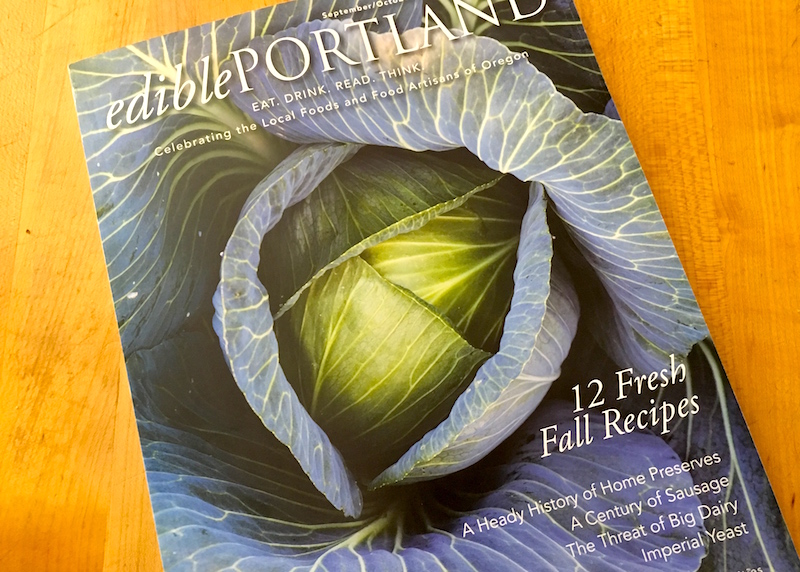
Sad news came today that Alex Corcoran, owner and publisher of Edible Portland magazine, has announced that the magazine will cease publication after the current November/December issue.

Corcoran bought the magazine last year after Ecotrust, which had owned the publication since its inception in 2006, decided to cease publication after the Spring 2015 issue and put it up for sale. At the time that Corcoran bought it, Eric Thorkilsen, then-CEO of Edible Media, said, "Alex has a great track record of success managing Edible publications, starting with Edible Rhody [Edible Rhode Island] and continuing with Edible Seattle. His capacity to immerse himself in the local food community—forming solid relationships with small businesses and attracting a devoted readership—suggests a great future for Edible Portland."

The first edition under Corcoran's leadership was the September, 2016, issue. Corcoran initially posted an ad for the sale of the magazine, but because of contractual disagreements with Ecotrust, he has pulled the ad.

In an e-mail to Good Stuff NW, Carolyn Holland, VP of Engagement at Ecotrust, said that Corcoran "does not have the rights to sell the magazine. He has been in breach of his contract with Ecotrust since 2015 when he signed on to assume the license. While we were working with him to give him time to get it on track, now that he has decided to fold, the rights to magazine will revert to [Ecotrust]."

Mr. Corcoran declined a request to comment for this post.

* * *

UPDATE: I received the following update today (11/28) from Carolyn Holland at Ecotrust:

"Free Range Media, publisher of Edible Portland, is ceasing publication of the award-winning magazine at the end of 2017. According to a previous agreement, Edible Portland will return to its original owner and publisher, Ecotrust, which originally launched the magazine in 2006 as one of the first Edibles in the nation. Ecotrust will work with the national media organization Edible Communities, licensor of more than 90 Edible magazines across the United States and Canada, to find a new home for the magazine. Edible Portland boasts a devoted readership of more than 75,000 and has a solid base of both advertisers and contributors. Ecotrust is committed to supporting a smooth transition in ownership. If you are interested in becoming the publisher of Edible Portland, please contact Carolyn Holland, Ecotrust’s VP of Engagement, at 503.467.0754."

Read my recent article for Edible Portland, "Big Milk: Big Issues for Local Communities."

Correction: An earlier version of this post mistakenly stated that Edible Seattle was for sale. It is not. Corcoran is inviting a new publisher to start an Edible magazine in the South Sound area.