Sunday, December 05, 2010

Crustacean Celebration: And They're Off!


I can't believe how excited I was for crab season to start this year. After last year's marathon Crustacean Celebration, the countdown to the start of the season was excruciating. Because of dickering over prices that crabbers would receive and conflicting results of test for something called meat fill, it was possible that the season could be delayed for as long as two weeks.

But when I went to the northern Oregon coastal town of Seaside on Thursday and stopped in at the shrine to crabbiness that is the Bell Buoy (left), they had freshly caught crabs aplenty. My friend Michel and I whipped up a fresh crab salad with some romaine, slivered fennel and a lemon vinaigrette and dove in. Supplemented by a loaf of Dave's wonderful homebaked sourdough and a glass (or two) of rosé, its sweet, slightly salty meatiness was the perfect, simple start to a season of indulgence.

I came back home to the news that the crabs had organized themselves into a group called the Dungeness Crab Commission and, in a stroke of brilliance, got themselves certified by none other than the Marine Stewardship Council (MSC) as a sustainably managed fishery. Meaning that it's one of only three crab fisheries in the world to put the MSC label (right) on its products, and the only one of the five Dungeness fisheries (CA, OR, WA, B.C., AK) along the West Coast to be certified. Those are some crazy smart crabs!*

I'd purchased two more whole crabs on the way out of Seaside, determined to whip up an appropriately crabby dinner for the troops at home. Pulling out a recipe from last year and, hewing to the original intent (i.e. keeping it crabby), I made a few modifications and was rewarded with the oohs and aahs of satisfied diners.

If you have favorite crab dishes that you put together for your troops (or even just yourself), please share them in the comments below. It's looking like we're in for another banner year!

Pasta with Crab and Radicchio
Adapted from Tyler Florence, the Food Network

2 Dungeness crabs, approx. 1 lb. each
1/4 c. extra-virgin olive oil
1/4 c. finely chopped shallots
2 Tbsp. finely minced garlic
2 whole Mexican hot red chiles
1 c. rosé
1 lb. pasta
1 small head radicchio, thinly sliced into chiffonade
Juice of 1 lemon, straining out the pulp and seeds
Finely grated parmesan or, for a nice change, extra-sharp cheddar for sprinkling

Bring 6 quarts water to boil and add 2 tablespoons salt.

Pull carapace off of cooked crabs (the large red outer shell). Under running water, clean off all the gills until you're left with the hard shell of the body beneath. I normally rinse out the "tamale" or ochre-colored bits that some people consider a delicacy (you can have them cleaned by your fishmonger if this is all too real). Remove the meat from the cleaned crab and collect in medium-sized bowl.

In a large sauté pan, heat the oil until smoking. Add the shallots, garlic and chiles and sauté until golden brown, about 4 to 5 minutes. Add the wine, bring to a boil. Cook the pasta in pot of boiling water according to the package instructions, until just al dente, and drain.

Remove the whole chiles from the wine sauce. Add the drained pasta to the pan with the wine mixture and return pan to heat. Add crab and radicchio and toss briefly until radicchio is slightly wilted, about 1 minute. Pour the lemon juice over the top. Pour into a warm serving bowl, sprinkle with the cheese and serve.

* Seriously, the Dungeness Crab Commission is an industry-funded agency tasked with "enhancing" the Dungeness crab industry.

Check out this season's Crustacean Celebration series: The Big Boys Weigh In, Deadly? I Think Not, Let Them Eat Cakes, Parallel Universe and last season's series starting with Hot Artichoke and Crab Dip (and links to other posts in the series).

Saturday, December 04, 2010

Farm Bulletin: Jam Session


The first time I tasted the preserves from Ayers Creek Farm, it was a jam made from the blackcap, a tiny blackish-blue berry whose shape is similar to a raspberry but with a shallower cup and much tinier drupelets. Spread on warm buttered toast it was a revelation, and I've since gone on to sample many more of their amazing preserves, each one the distilled essence of the fruit. This week contributor Anthony Boutard describes the process used in making them, and you can get some for yourself two Sundays a month through the winter at the Ayers Creek stand at the Hillsdale Farmers' Market.

In mid-November, we made our third run down to Elmira, a small town 105 miles south of Gaston. The sky was clear and Orion's belt twinkled low and clear in the early morning sky. We left 20 minutes early, hoping to arrive before our customary 9:06 arrival time. Bogged down in Corvallis, we arrived at 9:09. Upon entering the sparkling processing room at Sweet Creek Foods, it is clear that Paul has everything set up for the day's processing run. The deseeder is in the middle of the room. Stainless steel vats were filled with fruit that had been macerating in sugar for 36 hours. On the table stood a hand-cranked juicer, a case of organic lemons, a knife and cutting board.

Sweet Creek Foods is a small processing and bottling company operated by Paul and Judy Fuller. The facility is certified organic and the Fullers pack tuna, pickles, salsas and jams under their own label. They are also a co-packer; they allow farmers to bring in fruits and vegetables they have grown for canning. Paul is a refrigeration and food processing engineer, and runs the facility. The machinery has been assembled from auctions and demolitions as the valley's smaller canneries closed their doors. It is a classic steam operated cannery, the most gentle way to process food. The machinery clanks, hisses and wheezes just like the 'African Queen'. At the center of the facility is a bottling machine Paul purchased new from Italy. There are some machines, he notes, that must be purchased new, and a bottler is one of those.

In the summer of 2005, after our second winter season at Hillsdale, we decided to produce preserves from the fruit grown at Ayers Creek, and contacted Paul and Judy whom we had met a couple of years earlier. From test runs, we knew we wanted a simple preserve made from fruit, sugar and lemon juice, without additional pectin. Adding commercial pectin dulls the acids in the fruit, and you lose its spritely quality. We also learned to cook up the fruit in small, two-gallon lots and use freshly squeezed instead of frozen lemon juice. We harvest the earliest fruit for the preserves; they have the highest concentration of pectins and acids. It works for us because there is not enough fruit in those early harvests to justify a delivery run. Mixing the fruit and sugar a day or more in advance is called "maceration" and helps free the pectins in the fruit. These complex molecules give fruit its body and, when brought to 222°F, cause the fruit to set. After explaining with due diligence that this is not the way processors make preserves, Paul set about make it work for us. 

Every single variety of fruit cooks differently. Of the fruit we process, the most difficult are the raspberries. Red raspberry should be simple, but it is a delicate fruit and quick to take umbrage at careless handling. This year's run went without a hitch and is the very best we have ever made. Blackcap and purple raspberry have hard, sharp seeds, so deseeding is essential. For some mysterious reason they also take about three times as long to cook as the other berries or the plums. We have learned to cook purples and blackcaps on separate days, and always in the morning when our humor is fresh. The raspberry, boysenberry and loganberry are the most fragrant fruit to cook. The currants are explosive in the pot and exact their share of blisters. The plums have a rolling, sensuous boil due to their heavy skins.

Working with Paul and his staff is one of the great pleasures of the year. The Fullers are in a tough, competitive business, yet they retain a playfulness and enthusiasm that makes a five-to-nine day fun. They source fruits and vegetables locally, and buy our blackberries for the preserves. The tuna is purchased from a fisherman that Paul has known for years. The wall of Judy's office is decorated with jars from the many farms they have worked with over the years. Our preserves are possible because of their vision and business acumen. The two of us have strong opinions about making preserves, yet at the end of the day full credit goes to Paul and Judy for opening such a fine little factory to so many farmers.

Friday, December 03, 2010

December in Oregon?


The thing about the weather on Oregon's coast in winter is this: you just never know. Yesterday the drive over was drizzly, and that night the roof of the 90-plus-year-old house I stayed in was hammering with the rain from a big storm front. This morning I woke up to this. By noon the thermometer read 50° in the sun, though it was a few degrees chillier on the beach with the wind from the northeast. Did the dogs mind? Did I? Not at all!

Wednesday, December 01, 2010

Now That's Italian…Kind Of?


Once in awhile something just strikes me and I'm compelled to go for it. Like the first time I saw Dave. Or started this blog. Or saw that little black cuteness below.

When I perused this recipe on my brother's blog, I'd never heard of braciole before, but I suddenly saw big red blinking letters that flashed "DINNER!" "DINNER!" "DINNER!" over and over. A little research revealed the pronunciation (bruh-ZHOLE) and the fact that it's normally a thin cut of beef (though it can also be fish, chicken or pork) that's spread with a filling and rolled, then pan-fried in oil.

This recipe from chef Andrew Carmellini is, to put it mildly, a deconstructed version made with beef short ribs that are browned and then braised in a tomato sauce until they're fall-apart tender. He then serves them beneath a shower of herbs and hard-boiled eggs that might, just might, pass for the stuffing. If you don't think about it too hard. Or at all.

I'm sure Italian purists would be horrified but (toe-may-toe toe-mah-toe) dang it's tasty whatever you call it.

Short Ribs Braciole
Adapted from Andrew Carmellini's Urban Italian: Simple Recipes and True Stories from a Life in Food

For the ribs:
1/2 c. roughly diced pancetta or bacon (about 1/4 lb.)
4 boneless short ribs (about 2 lbs.), cut into thirds
1 heaping Tbsp. salt
1/2 tsp. pepper
1 yellow onion, diced
3 cloves garlic, chopped
1/8 tsp. red pepper flakes
2 28-oz. cans tomatoes, plus their juice

For the topping:
1/4 c. pine nuts, chopped roughly
1 Tbsp. olive oil
1/4 c. breadcrumbs or panko
2 tsp. dried oregano
2 Tbsp. chopped parsley
a pinch each of salt and coarse-ground black pepper
3 hard-boiled eggs, roughly chopped
2 Tbsp. grated Parmigiano-Reggiano

Preheat the oven to 375°.

Cook the pancetta in a large, dry, ovenproof saucepot over medium-high heat until the fat renders, about 2 minutes, stirring occasionally to keep from sticking. Season the short ribs on both sides with salt and pepper, add them to the pan, and brown the meat, about 5 minutes. Add the onion and cook until it softens, about 1 minute. Add the garlic and the red pepper flakes, mix well, and continue cooking. Crush the tomatoes over a bowl with your hands, then add them to the pot along with their juice. Bring the mixture up to a low boil. Remove the pot from the stove and place it in the oven. Check the ribs about every 15 minutes or so to make sure they're not boiling too hard. Cook until the meat is supertender and a fork can pass through it without sticking, about 2½ hours.

Toast the pine nuts in a dry sauté pan over low heat, shaking the pan occasionally to avoid burning or sticking, about 8 minutes. Add the olive oil and mix well. Add the breadcrumbs or panko and continue cooking over low heat, mixing occasionally, until everything is toasty brown, about 2 minutes. Cool and transfer the mixture to a medium-sized mixing bowl. Add the oregano, parsley and chopped eggs. Season with the salt and pepper. Stir in the Parmigiano-Reggiano.

Remove the pot of short ribs from the oven and immediately remove the ribs to a plate, using a pair of tongs. Use a ladle to remove some of the fat from the sauce, by pressing the chunky sauce away as you tip the pot so that the ladle fills only with the clear fat. (This is optional, but it definitely makes the sauce prettier-there's about 2 tablespoons' worth of fat there.) Add 1/2 cup of water to the sauce and stir to bring it together.

Place 4 to 5 pieces of meat on each plate. Pour the sauce from the pot directly over the short ribs and sprinkle the topping generously over each dish. Serve immediately.

Making Waves


Upside down.

Who'd have thought that a little 6-lb. nymphet of a kitten could turn our lives all topsy-turvy? Her name is Otter, she's a 7-month-old spitfire with decidedly laid-back tendencies, which bodes well as she matures, and she seems completely nonplussed by the other two furry ones in the household. (Not talking about the husband or son here.)

A friend found her and her sister living in the horse barn where my friend's daughter rides. They'd been dumped there to become "barn cats," but the two half-feral cats already in residence didn't take kindly to the interlopers. Plus the kittens kept running out into the driveway to greet anyone who drove up…hmmm…black kittens, dark morning…nothing could possibly go wrong, right?

And since I was starting to feel like we were ready to jump into the kitty pool again after losing our Chester a year ago, I went out to "take a look" and, you guessed it, fell hook, line and sinker. I'll keep you updated on occasion as our ship gradually rights itself again, but I think this new crew member will fit in just fine.

Tuesday, November 30, 2010

Great Gifting: Class Acts


One of the best gifts I ever gave Dave and, by extension, myself, was a cocktail-making class with Lucy Brennan, Portland's Queen of Cocktailiana. He learned basic skills like shaking, muddling and mixing and came home with recipes for a classic martini and other Brennan-devised specialty cocktails. Which, over the years, has made for lovely evenings spent in the company of Messieurs Negroni, Sidecar and Manhattan and even Madame Corpse Reviver. Lincoln restaurant has a series it calls Bar Camp, a class that introduces non-professionals to the history of cocktails. Just think how nicely a gift certificate for a class would be tucked into set of martini glasses!

Details: Private cocktail-making classes for groups of 8 with Lucy Brennan at Mint/820: check the website or call 503-284-5518 to inquire about general classes. Bar Camp at Lincoln: check the website or call 503-288-6200.

* * *

Whether your giftee is gifted in the kitchen or not, a cooking class can expand an existing repertoire or give confidence to a novice. And it doesn't have to cost a fortune. My friend and fellow blogger Katherine Deumling of Cook With What You Have has a series of classes coming up in January on stocking your pantry that includes a dozen new ideas for quick weeknight dinners. She also does private classes for a reasonable price that can range from baking to quick meals for your family. Another option for bakers is a pastry class at SweetWares in Hillsdale, which has a full schedule of classes featuring breads, cakes, pastries and even gluten-free options. And if your cook wants to explore new horizons, I can't think of a better way to add some international flavor to your table than a class with Sophie Rahman of Masala. My post about her class is here, and I can guarantee your gift will be appreciated!

Details: Cooking classes with Katherine Deumling of Cook With What You Have: check her website or e-mail Katherine. Baking classes at SweetWares: check the website or call 503-546-3737. Indian cooking classes with Sophie Rahman of Masala: check her website or call 503-233-1966.

* * *

And how could I leave out the cheesiest gift of all? I couldn't! So if your beloved goes weak in the knees over washed-rind cheeses or gets all gooey for gouda, a cheese-making class might be just the ticket. Some of the best in the area are offered by Chrissie at Kookoolan Farms in Yamhill, who brings in artisan cheesemakers from around the area to do everything from soft, fresh cheeses to Port Salut, Muenster and Tallegio. Another option for the not-so-hands-on recipient would be a cheese tasting class, and I can think of none better than those offered by Luan Schooler of Foster and Dobbs in Northeast Portland. With classes on styles of cheese (think goudas or goat), the cheeses from a single cheesemaker (Mt. Townsend Creamery or Vermont's Jasper Hill) or pairing cheeses with wine, you can't go wrong.

Details: Cheesemaking classes at Kookoolan Farms in Yamhill: check the website or call 503-730-7535. Cheese tasting classes at Foster & Dobbs: check the website or call 503-284-1157.

If you know of other cocktail, cooking or cheesemaking classes that offer gift certificates, please let me know in the comments section below!

Check out the other gift suggestions in the series: Book by Book, Classic Design, Not Dead Yet! (food magazines you'll love) and Giving From the Heart.

Saturday, November 27, 2010

Warming Up in Winter


My first exposure to braising was my mother's version of pot roast, a large top round steak simmered in crushed tomatoes in her favorite kitchen appliance, an electric frying pan. As a working mom trying to feed three hungry kids, she never really had enough time to simmer it until it was fall-apart tender, so what was put on the table was a fairly chewy hunk of well-done beef. Any complaints about the texture were turned aside by my father whose standard line was, "It's good for your jaw muscles."

The breakthrough braising experience for me was a college friend's recipe calling for a packet of Lipton's onion soup and a half bottle of wine. Roasted for a couple of hours in a 400-degree oven, it still wasn't fall-apart tender but was a step up from the version I was raised on.

From there it wasn't a tough climb to conquer Julia Child's recipe for chicken braised in white wine, which, before I learned her version, may or may not have been made with cream of mushroom soup (I'm not admitting to anything here). But I've got to 'fess up that one of my very favorite braised dishes came from my friend Michel, who created a real winter warmer, a lamb shoulder simmered in tomatoes, stock, prunes, peppers and spices that has been the star attraction of many successful dinner parties.

I ran the recipe three years ago, but decided it merited reposting since we had it again the other night and it totally sang. Easy to put together, it would be an ideal candidate for a slow cooker, and walking in the door after a long day in the cube might cause a buckling of the knees, if not a full swoon, from the aroma that fills the house. It's fantastic served with polenta or couscous, but is equally dreamy with mashed potatoes.

Michel's Braised Lamb Shoulder

1 lamb shoulder roast
1 med. onion, coarsely chopped
1 med. red bell pepper, coarsely chopped
1 pasilla, ancho or poblano pepper, coarsely chopped
4 cloves garlic, sliced
2 tsp. whole cardamom seeds
2 tsp. cumin seeds
1/2 c. prunes
1 c. chicken stock
15 oz. can diced tomatoes (approx. 2 cups)
Zest of 1 lemon

Preheat oven to 325 degrees.

In medium hot braising pot, brown shoulder in olive ol; salt and pepper each side. After first side of lamb is browned, add cumin and cardamom seeds to the oil around the lamb and stir to toast. Add garlic and onion, stir until golden. Add peppers and stir until softened. Add canned tomatoes, stock and prunes and stir. Cover braising pot and place in middle of preheated oven. Simmer in oven at least 3 hours.

Remove lamb from pot. Cover and hold on heated platter. Skim fat from liquid in pan and bring to boil to reduce. Season to taste and pour over lamb.

Friday, November 26, 2010

Setting a Big Table


An edited version of this story first appeared in the September/October 2010 issue of NW Palate magazine.

* * *

Clementine, the Catahoula leopard hound, has been anxious since dawn, not wanting to be too far from her owner, Clare Carver of Big Table Farm. Clare has been moody for the last couple of days. Even Clare’s husband, Brian, has been giving his wife a wide berth. When Clare goes up to the hill pasture to sit with her pigs, Picnic and Pancake, Clementine stations herself with a good view of the road. She knows something is coming, something that is making Clare sad, and she wants to be ready.

Clare Carver sits in the pen with her pigs, scratching their backs when they lean their 300-pound bodies against her, snorting and squinting in the bright sunlight. Like a couple of big dogs, they dash off to play with each other or to chase something in the bushes or to root through the grass in the pasture, but eventually they come back to get more attention from Clare. She's raised them from tiny weaner pigs, and today is their last day.

An inspired painter whose subjects are the cows, horses, chickens, goats, pigs, old trucks and tractors that populate the farm she owns with her husband, Brian Marcy, in Williams Canyon outside Gaston, Oregon,she also has a large vegetable garden that supplies most of the couple’s food and the large farm dinners they host for people who buy the wines Brian makes under the Big Table Farm label.

Growing up in a large Catholic family (she has eight brothers and sisters), Clare heard stories about the farm in upstate New York that her parents had bought in the late 50s. They sold the farm when Clare was seven and moved their large family to the suburbs of Valley Forge, Pennsylvania.

She carried those tales of the farm with her into her career as an advertising art director for an East Coast ad agency, and one day a consultant for the agency told her, “You need to go out and see the world. You shouldn’t be doing this because your life is going to look exactly the same in ten years as it does now.”

“It was a complete wake-up call,” Clare said. She sold all her belongings and moved to San Francisco to start her own business. Shortly after the move she began dating Brian, who was transitioning to making wine after working for several years as a beer brewer.

“With beer, the whole goal is to take varying inputs and make the same product year in and year out without considering season or ingredients,” she said. “In wine it’s just the opposite, where people expect the product to be affected by season and ingredients. It felt more creative to him.”

Their move to Oregon was prompted, oddly enough, by a season spent harvesting grapes in Australia.

“It was a really romantic time for us and we started looking around at the land,” she said. “Honestly, that was the first time it started to creep into our consciousness that we could have a farm as well as have a winery.”

Their requirements for their farm were fairly simple: It had to be within an hour of a big city so Clare could continue her graphic design business, it needed to be located in a wine-producing area so Brian could be a consulting winemaker while developing their vineyard and, of course, it had to be within their budget.

The farm they found in 2006 fit their list to a T: Close to Portland, it was in the middle of a burgeoning wine region. It had perfect southeast facing hills and a charming Victorian farmhouse. Their bid was accepted.

“We didn’t really know anything about farming, and we read ‘The Omnivore’s Dilemma’ by Michael Pollan when we were closing on the property,” Clare said. “It totally changed the way we thought we were going to set up our farm.”

While the book is mostly about what Pollan believes is the broken food system in the United States, where people are disconnected from the sources of their food, he also writes about a visit to Polyface Farm in the Shenandoah Valley and farmer Joel Salatin. Salatin calls himself a “grass farmer” and believes in rotating the animals on the land to keep the soil and the plants, and thus the people who eat the animals and plants, healthy.

With Salatin’s principles in mind, they’re transforming the nearly ruined hillsides and pastures of their Big Table Farm to an organic, balanced system. Brian made a trailer, called the “chicken bus,” to transport their laying chickens from one area to the next. Goats clear blackberries and scrub, watched over by a “guard llama” who challenges any predators who get too close. The cows, pigs and Clare’s beloved draft horses are confined by electrified tape that can be easily moved when the pasture needs a break from grazing.

When Salatain made a trip to Oregon, she asked him about organic feed, an important part of the system at their farm.

Salatin’s answer? “People can handle nudists and they can handle Buddhists, but they can’t handle nudist Buddhists.

“What he was saying is that people can handle the concept of pasture, they can get their head around that. But when you start talking about pasture and then you start talking about organic feed, they hold their heads and scream.”

She told Salatin that while that might be the case in his home state of Virginia, she felt that Northwesterners were able to handle that kind of information. Like the fact that she flat out refuses to send any of her animals to processing facilities to be slaughtered.

“The primary reason is because of the stress on the animal,” she said. “The stress and the adrenaline that goes through the animal changes the meat, and there’s hard science behind that.”

Take pigs, she said. They’re very smart and sensitive, so when they’re put into a truck for the first time in their life, it’s terribly stressful. And a pig’s sense of smell is even keener than a dog’s.

“Can you imagine what a processing center smells like to a pig?” she asked. “It makes my hair stand up just to think about it. Those poor animals.”

Because strict federal regulations require any meat that is sold to the public has to be processed in a USDA-approved facility, the meat from her pasture-slaughtered pigs can’t be sold in supermarkets or at farmers' markets. This is despite the growing demand for just the kind of pasture-raised meat she and other small-scale farmers in the region are producing.

With small processing plants closing down because of the recession, it’s hard for small producers to get their animals into larger slaughter facilities. With just a handful of USDA-approved mobile slaughter trucks in the entire Northwest, there isn’t one available for Clare’s farm.

Which brings us back to Clementine standing watch and Clare waiting with her pigs in their hillside pasture. When the truck from Frontier Custom Cutting finally pulls into the driveway in the late morning, Clemmie starts barking. She won’t stop until it leaves.

Richard, a burly man wearing orange rubber overalls and carrying a black rifle, walks up the hill. While Clare distracts Picnic with some fresh eggs, Richard puts the rifle behind Pancake’s ear and pulls the trigger. Then he walks over to Picnic munching on her egg and does the same.

Clare feels it’s the most respectful way to kill them.

“The bullet goes right to the spinal cord, but their heart is still pumping, so they’re essentially brain dead,” she said. “It’s a little violent but it doesn’t last very long. That part is the part I hate to watch, but dying is dying and it’s not pretty. It is what it is.

“I really hope when it’s my time I get afforded a respectful, quick death,” she added. “That’s what I would want. So I do the best I can for my animals in that sense.”

And each time she allows herself to feel the loss.

“It’s the way you feel when a human dies. They’re gone…really gone,” she said. ”I go out to their pasture the next day and I’m like, oh, they’re gone. It’s a reminder of how much power we have and how careful we have to be of that power, that we just created and took this life.

An observer could note that, in the way they run their farm and raise their animals, she and Brian haven’t chosen an easy route. And, like the move to Oregon and buying the land, it’s all been done without a business plan.

“If we had a business plan some things might be smoother for us,” Clare said. “But, like anything in life, it’s like, ‘Well, I’m going up that hill and maybe I’m not going to take the straightest path. But maybe I’m going to see some things I didn’t expect if I don’t have an exact map of how I’m going to get there.

“Sure, if we had a business plan we might get to the top of the hill faster,” she continued, “but we’re still going up there because we have the same goals and that hasn’t changed. Or if it does, we talk about it and we change it together.”

Asked about the best part of their lives on Big Table Farm, she thought for a moment, then answered.

“Almost every morning when I do chores I look around and this incredibly deep sense of satisfaction strikes me,” she said. “Being deeply happy with this path we’re on now.”

Thursday, November 25, 2010

Happy Thanksgiving All!


Kinda sums it up, don't you think?

But to be a bit more specific: I'm thankful for all of my family, friends and readers, and for all the wonderful people who've shared their stories with me so I can share them with others. And for the amazing farmers and cooks who work so very hard to make our lives more pleasurable. And, most of all, I'm thankful for my amazing husband Dave and son, Mr. B., who are at the center of my happiness.

Sunday, November 21, 2010

In Season NW: Winter Wonderland


With temperatures hovering in the mid-30s and the threat of snow in the forecast, Portlanders were out in force this last weekend stocking up for the rapidly approaching Thanksgiving holiday. The bounty of squash, peppers, greens, meats and cheeses didn't disappoint, and the overflowing tables promise many good shopping opportunities at the several markets that will stay open through the winter months, including those at Lloyd, Hillsdale, People's and Oregon City. Montavilla will hold a monthly "stock up" market once a month through February; check their website for dates and times. If you know of others, please add them in the comments section below. For addresses, websites, maps and links, check the GoodStuffNW Oregon Farmers' Markets page.

Warm Hands, Warm Heart


I'm not a big chocolate hound, but the other morning I had a hankering for a mug of hot chocolate. Maybe it was the chill of winter in the air, maybe it was the rich smell of steaming chocolate, but it made me pick up the phone to call my friend Giovanna, who knows how to satisfy a chocolate craving like few others.

It was a little early to go to Alma Chocolate for a cup of their orange or chile-laced drinks, so she suggested Coffeehouse NW and their special mocha made with Michel Cluizel chocolate. It didn't take much urging to get her to agree to come along, so I picked her up in Chili and we made tracks over to the Euro-charming, very tiny coffee bar on West Burnside.

Cluizel chocolate is well-known to choco-maniacs as among the finest in the world, having been made by the Cluizel family for three generations from their home base in Normandy, France. When combined with a shot of espresso and poured into a preheated cup,  its aroma reminded me of childhood when a steaming cup of hot chocolate made winter's chill melt into oblivion. And the slightly-but-not-overly sweet taste almost made me look forward to the cold days coming, as long as I could also have a mug of this to linger over on a regular basis.

Details: Cluizel Chocolate Mocha at Coffeehouse NW, 1951 W Burnside St. 503-248-2133.

Saturday, November 20, 2010

Farm Bulletin: Farming al Fresco…in Winter?


I wouldn't say that contributor Anthony Boutard or his wife, Carol, are contrary, exactly. The successful practices they've developed at Ayers Creek Farm in Gaston are hard-won and have involved years of trial and error. But if the way they do things flies in the face of convention, so be it. Sidelong glances and heads shaking at their foolish ways isn't going to change a thing. Get a taste of their unique approach to farming at the Hillsdale Farmers' Market as it moves into its twice-a-month winter schedule through April.

A few years ago, we answered a call from somebody associated with the OSU Extension Service. They had heard we sell greens and other vegetables all through the winter. The person was putting together a panel on "season extension" and wanted to know if we would sit on the panel. After hearing an amiable "yes," she asked us what sort of season extension we used. We explained that the most important factor was the latitude in which the crop was developed. We farm at the 45th parallel, so we look for crops adapted to that latitude or higher. Crops adapted to lower latitudes tend to bolt, or go to flower, prematurely—flowering crops lose their ability to resist freezing. Having a deep selection of winter crop varieties (top photo) gives us greater flexibility in harvest times. Finally, we explained that we supplemented the cultivated crops with the feral greens in our cane fields and orchards.

Fennel flowers.

After listening to this explanation, the caller asked again what we did for season extension. Did we use greenhouses, high tunnels or cold frames? We explained that it seems crazy to buy a bunch plastic structures when the Willamette Valley has the ideal climate for field-grown vegetables. A vegetable growing in the open air is denser and has better flavor and nutrition. Moreover, the idea of needing to water in the winter seems odd. Unimpressed, she explained that the panel organizers wanted farmers who used actual structures rather than planning and variety selection. The conversation ended on that note.

Today, as we harvested the fennel in the gusty squalls, it was fun to watch the trimmed fronds bounce across the field like tumbleweeds. Then, as the late afternoon gloom and chill gathered, the idea of harvesting beneath a canopy of plastic developed a bit more allure. Nonetheless, a salad of fennel grown in the drenching rain and whatever sun the valley can muster restored good sense and banished any doubts. There is full, robust quality to a field-grown vegetable that cannot be had from one coddled in plastic, protected from our nourishing rains.

Friday, November 19, 2010

A Little Something on the Side


I don't know about you, but whether the main dish at the holiday is ham or roast beef, turkey, chicken or even fish, what I really care about is the sides. This week Jim Dixon of Real Good Food shares his most-requested holiday side dish and reminds you that you can get great winter squash, brussels sprouts (whole stalks for as little as $3), fresh cranberries, mushrooms, hearty greens, cheeses, eggs and almost everything else you need for your own holiday meal at your local farmers' market. Find Jim at PSU starting at 9 am on Sat., 11/20, or check here for listings.

I’ll be moving the content from my original website to the new one for the next several months, but I did get my version of Thanksgiving online. While it includes the instructions (I can’t really call it a recipe) for the industrial version of green bean casserole, do your guests a favor and make these brussels sprouts instead.

Caramelized Brussels Sprouts with Mustard

Once I started cooking brussels sprouts like this, nobody ever wanted them any other way. It seems like everybody is using bacon with brussels sprouts this year, and while bacon is never a bad idea, it makes whatever it’s in more about the bacon. Brussels sprouts are delicious on their own, and this dish has converted more than a few haters. The key, as with many in the cruciferous family, is to cook uncovered.

I learned this from Jason French and David Padberg when they cooked at the late, great, clarklewis here in Portland (and by “late” I mean the long gone days of Michael Hebb and Morgan Brownlow; the place is still open, but with chef Dolan Lane cooking). Jason’s now chef-owner at Ned Ludd; David’s the chef at Park Kitchen. They used butter, “more than you might think,” as David said, but I use extra virgin olive oil, natch, and the results are delicious.

Trim a pound of sprouts, then halve or quarter lengthwise (the flat cut surfaces brown better). Dice a medium onion. Cook the onion in about a generous pour of extra virgin olive oil and a good pinch of sea salt for a few minutes. Reduce the heat to medium low and add the sprouts. Cook uncovered, turning occasionally, for about 45 minutes, until the sprouts have browned nicely. Add about a quarter cup of whole grain mustard, stir, and cook for another 10 minutes. Serve immediately.

I'm Varmer Already!


It's dark, raining and cold with a threat of snow in the forecast. And that means it's time for a nice warm pub with a nice pint of local winter ale. In this case it's Vinter Varmer at Laurelwood, brewer Chad Kennedy's dark and spicy hymn to short days and long nights. Curl up with one of these and you'll be all set till spring rolls around!

Details: Vinter Varmer at Laurelwood Brewing Company. Various locations in Portland, including 5115 NE Sandy Blvd., 2327 NW Kearney St. and at the Portland airport. Also 1401 SE Rasmussen Blvd. in Battle Ground, Wash.

Thursday, November 18, 2010

Wet and Wild


My friend Donald Kotler loves to grow vegetables for his café, Toast, in southeast Portland. What he can't grow himself, he'll sometimes contract with local farmers to grow for him or buy from farmers directly.

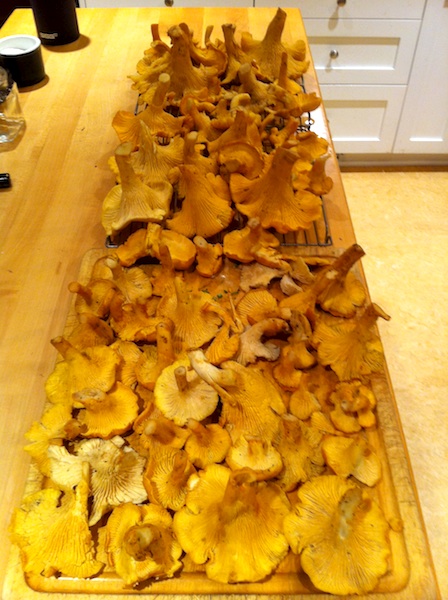
He's also a forager extraordinaire, and when he mentioned going out to hunt down some wily late-season chanterelles, it was all I could do not to drop to my knees and plead to go along. And, a couple of weeks later, head out we did on what turned out to be a drenchingly wet November day, with temperatures plummeting into the mid-40s.

One of the rosy-pink mystery mushrooms.

Since most of his favorite spots are three to four hours away and we both had to get back to town by mid-afternoon, Donald decided to head up the Gorge on the Washington side and see if we could find some likely locations. Turning off the highway past Camas, we drove up a forest road, pulling off to investigate a couple of spots that Donald said "didn't feel right" and then eventually parking at a gated side road that looked like it hadn't had much traffic of late.

Another mystery mushroom.

Mushroom hunting is akin to other types of hunting in that you basically charge off into the underbrush, over fallen trees and through thickets. The best places don't feature groomed trails or signage ("Mushroom picking 100 yards ahead" signs are rare), and you have to be prepared to climb steep hillsides, slide down muddy embankments or bushwhack your way through the underbrush that grows up out of the Doug fir duff where you'll find your prey.

The other key, particularly if you're like me and your sense of direction goes out the proverbial window when you're in the woods, is to go with someone who possesses an unerring sense of direction, i.e. who knows where they left the car. The only other gear required is a bag for your booty, should you find any, and a pocket knife for cutting the mushrooms, rather than yanking them up and potentially damaging the root that will sprout new mushrooms. An experienced guide with a well-thumbed guidebook is also valuable.

The haul, cleaned and drying out a bit.

We began on one side of the road and found several kinds of mushrooms, some small and brown (Donald calls them LBMs for Little Brown Mushrooms), others amber-colored and some with a rosey pink glow on top and white gills underneath. Like the other trips I've made to hunt fungi, at first I find myself overwhelmed by the sheer complexity of what I'm looking at, with fallen leaves, moss, fir needles and shrubbery competing for my attention. But then I'll see one mushroom, then a few more, and eventually I'm able to pick out the ones I want from the visual noise of the forest floor.

After crossing the road, we came on several patches of chanterelles that were, like us by this point, a bit soggy from the rain. But the thrill of finding first one, then another, then a few together was thrilling enough to keep us looking until we had four or so pounds between us, at which point we reluctantly agreed it was time to head back. I'm just hoping I'll remember where it was when the season rolls around next year, but even if I can't I'll know better where to look if I stumble across a place that, in Donald's words, feels right.

Find directions on how to roast mushrooms for freezing or use in other recipes like Wild Mushrooms with Pasta and White Wine Sauce, Mushroom Risotto with Truffle Shavings, Springwater Farm Cream of Mushroom Soup and Mushroom Quiche.

Monday, November 15, 2010

Livin' in the Blurbs: Thankful For What We've Got


Thanksgiving's just a little over a week away and that means I'm making lists of favorite foods and favorite people, and trying to remember where the heck I put the gravy boat after last Thanksgiving. Our farmers' markets are gearing up for the big day, too, with several reopening for a final blowout, many featuring special products and vendors. Think turkeys, brussels sprouts, squash, patés, jams, greens, cheeses…close to everything you'll need for this most seasonal of feasts. Check out what's going on at a market near you by going to GoodStuffNW's complete list of Willamette Valley markets to find links, maps and locations. Here's what a few are doing:
  • Sat., Nov. 20, 8 am-1:30 pm: Beaverton Farmers' Market celebrates with a Harvest Market that not only has harvest-fresh foods for your table but holiday wreaths and garlands, gifts and stocking stuffers. SW Hall Blvd. between 3rd and 5th Sts., Beaverton.
  • Sat., Nov. 20, 9 am-2 pm: Portland Farmers' Market's Thanksgiving Feastival with all things fresh and tasty for your holiday celebration. In the Park Blocks between SW Montgomery and Park.
  • Sat. Nov. 20, 10 am-2 pm: Oregon City Farmers' Market shows off its new Winter Market that will continue every other week through April and has everything you need for a picture-perfect Thanksgiving. 8th Street at Main in downtown Oregon City.
  • Tues., Nov. 23, 1-5 pm: Thanksgiving Reunion at Buckman Farmers' Market gives those of us who like to wait till the very last moment a shot at the freshest food, drink and trimmings. SE 20th and Salmon between Belmont and Hawthorne.
* * *

Walk into any Portland Grand Central Bakery and Cafe this holiday season and you'll be bowled over by the colorful artwork from the women of the Zimbabwe Artists Project (ZAP) in Weya, Zimbabwe. Started as a cooperative effort by Lewis & Clark College sociology professor Dick Adams and the women of the village, 100% of the proceeds from the sale of the artwork goes to help the women afford food, clothing, school fees, medicine, seeds and fertilizer for their crops. Think of how good you'll feel each time you see it at your own home or one of your friend's (hint hint), knowing that it touched the life of someone halfway around the world. Isn't that what the holidays are all about?

Details: Benefit Show and Sale of artwork of the women of the Zimbabwe Artists Project at Grand Central Bakery and Cafes. Sale continues Nov.-Dec. Locations here.

* * *

And don't forget to celebrate World Toilet Day on Friday (Nov. 19). What sounds like the opening line of some gross poop joke is actually an opportunity to understand the importance of sanitation and raise awareness for the 2.6 billion people (nearly half of the world's population) who don't have access to toilets and proper sanitation. The statistics are shocking: diarrheal disease kills five times more children in the developing world than HIV/AIDS or malaria; it stunts growth and forces millions of adults and children to take weeks away from school and work, affecting their education and income, which hits both a country's economy and its citizens' chances of a better future. And that's no joke.

Details: World Toilet Day, sponsored by the World Toilet Organization. Friday, Nov. 19. Donate here.

Sunday, November 14, 2010

The Best Bacon Ever


I'd been working on getting Dave to smoke some pork belly for at least a year. It's not that he didn't want to, or was just being intransigent about taking his wife's suggestion. After all, he has a full-time job that supports his family, and any free time has been subsumed by a passion for developing his own sourdough starter, using it to make some fine breads, English muffins and biscuits.

Ready to cure in the fridge.

And that's not to mention the cocktail research, which these days is focused on the subject of bourbons and bitters. But after buying him a couple of books on home charcuterie and sending links to online articles on the subject, I could see his interest shifting to a more active state. Then came the day that he announced he'd ordered five pounds of pork belly from New Seasons and needed to go on a hunt for curing salt.

If we were the types to plan ahead, there are myriad online retailers who carry this special combination of table salt and sodium nitrite or nitrate, dyed pink to distinguish it from other salts since it's apparently quite lethal. But because we subscribe to the last-minute school of life, a little research led us to The Meadow, Mark Bitterman's shrine to NaCl. Fortunately it's also close by, so we could run over and get back while the sourdough Dave was working on that day (I didn't say he gave up his infatuation) finished rising.

A sample of the finished product.

The only problem we ran into was finding a bag that would fit the five-pound slab, since it needed to cure in the fridge for a week. Now, we could have cut it in half and slipped it into two one-gallon bags, but that would have reduced the impressive feat of slapping the whole monster on the grill. So not being able to find the 2-gallon bag called for in the recipe, we used a large size oven bag sold for turkeys.

Other than that it was rubbing the slab with the salt mixture, putting it in the fridge in the duct tape-sealed bag and turning it daily for a week. Smoking took about three hours, and then we cooled it, whacked it up into one pound chunks and put it int the freezer. A sample we fried up on the spot indicated a deeply but not overly smoky belly that one volunteer said was some of the best he's ever had. I'd say it was definitely worth waiting for.

Home-Cured Bacon
Adapted from Michael Ruhlman's Charcuterie: The Craft of Salting, Smoking, and Curing

• Order five pounds of fresh pork belly from your grocery store, the pork guy at your farmers market, or from a local butcher shop.


• Buy a box of 2-gallon zip-top bags if you don’t have a container big enough to hold the belly or use oven bags meant for turkey.

Mix the following together in a small bowl:
2 oz. (1/4 c. Morton or Diamond Crystal coarse kosher) salt
2 tsp. pink curing salt #1
4 Tbsp. coarsely ground black pepper
4 bay leaves, crumbled
1 tsp. freshly grated nutmeg
1/4 c. brown sugar, honey or maple syrup
5 cloves garlic, smashed with the flat side of a chef’s knife
2 Tbsp. juniper berries, lightly crushed (optional)
5 to 10 sprigs fresh thyme (optional)


Put the pork belly in the zip-top bag or in an oven bag. Rub the salt and spice mixture all over the belly. Close the bag (if using the oven bag Dave recommends black duct tape for the aesthetics) and stick it in the refrigerator for seven days (get your hands in there and give the spices another good rubbing around midway through). After seven days, take it out of the fridge, rinse off all the seasonings under cold water and pat it dry.

For cooking in the oven:
Put it on a sheet tray and put it in the oven (put it on a rack on a sheet tray if you have one) and turn the oven on to 200°. (if you want to preheat the oven, that’s fine, too). Leave it in the oven for 90 minutes (or, if you want to measure the internal temperature, until it reaches 150 degrees F.). Let it cool, cut it into usable chunks (we did approx. 1-lb. chunks) and refrigerate or freeze it until you’re ready to cook it.

For cooking in a smoker:
Build a fire from charcoal or hickory chunks. When the temperature inside the smoker reaches 125-150°, put the pork belly on the top rack. Maintain the 125-150° temperature inside the smoker for approximately 3-3 1/2 hrs. or until the internal temperature of the belly reaches 150°. Remove and cool. Slice into usable chunks and refrigerate or freeze.

Simmering at the Savoy


I'm always reduced to drooling by the weekly newsletters that I get from Jim Dixon of RealGoodFood. A combination of memoir, recipe and the week's offerings of his once-a-week-or-so "pop-up" store at Activspace, he always comes up with something that makes me want to run into the kitchen and start cooking.

For many years my booth at the Portland Farmers Market was next to Fred Carlo’s. I’ve known Fred for a long time, and I didn’t mind the savory aroma of frying onions, peppers and pork that clung to me after the market was over. During the colder months we’d share whatever we’d brought to “sweeten” our coffee, and we’d swap stories about business, Italy and the things we loved to eat.

I don’t remember exactly when Fred told me about one of the dishes his grandmother made, but it’s always been stuck in my head. He described how she’d add Savoy cabbage to a pot of beans, then pour in polenta and let it simmer together to form a thick, chunky stew. It was one of his favorite things. So last week at the market, when I saw the dried borlotti beans at Viridian Farms and the bright green, wrinkled leaves of Savoy cabbage at Spring Hill Farm, I knew it was time to make Fred’s grandmother’s beans.

Borlotti Beans, Savoy Cabbage, Polenta

Borlotti beans are also called cranberry beans, and it’s worth it to seek the best, either from Viridian Farms or Ayers Creek Farm. Bob’s Red Mill sells packaged cranberry beans, and in a pinch you could substitute pintos. Good polenta makes a huge difference, too, and Ayers Creek is the best. If you can’t get to the Hillsdale Farmers Market early on a Sunday when they actually have some, Anson Mills mail order might the next best.

Cook a half pound beans separately using my no-soak oven approach. Combine the beans with about three times as much water, a big pinch of sea salt, and a healthy glug of extra virgin olive oil. Cook in the oven at 250° until tender, usually at least a couple of hours. Add more water if the top of the beans are dry. Do this a day or two ahead and store in the refrigerator.

I decided to cook the polenta separately. Put a cup of polenta into a saucepan, then stir in 3 cups of cold water; add some salt. Heat slowly, stirring occasionally and scraping the bottom of the pan. Cook on very low heat for about 45 minutes, adding a little hot water if it gets too thick (I usually add about a half cup over the last 20 minutes or so).

Dice about a half pound of pancetta (or another fatty cured pork product; bacon, ham, proscuitto) and cook for about 10 minutes in extra virgin. Add a diced onion, cook for about 5 more minutes, and add a couple of diced garlic cloves. Let that cook while you chop half a head of Savoy cabbage (use plain green cabbage if you can’t find Savoy). Toss in the cabbage and cook uncovered for 10 minutes or so, then add the beans and simmer for another 15 minutes.

If you want to cook the polenta with the beans and cabbage, add it to the pot after the cabbage, but use less (maybe half a cup) and make sure there’s enough liquid from the beans (add a little water if necessary). Simmer everything for at least 40 minutes, stirring often.

Spoon the beans and cabbage over the polenta, drizzle with good extra virgin olive oil and sprinkle with flor de sal.

Tuesday, November 09, 2010

Come In…The Wine's Fine!


Despite the grim news about the economy that is pouring out of every pundit's pie-hole, the good news is that…well…there's lots of good news about good things happening to good people, at least here in my little corner of the world. And doggone it, since this blog is supposed to be about good stuff, I'm gonna share it with you whether you like it or not!

The best news lately is that my brother, Bruce, the ever-upfront guy behind the blog Eat. Drink. Think. and my personal hook-up for fabulous foodstuffs (as well as the papa of my beloved nephew C-boy), has today opened his spiffy new location on the corner of SE 28th and Ash. Just down the street from Ken's Artisan Pizza and on the opposite corner from Crema and Coalition Brewery, it's a bigger, more uptown-yet-still-accessible set-up.

So if you're in the neighb', stop in, check out the space and give him a big ol' sloppy one from his big sis. (I dare ya!)

Details: Vino, 137 SE 28th Ave. 503-235-8545.

Monday, November 08, 2010

The Greening of Dinner


Here's a list of things I didn't expect when I started this blog:
  • That anyone, aside from a few friends, would ever read it.
  • That it would start me on the path to a new career as a writer.
  • That I would still be doing it more than four years and some 1800-plus posts later.
  • That I would get on e-mail lists for nice things like media dinners but also on those promoting the latest books from new age/horror/makeover authors (wait, is that a new genre?).
  • That boxes would appear on my front porch containing books, locally roasted coffee, snack chips and garbanzo beans.
Yes, garbanzo beans. Flash-frozen green garbanzo beans. Which I had never cooked with before. And now I had a case of them.

I'd seen green garbanzos once before in their husks (left) at the Forest Grove Farmers' Market. Fortunately someone had already done the work of de-husking these, making them much more attractive when it came to actually doing something with them. Asking around, I heard they made great hummus and could be used in stir fries, soups and stews.

So when I was stuck (again) for something to make for dinner last night and, ever the optimist, opened the door to the freezer to see if some fairy might have magically left a whole frozen lasagne buried under the bags of parmesan rinds, nuts and bread ends, I saw one of those big green bags staring at me. Since I'd been hankering for some curry, I grabbed it and some rice and tomatoes from the pantry and, within a half hour, had dinner on the table. Talk about side benefits!

Green Garbanzo and Tomato Curry

2 Tbsp. canola oil
1 yellow onion quartered and thinly sliced
3 cloves garlic, minced
1 red bell pepper, quartered and thinly sliced
1/2 tsp. turmeric
1/4 tsp. cumin
1/8 tsp. coriander
2 c. crushed tomatoes
2 c. green garbanzo beans
Splash fish sauce (optional)
Salt to taste

Heat oil in deep skillet. When it shimmers, add onion and garlic and sauté over medium heat till the onion is transparent. Add the red bell peppers and sauté till tender. Add spices and stir for 30 seconds, then add tomatoes and garbanzo beans. Salt to taste and, if desired, add a splash of fish sauce. Simmer for 15-20 minutes. Serve with rice and chutneys (we particularly like Patak brand, especially their Lime Relish).