Showing posts with label roger and me. Show all posts

Monday, December 29, 2014

Why I Butcher My Own Meat


My fascination with butchery began decades ago with the humble chicken, though the exact details of the experience are lost to the mists of time. Was it in college in a fit of DIY enthusiasm? Or when I was living on my own? Or perhaps as a young married person, when I realized that buying a whole chicken was a lot cheaper pound-for-pound than its already-segmented version? In any case, somehow, somewhere, from a live person or on TV, I learned how to cut up a whole chicken into its component parts.

Meeting my meat.

It was a satisfying achievement, much like learning how to change a tire or install a rheostat, one of those things adults (and real cooks) do. Learning to feel the joint in the leg between the thigh and drumstick, that little indentation that, when sliced, cleaves with almost no resistance into two perfect parts. A wonderful skill, both mechanical and edible.

I never had a problem with the "yuck" factor, not being the squeamish sort when it came to blood, though that's rarely a problem with properly slaughtered animals. My decision was reinforced when news came out that the best-quality commercial chickens appeared whole in the butcher case, and that the trays of parts often came from carcasses where some portion of the bird might have been damaged from a defect or mishandling.

Who needs roses?

Butchering a larger animal never occured to me. Growing up, my family was inclined to frequent steakhouses more than hunting blinds, my father not being the outdoorsy type and only going hunting when he felt he couldn't refuse a customer's invitation. My mother wasn't interested in dealing with plucking or cooking whatever game he brought home, since the birds were often peppered with buckshot and she had no clue how to cook deer or elk.

It wasn't until I became a food writer that I felt obliged to follow an animal from its pasture to my plate, and to experience what it means to take the life of a living creature. Recounted in a series of posts called Thinking of Eating, I met a young pig named Roger and watched as he grew up, was killed in his pasture at the farm and then taken to the place where I was going to be taught how to butcher him.

Two-rib chops, anyone?

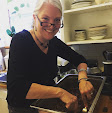
Under the tutelage of master butcher Melinda Casady (top photo), I was initially overwhelmed and then profoundly amazed as she led me through the process of breaking down a nearly one hundred pound carcass into large, manageable chunks called primals using just a bone saw, knives and some muscle. Like the chicken, there were anatomical clues to dividing the large hunks into the roasts, steaks, ribs and other pieces that would end up in the braising pot, smoker or meat grinder.

A better pot of beans.

One of the best things about it was being able to make my own decisions about how large the roasts should be, whether I wanted lots of chops or if I should leave a chunk for a rib roast—boned or bone-in—plus getting to save all the bones for roasting and making into stock. Even the trotters were saved and tied for throwing into a pot of beans. Talk about snout-to-tail and using every part! It made me feel like I was really getting my money's worth, again much like cutting up my own chicken, making stock from the carcass and picking off the cooked meat for salad, tacos or chicken pot pie.

Happy freezer.

In the years since, I've butchered two other half pigs and a couple of lambs and watched a chef break down a goat. I'm convinced that if you care about how your meat is raised, whether from an ethical, environmental or quality standpoint, there's no better way to guarantee you're getting what you want than to buy it intact and butcher it yourself, especially if you buy direct from a farmer. Not many of us can do this 100 percent of the time, of course, but in my experience, it's cheaper pound-for-pound than buying pieces of similar quality meat at the butcher's counter in the store, and you get so much more for your money.

There are many local farmers who sell sustainably raised (as well as pastured) meat directly to consumers, and it's possible to buy chickens, ducks, pigs, cattle and goats in the local area. Most can supply either whole, half or portions of larger animals, and are happy to refer you to a packing plant that will butcher the animal for you. In the last couple of years Portland meat-eaters have seen several butchers start offering classes that can lead neophytes through the process of butchering. Some of those are listed in the calendar in the left-hand column.

Tuesday, February 18, 2014

A Pig Named Roger: Celebrating a Life Given


Two years ago I met a pig named Roger. This is the last in a series of three videos that was filmed at that time. Here are the initial paragraphs of my post about the meal that celebrated his life.

The very first post in this series started with a question: Can I eat an animal I've played tag with?

At first it was merely an interesting notion. I'd buy half a pig from my friend Clare at Big Table Farm, something I'd been wanting to do for some time. But I didn't want to simply wait for the time, some months hence, when she'd call to say my half was butchered and ready to pick up from the packing house. I wanted to meet this pig named Roger, and trace his life from his pasture to my plate.

Roasted bones for stock.

I didn't have an agenda in mind. This wouldn't be an attempt to follow the already well-trodden path of other food writers like Michael Pollan or Barbara Kingsolver. I didn't want to hammer home points about whatever-vores, 100-mile diets or the evils of corporate agriculture. It was simply a documentation of my experience, with no expectations of a major life change ("I'll never be able to look a pork chop in the eye again…") or revelation ("Roger came to me in a dream one night…").

Read the rest of the post, Thinking of Eating: Pasture to Plate.

Watch the other videos in the series, Getting to Know My Food and Learning to Butcher.

Tuesday, February 11, 2014

A Pig Named Roger: Learning to Butcher


Two years ago I met a pig named Roger. This is the second in a series of three videos that was filmed at that time. Here are the initial paragraphs of my post about the butchering.

I arrived at Portland's Culinary Workshop (PCW), where I would be butchering my half of Roger, about thirty minutes before Clare was to arrive with him and her half of Don. I walked in to find the tables set up for the butchering along with the various knives and saws we'd be using to do the job. In the spirit of the day, there were also two tubs set up to hold the butchered meat, one labeled "Roger" and the other, "Don."

A hands-on cooking school started by my neighbor, Susana Holloway, and her friend, Melinda Casady (left), both former culinary school instructors, PCW seemed the perfect place for this part of the process. Especially because Melinda, nicknamed "The Mistress of Meat," loves to teach people how to cut up whole animals or, to use the term of art, "break down" carcasses.

The halves of Roger and Don had been hanging in Clare's shed at the farm to chill overnight, and when she drove up they were cool as cucumbers, wrapped in plastic sheeting in the back of her truck. She'd stopped at a friend's winery on the way in and weighed the halves, with my half of Roger coming in at 96 pounds, making his live weight close to 320 pounds. Quite the pig.

Read the rest of the post at: Thinking of Eating: The Meat of the Matter.

Watch the other video in the series, Getting to Know My Food and Celebrating a Life Given.

Tuesday, February 04, 2014

A Pig Named Roger: Getting to Know My Food


Two years ago I met a pig named Roger. This is the first in a series of three videos that was filmed at that time. Here are the initial paragraphs of my first post about the project.

 Can I eat an animal I've played tag with?

It's a question I've been struggling with since committing to buy half a pig from my friend Clare Carver at Big Table Farm. Twice a year for the last several years, Clare has bought two organically-certified weaner pigs from her friends Amy Benson and Chris Roehm at Square Peg Farm, and I'd promised myself that someday I'd get one.

This spring she got two Berkshire Cross pigs, a heritage breed known to thrive on pasture and whose meat is darker and far more flavorful than store-bought. Named Don and Roger after two of the main characters from the TV series Madmen, they're being raised inside an electrified tape corral on grass pasture. The corral is moved every few weeks in a process called rotational grazing, an especially good idea since young pigs like to root around, roll and generally tear up the ground. Their diet consists of grass, organic grain, occasional treats of the farm's organic eggs and scraps and vegetable trimmings from the kitchen.

Clare doesn't believe in moving her animals off the farm for slaughter because of the stress it puts on them and the effect that can have on the quality of the meat (see previous story here). So when Don and Roger reach 270 pounds or so they'll be killed in their pasture on the farm.

Read the rest of the post at: Thinking of Eating: Roger and Me.

Watch the other videos in the series, Learning to Butcher and Celebrating a Life Given.

Tuesday, March 05, 2013

Spare But Not Skimpy: Chinese Braised Spare Ribs


It's no surprise I would find a package of spare ribs in the freezer that'd been packed in there over a year ago, the very last remnant of Roger the pig. I mean, there are dust bunnies in our house that could be considered "vintage." And there was the time our son finally got tall enough to see the top of the fridge and I caught Dave frantically signalling him to not say anything about the quarter-inch of dust he could see there. The boy couldn't help himself, of course, and my response was to hand him a sponge…funny how he's never remarked on it since.

Montinore Estate's verjus…awesome!

Anyway, back to the spare ribs. When they thawed out I found a teensy bit of freezer burn on one corner, but otherwise they looked fine. After cutting off the little burn and figuring neither the weather outside nor the age of the ribs merited the traditional barbecue treatment, I remembered a dish we'd had recently that featured braised spare ribs.

A little research yielded a few recipes that gave me an idea of ingredients and timing, so I cobbled together what sounded good and what I could fill in with ingredients from the pantry. The brilliant part, if I do say so myself, was substituting verjus for the stock or wine called for in the other recipes. Its mild, slightly vinegary flavor seemed, at least to my mind, to go with that sweet-sour taste I love in Asian dishes.

It turned out to be a door-buster of a dish, the succulent meat not quite falling off the bone, and definitely fit for guests when I make it again (and I definitely will). In fact, if I'm not mistaken, there are some spare ribs from Petunia out in the freezer someplace. I'll just have to dig them out.

Chinese-style Braised Pork Spare Ribs

1 1/4 c. verjus, white wine or rice wine
1/3 c soy sauce
1/4 c hoisin
6 cloves garlic
1/2 onion, coarsely chopped
2 whole dried hot red peppers
1/2 tsp. ground coriander
1/2 tsp. ground cumin
2 lb spare ribs
Cilantro, finely chopped, for garnish

Preheat oven to 300°.

Put all ingredients except spare ribs in medium sized Dutch oven over medium heat and bring to a boil, stirring to combine. Add spare ribs and return to a boil. Cover and place in oven for 1 1/2 hrs.

Remove from oven and pour off juices into skillet, leaving ribs in covered pot to stay warm. Bring juices to a boil and reduce by half or until it thickens to a sauce-like consistency. Skim off fat (I used my glass fat separator). Put ribs in serving bowl and pour sauce over top. Garnish with chopped cilantro.

Monday, March 05, 2012

A Really Great Day


The e-mail's subject line was enough to grab my attention: "Oink oink."

Turns out my friend Matt Berson, winemaker under his own Love and Squalor and Behemoth labels, had bought half a pig from Chris and Amy at Square Peg Farm and was looking for some moral support. He'd observed a couple of other butcherings, and taken the hands-on pig butchering class from Melinda at Portland's Culinary Workshop, but this was his first solo effort.

I told him I'd only butchered a pig once under close supervision, but he said the company would be helpful, so I was (more than) happy to come and lend a hand. I climbed the stairs at his friend Matt Johnson's Secret Society and up to the kitchen where Peg the pig (named after its former home) was waiting on a long table.

After consulting a couple of online resources, Matt set to work cutting it into the large primal sections, leaving the leg in a single piece for prosciutto. The jowl came off, then the belly, a nice long slab of bacon-to-be. We threw scraps of meat and fat into a bin for sausage, then after removing the backbone and dividing the rib sections, I had to leave Matt to do the rest of the piecework since I was meeting my friend Kathryn for a lunch date.

Kevin was just turning the "CLOSED" sign around as I got to Evoe, so I grabbed two seats at the prep table, the better to observe the chopping, shaving and mixing of the ingredients that makes this place my personal choice for the best restaurant in town. By the time I'd perused the chalkboard with the day's offerings, Kathryn had arrived and we promptly ordered two house-made elderflower spritzers and the pickle plate.

Knowing as I do that Kathryn's appetite for Kevin's food is as prodigious as mine, despite the fact that she is (quite astonishingly) petite, we set about ordering. Nettle dumplings with cream (left) were the essence of spring, three light-as-a-feather quenelles arranged in a dish of cream and briefly set under the broiler to warm and brown.

To follow that we chose a light salad. Kevin has had a way with butter lettuce salad since the early days of Castagna, and we knew this one would be the perfect mid-meal break with lightly dressed whole leaves tossed with chopped anchovies. The culmination of lunch was duck confit (right), a whole leg that had been sitting in duck fat for several days, which was then toasted to crunchy, crusted perfection and served with a spoonful of thick applesauce. After that we considered splitting the spicy pork sandwich for dessert, but decided that might be a bit too much even for us.

Dave came home that evening in the mood for a martini, so while I cubed up some of the jowl from Roger the pig that he'd cured and smoked the weekend before, he shook up a couple of his house specials. In Italy a cured, unsmoked jowl is called guanciale and, when sliced, looks a lot like bacon with ribbons of fat streaked with meat. It's used in dishes like carbonara and pasta all'amatriciana, and since I had a couple dozen of Clare's amazing eggs, I decided to go with the carbonara, a fitting tribute to Roger's home and an appropriate end to a spectacular day.

Sunday, November 13, 2011

Thinking of Eating: Pasture to Plate


The very first post in this series started with a question: Can I eat an animal I've played tag with?

At first it was merely an interesting notion. I'd buy half a pig from my friend Clare at Big Table Farm, something I'd been wanting to do for some time. But I didn't want to simply wait for the time, some months hence, when she'd call to say my half was butchered and ready to pick up from the packing house. I wanted to meet this pig named Roger, and trace his life from his pasture to my plate.

Roasted bones for stock.

I didn't have an agenda in mind. This wouldn't be an attempt to follow the already well-trodden path of other food writers like Michael Pollan or Barbara Kingsolver. I didn't want to hammer home points about whatever-vores, 100-mile diets or the evils of corporate agriculture. It was simply a documentation of my experience, with no expectations of a major life change ("I'll never be able to look a pork chop in the eye again…") or revelation ("Roger came to me in a dream one night…").

The hardest part, as might be expected, had been the moments just before and after Roger was killed in his pasture. The butchering was an exhausting but fascinating process on its own, with 96 pounds of meat to parse. And when it came to cooking this pig I'd met, it was similarly freighted with both emotion and practicality.

Big Table Farm eggs, Roger bacon and cornmeal scrapple.

I'd decided our first dinner featuring Roger wouldn't be a big party, just a quiet family dinner at home. I'd chosen pork chops as our entrée, a simple cut simply seasoned with a smear of olive oil, salt and pepper, the better to taste the flavor of the meat itself. Dave got the grill going, I had a beet risotto simmering on the stove and a green salad with seared figs ready. A bottle of Big Table Farm pinot was opened.

Dave brought the chops in from the grill, and as they rested on their platter, perfuming the air with their meaty scent, we set the table and poured the wine. Each of us chose our chop, I held up my glass and we toasted Roger, thanking him for his good life and for giving us this meal, as well as for what would surely be many other good meals to come. The first bite was succulent and porky, mild and just a bit smoky, certainly one of the best pork chops I'd ever tasted.

Making sausage is fun.

As we ate, I thought of Roger in his field, playing with Don in the long grass of his pasture and sitting under the spray from the hose, enjoying the respite from the day's heat. I remembered him laying in the grass, his face contented as I scratched him behind the ears. That is the face I carry with me, one I am truly thankful I got to know.

In the weeks since that dinner, we've made bacon and sausage, smoked a fresh ham and made pork stock for ramen. We've referred to it as Roger bacon or Roger sausage, in the same way I remember a friend every time I use the gift she gave me. And while that may sound trite or even macabre, it feels oddly natural. We've shared these experiences, and this food, with our larger community of family and friends. And isn't that what it should be all about?

I'll be sharing the recipes with you in coming posts, and hope that you'll enjoy his continuing story. To him I say, thank you, Roger, you were a good pig.

Read the other posts in this series: Roger and Me, Roger Grows Up, Saying Goodbye, The Day Finally Comes and The Meat of the Matter.

Sunday, October 02, 2011

Thinking of Eating: The Meat of the Matter


I arrived at Portland's Culinary Workshop (PCW), where I would be butchering my half of Roger, about thirty minutes before Clare was to arrive with him and her half of Don. I walked in to find the tables set up for the butchering along with the various knives and saws we'd be using to do the job. In the spirit of the day, there were also two tubs set up to hold the butchered meat, one labeled "Roger" and the other, "Don."

Melinda Casady, Mistress of Meat.

A hands-on cooking school started by my neighbor, Susana Holloway, and her friend, Melinda Casady (left), both former culinary school instructors, PCW seemed the perfect place for this part of the process. Especially because Melinda, nicknamed "The Mistress of Meat," loves to teach people how to cut up whole animals or, to use the term of art, "break down" carcasses.

Roger's tub.

The halves of Roger and Don had been hanging in Clare's shed at the farm to chill overnight, and when she drove up they were cool as cucumbers, wrapped in plastic sheeting in the back of her truck. She'd stopped at a friend's winery on the way in and weighed the halves, with my half of Roger coming in at 96 pounds, making his live weight close to 320 pounds. Quite the pig.

Just getting started.

We carried the carcasses in and laid them on the tables—end to end it was about five feet of pig to cut up—and Melinda discussed with each of us the different ways we could cut up our pig. Did we want lots of chops and steaks? Or would we rather have more roasts? Big or small? Bone in or out? What about the ribs? Did we want whole racks?

Can't wait to throw these on the grill!

Some decisions were easy…we're more roast types than steaks, but a nice chop is good once in awhile, too. Some decisions we left until we saw what the actual cuts were like, made easier because the breaking down involves cutting the animal into large sections called primals, then sectioning each primal into smaller and smaller pieces. It also involves finding and cutting out glands and other non-edible bits, and I was glad for Melinda's expertise with that particular chore.

I gotta get me a hacksaw.

There was very little waste, even from a pig that big, since I was planning on making stock from the bones and making sausage with the inevitable collection of scraps of meat and fat. While I was secretly relieved that I'd decided not to keep the head because it would be too recognizable as Roger, I was also a little sad I wouldn't get to make scrapple again.

Getting a little rummy.

While I won't go into the blow-by-blow on breaking down a carcass, it was fascinating to see how much a pig's anatomy resembled our own, and how the different joints are connected. Emotionally it wasn't hard to do, probably because the carcass didn't look like Roger any more (the head thing again), and I was focusing on the job at hand, trying not to slice myself up in the process. It was all kind of geeky in a messy, sweaty sort of way and as we got down to the last few cuts, after four hours or so of work, I was getting really exhausted.

Wrapped and ready.

When the wrapping and packaging were finally done, we opened beers and a bottle of wine and toasted, first, Roger and Don for the wonderful meals they'd provide, then ourselves and Melinda for a job well done. Roger is now resting comfortably in our freezer, and I can't wait to have our first dinner featuring him.

Read the other posts in this series: Roger and Me, Roger Grows Up, Saying Goodbye, The Day Finally Comes and Pasture to Plate.

Tuesday, September 06, 2011

Thinking of Eating: Saying Goodbye


"You're cruisin' for a bruisin'," were his exact words. I'd been interviewing Portland bartender Dave Shenaut for an article about Portland Cocktail Week, and he asked what I'd been up to lately. I told him about Roger, the pig I was getting from Clare Carver of Big Table Farm, and that I'd wanted to get to know him, to put a name to the food on my table.

I've had other friends express everything from horror to admiration about the idea, but when I went out to Big Table to say a last goodbye to Roger before he was slaughtered, I knew that Mr. Shenaut had hit the nail on the head.

When I went into the pasture he shares with Don, the other pig Clare is raising, Roger drank some of the water we'd just poured into his bowl. Then, while Don slurped away, Roger came over and stood near me so I could scratch his ears and back. Clare had said that he liked his belly rubbed, so when I reached over his back and started scratching his belly, he slowly sank to his knees and rolled over on his side. He closed his eyes, and his piggy mouth turned up as if he was smiling.

As much as I've dreaded and, in an odd way, looked forward to it, this is Roger's last day. At six o'clock this evening, Richard will drive up to Clare's farm and kill Roger and Don, giving them an instant and humane death. I'll be there, as will another family who are taking half of one of the pigs. It's going to be hard, and tomorrow morning we'll butcher the meat, wrap it up and freeze it for what I'm sure will be some amazing meals.

I'll miss you Roger. You were a good pig.

Read the other posts in this series: Roger and Me, Roger Grows Up, The Day Finally Comes, The Meat of the Matter and Pasture to Plate.

Thursday, August 25, 2011

Thinking of Eating: Roger Grows Up


I got a call from Clare the other day saying that Don and Roger were growing much faster than she expected and would reach their ideal slaughter weight a couple of weeks before she'd anticipated.

You might remember the last time I went out, the pigs weighed in the neighborhood of 200 pounds. Don has always been the larger of the two, outweighing Roger by ten or so pounds, and he's definitely the more food-oriented. It was obvious when we went out to feed them table scraps and vegetable trimmings—Don went right for their food bowl, while Roger stood and leaned against me, insisting on getting scratches before he joined his brother.

After playing some piggy tag with them, Clare suggested feeding them some of the blackberries from the bushes just outside the pasture. Now, these are big animals, at least three times the size of the biggest dog I've played with. Even Walker has surprised well-meaning guests when they've proferred a treat and in his excitement he's taken their whole hand into his mouth.

But when I offered Roger a juicy blackberry, rather than chomping down, he gently took it from my fingers with his lips and swallowed, grunting appreciatively. After several more he ran off to play with Don, who'd decided that he was through with this dainty exercise and had gone to the grain bucket for some real chow.

While Don was munching away, we gauged his weight by measuring him with string. Yes, you heard me right. You take a five foot or so length of string, put one end between your pig's ears and run it down his back to the base of his tail (illustration, right), then mark it with tape or a knot. Then you measure his girth by putting the string around him just behind his front legs. Measure the marks on the string with a tape measure, use the following formula and you'll get a weight that Clare has found accurate (on pigs…not so much on people or dogs) to within five pounds:

Weight (lbs) = (Length x Girth x Girth) ÷ 400 (inches)

Which put Don at about 285, making Roger's weight around 270, confirming her suspicion that they were going to be ready for slaughter any time in the next couple of weeks.

Not to get off track, but we had a delicious posole verde the other day, made with pork shoulder that had been simmered for several hours till it was fall-apart tender. Served with rice and a cabbage slaw it was fabulous. I no more thought about the pig that shoulder came from than I thought about the plant the tomatillos came from.

Which is where this whole thing gets complicated. I find myself thinking at odd moments about Roger, who's definitely a people-oriented guy, and I'm getting kind of attached to him for just that reason. It's hard thinking he's going to be killed in just a couple of weeks and I'm frankly not looking forward to being there.

Having been through this several times before, Clare says she find it helps to replace the sadness with feelings of gratitude, so I'll be working on that in the coming days. I'll keep you posted.

Read the other posts in this series: Roger and Me, Saying Goodbye, The Day Finally Comes, The Meat of the Matter and Pasture to Plate.

Wednesday, August 10, 2011

Thinking of Eating: Roger and Me


Can I eat an animal I've played tag with?

It's a question I've been struggling with since committing to buy half a pig from my friend Clare Carver at Big Table Farm. Twice a year for the last several years, Clare has bought two organically-certified weaner pigs from her friends Amy Benson and Chris Roehm at Square Peg Farm, and I'd promised myself that someday I'd get one.

Genuine pigtail.

This spring she got two Berkshire Cross pigs, a heritage breed known to thrive on pasture and whose meat is darker and far more flavorful than store-bought. Named Don and Roger after two of the main characters from the TV series Madmen, they're being raised inside an electrified tape corral on grass pasture. The corral is moved every few weeks in a process called rotational grazing, an especially good idea since young pigs like to root around, roll and generally tear up the ground. Their diet consists of grass, organic grain, occasional treats of the farm's organic eggs and scraps and vegetable trimmings from the kitchen.

Clare doesn't believe in moving her animals off the farm for slaughter because of the stress it puts on them and the effect that can have on the quality of the meat (see previous story here). So when Don and Roger reach 270 pounds or so they'll be killed in their pasture on the farm.

One happy guy.

Which is a problem when it comes to selling her pasture-raised, humanely treated pigs to people like me, who are looking for exactly that kind of meat for our tables. That's because the only meat that the USDA allows farmers to sell to the public must be killed in a USDA-approved facility, and there are no USDA-approved mobile slaughter units in Oregon for Clare to call on. But an exception to that rule allows her to offer her pigs to buyers while the animals are still alive in an arrangement where the buyer ostensibly pays the farmer to raise the pigs for them and pay separately for their slaughter and butchering.

Which is where I came in.

Playing in the sprinkler. Roger's on the left.

When she got her weaners, Clare sent out an e-mail to her list of interested pig-buyers offering half a pig to three buyers (she and Brian will keep one half for themselves). I responded quickly to the first-come-first-serve offer and will get half of Roger sometime in September. I plan to attend the killing and slaughter, then take my half to Portland's Culinary Workshop where co-owner Melinda Casady will guide Dave and I in butchering the meat.

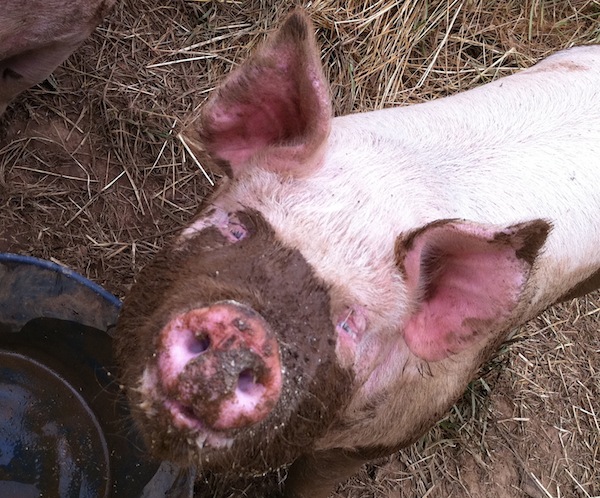
So far I've made two trips to the farm to visit Roger. On the first visit he and Don weighed in at around 100 pounds, about the size of a big dog (top photo). I'm always startled at how much like dogs they are as they run around and play with each other, obviously enjoying rolling in the dirt or grunting with pleasure as they scratch themselves against their mobile pig house, dubbed the "Winnapigo."

If this is slop, give me some, too!

They'll even play a piggy version of tag, ears pricked up at attention as you run behind their house, running around to "tag" you when you peek out, then dashing away to start again. On my second trip three weeks later they weighed around 200 pounds (above left and right). Clare turned on the hose and they ran under its arcing spray like kids playing in a sprinkler on a hot summer day.

My next visit is in a little more than a week, with slaughter scheduled for mid-September. And while I have no illusions about developing a deep relationship with Roger, I'm wondering if spending some time with him is going to change the experience of consumption in unexpected ways. Regardless, I'll be sure to let you know what happens in future installments.

Read the other posts in this series: Roger Grows Up, Saying Goodbye, The Day Finally Comes, The Meat of the Matter and Pasture to Plate.