Showing posts with label Melinda Casady. Show all posts

Monday, December 29, 2014

Why I Butcher My Own Meat


My fascination with butchery began decades ago with the humble chicken, though the exact details of the experience are lost to the mists of time. Was it in college in a fit of DIY enthusiasm? Or when I was living on my own? Or perhaps as a young married person, when I realized that buying a whole chicken was a lot cheaper pound-for-pound than its already-segmented version? In any case, somehow, somewhere, from a live person or on TV, I learned how to cut up a whole chicken into its component parts.

Meeting my meat.

It was a satisfying achievement, much like learning how to change a tire or install a rheostat, one of those things adults (and real cooks) do. Learning to feel the joint in the leg between the thigh and drumstick, that little indentation that, when sliced, cleaves with almost no resistance into two perfect parts. A wonderful skill, both mechanical and edible.

I never had a problem with the "yuck" factor, not being the squeamish sort when it came to blood, though that's rarely a problem with properly slaughtered animals. My decision was reinforced when news came out that the best-quality commercial chickens appeared whole in the butcher case, and that the trays of parts often came from carcasses where some portion of the bird might have been damaged from a defect or mishandling.

Who needs roses?

Butchering a larger animal never occured to me. Growing up, my family was inclined to frequent steakhouses more than hunting blinds, my father not being the outdoorsy type and only going hunting when he felt he couldn't refuse a customer's invitation. My mother wasn't interested in dealing with plucking or cooking whatever game he brought home, since the birds were often peppered with buckshot and she had no clue how to cook deer or elk.

It wasn't until I became a food writer that I felt obliged to follow an animal from its pasture to my plate, and to experience what it means to take the life of a living creature. Recounted in a series of posts called Thinking of Eating, I met a young pig named Roger and watched as he grew up, was killed in his pasture at the farm and then taken to the place where I was going to be taught how to butcher him.

Two-rib chops, anyone?

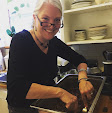
Under the tutelage of master butcher Melinda Casady (top photo), I was initially overwhelmed and then profoundly amazed as she led me through the process of breaking down a nearly one hundred pound carcass into large, manageable chunks called primals using just a bone saw, knives and some muscle. Like the chicken, there were anatomical clues to dividing the large hunks into the roasts, steaks, ribs and other pieces that would end up in the braising pot, smoker or meat grinder.

A better pot of beans.

One of the best things about it was being able to make my own decisions about how large the roasts should be, whether I wanted lots of chops or if I should leave a chunk for a rib roast—boned or bone-in—plus getting to save all the bones for roasting and making into stock. Even the trotters were saved and tied for throwing into a pot of beans. Talk about snout-to-tail and using every part! It made me feel like I was really getting my money's worth, again much like cutting up my own chicken, making stock from the carcass and picking off the cooked meat for salad, tacos or chicken pot pie.

Happy freezer.

In the years since, I've butchered two other half pigs and a couple of lambs and watched a chef break down a goat. I'm convinced that if you care about how your meat is raised, whether from an ethical, environmental or quality standpoint, there's no better way to guarantee you're getting what you want than to buy it intact and butcher it yourself, especially if you buy direct from a farmer. Not many of us can do this 100 percent of the time, of course, but in my experience, it's cheaper pound-for-pound than buying pieces of similar quality meat at the butcher's counter in the store, and you get so much more for your money.

There are many local farmers who sell sustainably raised (as well as pastured) meat directly to consumers, and it's possible to buy chickens, ducks, pigs, cattle and goats in the local area. Most can supply either whole, half or portions of larger animals, and are happy to refer you to a packing plant that will butcher the animal for you. In the last couple of years Portland meat-eaters have seen several butchers start offering classes that can lead neophytes through the process of butchering. Some of those are listed in the calendar in the left-hand column.

Tuesday, February 11, 2014

A Pig Named Roger: Learning to Butcher


Two years ago I met a pig named Roger. This is the second in a series of three videos that was filmed at that time. Here are the initial paragraphs of my post about the butchering.

I arrived at Portland's Culinary Workshop (PCW), where I would be butchering my half of Roger, about thirty minutes before Clare was to arrive with him and her half of Don. I walked in to find the tables set up for the butchering along with the various knives and saws we'd be using to do the job. In the spirit of the day, there were also two tubs set up to hold the butchered meat, one labeled "Roger" and the other, "Don."

A hands-on cooking school started by my neighbor, Susana Holloway, and her friend, Melinda Casady (left), both former culinary school instructors, PCW seemed the perfect place for this part of the process. Especially because Melinda, nicknamed "The Mistress of Meat," loves to teach people how to cut up whole animals or, to use the term of art, "break down" carcasses.

The halves of Roger and Don had been hanging in Clare's shed at the farm to chill overnight, and when she drove up they were cool as cucumbers, wrapped in plastic sheeting in the back of her truck. She'd stopped at a friend's winery on the way in and weighed the halves, with my half of Roger coming in at 96 pounds, making his live weight close to 320 pounds. Quite the pig.

Read the rest of the post at: Thinking of Eating: The Meat of the Matter.

Watch the other video in the series, Getting to Know My Food and Celebrating a Life Given.

Sunday, October 13, 2013

The Norman Chronicles: Getting to Shepherd's Pie


When a friend offered me one of her sheep that was going to be slaughtered this fall, I couldn't have said yes fast enough. After all, it had been born in April in the pasture she rented from a neighbor and had been raised almost exclusively on pasture grass and hay, supplemented with a little grain.

Norman as a baby.

I'd first met the lamb, named Norman, when he was born into the small herd my friend had. His mother was a big ewe and there was every indication little Norman would be large, too, since he grew much faster than the other lambs born at the same time. Very tame and with melting brown eyes, he always stood to be scratched behind the ears while the other sheep crowded in to get the hay my friend, Kim, and I would throw out.

Kim had hoped to find a reasonably priced mobile slaughter unit to do the job, since Norman was more family pet than livestock and her husband, though he's a hunter who had done a lot of field dressing of deer and elk, was particularly fond of him and didn't want to have to do the kill. Unfortunately no one could come out to do it in a reasonable amount of time, and it was left to her husband to manage the task himself.

Norman grazing in his pasture with his pals in the group on the right.

I offered to help, since at six months old Norman was fully grown, weighing in at around 200 pounds, a lot for one person to manage in a steep, uneven pasture. When we went out to the pasture, a pile of grain was poured on the ground and Norman eagerly started munching away at our feet. A shot to the back of the head dropped him instantly—he literally didn't know what hit him—and the last few beats of his heart pumped the blood out of his body through a slit made in the artery in his neck.

Lest I sound like a cold-hearted so-and-so, for me the moment of the kill is always fraught. I always hope the end is quick, painless and without struggle, which, in the three kills I've attended, has been the case. All of the animals were killed in the pasture they were born and raised in, with (or by) people they trusted, not trucked hundreds of miles to a processing plant to die with strangers in a strange place. Which, from my perspective, makes their pasture a much more humane place to end their lives, both for the lack of stress to the animals and, because hormones are released into the muscles when animals experience stress,  how it affects the final quality of the meat.

Dry-aging in Kitchen Cru's walk-in.

Norman was gutted and loaded into a wagon, then hauled to a pine tree in an upper pasture near the house. We hung the now-100-or-so-pound carcass from a device called a gambrel, a ratcheted device that was slung over a branch, that could hoist the animal to make skinning easier. As Kim's husband worked, I held it steady and smelled the lamb-y aroma coming from the still-warm meat.

Melinda ready to rock.

Clad in a game bag, a giant stretchy sock to protect the carcass, then wrapped in a plastic sheet and bungied in the back of our truck, I drove down the freeway feeling a little conspicuous, but no one honked or pointed or, worse, called the cops. Norman was destined to hang for five days in the walk-in at Michael Madigan's Kitchen Cru, the only place, for various reasons from USDA regulations to the start of deer season, that I could find for a pasture-slaughtered lamb his size.

Grinding trim pieces for ground lamb.

Dry aging, or hanging, in a cool (below 40°) environment helps the natural enzymes in the meat start to break it down without spoiling it. As the cell structure breaks down, it causes the meat to become more tender and the flavor to become richer and more intense, according the John Neumeister of Cattail Creek Lamb, who was kind enough to advise a newbie on the particulars of dry aging.

Layering on the mashed potatoes for a classic shepherd's pie.

Now weighing about 75 to 80 pounds—dry-aging causes a carcass to lose moisture, approximately 15 to 20% of its weight—Norman traveled to Portland's Culinary Workshop where co-owner Melinda Casady and her array of butchering skills and tools made quick work of breaking down the carcass into its component parts. I chose to leave most in large, braisable chunks with a few roasts and chops, leaving the legs on the bone for special occasions, and hoping Dave can cure and smoke the breasts for bacon.

Packed in a cooler and transported to the freezer in our garage, Norman will be the subject of many toasts at many meals this winter. Thank you, Norman.

Shepherd's Pie with Ground Lamb

For the potatoes:
2 lbs. whole potatoes
4 Tbsp. butter or margarine
1/4 c. milk
 Salt to taste

For the filling:
2 lbs. ground lamb
1 onion, chopped into dice
3 cloves garlic, minced
3 medium carrots, diced
1 c. chicken broth
1 c. frozen peas
1 tsp. dried thyme or tarragon
Salt to taste

Preheat oven to 400°.

Peel the potatoes if you prefer, then chop into 1/2" dice. (I used Yukon golds so didn't bother peeling them.) Put in medium-sized pot, cover with water and bring to boil over high heat. When water boils, reduce to low and simmer until potatoes are tender, about 20 mins.

While potatoes cook, heat large sauté pan over medium heat, add ground lamb and brown. When browned, drain off all but 2 Tbsp. of fat. Add onion, garlic and carrots to lamb and sauté till tender. Add chicken broth, peas and herbs and bring to a simmer, cooking for a couple of minutes. Season to taste with salt, then remove from heat while you mash the potatoes.

When potatoes are tender, drain them and add butter or margarine and milk. Mash with potato masher until smooth and thoroughly combined. Salt to taste.

Put lamb mixture in 9 by 12-inch baking dish and smooth the surface. Drop mashed potatoes onto the top of the lamb in dollops, spreading the potatoes out with the back of a spoon or spatula to completely seal in the lamb. Place baking dish in oven and bake for 25 minutes until potatoes begin to brown. If desired, you can then briefly place the baking dish under the broiler to crisp the top further, but it's not necessary.

Read the other posts in The Norman Chronicles: Braising Saddles, Shanks and Hearts and Neck and Neck.

Read about a lamb butchering class I took from Melinda in Class Cut-Up. Thanks also to Hank Shaw of Hunter Angler Gardener Cook and Ron Muise of Fearann Kisha for their help and advice.

Wednesday, June 06, 2012

Livin' in the Blurbs: Adding to Your Skillez


One of the highlights of my year is the annual spring tour of Ayers Creek Farm in Gaston with Anthony and Carol Boutard. Not only is it one of the few times of the year that they open their amazing organic farm to the public, it's one of the rare moments that you can actually chat with them for longer than it takes to ring up your purchases at their popular stand at the Hillsdale Farmers' Market.

His lofty eminence.

As usual, there will be a short tour of the farm narrated by the always-informative Anthony, to be followed by some snacky bits. Plus I hear they've arranged to have a celebrity greeter, the not-so-secret power behind the throne known as Tito. (If we're very lucky he might demonstrate his vole-fetching skills!)

Details: Ayers Creek Farm Ramble, Sun., June 24, 3-5:30 pm. 15219 SW Spring Hill Rd. near Gaston. This is a real farm, so bring your wellies in case of mud, or at the least wear sturdy shoes for walking.

* * *

Summer is an ideal time to pick up some new skills, whether its at the grill, learning to preserve summer's bounty or picking up pointers on a new cuisine. Whether you're an experienced hand in the kitchen or someone who's more familiar with a take-out menu than a chef's knife, there's a plethora of excellent classes available this summer. Here are some of my faves and a sampling of what they're offering; most are small classes of no more than a dozen students at a time and are very reasonably priced.
  • Sophie Rahman of Masala NW: Learn the basics of Indian cooking, including how to prepare lentils (vegetarian and gluten-free), flatbreads and classic biryani, as well as dishes from Goa, Chowpatty street food and how to grill tandoori-style.
  • Melinda Casady and Susana Holloway of Portland's Culinary Workshop: These gals are making waves on the Portland scene for their fun-yet-informative approach. Both were professional instructors at culinary schools, and bring their extensive knowledge and love of teaching to their classes on a dizzying array of classes on grilling, smoking, preserving, butchery, vegetarian and vegan cooking, knife skills, sushi…you name it, they teach it!
  • Katherine Deumling of Cook With What You Have: Katherine teaches how to cook simple, nutritious family meals, how to stock your pantry to avoid endless trips to the store and how to make the most of seasonal produce. Upcoming classes, which she offers in her home kitchen, include how to use fresh herbs in your dishes and kitchen fundamentals.
* * *

Summer's a time when kids are off from school and parents are desperately looking for quality classes for their young'uns. If you've got a budding Scorsese or Coppola in your house, then the Hollywood Theatre has a camp for you. Project Youth Doc for teens still has a few scholarships available, and if I could still pass for 19 I'd be all over this: Kids will work with industry pros and world-class gear to make a film from start to finish.  Check it out!

Details: Project Youth Doc, a filmmaking class for teens. Two sessions: June 18-July 13 and July 2-27. Scholarships available. Classes at the Hollywood Theatre, 4122 NE Sandy Blvd.  503-493-112.

Sunday, October 02, 2011

Thinking of Eating: The Meat of the Matter


I arrived at Portland's Culinary Workshop (PCW), where I would be butchering my half of Roger, about thirty minutes before Clare was to arrive with him and her half of Don. I walked in to find the tables set up for the butchering along with the various knives and saws we'd be using to do the job. In the spirit of the day, there were also two tubs set up to hold the butchered meat, one labeled "Roger" and the other, "Don."

Melinda Casady, Mistress of Meat.

A hands-on cooking school started by my neighbor, Susana Holloway, and her friend, Melinda Casady (left), both former culinary school instructors, PCW seemed the perfect place for this part of the process. Especially because Melinda, nicknamed "The Mistress of Meat," loves to teach people how to cut up whole animals or, to use the term of art, "break down" carcasses.

Roger's tub.

The halves of Roger and Don had been hanging in Clare's shed at the farm to chill overnight, and when she drove up they were cool as cucumbers, wrapped in plastic sheeting in the back of her truck. She'd stopped at a friend's winery on the way in and weighed the halves, with my half of Roger coming in at 96 pounds, making his live weight close to 320 pounds. Quite the pig.

Just getting started.

We carried the carcasses in and laid them on the tables—end to end it was about five feet of pig to cut up—and Melinda discussed with each of us the different ways we could cut up our pig. Did we want lots of chops and steaks? Or would we rather have more roasts? Big or small? Bone in or out? What about the ribs? Did we want whole racks?

Can't wait to throw these on the grill!

Some decisions were easy…we're more roast types than steaks, but a nice chop is good once in awhile, too. Some decisions we left until we saw what the actual cuts were like, made easier because the breaking down involves cutting the animal into large sections called primals, then sectioning each primal into smaller and smaller pieces. It also involves finding and cutting out glands and other non-edible bits, and I was glad for Melinda's expertise with that particular chore.

I gotta get me a hacksaw.

There was very little waste, even from a pig that big, since I was planning on making stock from the bones and making sausage with the inevitable collection of scraps of meat and fat. While I was secretly relieved that I'd decided not to keep the head because it would be too recognizable as Roger, I was also a little sad I wouldn't get to make scrapple again.

Getting a little rummy.

While I won't go into the blow-by-blow on breaking down a carcass, it was fascinating to see how much a pig's anatomy resembled our own, and how the different joints are connected. Emotionally it wasn't hard to do, probably because the carcass didn't look like Roger any more (the head thing again), and I was focusing on the job at hand, trying not to slice myself up in the process. It was all kind of geeky in a messy, sweaty sort of way and as we got down to the last few cuts, after four hours or so of work, I was getting really exhausted.

Wrapped and ready.

When the wrapping and packaging were finally done, we opened beers and a bottle of wine and toasted, first, Roger and Don for the wonderful meals they'd provide, then ourselves and Melinda for a job well done. Roger is now resting comfortably in our freezer, and I can't wait to have our first dinner featuring him.

Read the other posts in this series: Roger and Me, Roger Grows Up, Saying Goodbye, The Day Finally Comes and Pasture to Plate.

Monday, June 13, 2011

Livin' in the Blurbs: Celebrate, Forage, Cook!

It's almost as hard to imagine Portland without its farmers' markets as it would be to think of it without rain, devoid of the lushness and fertility that makes the Willamette Valley so bountiful. This year marks the 15th season for the Hollywood Farmers' Market, the 10th for Hillsdale Farmers' Market, the 24th for the Beaverton Farmers' Market and Portland Farmers' Market's 20th anniversary. Starting with only 13 vendors in the parking lot of Albers Mill under the Broadway Bridge, the Portland market has grown to include more than 180 vendors at the PSU location alone. And this Saturday it's rolling out the big cannons to celebrate, with speechifying by politicians, free food by local chefs, live music and, yes, even a dunk tank. Now to see if Mayor Adams will be man enough to take the plunge!

Details: Portland Farmers' Market 20th Birthday Bash. Celebration begins at 11 am. Portland Farmers' Market at PSU, at SW Park Ave. and SW Montgomery St. 503-241-0032.

* * *

My friend Hank Shaw, he of the James Beard Award-nominated hunting and foraging blog "Hunter Angler Gardener Cook" and the recently released all-you-could-ever-want-to-know-about-foraging "Hunt, Gather, Cook,"is making a stop in PDX the weekend of June 25 and 26 to do some foraging and feasting Northwest style. Sponsored by the Portland Culinary Alliance in conjunction with Castagna restaurant, Hank and Castagna chef Matt Lightner will take a few lucky locals who snapped up tickets on a foraging trip on Saturday, then Lightner will prepare a feast on Sunday from the goods they gathered. Tickets are still available for the dinner, and I can guarantee that it will be sumptuous. Get your seat reserved before the official word goes out, because it will sell out and soon.

Details: Hunt Gather Feast: A Weekend of Wild Food with Hank Shaw and Matt Lightner. Foraging expedition, Sat., 6/25, is sold out. Dinner Sun., 6/26, 6 pm at Castagna, 1752 SE Hawthorne Blvd.; $75, PCA members, $85 non-members, includes wine pairing and gratuity. Tickets available online.

* * *

Schools are releasing the students they've had cooped up all year, and that means parents are desperately looking for something to keep those busy young bodies occupied. I can't think of a better activity for young hands and minds, not to mention their developing tastebuds, than to learn how to cook. Each Thursday morning this summer Portland's Culinary Workshop is offering a hands-on Kids Cook cooking class for youngsters 5 years old and up, with a week-long Teen Cooking Camp for young people ages 12 to 18 that will focus on a new skill or type of cuisine each day. Taught by co-owners Melinda Casady and Susana Holloway, both chefs and former culinary school instructors, these folks know their stuff. “How do we get kids to eat better and learn vital life skills?” asks Casady. “Get them involved with how their food grows and how to cook it."

Details: Kids Cook classes for ages 5-12 and Teen Cooking Camp for ages 12-18. Individual class information and costs on the website. Portland's Culinary Workshop, just across the Steel Bridge at 807 N Russell St. (near Widmer Brewing). 503-512-0447.

Tuesday, March 29, 2011

Class Cut-Up


When my neighbor Susana first announced that she and a friend were going to start a cooking school, I was understandably excited. After all, both women are professional chefs with years of experience teaching at two of Portland's best culinary schools. Knowing them, I expected they'd offer a bit more than the run-of-the-mill, watch-and-nosh classes you find locally, maybe even allowing folks to (gasp) actually get their hands dirty.

I should have known better.

In their first month of operation the newly launched Portland's Culinary Workshop offered classes on sushi, Brazilian cuisine, knife skills, Asian dumplings, how to break down a chicken, making meals with raw foods, making baby food, pastas and sauces, as well as butchering pig and lamb. And that's just for starters. These gals are bent on having fun with class titles like "Mind Your Meat Mistress," "Gettin' Saucy in the Kitchen" and "Sexy Couples Class." With side trips that include watching your instructor debone a chicken. Blindfolded. How cool is that?

Melinda Casady (top photo), the mistress in the title of the meat class and no slouch with a meat saw, led a recent class on breaking down a whole lamb into its component parts. I was a little disappointed it came without the head on (upper left), but when Melinda had us grab knives and hack saws and have a go at the carcass (taking turns, of course), I was all in (right).

In approximately 90 minutes we had dismembered…I mean butchered…the entire lamb (left), learning how to debone the leg roasts, whack some fine shanks, pare out the ribs into lovely lamby lollipops and save all the meaty scraps for ground lamb and stew.

Not bad for a couple of hours on a Saturday, especially considering we got to divvy up the meat we'd just butchered and bring it home for some mighty fine eating (and bragging).

Details: Portland's Culinary Workshop, 807 N Russell St. 503-512-0447.

Sunday, January 30, 2011

Classes for the Masses


Ever wish you could wield a chef's knife like a pro? Or make sushi at home that's as good as the expensive stuff in Japanese restaurants? How about breaking down whole animals into their component parts?

Two Portland chefs, both instructors at local culinary schools, have started up a cooking school for the rest of us called Portland's Culinary Workshop. Its mission is to teach us to have more confidence in the kitchen, not only in using tools but by getting hands-on experience in braising, preparing smashing meals with raw foods and making salads and burgers sing with vinaigrettes and aioli mayonnaise (just a few of the plethora of offerings).

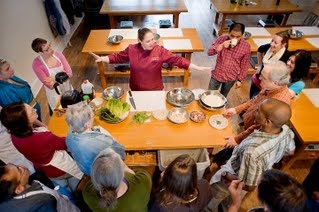
The difference between these classes and others in the city is the cost, most under $65, and that they all contain a big fun factor, like a class called "Mind Your Meat Mistress" that teaches about different cuts of meat, how to cook them to make the most of their flavors and then how to cut up a whole chicken. Chef Melinda Casady (left in top photo), one of the two owners, teaches this class and is known across the city for her butchering skills, as well as her ability to debone a chicken with lightning speed while blindfolded. (Whether she'll be wearing leather and carrying a whip remains to be determined.)

Susana Holloway (right in top photo), the other half of the pair and, in the interests of full disclosure, a good friend and neighbor of mine, will be bringing her mastery of technique along with a knowledge of international cuisines gleaned from her upbringing in Brazil and other countries. An incredible gardener, she's also going to be offering a class called "Plot to Plate" about making meals from food you grow yourself or, as the class description says, you'll "find out what grows together and goes together."

Another unique feature are lectures with an emphasis not just on cooking but on understanding the dynamics of our food system and how to make choices that promote our own health and that of the environment. With titles like "Feed Your Body: Nutrition 101," "Science Geeks in the Kitchen," "Exploring Genetically Modified Foods" and "The Shopping Dilemma, the Ethics of What We Buy," these promise to be loaded with useful info for making responsible decisions.

The two also plan to teach folks to make their own baby food, cook for special diets, and have continuing education classes for culinary professionals as well as team-building classes for companies that want to boost morale and encourage teamwork. Plus they've committed to displaying two blackboards that are dedicated to their current passions like must-have kitchen tools, favorite restaurants, food movies and produce. Can you imagine anything more fun?

Details: Portland's Culinary Workshop, 807 N Russell St. 503-512-0447.