Showing posts with label cucurbits. Show all posts

Monday, October 27, 2014

Gathering Together Farm: Growing for 27 Years


"I still go to the markets because I love talking to people about food."
- John Eveland, Gathering Together Farm

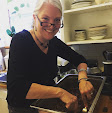
On a quiet stretch of the Marys River just outside Corvallis in the tiny town of Philomath, John Eveland (top photo) and his wife, Sally Brewer, are running a certified organic farm on a combination of rented parcels and land that's been bought from neighbors over the past 27 years. John estimates that in 2014, total sales at their Gathering Together Farm will top two million dollars between 12 farmers' markets—three in Corvallis, six in Portland, the Beaverton Farmers Market and two at the coast—a year-round CSA, wholesale customers, restaurant customers and the farmstand and restaurant on the property.

John checking a hoophouse.

John and Sally don't get to keep all that money, of course, since, aside from hard costs, at the peak of harvest season John signs 128 full and part-time paychecks every month and even in the slower winter months he employs a crew of 40. The farm has two managers, Rodrigo Garcia and Joelene Jebbia; a chef, J.C. Mersmann, who runs the farm restaurant and catering arm; as well as an HR department.

All this started on just two acres of land in 1984. It wasn't meant to be more than that, originally, just enough to supply the vegetarian restaurant, Nearly Normal's, that John, his first wife and three friends started in Corvallis in 1980. Dissatisfied with the quality of vegetables they could get from distributors, a group of them decided to try to become farmers and grow their own. The other partners found it a bit more of a commitment than they anticipated and dropped out, leaving John and his first wife (and eventually him and Sally), to manage the new farm on their own.

Year-round markets were a game-changer.

John said that, unlike today when we have a rainbow of heirloom vegetables to choose from, back in those early days carrots came in one color, orange, and tomatoes were big red slicers, mostly beefsteaks. From the beginning the farm used hoop houses, a series of plastic-covered hoops set over rows of crops, to extend their growing season, but things would pretty much shut down in November until planting season began again in January.

"The game has changed with winter markets," he said, and more varieties of cold-tolerant crops that do well in the maritime Northwest made it possible to keep plants in the ground through the winter. But what really pushed Gathering Together Farm into its current year-round status was that his crew needed full time employment to stay in the area, so the farm now grows leeks ("They're bullet-proof," Eveland said.), turnips, rutabagas,  parsnips, kale and a popular winter salad mix, with more added every year.

The covered patio at the restaurant at the farmstand.

Plus, he said, "People are a lot more sophisticated in terms of their taste and what they're looking for." Unlike the old days where shoppers would turn up their noses at root vegetables or anything that wasn't a standard shape, he said they're now willing to try new things and buy non-uniform vegetables. And for those crops that might have blemishes but are otherwise perfectly good to eat, the farm has developed what are called "value-added" products like salsas, jams, pickles and sauces.

Delicatas are perfect for soup (recipe below).

Now pushing 66 years old, Eveland laughed and said he plans to be out in the field until he drops. Turning momentarily serious, he said that it's been critical to develop a staffing structure that provides a pool of expertise and knowledge to keep the farm humming along, especially since he considers himself "a creator, not a maintainer."

Reflecting on nearly three decades of farming, Eveland said it's certainly a much bigger, more complex farm than he would have ever dreamed of back in those early days.

"We're proud of what we've created in the community and the reputation we've earned," he said. "I just hope we've created something solid that makes the world a better place in some small way."

Ricky’s Delectable Delicata Soup
Adapted from Gathering Together Farm

The farm’s CSA coordinator, Hannah, says this is her favorite soup. It comes from Ricky, one of the cooks in the farm’s restaurant.

2 medium onions, julienned
4 garlic cloves, minced
2 leeks, whites only, chopped
8 oz. roasted red peppers
3 small delicata squash or 2 large ones (the flesh should equal 4 cups)
1 qt. vegetable stock (chicken stock works well, too)
1/2 c. cream
Pinch of cayenne
Juice of 1/2 lemon
Salt to taste

Preheat oven to 350°.

Halve squashes and scoop out seeds. Roast in oven until flesh is tender when pierced with a fork, about 40 min. Cool and scoop out flesh to make 4 cups. Purée in blender or food processor.

Over medium heat, sauté onions, garlic and leeks until they are softened and glassy.

Add roasted peppers, delicata purée and stock. Bring to a simmer and cook for 15 minutes. Add cream, cayenne, lemon juice and salt to taste. Stir well to combine.

Purée the soup in a blender in batches or use an immersion blender. You can also serve it without blending; the finely sliced onions and slivers of pepper make it quite a pretty soup as is.

Note: You can also speed up the process by peeling the delicatas with a vegetable peeler, halving them, scooping out the seeds and chopping them into 1" cubes. Add cubed squash when you add the stock, increase the cooking time to 30 minutes, then purée. This also works with other types of cucurbitaceae like butternut, acorn, etc.

This article was developed in collaboration with the Beaverton Farmers Market, a sponsor of this blog. Top photo of John Eveland by Jake Stangel.

Saturday, February 04, 2012

Farm Bulletin: Filling the Compost Bucket is an Agricultural Act


One of the many things I love about contributor Anthony Boutard and his wife, Carol, of Ayers Creek Farm, is that they approach their work as farmers deliberately yet with a sense of whimsy, and work hard at not only pleasing their legions of fans, but themselves, as well.

The midden heap, the proto-compost pile of prehistoric settlements, is the first stop for archeologists. The bone fragments, chewed plant remains called "quids," shells, obsolete tools, and seeds tossed upon the heap provide insights on a culture's food habits, trade and other aspects of life before we started chronicling it all on tablet and paper. The midden was also the likely first stop for agriculture – a fertile incubator for the domestication and cultivation of plants. The concentration of organic matter and minerals yielded tender and flavorful vegetables close at hand, initially by chance and later by design. Those of you who have been tossing this winter's squash seeds into your backyard compost may have a knot of vines emerging among the potatoes and other kitchen scrap survivors. Composting is, in some respects, a reenactment of early agriculture. 

In archeological excavations, the squashes and pumpkins that emerge from your compost show up as the oldest domesticated plants in the Americas. In the neolithic age, before the development of pottery, they were collected at large for use as vessels for water, seeds and fruits. Around 6,000 to 9,000 years ago, cultivated forms of these cucurbits start to enter the archeological record. They were still the hard shelled cultivars used as containers, but the selection, planting and cultivation of the now larger fruits also yielded much larger seeds, one hallmark of domestication. Even with the advent of pottery production, light and durable squash hulls remained important vessels.

With domestication of the plant, squash and pumpkin seeds found their way into the American diet. They are flavorful and very nutritious. In Mexican and Central American cookery, the seeds are still used extensively in stews, soups and sauces, most famously in moles and pozoles. In Mexico and Central America there are dozens of local varieties with a range of flavors and seed sizes.

Members of the Cucurbitaceae contain extremely bitter toxins called cucurbitacins in their foliage, flowers and fruits which delayed the use of the other parts of the plant as a food. In addition, the early pumpkins had very fibrous flesh, essentially the unadorned vessels leading from the plant to the seed.  Eventually, in the protective custody of the plants' cultivators, the toxins no longer conferred an advantage and non-bitter cultivars emerged. These developed into the modern zucchini, crooknecks and winter squash we bring to market, where the vessels are surrounded with soft pulp. The squash and pumpkins bearing edible fruit were favored by the indigenous people of North America. Further south, the seeds, tendrils and flowers are still preferred over the fruit.

Like potatoes, peppers, corn and tomatoes, American squash found a place in European and Asian cooking. For the most part, the fruits and flowers are used. In the Austrian state of Styria, special pumpkins are grown for their seeds, which are roasted and pressed for oil. Towards the end of the 19th century, a Styrian pumpkin without a tough seed coat appeared, making the task of pressing oil more efficient. Although they are typically called naked seeded or hull-less, a papery vestigial seed coat remains. Kakai and Lady Godiva are the naked seeded Styrian pumpkin varieties commercially available in the United States. 

Three years ago, we purchased a package of "Brand X" pumpkin seeds for pozole and we were disappointed by their quality. They were expensive, stale, and most of the seeds were broken. Our disappointment led us to conclude that, as we were growing all of the other pozole ingredients, why not the pumpkin seeds? The following spring, we planted both hull-less varieties. Mice managed to find every seed in the Kakai row, but a few Godiva were missed and we harvested a small crop. The harvested seeds were orders of magnitude better than the Brand X sorts, but still expensive as the seeds were time-consuming to extract and clean. This year, we planted Kakai again and we refined the extraction process. We will have some of this year's pumpkin seeds this Sunday, close to Brand-X pricing.

The commercially available seed for Kakai is not well maintained, posing a challenge to the farmer. There is a huge amount of unproductive variability in the grex (breeding population). Some fruits have a high percentage of split seeds and their size varied tremendously (top photo; bad pumpkin, right; good pumpkin, left). Some of the plants were bush types, and others vining. As we worked through them, we noticed the giant fruits had no more seeds than those a quarter of their size, just more useless pulp. There was variation in seed flavor from fruit to fruit, but for the most part it was consistently good. The serious problem was the number of fruits with split seeds, roughly 50%. The split seeds had started to germinate in the fruit and had an unpleasant bitterness.

We now have a rough idea of the beast at hand, and next year we will be working on selecting the best pumpkins for seed. We will plant the Kakai in an isolated section of the farm so there is no cross-pollination with other squash types. At harvest, we will mark the fruits with a plant number and, after they have cured, start the process of selecting seed from those with good characteristics. Initially, we will focus on small fruits without split seeds. We expect it will take several years to rework the variety. If we are successful, we will sell a very good pumpkin seed that makes financial sense to grow and harvest.

The process of drawing out favorable qualities from seed as described above is just the same as when a person selected the better seed among the plants sprouting on the midden heap, or the sharp-eyed Styrian farmer who happened upon a fruit with naked seeds and worked on its improvement. Patience and careful observation is what it takes. We have a big advantage because we will be building on dedicated work and expertise of the midden heap and Styrian farmers.

Monday, March 09, 2009

Getting Schooled


"Cucurbits were bottle-necked a long time ago."*
- John Navazio, senior plant breeder, Organic Seed Alliance

There were moments during last week's Organicology conference, as when I heard the comment above, that I felt like I was seriously in over my head. And not just because there were seminars titled "Fertilizers and Amendments for Organic Farming: Making Sustainable Choices" and "Sustainable Business Performance Measurement Tools and Reporting."

Fortunately for me, there were other topics available, too, on organic seed production (with seed guy and rabble-rouser Frank Morton, left) and the farmer-chef connection (with the irrepressible A. Boutard).

But it was definitely targeted to those seriously committed to organic and sustainable practices, with the initial keynote from Claire Hope Cummings, author of Uncertain Peril: Genetic Engineering and the Future of Seeds.

The second was from writer and journalist Paul Roberts (right), whose book The End of Food says that, because living systems can't be industrialized or commodified, our current food system is doomed to fail. And I loved it when he tweaked this very committed crowd when he stated that there has to be room to acknowledge those who may not be completely organic in their practices but are moving away from conventional methods, like the farmer who has reduced his use of pesticides and fertilizers by 70%. You could have heard a pin drop!

The final word was left to Vandana Shiva (top and left), a leader in the struggle for global justice and author of Earth Democracy: Justice, Sustainability, and Peace, as she laid out the case against the corporatization and privatization of our genetic heritage as it is expressed through seeds and culture. She believes that the ability of farmers to save their own seed is absolutely necessary for local, sustainable economies to be nurtured. And you should have seen some of the grown men crowding around after her talk and getting their "fan boy" pictures taken with her!

After three days, all I can say is that there are some truly exciting people on both sides of the plow, the pen and the plate, and I hope to be letting you know more about them in the near future. In the meantime, I'll pass on a few of my favorite bits from my notes:
  • At breakfast the first day, I knew it was a different sort of gathering when I saw hot maple amaranth and a tofu scramble on the steam table.
  • Spinach plants mature and can bolt quickly because of daylight, not heat (though heat can facilitate the process)
  • Flowering plants arrived much later than other types (like ferns) but evolved much more quickly because of their ability to produce seeds
  • The number of silks on an ear of corn is equal to the number of kernels on that ear, and the silk is the stamen of the plant, (i.e. a hollow tube that carries pollen)
  • Seed companies grow little or none of their own seed, though they may do trialing (or testing) of the seeds they sell
  • All canola labeled "non-GMO" is contaminated with genetically modified organisms
  • According to Ken Roseboro of the Non-GMO Project in Eugene, "92% of soybeans, 73% of corn and 87% of cotton is GMO"
  • The key to sustainability is developing relationships. With food, that means seed growers building connections with farmers, who connect with food producers and consumers who then connect to their larger communities and the world.
Too pie-in-the-sky? If you believe these folks, not if we take it one decision at a time, one day at a time.

* "
Cucurbitaceae is a plant family commonly known as melons, gourds or cucurbits and includes crops like cucumbers, squashes (including pumpkins), luffas, melons and watermelons. The family is predominantly distributed around the tropics, where those with edible fruits were amongst the earliest cultivated plants in both the Old and New Worlds." - Wikipedia