
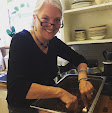

It all goes back to growing up on his family's small farm in Nebraska just outside of Omaha. That four-acre farm, which his family called a "hobby farm," was where the Dillon family raised vegetables and kept a few cattle. Young Matthew and his siblings would harvest the vegetables from the fields, then carry them up and down the road that ran in front of their house that cut through the heart of Nebraska's rich agricultural land, selling armloads of the crops to their neighbors.
Matthew was a smart kid, and his boredom with school, which he refers to as "an 1890’s model of education," caused him to get a reputation as a rabble-rouser. "I’d definitely gotten in trouble for vandalism, smoking pot and all those things," he said. "That’s why I was getting in trouble—because I wasn’t challenged. I was totally bored."

Mount Michael Benedictine School.
So his parents plucked him out of public school and sent him to a nearby boarding school called Mount Michael Benedictine School. "It was competitive to get in, you had to start as a freshman, he said. "100 percent of students going off to college, 90 percent on scholarships, highest ACT and SAT scores in the state."
The monks also had a three-acre organic farm.
But compared to the vegetables his family grew, "the carrots and the produce were pretty crappy looking," he remembers thinking. "I guess this is good for the planet, but it doesn’t look very edible."
After graduating from Mount Michael, Dillon went to the University of California, studying the evolution of human consciousness through a special outdoor wilderness program on the impacts of the human psyche on ecosystems.
Then his father got sick. Cancer.
"He'd had an agricultural supply business, everything from veterinary health supplies to pesticides, you name it, the whole kit and caboodle," Dillon said.
Matthew dropped out of school to help his mother take care of his dad and worked to help pay the family's bills.

"My dad was so healthy. Why is he, of all people, getting non-Hodgkins lymphoma?" he asked himself. "I started looking into it, and the Platte River Valley of Nebraska has this insanely high rate of non-Hodgkins lymphoma because of nitrates in the wells [from] pesticide runoff."
Dillon's father died shortly thereafter, and it began to dawn on him that the pesticides his father sold and that all the farmers in the area used might have contributed to not only his dad's disease, but to his own serious illness at the age of 12, eventually diagnosed as an endocrine disruption and after which he never grew again.
He became intrigued with agriculture. He got a job working on urban garden projects in and around Omaha, plus a side business running an electronics smuggling operation in Russia (read more about that here).
Working on the garden projects, "I realized that the only way I was going to be close to my dad again was if I started growing food," Dillon said. "The thing that he loved the most was that hobby farm. He liked that more than the business. He just liked growing food, he liked making food, [and] it became really clear to me that I needed to go and get my hands in the soil."

Touring a field study for the OSA.
An internship at an 18-acre organic farm in California's Anderson Valley introduced Dillon to an integrated approach to agriculture, where everything was different from the practices his family had used in Nebraska. But one thing struck him as odd: the seed on the organic farm came from the same sources as the seed that the conventional growers used back home.
"All of the inputs are different, our approach to caring for the soil is different, but the seed was the same," he said. Other than some heirloom seed from the Abundant Life Seed Foundation and the Seed Savers Exchange, which he said was beautiful but not agronomically strong, the bulk of the farm's seed came from conventional sources.
"Why is that?" Dillon wondered. "Where’s the organic seed?"
"So I got kind of obsessed, as I do, about the concept that you breed for the environment of intended use, and you breed for the management system of intended use," he said. "Organic environments and organic management systems were different."
That line of inquiry sent him up to Port Townsend, Washington, to the headquarters of Abundant Life, where he volunteered almost full time, eventually landing a spot on their board of directors. Having lost its executive director, the board asked Dillon to take the position as interim director, which led to his accepting the position of executive director.
And that's when the fire hit. A story in the Capital Press from August 8, 2003, summarized the damage:
"An early Monday morning fire in Port Townsend, Washington, that destroyed a landmark building, home to the oldest grocery store in the state, also destroyed Abundant Life Seed Foundation’s office, its extensive library and thousands of its seeds—hundreds of which were one-of-a-kind varieties. Matthew Dillon, executive director of the foundation, describes it as the loss of 29 years of collecting and stewarding germ plasm."Reflecting on the effect of the devastating loss almost 15 years later, Dillon is sanguine.

"By that time I’d met [Dr. John] Navazio and [Wild Garden Seed's Frank] Morton," he said. "All these guys who were saying, yeah, heirlooms are great and everything, but we can have the best heirlooms and we can start breeding in disease resistance and making these crops more workhorses and more robust. And that just intrigued me."
Dillon and the plant breeders and contract growers at Abundant Life had already started to improve some of the heirloom varieties, but their work wasn't without controversy, even within the organic community.
"We’d get angry letters, like 'how dare you not save the seed just as it is, how dare you make a cross or how dare you make a selection!'" he said, shaking his head. "It was intense.
"The whole thing was that heirlooms are not like these gifts handed down by the gods from Olympus to our grandparents. They evolved with those practices, intentionally or not."
Dillon feels that, in general, agricultural history hasn’t given credit to the farmer innovator, saying that farmers and gardeners have always riffed on what they find in their gardens and made selections based on their own preferences. He believes that's where we got the diversity of the heirloom and heritage seed that we find in catalogs and garden stores today.
"Our whole thing was the heirlooms of tomorrow," he said. "That’s all we were doing. In the long run, obviously, a lot of folks have embraced that and it’s become the focus of the alternative seed movement, going beyond heirlooms, still respecting conservation and the need for conservation."

Clif Bar Seed Matters initiative.
Out of the literal ashes of Abundant Life, Dillon founded the Organic Seed Alliance (OSA) with Navazio, a renowned plant geneticist, agroecologist, author and organic seed production specialist. With a belief that seed is part of our common cultural heritage—a living, natural resource that demands careful management to meet food needs now and into the future—the OSA's mission was to support the growing organic seed movement and advance what it calls "ethical seed solutions" to meet food and farming needs in a changing world.
Under Dillon's leadership the OSA educated thousands of farmers and other agricultural community members, conducted professional organic plant breeding and seed production research, and advocated for national policies strengthening organic seed systems.
But, as Dillon said, "I'm not a manager, I'm a start-up guy." Once the OSA was humming along with great people like Navazio, Micaela Colley, Kiki Hubbard and others in place, he said, "I was like, I’m done. I’m ready for something new."

That new, shiny thing came in the unexpected form of a job with a candy bar—or what these days is called an "energy bar"—company, Clif Bar. After leaving OSA, Dillon did some consulting, and the Clif Bar Family Foundation was one of his first clients. He found it intriguing because, though only about 70 percent of the ingredients in Clif Bar products were organic, its founders, Gary Erickson and Kit Crawford, wanted to figure out how to get more organics into the system, which meant scaling up the growing organic industry, starting with seed.
"I would tell them things like, the organic movement needs to stop marketing ourselves as being grandma and grandpa’s farm and going back a hundred years," he said. "We’re not going back. We’re using the best scientific principles and practices for our production system to figure out how to move our production system forward. To do that you have to give the farmers better tools, you have to understand cover cropping better, you have to understand soil management better, there’s all of this investment you need to make."
Rather than taking the tack of much of the organic movement, like making investments in fighting GMOs and GMO labeling, Dillon's experience told him that not enough investment was being made in agricultural research. His mission from that point on was clear. "Let’s start with seed," he said. "Let’s focus on a seed initiative that improves organic seed, and then let’s see where we can go from there."
He began his work at the foundation in 2009 by founding the company's Seed Matters initiative, with a mission to improve the viability and availability of organic seed to provide more nutritious and productive crops. It would do this by conserving crop genetic diversity, promoting farmers’ roles as seed innovators and stewards, and by reinvigorating public seed research and education. It meant working with farmers, educators, researchers, nonprofits, public universities, community gardeners and seed advocates, as well as establishing graduate fellowships for students to enter the field of organic plant breeding.
A chance to move over to the company and effect what he perceives of as systemic change has placed Dillon in a critical role, as Clif Bar's Director of Agricultural Policy and Programs. For Clif Bar, he said, it was a question of looking at their agricultural supply chain, then figuring out how to make investments that will be good for their farmers but also be good for the company.
Again, for Dillon it goes back to his upbringing in the Midwest in the 1970s.
"What I love about [Clif Bar] is, you hear about companies that are triple bottom lines; Clif Bar was this five bottom line," he said. "They have people, planet, community, business and brands, and agriculture they put under community aspiration, and to me that was really cool.
"As a kid growing up in a rural community, I’d seen the farm crisis in Nebraska in the late 70s—farmers' suicides, consolidation. All of that was alive and crushingly apparent in my community. I was watching people lose farms, family members and friends losing farms in the late seventies and early eighties. So, to me, it was the idea that big ag comes in and extracts value out of communities. It’s systemic."
While Dillon openly admits that Clif Bar is far from perfect, he said that they know they have work to do.
"Because the question of any food company should be, how do our decisions either add value to communities, make communities more robust and healthy and resilient, or how do they detract from that?" he said.
Photo of Dillon at Wild Garden Seed by Shawn Linehan.


 Posts


