Showing posts with label astiana. Show all posts

Saturday, September 29, 2018

Umami Bomb from…Tomato Skins?


I'm admitting up front that I am borrowing this from the estimable Ms. Katherine Deumling of Cook With What You Have, who mentioned this unique idea recently. Intrigued, and still in the middle of processing, oh, about 100 pounds of tomatoes, I was swimming in tomato skins that I had plucked out of the sheet pans of roasted tomatoes that were flying out of my oven.

Dried tomato skins.

Instead of tossing them into the compost, I spread them out in a thin layer on a parchment-lined sheet pan and put them in the oven, which I'd preheated to 150°. It took a few hours, but eventually there was a whiff of roasty tomato smell coming from the oven. Checking them, they were very slightly moist but with that leathery texture of good dried peppers. So after letting them cool, I threw some in the spice grinder, and in a few seconds they were reduced to a fine, flakey consistency, with that gorgeous red color intact.

As a layer in rolled pork loin.

So far I've sprinkled them in scrambled eggs, scattered them on top of macaroni and cheese, and layered them in a pork loin roast with rosemary, fennel pollen and salt, all to delicious effect. Their roasted tomato essence carries through when they soften, and adds a layer of umami that you might get from, say, roasted peppers. I can see using them in hummus or a sour cream dip, in sauces and as a sprightly addition to some of my favorite deviled eggs.

Thanks, Katherine, for the suggestion!

Monday, April 09, 2018

On-Farm Seed Production, Part Three: 'Astiana' Sauce Tomato


When I would go to the farmers' market or the grocery store, I browsed the vegetables on offer to find the one that I deemed worthy to take home to my table. I never wondered how it got there—I assumed the farmer planted seeds from a previous crop (or a seed packet) and the vegetable would grow reliably as it had in previous seasons. It never occurred to me that what I was looking at was the result of deliberate choices on the part of the farmer (or seed breeder) over many years. The following is the third part of an article that contributor Anthony Boutard wrote for Acres USA magazine outlining that patient process. (Read previous posts here.)

We did not sell tomatoes for years, avoiding the frenzied and irrational hustle to produce the first tomatoes in the market. We shun hoop-house culture and we were happy to avoid all the precious heirloom hype. That said, we grew up on home-canned tomato sauce and missed growing a high-quality sauce tomato. The varieties sold as ‘San Marzano,’ ‘Roma’ and ‘Amish Paste’ are poorly adapted to our latitude and the cool nights that attend the maritime climate of the Pacific Northwest.

Ten years ago, we purchased a few tomatoes labeled as local in Asti, a town in the Italian Piedmont that is close to the latitude of our farm. It was mid-October and we saw similar tomatoes in gardens throughout the area. The tomatoes were large at the base and tapered to a narrow top. They were pleated and distinctly green-shouldered. The seed cavities, or locules, were dry and had very few seeds. The skin was thick and the flesh highly acidic. Raw, the tomato was flat and uninteresting. When cooked the flavor opened up and was so outstanding, we reserved the 15 seeds they yielded and brought them home with us. Over time, we adapted this representative of a northern sauce tomato landrace to our farm and customers.

The characteristics described above were all important to the quality of the tomato. The large fruit with its hollow cavities meant that it held the field heat accumulated during the day well into our cool nights, extending its ripening hours. The green shoulders are an ancestral trait associated with heightened flavor. The tomato’s lycopene and pectin are concentrated in the skin and the adjacent tissue adhering to it, thus the pleated skin increases the amount of flavorful skin relative to a smooth tomato of the same dimensions. Pectin provides “mouth feel” and softens the acids present in the fruit, but generally get short shrift when we discuss tomato quality. For a sauce tomato, ample acidity is important for flavor and canning.

Our selection protocol for the tomato is based on the cooked flavor. For a given vine, if the first one or two fruits fully meet our visual criteria, we harvest and cook them. If the cooked tomato meets our standards for flavor, the seeds are reserved.

We harvest and sell the tomatoes over a six-week period, starting around Labor Day. Consequently, we select for late fruiting plants, not just early ones. However, we are careful to use only the first ones that ripen on a given plant. Tomatoes are typically self-pollinating, but as the season progresses they will shift to outcrossing, perhaps due to the depletion of trace minerals within the root zone. From our observations, tomato fruits that display a sharp increase in seeds are likely outcrossing. The shift from self-pollination to cross-pollination in response to the depletion of copper and boron has been documented in wheat and barley. Even where the outcrossing occurs within the same variety, the genetic reshuffling will produce unpredictable offspring.

When growing both a crop for sale and producing seeds for self-pollinating crops, it is tempting to sell the best at market, and harvest seed later assuming that self-pollination is a fixed characteristic. My advice is, don’t. Select for seed first and harvest crops later. If you want to produce seed for snap beans, mark the seed plants and do not touch them until the seed is ripe. If seed production is a lower priority, don’t bother trying.

Ten years after purchasing those tomatoes in Asti, sauce tomatoes are another signature crop for our farm. We now sell them as ‘Astianas’, a nod to the market where we encountered them. We sell them in bulk lugs specifically for sauce. Because they ripen during the cool days as autumn hastens, people are more willing to spend the time in the kitchen.

Read the other posts in the series.

Top photo by Anthony Boutard.

Wednesday, September 13, 2017

Tomatoes Galore


"And now for your delectation, the delicious Tomatoes Galore will tickle your fancy with her juicy rendition of 'On Top of Old Smoky'…"

Forgive me, dear readers, but I'm in head-down tomato processing mode. I've got two baking trays of chopped tomatoes in the oven that need to come out in 30 minutes, so this is going to be quick. They're the tail end of 60 pounds of the red-ribbed beauties known as Astiana tomatoes from Ayers Creek Farm, the first round of the 150 pounds I plan to process (I know, crazy, right?) this year and squirrel away in the freezer for the winter.

Astiana tomatoes at Ayers Creek Farm.

Those tomatoes, with just the right balance of tart-to-sweet, the product of more than a decade of selecting for flavor, plant health and field-hardiness on the part of Carol and Anthony Boutard, began with a meal that the couple had in the Piedmont region of Italy. There they tasted a fresh tomato that Carol said they had to bring back to their organic farm in Gaston—Anthony would remind me that Italy's Piedmont is on roughly the same latitude as Oregon, meaning that the seeds could be adapted to our climate—and the story goes that she ran out to the dumpster behind the restaurant, diving in to gather enough seeds to bring back.

Roasted tomato soup (recipe below).

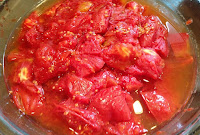
My method of roasting is super simple: preheat the oven to 400°, chop the tomatoes into quarters, load onto two sheet trays skin-side down and roast for an hour. Cool enough to pull most of the skins off (easiest by hand if you like chunky sauce; a food mill smooshes them too much for our uses), load into quart freezer bags and you're done.

Speaking of done, it's time to pull those tomatoes out of the oven. Here's a recipe for a fabulous tomato soup I made last year, one that I think rivals the best you're likely to have.

Creamy Roasted Tomato Soup

8 Tbsp. (1 stick) butter
2 med. onions, chopped fine
3 cloves garlic, minced
1/4 c. flour
2 qts. (8 c.) roasted tomatoes or 3 28-oz. cans crushed tomatoes with their juices
2 c. chicken broth
1 Tbsp. kosher salt plus more to taste
1 tsp. celery salt
1/2 tsp. black pepper

In a Dutch oven or large soup pot, melt butter over medium heat. Add onion and sauté until tender and translucent. Add garlic and continue to sauté 2 minutes. Add flour and stir, making sure it doesn’t stick to the bottom of the pan, for 3 minutes. Add broth, tomatoes, salt, celery salt and pepper. Bring to a boil, then reduce heat to simmer for 30 minutes, stirring frequently to make sure nothing sticks to the bottom of the pan. Remove soup from heat and, using an immersion blender,  purée the soup thoroughly until smooth*. Add more salt to taste, if needed. Serve.

* I don't mind a little texture from any bits that don't get totally blended in, but if you want a completely silky smooth finished product, you can press it through a fine mesh sieve, which will catch any remaining seeds or other bits.

Monday, February 27, 2017

Best Tomato Soup (Apologies to Campbell's)


Dinner at my family's table growing up was a product of the then-new and novel notion of convenience for housewives. Why spend hours preserving fruits and vegetables when you can simply open a can and have dinner on the table in less than half an hour? Cookbooks, women's magazines and television commercials touted "open a box" instant gratification for puddings, cakes, hamburger helpers and soup mixes with brand names that became part of the family—think Duncan Hines, Campbell's, Lipton and, yes, Betty Crocker.

Going in the oven to roast.

With three kids and a husband to feed every night, and especially when she started working full time, my mother needed all the help she could get. I've joked that during my childhood I thought that Campbell's cream of mushroom soup was the glue that held the universe together. Even when I was on my own, a good tuna casserole needed that special touch that only one product—I've since found a superior recipe—could achieve. My future husband wooed me with lunches he made himself with cream of tomato soup (Campbell's to the rescue again!) and grilled cheese sandwiches.

So, as with that tuna casserole, recreating the flavors I remember and the satisfaction they provided has become a bit of an obsession. A cream of tomato soup like the one from the can with its smooth, silky, tomatoey flavor—we always made it with water rather than milk—that filled your mouth and warmed your belly is one that has been at the top of my "figure this out" list.

After roasting, ready for anything.

Lots of recipes I researched called for various herbs and spices to be added; some add vinegar or honey, probably to balance out the acidity of the tomatoes. But I was looking for a recipe that was simple to make and that would have been easy enough for my mom to whip up for her family's dinner after a long day at the office, a glass of wine in one hand (would that she would have allowed herself that) and a wooden spoon in the other.

With a good supply of frozen, roasted astiana tomatoes in the freezer, I was all set with the main ingredient, and their perfect balance of sweetness to acidity made the notion of adding anything else just so much unnecessary froo-froo. Having made this soup a few times now, both with and without grilled cheese sandwiches, it's always brought back those days of yore, but with the satisfaction of knowing I no longer need help from the folks at Campbell's.

Creamy Roasted Tomato Soup

8 Tbsp. (1 stick) butter
2 med. onions, chopped fine
3 cloves garlic, minced
1/4 c. flour
2 qts. (8 c.) roasted tomatoes or 3 28-oz. cans crushed tomatoes with their juices
2 c. chicken broth
1 Tbsp. kosher salt plus more to taste
1 tsp. celery salt
1/2 tsp. black pepper

In a Dutch oven or large soup pot, melt butter over medium heat. Add onion and sauté until tender and translucent. Add garlic and continue to sauté 2 minutes. Add flour and stir, making sure it doesn’t stick to the bottom of the pan, for 3 minutes. Add broth, tomatoes, salt, celery salt and pepper. Bring to a boil, then reduce heat to simmer for 30 minutes, stirring frequently to make sure nothing sticks to the bottom of the pan. Remove soup from heat and, using an immersion blender,  purée the soup thoroughly until smooth*. Add more salt to taste, if needed. Serve.

* I don't mind a little texture from any bits that don't get totally blended in, but if you want a completely silky smooth finished product, you can press it through a sieve, which will catch any remaining seeds or other bits.

Monday, September 26, 2016

Preserving Summer: Tomato Overload


I've reached total tomato overload.

It happens every year: I get to the point where I can't look at one more tomato without cringing. Though I have to admit it's usually after processing well over a hundred pounds of them, packing them away in my freezer in quart ziplock bags.

When tomato season first begins, I'm driven by the knowledge that sometime around March of next year, after profligate use of them in the soups, braises, risottos and pasta dishes that fuel my family during the winter months, I'll realize that…oh no!…there are just a few precious packages left. So I start laying out my battle plan, determined that this year, by gum, I'll have enough to last us until next tomato season starts up again.

Last year Dave and I basically picked and brought home 140 pounds of Astiana tomatoes from Ayers Creek Farm, not realizing that meant that they'd all need to be processed within a few days. Which led to five days of full-time, head-down tomato roasting, with the oven blasting in the kitchen and the grill blazing away on the patio. The good part is that we got it done in one fell swoop—I can't even write that without hearing my father saying "one swell foop"—the downside being that there was a major case of burnout for days afterward.

I've heard a similar story from other ants living the real-life version of this ant-and-grasshopper fable. One woman told me that she went cucumber crazy one year in her garden, and when she came to she found herself sitting on top of 140 jars of pickles. Or the guy who asked a few too many of his friends to send over any extra fruit they had. By the time he dug his way out of that one, he had made enough jam to last several lifetimes.

This year I took a more moderate path, bringing home a couple of 20-pound lugs of tomatoes at a time, which required a few hours to process, after which I'd squirrel away those precious bags, each time estimating how many more it would take to feel satisfied we'd somehow make it through the winter. Well, my friends, I'm here to tell you that I finally chopped, roasted and bagged my last quart of tomatoes, tossing it (carefully) onto the pile with 39 of its brethren.

I'm feeling pretty rich right now, and ready for the tomatoey free-for-all to come. Just as long as I don't have to (shudder) face processing any more. I'll keep you posted on how long they last (and what I make with them).

Check out my technique for roasting tomatoes!

Wednesday, August 31, 2016

Farm Bulletin: Of Tomatoes and Green Shoulders


Followers of Good Stuff NW know that I am a dedicated fan of the Astiana tomatoes grown by Anthony and Carol Boutard at Ayers Creek Farm. They are my family's sauce tomato, and this year I'm planning on roasting upward of 200 pounds of them to last us through the winter. Below, Anthony outlines just a few of the reasons I love them so.

Astiana is our cooking tomato derived from a Po River Valley tomato landrace of northern Italy. The fruits are large, usually green-shouldered, pear-shaped and pleated to varying degrees. A landrace is a population of fruits, vegetables or livestock that is shaped by the environment and culture of the region to which it belongs. More broadly construed than a simple catalogue variety, representatives of the landrace will vary from village to village, garden to garden, plant to plant, but they have similar qualities. In their natal valley, these tomatoes were selected for the quality of their flavor and texture after their encounter with the stove, and not for the salad plate.

We never use the word heirloom in reference to the crops we grow. We avoid the term as it coveys the idea of something not for daily use, delicate teacups for special occasions and their ilk. Our goal is to grow everyday food. Also, the honorific "heirloom" is merely defined as named varieties that have been around for at least 25 years without regard to quality or link to the land. A callow, boring and not very useful definition, up there with the silly term ancient grains. We work hard and take great care to produce fresh grains and legumes every year, and bridle at the thought that people describe them as ancient, not fresh and flavorful. If you want ancient, the bulk bin of the grocery is a good source for ancient beans and grains that don't cook up quite right.

Seeds are living plants, reshaped by their cultivators and the environment year after year, and landrace is the better term. It recognizes that living organisms are constantly adapting to changes in environments, cultures, and cultivators. The idea of a precious variety frozen in time may have a romantic pull, but the competent cultivator works to observe and guide the genetics of the crop.

Astiana, as we have named it, is our own tomato. It is the result of a decade of reselection of traits that two of us have mapped out in what we call a "design brief." We are, in effect, sheepdogs herding a milling bunch of traits. The most distinct and important trait of our tomato is its persistent green shoulders. This is an ancestral trait in tomatoes that modern breeders have long selected against because in the market they are seen as not yet ripe. It is a visual imperfection because people have long associated pure red fruit as ripe. Nonetheless, the green shoulders are closely linked to elevated flavor and recently some breeders have been looking to reincorporate this gene complex into their breeding populations. A good cooking or culinary tomato has high acidity as well as a high level of sugars and pectins. For a salad tomato, pectins are undesirable because in the raw fruit they mask certain flavors, and when dressed with vinegar or lemon juice, high acidity is not so important.

The large, blocky shape of the Astiana holds the field heat much longer than the smaller pear types favored further south in Italy and in the U.S. The ample body below the lovely green shoulders stays warm after sundown, allowing it to ripen and develop its intense flavor even during the short days followed by long, cool, late summer nights typical of the Po and Willamette Valleys, both sharing a perch on the 45th parallel. The plump, pear shape is a functional trait.

As a sauce tomato, we want a fruit with a high solid content, a relatively dry fruit. For seed production, we favor fruits with a dry locular or seed cavities. When you slice into the fruit, there is often air around the seeds. Acceptance of this trait carries some risk because if there is an opening to the outside environment, one of the cavities may mold.
In addition to the traits described above, there are a few other qualities we have selected as part of our breeding population. We include plants that are very late ripening, well into October if the rains hold off. A long counter life is another desirable quality. We have held them on the counter for more than five weeks without the slightest loss of quality, in fact they improve over that time. Disease resistance in an important consideration. Flavor is paramount, though. Every tomato is cooked and tasted before its seeds go from the cutting board to the seed jar. We want a good culinary tomato, not a slicer. It is superb as a dried fruit, as well.

So as you prepare your tomatoes, whether it is this weekend or sometime in October, you will have this mental map of how we approach the fruit. And if you hit a mold locular cavity, know that it is the nature of the beast, a trade-off we accept in our quest for a good sauce tomato.

As a bit of trivia, the tomato Gretl drops in the market of Salzburg is almost identical to the Astiana in size, shape and pleating, though it lacks the lovely green shoulder. The Sound of Music was filmed on location in the summer of 1964, providing a historical reference for this style of tomato that ranges up into Austria. If we had made the connection earlier, we might have been tempted to call our tomato 'Gretl'. (Not really, the green shoulders are missing in the Salzburg rendition.)

NOTE: Here's my technique for roasting these luscious beauties. Or check out the Boutard's recipe for tomato sauce.

* * *

For those interested in obtaining some of these seasonal beauties, Anthony has sent this additional note on Monday, Sept. 5:

"For those who find it hard to travel west to Ayers Creek on the weekends, Rubinette Produce will order 20-pound lugs of Astianas from us upon request. Rubinette will charge $42 per lug if paid by credit card, or $40 by cash/check. Place your order by e-mailing Josh Alsberg, the owner of Rubinette. He will need your order by Wednesday afternoon. He will get his order in to us Wednesday evening so we can harvest and pack the tomatoes for delivery Friday. The tomatoes will be available for a few weeks, weather permitting."


Monday, September 14, 2015

Preserving Summer: Tomatoes


The avalanche started in mid-August, and now, in mid-September, it's pretty much over. The onslaught of roasting, bagging and freezing tomatoes that normally takes place in late fall—in posts from 2010-2013 it hit squarely in early October—began, as it did last year, in late August. If that's not enough of a hint about Oregon's "new normal," then just ask the vineyard owners who are experiencing their earliest grape harvest in history.

If you want to grab a box of tomatoes at the farmers' market, you can read about the Ayers Creek Farm method for making the planet's best tomato sauce or check out my lazy cook's version of oven roasted and frozen tomatoes. I'm (most likely) calling it quits with twenty-eight quarts of roasted lovelies resting comfortably in the freezer, so it looks like we're set for most of the coming winter's soups, braises and sauces. As Jackie Gleason used to say, "How sweet it is!"

Saturday, August 29, 2015

Farm Bulletin: Getting Saucy with Tomatoes


In this essay contributor Anthony Boutard of Ayers Creek Farm guides us through the process of making tomato sauce from his most excellent Astiana paste tomatoes, the descendants of an Italian variety, the seeds of which his wife, Carol, dug out of a compost pile during a trip to the Piedmont many years ago. I am a devoted fan of these tomatoes, and plan to freeze about 150 lbs. of them this year using this method. Oh, and Anthony has stated that present company is excepted when he refers to certain food writers. Whew.

We had several questions about making tomato sauce last week. Here are our thoughts. Despite what food writers stress, fully ripe or over-ripe fruit should be avoided for canning purposes, use these in a fresh sauce. (Another calumny of the present crop of food writers is that tomatoes instantly stop ripening when they are picked from the vine. This is absolute nonsense, foolish fussiness from people who are paid to know better but never seem to actually work with fruits, just write about them.) We find the brightest and most flavorful sauce comes from fruit on the near side of ripeness, a diversity of stages produces a more interesting sauce. Avoid the fixation on color; flavor is what counts come January. A high level of acidity assures a bright and flavorful sauce.

Picked at the "nicely pinked" stage…

We resist the Macbeth "boil and bubble, toil and trouble" approach to sauce making. Nothing is gained from the drama of watching and stirring the cauldron, and it leads to time wasted and an over-cooked sauce. (Akin to putting berries one-by-one, never touching, on a cookie sheet prior to putting them in the freezer when it is much easier to put the whole flat in instead.) Cooking does not concentrate the sauce, heat-facilitated evaporation does. Only at the canning stage is a higher heat briefly necessary.

…tomatoes can fully ripen within a couple of days.

We wipe off the whole tomatoes if needed, pierce them a few times with a knife and place them in a big oven pan. Mound them up as they will settle down as they cook, and sprinkle some salt over the top if desired, which helps preserve the color. Put the pan in a slow oven, around 200°F. You can leave them there for hours, or overnight. Periodically, we decant off the "nectar," the amber liquid that drains from the tomatoes. We put this into 1-quart canning jars as a stock for stews and soups. After the tomatoes have fully collapsed, we run them through a food mill. We also can some whole tomatoes.

At this point, the sauce is medium thick, and can be be canned. We also further concentrate some sauce by returning it to the low oven for a day or so. Slowly and gently, it will evaporate and thicken. We find this gentle heat produces a far better sauce than rushing the process over the stovetop flame. Commercial sauces are often made with a vacuum cooker which concentrates the sauce quickly at a relatively low temperature in the range of 180°. Once again, a gentle process but as of yet there are no home kitchen vacuum cookers. The oven method works very well.

Tomatoes roasting in the oven.

We pressure can because, well, we have one, and it is fast and easy. You can also process in a hot bath per standard instructions because these traditional tomatoes are acidic enough. Many people freeze the sauce instead of using a canner. Although we put up over 100 pints of tomato sauce at varying degrees of thickness, we never add anything but salt. We prefer to add seasonings later. Caution applies especially to ingredients that lower the acidity (increase the pH) like peppers. The acidic nature of tomatoes makes them safe and easy to can. Best not to mess with that comfortable margin of safety.

Because Astiana is our own variety and not a precious heirloom or such, we can sell them at $35/20 pounds without shame, and you get the stylish Ayers Creek Farm lug in the bargain. We will have some tomatoes prepackaged and, with a measure of trepidation, accept requests to hold 20# lugs as supply permits. Please email us before 4 pm on Saturday, and we will try to fill requests for 20# lugs only. And don't fret if this isn't the week for you, we will have them for the next few weeks.

Saturday, August 30, 2014

Towering Temple of Tomatoes


I can hear my mother's words echoing in my head: "This is because your eyes were bigger than your stomach."

It all started innocently enough, when Dave and I drove out to Ayers Creek Farm to pick some of the Astiana tomatoes that, for the last few years, we've roasted and frozen to use throughout the winter in soups, sauces and, yes, even cocktails. The first year we bought a total of 50 pounds of the blood-red, heart-shaped tomatoes that Anthony and Carol brought from Italy as seed and adapted to the climate of the Wapato Valley. (Read the very entertaining story of their discovery of these tomatoes.) The next year it was 80 pounds, then 120 pounds, and this year I figured we needed 150 pounds to take us all the way to the next season.

Roughly chopped, ready for roasting.

Named Astiana after the town in the Piedmont region of Italy where they originated, these large tomatoes are almost all flesh with very few seeds, ideal for making sauce and paste. My plan was to get a jump start on the processing by bringing home 50 pounds or so, then getting two more batches of 50 pounds each as the season, about a month long, progressed. I say "was" because when we got to the field and started picking, using the four yellow crates that Carol insisted we would need—you can tell I'm trying to shuffle off blame here, right?—well, that's when my clever plan went a bit sideways. By which I mean completely off the rails.

After roasting, ready to bag and freeze.

Hauling the crates back to the processing shed, we knew we had more than 50 pounds-worth staring back at us, but when it was all weighed and bagged, that's when I heard my mother's voice. It turns out there were 142 pounds of my favorite fruit sitting on the table in that shed, 142 pounds that were subsequently driven home and the same 142 pounds carried into the house.

Roasting on the grill.

To say I saw my life, or at least the next few days of my life, flash before my eyes might be a wee bit of an overstatement, but there was definitely an "Oh my god what have I gotten myself into" feeling at surveying the bags and bags (and bags…) of ripening tomatoes at my feet. Fortunately they were at varying stages, from squishy, do-something-with-them-right-now-or-say-sayonara ripeness to barely pink-almost-green ones that, with luck, would take three or four days to get fully ripe.

Sorting through them and labeling bags "soon" for those needing attention in the next day or two and "hold" for those that could wait a couple of days, we dove in and grilled two batches of the softest ones that evening, which went immediately into the freezer. We hope to have the rest done by Sunday, divided more or less evenly between grilled and oven-roasted. Wish us luck!

Friday, October 04, 2013

Method to My Madness


I go a little crazy this time of year. I feel the chill in the air, hear the leaves crunching underfoot and piling a little deeper every day, and it makes me feel like grabbing what little is left of summer and saving it for the cold, damp days to come. Especially when I hear that Anthony and Carol at Ayers Creek Farm are starting to bring in their astiana tomatoes.

For the last three years I've roasted and grilled dozens of pounds of them, let them cool, then bagged them in zip-lock freezer bags and tossed them in the freezer. The roasting concentrates their already deep flavor, and using them in a pasta sauce or for braising a pot roast is like adding the taste of a late summer day to whatever I'm cooking.

The method is simple, the time spent well worth it. And if you make enough, it'll make summer last till next summer comes around again.

Roasted Tomatoes

Preheat oven to 400°. Chop tomatoes into large chunks, about 2" across. Place in shallow roasting pan and place the pan on a rack in the middle of the oven. Roast for one hour or until tomatoes are tender and some are starting to brown on the edges.

Scoop from pan into large mixing bowl and allow to cool. Remove skins if you want (they should just slip off), then ladle into quart freezer bags. Freeze and use all winter!

For grilling method, see Tomatoes Galore.

Saturday, September 07, 2013

Farm Bulletin: A Handful of Seeds


It's a revelation to think of the fruit or vegetable you hold in your hand as a living seed packet, but that's just what contributor Anthony Boutard of Ayers Creek Farm points out in this week's essay.

People often ask us where they can buy seeds for our Astiana tomatoes. The fact is, you are buying seeds when you buy the fruits at the market. That is how we started with the tomato, just 15 seeds from a tomato purchased in the market of Asti, a town in the Piedmont of Italy. It is a representative of a cooking tomato landrace from the Po River Valley. The fruits are large, green-shouldered, pear-shaped and often pleated. A landrace is a population of fruits, vegetables or livestock that is shaped by the environment and culture of the region to which it belongs. Representatives of the race will vary from village to village, but they have similar qualities. These tomatoes are selected for the quality of their flavor and texture after their encounter with the stove.

We never use the word heirloom in reference to the varieties we grow. We dislike the term, and the last time it was used in this newsletter was to explain our dislike of the word best applied to fragile, inanimate objects handed down generation to generation. Beautiful Corn was written without using the word at all. Heirlooms are defined as named varieties that have been around for 25 years. Seeds are living plants, reshaped by their cultivators year-after-year, and landrace is the better term. It recognizes the living organisms are constantly changing and adapting to new environments and cultures, and this applies to their cultivators as well. The fact is, we have reshaped that tomato we purchased in Asti seven years ago, but we have carefully kept its fine cooking qualities foremost in our efforts.

Approximately 80% of the legumes, vegetables and grains we bring to market are grown from seeds we produce on the farm. Another 10% are grown from the seeds developed by Frank Morton at Wild Garden Seed in Philomath, about 60 miles south of Gaston. Producing our own seed allows us to draw out traits valuable for successful production in the Willamette Valley.

This month the Organic Seed Alliance will hold organic seed production workshops for farmers at Adaptive Seeds in Sweet Home on the 17th and at Ayers Creek on the 19th. Veteran seed producer John Navazio will lead the workshops. He is both practitioner and theoretician, an important source of information and inspiration to those of us who grow our own seed. Linda Colwell will prepare a lunch for the participants that will include the fruits, vegetables and grains we grow at the farm, underscoring the link between the seeds and food. It will be a fun day for all and we expect to learn a lot from Navazio.

Adopting the name Astiana for our tomato, we honor the long tradition of naming varieties after the location of their origin. This week, we will bring to the market a delightful, spicy grape called Canadice. It is a celibate variety from New York State research station in Geneva, New York. Until recently, they named all their varieties after places in New York; Candice is one of the Finger Lakes in western New York. Other varieties that we grow from that program with a New York tag include the grapes Interlaken, Sheridan and Steuben, and the plums Seneca and Stanley. Sadly, they have abandoned this tradition and now names are developed through "consumer testing." Two recent releases are called SnapDragon and RubyFrost. Perils of callow thinking.

Tuesday, October 16, 2012

Putting Food By: Tomato Paste


I was totally bummed when my friend Hank Shaw, author of DIY (and by that I mean forage, kill, scavenge-it-yourself) guide Hunt, Gather, Cook, mentioned that every year he makes tomato paste in his driveway. You see, he lives in Sacramento where it gets around a million degrees in the summer. He can put a tray of puréed tomatoes on the hood of his truck and in a couple of days it has evaporated into paste.

Try that here and you'd have a tray-full of moldy moosh.

The raw goods, straight out of the field.

Somehow it had never occurred to me to try another method, that is until I was out at Ayers Creek Farm and Anthony Boutard was putting a bowl of puréed Astianas into their wood-fired oven. Call it a lightbulb moment, OMG, St. Paul-flattened-in-the-road, whatever. Here I've been making gallons of roasted tomatoes to pull out this winter and have never once considered sticking some in the oven for a few hours to make paste.

Knock me over with a feather. Or, as Anthony's wife Carol says, "Shoot me in the foot."

Roasting.

Fortunately I'd just gleaned a box of tomatoes from their field, and I couldn't get home fast enough to roast 'em up (400° oven for 45 min.-1 hr.), purée them with an immersion blender—I'll use a food mill next time to make a completely smooth texture—and stick them in a 200° oven.

About halfway there.

With my 2 3/4 qt. Le Creuset preheated in the oven as it came up to temp and then filled to the rim, it took about 24 hours for it to reduce by half (top photo). It needed stirring every few hours, and I probably could have reduced it further, but the paste was rich and smooth and would suffice for my purposes. I ladled it in 8 to 10-ounce quantities into zip-lock freezer bags, packed them two-to-a-bag in quart bags and stuck them in the freezer. Done.

And I'm sure my embarrassment about not thinking of this before will abate the first time I thaw it out, spread it on bruschetta and top it with chevre or tapenade, don't you think?

Wednesday, October 12, 2011

Tomatoes Galore


That title sounds like the name of a burlesque star, doesn't it?

"And tonight the delicious Tomatoes Galore will tickle your fancy with her juicy rendition of 'On Top of Old Smoky'…"

It began raining tomatoes on Sunday when Carol Boutard of Ayers Creek Farm dropped off seventy-five pounds of tomatoes, the last of the awesome Astianas that made such crazy sauce last year. With my brother taking twenty pounds, that still left between fifty and sixty pounds to deal with. So I decided to dedicate a day to their roasting, firing up both the oven and the grill in order to get through all of them in a timely fashion.

Unlike last year, I'm not doing anything but cutting the tomatoes in quarters, laying them skin-side down in pans (or on foil on the grill) and letting 'er rip till they've started to burn a bit on the bottom. Then it's scraping them off into a bowl to cool, pulling any charred skins off and ladling them into freezer bags.

The tomatoes cook down a surprising amount, with about four to five pounds of tomatoes making around a quart of sauce. And no doubt some mighty fine eating this winter. Wish me luck!

* * *

UPDATE: Twelve quarts of luscious sauce are now resting comfortably in the freezer waiting to make some kick-ass dinners this winter. Stay tuned!

Saturday, October 09, 2010

Saucy Lady


Talk about gift horses.

When Carol Boutard of Ayers Creek Farm called to ask if I would like a few of the very last of their end-of-season Asti paste tomatoes, I said, "Well, yeah!" After all, the last batch, which I roasted on the Weber, produced a smoky, rich, brick-red sauce that is sitting, bagged and waiting, in the freezer for the time when Dave gets a yen to make pizza on the grill.

Walker, checking out the goods.

Little did I suspect that by "just a few" she meant a big heavy duty cardboard box containing, oh, about  30 pounds-worth delivered by the angel herself on her way to drop off a little produce with one Mr. Greg Higgins. So with the box sitting on my counter and fruit flies buzzing greedily around, I fired up the oven, got out my two largest roasting pans and got to work.

Grinder-iffic!

For those of you who know that I adore my tomatoes smoked on the Weber (charcoal, of course), the reason I chose the oven method was two-fold: first, I have lots of the smoky goodness already (see above), and second, I wanted to be able to leave them roasting away without worrying about adding coals or turning the grill. And 30 pounds at four pounds a batch and two hours each was more math than I wanted to do.

Concentrating.

So, unlike my last oven-roasting session, I simply chopped the tomatoes into big hunks, set them skin-side down in the roasting pans and slid them into a 300° oven until they started caramelizing, which took about two to two-and-a-half hours. No onions, no garlic, no oil, just tomatoes. Then I scooped them out into a bowl, let them cool a bit and pulled the skins off by hand (a sieve or food mill would be another option if you don't want skins or seeds).

Mind you, it took all day and four of those double-roasting pan batches to do them all, but do them all I did. Then Dave got out the KitchenAid mixer with its handy-dandy grinder and produced a fine grind that is, even as I write, simmering away on the stove to reduce to a fine sauce, soon to join its brothers-in-bags in the deep freeze. Can't wait!