Showing posts with label bees. Show all posts

Saturday, July 27, 2019

Bumbles in My Back Yard!


Earlier this summer I was having a bit of a crisis. You see, for the last couple of summers we've had a very active bumblebee nest in our back yard. It's hidden behind a bed of hostas and a bleeding heart growing around the foundation of our garage, the entrance hidden under a scattering of oak leaves (see above).

Orange sacs on the bumblebee's back legs hold the pollen it has collected.

I was alerted to its presence when I was innocently watering the garden and suddenly heard a vibrant buzzing coming from a corner of the garden bed. Several fairly large bumblebees were circling around the area, looking for the intruder—me—who had apparently come a little too close to the nest.

Now, some people might freak out at the thought of a bees' nest in their back yard and call an exterminator. But knowing as I did that, in general, bumblebees are peaceful insects and will only sting when they feel cornered or when their hive is disturbed, I simply stepped back several feet and waited for them to realize I wasn't a threat. It also gave me a chance to see where they were returning to.

Of course my first act was not to look up the Wikipedia article on bumblebees. It was to call our long-suffering neighbor, who works for the Xerces Society and who puts up with my endless bee questions, along with the occasional accusation along the lines of "one of your friends just stung me!" He informed me that congratulations were in order because there was indeed a bumblebee nest under our garage and they seemed perfectly happy.

I felt like a new parent.

Busy as a bee collecting more pollen.

Which is why, when earlier this summer I observed no activity from the nest and very few bumblebees on the flowering shrubs and bushes on the block, I got a little panicky. When I consulted my neighbor (like I said, he puts up with a lot), he said it was possible that they had abandoned the nest, but with the unusually cool spring and early summer, they might just be late in appearing.

So I waited. And waited.

It was just about exactly when our neighbors' prodigious stand of lavender bushes burst into bloom that, joy of joys, I saw the bumbles return, buzzing happily from wand to wand, taking their gathered treasure back to the nest behind the garage. I was ecstatic. And yes, I texted our neighbor with the good news.

Saturday, April 21, 2018

Earth Day, 2018: Celebrate with the Bees!


What better way to celebrate Earth Day than with a tale of the simple joy brought to people by bees? The following essay  by Mace Vaughan, who co-directs the Xerces Society's Pollinator Conservation Program, was published here in 2015, and is just as relevant today as it was then.

In the summer of 2009, my family and I moved into a house across from the Sabin Elementary School in northeast Portland, Oregon. Our daughter started kindergarten at the school that fall. Sporadically, as other school parents learned of my work in pollinator conservation, they would ask me if I’d ever seen the “tickle bees.” I would respond with a polite “no,” unsure what they meant. Still, as the question continued to come up through the December holidays and into the late, wet winter, my curiosity grew. Everyone seemed to know about the tickle bees.

And then St. Patrick’s Day arrived. The sun shone and it was warm for a March afternoon. I sat in our dining room, working from home and enjoying the sounds of kids playing in the schoolyard across the street from our house. Every so often I would sneak a peek across the street to see if our daughter was running around, and that was when I spotted a boy, all alone, kneeling on the ground as he tried to catch something. He grabbed and lunged, attempting to seize it from the air. In that moment, it all came clear to me.

I waited until the kids had cleared out of the field, closed my computer, and walked across the street. And there, to my amazement, were the tickle bees of Sabin Elementary. Not tens, not hundreds, but thousands of gentle, ground-nesting bees were emerging all across the two-acre field. I was standing in a giant aggregation of mining bees, which turned out to be at least two species of the genus Andrena—christened the “tickle bees” by the students of Sabin.

For the next two months I watched as more and more bees emerged from the ground. Scattered across baseball diamonds, the bare dirt under park benches, and all across the soccer pitch were mounds of soil the bees had excavated from underground. They seemed to deepen their tunnels mostly at night; walking across the grounds in the morning you would see freshly dug dirt hiding the holes underneath. By the afternoon, the dirt was pushed aside as the females emerged to fly to the flowering maple trees, dandelions, and cherry and plum trees around the neighborhood. On an especially warm day, you couldn’t run across the field without bumping into these amazing insects.

As someone who has worked hard to convince people worldwide that insects are not a bunch of biting, stinging, crop-killing animals, but rather the drivers of healthy ecosystems, I was touched by the reception these bees received. For the two months the bees were active, parents and students regularly approached me with questions. I helped dozens of people discover what, for them, was a whole new world of ephemeral bees, with their golden stores of food and developing brood buried below soccer and kickball games.

Tickle bees are not unusual or uncommon. Every spring we receive calls at the office starting in early March from people wondering about the bees that are showing up in their lawns, whether they are safe, or just wanting to know what they are. Across the rest of the country, as spring comes on after this harsh winter, look for holes in the ground and bees flying. If you want to find your own tickle bees, go out on a warm spring day and watch sunny, south-facing slopes around your neighborhood. You might find your own aggregation of mining bees.

As for Sabin, five years later the tickle bees are going strong. As kids get older, they may lose interest. But each spring, a new group of kindergartners gets to meet the tickle bees and share something unique that their older classmates have cherished for years.

Watch an interview with Mace talking about the tickle bees of Sabin School.

Friday, February 05, 2016

Food News: Campbell's Labels GMOs, USDA Drops Grass-Fed Standards, EPA Indicts Neonicotinoids


In what might be considered a tipping point in the battle over labeling genetically modified organisms (GMOs) in food products, Reuters reported that the Campbell's Soup Company "will label all its U.S. products for the presence of ingredients derived from genetically modified organisms." The company went a step further, announcing that it will break ranks with its peers and withdraw from any efforts to prevent such labeling.

In a press release on the company's website, Campbell's states that "it is necessary for the federal government to provide a national standard for labeling requirements to better inform consumers about this issue. The company will advocate for federal legislation that would require all foods and beverages regulated by the Food and Drug Administration (FDA) and the U.S. Department of Agriculture (USDA) to be clearly and simply labeled for GMOs. Campbell is also supportive of a national standard for non-GMO claims made on food packaging."

While a timeline to begin labeling its products has not been announced, it has prepared labels that will be used to comply with Vermont's recent passage of a GMO labeling law that will take effect in July 2016. The company said that if a national standard for labeling is not enacted quickly, "it was prepared to label all its U.S. products for the presence of ingredients that were derived from GMOs and would seek guidance from the FDA and approval by the USDA."

* * *


If you find yourself standing in front of your market's butcher case trying to decide between a grass fed steak and one from a cow that was raised conventionally, your decision has just become much more fraught.

The National Sustainable Agriculture Coalition reported that a battle between two federal agencies has led to the revocation of the standard for labeling grass fed meat. The USDA's Agricultural Marketing Service (AMS) "rescinded the labeling standard for grass fed meat, which was developed over the course of four years and finalized in 2006 with the support of national farm and consumer organizations."

This is a result of an internal turf battle that erupted between the AMS and the USDA's Food Safety Inspection Service (FSIS) over an internal legal decision that the AMS did not have the legal authority to establish the standard in the first place, instead declaring that the authority to make the decision rested solely with the FSIS.

This leaves farmers and meat producers to either revert to a previous, less rigorous grass fed meat standard or to develop one on their own, which could lead to a mish-mash of competing standards and claims, leaving the consumer to have to figure out which producer is telling the real story.

"Meat labeling just became even more confusing for farmers and consumers," Ferd Hoefner, policy director for the NSAC, is quoted as saying. "USDA is revoking a label standard that had widespread farm and consumer support. Actions such as this take us into a Wild West situation, where anything goes and both farmers and consumers lose."

* * *


The Xerces Society reports that an Environmental Protection Agency (EPA) report has found that one widely used neonicotinoid insecticide, imidacloprid, is a threat to pollinators. A preliminary risk assessment states that this neonicotinoid "potentially poses risk to hives when the pesticide comes in contact with certain crops that attract pollinators" even when used in legal applications.

Neonicotinoid insecticides affect the central nervous systems of insects, causing paralysis and death, and have been linked to colony collapse disorder in bees. The insecticides were at the center of the deaths of 50,000 bees in Oregon when blooming linden trees were sprayed with the insecticide, and have been implicated in subsequent large bee kills.

Addressing the effect of neonicotinoids on bees, Lori Ann Bund of the Center for Biological Diversity said in an article in the Oregonian that "bees who are exposed to even tiny levels experience hits to their neurological function. They can't find they way back to the hive, they have less foraging success, they can't communicate effectively, and they can't fight off wasps. Those are the impacts that are really significant on the population scale."

The Xerces Society, while noting some significant problems with parts of the EPA assessment, said that "the EPA’s preliminary assessment recognizes significant risks from the legal use of imidacloprid. If these risks are to be reversed, the EPA must suspend the use of imidacloprid until we know if and how it can be used without threatening bees and other pollinators."

Campbell's photos from Reuters and Campbell's Soup Co. Photo of cattle from USDA.

Friday, October 09, 2015

Food News: Bees Win One, Spanish Hotline, Factory Manager Appointed to Board of Ag


In a groundbreaking ruling, the U.S. 9th Circuit Court of Appeals overturned the federal Environmental Protection Agency's (EPA) approval of a pesticide, sulfoxaflor, because the approval was "based on flawed and limited information." In an article in the Los Angeles Times, it said that "initial studies showed the insecticide was highly toxic to honey bees" and quotes one of the three-judge panel as writing that "bees are essential to pollinate important crops and in recent years have been dying at alarming rates."

The lawsuit challenging its approval was brought by a consortium of beekeepers and beekeeping organizations, which were represented by Earthjustice, an environmental group. The pesticide, a neonicotinoid made by Dow Agrosciences and sold under the brand names Closer and Transform, was registered for use on lettuce in California in 2014, but because the approval by the EPA was national, the ruling revokes its use nationwide.

The article quotes the ruling as concluding "given the precariousness of bee populations, leaving the EPA’s registration of sulfoxaflor in place risks more potential environmental harm than vacating it."

* * *


A toll-free hotline has been established in Oregon to help Spanish-speaking workers report mistreatment in the workplace, according to an article in The Oregonian by work life reporter George Rede. Part of the U.S. Department of Labor's Employment Education and Outreach alliance, EMPLEO (Spanish for employment) is "a program designed to help workers cut through red tape with a single phone call."

The article says that "in Oregon, workers are especially vulnerable in construction, restaurants and forestry jobs involving tree-planting and thinning" and quotes Juan Coria, deputy regional administrator of the Labor Department's Wage and Hour Division office in San Francisco, as saying "we're seeing a lot of workers being exploited because they are unaware of their rights and resources."

The number? 1-877-552-AYUDA, Spanish for "help."

* * *


In a move that feels to Oregon's family farmers like a kick in the teeth, Governor Kate Brown has deliberately overlooked them in favor of appointing the manager of a powerful out-of-state factory farm to the State Board of Agriculture. The board, which advises the Oregon Department of Agriculture (ODA) on policy issues, also develops recommendations on key agricultural issues, and provides advocacy of the state's agriculture industry in general.

Marty Myers, the governor's appointee, is general manager of Threemile Canyon Farms LLC (photo above), which opened a plant in Boardman on the Columbia River in 2001 and has been "at the center of several controversies, including labor violations and allegations of animal abuse," according to an article in the Capitol Press by Kendra Kimbirauskas.

Kimbirauskas said the plant in Boardman, which supplies milk to Tillamook Cheese, is licensed to expand to 90,000 cows in a concentrated animal feeding operation (CAFO), and that in 2005 it revealed it released 5.6 million pounds of ammonia into the air each year, a byproduct of decomposing liquefied manure. As a result, Threemile Canyon has been accused by the U.S. Forest Service as being "one of [the] two major sources of acid rain and haze in the Columbia Gorge."

So why did Governor Brown choose Myers to the 10-member Board of Agriculture rather than Jon Bansen, a 4th-generation dairyman in Monmouth, who also applied for the appointment? We may never know, because, as Kimbirauskas points out, the appointment process "allows the Department of Agriculture and the governor’s office to work in secrecy to secure the appointment of their preference without any public scrutiny. Further, the Board of Agriculture is exempt from Oregon Government Ethics requirements that public officials provide statements of economic interest to ensure financial conflicts of interest are disclosed and addressed."

With small to mid-size family farmers comprising close to 85% of Oregon's farm ownership, it seems Gov. Brown could have made a different choice.

Monday, May 18, 2015

Report Those Swarms!


Did you know that Portland has a bee swarm hotline? Neither did I!

Portland Urban Beekeepers is an organization that "provides community, advocacy and education for those interested in raising honey bees and supporting their presence in the environment." They've established a hotline for people who run across bee swarms to report its location and have experienced beekeepers come and collect it. The swarms are then donated to beekeepers who are looking to start or add to their existing hives.

If you want to report a swarm, the hotline number is 503-444-8446 or you can report it online (the online form is a national organization, so you can report a swarm anywhere). If you're interested in getting a swarm for your hive or learning how to collect them, sign up at the website. The beekeepers also have monthly meetings that are held the first Wednesday of the month from 6:30 to 8:30 pm. Check their calendar for the next meeting date.

Friday, April 11, 2014

Ask Before You Buy: Bee-Friendly Plants Might Kill Instead


There's a lot of buzz about the importance of pollinators to our food system and a big push for home gardeners to include more bee-friendly plants. Some of your neighbors, like mine, might be looking to get their yards officially certified as officially bug-friendly habitats. So it's time to start making lists of the plants and seeds we need, then head to the nursery, right?

Well, pause a moment in that list-making, friends, because what you may not be aware of is that some of those lovely plants at the nursery labeled as "bee friendly" might actually be harmful or even toxic to pollinators. Remember last year when a Wilsonville landscaping company sprayed dozens of blooming linden trees, killing more than 50,000 bumblebees? The insecticide they used to spray the trees—apparently without reading the instructions, which strictly forbade using it on trees in bloom and which the company was subsequently fined a bit more than $2,800, about a nickel a bee—is one that is often used on landscaping plants.

Called a neonicotinoid, or "neonic" (pron. NEE-oh-nick), it's a systemic chemical that's absorbed by the plant and dispersed through the plant tissues, including pollen and nectar. Developed to target nerve impulses in insects and other invertebrates, neonicotinoids are deemed "safe" since harm to humans and other mammals is minimal. However, neonicotinoids are toxic to bees and many other beneficial insects and can linger in the soil for months or even years, where they can be picked up by the next season’s plants.

Even when used according to printed instructions, the concentration of neonicotinoids in garden products can be dozens of times greater than the amounts found on farm crops. This means that bees can be exposed to lethal doses of neonicotinoids in gardens. Even if bees are not killed outright, smaller, nonlethal doses can impact their health, causing bumblebee colonies to grow more slowly, produce fewer queens and impair honeybees' ability to fly, navigate and forage for food.

Only one nursery in the Portland area, Garden Fever on NE Fremont, has pulled all pesticides containing this group of chemicals from its shelves. At any of the other garden stores it's important to ask staff people if the plant you're buying has been treated with systemic pesticides at the wholesale nursery or grower, or if that grower uses neonicotinoids in spray form or as granules (since they can travel through the air or linger in soil). If the staff doesn't know or isn't sure, you can call the distributor, but your best bet would be to buy organic plants and starts to be sure.

Above all, according to Mace Vaughan, Pollinator Program Director at the Xerces Society, "folks should be looking for alternatives to pesticides, which means using no long-lived neonics and learning how to apply the least harmful methods." He highly recommends consulting Metro's Natural Gardening website. (Download Metro's natural gardening guide.)

If you want to take that a step further and get active in the effort to classify neonicotinoid pesticides as "restricted use" in Oregon—which would mandate that any commercial use (e.g. at a greenhouse) requires a trained applicator—you should contact your state representative. As it stands now, Vaughan says, "if I owned a nursery in this state, my 11-year-old daughter could go out and spray everything with neonics. Common sense dictates that trained applicators should be the only ones do this, which dovetails with the new law (HB4139) passed in the last legislative session requiring that trained applicators learn about bee protection."

For more information on neonicotinoids and their use, download the Xerces Society's brochure, Protecting Bees from Neonicotinoid Insecticides in Your Garden.

Top photo: buff-tailed bumblebee (bombus terrestris) by Alvesgaspar from Wikimedia Commons.

Friday, July 12, 2013

The Buzz: Banning the Bee-Killers


Fifty thousand bees killed in a Wilsonville parking lot. Millions of bees killed in a single event in Canada. All laid to the use pesticides containing a group of chemicals called neonicotinoids, which are used in many commercial sprays and can even be purchased in most hardware stores and nurseries under various trade names.

Today Oregon Congressman Earl Blumenauer joined Xerces Society executive director Scott Hoffman Black in introducing the Save American Pollinators Act. The legislation suspends the registration of any neonicotinoid for use in seed treatment, soil application or foliar treatment on bee-attractive plants until the Environmental Protection Agency reviews these chemicals and makes a new determination about their proper application and safe use.

The fact that neonicotinoids are known to kill pollinators like bees and other beneficial insects is not news. The European Union banned neonicotinoids earlier this year, noting the chemicals, which attack the insects' nervous systems, could be directly related to falling bee numbers. Neonicotinoids were originally thought to be a "silver bullet" pesticide because they are absorbed into the plant tissues, meaning they aren't washed off by rain and they remain in the tissue for a significant period after application.

Unfortunately for the insects that depend on the plants for their survival, the chemicals are also found in the flower nectar and pollen when the plant blooms. The University of Minnesota’s Dr. Marla Spivak, a leading global authority on bee health, said that in addition, neonicotinoids "are long-lasting in soil and they readily move into water. If the Oregon event is an indication of what is happening more widely, we will begin to see catastrophic threats to food security and the pollination of wild plants."

The announcement of the Save the Pollinators Act was announced in Portland, Oregon, at Garden Fever, a local nursery that has pulled all products containing neonicotinoids from their shelves.

* * *

Meet Representative Earl Blumenauer and express your support for the Save the Pollinators Act at the Sabin Neighborhood Bee-Friendly Garden Tour, an event to celebrate bee-friendly gardening with a tour of neighborhood backyards and gardens. It's also a great way to learn more about how to make your yard and garden more friendly to pollinators!

Details: Sabin Neighborhood Bee-Friendly Garden Tour. Sun., July 14, 11 am-3 pm. Rep. Blumenauer will kick off the tour at 11:15 am at the garden of Diane Benson, 3926 NE 11th Ave. Call 503-232-6639, ext. 102, for information about the event.

More information on the killing of 50,000 bees in Wilsonville.

Top photo from the Xerces Society. Bumble bee photo by Motoya Nakamura for The Oregonian.

Friday, June 21, 2013

The Buzz: Dead and Dying Bees Still Being Found


In a press release, Rich Hatfield, a biologist with the Xerces Society, estimated that over 50,000 bumble bees were killed in the Wilsonville tragedy, a number that represents more than 300 wild colonies.

“Each of those colonies could have produced multiple new queens that would have gone on to establish new colonies next year," he said. "This makes the event particularly catastrophic.”

Volunteers making nets to wrap trees.

An earlier report stated that the Oregon Department of Agriculture (ODA) confirmed that the bee deaths were caused by the bees coming into contact with dinotefuran, the active ingredient in the pesticide Safari, made by the Valent Corporation. A neonicotinoid, it contains a powerful neurotoxin that, according to the instructions, should never be applied to a blooming tree full of pollinators as it was in the case of the linden trees in Wilsonville.

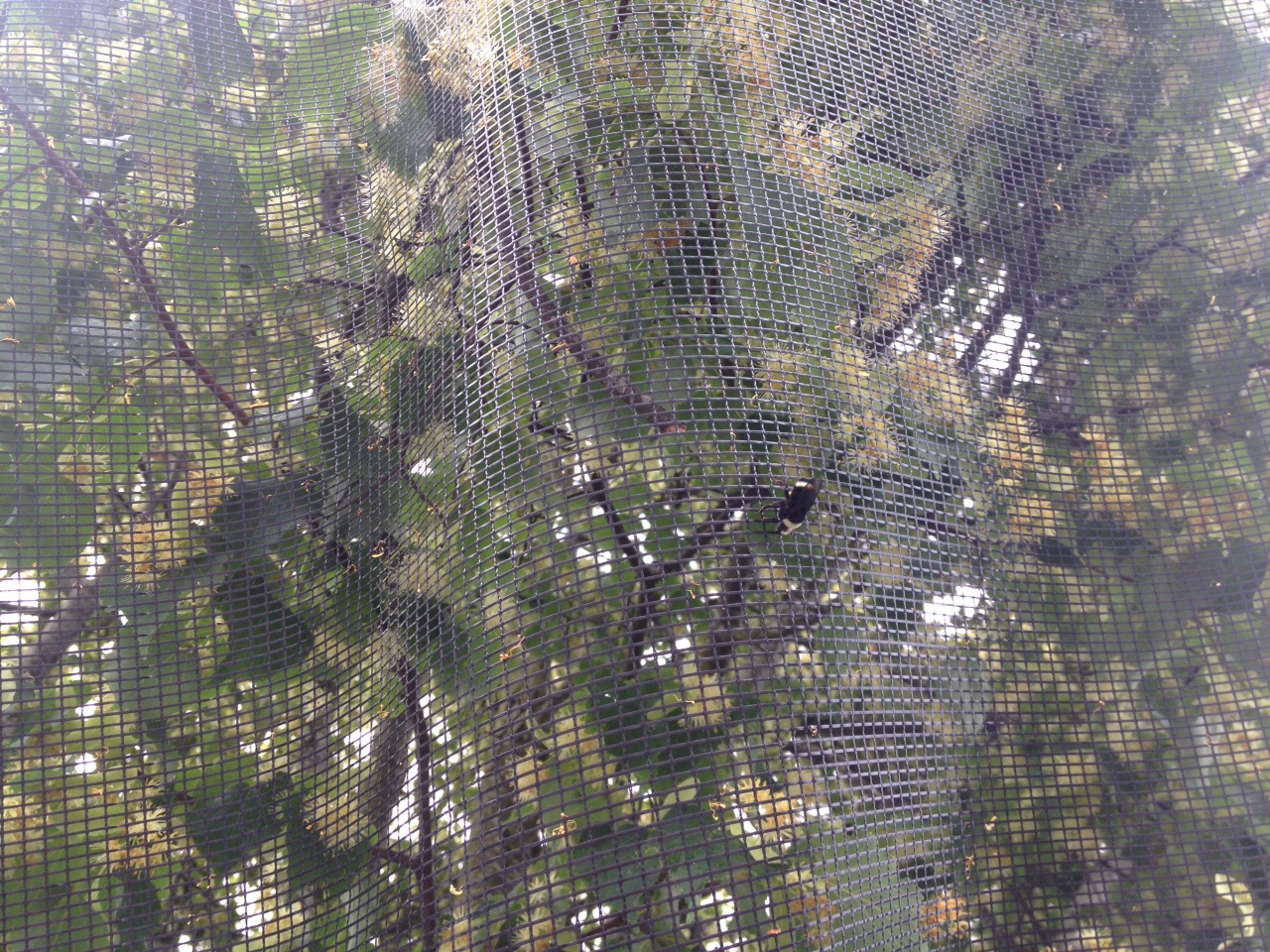
The city of Wilsonville, along with staff from the Xerces Society and the ODA, have been working feverishly to cover the trees with nets to keep the bees from coming into contact with the poison. Workers estimate that all 50 trees should be covered by the end of the day on Friday.


Update: 7 am, 6/24/13 Mace Vaughan, Pollinator Program Dir. for the Xerces Society, posted on the Xerces Facebook page: ""By 5 pm on Friday (June 21), the City of Wilsonville, with help from boom trucks and crews from at least four nearby cities, the Oregon Dept. of Agriculture and Xerces Society had covered all 55 poisoned trees in netting. Amazing!! We cannot thank the City of Wilsonville enough for their rapid response!"

Read the first report in this series: "City Steps in to Save Bees"

Video and photos courtesy Mace Vaughan, Pollinator Program Dir., Xerces Society.

The Buzz: City Steps in to Save Bees


The City of Wilsonville and the Xerces Society are wrapping 50 linden trees in netting to help save bees from the misapplication of the pesticide Safari, a powerful neonicotinoid made by the Valent Corporation, that has killed more than 25,000 bees so far in this one event.

Wrapping trees with protective netting.

The landscaping company that did the spraying, which has yet to be named, sprayed the 30-foot trees while they were in full bloom, a use specifically prohibited by the instructions that come with the pesticide. No legal action has been initiated as of today, but the city and the Xerces Society are in discussions with the property owners and the property manager, Elliot & Associates.

Neonicotinoids, a class of neuro-active insecticides chemically related to nicotine, are still legal in the United States, but have been banned in Europe due to evidence of a connection to honey-bee colony collapse disorder.

Xerces Society staff helps with netting.

Ironically, this tragic occurrence coincided with the beginning of National Pollinator Week, meant to "raise awareness about the importance of bees, birds and other pollinator species to agriculture, forest and grassland environments and other ecosystems," according to Agriculture Secretary Tom Vilsack.

Xerces Society Executive Director Scott Black, in an interview, said that to prevent future events like this, "we need to take action to protect native pollinators" from "the use and over use of toxic insecticides."


Update: Noon, 6/21/13 The Oregon Department of Agriculture (ODA) confirmed in a press release that the bumblebees were poisoned by dinotefuran, the active ingredient in Safari, the neonicotinoid sprayed on the trees. According to the press release, "ODA continues its active investigation of the incident to determine if the pesticide application was in violation of state and federal pesticide regulations."


Update: 3 pm, 6/21/13 Rich Hatfield, biologist for the Xerces Society, now estimates that more than 50,000 bees were poisoned in Wilsonville in the largest mass bumblebee death on record. (Read the post.)

Read the second report in this series: "Dead and Dying Bees Still Being Found"

Photos by Mace Vaughan, Pollinator Program Director of the Xerces Society.

Sunday, November 11, 2012

The Buzzin' of the Bees in the Linden Trees


There's a heavy, somewhat astringent perfume that wafts through Portland's neighborhoods in early summer. Emanating from the cascading yellow-white blossoms of linden trees planted along the city's sidewalks, the aroma is apparently akin to crack for honeybees.

Walking beneath one when it's in bloom is to experience what it must be like to live inside a beehive, with a constant, rhythmic thrumming of wings as the bees go from blossom to blossom collecting the copious amounts of nectar the flowers produce. One tree can have the equivalent of a couple of acres of flowers, enough for a backyard hive to produce a particular type of honey known as basswood.

Highly prized, basswood honey is light-colored but with a distinctly strong flavor that is, not surprisingly, reminiscent of those strongly scented linden flowers. It's moderately sweet, has a very slight bitterness and a taste that lingers on the tongue.

How do I know all this? Well, a neighbor recently harvested about 50 pounds of honey from his hives and, as he'd hoped, some of it was the basswood honey from a nearby linden. It only took a moderate amount of begging, but the other day we were presented with a small jar of golden treasure. This morning we opened the jar, drizzled the honey on the sourdough biscuits Dave made and found out what all the fuss was about.

This is just to say that if you have a wide parking strip of, oh, six to eight feet wide with no overhead wires, the city of Portland okays the linden as a street tree. And after tasting this honey, I'd highly recommend planting one of these babies and getting into beekeeping.

Sunday, July 22, 2012

Livin' in the Blurbs: To Bee or Not To Bee…


First chickens, then goats. Now being into bees is the latest preoccupation among urban agriculturists in this most ag-obsessed city. In its third year, the Tour de Hives not only celebrates this industrious pollinator, it gives enthusiasts (wannabees?) the opportunity to learn what's going on in the backyards of other apiarists and learn the secrets of their success. Coinciding with National Bee Day on August 18 and organized by the Zenger Farm Bee Group, the tour will feature hives in the North, Northeast, Southeast and Gladstone areas. Best of all, the day is capped by lifting pints and discussing the finer points of beekeeping at the Lucky Lab pub. Now to organize an urban pig tour followed by a smoke-off…

Details: Tour de Hives organized by the Zenger Farm Bee Group. Sun., Aug. 18, 1-4 pm; post-event gathering at Lucky Lab at 915 SE Hawthorne, 4-6 pm. Tickets $5-$15 sliding scale with preregistration.

* * *

For those too squeamish (or allergic) to want to put in their own beehives, there are ways to promote these infinitely useful invertebrates. One Northeast neighborhood has organized the Sabin Bee-Friendly Front Garden Tour that shows how easy and beautiful it is to plant a bee-friendly habitat. With 30 neighborhood homes participating, the tour is self-guided and you can peruse the gardens at your leisure all summer long. Even more helpful, there's an audio track available narrated by the homeowners themselves talking about their gardens. It's a great opportunity to learn a lot with little effort other than taking a walk through this lovely area.

Details: Sabin Bee-Friendly Garden Tour. Map available online or at Livingscape, Garden Fever or the Backyard Bird Shop Fremont location. Narrated audio track can be heard at 503-205-0326. For more information e-mail Diane Benson.

* * *

And if the above activities aren't enough for you, or you get insanely inspired and become convinced bees are your new life's calling, there are several places you can get your bee on, learn more about hives and talk to your heart's content with other bee enthusiasts. (Don't you love living in Portland?) Check out these places for information:

Monday, April 09, 2012

Tickle Bee Time!


Dave saw him first. Our neighbor, Mace, was on his knees in the school field across the street. No, he hadn't lost a contact lens or dropped his keys.

You see, Mace is a bee guy, and he was giddy over the Andrena sitiliae that had just made their annual appearance in the field. The school kids call them "tickle bees" for the way they feel when they crawl on your skin without biting or stinging.

Mace's assistant, a budding entomologist.

Mace, the pollinator program director (like I said, "bee guy") for the Xerces Society, has been helping to educate the kids about these little bees and their importance in the local ecosystem. He's working on a video about the bees to use at the school and to help illustrate the importance of pollinators on his nationwide lecture, so I'll post that when it's available.

Until then, enjoy these little guys for what they signify. As Mace said, "It's a sure sign that spring is officially here."

Sunday, December 11, 2011

This Bee's Life


My friend Linda is in Paris looking after her daughter who is finishing her school finals there. (What a good mom!) In her spare time she's exploring the city and came across these beehives in the Luxembourg Gardens. The apiary school, called the Rucher du Luxembourg, was created by the Société Centrale d’Apiculture on the Senate estate in 1856, and it still holds classes and produces honey from its hives. It sells its bounty once a year at an annual autumn honey festival at the garden’s Orangerie or nursery.

Wednesday, June 08, 2011

A Bee, See?


The other day I was invited to tag along as my neighbor, Mace Vaughan, Pollinator Program Director of The Xerces Society, inspected the hive at a nearby neighbor's home.

The hive had swarmed into a nearby tree (left) a couple of days before. Another box, or "super" in beekeeping terminology, had been added to give them more room, and Mace wanted to take a look. Mace's daughter came along and that's her you hear in the video.

Note that the guys are just wearing hoods and veils, but no other protection and neither was stung. The bees completely ignored me, though I was standing nearby and wasn't protected at all. Fascinating!

Saturday, September 19, 2009

Farm Bulletin: Of Hornets and Men


Contributor Anthony Boutard has written eloquently about the wildlife, both vertebrate and invertebrate, that inhabit the fertile fields of his farm in the Wapato Valley and the graceful dance (a waltz? a tango? a tarantella?) that is required between a farmer and the native species that inhabit the land.

The showers Wednesday afforded an opportunity to mow the chestnut and walnut plat in dust-free comfort. We need to have low vegetation so we can find the nuts. At this time of the year, we run the tractor with the roll bar up, even though the operator gets a shower passing under low limbs, and a spiny chestnut burr or two in the lap.

This is yellow jacket and bald face hornet (above) season, and the plat always has a couple of yellow jacket nests in the ground, and an occasional a bald face hornet nest (left) on a low hanging limb. When disturbed, the wasps attack the highest point on the tractor; by instinct, they go for the head. The mower passed over two yellow jacket nests, the roll bar warded off the stings, and the locations were noted. It's now two days later and they are still on the alert. The bald face hornet nest is in the poplars adjacent to the plat, and is huge compared to other years.

These wasps are generally unpleasant to encounter, but they are also a valuable component of the farm's ecosystem, so we avoid killing them unless it is absolutely necessary. They kill a lot of harmful insect larvae. Social insects in the order Hymenoptera, which also includes bees and ants, but not termites, are described by the entomologists E.O. Wilson and Bert Hölldobler, as "super organisms." The wasp nest develops from a single queen who has survived over the winter. The nest's purpose is to generate as many queens as possible to over-winter and start nests the following spring. You will find the overwintering queens, large and mild mannered, in leaf litter, wood piles and any sheltered nook.

At this time of the year, the activity in the nest is feverish. Wasps are arriving and departing in a constant stream. They are bringing in fragments of fruit, aphids, caterpillars and carrion. They will even attack weak bee hives and have a yen for all manner fruit, especially grapes. For us they are a very minor irritation. The bald face hornets have more powerful mandibles, and seem to do more damage. Unless you stumble on the nest, the wasps are too busy with food collection to pay attention to nonfood matters. We are stung more frequently by honey bees. That said, a misstep can result in a dozen or more very painful stings. So we constantly scan for evidence of nests.

The yellow jacket meets it match in the skunk (right). Like the yellow jacket, the skunk is generalist. It belongs to the family Mustelidae, which also includes weasels, mink and badgers. Skunks are nocturnal and hide in burrows or under building during the day. From time to time, skunks will take up residence under the trailer that serves as our office. The skunk is a powerful digger, and will root yellow jacket nests. The animal is unbothered by the stings. They are pretty genial animals and give plenty of warning by stamping their feet before spraying. Unfortunately, some dogs never learn the cues. Although they will raid poorly constructed chicken coops, like the yellow jacket, skunks are a valuable part of any farm. Skunks mostly eat small rodents, grubs and adult insects.

And a final note (be sure to watch to the very end of the trailer):


On the 25th, 26th and 27th of September, the documentary "Ingredients" will be shown at the Bagdad Theater. Each night, the ticket sales will benefit a different local organization. These are: Multnomah County Food Initiative, Loaves and Fishes, and Ecotrust's Farm to School Program. We encourage you to see this documentary, as it has a lot of local Portland influence.