Showing posts with label Lynne Curry. Show all posts

Tuesday, May 01, 2018

10 Easy Ways to Eat Less Meat


Oregon's Lynne Curry wrote the book, quite literally, on cooking with grassfed beef. A new edition of Pure Beef was issued last year and has just been listed as one of Oregon's Top 10 Cookbooks by Travel Oregon. So when she offered to share her tips for eating less meat and using grassfed or pasture-raised instead of conventional—a strategy that's better for us, for the planet, and supports small farmily farmers—I jumped at the chance! (See the end of the post for a free guide to where to find pasture-raised meat in Oregon.)

My strategies show you how to eat less meat even when you are eating it. So, if you’re looking to slim down the portions of meat you eat without giving it up completely, I’ve got 10 ideas to guide you.

1. Skewer it. Grilled meat on a stick is a worldwide favorite, often in the form of a kebab or satay. Sliced into ribbons or cubed and marinated in anything from teriyaki to garlicky yogurt, a little bit of meat becomes a meal when served over a pile of noodles or rice with ample fresh vegetables. Freezing the meat for 20 minutes eases close cutting. Plan on one meat kebab and two to three sticks of satay per person.

2. Stretch it. Depression-era cooks knew how to make a pound of ground meat feed many. Make your mixture roughly three parts meat (ground beef, turkey, pork, lamb, veal or combination) to one part breadcrumbs, oatmeal, bulgur, rice, quinoa or any other cooked grains or even legumes. Add chopped onion, an egg for binding, seasonings and spice it up as you like for classic meatloaf, exotic meatballs, burgers or sliders that go far.

3. Wrap it. Tacos are the model, but you can fold minced, cooked meat up in crepes, roti, rice paper rolls, tender lettuce leaves and nori, to name a few. Or, make a meat filling to encase in a dough—from pastries and empanadas to samosas and egg rolls. One cup of finely chopped or shredded meat makes six to eight portions to accompany with salsa, chutney or ginger-soy dipping sauce.

4. Serve it on the bone. Eating meat on the bone satisfies a primal urge and gives the feeling of satiety with relatively small amounts of meat. Whether it’s pork ribs, chicken wings or flanken-style short ribs, this is a meal to pile on sides of coleslaw and baked beans, steamed rice and vegetables or mounds of mashed potatoes. Cut between the bones of back ribs, spare ribs or racks to make single-serving portions.

5. Mince it. Hand-chopped raw or leftover meat is the basis for some of the world’s classic dishes—think fried rice and corned beef hash. Combine meat with cooked grains to stuff and bake into eggplant, peppers, cabbage leaves or acorn squash. The token protein—be it bacon or roast beef—serves as a major flavor boost. Or, serve slivers of meat in tiny amounts to fashion bibimbap or a stir-fry.

6. Stew it. No amount of meat is too small—like a ham hock to season a pot of beans or a couple of chicken thighs simmered in coconut-milk—to make stew. In a pot chock full of seasonal vegetables or legumes, the cheapest, toughest cuts have a lot to offer (all the better if there’s bone). And the more ingredients you add, the less meat you need in a belly-filling meal. Shred the cooked meat to disperse it into the stew before serving.

7. Stuff it. There is no better side dish for roasted meats than stuffing. Rolling the stuffing inside any boneless meat cut not only fancies up the presentation but bulks up portion sizes considerably. Butterfly larger cuts, like pork loin and turkey breast, or pound flank steak and chicken breast to 1/4-inch thick with a meat mallet or heavy rolling pin. Season a bread or grain-based stuffing well before rolling it up and securing the roll with toothpicks for oven roasting or grilling. Serve in one-inch-thick slices with extra stuffing on the side and add a gravy, if you like.

8. Slice it thin. When holidays and other special occasions call for a large roast or thick steaks, you still don’t have to go big on the meat. With a sharp slicing knife, make 1/4-inch thick slices of ham, for example, and serve it with all the trimmings. Instead of serving a whole steak, plate slices with a generous salad; that single cut will serve three to four. Portion the leftovers in resealable bags for the freezer for a month’s worth of ready-made sandwich fillings. A sandwich may be the most familiar form for protein portion control—so long as you follow the meat-moderate panini approach and not the Carnegie Deli’s.

9. Flavor with it. A single slice of bacon or a ham hock can flavor an entire pot of soup or stew. Split pea soup and Southern-style collard greens are both great examples of how a little bit of meat goes a long way. Or even no meat and just the fat, as in a pot of clam chowder flavored with salt pork or chicken soup that starts with schmaltz. Rendered fat from bacon, chicken and beef is one of the tastiest cooking mediums around—and if it comes from pastured animals, it’s loaded with nutrients like omega-3s.

10. Bone broth it. You’ve heard of this trend by now, of course. A nourishing broth made from bones, it is a perfect example of whole animal eating and limiting food waste, too. You can request bones from your butcher or reserve bones in the freezer from T-bone steaks or a whole roast chicken to make your own bone broth. It’s also great that more companies are offering good-quality chicken and beef bone broths and making good use of all those bones.

Read the full post and get more of Lynne's handy tips, including recipes, for eating less (and better) meat that supports Oregon's small family farmers. Find a farmer near you with this handy Oregon Pasture Network Product Guide.

Photos by Lynne Curry.

Monday, June 19, 2017

The Ultimate Guide to Grilling Grass-fed Burgers


When I wanted to get some advice about grilling the best grassfed burgers at home, I turned to my friend Lynne Curry, who literally wrote the book on cooking with grassfed beef. (Her book, Pure Beef: An Essential Guide to Artisan Meat with Recipes for Every Cut, has just been rereleased should you want a copy.) Fortunately she had just written a post about burgers on her Forage blog, and I asked if I could share it with all of you.

At last, it’s grilling season!

(I know you have already cleaned the old ashes/ grate of your grill, filled the propane tank and checked the lines if you use gas or purchased plenty of hardwood charcoal—right?)

In celebration, I’ve compiled everything I know about grilling grassfed burgers. For a quick primer, check out my previous posts on perfect grassfed burgers:

5 Quick Facts for Perfect Grassfed Burgers at Home, Part 1
5 Quick Facts for Perfect Grassfed Burgers at Home, Part 2

Here’s what’s included in this post:

What's Different About Grass-Fed Burgers

By now, you’ve certainly encountered grassfed ground beef wherever you shop. And maybe you’ve even made the switch because of the reasons I touched on in Part 1—namely the traceability and quality of grassfed beef.

Caramelized onions…heavenly!

You feel good about buying grassfed beef for your backyard barbecue, but how confident do you feel about grilling it? I’m here to help.

Most important to me is that the beef I buy comes from animals raised for their whole lives on pasture. And it supports family farms, not factory farms.

Maybe for you it’s the composition of good fats and the overall nutritional profile of grassfed over conventional beef. Whatever your reasons, grassfed beef is a completely different animal when it comes to grilling.

Here’s why.

The Lean Factor

Every cut of grass-fed beef is more susceptible to overcooking simply because it is extra-lean. Ground beef from pasture-raised animals is typically 85 percent to 90 percent lean, far less fatty than the 70 percent lean meat many burger connoisseurs recommend.

A burger that fits the bun is essential.

Less fat means that there’s less insulation to protect the proteins and baste the meat internally. So how do you grill a juicy grassfed burger?

Some home cooks blend egg, milk and bread crumbs into their ground grass-fed beef as insurance against dryness. Shredded or diced cheese, sautéed vegetables and minced pancetta are other mix-ins that can help protect the burgers from heat and keep them juicy.

Since I prefer my hamburgers to be 100 percent grass-fed beef, I do nothing but season them well with kosher salt just before cooking.

And I cook them over high heat, but more on that in a moment.

How To Form Hamburger Patties

Many recipes caution that over-handling ground beef will make hamburgers tough. This warning can cause cooks to barely form patties at all, resulting in scraggly, lumpy burgers that don’t fit the buns.

Grilled to perfection.

The truth is that the grinding process forces beef through a die cutter and minces every strand of connective tissue, making the meat tender enough to eat raw à la steak tartare.

The key is to handle the ground beef just enough to shape it without compressing it like a meatball, and without melting the fat with the heat of your hands. If you prefer, you can use a jar lid or one of the burger molds on the market.

I like to form the patties a few hours before cooking (but I do not salt them until I’m ready to cook because the salt will draw out the moisture.).

My ideal hamburger is 1/3 pound of meat (about 5 ounces) shaped into a uniform disk about 1 inch thick. I make it wide enough to fit within the bun, roughly 5 inches.

Now, the one sure way to make your burger dry is by pressing on them with a spatula while grilling and squeezing out all the juices. But again, I get ahead of myself.

Over-Handling Versus Under-Handling

Keeping that fat intact is key to a tender and juicy burger. So if you handle the ground beef for too long and it starts sticking to your hands, then your burger will be compromised.

I’ve realized that shaping hamburgers is a lot like making pie dough. People have been warned for so long about not overhandling the dough that they tend to underhandle it. So they end up with dry, raggy-edged pie crust.

Same is true with the burgers. Try this:
  1. Shape nicely uniform discs of ground beef while keeping contact to a minimum. I use a scale to portion the ground beef. But if you have a one-pound package of ground beef, it’s easy to eyeball it into thirds for 1/3-pound burgers, or fourths for 1/4-pound burgers.
  2. Then take each piece in your hands and press it while spinning it around like you’re making mini-pizza about 5 inches wide and 1 inch thick (okay, a very thick mini-pizza).
  3. Put it on a plate and use your thumb to make an indentation in the center so that when the patty expands during grilling, it won’t blow up into a burger ball. I have witnessed too many burger balls at backyard barbecues, and it’s a sad sight.
Now, how long did that take? If it was less than one minute, you’re safe from over-handling but still have an actual hamburger patty, not a blob of ground beef.

And now that you have your burger patties ready to go on the grill, here's how to cook them to perfection (plus toppings that will put them…well…over the top)!

All photos courtesy Lynne Curry.

Friday, April 21, 2017

A User's Guide to Good Eggs


Eggs are getting a lot of press these days, from the ballyhoo over big corporations announcing they'll only use cage-free eggs to debates over the credibility of the dizzying plethora of labels stuck all over the cartons in supermarket egg cases. So when I read this deep dive into the subject by my friend, writer Lynne Curry, I knew you'd be as intrigued as I was.

The other day I met a woman in the grocery store where we stood side by side scanning the overflowing options of the yogurt aisle. I felt almost dizzy trying to find organic yogurt.

When I reached for a quart of grassfed Stonyfield, she laughed. “That’s what I was looking for!” And then we chatted briefly about the ridiculously high sugar content in flavored yogurt for our kids.

She’s another shopper like me, I thought as I watched her walk toward the egg section. No supermarket stalker, I looked on with curiosity because I’ve been researching and writing about organic egg production here and here.

Again, she mulled over the offerings and surveyed the cartons bearing labels from cage free to organic to free range. When she picked up a carton of cage-free eggs, my heart sank a little.

Nope, I realized, she doesn’t know either. And so I committed to finishing this egg post to share what I know about finding, buying and eating good eggs.

Why Eggs Matter Now

Maybe you’ve noticed that the egg industry is undergoing a quiet revolution. We’re eating more eggs now than in the past 30 years—263 eggs per person in 2014, according to The Washington Post.

The story I’ve been following involves major policy changes and the 200-plus big businesses that have committed to transition to cage-free eggs by 2025. While Big Ag policy stuff is a big yawn most of the time, this change is already sweeping the country and changing the egg market for the better.

The shift to cage-free and the popularity of organics are two reasons why there are more choices on the market than ever—which makes buying eggs so confusing.

But here’s the uplifting takeaway: change is coming from the bottom, not the top. Consumer buying habits and concerns about the treatment of animals are the main driving force behind changes in egg production methods that affect the hens, the lands, the farmers and local economies as well.

It’s you. It’s me. It’s all of us shifting eggs away from the grip of factory farming because we want better lives for animals, better foods for our families and more corporate responsibility (read: honesty).

All Fresh Eggs Are Not Alike

You probably already know this if you have been lucky enough to taste a local egg. It’s hard to go back to store bought. But this winter, despite foraging far and wide, there were no local eggs to be found.

So, I had to make choices from the egg section at the grocery store.

Buying eggs is about the chicken and the egg. The difference of each type of egg carton—from cage-free to organic to pastured—is an indication of the chicken’s lifestyle, the nutrition and the flavors of each egg.

(There has been little research on the effects of pasture on egg flavors and the one study I found claimed there was no difference. C’mon! We’re just going to have to chalk up the question of egg taste to subjectivity and personal preference.)

But unfortunately, it’s not the whole story, and you have to dig deeper to get a truly good egg.

What about all of those labels festooning the cartons?

They are more confusing than helpful, in most cases. While there are a lot of egg label guides, I find most of them a little hard to decode, so I recommend downloading Animal Welfare Institute’s pocket guide. Or to find out how the organic eggs you already buy rate, scan this scorecard from the watchdog food group Cornucopia Institute.

Don't Be Fooled By Cage-Free Eggs

Here’s the deal: all eggs are going cage free. This means that millions of laying hens will no longer be confined to battery cages the size of an 8 1/2 by 11-inch sheet of paper.

While it’s a major step in the right direction for animal welfare, it’s a little more complicated than that, as this Mother Jones article reports. In short, these debeaked chickens are still confined to multistory laying facilities called aviaries where the conditions are crowded, air quality is questionable and the pecking order causes higher mortality rates.

Cage-free is not a compassionate eater’s dream, in other words. Cage free also has no bearing on the nutrition, quality and taste of the egg for you.

Why not?

The chicken feed is the same as for caged hens. Plus, while they can at least flap their wings and lay down, they do not get outdoors where they exercise and get sunlight while ranging for insects and other tasty items that diversify their nutritional intake.

Other Egg Labels and Seals 

Organic is pretty much about the feed, that’s it. So while organic eggs will be antibiotic and GMO-free, they will not necessarily come from hens who had any genuine access to the outdoors. In fact, the biggest producers of organic eggs operate giant multi-story hen houses called aviaries and they dominate the organic egg industry.

Chances are high that the organic eggs you buy come from an industrial egg producer. (This January, I reported how the organic rules were all set to change to disallow aviaries with no true outdoor access from qualifying as organic eggs. But that all went away.)

Free-range sounds good, but it doesn’t mean anything at all without any other verification to back it up. It is simply an alluring marketing claim that producers can slap on an egg carton at will.

Same goes for pasture raised, an unregulated term, so be on alert for false advertising.

Here are all the other labels that do not have any bearing on chickens’ quality of life or the nutritional quality or flavor of their eggs:
  • farm fresh
  • natural/all-natural
  • free roaming
  • sustainably farmed
  • vegetarian fed
  • hormone free
Stand-alone labels like these are just there to fool you. So just go ahead and ignore all of these meaningless claims from now on, okay?

Animal Welfare Certifications

These seals—or stamps of approval—on egg cartons do mean something. Called third-party certifications, they verify that the marketing claims are true. So, for example, if the label says pasture-raised or free-range and its paired with the logo from Animal Welfare Approved, this is the gold standard.

You can trust that an independent auditor made sure that the hens truly do live on pasture except for when their health or safety is at risk.

Certified Human (less stringent than AWA) and American Humane (less stringent yet) are two more third-party certifiers for eggs.

Yes, it is mind boggling. And yet necessary in a world where we have commoditized living creatures for profit.

But here’s where anyone can make a real difference…

(Read the rest of the article here and find out why pasture-raised eggs are nutritionally better, the four best types of eggs to buy and where to buy them!)

Small photos of egg cartons, cracked eggs and farm stand by Lynne Curry.

Monday, December 05, 2016

Great Gifting: Booking It for the Holidays


Several years ago, so long ago, in fact, that the internet was in its infancy—if the browser names Mosaic and Netscape Navigator ring any bells, you're in the right era—where carrying a powerful computer around in your hip pocket, one that could answer virtually any question within seconds, was a concept left to science fiction fantasists, and people at dinner parties had to scour actual books to settle arguments about the name of the guy who was in that movie or else argue for hours over the name of the dog that was sent into orbit by the Russians (Laika, for those who care).

A well-loved (and well-marked) book.

Our house was pretty handy for situations requiring reference material, so much so that one visitor dubbed it "the house of books" for the piles that were—and still are—a major part of our living room decor. So when the holidays roll around it's no surprise that books will fill many slots on our gift lists, both for receiving and giving. In no particular order, here are a few of my favorite food-centric tomes ideal for the bookish on your list. And feel free to add your own pick by clicking on the comments link below!

Buck Buck Moose by Hank Shaw. The third book by this self-described "hunter, angler, gardener, cook"—who is a superb writer on those topics as well as a good friend of mine—is a thorough compendium of hunting, cooking and eating "antlered things." Perfect for hunters, it's also a thoughtful treatise on how these animals are deeply intertwined with our history as a species. Carnivorous cooks will appreciate it, too, since his meticulously tested recipes are great even if you can't easily obtain venison—simply substitute beef, lamb or pork.

Life Without a Recipe by Diana Abu Jaber. Memoirs are slippery beasts, the good ones treading the fine lines between tell-all and tight-lipped, between my-life-is-so-fabulous and Blanche Dubois, cringe-inducing drama. Abu Jaber, a professor of writing and literature who splits her time between Portland and Florida, writes with skill about growing up the daughter of an American mother, a Jordanian father and a powerhouse of a German grandmother. In this, her second, memoir, she continues the journey she began in The Language Of Baklava, weaving "a book of love, death and cake."

Better from Scratch and Crackers & Dips by Ivy Manning. Prolific writer and author of cookbooks on subjects ranging from how to cook for a mixed-diet family to fixing easy weeknight vegetarian meals to one of the best farmers' market cookbooks around, these two slim volumes are packed with recipes so good they're already as well-thumbed as my grandmother's Joy of Cooking. Better from Scratch will stun you with how easy it is to make things you usually buy from the store—often for a premium price—like granola, beef jerky, graham crackers and kimchi. Ditto for Crackers and Dips, where you'll have fun, spend less and enjoy crunchy, sweet and savory treats made from whole grains, real butter, cheese, fresh spices and no preservatives.

Oysters and Crab by Cynthia Nims. Seattle writer and cookbook author Nims is passionate about the bounty of the Pacific Northwest, especially the creatures pulled from the depths of the waters off our own West Coast. In Oysters she describes in detail the biology of these amazing shellfish and how they help purify the waters they live in. She then moves on to suggest the best methods of buying, cooking (or not!) and eating them, with more than 30 recipes. Our West Coast Dungeness is the star of Crab, but she also covers its Atlantic and Gulf Coast cousins, delving into the history and importance of the commercial fishing industry, then quickly moving on to how to buy, clean and—with more than 50 recipes—how to cook these beauties.

My Beer Year by Lucy Burningham. This book by Portland beer writer Burningham has a long but delightful descriptor: "Adventures with hop farmers, craft brewers, chefs, beer sommeliers, and fanatical drinkers as a Beer Master in training." With wit (as well as Wit), it describes how this young writer and mom fell in love with beer to the point where she decided to become a Certified Ciccerone, going through the rigorous and arcane training and testing regimen to become a beer expert. (And you just thought knowing an IPA from a Porter made you that, right?) Full of character and plenty of characters, its a great book for the beer fanatic in your life.

Pure Beef by Lynne Curry. The current dietary advice, as Michael Pollan famously said, is to "eat food, not too much, mostly plants." But if we are going to eat protein, its important to eat animals raised humanely, with their feet on the earth and the sun on their backs. In other words, pasture-raised animals rather than those raised in crowded, confined conditions requiring daily doses of antibiotics to survive. To that end, I heartily recommend Joseph, Oregon, writer Lynne Curry's book on buying, cooking and eating grass-fed beef, an incredibly well-researched and thoroughly recipe-tested primer on how to get the most delicious results possible from these tasty beasts.

Virgin Territory by Nancy Harmon Jenkins. Dividing her time between a home on the coast of Maine and an olive farm in Tuscany, Jenkins shares her contagious passion for the flavors of the Mediterranean, a diet she is convinced is one of the most healthful and flavorful on the planet. I've tried several recipes from this book, and I can't argue with that premise.

Tartine Bread by Chad Robertson. If you have a bread baker in your life, or someone who's interested in learning to make bread, I can't recommend this book highly enough. My husband worked for two years to make what he considered the perfect artisan loaf, and was frustrated with what he felt were mediocre results until friends got him this book. It was a game-changer, and it apparently has some pretty good recipes for other good things to eat, though those pages remain remarkably unthumbed around here.

James Beard: A Biography by Robert Clark. As a fifth-generation Oregonian, I thought I knew plenty about native son James Beard. That is, until I read this biography of this world-famous cook, eater and bon vivant. A truly fascinating character in his own right, it follows Beard's upbringing in Portland in the late 1800s, his escape from his controlling-yet-supportive mother to New York and Europe and his lifelong love affair with the flavors and ingredients of the Northwest. In addition, it follows the evolution of the American palate with discussions that add depth and nuance to Beard's at times tragic yet joyful journey.

Friday, September 09, 2016

Travels with Chili: Mountains of Fun, Part 3


On a trip to Eastern Oregon for a food conference in May (read my report here), I decided to take a couple of days to explore this incredibly beautiful part of the state. You can read part one about the trip to La Grande and Union; part two traveled to Baker City and Halfway, where I uncovered murder and mayhem on a bison ranch. The portion below follows up with adventures in the Wallowas, with stops in Joseph, Enterprise and tiny Lostine.

It was tough to leave beautiful Halfway and the stories of bison rancher Dave Dur, but my husband Dave and I were due in Enterprise for our farm stay at Barking Mad Farm, where owners Emily and Rob Klavins had arranged a meet-and-greet with local food folk. The trip was going to take three hours if we took the standard route back to Baker City to catch I-84 to La Grande, basically making a long circle around the western side of the Wallowas.

Barking Mad Farm.

But we'd heard about a short cut through the mountains on a National Forest highway that would slash our travel time by a third. Trouble was, no one could tell us for sure if the road—which is closed in the winter due to snow—had been cleared of debris and fallen trees. We were pretty sure the snow was gone, but I wanted reassurance that it was passable all the way through to Joseph. The forest service office in Baker hadn't heard, so Dave Dur called his buddies at the Halfway ranger station, and, while they couldn't officially announce it was open, they assured him that it was clear to Imnaha, just a few miles from Joseph. (Read about a previous camping trip to the Imnaha.)

So we took off in Chili, crossing our fingers that its low clearance wouldn't be a problem, and found our way to NF 39, a winding—and paved—two-lane highway that snaked its way through the mountains. At times it followed beautiful creeks that cut their way between steep forested gorges, at others it climbed zigzagging switchbacks to dizzying alpine heights above the trees. Eventually it dropped down to the Imnaha River and into Joseph, where we decided that our daredevil exploits deserved to be celebrated with a pint of local brew.

Well-deserved beers at Embers Brewing.

Unfortunately when we got to Joseph we found that Mutiny Brewing, our favorite area brewpub—and at the time the only woman-owned brewery in the state (now there's Covalent Brewing in Portland, owned by Meagan Hatfield)—had closed. Luckily we discovered Embers Brew House just down the street featuring 17 beers on tap and settled at the bar for our celebratory pints.

We pulled up to Barking Mad Farm with a half hour to spare, which gave us time to unpack and chat with Emily and Rob and meet their cattle dog, Roo. Their comfortable craftsman farmhouse is situated just outside Enterprise on the rolling plain at the foot of the mountains, which affords a spectacular view of the range (top photo) and an occasional peek at the its highest point, snow-covered Sacagawea Peak. The lawn and garden are studded with Adirondack chairs, with additional seating on the expansive deck, but I was drawn to the double hammock slung to take advantage of the view.

Michael and Jody Berry of Dandelion Wines.

Our room on the second floor of the house, called the Treetops Suite, was a large, airy room with sliding doors opening onto a private deck looking out at the mountains. I was ready to settle in with a book, but people were starting to arrive for the meet-and-greet. Emily had laid out a generous spread of breads and cheeses, along with dips and wine, and introduced me to the crew, including my friend Lynne Curry, a local author, food activist and blogger. Lynne had given the keynote at the food systems conference I'd attended—which led us into a discussion of local farms, CSAs and issues of food access in rural communities. (See my report here.)

After that we adjourned to spend a little more time catching up with Lynne, and she suggested a new wine shop in Enterprise that was having a rosé tasting that evening. We walked into Dandelion Wines, owned by Michael and Jody Berry, and saw not the expected lineup of four or five wines, but a counterlength formation of more than a dozen rosés from all over the globe ranging from the palest of blushes to a bright lipstick red. The just-over-ten-feet-wide by a hundred-feet-long space was also packed with locals exchanging hugs and catching up on gossip while juggling wine glasses and plates of noshes from a sideboard of delicacies that would be impressive at any catered event in the big city.

"This is Eastern Oregon?" I found myself thinking. "My, how you've changed!"

Wallowa Lake Lodge.

The evening continued at Terminal Gravity Brewing's pub, where you'd swear you'd walked into that Boston bar called Cheers where everybody knew everybody's name and the beer and food flowed freely in a spirit of community and conviviality. After that, retiring to our quiet aerie at the farm, we fell asleep as fast as our heads hit the pillows.

The next morning the coffee was strong, the pastries piping hot from the oven and the eggs were fresh from Emily's chickens, their bright yolks making up for the lack of sun in the sky. We drove off in Chili right after that, knowing we wanted to make a couple of stops on the way back, first an obligatory pause to admire Wallowa Lake and its historic lodge.

Original log chair at Wallowa Lake Lodge.

The lake was originally home to the Wallowa tribe of the Nez Perce band before settlers arrived, and the lake and the area surrounded it were guaranteed to the tribe in the Treaty of 1855. It was, that is, until gold was discovered in the area, and the tribe was displaced and banished. The Wallowa Lake Lodge was built in 1925 and is a gem among small lodges that still retain their rustic roots. The lodge's 22 rooms sit above the main floor with its stone fireplace and wood panelled dining room, and historic photos document the building of the lodge and grounds. This is definitely a place we want to come back to.

Our second stop was in the tiny town of Lostine. I'd read in none other than the New York Times Sunday Magazine about a fellow named Tyler Hays, who'd recently opened a shop in SoHo called M. Crow and Company carrying "a marshmallow roasting stick made of oil-rubbed walnut, copper and leather ($60). A child’s leather tool belt with a toy hammer made of cherry and Osage wood ($250). A pickle jar handcrafted from local clay and glazed with wood-stove ashes ($260). A pot of hair product made with homemade beeswax and hand-expelled oils ($120)."

M. Crow in Lostine.

What does this have to do with Lostine? Well, it turns out that the tony New York store is Tyler's second. The first is in Lostine, just miles from his hometown of Joseph. According the store's website, Tyler's family "were among the first few dozen families to settle the valley in the late 1800's" and the store in Lostine was run by the Crow family for 107 years. In 2012 he purchased the store "to prevent its closure and the loss of an iconic memory of my childhood" and to provide an outlet for his fascination with making everything he needs.

Interior of M. Crow in Lostine.

Much more rustic than the photos of the ultra-spare, white-walled SoHo store, the original in Lostine still has the creaking floorboards and dusty, old-building smell that I remember vividly from my childhood when I'd explore abandoned buildings and old cabins. It's got some of those expensive over-$300 jackets and fancy cutting boards, but it also features house-brewed beer and local honey (more of Tyler's hobbies). The article in the Times said "he plans to build a workshop in Lostine that will take over much of M. Crow’s production while creating jobs for area residents," providing an economic boost to the communities around the store.

Tap list at Ordnance Brewing.

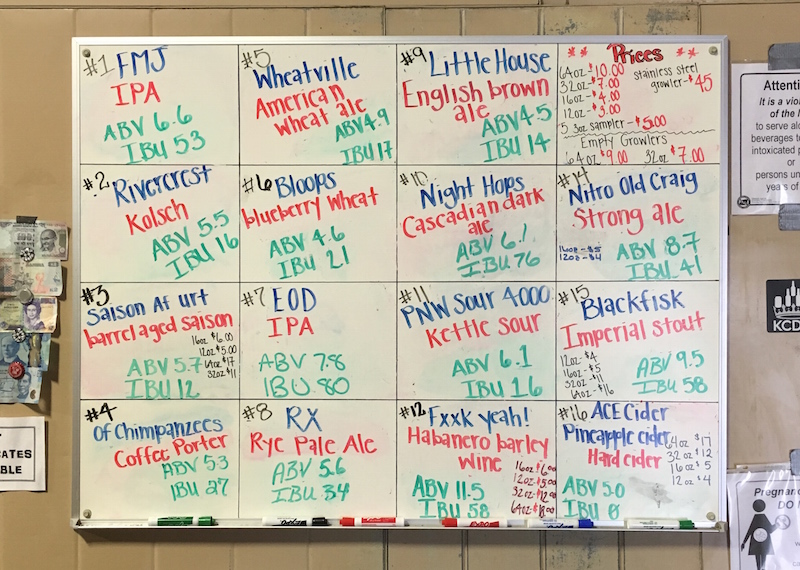
It certainly gave us something to talk about as we drove home, making our final stop in Boardman at Ordnance Brewing to check out just what was going on in the big metal storage building by the train tracks. (In the first installment of this series we'd arrived too early to sample its wares.) While it isn't a glossy brewery with repurposed timbers and copper-topped tables, they make an impressive array of 30 beers from the expected IPA to a fruit beer called Bloops to a sour beer, a CDA, a saison and a host (literally) of others, eleven of which were listed on the whiteboard graph tacked up behind the bar. It's easy to enjoy one or more sitting on folding chairs at the cable-spool tables.

Read the rest of the Mountains of Fun series: Part One about La Grande and Union and Part Two about Baker City and Halfway.

Top photo from Barking Mad Farm; photo of Dandelion Wines by Lynne Curry.

Wednesday, June 01, 2016

Getting Good Food to Oregon's Far-Flung Corners


A couple of great new cookbooks arrived on my front porch awhile ago, and I wanted to try out a few recipes so I could share them with you. So, without thinking about it, I pulled out my phone and started a list of ingredients I'd need: basmati rice, fresh peas, tahini, mint, fennel, lemons, poblano peppers, smoked paprika, kimchi, fava beans, maybe some seasonal greens like garlic scapes, mizuna or raab.

Between a Whole Foods within walking distance and two New Seasons stores less than a mile away, plus Providore on Sandy that's not much further, most of the list was covered. Not to mention the four farmers' markets nearby for seasonal produce like local peas, favas, carrots, fruit and whatnot. Meats or fish? There are butchers and fish markets aplenty. And even if a recipe calls for exotic ingredients like Vietnamese culantro or key limes or black cardamom pods, between the Asian, Thai and international specialty markets in the area, there are very few things I don't have access to.

Okay, maybe not fresh durian. You've got me there.

M. Crow general store in Lostine, Oregon.

So my trip last week to the northeastern reaches of Oregon was a bit of a wake-up call. I was there to attend the Eastern Oregon Community Food Systems Gathering in La Grande, sponsored by the Oregon Food Bank. Added benefit: the keynote for the day-long conference was delivered by my friend Lynne Curry, an author, food activist and journalist from Joseph, Oregon.

The 53 people who gathered that morning over local pastries and coffee were a mix of food bank folks, Oregon State University Extension people, representatives from other community food agencies and a handful of area farmers and food retailers.

Curry's keynote contrasted the food system she found in 2001 when she moved to Joseph with the one that exists in 2016. When she first arrived, the only stores that carried groceries had a few staples, but depended mostly on sales of cigarettes, beer and junk food. Most of her actual food came from what she termed the "hidden food system" of rural living: food access meant getting eggs from the woman at the bookstore who raised chickens, foraging for mushrooms and other greens, and growing vegetables herself or trading with neighbors for the things she didn't grow. In the winter she fed her family from meat in her freezer and the jams, pickles, vegetables and sauces she'd preserved during the summer, much like our grandparents did in earlier times.

General store, Haines, Oregon.

It was amazing to me to realize that almost none of the food produced—mostly wheat and cattle—on the region's rich agricultural land is consumed locally. Rather, it's shipped hundreds, if not thousands, of miles across the country to go into the commodity market. Though, as Curry noted, that is starting to change, with livestock producers like Carman Ranch in Wallowa and 6 Ranch in Enterprise beginning to produce a marketable number of grass-fed cattle, as well as working with other area farmers to offer pigs, lamb, goats, chickens, eggs, honey and vegetables to their neighbors. These ranchers are also bringing their products to a growing number of families in Western Oregon who are interested in humanely and sustainably raised local meat.

Curry is seeing the interest in locally produced food—like the meat and vegetables above, along with beer and other products—becoming much more widespread, losing the "elitist" or "gourmet" label it had in 2001. Today, even in the far-flung regions of our state, she said that people are talking about where their food comes from, along with how it is produced, in a much more meaningful, inclusive way. And in this region where conventional agriculture—i.e. an industrial model that uses pesticides, herbicides and antibiotics—was the norm, people are beginning to demand more organic, sustainable food products for their tables.

Produce at the La Grande Farmers Market.

Farmers' markets in the area, which were few and far between in 2001, became a big outlet for local farmers and producers, and experienced growth that has slowed somewhat today. But, like here in Portland, they still act as incubators for new products, plus being what Curry referred to as a "third place" where communities can gather. She believes that this social aspect may be as important as the food that is sold, with the added benefit that they have an intrinsic educational component, showing people a different model of a food system, one based on community and relationships.

Despite this good news, though, there is still a great deal of work to be done on the issues of access to good food, not to mention the problem of food insecurity—that is, not having reliable access to a sufficient quantity of affordable, nutritious food. As outlined by Lauren Gwin and Sara Miller of the Oregon Community Food System Network, 18 of Oregon's least populous counties have lost stores where the community can access food. For instance, Morrow County went from five stores to one; Lake County went from three to one; Umatilla County went from 16 to 12. The town of Union has one store, which carries everything from hardware to t-shirts and features a small but adequate selection of staples on its shelves.

Pigs from Community Merchants in Union, Oregon.

Not surprisingly, these small, isolated communities also have the highest average cost of a meal, which makes sense considering the cost of getting the food to rural locations and the distances people have to travel to buy food. Compared to a national average of $2.77 per meal, people in Crook County average $5.01 per meal. In Curry County it's $3.18 and in Wasco County it's $3.10 per meal. Which, of course, means that the people who have the least amount of money to spend on food end up paying some of the highest prices for it.

Laying out the issues and challenges was the precursor to start coming up with solutions. Lynne Curry spoke about the opportunity to connect technology to the food system, proposing, like food hubs in urban centers, establishment of a collaborative network for transporting and distributing food to far-flung communites. This echoed another suggestion that rural groceries—which rarely meet the minimum orders required by large distributors—should have a system of joint purchasing agreements, which could potentially lead to purchasing and distributing produce and meat from area farmers and ranchers, which would also benefit local economies. There was a discussion of connecting the local health community to the food system in the Veggie RX "screen and intervene" program, where health care providers give low-income clients vouchers for free fruits and vegetables to stretch their SNAP (food stamp) benefits.

One group of farmers and retailers met to discuss how to bring more locally produced value-added products to market—jams, jellies, baked goods, pickles, etc.—with a focus on establishing certified community kitchens where producers could access commercial equipment. There was also discussion of the recently passed home bakery exemption (SB320) and the domestic kitchen license, with many questions asked about how it could be applied to bring more local products to market.

The energy of this group, even after a day of presentations, discussions and summations, and their desire to work together to better the everyday lives of the people in their communities, was inspiring. I'll be following up on these issues in future reports, and if you have comments or questions, please post them in the comments section below and I'll try to get them addressed.

Photo of Joseph, Oregon (top photo) from its website; photo of La Grande farmers market from its website; photo of Community Merchants pigs from its website.

Thursday, April 03, 2014

Burgers and Beer Build Community in Lostine


Living here in the densely populated land of plenty that is Oregon's Willamette Valley, it's easy to forget that there's another Oregon just a few hours away on the other side of the Cascade Range. It's a much drier place, a high desert populated by sagebrush, pine trees and rolling hills where cattle outnumber people. Other mountain ranges, including the Blue Mountains and the Wallowas, are dotted with deep lakes, and the deer, elk and other wildlife that live there have adapted to the extremes of temperature that can go from well below freezing in winter to above 100 degrees in summer.

The original building that became the Lostine Tavern.

There are no New Seasons or Whole Foods stores stocked with aisles of fresh produce and sustainably harvested West Coast albacore. In fact, many of the small towns in the region are designated by the USDA as "food deserts"—rural towns with limited
 access to fresh foods. That's one reason why Joseph resident and writer Lynne Curry and her business partner, rancher Peter Ferré, have decided to rebuild a landmark tavern in the tiny town of Lostine, 10 miles northwest of Enterprise.

Beginning the renovation.

The Lostine Tavern, built in 1902 from locally quarried Bowlby stone, was originally a pharmacy and doctor's office, then became a tavern in the 1940s until it closed in January, 2013. Curry and Ferré, both active in efforts to revive a strong local food system, hope to build their menu around produce and meats from area farms and ranches. Which includes bringing back community favorites like taco nights and pie socials, as well as cooking classes and a small market and deli that they hope will nurture the beginnings of a rural food economy.

Detail of original stone walls, wood ceiling. Cool!

Curry admits it's a bit of a stretch to build a successful farm-to-table restaurant considering the size of the population in the area, but is encouraged by the enthusiastic response they've received from local residents. And because of a tragic fire in early February that burned the South Fork Grange and Norton Welding—two adjoining historic structures that formed the core of the small downtown—to the ground, the rebuilding of the tavern has become even more critical to the community.

Please consider donating whatever you can to their campaign, which ends on April 14, but also plan to visit after the tavern opens in mid-May…this stunningly beautiful area is going to get even more amazing.

Friday, November 29, 2013

Great Gifting: Bookin' It


Hello. My name is Kathleen and I love books.

A few years ago I heard someone say that they never traveled without a "flood book." That is, if they were on a trip and couldn't continue because the road was flooded—or the flight was delayed or a bus was late—they'd always have a book at the ready to help pass the time. We subscribe to that philosophy as well, and it's rare that you'll find either Dave or me without printed reading material of one kind or another on our person.

Several books by friends have come out in this past year, and any would make a fine flood book for the folks on your list.

Duck, Duck, Goose: Recipes and Techniques for Cooking Ducks and Geese, Both Wild and Domesticated by Hank Shaw. This book is a must-have for the hunters on your list. It's also a great choice for cooks who are interested in becoming more familiar with fowl that isn't chicken, especially since ducks and geese are becoming more available to we non-chef types. From hunting and processing wild birds to getting one from the grocery store that's ready to go, Shaw explains what to do with whole birds or parts, breasts to eggs to legs. And as readers of his previous book on foraging and hunting, Hunt, Gather, Cook, know, his recipes are easy enough for moderately experienced home cooks, with clear lists of ingredients and instructions. Holly Heyser's step-by-step photos of boning and other processes, plus mouth-wateringly gorgeous photos of finished dishes, illuminate Shaw's words and make this beautifully designed book a great one for the serious cook's shelf.

Pacific Northwest Cheese: A History by Tami Parr. Author of the premier blog about artisan cheese, the Pacific NW Cheese Project, as well as the first book about the Northwest's booming cheese scene, Artisan Cheese of the Pacific Northwest: A Discovery Guide, Parr's new book is the result of extensive research that shows our current bounty of local cheese is no fluke. Fans of cheese, along with NW history buffs, will appreciate the stories of early cheese-making operations established by the Hudson's Bay Company and the contributions by people like Mrs. Helen West of Tigard, who started the Red Rock Cheese Co. in 1919, distributing her cottage cheese to customers via the Oregon Electric Trolley line which ran along the back of her property. Historic photos of early cheesemaking and quaint labels give way to contemporary portraits of the artisan cheesemakers who formed the backbone of our current artisan industry. Appendixes include the history of cheesemaking in Alaska as well as an up-to-date list of current curdsters. A fascinating read.

The Mushroom Hunters: On the Trail of an Underground America by Langdon Cook. Mushroom hunting comes as naturally to many Northwesterners as pulling on their Danner boots. Even those of us who eschew the damp, dirty work of foraging the precious fungi from our forest floors anticipate the start of chanterelle season when stores and menues are packed with these gems. Cook, author of the blog and book Fat of the Land, takes readers behind the scenes into the murky, secretive world of the commercial mushroom hunters who supply markets and chefs with these seasonal treats. It's a truly amazing, and sometimes frightening, journey as Cook "follows the invisible food chain from patch to plate," interviewing new immigrants and scrappy geezers, and will appeal equally to those interested in food, natural history and outdoor adventure.

Crackers and Dips: More Than 50 Handmade Snacks by Ivy Manning. I don't know what it is, but my Portland neighborhood may have more food writers per square mile than anyplace in the country. I am fortunate that Ivy is one of those who lives close by, since, when she's working on an article or book and testing recipes, she will often call and ask if I want some of the results of her meticulous (and delicious) labors. It's especially great when she has to concoct recipes containing meat, since her husband, dubbed Mr. Tofu, is a confirmed vegetarian and there's often too much for her to consume on her own. (A situation that led to her previous book, The Adaptable Feast: Satisfying Meals for the Vegetarians, Vegans, and Omnivores at Your Table.) So I can personally testify to both the incredibly variety and insanely tasty recipes she presents in this latest effort. Easy enough for beginning cooks and interested kids, it also includes toppings and dips to serve with these crunchy snacks. You may never buy a cracker from the store again.

Salty Snacks: Make Your Own Chips, Crisps, Crackers, Pretzels, Dips, and Other Savory Bites by Cynthia Nims. This ode to snackage by my friend, Seattle writer Cynthia Nims, is a compelling argument on the savory side of the sweet versus salty debate. It's geared to a more adult palate but, like Ivy Manning's book (above), it would make a great gift for cooks who like to entertain.

Other suggestions: Pure Beef: An Essential Guide to Artisan Meat with Recipes for Every Cut by Eastern Oregon writer Lynne Curry is a comprehensive, eminently useful book for those of us wanting to move from industrially processed meat to a pastured product; includes recipes and shopping tips. The Gluten-Free Asian Kitchen: Recipes for Noodles, Dumplings, Sauces, and More by Laura B. Russell is a godsend for those who love Asian cuisine but can't get around its heavy dependence on wheat products; great resource. And one more, non-local but knee-slappingly funny sliver of a book, Nietzsche's Angel Food Cake: And Other "Recipes" for the Intellectually Famished by Rebecca Coffey is a collection of pseudo-recipes/essays with titles like "Ernest Hemingway's Battered Testicles" and "Geoffrey Chaucer's Stinking Bishop's Tart" that begs to be read out loud; perfect as a stocking stuffer or for foodies with (or who need) a sense of humor.

Read the other posts in this series: Gifts That Give Back, Mad Skills, Kids' Stuff and Good Eatin'.