Monday, January 17, 2011

An Offer I Couldn't Refuse, Pt. 2: Having a Gas


Time for some history:

More than once we heard Vancouver, BC, referred to as the "City of Glass" after the legions of windowed towers that dominate the city proper. The original settlement, however, was much more humble. Called Gastown, it was named after gold prospector, riverboat captain and saloon keeper John "Gassy Jack" Deighton (statue, above). It was reincorporated as the City of Vancouver in 1886, though less than two months later the entire city was burned to the ground by an out-of-control brush-clearing fire. Whoops.

The two surviving buildings formed the core of the city's rebuilding efforts, and the neighborhood known as Gastown grew and prospered into the 20th century until developers' attention wandered to other, more lucrative ventures. Like many historic districts, it fell into disrepair, neglected by all but the city's least fortunate citizens. But, as happened in many urban centers in the 1960s and 70s, just as the mania for so-called "urban renewal" was about to level it, a dedicated group of citizens organized a campaign to save the area and Gastown was declared a historic district in 1971.

Like Portland's Old Town, at first it was a huge tourist draw, though it struggled with drug and gang activity for decades. Then, about five years ago, new entrepreneurs were drawn to the area by attractive rents and a reflowering began.


Our tour began with a preview of Big Lou's Butcher Shop, a venture by neighborhood restaurateurs Karl Gregg and Allan Bosomworth (left) (see Two Chefs and a Table, below) that was scheduled to open in  the next couple of days. Advertised as a nose-to-tail butcher shop, the partners are sourcing their meat from area farms like Polderside Farms, Sloping Hill Farm, Pemberton Meadows Beef and Heritage Valley Farm. Though they aren't curing or dry-aging their own meats yet, they do share a cold storage facility with other suppliers and plans are in the works for an expanded list of house-made products. What they do have is a meat-case full of very large hunks of animal flesh and sausages made in-house, and a menu of specialty sandwiches. Details: Big Lou's Butcher Shop, 269 Powell St., Vancouver, BC. 604-566-9229.


A couple of blocks away Karl and Allan had done a quick change into their chef coats and were talking us through the menu at Two Chefs and a Table, a bistro as well as a catering and event planning company. Like many of the restaurants we visited, it's dedicated to showcasing local, sustainable products as much as possible in this northerly climate. Or, as Karl said, "Someone calls and says they've got 300 pounds of tuna and we'll change the menu." The open kitchen isn't surprising, but the reason they have one is, according to Gregg. "It's so you can smell the food before it comes to you," he said. As to why they recently added a full brunch on the weekend, he said, "It's because I like a good brunch." Any wonder that I'm putting this tiny place at the top of my list of must-visit restaurants on our next trip north? Details: Two Chefs and a Table, 305 Alexander St., Vancouver, BC. 778-233-1303.


The next three Gastown spots we visited were owned by Gastown mover-and-shaker Mark Brand, who looks like he just stepped out of a Scorsese gangster movie. Sea Monstr Sushi occupies a long, narrow brick-walled space where the disembodied heads of the sushi chefs hover behind the service bar-cum-seating area. Your orders are placed along the top of the counter as they're plated, the lighting specifically designed to spotlight the food at each place. Details: Sea Monstr Sushi, 55 Powell St., Vancouver, BC. 604-681-2144.


The Diamond has that slightly dangerous, speakeasy vibe, only enhanced by its narrow, gated entrance at street level. From there it's a climb up a darkened staircase to a windowed room that feels like it's straight out of a turn-of-the-century brothel. Which, according to Brand (photo above), at one time it was. In the second-oldest building in Vancouver, the story goes that it survived the 1886 fire only because it was the favorite bordello of the city's firefighters, once again proving that it's not what you know, it's who has a big firehose (so to speak). Also a bartending school, it offers classes from beginner to expert, which accounts for the plethora of stoppered bottles of house-made bitters and infusions behind the bar. Though the drinks are the focus, the food is also rumored to be good, consisting of small plates meant to be shared. The one disappointment? We didn't get to go into the secret room behind the bar where guest bartenders test their latest creations. Details: The Diamond, 6 Powell St. 604-408-2891.


A favorite of reviewers and the public alike, Boneta is the third jewel in Brand's crown, one he shares with partners Neil Ingram and Jeremie Bastien. It's named after Brand's mother, though he lays the creative spelling of her name at his grandmother's feet. Consistently excellent quality is a hallmark of this casual French dining spot, its hottest selling items being the bison carpaccio and the very (French) Canadian poutine of crispy fries, Okanagan cheese curds and a salty brown gravy. The rest of the menu changes regularly to reflect seasonal availability, with one reviewer calling 29-year-old chef Bastien's menues "youthful, exuberant, unbuttoned." This is not expected to change when the restaurant moves to its new location a few blocks away in the historic Garage building in mid-February. Details: Boneta, (new location) 12 Water St., Vancouver, BC. 604-684-1844.


Not that I'm a big fan of restaurant taglines, but the three words attached to Gastown newcomer Cork & Fin are "Eat. Drink. Local." Owners Elliott Hashimoto and Francis Regio shop local waters and pastures for the fresh seafood and meat featured in their restaurant, preferring to have relationships with small family purveyors over larger distributors.  Their $30 three-course prix fixe menu is said to be one of the best deals in the city. Not only that, but they actually encourage customers to share it with a dining companion. And in warmer weather, the whole front of the restaurant opens up to spill onto the sidewalks, sharing some of that seafaring ambience with the rest of the city. Details: Cork & Fin, 221 Carral St., Vancouver, BC. 604-569-2215.
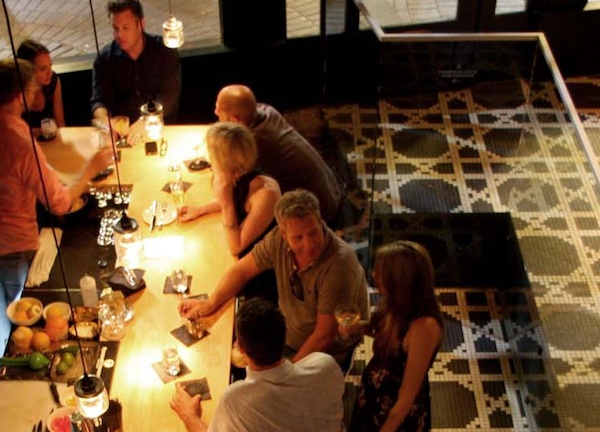

As if a tour of six restaurants in one afternoon wasn't enough, we were scheduled to attend a preview of the Vancouver Tales of the Cocktail event at the hotel before dinner at L'Abattoir back in Gastown. After sampling an authentic (and perfect) Sazerac made by Jay Jones of Pourhouse*, served in an antique glass from his personal collection, we hopped (or was it stumbled?) into taxis and were whisked over to L'Abattoir where bartender Shaun Layton "crossed the wood" with a cocktail, the Loire Sidecar, that he recreated from the menu at the Hemingway Bar in Paris. (He's also known for collecting antique crystal glassware and bar tools, so if you want to make friends fast, start complimenting him on his selection.) Chef Lee Cooper's menu tends toward traditional preparations with totally fresh ingredients, with all sauces, pastas, breads and even fresh cheeses made in-house. His baked sablefish with mushrooms was fabulous and prompted a spirited discussion of naming fish for marketing purposes (sablefish is also called butterfish or black cod, though it's no relation to the true cod). The brick-walled dining room is on two levels, with the bar one the first level and a glass atrium that would be an ideal hideaway for murmured, romantic conversations. Details: L'Abattoir, 217 Carrall St., Vancouver, BC. 604-568-1701.

For more from my culinary tour of this gorgeous city, see Part 1: An Offer I Couldn't Refuse and Part 3: A Grand Tour.

*Jay Jones has since accepted a position at the bar at Market by Jean-Georges at the Shangri-La Hotel.

Saturday, January 15, 2011

Pancakes 101


Good cooks become good cooks over time, developing recipes through trial and error, experimenting with ingredients and methods until they finally find the mix that works for them. Contributor Jim Dixon of Real Good Food has done just that with pancakes, and this week he shares two of his favorite recipes with us.

My pancake touchstone is the recipe in my 1943 Joy of Cooking. A couple of eggs, milk, salt and flour, the batter leavened with double acting baking powder. When our boys were young I made it with buttermilk, Nancy’s yogurt and a blend of white and whole wheat flour. We ate them with jam and yogurt mostly, sometimes fake maple syrup. My approach has evolved a bit over the past couple of decades.

Pancakes

For basic pancakes you need three mixing bowls. In one combine about a cup and half of whole wheat flour (or mixture of unbleached white, white whole wheat, etc.) with a teaspoon each of baking powder and salt. Blend well.

Use the other two bowls to separate two eggs. In the bowl with the yolks, blend in about a cup of buttermilk (or milk and yogurt mixed, or just milk). Set the whites aside for a minute.

Make a depression in the flour mix in the dry bowl, pour in the milk blend, and mix gently until combined. It should be fairly thick, but not that it won’t pour, so add a little more milk if necessary, but don’t mix any more than you need to.

Use a manual eggbeater to beat the whites to soft peaks, then gently fold them in to the batter.

Your griddle or skillet should be heated already (low heat, preferably cast iron). Drop spoonfuls of batter onto the griddle; keep them small and the cakes will be easier to manage. Don’t crowd them, either.

Ignore them for about 3-4 minutes, then look to see if the edges are drying out and small bubbles are forming on the top. When the bubbles on top begin to open, gently slide a thin metal spatula under the edge of the first cake. Lift it a bit to make sure it’s brown, then loosen the edges before flipping it over. Flip the rest, cook for another 3-4 minutes, then remove to a warm plate for eating.

After I started getting the incredible corn meal produced by Carol and Anthony Boutard at their Ayers Creek Farm, I made corn cakes by substituting the corn for some of the flour. These are also delicious, especially with the addition of some chopped cooked bacon, or, even better, candied bacon.

But after making some fritters from cooked winter squash and polenta, and liking how the squash blended with the corn, I thought the same combination might work with pancakes. It does.

Winter Squash Corncakes with Bacon

In one bowl, combine the dry ingredients: 1 cup good cornmeal (Ayers Creek, Anson Mills or similar whole grain ground corn), 1/2 cup whole wheat flour, 1 teaspoon each baking soda and salt. Add about a half cup of chopped, cooked bacon.

Separate two eggs. To the yolks, add a cup of cooked winter squash, and a cup of milk (or buttermilk or yogurt or a mix). Blend well, then combine with the dry ingredients. Add more milk if the batter is too thick to pour. Beat the whites to soft peaks and fold in.

Cook as described above. I like to eat these with maple syrup and creme fraiche.

Top photo: For a great topper, check out this recipe for Braised Apples, Maple Syrup and Bourbon.

Friday, January 14, 2011

An Offer I Couldn't Refuse, Pt. 1


The chime of the incoming e-mail message sounded normal enough. But when I clicked to read it I nearly fell out of my chair. Someone from Tourism Vancouver was asking if I'd be interested in coming to that city for a three-day culinary tour of the latest hot spots, along with a cocktail showcase previewing the upcoming Tales of the Cocktail festival and a sampling of restaurants participating in Dine Out Vancouver.

Assuming they must surely have me confused with some other writer, I nonetheless hit the reply button as quickly as I could, hoping it would get there before they realized their error. Then, being the nice people that Canadians are reputed to be, they'd be too polite to rescind the invite. Right?

The itinerary arrived a few days later and I found out they'd not only be flying me up, but I'd be housed at one of the newest hotels in town, the Fairmont Pacific Rim, smack dab on the harbor overlooking Stanley Park and directly opposite the Coast mountain range that rings the city (top photo). They'd invited a dozen writers to come on the tour, including my neighbor, author Ivy Manning, a veteran of many tours who could dispense sage advice to a noob like myself.

First up after pitching my bag in the hotel room was a sushi making class and sake pairing with Chef Jason Harris (left) of the Fairmont's Oru restaurant. A very personable guy (nice people, the Canadians, remember?), he'd decided to have us make albacore nigiri, the fish and a smear of wasabi perched on a compressed scoop of rice, as well as a tamaki cone filled with either a salmon or spicy albacore mixture along with our choice of vegetables.

The key with nigiri, as any of you experienced sushi makers know, is to keep your hands moist so the rice sticks to itself rather than turning your hands into rice-covered mittens. Chef Harris prefers a special sushi rice called koshikari, since it keeps its shape while still sticking together. Then it's just forming the rice into a tight little log, swiping the slice of fish with a smear of wasabi and placing it on top of the rice. A little pressure on the sides of the fish to conform it to the rice and seal the deal and you're done. Wow!

The tamaki was fascinating, since there's a real trick to forming the cone. Moistening your hands, take a small amount of rice and, with your fingertips, form it into a triangle at the top of a sheet of nori (about 4" by 8"). Then place matchsticks of vegetables or other fillings at an angle across the rice (right). Take the upper left-hand corner of the nori and gently fold it down to the right, making a 45° angle. Continue rolling until it forms a cone (below left). Simple!

Chef Harris emphasized that it's important to eat the cone as soon as possible after making it, since the moisture in the rice will quickly soak into the nori and it won't have the crisp freshness that lends so much to the texture of the cone.

There was a little time left in the class before we sat down to lunch, so Chef Harris showed us how to make a simple sushi roll. With moistened fingertips, cover three quarters of the nori sheet (approx. 4" by 8") with a thin layer of rice, arranging the fillings at one end. Then, gently but firmly, roll it toward the open end.

Again there's a trick, and that's to wrap the bamboo sushi mat with plastic wrap so the roll won't stick to it. Then cover the roll with the mat and gently press it with your hands to seal the roll. All that's left is to slice the roll crosswise into rounds and eat.

Of the two sakes we paired with these, one was made by artisan sake producer Masa Shiroki of Osake on Granville Island. All of the sakes he makes are junmai sakes, that is, they're made from rice, water, yeast, and the micro-organism called koji. It's unfiltered, with a very light and slightly sweet taste and a body similar to sauvignon blanc. The other was, to my surprise, from Oregon-made Momokawa sake, with a slightly drier taste and smooth body. Both were terrific, and made me want to explore this wine a little more.

I'm thinking a small cocktail party with sushi fixings would be a fun twist on the usual snacks-and-drinks gathering, plus people would be astonished at not only how easy it was, but that I learned to do it on a trip to Canada. Who'd expect that?

For more of my culinary tour of this gorgeous city, see Part 2: Having a Gas and Part 3: A Grand Tour.

Friday, January 07, 2011

Some Lazy Sunday


Growing up in an Episcopalian family, Sunday mornings were for church, immediately followed by a quick change into more comfortable clothes. But in this largely un-churched age (especially here in Oregon) people use it as an opportunity to get projects done around the house. Painting the basement? They'll run to the paint store for supplies in the morning and finish up by nightfall. Digging up the parking strip and planting 100 feet of garden next to the house? We'll hear the rototiller chug to life at 8 am and the summer's crop will be in the ground by late afternoon. Staked and fertilized, too.

All this busyness makes us look like the layabouts that, to be completely honest, we truly are. Sunday mornings around here are spent in bathrobes that are rarely doffed before noon. Not that there's any lack of activity, mind you. There's coffee to be made, dogs to be fed, newspapers to be fetched from the front porch and read, plus NPR to be listened to (and commented on).

And even though the days of the big breakfast should be long gone, there's nothing Dave likes better than to fire up the oven and bake his signature sourdough biscuits, or make English muffins that go ever-so-perfectly with a cheese omelet.

Lately he's been experimenting with some new scone recipes, and found one that's become his current favorite. Any leftovers freeze well and are terrific for a hurried mid-week breakfast. But if you drop by our house some Sunday morning expect to be met by a couple of sleepy-eyed, slipper-clad lazybones with papers in hand. Though if you pour a cup of coffee and sit down with one of these scones, you might just find a new groove for your Sunday morning.

Lazy Sunday Scones
Adapted from Bakingby James Peterson

3 c. flour
5 Tbsp. sugar
1 Tbsp. plus 1 tsp. baking powder
1/2 tsp. salt
1 c. cold butter or margarine
1 1/4 c. milk

Preheat oven to 375°.

Mix dry ingredients in processor. Add thin slices of margarine and pulse until mixed. Add milk and process until mixed. Turn out onto floured surface. Gather and knead about 10 times (not too much or scones will be tough). Roll until about 1/2 inches thick. From one side, fold one-third of the dough up, then do the same from the opposite side. Turn a quarter turn and fold the ends up similarly. Place on plate and put in freezer for five minutes.

Remove from freezer. Roll out again into rough rectangle to about 1/2 inch thick. This time roll up starting on short edge. Roll out rolled dough into rectangle with long sides and short ends, to about 1/2 to 3/4 inches thick. Cut dough into rectangles, then wedges to desired size. Place on baking sheet. Lower oven temperature to 350°. Bake until golden brown, about 25-30 minutes.

Wednesday, January 05, 2011

Sunshine on a Cloudy Day


Over the holidays a friend sent this view from her vacation perch in Honolulu (click to get the full-size photo). Now I have it as my desktop so I can dream about tropical breezes, tall, cool drinks and the faraway sound of the surf. Ahhhhhhhhh…

Tuesday, January 04, 2011

14 Things I Love


If only there was an app for that: I'm talking about 100 Things We Love, the compilation of the year's best food, drink, books and places to fuel your next obsession, put together by the writers and contributors to the Oregonian's FoodDay section.

This year it covers everything from farmers' markets to pantry must-haves to bookshelf staples, and the editor was kind enough to include a few of mine:
It's always a great read, and I guarantee you'll discover things that you never knew existed. Now to get my in-house programmer working on that app…

Monday, January 03, 2011

Brought to You by the Letter P: Purple Pleasures


Aubergine, melongene or eggplant: no matter what you call them, these purple members of the nightshade family, related to potatoes and tomatoes, have a dense, meaty texture. They're found in many of the world's great cuisines, and contributor Jim Dixon of Real Good Food loves the way they can be combined with different flavors to make a great meal.

Most eggplant recipes include directions for salting to “draw out bitterness.” This step has always mystified me, and perhaps it’s a relic of some long ago time when eggplant were actually bitter. But I’ve eaten literally hundreds of eggplant and never tasted anything bitter. So skip the salting. This is my current favorite:

Garlicky, Spicy, Smoky Eggplant

Slice a large eggplant into disks, stack 2 or 3 at a time, and cut them into strips, then cubes, roughly half an inch square. Heat a heavy skillet, preferably cast iron, and add enough extra virgin olive oil to cover the bottom with a thin layer. When the oil ripples a bit, add the cubed eggplant, but only so much to cover the pan in a single layer. Leave it alone for several minutes, then use a stiff spatula to lift and turn the cubes. Keep this up until the eggplant is nicely browned and softened, about 15 minutes cooking time total. If you couldn’t cook all the cubes at once, remove the cooked ones and repeat with the rest.

When it’s cooked through and nicely browned, reduce the heat a bit and add 3-6 (or more) roughly chopped garlic cloves. Optional, but highly recommended, are 1-2 finely diced anchovey fillets, preferably the salt packed variety (rinse these under cold running water and filet with your fingers, much easier than it sounds).

Cook for a few minutes to soften the garlic, then add a nice sprinkle of some kind of hot chile: piment d’espellette if you can find it, cayenne, or red chile flake. Shake on a more generous amount of the Spanish smoked paprika called pimenton (I like the “dulce” version, but you could use the hot variety to cover both the smoky and spicy bases here). Cook for another minute; salt to taste and drizzle with good extra virgin olive oil at the table.

Sunday, January 02, 2011

Echoes From the Canyon


My friend Clare Carver was a Bay Area artist and graphic designer when she and her husband,  winemaker Brian Marcy, decided that they wanted to own a farm and grow their own grapes. I wrote about her experience in an article for NW Palate magazine titled "Setting a Big Table," and Clare has continued recording her journey from city gal to seasoned farmer on her Big Table Farm blog.

She recently celebrated the fourth anniversary of that blog by reposting one of her first entries about being a newcomer to country life, then adding a 2011 addendum to each one. You can read the entire post here, but I'm excerpting a few of her pithy observations below:

On transportation

  • 2007: You get really excited when you see the bulldozer on the road. It means you're getting new gravel and less potholes. 2011: I've learned to buy the cheapest tires possible, as you go through about one set per year on gravel.
  • 2007: You never thought you’d be driving your hybrid car with shotgun shells rattling around behind your seat. 2011: and that your car would permanently smell like a barn.
  • 2007: When you make a trip “to town” you make it count! 2011: and it's a good idea to get off the farm at least once a week and see beings on two feet.
  • 2007: Your husband puts his rusty old jeep in the front yard and you really don’t care. 2011: The jeep has been joined by a second rusty vehicle and you now think it's charming. Hell, you liked it so much you did a painting of it (above left).

On Heat

  • 2007: The wood stove is king. 2011: and insulation is the prince. No, wait, my husband is the prince for putting it in!
  • 2007: You learn the maul is NOT where you go for shoes, it’s what you use at 7am on a Sunday morning when the fire burned down too far for a big log and you need some kindling…shin guards are recommended. 2011: you get all your wood split and stacked and in the wood shed in the SUMMER!

On Power and other modern conveniences

  • 2007: You learn when you lose power it’s not heat that’s the problem, it’s water. (Most wells require power. Who knew?) 2011: Brown water coming out of your tap before you are about to have 10 people over for dinner makes things fun.
  • 2007: The mail lady knows your dog's name and nags you about the “accessibility” of your mail box due to the road being washed out. 2011: And she literally hikes through snow to bring Christmas presents. And the UPS guy, well, just saw him at the bar in town (the one horse tavern) when we stopped in for a beer.
  • 2007: The wood stove is also a very valuable cook surface. 2011: and I will say I've mastered the stock pot.
  • 2007: Hot water bottles are one of man’s greatest inventions. 2011: Hmmm…I may go get some water going for one right now.

Other things I’ve noted


  • 2007: It’s quiet…I mean really quiet! 2011: not as quiet now as I've acquired lots of animals that like to remind me of their presence every time I walk outside.
  • 2007: I can see sky from every window. 2011: and who's gonna clean these stinkin' windows anyway?
  • 2007: Our friends still visit, which is amazing! 2011: Still true. Thanks to all for the company, love and friendship!

And thank you, Clare, for sharing your life with all of us!

All photos by Clare Carver.

Friday, December 31, 2010

A Jewel in Sellwood


Excuses. We've all got 'em. "Don't have time" is one of my regulars. "Slipped my mind" is becoming alarmingly frequent and, alas, all too true. "Had to answer an e-mail" slips in with startling regularity, too.

Such was the case when Dave and I had errands to run on the west side of the river and found ourselves peckish. Without a decent place to eat in sight, we opted to drive across the notoriously wibbly wobbly Sellwood Bridge and stop in at Jade Teahouse. That's when the cascade of excuses poured forth.

You see, Jade has been near or at the top of the list of my very favorite places since April Eklund (on right in photo at left) and her immensely talented mother, Cuong "Lucy" Eklund, opened it in October of 2008. Pretty soon April's exquisite design sense coupled with her mother's training as a chef and patissier in France, not to mention the handmade noodles, breads and pastries pouring out of Lucy's kitchen, made it an instant hit. And when PDXploration blogger Joshua Chang joined the team with his extensive knowledge and love for blended teas, as well as a killer smile and can-do attitude, things heated up even more.

But, and here's where the excuses come in, I hadn't been there in awhile and nothing gets past Lucy's eagle eye. So after her usual warm greeting, she very tactfully mentioned my absence from the lunch counter. Gulp. "Well…um…uh…" and brought up my brother's wine shop moving out of the neighborhood, the holidays, work, dragons, fires, floods.

Needless to say, Lucy just smiled and brought out her homemade roasted chile oil to go with my khao soi (top photo), a bowl of deeply flavorful broth filled with ground pork, tomatoes, chopped greens and some of Lucy's crazily light and luscious wide noodles. Dave opted for the beef and squash in red curry broth, another perfect combination and an ideal antidote to the wet, cold day outside.

Sufficiently fortified, we said our goodbyes and headed home, swearing to return soon despite work, holidays or dragons. Really.

Details: Jade Teahouse and Patisserie, 7912 S.E. 13th Ave. 503-477-8985.

Thursday, December 30, 2010

Crustacean Celebration: Deadly? I Think Not


Most cookbooks are divided into categories. Some go with the "meat, vegetables, seafood" format where recipes are slotted by main ingredient. Others divvy them up by course: appetizers, entrées, desserts, etc. I even have one that has separated the recipes into occasions, like picnics, parties, casual dinners and, of course, formal dinners. The pages of that last section, by the way, are as pristine as the day it was bought at a garage sale, giving you an idea of how useful its various owners have found it.

But I propose another way to categorize a cookbook, and that's by how you feel. Happy? Make some small plates of your favorite foods, including simple salads and desserts. Depressed? You could indulge in a big ol' chocolate cake by yourself, or treat your mood with lots of fish and kale (Omega 3s and anti-oxidants).

Then there's sinful, which I'm sure someone has been done already and titled "Food for Lovers" or some such, full of unctuous (good word for that category, right?), creamy, rich or sweet flavors that beg to be licked off the plate or some other surface (but we'll stop there).

A perfect food for that category, though one I doubt would normally be thought of, is crab. It's certainly rich and has a delicate sweetness on its own…think whole pieces of leg or joint eaten right out of the shell. But it takes on a whole different personality when folded into a creamy sauce or warmed in a bisque, its sweet character enhancing the lushness of the dish and the warm meat melting when it hits your tongue.

Which is why, when I saw that cooked whole crabs had hit $3.99 a pound, and knowing that early season crab is the sweetest, I bought two and fantasized about using it in macaroni and cheese. While I was only planning on using the meat from one of them for the casserole, the price and my lack of inhibitions made me throw the meat from both into the noodles and sauce just before I slid it into the oven, and it was so worth it.

This recipe would be terrific for a special dinner, served in individual ramekins which, depending on your mood and the setting (say, in front of the fire on a lambskin rug?) could make for a memorable evening. Champagne, anyone?

Crab Macaroni and Cheese

1 lb. dried pasta (penne or cavatappi are my faves)
 4 Tbsp. butter
4 Tbsp. flour
2 c. milk (or 1 c. cream, 1 c. milk)
 3/4 lb. extra-sharp cheddar cheese, grated
8 oz. cream cheese
1/2 tsp. hot pepper sauce (I use Sriracha or harissa) 
Salt and pepper to taste
Meat from 1-2 crabs

Boil large pot of water. While water is heating, melt butter in medium saucepan. Remove from burner and add flour, stirring to combine. Return to burner and cook on low heat for 1-2 minutes, stirring constantly. Add milk and stir until it thickened, then add cheese in handfuls, stirring until melted. Add cream cheese and stir until sauce is thick and creamy, then add hot sauce with salt and pepper to taste.

Add pasta to boiling water and cook till al dente. Drain and put back in pasta pot, pour cheese sauce and crab meat over top and fold in briefly to combine, keeping crab from breaking up too much. Pour into baking dish. Bake in 350 degree oven 30 minutes.

Check out this season's Crustacean Celebration series: Pasta with Crab and Radicchio, The Big Boys Weigh In, and Let Them Eat Cakes. See also: last season's series starting with Hot Artichoke and Crab Dip (and links to other posts in the series).

Monday, December 27, 2010

Simple Soup


Contributor Jim Dixon's last post of the year comes with a twist on a classic soup. Appropriate to kick off a brand new decade, no?

We’ll all be eating too much over the next week or so, and holiday food tends toward rich and extravagant. When you need a break, make this simple and relatively quick chicken soup.

Simple Chicken Soup

Put 3-4 boneless, skinless chicken thighs (cheaper and better flavor than breast meat) in a couple of quarts of water, add sea salt and start cooking. While the chicken’s cooking, chop an onion, carrot, and some celery. (I never buy a whole bunch, but instead cherry-pick the inner stalks from the loose celery in the New Seasons produce section so I get the tasty leaves, too.) Toss it in, then chop a half head of green cabbage. A small can of tomatoes is an option, but not necessary. Cover, reduce heat and simmer for about 20 minutes.

Use tongs to fish out the chicken thighs and set them aside to cool a bit. Taste the broth, adding more salt if necessary. I also add a splash of fish sauce (or even a few diced anchovies), a little soy and a healthy dose of Crystal hot sauce. If you want a more substantial soup, add a half cup or so of Koda farms brown rice. Tear or chop the chicken into bite-sized pieces and return to the broth. Simmer until the rice is done, about a half hour. Drizzle with extra virgin olive oil at the table.

You can find Jim at his Real Good Food "warehouse" most, but not all, Mondays, where he has a stunning array of artisan salts, vinegars, olive oils, grains and beans available for purchase. You can e-mail Jim to get on his list to be notified when he's open!

In Season NW: A Cabbage Fit for a King


This stunner, growing in the field at Ayers Creek Farm, was begging to have its picture taken. And now with cabbages dancing in my head, I am of a mind to dig out my grandmother's recipe for a dish she called hoblich, ham and rice-stuffed cabbage leaves. Wonder if I can find it?

Sunday, December 26, 2010

Ate Oh Ate? Man Oh Man!


The menu for a restaurant dedicated to the foods of my childhood would start with a list of appetizers that included large cheese balls rolled in walnuts with Triscuits alongside, a brick of cream cheese smothered in cocktail sauce and sprinkled with little pink shrimp (more Triscuits) and, of course, the crack…er…dips my mother made from sour cream mixed with instant French onion soup or canned clams.

The entrée list would lead off with tuna casserole à la Campbell's (bien sur!), then meander through Spanish rice, hamburger casserole (we called it goulash), chipped beef on white bread, hamburger tacos and fried-to-death pork chops. Desserts would come from a box (cakes, puddings) with the occasional made-from-scratch fruit crisp or ice cream topped with chocolate sauce and salted peanuts and called a Tin Roof.

You can thank your lucky stars that Ben Dyer came from much more interesting culinary roots when he decided to open a restaurant dedicated to the foods he remembered from a childhood spent in Hawaii. Add to that the high-quality ingredients he's become known for at ventures including Simpatica Dining Hall, Viande and Laurelhurst Market, and Ate Oh Ate…a pun on the area code for Hawaii…looks like a sure winner. Especially when you factor in that a plate full of food rarely runs over $10.

Though when my friend Ivy suggested going there for lunch I was a little hesitant, since the only Hawaiian food I'd had consisted of a large platter of white rice topped with cubed chicken breast that had been drowned in sweet teriyaki. But when our order arrived my fears evaporated like the rain after a tropical storm, the Lau Lau pork shoulder and house-cured salt cod steamed in taro leaves (left, above) achieving a miraculous melt-in-your-mouth quality. (Note: don't forget to eat the taro leaves…with a flavor similar to kale, they add a slightly bitter green note that brings out the sweetness of the pig.)

Even Dyer's side of macaroni salad was great, probably the best I've ever had of that much-maligned and rarely successful chestnut of barbecue and Hawaiian joints. The poke (pron. POH-kay) daily special of raw fish tossed with green onions, shoyu and ginger (top photo) was amazing, and the fire engine-red chile sauce on the cucumber kimchi (right) took me back to my college trip to Seoul.

So until I can arrange a trip to Hawaii to sample these island specials for myself, I'll rely on Ben to guide me through the finer points of his native land. And rest easy. Unlike Mr. Dyer I don't have any intention of recreating my childhood in restaurant form.

Details: Ate Oh Ate, 2454 E. Burnside St. 503-445-6101.

Friday, December 24, 2010

Ready for Santa


Or or is he thinking, "You've got to sleep sometime, pal, and then it's payback time."

But really, when your neighbors bring over the Christmas reindeer antlers, what can you do but strap 'em on and start snappin'? Photos, that is. Happy holidays!

Thursday, December 23, 2010

Hallelujah!


Hoping you and yours have a happy, healthy and very fresh holiday season wherever you are. Thanks for reading!

Monday, December 20, 2010

Keeping It Simple: Kevin Gibson of Evoe


An edited version of this story first appeared in the November/December 2010 issue of NW Palate magazine.

* * *

“The whole idea was to show how simple it is. No smoke and mirrors.”
—Kevin Gibson

One of the big fictions in this current food-obsessed age is that you can't prepare great food if you have anything less than a gourmet kitchen filled with gleaming stainless steel appliances, preferably restaurant-grade.

The truth is that fine cooks can make do without all the fancy high-end equipment. Just drop in to Evoe, a plain-looking café from the street in Portland, Oregon, as I did one early afternoon, and take a seat at chef Kevin Gibson's prep table-cum-chef's bar. With little more than a sharp knife, a mandoline, a household-grade electric stove, and the same non-stick plug-in griddle my mom made pancakes on for most of my childhood, he turns out some of the best food in the city.

Not to be missed are Gibson’s deviled eggs, a mustard-infused version dipped in breadcrumbs and fried on the griddle till warm and vaporous. The best thing to do is to order another item as each one arrives: blistered padron peppers (from Oregon’s Viridian Farms), for instance, followed by thin slices of artisan-cured meats with an assortment of house-made pickles. Ordering this way allows you to sit at the butcher block counter and watch Gibson peel an artichoke to order, or shave a delicata squash into ribbons. It’s like having a personal chef prepare your lunch while you take a master-level cooking class.

While he prepares plate after perfectly composed plate, Gibson tells the story of how he came to his current post.

The oldest of four children, Gibson grew up in a solidly middle-class family in Iowa City, Iowa. His father was in charge of facilities for the University of Iowa and has a square named for him on the campus. His mother pursued her master’s degree in social work when the kids started school, and he recalls that may have piqued his nascent interest in the culinary arts.

“I think what started it was that while Mom was going to school, she would let each one of us kids cook a dinner each night of the week,” he said. “It was casseroles and gravy and tater tots.”

He also remembers visiting his father’s parents on their farm, and the cellar where his grandmother put up row upon colorful row of preserved fruit and vegetables to pull out during the long Midwestern winters.

During summer his family would head west to visit his mother’s parents in Portland, Oregon. He remembers going with his grandparents to buy produce from the farms and farm stands that used to be out near the airport. It may have been that exposure to the Pacific Northwest that drew him back after college.

With experience managing a café and bakery in his hometown, he found work in the food service industry almost immediately upon his arrival in Portland. Following a tip from a co-worker, he eventually came to work at the now-legendary restaurant Zefiro. It was to be a watershed experience for Gibson for several reasons, not the least of which was that his first interview was with Monique Siu, the woman who would later become his wife and partner in opening Castagna.

“I came in with all this managerial stuff from Iowa and she asked, ‘How are your knife skills?’” he said.

Gibson attended culinary school while working at Zefiro. After graduating, he left for a six-month stint at a resort in Costa Rica, which turned out to be another instructional experience.

“There was a staff of women who lived in a little village down the beach, and they would bring all this great super-simple food that was so delicious,” he said. “Chicken soup with masa dumplings that had cilantro and onions inside of them, and gallo pinto, black beans with peppers and rice with a piece of fish on top or steak.”

He also recalls the fruits. “This produce guy would show up and have everything from watermelon to strawberries to berries and papaya. It would all be super-fresh.”

When he returned to Portland, he returned to Zefiro, but this stint was short-lived due to his blossoming relationship with Siu. “We jibe really well on food, on what we like to eat, aesthetics, how people should be treated,” he said.

They married, and eventually Gibson and Siu opened their own restaurant, Castagna, in what was then a moribund stretch of industrial buildings along southeast Portland’s Hawthorne Boulevard. Here, Gibson honed his approach to food, focusing on the freshest ingredients available locally and prepared simply to bring out their essence.

In 2007 he left the kitchen at Castagna, working for several months at Cameron Winery. “It’s really hard work,” he said. “It was fun, but it’s not glamorous. Pruning in the cold, you start listening to the birds and your mind starts to wander. You appreciate a warm place for lunch.”

Three months into his sabbatical he got a call from Peter de Garmo, the godfather of Portland’s Slow Food movement and owner of Pastaworks, the city’s premier Italian food market. He lured Gibson back with his idea for opening a café that would showcase the store’s existing products and act as a testing ground for new items.

“The whole idea was to show how simple it is. No smoke and mirrors,” Gibson said. The café, which came to be named Evoe, is a place where people hang out and talk, with wine and small plates that Gibson loves to make, along with reasonably priced entrées that sing with freshness and simplicity.

Gibson is still getting accustomed to cooking in front of his customers. It’s been hard for this essentially shy chef to go from the shelter of a restaurant kitchen to being within arm’s reach of his customers, but he says it’s also been eye-opening.

“Putting a plate down in front of people, that immediacy, I like that,” he said, smiling at the thought. “You know that old adage, “You eat with your eyes first”? I always kind of suspected that, but I’d never really experienced it.”