Showing posts with label MSC. Show all posts

Sunday, August 28, 2016

Hot House? Chill Out With Cool Shrimp Tacos


I know it's been too hot for too long when I open a cupboard door and a blast of hot air rolls out and hits me in the face. At our house it seems to take about three days of temperatures in the high 90s to achieve this effect, so the last thing I want to do it exacerbate the problem by turning on the stove. Normally that means grilling outside, but Dave's been out of commission this week with cataract surgery, leaving dinners a last-minute "what are we gonna do" problem.

Fortunately there are good friends who have our back, who know that the last thing a person wants to do on a hot evening after a day of shuttling back and forth from doctor appointments is figure out what to have for dinner. My friend Ann offered to bring over her family's favorite hot weather, no-cook dinner on one of those nights, arriving in the late afternoon with a chilled container of shrimp salad she'd adapted from a recipe clipped out of a newspaper years before.

Made with local pink shrimp—which have passed a rigorous certification process and been declared a sustainable fishery by the Marine Stewardship Council (MSC)—and in-season avocados, this is a godsend in hot weather, but it's also a terrific quick solution to a weeknight dinner. Plus I can see it topping a salad of chopped greens or piled into a pita or tossed with hot or cold pasta or topping some crostini for a refreshing appetizer. Seriously, it's that flexible.

So while it's kinda hard to clip a recipe out of the computer screen, it'd be worth your while to bookmark it, save it or pin it someplace for future reference. Which is exactly the reason I'm writing this post—so I can find it the next time I need it!

Shrimp and Avocado Tacos

1 lb. pink shrimp
2 medium slightly firm avocadoes, diced
1 medium cucumber, peeled, seeded and diced
2 green onions, thinly sliced crosswise
1/2 c. chopped cilantro (leaves only)
Juice of 1 lime
Salt to taste
Corn or flour tortillas, at room temperature or warmed in the microwave

Combine all ingredients in large mixing bowl. Serve with tortillas.

While this is great all by itself, I chopped some cabbage to serve alongside, and you could also included sour cream, salsa or hot sauces as desired.

Saturday, August 08, 2015

Buying Whole Fish: Don't Be Afraid!


When you see a price like $5.99 per pound for albacore, our West Coast version of filet mignon, it's hard not to start drooling. But then you realize that's for a whole fish, which average 12 to 14 pounds. It's not only a little intimidating to think about what in the heck you'd do with that much fish flesh, but it can also be a drain on your bank account.

Tuna confit.

But here's the thing: When you consider that albacore normally sells for twelve bucks and up per pound, buying the whole fish makes a lot of sense from the perspective of your wallet. The store will filet the fish for you, removing the loins (four per fish) from the skeleton. To get even more value from your fish, ask the butcher to package the bones and scraps separately, which may have as much as a couple pounds of flesh still clinging to it.

Smoked albacore.

When you get the fish home, you have several choices: you can fire up the grill or the oven and roast one of those loins for dinner. The other three loins can go in the freezer for another day—they'll be good for several months if they're well-wrapped to eliminate any air getting to the fish. You can also confit one of the loins (recipe below), a quick process that will make any canned fish you've had pale by comparison. Or if you have a smoker, I can personally testify as to the deliciousness of smoked albacore, which also happens to keep quite nicely in the freezer.

Roasting the carcass.

That skeleton can be tossed in a big pot of water and simmered for an hour or so, giving you quarts of amazing fish stock (again, keeps for months in the freezer). Or you can put the carcass in a roasting pan at 400° for a half hour or so till the meat is cooked through, then cool it slightly until you can pull the meat off the bones. This results in a surprising amount of fantastic tuna that you can use in salads, sandwiches, a tuna "schmear" or dip—go crazy, there'll be lots!

Albacore, grain and vegetable salad.

To gild the lily, not that it needs it, West Coast albacore, because the fish are young when they're caught and haven't lived in the ocean that long, are extremely low in mercury and are perfectly safe to eat for young and old alike. They're high in omega-3 fatty acids, complete proteins, selenium and vitamin B-12, all shown to be beneficial for health. Not to mention that the fishery off our coast has gone through a rigorous certification process and has been certified as sustainable by the Marine Stewardship Council (MSC).

Also know that almost all the boats in our coastal fleets are owned by individual families, so the more albacore you buy (and enjoy) the healthier and more sustainable our coastal fishing communities will be. So the next time you see that there's a big sale on whole fish, buy one for your family or to share among a group of friends. You won't be sorry!

Albacore Tuna Confit

1 skinless tuna loin
2 tsp. kosher salt
1/4 tsp. sugar
1/2 tsp. red chili flakes
1 tsp. dried thyme
4 cloves garlic, peeled and crushed in a garlic press
Zest of 1/2 lemon
3-4 c. decent quality olive oil

Cut trimmed loin in four pieces. In a shallow pan, mix salt, chili flakes, thyme, garlic and lemon zest. Roll tuna pieces in the spice mixture, making sure to cover all surfaces (this doesn't have to be thick, it's just a rub). Place in dish on counter for at least a couple of hours or covered in the fridge if you're marinating it longer.

Place fish pieces in a saucepan and cover with oil. Put over very low heat and, using an instant-read thermometer, very slowly raise the temperature to between 140-150° (fast heating will cause the surface to seize and it will turn out dry rather than moist and tender). Maintain temperature for three to ten minutes, or until the center of the thickest piece is almost cooked through. (You can use a fork or knife for this purpose.) Turn off heat and allow the oil to cool. Remove fish from oil. Strain remaining oil through a fine mesh sieve.

If you're not using all the fish right away, place it in a container that has a tight-fitting lid. Cover the fish with the strained oil and seal. It will keep in the fridge in its oil for a couple of weeks. Any remaining oil can be used for dressings or other purposes—it has a fantastic flavor!

For more information on Oregon albacore, read Oregon Albacore A to Z.

Thursday, September 04, 2014

Consumer Reports' Warnings on Tuna Get It Wrong


You may have seen articles in the press recently citing a study from Consumer Reports that analyzed recommendations from the FDA calling for Americans to increase fish consumption in their diets. Among other things, Consumer Reports got a little screamy over the issue of mercury levels in tuna, stating, "Consumer Reports disagrees with the recommendations from the FDA and EPA on how much tuna women and children may eat. (We don’t think pregnant women should eat any.)" [Emphasis theirs - KAB]

Fishing boat in Ilwaco, WA.

As I've stated here many times, lumping all tuna into one full-of-mercury category is wrong from both a health and a factual standpoint. And yes, I know, parsing complicated issues when speaking to the public is difficult, but facts are facts, and fear-mongering headlines negatively impact thousands of fishing families in Oregon and Washington and hundreds of coastal communities that depend on the fishing industry for their survival.

Unloading albacore in Warrenton.

The Western Fishboat Owners Association, which represents about 400 of these fishing families, responded to the barrage of bad press this way:

"The U.S. albacore troll/pole fleet is a small boat fleet of hook and line vessels generally 35-75 ft. in length, that are family-owned and operated and fish for albacore tuna from July through October off the west coast, mainly Oregon and Washington. The fishery is certified by Marine Stewardship Council (MSC) as sustainable and well managed and also appears on the "Green" list from the Monterey Bay Aquarium Seafood Watch. Our fleet lands on average 30,000,000 pounds each year with about half exported to Europe and Asia. The fleet catches 2 to 4-year-old albacore (10-25 pounds) with an average of about 13 pounds year after year. Extensive mercury testing has been [done] over the last 10 years through Oregon State University as well as by buyers and exporters. All recent mercury testing has shown very small levels of Hg [mercury] in the fish well below FDA standards of 1.0 ppm and well below Canadian guidelines of .5 ppm (The Canadian government has recently removed their 'no eat' recommendation from their local troll albacore caught off the U.S. and Canada.)"

Fresh-packed West Coast albacore tuna.

What should you do when you go to the store to shop for tuna? First, look for the blue MSC label or, better yet, read the fine print on the label. The only ingredient should be albacore tuna—though some also add salt—because it's fresh-packed, so the fish cooks in its own juices (left) eliminating the need for added oil or water. If it has oil or water, it's almost guaranteed to come from large fishing vessels that ply the deep southern Pacific ocean. These gigantic vessels catch older, much larger albacore that have lived for years in the mercury-polluted ocean waters (a whole outrage on its own).

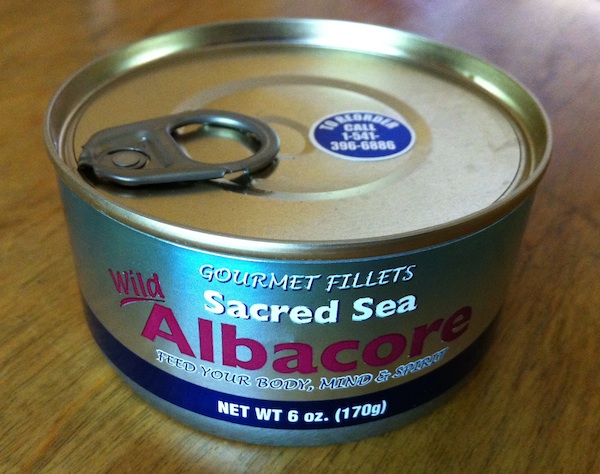
Good local brands to look for are Sweet Creek processed by Paul and Judy Fuller in Elmira, Oregon; Sacred Sea from the Goché family in Coquille; and Skipanon from the Kujala family of Warrenton.

Top photo from Wild Pacific Albacore. Read my article on the Oregon albacore fishery, which goes into more detail about how albacore is caught and processed.

Sunday, July 27, 2014

Get More For Your Money: Roast Those Carcasses!


Summer means that cooking moves outdoors, with electricity replaced by fire. Around here we're putting not just steaks and chickens on the grill but fish, usually whole salmon or tuna loins.

Whole albacore on sale.

Albacore season has just started and you'll see whole fish going on sale at supermarkets around town. Caught off our coastline, mostly by small family-owned boats using a pole-and-line method, the entire West Coast fishery has been certified as sustainable by the Marine Stewardship Council (MSC). These smaller fish (12-25 lbs.) are low in mercury and other toxins simply because they haven't spent as much time in the ocean environment as the larger, 40 to 60-lb. fish caught in the deep oceans, the ones that appear in cans on store shelves. (Read my story on Oregon albacore for more information.)

Roast that carcass, don't toss it.

So enjoy roasting those triangular loins, whether whole or sliced into steaks and seared on the outside, leaving the centers barely warm and still pink. But please, oh please, when you buy that whole fish, ask them to bag up the carcass, too, or you'll be throwing away two pounds or so of good meat, not to mention the stock you can make from the bones, fins and head (if you buy it with the head on).

Pick meat off the roasted carcass, then make stock with the bones.

And don't believe those charts meant for chefs that say the yield from a whole albacore, gutted and without the head, is 50% of the weight. From the 17-pound fish (head off) that I bought yesterday, my yield was more than 80% after removing the loins, roasting the carcass (350° for 30 min.), picking off the meat (nearly 2 lbs.!) and then making stock from the bones (2 1/2 qts.). The total weight of bones, fins and detritus that went into the compost bin was only two or three pounds. (Kind of tells you about the food waste that happens in restaurants, though, doesn't it?)

The flaked albacore from the bones will be going into salads, fish cakes, sandwiches and soups or chowders, and the stock is fabulous for paella, risottos, chowders, bouillabaisse, etc. So get the most for your money, roast those carcasses, and reap the delicious rewards!

Here's the blog post from my friend Hank Shaw that got me started roasting carcasses.

Monday, August 22, 2011

Oregon Albacore A to Z


With albacore season in full swing, it seemed like a good time to run this article, which I wrote last season for NW Palate magazine.

Wind off the ocean whipped through the rigging on his boat, and sea lions barked in the background as albacore tuna fisherman Rick Goché recalled growing up on Tillamook Bay on Oregon’s north coast.


“I’ve been fish crazy since I can remember,” he said. “When I was old enough to make my way down to the creek, I was fishing with a safety pin and a string. I can still remember when I got my first factory-made hook.”

Rick Goché's boat, the Peso II.

Goché grew up to be a fisherman; today, he fishes the Pacific Northwest’s deep, abundant waters, casting off from Coos Bay for two to six weeks at a time. It’s hard work, and definitely not child’s play. “When you’re a hundred, 200, 300 miles offshore, it’s not like you can duck into a port when the weather gets bad,” he says.

His brother, Larry (below right), fishes with him, and his son, his daughter, and his grandson have taken turns on the boat as well. He has hopes that his daughter Lauren, who will be working on tuna boat this summer, may eventually take up fishing as a career.

“Even though she won’t be on the boat,” he said, “it’ll be cool to be on the water with her.”

Larry Goché on board the Peso II.

The average age of a fishboat owner is 62 (Goché is 57—“I’m one of the young guys,” he says), and the industry has had trouble attracting younger people into a career that not only is dangerous but also requires hard physical labor and long periods away from home.

Another issue facing the industry is consumer awareness, a concern voiced by chef Eric Jenkins while he was handing out samples of hot-off-the-grill wild West Coast albacore outside a Portland-area Whole Foods market. “I’ve had a couple of people say they won’t eat fish because of the mercury,” he said.

It’s a sentiment echoed by Wayne Heikkila, a second-generation albacore fishboat owner and now executive director of the Western Fishboat Owners Association (WFOA). “[People] don’t know tuna from albacore, or skipjack from yellowtail.”

Unloading the albacore from the hold.

The tuna most of us grew up eating in casseroles and sandwiches was probably skipjack, which is caught on giant factory ships that operate in the deep, tropical oceans of the world and is sold under brand names like StarKist, Bumblebee, and Chicken of the Sea. Nearly all of those ships are longline fisheries, which tow a fishing line several miles long with thousands of hooks baited at regular intervals along its length. The problem with this method is that it produces significant bycatch—meaning that it also hooks endangered and threatened sea turtles, seabirds, marine mammals, sharks, and other fish besides skipjack.

The tuna caught in these deep waters are several years old and can weigh 40 to 60 pounds. They have absorbed mercury and other toxins, enough to cause the Food and Drug Administration and the Environmental Protection Agency to advise pregnant women, nursing mothers, and young children to limit their intake of the fish.

Those warnings have caused big headaches for the West Coast albacore industry.

That’s because the advisories don’t distinguish between the albacore caught in the deeper oceans and those younger and smaller tuna caught off the West Coast of the United States and Canada. Ranging in age from three to five years old and weighing 12 to 25 pounds, these younger albacore simply have not spent enough time in the ocean environment to contain the levels of mercury found in the larger, older fish.

Heikkila is frustrated that so much of the albacore caught off our own coast is exported to Japan for sushi, and that Northwest foodies would rather buy a can of albacore tuna from Spain (produced, ironically, from West Coast albacore that is exported to that country) than albacore caught and canned on their own coastline.

Fresh Oregon albacore just before it's sealed.

“We’re trying to get consumers to eat more of the local product,” Heikkila said. Approximately 16,000 to 23,000 tons of albacore are caught per year. “It’s crazy—we send 80% to 90% of it to other countries and then the U.S. consumer has to buy it from overseas. That money could go into local fishermen’s pockets.”

What’s more, Northwest consumers are generally unaware that these local fish are caught one at a time using what’s called a pole-and-line or troll-and-jig method. This approach employs 10 to 15 lines of nylon cord measuring six to 100 feet long that are towed behind a boat. Each line has a barbless “jig” or lure at the end that is attached to a double barbless hook. When a fish bites the jig, the fisherman hauls it by hand into the boat, allowing the fishermen to keep only “right-size” fish and eliminating bycatch.

The Goché's Sacred Sea brand albacore.

The U.S. and Canadian albacore fisheries in the North Pacific, made up of mostly small, family-owned boats like Rick Goché’s, received a boost last year when Seafood Watch, a program of the Monterey Bay Aquarium that evaluates the ecological sustainability of wild-caught and farmed seafood, listed U.S. and Canadian troll- and pole-caught albacore from the North Pacific as a “Best Choice” due to negligible bycatch and the healthy stock of albacore in the region.

But the biggest shift in public awareness may come from the recent announcement by the Marine Stewardship Council (MSC), which has certified the Canadian Highly Migratory Species Foundation (CHMSF), an albacore fishery of Canadian-based boats, and the U.S.-based WFOA as sustainable and well-managed.

“It’s a very rigorous, on-site process that looks at a fishery as opposed to a sweeping view of a species,” said Kerry Coughlin, the Regional Director for the Americas of the MSC. “It’s our view that’s how you get a very rigorous assessment process that’s accurate, and it’s how, in some cases where fisheries aren’t sustainable, you’re going to bring about change on the water.”

And when they see the blue MSC label (right) in their grocer’s seafood case or on a can of albacore, “consumers can have the assurance that it is an environmentally responsible choice,” Coughlin said. And, because they come from younger fish, the fresh loins of albacore available from July through October at most retailers contain more have more “puppy fat,” as an industry spokesperson called it.

“I think it’s moister,” Jenkins said. “It seems to have higher fat levels, particularly concentrated in the belly.” His suggestion to consumers buying a whole loin is to ask their butcher to keep the belly meat on, adding that many butchers either keep it for themselves even cut it out, which he considers a travesty.

Locally canned albacore would be almost as much of a shock to most shoppers. The major-brand tuna on their grocery shelves was caught and frozen at sea, then thawed at a cannery and cooked in big steamers, where it loses much of its natural juices and fats. It is then packed in cans and cooked again, requiring the addition of water or oil to keep it moist.

That contrasts with most local tuna, which is packed in cans when it’s fresh and cooked only once, sealing in the natural juices and not requiring the addition of oil or water to keep it moist.
Between MSC certification and a growing concern among consumers about where their food comes from, families that depend on the North Pacific albacore are seeing a brighter future for their children, and a way of life that they prize.

“On a boat, you have to have all your senses attuned to your boat and the fish and your gear, but what it comes down to is stay alive and fill up the boat,” said Rick Goché. “When I pull away from the dock and I cross the bar and I feel the ocean lifting the boat, I leave everything behind as much as possible. Sure, I miss my family, but I don’t miss all the complexities of being on land.”

Tuesday, January 04, 2011

14 Things I Love


If only there was an app for that: I'm talking about 100 Things We Love, the compilation of the year's best food, drink, books and places to fuel your next obsession, put together by the writers and contributors to the Oregonian's FoodDay section.

This year it covers everything from farmers' markets to pantry must-haves to bookshelf staples, and the editor was kind enough to include a few of mine:
It's always a great read, and I guarantee you'll discover things that you never knew existed. Now to get my in-house programmer working on that app…

Saturday, December 18, 2010

Crustacean Celebration: The Big Boys Weigh In


They were dubbed the three tenors of Portland chefs: Vitaly Paley, Philippe Boulot and Cory Schreiber. Think what you will of that moniker, but the dinner they orchestrated to celebrate the certification of Oregon's crab industry as sustainably managed by the Marine Stewardship Council (MSC) was a multi-layered symphony to our state crustacean. (OK, OK, enough with the musical metaphors.)

Crab and mushroom shepherd pie.

I received an invitation to the event the week before and couldn't say yes fast enough. It promised not only four courses reflecting the special place that the Dungeness crab, or Metacarcinus magister, holds in our state's food pantheon, but with wines to match from local wineries. See why I hit the reply button so quickly?

Like the certification received by the West Coast albacore fisheries earlier this year, which included tuna caught from California to British Columbia, the crab fishery as a whole, including crabbers and processors, was assessed against rigorous MSC standards. These included assessment of the stock, effect of the fishery on the ecosystem and the fishery management system. It's only one of five in the world to achieve this prestigious designation, and the only one of the five Dungeness fisheries on the west coast to be certified. Is that cool or what?

Ribeye with kale, black truffles and crab.

As for the dinner, it kicked off with a classic crab salad with plenty of shredded crab, grapefruit sections, lovely soft leaves of Oregon chicory and a sprinkling of pomegranate seeds (top photo). The wine was a stunning 2009 Pinot Blanc Estate from Bethel Heights, a spicy, full-bodied, lovely complement to the bright, sweet flavors of the salad, and to my mind the most memorable wine of the night.

The second course was a slightly disappointing crab and matsutake mushroom shepherd's pie, mostly because the crab and mushrooms were indistinguishable from the thick layer of mashed potatoes on top. A good idea, but the execution was lacking, and the Domaine Drouhin 2008 Chardonnay "Arthur" poured with it only confirmed my lack of excitement over the wines I've had from them.

Poached pear with pistachio panna cotta.

But the thick slice of medium rare Carman Ranch ribeye that came next, with a side of creamed kale and black truffle hollandaise and three intact hunks of crab leg on top, was to die for, especially paired with the Penner-Ash 2008 Willamette Valley Pinot Noir, a big-but-not-over-the-top, earthy mouthful. The fact that the crab wasn't the focus of the dish but was used as a garnish didn't bother me in the least and, to me, showed that Vitaly Paley has a sense of humor and isn't afraid to bend the rules. Good job!

Crab was noticeably absent but hardly missed in the dessert of poached seckel pear with a pistachio panna cotta perched on a salty, crunchy round of spice cookie, and the Adelsheim 2008 DeGlace of Pinot Noir was nice, but what I really craved was more of that pinot blanc from the first course. Though if at this point you're thinking, "Well, wah wah wah, Kathleen, too bad for you…" I wouldn't blame you, since over all this crab-filled performance piece deserved a standing O.

Check out this season's Crustacean Celebration series: Pasta with Crab and Radicchio, Deadly? I Think Not, and Let Them Eat Cakes. See also: last season's series starting with Hot Artichoke and Crab Dip (and links to other posts in the series).

Sunday, December 05, 2010

Crustacean Celebration: And They're Off!


I can't believe how excited I was for crab season to start this year. After last year's marathon Crustacean Celebration, the countdown to the start of the season was excruciating. Because of dickering over prices that crabbers would receive and conflicting results of test for something called meat fill, it was possible that the season could be delayed for as long as two weeks.

But when I went to the northern Oregon coastal town of Seaside on Thursday and stopped in at the shrine to crabbiness that is the Bell Buoy (left), they had freshly caught crabs aplenty. My friend Michel and I whipped up a fresh crab salad with some romaine, slivered fennel and a lemon vinaigrette and dove in. Supplemented by a loaf of Dave's wonderful homebaked sourdough and a glass (or two) of rosé, its sweet, slightly salty meatiness was the perfect, simple start to a season of indulgence.

I came back home to the news that the crabs had organized themselves into a group called the Dungeness Crab Commission and, in a stroke of brilliance, got themselves certified by none other than the Marine Stewardship Council (MSC) as a sustainably managed fishery. Meaning that it's one of only three crab fisheries in the world to put the MSC label (right) on its products, and the only one of the five Dungeness fisheries (CA, OR, WA, B.C., AK) along the West Coast to be certified. Those are some crazy smart crabs!*

I'd purchased two more whole crabs on the way out of Seaside, determined to whip up an appropriately crabby dinner for the troops at home. Pulling out a recipe from last year and, hewing to the original intent (i.e. keeping it crabby), I made a few modifications and was rewarded with the oohs and aahs of satisfied diners.

If you have favorite crab dishes that you put together for your troops (or even just yourself), please share them in the comments below. It's looking like we're in for another banner year!

Pasta with Crab and Radicchio
Adapted from Tyler Florence, the Food Network

2 Dungeness crabs, approx. 1 lb. each
1/4 c. extra-virgin olive oil
1/4 c. finely chopped shallots
2 Tbsp. finely minced garlic
2 whole Mexican hot red chiles
1 c. rosé
1 lb. pasta
1 small head radicchio, thinly sliced into chiffonade
Juice of 1 lemon, straining out the pulp and seeds
Finely grated parmesan or, for a nice change, extra-sharp cheddar for sprinkling

Bring 6 quarts water to boil and add 2 tablespoons salt.

Pull carapace off of cooked crabs (the large red outer shell). Under running water, clean off all the gills until you're left with the hard shell of the body beneath. I normally rinse out the "tamale" or ochre-colored bits that some people consider a delicacy (you can have them cleaned by your fishmonger if this is all too real). Remove the meat from the cleaned crab and collect in medium-sized bowl.

In a large sauté pan, heat the oil until smoking. Add the shallots, garlic and chiles and sauté until golden brown, about 4 to 5 minutes. Add the wine, bring to a boil. Cook the pasta in pot of boiling water according to the package instructions, until just al dente, and drain.

Remove the whole chiles from the wine sauce. Add the drained pasta to the pan with the wine mixture and return pan to heat. Add crab and radicchio and toss briefly until radicchio is slightly wilted, about 1 minute. Pour the lemon juice over the top. Pour into a warm serving bowl, sprinkle with the cheese and serve.

* Seriously, the Dungeness Crab Commission is an industry-funded agency tasked with "enhancing" the Dungeness crab industry.

Check out this season's Crustacean Celebration series: The Big Boys Weigh In, Deadly? I Think Not, Let Them Eat Cakes, Parallel Universe and last season's series starting with Hot Artichoke and Crab Dip (and links to other posts in the series).

Monday, March 29, 2010

Livin' in the Blurbs: Fishy Business

Today the Marine Stewardship Council (MSC) announced that two North Pacific albacore tuna fisheries have passed the rigorous process required to become certified as well-managed and sustainable. Tuna caught by the Canadian Highly Migratory Species Foundation (CHMSF) troll/jig fishery and the U.S.-based Western Fishboat Owners Association (WFOA) will now be able to carry the MSC label (left) on their products. Many of the families that belong to these fisheries are second and third generation fishers, and MSC certification means that their products will be sought out by the increasing number of consumers, restaurants and grocery outlets looking for sustainably caught fish. It may help assure that not only will the fish stocks they rely on be available for the foreseeable future, but that their livelihoods may survive for generations to come as well.

* * *

West coast troll and line-caught albacore tuna has also recently been listed as a "Best Choice" fish by the Monterey Bay Aquarium's Seafood Watch program, which advises consumers looking for seafood that is fished or farmed in ways that don’t harm the environment. While not requiring fisheries to go through the same rigorous certification process required by the MSC (above), their scientists do comb through government reports, journal articles and white papers, as well as contacting fishery and fish farm experts to develop an in-depth Seafood Watch Report which forms the basis for their recommendations. On the website you can check their latest recommendations, download a pocket guide or, better yet, download their iPhone app and impress everyone at the fish counter with your grooviness.

* * *

And, last but definitely not least, Trader Joe's has announced a goal to have all of their seafood purchases shift to sustainable sources by Dec. 31, 2012. The press release on the TJ's website states that "it is our intent to have this goal function as a seafood policy that addresses customer concerns including the issues of over fishing, destructive catch or production methods, and the importance of marine reserves." This follows on the heels of an announcement by Target in January that it has eliminated all farmed salmon from its fresh, frozen and smoked seafood offerings in Target stores nationwide. Great news not only for our oceans and future fish stocks, but for our dinner tables, too!

Sunday, November 16, 2008

You Take a Stick of Bamboo


You take a stick of bamboo,
You take a stick of bamboo,You take a stick of bamboo,You throw it in the water...

Peter, Paul and Mary may or may not have meant this song as a political statement, but it nicely encapsulates the philosophy behind the opening of Bamboo Sushi on SE 28th. Formerly a sushi restaurant called Masu East, it was the eastside outpost of downtown's Masu owned by partners Jeff Berback and Kris Lofgren.

Lofgren became increasingly concerned about the environmental and sustainable aspects of owning a sushi restaurant, where it's hard to find out how or where the fish is caught, much less the ripples its distribution may have on other species and the environment. He decided to buy out Berback and reopen as the first seafood restaurant in the United States to be certified as sustainable by the Marine Stewardship Council (MSC). Along with MSC, he is also partnering with other blue-chip organizations including the Monterey Bay Aquarium, Blue Ocean Institute and the Green Restaurant Association. Using the guidelines established by Blue Ocean Institute and Monterey Bay Aquarium, Bamboo says it will only serve seafood listed as "best choices" or "good alternatives."

So fine, you say, but how is the food? Well, at an event to showcase the menu for the media, it was both good and a little uneven. Overall, the sushi was excellent with some unusual (and tasty) combinations that you won't find at other sushi spots in town. The usuzukuri, made with thinly sliced whitefish, jalapenos, ponzu, green onions, tobiko and sesame seeds (photo, top), was a fresh take on a traditional dish, with salty and sweet flavors combining with the popping of the flying fish roe for a fun sensory experience. The hoki poke box (above left), sushi rice pressed with red crab salad and layered with tuna, avocado, green onion, togarashi and poke sauce, also had the traditional-with-a-twist thing going on, and the grilled kobe flank with sweet potato, sauteed garlic greens with bacon, pickled mushrooms and momiji sauce was amazing.

The unevenness came when the kitchen strayed from the Japanese theme, throwing in au courant items like panko-crusted goat cheese (above right), smoked cipollini onions and candied walnuts that begged a "Huh?" response.

But the most surprising thing was the desserts, which were actually quite good and worth ordering on their own. The adzuki filo (left, above), basically a red bean paste-filled empanada, was a crunchy, oozing delight and had a sweet potato-lime sorbet with a fence of raspberry poached pears, ideal complements to the empanada's sweetness. The chocolate "egg rolls" were chocolate pudding-filled pastry rolls that had been rolled in ginger sugar and served with candied ginger ice cream and seasonal fruit. Sensational on all counts.

Though Lofgren says they're working hard to keep their prices comparable to other spots in town, it is pricey so choosing wisely (and conservatively) might be the best policy, at least at first.

Details: Bamboo Sushi, 310 SE 28th Ave. Phone 503-232-5255.