Showing posts with label albacore. Show all posts

Tuesday, August 27, 2019

Buying Whole Fish (Plus a Hack for No-Hassle Freezing)


If you've been seeing ads from your grocery store or fishmonger offering whole fish for a fraction of the regular retail price but you're not sure how you'd use it, I've put together this handy guide.

There is nothing better, or better for you, than fresh, wild, local fish. Fish are packed with Omega-3 fatty acids, high in protein and low in saturated fat, and the American Heart Association advises eating fish twice a week. Trouble is, the usual price per pound for fresh fillets in the butcher case puts it out of reach for most budgets. Plus many commercially available ocean species can be high in mercury, and farm-raised fish are usually fed high doses of antibiotics—think of them as factory farms for finned creatures—due to the crowded pens they're raised in. And don't get me started on the effects of these farms on our waterways.

Albacore swims just off our coastline.

But those of us on the West Coast are fortunate to have access to some of the most delicious wild fish on the planet in our populations of native wild albacore and salmon. This year the fleet of primarily family-owned boats have been pulling in a supply of albacore from the fishery that stretches from Northern California up into British Columbia. Certified as sustainable by the Marine Stewardship Council, these albacore are young—just three to five years old, low in mercury and weighing in at 12 to 25 pounds—and individually caught with a hook-and-line system. (Want more info? Read my post, Albacore A to Z, for details.)

Coho spawning in Tillamook State Forest.

Wild salmon, particularly from Alaskan waters, are in plentiful supply right now, too, with stores advertising tempting steaks, fillets and roasts. But if you want to get a real deal, look for special sales events featuring whole fish.

"Whole fish?" you say. "I don't even know where to start with a whole fish!"

Well, let's talk about where you buy it. Make sure the fishmonger is a reputable source—recent studies have found that almost 20% of fish sold to consumers are mislabeled, and fish ordered at restaurants are more likely to be incorrectly labeled than fish bought at markets or grocery stores. I recently bought two whole albacore and two whole Coho salmon at New Seasons Market, a regional chain that buys its whole fish from local boats and has several one or two-day sales events per season.

Whole albacore loins ready to freeze.

When you buy whole fish, you'll need to specify how you want it packaged. The fish are already cleaned, and most stores will butcher your fish at no charge, whether you want steaks or roasts or whole fillets. I always ask for the trimmings to be included, since the head, fins and bones make amazing stock for soups, chowders, risottos and paella, among many other uses. (Here's my technique for using those trimmings.)

Making stock is simple: put fish in pot, add water.

And don't believe those charts meant for chefs that say the yield from a whole albacore, gutted and without the head, is 50 percent of the weight. From the 17-pound fish (head off) that I bought, my yield was more than 80 percent after removing the loins, roasting the carcass (350° for 30 min.), picking off the meat (nearly 2 lbs.) and then making stock from the bones (2 1/2 qts.). The total weight of bones, fins and detritus that went into the compost bin was only two or three pounds. (Kind of tells you about the food waste that happens in restaurants, though, doesn't it?)

Coho fillet ready to freeze.

If you're not going to throw the fish on the grill right away—never a bad idea, but just one good-sized fillet will feed four to six—you'll also need to think about how you want to store it. With a vacuum sealer it's a done deal, since properly packaged fish will keep for as long as a year. The idea is to keep air away from the meat to prevent freezer burn, so if you don't have a vacuum sealer, what do you do?

I quizzed the fellow at the fish counter when I bought my salmon, and he said that his dad, an avid fisherman, would put a single fillet in a zip-lock bag and submerge it in a sink full of water, holding the closure just above the water line. The water pressure pushes the air out, making an airtight seal around the fish. Not having a sealing machine myself, a little smoothing of the wrinkles in the bag while it was underwater did almost as good a job as the machine. (I found that a two-gallon zip-lock bag will hold a good-sized fillet quite nicely.)

Note: Pull those pinbones!

A note: it's good to go over your fish to check for pinbones or other bones that the butchers may have missed. First, it makes it easier to just throw it on the grill without worrying about biting down on one while you're eating and, second, it keeps those pokey bones from puncturing the bag and letting air in. Just hold the fillet and feel for any bones by running your fingers down the flesh, then use a pair of (clean) needle nose pliers to pull out the bones.

All this is to say that you can have more fresh, local, sustainable fish in your diet without paying dearly for the privilege. As the old commercial used to say, "Try it, you'll like it!"

For fabulous salmon recipes, click here.

For to-die-for albacore recipes, click here.

Tuesday, August 07, 2018

Tapas Tips: Albacore-Stuffed Piquillo Peppers


I was torn. Vacillating. Perplexed, even. My brother was making his first paella on the grill for a group of friends and he'd asked the invited guests to contribute a tapa to serve before the main event.

Bruce working the grill like a boss.

Like visions of sugarplums, the many possibilities danced through my head. Mussels or clams with chorizo in a broth of rosé? A classic potato-and-egg tortilla Española? Maybe deviled eggs with anchovy-stuffed green olives? Or how about those fab albacore-and-caper-filled piquillo peppers I'd made for a previous gathering at his place?

See what I mean? A veritable embarrassment of riches to choose from, especially at the height of the summer harvest season. What to do?

A masterpiece!

That's when I happened to read my friend Cynthia Nims's ode to her favorite egg salad, a mint-and-egg combo with green onion, olive oil and lemon juice as the only additions. So I thought to myself, what about combining flaked albacore with chopped hard-boiled egg, the aforementioned green olives, and throw in some green onion and a drizzle of olive oil, then using that to fill what are rapidly becoming my favorite roasted peppers? (Piquillos, in case I lost you back there.)

The result? Turned out to be what may be, at least until I try Cynthia's version, my new favorite egg salad!

Piquillo Peppers Stuffed With Albacore, Hardboiled Eggs and Olives

12 roasted piquillo peppers, drained and patted dry
6.5 oz. albacore tuna (I like the no-salt, line-caught Sweet Creek Foods in its own juice)
10 anchovy-stuffed Spanish olives, finely chopped
2 hard-boiled eggs, finely chopped
1 Tbsp. slivered green onions (green part only)
2 cloves garlic (pressed in a garlic press or smashed with a knife and minced)
2 Tbsp. parsley, finely chopped
1 Tbsp. olive oil
Salt to taste

Flake the tuna and add its juice in a medium-sized mixing bowl. Add remaining ingredients and mix well. Add more olive oil to help bind it if necessary. Add salt to taste. Using a fork, fill peppers with the tuna mixture but don't overstuff.

This makes a great sandwich, too, if you have leftover filling. Just mix in some finely chopped piquillo peppers, a dollop of mayonnaise to moisten, and enjoy!

Check out this recipe for a mildly piquant piquillo pepper sauce. And here's my recipe for an easy paella on the grill.

Saturday, August 08, 2015

Buying Whole Fish: Don't Be Afraid!


When you see a price like $5.99 per pound for albacore, our West Coast version of filet mignon, it's hard not to start drooling. But then you realize that's for a whole fish, which average 12 to 14 pounds. It's not only a little intimidating to think about what in the heck you'd do with that much fish flesh, but it can also be a drain on your bank account.

Tuna confit.

But here's the thing: When you consider that albacore normally sells for twelve bucks and up per pound, buying the whole fish makes a lot of sense from the perspective of your wallet. The store will filet the fish for you, removing the loins (four per fish) from the skeleton. To get even more value from your fish, ask the butcher to package the bones and scraps separately, which may have as much as a couple pounds of flesh still clinging to it.

Smoked albacore.

When you get the fish home, you have several choices: you can fire up the grill or the oven and roast one of those loins for dinner. The other three loins can go in the freezer for another day—they'll be good for several months if they're well-wrapped to eliminate any air getting to the fish. You can also confit one of the loins (recipe below), a quick process that will make any canned fish you've had pale by comparison. Or if you have a smoker, I can personally testify as to the deliciousness of smoked albacore, which also happens to keep quite nicely in the freezer.

Roasting the carcass.

That skeleton can be tossed in a big pot of water and simmered for an hour or so, giving you quarts of amazing fish stock (again, keeps for months in the freezer). Or you can put the carcass in a roasting pan at 400° for a half hour or so till the meat is cooked through, then cool it slightly until you can pull the meat off the bones. This results in a surprising amount of fantastic tuna that you can use in salads, sandwiches, a tuna "schmear" or dip—go crazy, there'll be lots!

Albacore, grain and vegetable salad.

To gild the lily, not that it needs it, West Coast albacore, because the fish are young when they're caught and haven't lived in the ocean that long, are extremely low in mercury and are perfectly safe to eat for young and old alike. They're high in omega-3 fatty acids, complete proteins, selenium and vitamin B-12, all shown to be beneficial for health. Not to mention that the fishery off our coast has gone through a rigorous certification process and has been certified as sustainable by the Marine Stewardship Council (MSC).

Also know that almost all the boats in our coastal fleets are owned by individual families, so the more albacore you buy (and enjoy) the healthier and more sustainable our coastal fishing communities will be. So the next time you see that there's a big sale on whole fish, buy one for your family or to share among a group of friends. You won't be sorry!

Albacore Tuna Confit

1 skinless tuna loin
2 tsp. kosher salt
1/4 tsp. sugar
1/2 tsp. red chili flakes
1 tsp. dried thyme
4 cloves garlic, peeled and crushed in a garlic press
Zest of 1/2 lemon
3-4 c. decent quality olive oil

Cut trimmed loin in four pieces. In a shallow pan, mix salt, chili flakes, thyme, garlic and lemon zest. Roll tuna pieces in the spice mixture, making sure to cover all surfaces (this doesn't have to be thick, it's just a rub). Place in dish on counter for at least a couple of hours or covered in the fridge if you're marinating it longer.

Place fish pieces in a saucepan and cover with oil. Put over very low heat and, using an instant-read thermometer, very slowly raise the temperature to between 140-150° (fast heating will cause the surface to seize and it will turn out dry rather than moist and tender). Maintain temperature for three to ten minutes, or until the center of the thickest piece is almost cooked through. (You can use a fork or knife for this purpose.) Turn off heat and allow the oil to cool. Remove fish from oil. Strain remaining oil through a fine mesh sieve.

If you're not using all the fish right away, place it in a container that has a tight-fitting lid. Cover the fish with the strained oil and seal. It will keep in the fridge in its oil for a couple of weeks. Any remaining oil can be used for dressings or other purposes—it has a fantastic flavor!

For more information on Oregon albacore, read Oregon Albacore A to Z.

Thursday, January 29, 2015

Chuck Charlie: A Life-Changing Tuna Recipe


Sorry to re-use a headline—c'mon, it was from 2009—but in this case it applies in spades. This recipe for tuna, Oregon albacore, actually, is so good you may never buy the canned stuff again. And I hate to say it, but even the locally processed, line and pole-caught stuff in jars can't hold a candle to its silky moistness.

I'll admit that the beginnings of this one particular piece of fish weren't all that pretty. We always try to buy a whole albacore when it goes on sale at the beginning of the season, but at some point in the past I forgot to write the purchase date on the packages containing the loins. Apparently this particular loin had been buried in the freezer for a year-and-a-half or so, and by the time I pulled it out and thawed it, I saw the damage…freezer burn on most of the surfaces. Figuring I had nothing to lose at this point, I started shaving off the burned bits, thankfully revealing the lovely pink flesh below. Whew!

A whole loin is about two pounds of fish, so after cutting it in four chunks, I rolled it in some herbs, garlic and salt and put it in a dish on the counter to marinate for a couple of hours. Then all it took was transfering the pieces to a saucepan and pouring in a decent-but-inexpensive olive oil to cover.

The next part was critical, though…you want to heat the oil sloooooooooowly. Apparently if the oil is heated too quickly, the surface of the fish seizes and the flesh turns out dry and hard like you often find in canned tuna. But cooked properly, it's terrific on its own as a tapas-style appetizer, or it can be mixed with pasta and grains for a stunning main dish. You could also make it into what will be the most amazing tuna sandwich you've ever had. Use your imagination!

Albacore Tuna Confit

1 tuna loin, trimmed of blood line and skin
2 tsp. kosher salt
1/4 tsp. sugar
1/2 tsp. red chili flakes
1 tsp. dried thyme
4 cloves garlic, peeled and crushed in a garlic press
Zest of 1/2 lemon
3-4 c. decent quality olive oil

Cut trimmed loin in four pieces. In a shallow pan, mix salt, chili flakes, thyme, garlic and lemon zest. Roll tuna pieces in the spice mixture, making sure to cover all surfaces (this doesn't have to be thick, it's just a rub). Place in dish on counter for at least a couple of hours or covered in the fridge if you're marinating it longer.

Place fish pieces in a saucepan and cover with oil. Put over very low heat and, using an instant-read thermometer, slowly raise the temperature to between 140-150°. Maintain temperature for three to ten minutes, or until the center of the thickest piece is almost cooked through. (You can use a fork or knife for this purpose.) Turn off heat and allow the oil to cool. Remove fish from oil. Strain remaining oil through a fine mesh sieve.

If you're not using all the fish right away, place it in a container that has a tight-fitting lid. Cover the fish with the strained oil and seal. It will keep in the fridge in its oil for a couple of weeks. Any remaining oil can be used for dressings or other purposes—it has a fantastic flavor!

For more information on Oregon albacore, read "Oregon Albacore A to Z."

Monday, August 11, 2014

In Season & Delicious: Albacore, Sweet Onion & Potato Salad


Contributor Jim Dixon of Real Good Food shares his recipe for a main dish potato salad. I can say it's definitely going to be making an appearance on our dinner table soon!

Oregon albacore tuna is in the markets right now, and so are Walla Walla Sweets. And they taste great together in this potato salad. Have your fish monger cut the skin from an albacore filet (annoyingly called a "loin") and slice the fish into steaks about an inch and a half thick. Warm about a quarter cup of extra virgin olive oil in a skillet over low heat and gently poach the fish, turning frequently, for about 10 minutes. When the tuna turns white, turn off the heat, cover the pan and let it sit for about 20 minutes.


Steam or boil 2 or 3 yellow potatoes; when easily pierced with a knife, let cool and peel. Cut in to bite-sized pieces, place in a large bowl, and toss with about 2 tablespoons of Katz Viognier Honey vinegar. Thinly slice a Walla Walla sweet onion and add it along with the poached tuna and the olive oil used for poaching. Pick the leaves from 6 or 7 parsley sprigs and chop. If you have any in your garden, chop about the about the same amount of lemon verbena leaves; if you can't find verbena, use fresh mint.


Soak a couple of tablespoons of Pantellerian capers* in cold water for 10 minutes, then drain and chop. Add the capers and herbs, along with a good pinch or two of dried Pantellerian oregano*, to the tuna, onion, and potatoes. Drizzle with a little more extra virgin if you feel like it, sprinkle on some flor de sal, grind in a little black pepper, and eat.

* These products from an island off the coast of Sicily can be substituted with regular capers and oregano. For the real deal, though, go to the Real Good Food website for purchasing details.

Sunday, July 27, 2014

Get More For Your Money: Roast Those Carcasses!


Summer means that cooking moves outdoors, with electricity replaced by fire. Around here we're putting not just steaks and chickens on the grill but fish, usually whole salmon or tuna loins.

Whole albacore on sale.

Albacore season has just started and you'll see whole fish going on sale at supermarkets around town. Caught off our coastline, mostly by small family-owned boats using a pole-and-line method, the entire West Coast fishery has been certified as sustainable by the Marine Stewardship Council (MSC). These smaller fish (12-25 lbs.) are low in mercury and other toxins simply because they haven't spent as much time in the ocean environment as the larger, 40 to 60-lb. fish caught in the deep oceans, the ones that appear in cans on store shelves. (Read my story on Oregon albacore for more information.)

Roast that carcass, don't toss it.

So enjoy roasting those triangular loins, whether whole or sliced into steaks and seared on the outside, leaving the centers barely warm and still pink. But please, oh please, when you buy that whole fish, ask them to bag up the carcass, too, or you'll be throwing away two pounds or so of good meat, not to mention the stock you can make from the bones, fins and head (if you buy it with the head on).

Pick meat off the roasted carcass, then make stock with the bones.

And don't believe those charts meant for chefs that say the yield from a whole albacore, gutted and without the head, is 50% of the weight. From the 17-pound fish (head off) that I bought yesterday, my yield was more than 80% after removing the loins, roasting the carcass (350° for 30 min.), picking off the meat (nearly 2 lbs.!) and then making stock from the bones (2 1/2 qts.). The total weight of bones, fins and detritus that went into the compost bin was only two or three pounds. (Kind of tells you about the food waste that happens in restaurants, though, doesn't it?)

The flaked albacore from the bones will be going into salads, fish cakes, sandwiches and soups or chowders, and the stock is fabulous for paella, risottos, chowders, bouillabaisse, etc. So get the most for your money, roast those carcasses, and reap the delicious rewards!

Here's the blog post from my friend Hank Shaw that got me started roasting carcasses.

Saturday, March 01, 2014

Fritter Chronicles: Tuna or Kale, It's All Good!


Contributor Jim Dixon of Real Good Food is a fritter fanatic, and he's back on track sharing his recipes for some phenomenal fritter satisfaction.

Sicilian Fritters with Oregon Albacore (Polpette di Tonno con Fiore di Finocchio)

These small tuna won’t be running for another 6 months, but Oregon albacore in a can or jar* is in season all year. Buy it canned in its own juice (and don’t drain it off!). If you can’t find any at your favorite market, order directly from the folks who catch it. In Sicily a mix of tuna and swordfish often goes into these, but they’re great with just the canned albacore.

At the fish market in Palermo.

Dump the fish and the juices in the can into a bowl and flake it with a fork. For each can of fish (typically 6-7 ounces), mix in an egg, a chopped shallot, about a tablespoon of bread crumbs, pinch of salt, and a teaspoon or so of fennel pollen (fiore, flower, in Italian). If the mixture seems dry, add another egg.

Use two soup spoons to form walnut-sized “meatballs.” I make mine more flat than round, but only because it’s a little easier than rolling them into balls. Pan fry in extra virgin olive oil until brown. Traditionally served in a simple tomato sauce, they’re pretty good plain.

* Sweet Creek Foods also has Oregon albacore, and is available at New Seasons and other markets.

Kale Fritters

These are the best thing to do with leftover cooked vegetables of any kind. But it's also pretty easy to drop a bunch of greens in a pot of boiling water. Any of the leafy kales—green, red, or Italian—work well, but I prefer the Italian for both flavor and texture. Drop a bunch into a pot of salted water and cook for about 5 minutes (or microwave for a few minutes). You want the kale wilted and partially cooked.

Kale fritters frying in olive oil.

Chop the kale into small pieces, the stem ends even smaller than the leafy ends. Use the whole stem, but make sure the thicker pieces are chopped small. You can do it in the processor, but I think the hand-cut texture is much better.

Combine the chopped kale in bowl with about a quarter cup of breadcrumbs, roughly the same amount of grated Parmigiano Reggiano cheese, 2-3 cloves of minced garlic, a nice pinch of salt and a couple of eggs. Mix well, then see if you can form a small, walnut-sized fritter using two soup spoons. If it won’t hold together, add another egg or two (and if it’s really soupy, more breadcrumbs).

Use the two spoons (the classic quenelle technique) to make the fritters, sliding each into hot extra virgin olive oil as you make it. Gently flatten each fritter, cook over medium until nicely browned, then flip and cook the other side. Sprinkle with flor de sal after they come out of the pan. These are good hot or cold, and they reheat in a skillet nicely. A little Crystal hot sauce is a nice touch.

Wednesday, September 12, 2012

Food Farmer Earth: Fillet Tuna Like a Master


In this video, a bonus feature from my interview for Food Farmer Earth with Mark Kujala of Skipanon Brand Seafood, watch Skipanon's Shirley Tischer demonstrate how an expert fillets a tuna. Wow!

Food Farmer Earth: A Small Cannery, a Community's Pride


For much of the last century, fishing was a secure livelihood for the people of Oregon's coastal towns, but in the 70s the industry crashed. Tiny Skipanon Brand Seafood survived because Mark Kujala and his family built a microcannery and began marketing their canned fish themselves. My interview for Food Farmer Earth tells their story.

It’s amazing to imagine what it must have been like to walk along the docks of Oregon’s small coastal towns like Astoria and Warrenton in the first half of the twentieth century. Hundreds of fishing boats would chug into port after spending weeks at sea, their holds full of salmon, tuna and sturgeon. They’d tie up next to the thirty or so canneries that lined the waterfronts and unload their catches, the air filled with the shouting of dock workers and the cry of seabirds looking to scoop up any scraps.

In the 1970s, Oregon’s coastal fishing industry, consisting for the most part of small, family-owned boats, was being devastated by the rise of large foreign fleets competing for ever-decreasing stocks. Seeing the industry changing and the big canneries moving out or closing, Warrenton fisherman Norman Kujala adapted by building his own cannery on the banks of the Skipanon River in 1978.

Skipanon Brand Seafood is now run by the second generation of the Kujala family, including Paul, who fishes for salmon on the family boat called the Cape Windy, and Mark, who runs the cannery and oversees the processing of salmon, sturgeon and albacore…

Read the rest of my story about the Kujalas and Skipanon, then watch Skipanon's Shirley Tischer demonstrate how to fillet a tuna…amazing!

In this week's cooking segment, you can learn to can your own fish (in this case sardines) at home using a pressure canner. To find out more about this series of interviews with local food producers, and to get some terrific recipes featuring the ingredients discussed, consider a free subscription. 

Saturday, August 11, 2012

Livin' in the Blurbs: Two Books and Some Fish

There aren't many events where eating wodges of meat coincides with a book-signing—pristine pages dotted with blood and meat juice spring to mind—but Oregon writer Lynne Curry, author of the newly released cookbook "Pure Beef,"is going to do just that. Along with her friend and fellow author Cheryl Sternman Rule and the transcendent talents of chef Anthony Cafiero, she's putting on what's promised to be an omnivorous evening comprised of dishes from her book and "Ripe,"Rule's compendium of cooking with fresh, local fruits and vegetables. (You may know Rule from her award-winning blog, 5 Second Rule or the writing she's done for national publications.) In any case, this meal is going to be one you won't forget, whether or not you end up dripping on those pristine pages.

Details: Three-Course Dinner with authors Lynne Curry and Cheryl Sternman Rule and chef Anthony Cafiero. Thurs., Aug. 23, 6-9 pm; $75 in advance, tickets available online. Dinner to be held in ChefStable private dining room, 1223 SW Washington St. 541-263-0347.

* * *

There are few things that go together better than cake and champagne, and both will be in abundance at the celebration of the release of Julie Richardson's new book, "Vintage Cakes."Co-founder with husband Matt of that palace of pastry pleasures, Baker & Spice in Multnomah Village, this to-be-classic contains timeless recipes for cupcakes, flips, rolls, layer, angel, bundt, chiffon and icebox cakes for today's sweet tooth. I'm a huge fan of her first book, "Rustic Fruit Desserts,"which vies with a couple of other fave cooking tomes on my shelf for the honor of most well-thumbed. As if you needed more than cake and champagne to draw you in, they'll also be offering 20% off the cover price of both books at the event.

Details: Champagne, Cake and Book Signing for Vintage Cakes by Julie Richardson. Thurs., Aug. 16, 6-8 pm; free. Sweetwares, 6306 SW Capitol Hwy. 503-546-3737.

* * *

Not to change the subject too abruptly, but there's another event you won't want to miss, and that's the annual "truckload o' albacore sale" at Whole Foods. This year it's called the Dog Days of Summer Street Fair and is happening at the new Hollywood location on Saturday, Aug. 18. You'll have the opportunity to buy whole albacore fish as well as precut loins, plus they'll be offering grilled albacore and Hatch chiles as a benefit for Oregon's pet food bank, the Pongo Fund. To make the "street fair" descriptor complete, there will be artisans from Handmade NW, some favorite vendors, neighborhood pet services and live music, too. The price for the whole albacore will be an amazing $3.99 per pound, with precut loins selling for just $7.99 per pound, so get there early for the best selection!

Details: Dog Days of Summer Street Fair at Hollywood Whole Foods Market. Sat., Aug. 18; truckload sale starts at 9 am, street fair from 10 am-2 pm. Hollywood Whole Foods Market, 4301 Northeast Sandy Blvd. on 43rd Ave. between Sandy and Tillamook Sts. 503-284-2644.

Monday, February 20, 2012

A Hungry Traveler in Palermo


A good travel experience requires having a good appetite, and contributor Jim Dixon of RealGoodFood is a sterling example of someone who knows how to travel well. A fritter aficionado, he couldn't resist when he came across a vendor with some fresh fried bits at a market in Palermo.

We only spent a few days in Palermo at the end of our trip last fall, and we were surprised how much we liked it. We stayed in a small hotel called Palazzo Pantaleo in the heart of the old city, so we could walk everywhere. La Vucceria, Palermo’s most well-known street market, has devolved into a tourist trap full of cheap junk, but there are a few others that primarily serve the Palermitani.

One is Il Capo (above), a few blocks from the Teatro Massimo (left). Known for its seafood stalls, the market stretches for several blocks through the narrow streets. Without a kitchen, I couldn’t buy much, but one of the fish vendors had cooked a few things from the day’s catch, and I munched on tuna meatballs sort of like these.

Polpette di Tonno con Fiore di Finocchio

Basically fish fritters, I make mine with leftover cooked albacore if I can, but good canned tuna works just as well. Buy local Pacific albacore canned in its own juice (and don’t drain it off!).

Flake the fish in a bowl. For each cup or so of fish (roughly a can’s worth), mix in an egg, a chopped shallot, about a tablepoon of bread crumbs, pinch of salt, and a teaspoon or so of fennel pollen (the Tuscans call it fiore, flower).

Use two soup spoons to form walnut-sized “meatballs.” I make mine more flat than round, but only because it’s a little easier than rolling them into balls in my hands. Your choice. Pan fry in extra virgin olive oil until brown.

These are good plain but also nice in a simple tomato sauce.

Photos by Jim Dixon of RealGoodFood.

Monday, September 05, 2011

Travels with Chili: Astoria Redux


I can't say it was better than our Fourth of July camping trip that featured the 14 Dozen Raw Oysters Throwdown (which we demolished, by the way). But when you get a weekend in Astoria that includes a room that may well have one of the most spectacular river views ever, and then get to have fresh-off-the-boat Oregon albacore prepared by the best chefs in town, well, that makes for a pretty memorable getaway.

The room was in the Cannery Pier Hotel which, unlike most hotels with "pier" in the name, is actually built on…yes…a pier sticking out into the Columbia River. As a matter of fact, the balcony of our first-floor room was just a few feet above the water that lapped the pilings supporting the building. The first morning as I stood in my plush hotel-supplied robe drinking a cup of coffee, a giant container ship chugged past a few dozen yards away, an awesome sight when you're just waking up, let me tell you.

In another unusual twist, the bathroom had a claw-foot bathtub discreetly placed behind a cutout in the bathroom wall, allowing the bather a view of the Astoria-Megler Bridge that soars over the hotel (top photo). And for those who prefer to let someone else do the driving, the hotel sports three 40s and 50s-era cars whose driver is happy to squire passengers around town.

On arrival the first afternoon we were desperately in need of some snackage, and found the Bridgewater Bistro conveniently situated on the waterfront next to the hotel. Though we were a little early for happy hour, the big barn-like space and deck with views of the water had a promising small plates menu that was perfect for our needs.

With a beer for Dave and wine for me, we ordered their calamari, boquerones of local anchovies and the oyster sampler. The oysters (above right) were local Willapa Bays, served as shooters with vodka cocktail sauce, smoked (on slaw) and in the shell with a crazy Bloody Mary sorbet. Though I'm not a big fan of mignonette or sauce with my raw oysters, the tomatoey, spicy sorbet complemented the flavor and creamy freshness of the oysters perfectly, and I'm going to be trying to recreate it here at home.

After a quick nap and some claw foot bath action, we decided to walk the mile or so downtown to Clementes where we were meeting our tour group for dinner. It was a clear, balmy evening and the half-hour stroll along the waterfront promenade was just the right preamble (no pun intended) to our dinner.

Gordon and Lisa Clement owned a nearby chowder restaurant and felt there was a need, as well as a market, for a dinner place in Astoria that featured local seafood and organic produce. They began working with area farmers and fishermen to develop their menu, which not only means everything is fresh but also seasonal, a nice fit with Gordon's love of Italian cuisine. He also has a deft hand when it comes to seafood and understands how to make the most of it while doing the least to it, as exemplified by the amazing albacore carpaccio with blood orange infused olive oil (left).

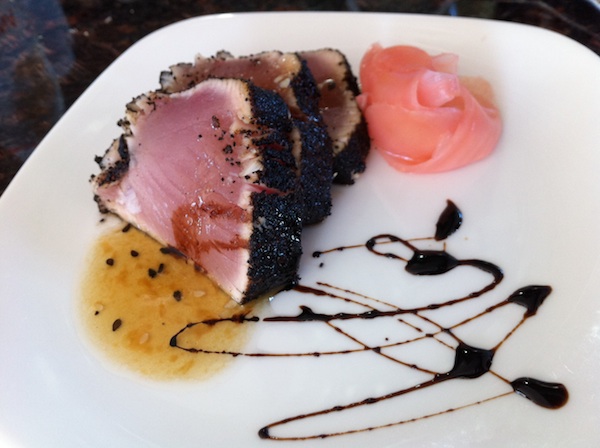
Another chef, Christopher Holen of Baked Alaska, demonstrated his love of local albacore and a bit of his native Alaskan bravado the next day with a dish called Thundermuck Tuna. It's basically a tuna loin dusted with locally roasted coffee grounds, seared rare and served with a honey ginger sesame sauce, balsamic reduction and pickled ginger. Not everyone's cup of tea (or coffee, as the case may be), but certainly original.

At that demonstration we also got a taste of a special lager brewed for Astoria's 200th birthday, a Pre-Prohibition 1811 Lager from Fort George Brewing, presented by affable head brewer Spencer Gotter. A light and refreshing beer with a nice backbone of flavor, he was excited to let us know that it was going to be appearing in stores soon…in cans! For those of you who haven't heard, cans are the new container of choice for many brewers, the technology having vastly improved over the tinny-tasting nastiness that most of us remember.

The one place we didn't make it to was the Blue Scorcher Bakery, a collective business that shares a building with Fort George. It apparently features a wide range of stunning breads and pastries, but it's developing a niche in gluten-free circles for weekly Gluten-Free Fridays with tasty pastries and lunches. Which gives us more than enough reason to go back, hopefully soon!

Wednesday, August 24, 2011

Smokin' Fish


We are firm Craigslist devotées. In addition to buying our living room furniture, teak outdoor dining table and some of my most prized pieces of Bauer ware from it, we've managed to sell some of the crap…I mean…hard-to-part-with and probably valuable items that were stacked in our basement for way more money and with way less pain than having a garage sale.

One of our best purchases, though, was the practically brand new and ridiculously cheap Weber Smokey Mountain (left) that has provided bellies-full of brisket, ribs, pork belly and pernil for the last couple of years.

So with albacore season in full swing, it was time to dive into the deep end and smoke some fish. West Coast albacore makes a perfect candidate with its high fat content and meaty texture. Plus, as opposed to pork belly which takes a solid week to cure and a full day to smoke, a loin of fish takes less than an afternoon to produce a bounty of toothy, tender and totally mouth-watering smoky deliciousness.

If you're spending any time at all at the coast, or just want an excuse to make a day trip over there, stop in at the local fish processing plant and pick up a loin or two. Or heck, even buy the whole thing and have them cut it up for you. Then you can freeze a couple of loins and smoke the other two!

Smoked Albacore Loin
Adapted from a Jan. '08 forum post on Sportfishermen.com by Andaman Andy

For the brine:
1 gal. water, room temperature
2 c. salt
1 c. brown sugar
1/3 c. lemon juice
1 Tbsp. garlic powder
2 tsp. white pepper

2 albacore loins (3-4 lbs.)

For the brine, mix all ingredients until everything is dissolved. (Dave made about 1 1/2 batches of brine to cover all the fish.)

Cut the loins into 4" chunks for ease of submerging and later handling. Put the fish into a container large enough to allow the fish to be completely submerged but not piled on top of each other. (Dave used two Pyrex baking pans for two loins.)

Pour the mixture over the fish so it's completely submerged. Cover with plastic wrap and chill in the refrigerator for 30 minutes to an hour.

After brining rinse the fish quickly under cold water. Pat dry and place the fish on a lightly oiled wire rack elevated on a tray. (Dave mentioned that the forum post said to place the racks in front of a fan in a place where flies and pets can't get at it.) This is intended to allow a  thin glaze ("pellicle") to develop; it's supposed to be a little sticky, and it helps the fish maintain moisture and allow smoke to adhere to the fish. We just put the tray into the refrigerator to wait for the pellicle.

Dave removed the fish from the refrigerator after about 1 1/2 to 2 hours, but he felt that may have been a little early.

Put the fish onto the cleaned and well-oiled grate of a smoker at 180-200 degrees. The fish is done when you can flake it easily with a fork and the internal temperature reaches 140 degrees. (Ours took about 1 1/2-2 hours to be done.)

Monday, August 22, 2011

Oregon Albacore A to Z


With albacore season in full swing, it seemed like a good time to run this article, which I wrote last season for NW Palate magazine.

Wind off the ocean whipped through the rigging on his boat, and sea lions barked in the background as albacore tuna fisherman Rick Goché recalled growing up on Tillamook Bay on Oregon’s north coast.


“I’ve been fish crazy since I can remember,” he said. “When I was old enough to make my way down to the creek, I was fishing with a safety pin and a string. I can still remember when I got my first factory-made hook.”

Rick Goché's boat, the Peso II.

Goché grew up to be a fisherman; today, he fishes the Pacific Northwest’s deep, abundant waters, casting off from Coos Bay for two to six weeks at a time. It’s hard work, and definitely not child’s play. “When you’re a hundred, 200, 300 miles offshore, it’s not like you can duck into a port when the weather gets bad,” he says.

His brother, Larry (below right), fishes with him, and his son, his daughter, and his grandson have taken turns on the boat as well. He has hopes that his daughter Lauren, who will be working on tuna boat this summer, may eventually take up fishing as a career.

“Even though she won’t be on the boat,” he said, “it’ll be cool to be on the water with her.”

Larry Goché on board the Peso II.

The average age of a fishboat owner is 62 (Goché is 57—“I’m one of the young guys,” he says), and the industry has had trouble attracting younger people into a career that not only is dangerous but also requires hard physical labor and long periods away from home.

Another issue facing the industry is consumer awareness, a concern voiced by chef Eric Jenkins while he was handing out samples of hot-off-the-grill wild West Coast albacore outside a Portland-area Whole Foods market. “I’ve had a couple of people say they won’t eat fish because of the mercury,” he said.

It’s a sentiment echoed by Wayne Heikkila, a second-generation albacore fishboat owner and now executive director of the Western Fishboat Owners Association (WFOA). “[People] don’t know tuna from albacore, or skipjack from yellowtail.”

Unloading the albacore from the hold.

The tuna most of us grew up eating in casseroles and sandwiches was probably skipjack, which is caught on giant factory ships that operate in the deep, tropical oceans of the world and is sold under brand names like StarKist, Bumblebee, and Chicken of the Sea. Nearly all of those ships are longline fisheries, which tow a fishing line several miles long with thousands of hooks baited at regular intervals along its length. The problem with this method is that it produces significant bycatch—meaning that it also hooks endangered and threatened sea turtles, seabirds, marine mammals, sharks, and other fish besides skipjack.

The tuna caught in these deep waters are several years old and can weigh 40 to 60 pounds. They have absorbed mercury and other toxins, enough to cause the Food and Drug Administration and the Environmental Protection Agency to advise pregnant women, nursing mothers, and young children to limit their intake of the fish.

Those warnings have caused big headaches for the West Coast albacore industry.

That’s because the advisories don’t distinguish between the albacore caught in the deeper oceans and those younger and smaller tuna caught off the West Coast of the United States and Canada. Ranging in age from three to five years old and weighing 12 to 25 pounds, these younger albacore simply have not spent enough time in the ocean environment to contain the levels of mercury found in the larger, older fish.

Heikkila is frustrated that so much of the albacore caught off our own coast is exported to Japan for sushi, and that Northwest foodies would rather buy a can of albacore tuna from Spain (produced, ironically, from West Coast albacore that is exported to that country) than albacore caught and canned on their own coastline.

Fresh Oregon albacore just before it's sealed.

“We’re trying to get consumers to eat more of the local product,” Heikkila said. Approximately 16,000 to 23,000 tons of albacore are caught per year. “It’s crazy—we send 80% to 90% of it to other countries and then the U.S. consumer has to buy it from overseas. That money could go into local fishermen’s pockets.”

What’s more, Northwest consumers are generally unaware that these local fish are caught one at a time using what’s called a pole-and-line or troll-and-jig method. This approach employs 10 to 15 lines of nylon cord measuring six to 100 feet long that are towed behind a boat. Each line has a barbless “jig” or lure at the end that is attached to a double barbless hook. When a fish bites the jig, the fisherman hauls it by hand into the boat, allowing the fishermen to keep only “right-size” fish and eliminating bycatch.

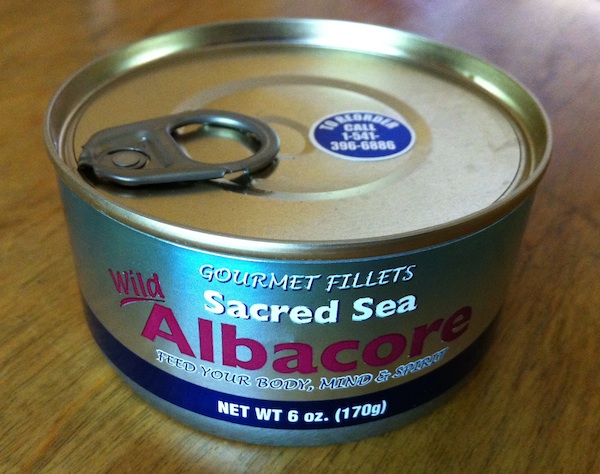
The Goché's Sacred Sea brand albacore.

The U.S. and Canadian albacore fisheries in the North Pacific, made up of mostly small, family-owned boats like Rick Goché’s, received a boost last year when Seafood Watch, a program of the Monterey Bay Aquarium that evaluates the ecological sustainability of wild-caught and farmed seafood, listed U.S. and Canadian troll- and pole-caught albacore from the North Pacific as a “Best Choice” due to negligible bycatch and the healthy stock of albacore in the region.

But the biggest shift in public awareness may come from the recent announcement by the Marine Stewardship Council (MSC), which has certified the Canadian Highly Migratory Species Foundation (CHMSF), an albacore fishery of Canadian-based boats, and the U.S.-based WFOA as sustainable and well-managed.

“It’s a very rigorous, on-site process that looks at a fishery as opposed to a sweeping view of a species,” said Kerry Coughlin, the Regional Director for the Americas of the MSC. “It’s our view that’s how you get a very rigorous assessment process that’s accurate, and it’s how, in some cases where fisheries aren’t sustainable, you’re going to bring about change on the water.”

And when they see the blue MSC label (right) in their grocer’s seafood case or on a can of albacore, “consumers can have the assurance that it is an environmentally responsible choice,” Coughlin said. And, because they come from younger fish, the fresh loins of albacore available from July through October at most retailers contain more have more “puppy fat,” as an industry spokesperson called it.

“I think it’s moister,” Jenkins said. “It seems to have higher fat levels, particularly concentrated in the belly.” His suggestion to consumers buying a whole loin is to ask their butcher to keep the belly meat on, adding that many butchers either keep it for themselves even cut it out, which he considers a travesty.

Locally canned albacore would be almost as much of a shock to most shoppers. The major-brand tuna on their grocery shelves was caught and frozen at sea, then thawed at a cannery and cooked in big steamers, where it loses much of its natural juices and fats. It is then packed in cans and cooked again, requiring the addition of water or oil to keep it moist.

That contrasts with most local tuna, which is packed in cans when it’s fresh and cooked only once, sealing in the natural juices and not requiring the addition of oil or water to keep it moist.
Between MSC certification and a growing concern among consumers about where their food comes from, families that depend on the North Pacific albacore are seeing a brighter future for their children, and a way of life that they prize.

“On a boat, you have to have all your senses attuned to your boat and the fish and your gear, but what it comes down to is stay alive and fill up the boat,” said Rick Goché. “When I pull away from the dock and I cross the bar and I feel the ocean lifting the boat, I leave everything behind as much as possible. Sure, I miss my family, but I don’t miss all the complexities of being on land.”