Showing posts with label cabbage. Show all posts

Wednesday, January 02, 2019

Guest Essay: Ode to a Cabbage


I can't think of anyone I know who adores cabbage more than contributor Jim Dixon of Real Good Food, as evidenced by this essay, an updated version of one first published here in 2015. Whether fresh, sautéed, braised, pickled, fermented or fried, you'll still find it making an appearance on his table. Here he shares some history, as well as his favorite ways to prepare it. 

I love cabbage.

And I’m not talking about Savoy cabbage, the frilly version that’s been tarted up with a first name hinting of royalty. Or the other members of the Brassica oleracea family, including the various kales and collards, broccoli, kohlrabi, cauliflower, and Brussels sprouts, deliciously gorgeous as they are. Or the strangely compelling relatives from central Asia, original home of turnips, broccoli rabe, bok choy, tatsoi, and mizuna, all part of the Brassica rapa clan.

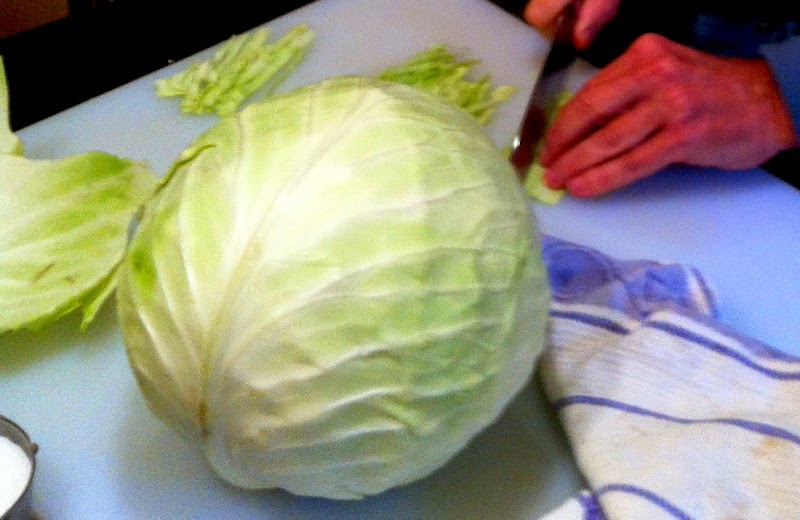
No, my heart belongs to the ordinary, everyday cabbage, its pale green leaves tightly bound into a waxy ball, the humble heads tucked coyly away in the corner of the produce section. It’s cheap, reliable, and flexible; who wouldn’t fall in love?

It doesn’t hurt that cabbage is good for me, lends itself to last-minute cooking, doesn’t cost much and grows, relatively speaking, in my own backyard.

Humankind’s relationship with Brassica started early. In his encyclopedic work Food: An Authoritative and Visual History and Dictionary of the Foods of the World, Waverley Root relates one ancient Greek belief of its origins: Dionysus, the god of wine, caught Lycurgus, the Edonian king, pulling up grapevines. While awaiting punishment, the king wept, and from his tears sprang cabbages.

An alternate myth has Jupiter sweating as he tries to explain contradictory oracles, and the cabbages sprout from his perspiration.

Those ancient Greeks might’ve been on to something. But given my devotion it seems more likely that Eros, the god of love, was involved.

Wild cabbages, resembling kale more than my beloved green globes, grew along the Mediterranean coast, and according to Harold McGee, in his book On Food and Cooking, the “salty, sunny habitat accounts for the thick, succulent, waxy leaves” that make cabbages so hardy. Domesticated about 2,500 years ago, cabbage spread across Europe.
Because it tolerates cold weather, cabbage became an important staple farther north, and we typically associate it with the hearty cuisines of climes damp and gray.

But the Romans, like me, loved cabbage, and they’re probably responsible for the selective cultivation that resulted in so many disparate variations. By encouraging an existing tendency for the curling leaves to form more tightly packed bunches, those early Italian farmers created today’s well-known “heading cabbages.”

Our name for these derives from the colloquial French word for head, caboche. Vegetable lore tells us that the Italian Catherine de’ Medici brought cabbage to France when she married fellow 14-year-old Henri de Valois, the Duke of Orleans and, eventually, King Henry II. History is silent as to whether she called him mon petit chou, or “my little cabbage.” But the endearment reflects the continuing French love of cabbage, from the choucroute of Alsace to the thick stew called gabure in the south.

Early cabbage fanciers also associated it with good health. Egyptians ate it with vinegar to prevent hangovers, Greeks dribbled cabbage juice into sore eyes, and Romans packed aching muscles with cabbage poultices. Herbalists today recommend cabbage for its anti-inflammatory effects, telling breastfeeding mothers to tuck a few bruised leaves into their bras for relief. It’s got lots of vitamins A, B, C, and E, and a study at Georgetown University showed how phytochemicals in cabbage might reduce cancer risks.

However, those same phytochemicals provide the frequently noted boardinghouse smell of overcooked cabbage, something that bothers others much more than it bothers me. Maybe I’m blinded, in an olfactory sense, by love, suffering from a cabbage-passion-induced anosmia. Or perhaps my approach to cooking mon petit chou reduces the breakdown of glucosinolates, the sulfur-containing compounds released when cabbage is boiled too long.

More likely, it’s the variety of cabbage. Brussels sprouts contain more of the healthful and stinky compounds than any of the other Brassicas. Heading cabbages, with their residual sugars, offer a sweeter love.

Farmers here in the Pacific Northwest harvest cabbage from mid-July through the end of December. Properly stored, it keeps for up to six months, so it’s theoretically possible to eat local cabbage all year. Prices vary, with conventionally grown cabbage usually less than a dollar per pound, organic about half again as much. Just before Christmas I bought an enormous head at a farmers’ market for only two dollars.

So, how do I love cabbage? Let me count the ways.
  1. I love it cooked in a little olive oil with onion. There’s a head of cabbage in the refrigerator and onions in the pantry most of the time, so I make this almost every week. But cabbage loves pork, and I love them together. So start with a little diced bacon, then sauté the onions and cabbage in the smoky fat. A dollop of crème fraîche makes both of these simple dishes unctuous and rich.
  2. A bed of shredded cabbage roasted under a chicken steals my heart.
  3. I love how the cabbage I add to my feeling-a-cold-coming chicken soup gives it enough substance to fill me up.
  4. I’m crazy for coleslaw, the green salad I turn to when winter’s lettuce comes wilted from a long truck ride north and again when the hot summer sun makes my garden’s leaves bolt and turn bitter.
  5. Je t’aime, choucroute braisée à l’Alsacienne: Julia Child kindled new passion for sauerkraut by teaching me to simmer it slowly for hours in crisp white wine.
  6. Marcella Hazan makes me cry, “cavolo sofegao, come sei bella,” with her Venetian-style smothered cabbage, another slow-cooked dish transformed with a splash of vinegar.
  7. Te amo cocido, tambien. While these one-pot Spanish stews often call for whole chickens, pigs’ trotters, veal shanks and a garden’s worth of vegetables, I make a simple version with just garbanzos, potatoes and cabbage.
  8. Louisiana-style smothered cabbage makes me ask, "how's ya mama and dem?"
Cabbage love comes in many other forms, and though the steady routine of our long-term relationship provides familiar comfort, I don’t want it to get stale. So I keep searching for new outlets for my passion, different ways to express my feelings, unexplored culinary territory where I can say, again and again, I love cabbage.

Sunday, January 08, 2017

Smothered Cabbage, Louisiana Style


Contributor Jim Dixon of Real Good Food is our local conduit for all things from New Orleans. With a kid (and now grandchildren) in the Big Easy, he's got an even better reason than food to spend lots of time there. As long as he keeps bringing back (and sharing) his recipes, I'm all for it!

There are lots of foods different cultures eat for good luck in the new year, including greens of some kind (some say it's because money is green). According to Gulf Coast chef John Folse, in Louisiana they'll be eating smothered cabbage on New Year's Day. But this old school recipe is so good you'll want to eat it all year.

Smothered Cabbage

Folse's recipe calls for andouille, the deeply smoked sausage of Cajun country, but it's hard to find the good stuff here in the northwest. You can order it from Jacob's or check with with the butcher shop at Laurelhurst Market [or Old Salt Marketplace], but you can smother cabbage with just bacon if you can't wait.

Start by cooking a quarter pound or so of chopped bacon in a little olive oil (if you've got andouille, cut it into bite-sized pieces and cook it with the bacon until brown). When it's browned, add a chopped onion, about half as much chopped celery, and a small green bell pepper, also chopped. While those are cooking, chop a couple of cloves of garlic and a tablespoon or so of fresh thyme; toss them in, along with salt, black pepper, and a half head of green cabbage cut into 2 inch pieces.

When the cabbage has wilted a little, add a quarter cup of water, cover, reduce to a simmer, and cook about 25 minutes. As Folse notes in his recipe, it might seem overcooked, but that's they way they like in Louisiana. Everybody I've served this to feels the same way.

Monday, April 18, 2016

Cooking with Fire: Charred Cabbage


I have to say that Jim Dixon's commitment to grilling or, as he would say, cooking with fire, is pretty close to matching the obsession that my husband, Dave, has with the flame. So when one of them offers advice on improving and/or expanding on your fiery repertoire, it's best to prick up your ears.

While fire and food have been part of the human experience for millennia, cooking over burning embers still offers surprises, like the charred cabbage I ate last week. More on that below; the first step is is the actual fire. One of my favorite quotes says everything: "The first thing, if you have a gas grill, is get rid of it," said Donald Link.

The standard Weber works great, but so does a backyard fire pit with a grill. Some kind of cover comes in handy for longer, lower heat cooking, but it's not absolutely necessary. I burn a mixture of real wood charcoal (sometimes called lump briquet even though it's not the same as the standard charcoal briquet) and hardwood, usually a mix of oak and frutwood trimmings from my backyard trees. Whatever you burn, don't use lighter fluid to start it; get a charcoal chimney.

Start your fire, spread it out in your Weber (or whatever you're using), and let it burn down a little. Move the coals around so one part of the fire is hotter. Clean your grill grate with a wire brush after it gets hot. You're ready to cook.

Charred Cabbage with Mint & Walnut Pesto

Make the pesto by picking the leaves from a lot of mint (for a cup or so of walnuts, use about 2 cups of loosely packed mint leaves). Blitz the walnuts in the food processor* with a couple of garlic cloves, then add the mint, about a half cup of extra virgin olive oil to start, and about a half cup of grated pecorino romano cheese (or Parmigiano Reggiano or a mix of both). Add a pinch of salt and process until smooth, adding more oil if the mix seems a little dry.

Cut a head of green cabbage into quarters, keeping the core intact so the pieces hold together. As usual, the grilled vegetable manifesto applies, so no oil on the cabbage. Cook the cabbage pieces over direct heat (right over the hot coals), turning occasionally until they're nicely charred on all sides. Move the cabbage to the cooler part of the fire while you cook other stuff (if you build a fire, you might as well cook everything over it).

Serving the charred wedges whole is more dramatic, but chopping them up makes for easier eating. Either way, pour some good extra virgin olive oil on them and serve with a big dollop of the pesto.

*  I use a blender for making pesto. It seems to make a smoother sauce, and doesn't warm up the ingredients the way a processor can. - KAB

Thursday, January 22, 2015

Ode to a Cabbage


I can't think of anyone I know who adores cabbage more than contributor Jim Dixon of Real Good Food. Fresh, sautéed, braised, pickled, fermented or fried, you'll find it making an appearance on his table. Here he shares his favorite ways to prepare it. 

I love cabbage.

And I’m not talking about Savoy cabbage, the frilly version that’s been tarted up with a first name hinting of royalty. Or the other members of the Brassica oleracea family, including the various kales and collards, broccoli, kohlrabi, cauliflower, and Brussels sprouts, deliciously gorgeous as they are. Or the strangely compelling relatives from central Asia, original home of turnips, broccoli rabe, bok choy, tatsoi, and mizuna, all part of the Brassica rapa clan.

No, my heart belongs to the ordinary, everyday cabbage, its pale green leaves tightly bound into a waxy ball, the humble heads tucked coyly away in the corner of the produce section. It’s cheap, reliable, and flexible; who wouldn’t fall in love?

It doesn’t hurt that cabbage is good for me, lends itself to last-minute cooking, doesn’t cost much and grows, relatively speaking, in my own backyard.

Humankind’s relationship with Brassica started early. In his encyclopedic work Food: An Authoritative and Visual History and Dictionary of the Foods of the World, Waverley Root relates one ancient Greek belief of its origins: Dionysus, the god of wine, caught Lycurgus, the Edonian king, pulling up grapevines. While awaiting punishment, the king wept, and from his tears sprang cabbages.

An alternate myth has Jupiter sweating as he tries to explain contradictory oracles, and the cabbages sprout from his perspiration.

Those ancient Greeks might’ve been on to something. But given my devotion it seems more likely that Eros, the god of love, was involved.

Wild cabbages, resembling kale more than my beloved green globes, grew along the Mediterranean coast, and according to Harold McGee, in his book On Food and Cooking, the “salty, sunny habitat accounts for the thick, succulent, waxy leaves” that make cabbages so hardy. Domesticated about 2,500 years ago, cabbage spread across Europe.

Because it tolerates cold weather, cabbage became an important staple farther north, and we typically associate it with the hearty cuisines of climes damp and gray.

But the Romans, like me, loved cabbage, and they’re probably responsible for the selective cultivation that resulted in so many disparate variations. By encouraging an existing tendency for the curling leaves to form more tightly packed bunches, those early Italian farmers created today’s well-known “heading cabbages.”

Our name for these derives from the colloquial French word for head, caboche. Vegetable lore tells us that the Italian Catherine de’ Medici brought cabbage to France when she married fellow 14-year-old Henri de Valois, the Duke of Orleans and, eventually, King Henry II. History is silent as to whether she called him mon petit chou, or “my little cabbage.” But the endearment reflects the continuing French love of cabbage, from the choucroute of Alsace to the thick stew called gabure in the south.

Early cabbage fanciers also associated it with good health. Egyptians ate it with vinegar to prevent hangovers, Greeks dribbled cabbage juice into sore eyes, and Romans packed aching muscles with cabbage poultices. Herbalists today recommend cabbage for its anti-inflammatory effects, telling breastfeeding mothers to tuck a few bruised leaves into their bras for relief. It’s got lots of vitamins A, B, C, and E, and a study at Georgetown University showed how phytochemicals in cabbage might reduce cancer risks.

However, those same phytochemicals provide the frequently noted boardinghouse smell of overcooked cabbage, something that bothers others much more than it bothers me. Maybe I’m blinded, in an olfactory sense, by love, suffering from a cabbage-passion-induced anosmia. Or perhaps my approach to cooking mon petit chou reduces the breakdown of glucosinolates, the sulfur-containing compounds released when cabbage is boiled too long.

More likely, it’s the variety of cabbage. Brussels sprouts contain more of the healthful and stinky compounds than any of the other Brassicas. Heading cabbages, with their residual sugars, offer a sweeter love.

Farmers here in the Pacific Northwest harvest cabbage from mid-July through the end of December. Properly stored, it keeps for up to six months, so it’s theoretically possible to eat local cabbage all year. Prices vary, with conventionally grown cabbage usually less than a dollar per pound, organic about half again as much. Just before Christmas I bought an enormous head at a farmers’ market for only two dollars.

So, how do I love cabbage? Let me count the ways.
  1. I love it cooked in a little olive oil with onion. There’s a head of cabbage in the refrigerator and onions in the pantry most of the time, so I make this almost every week. Cabbage loves pork, and I love them together. In my Cabbage with Bacon and Crème Fraiche, I start with a little diced bacon, then sauté the onions and cabbage in the smoky fat. A dollop of crème fraîche makes both of these simple dishes unctuous and rich.
  2. A bed of shredded cabbage roasted under a chicken steals my heart.
  3. I love how the cabbage I add to my feeling-a-cold-coming chicken soup gives it enough substance to fill me up.
  4. I’m crazy for coleslaw, the green salad I turn to when winter’s lettuce comes wilted from a long truck ride north and again when the hot summer sun makes my garden’s leaves bolt and turn bitter.
  5. Je t’aime, choucroute braisée à l’Alsacienne: Julia Child kindled new passion for sauerkraut by teaching me to simmer it slowly for hours in crisp white wine. And Marcella Hazan makes me cry, “cavolo sofegao, come sei bella,” with her Venetian-style smothered cabbage, another slow-cooked dish transformed with a splash of vinegar.  Here's my Braised Cabbage and Onion with Poached Egg.
  6. Te amo cocido, tambien. While these one-pot Spanish stews often call for whole chickens, pigs’ trotters, veal shanks and a garden’s worth of vegetables, I make a simple version with just garbanzos, potatoes and cabbage.
Cabbage love comes in many other forms, and though the steady routine of our long-term relationship provides familiar comfort, I don’t want it to get stale. So I keep searching for new outlets for my passion, different ways to express my feelings, unexplored culinary territory where I can say, again and again, I love cabbage.

Monday, February 24, 2014

Hate Sauerkraut? You'll Love Choucroute!


It's not often I get to write, "As we drove through the rolling hills from Frankfurt across the German-French border, the towns grew increasingly smaller and older, the buildings more charming and fairy tale-like with stone and moss the predominant textures."

Braising the vegetables.

It was an incredibly long time ago, and our last through the French countryside, a road trip that took us from the Alsace region across to the Loire, then down through the Dordogne with a swing back up to Frankfurt. Our first stop was in an auberge in the tiny town of Riquewihr, one with a traditional Alsatian restaurant on the main floor and rooms for guests on the second floor.

Adding the bacon.

Coming down for dinner that night, we found we'd walked into a special evening featuring that most Alsatian of dishes, choucroute garnie. A long table ran down one side of the room, the length of it piled with the most sweetly fragrant sauerkraut, braised for hours in stock, bay leaves and juniper berries. On top of the sauerkraut were all kinds of sausages from the area, along with slices of smoked ham, whole pork chops and other meats, all of which had been cooked in the braised sauerkraut.

In goes the meat…getting there!

That choucroute (pron. shoo-CROOT) completely changed my attitude toward sauerkraut, which up to that point had always been a tart, vinegary-tasting accompaniment to my grandmother's cabbage rolls, which she called "hoblich" (probably a variation on Ukrainian "holopchi"), or my mother's sauerkraut with hot dogs, her attempt to pay homage to my father's German heritage. In this version, rinsed of most of the salt and sourness, then simmered until meltingly tender, even the most adamant of the sauerkraut averse will rave.

Choucroute Garnie
Loosely adapted from Time-Life Foods of World: Provincial France

6 lbs. sauerkraut
1 lb. bacon
4 Tbsp. olive oil
2 med. onions, chopped fine
1 Tbsp. garlic, minced
2 c. carrots, cut in 1/4" rounds
1 tart apple, cored and chopped in 1/2" dice
6 c. chicken stock
2 c. dry white wine
1 Tbsp. salt
1/4 tsp. black pepper
8 sprigs parsley
3 bay leaves
17 juniper berries
2 lbs. uncooked sausages, like bratwurst
2 lbs. chicken thighs**
3 smoked pork chops or several slices smoked ham
Yukon gold potatoes

Preheat the oven to 325°.

Rinse the sauerkraut in several changes of water to get rid of excess salt and vinegar. (I've used both house-made sauerkraut from Old Salt and a good commercial brand like Bubbies, containing just cabbage, salt and water.) After rinsing, squeeze it vigorously to get out as much water as possible.

In a heavy 9-qt. casserole or Dutch oven (I used Big Blue), heat the oil over medium heat. Add the onions, garlic and carrots and sauté for 10 min., stirring often to prevent sticking. Stir in the chopped apple and continue cooking for 2 or 3 min., then stir in the sauerkraut and combine thoroughly. Reduce the heat as low as possible, cover the pot and braise the vegetables for 15 min. Then add the chicken stock, wine, salt, pepper, parsley, bay leaves and juniper berries and stir to combine. Lay the bacon on top of the sauerkraut. Cover tightly, place on middle rack of the oven and braise for 3 hrs.

After the sauerkraut has braised for 3 hrs., prick the sausages 4 or 5 times and add to the casserole with the chicken thighs, burying them in the sauerkraut. Cover, return the pot to the oven and braise for 30 mins. Add the pork chops to the sauerkraut and continue braising for 45 minutes.

Toward the end of the cooking time, heat a large pot of water till boiling, halve the potatoes and cook till tender.

To serve, transfer the sauerkraut to a deep, heated platter or serving dish, removing the bay leaves and as many of the juniper berries as you can. Mound the meat over the top. Serve with potatoes on the side.

* Duck legs or rabbit would also be great in this.

Monday, July 30, 2012

David's New Baby, Big and…Green?


I don't generally post photos of large vegetables, but when this came in over the transom I had to make an exception.

 That's 13 pounds, 4 ounces of leafy green goodness, friends. And David Kobos (yes, of Kobos Coffee fame) says he's got six more coming on. You can read the secret to his garden success in "How to Make Dirt."

And what's he planning on doing with these babies, you ask? Stay tuned!

Monday, December 27, 2010

In Season NW: A Cabbage Fit for a King


This stunner, growing in the field at Ayers Creek Farm, was begging to have its picture taken. And now with cabbages dancing in my head, I am of a mind to dig out my grandmother's recipe for a dish she called hoblich, ham and rice-stuffed cabbage leaves. Wonder if I can find it?

Monday, May 31, 2010

The Inveterate Griller


You gotta love the all-weather grillers who live in the rainy Northwest. Dave's been out in rain, sleet and snow working his beloved Weber, and no showery Memorial Day is going to keep him inside, and he proved it by smoking a 9-lb. brisket (known as "The Big-Ass Brisket") yesterday. Contributor Jim Dixon of RealGoodFood is a brother-in-barbecue, and sends the following as proof.

Given our wetter than usual weather, you may have forgone the traditional holiday weekend kickoff of the outdoor cooking season. I’ve stoked the Weber a few times in the last month, and I first cooked the pork patties below over charcoal. But they do just fine in a skillet on the stove or even as porky meatballs in the oven.

Pork and Cabbage Patties

I can’t bring myself to call these pork “burgers,” even after Bittman’s story in the NYT about other-than-beef hamburgers. If I cook them flat, they’re patties; round, I call them balls.

For a pound of ground pork, finely chop enough green cabbage to make about a cup. Chop half a medium onion equally fine. Combine the diced vegetables with the pork, add about a tablespoon of fish sauce, and, if you like a little heat, a spritz of sriracha. Add an egg and about a half cup of bread crumbs; mix with your hands. The mixture should hold together, but if it seems wet add more bread crumbs.

Form into patties and grill or pan fry. Or make into meatballs slightly large than golf balls, arrange on a baking sheet, and cook at 350° for about 20 minutes.

And yes, the photo above is on a (gasp) gas grill. Looking for a better one.

Monday, March 15, 2010

St. Paddy and the Zombie


Zombies aren't something you normally associate with St. Paddy's Day. That's normally left to shamrocks, leprechauns and green Peeps. Yes, green Peeps. Because who doesn't think of green marshmallow chicks on a holiday celebrating an Irish saint?

Radicchio strudel.

The zombie part came in when I was walking past the meat counter of my neighborhood grocery store the other day and saw a pile of briskets on sale for $5.49 a pound. They'd been brined and were covered with pickling spices, all set to make corned beef for the St. Patrick's Day holiday. Not really having time to cook it for dinner that night, I moved on with my cart, but the image of those gigantic briskets stayed with me.

The next day all I could think of were those briskets gleaming in the case, and pretty soon I found myself standing zombie-like in front of them pointing at a four pound monster with its half-inch cap of fat. I'd also run across a recipe for a radicchio-filled potato strudel that had intrigued me, so I picked up a couple of heads of chicory, came home and got busy, my craving for corned beef about to be satisfied.

Corned Beef and Cabbage

The recipe assumes the meat has already been brined, but there are lots of recipes available online if you want to do your own. You can put potatoes and carrots in the pot, as well, though since I was making the strudel (below) I didn't feel it was necessary.

4-5 lb. brined brisket of beef
1 Tbsp. salt
1/2 tsp. pepper
2 bay leaves
2 large onions, cut in wedges
1 head cabbage, cut in wedges
1 pt. dark beer like Cascadian Dark Ale or Porter
Water

Preheat oven to 300°. In deep casserole or Le Creuset pot large enough to hold the brisket, place the brisket fat-side up in the bottom of the pot. Top with bay leaves, wedges of onion and cabbage. Sprinkle with salt and pepper. Pour beer over the top and add enough water to barely cover the meat. Place in oven for 3 hours or until meat is cooked through and tender. Slice thinly and serve warm on platter with cabbage and onions.

Radicchio Strudel
By Chef Walter Potenza

For the Dough:
1 lb. potatoes
1 1/4 cups flour
1 egg, lightly beaten
2 Tbsp. grated cheese (Montasio cheese, or Parmigiano)
Salt
Olive oil

For the Filling:
1/3 c. olive oil
1 clove garlic, crushed
2 1/4 lbs. radicchio
Salt and pepper, to taste
1/4 c. grated Parmigiano Reggiano
Melted unsalted butter

Boil the potatoes until just tender, then peel them and mash them in a medium-sized bowl. Let them cool and combine them with the flour, eggs and cheese. Work the mixture into durable and uniform dough. Oil a cloth well and roll the dough out into a half-inch thick layer on it.

To make the filling, cut the radicchio into thin strips and sauté it with the garlic over a very low flame with the olive oil, covered, for about 20 minutes. While it's cooking heat a large pot of water. Discard the garlic clove and spread the sautéed radicchio over the dough.

Season to taste with salt and pepper, roll up the dough, wrap it in the cloth and tie the cloth shut. Salt the water, which will by now be boiling. Slide the strudel into it, and simmer it for about 20 minutes. Cool for 15 minutes before serving.

Serve it, sliced, with melted butter and grated Parmigiano Reggiano, and drizzled with extra virgin olive oil if desired.