Showing posts with label Norman Chronicles. Show all posts
Saturday, March 22, 2014
The Norman Chronicles: Neck and Neck
They're unofficially called "butcher's cuts," those not-so-frequently-seen-in-meat-cases pieces of lamb, beef or pork. Because they aren't big, gorgeous hunks of flesh, they were harder to sell and ended up going home with the butchers to feed their families, knowing as they did that these "off cuts" were often more flavorful than their more well-known compadres. Flank steak and hanger steak used to belong to that category until the beef association started promoting them, and now they'll often cost as much as steaks.
A cut that hasn't yet been popularized and, with any luck, will remain in the cheap-but-delicious category is lamb neck. This two-or-so-pound piece of meat is perfect for braising low and slow until the flesh is melting off the bone, and has enough heft flavor-wise to stand up to the richly flavorful Provençal-style sauce below. You can get one by ordering it from your favorite butcher or market that carries lamb, though it might mean the butcher's family will have to figure out something else for dinner.
Braised Lamb Neck Provençal
2 Tbsp. olive oil
1 lamb neck, about 2 lbs.
1 onion, chopped
3 cloves garlic, smashed
3 c. roasted tomatoes, chopped
1 c. dry white wine, such as sauvignon blanc
Zest of 1 lemon
1/8 tsp. saffron
1 tsp. salt
2 bay leaves
1/2 c. pitted oil-cured black olives or green olives, sliced*
2 lemons, cut in wedges
Preheat oven to 325°.
Heat oil in Dutch oven over medium-high heat. Brown neck on all sides. While lamb browns, put saffron and salt in mortar and pestle and grind until saffron is broken down. Remove browned neck to platter. Add onion and garlic to pan and sauté till translucent, scraping up browned bits of lamb. Add tomatoes, wine, lemon zest, saffron-salt mixture and bay leaves to pan and stir, then return lamb neck to pan. Cover pan with parchment paper and lid and braise in the oven for 2 1/2 hrs., turning the neck every 45 min. or so.
Add chopped olives and lemons to pan and continue cooking another 45 min. until meat is falling off the bone. Serve over polenta.
* I used Spanish anchovy-stuffed olives, which added that touch of umami from the anchovies. Yum!
Read the other posts in The Norman Chronicles: Getting to Shepherd's Pie, Braising Saddles and Shanks and Hearts.
Labels:
braised lamb,
budget cuts,
lamb,
lamb neck,
Norman Chronicles,
recipe
Monday, November 25, 2013
The Norman Chronicles: Shanks and Hearts
Here it is, almost Thanksgiving, and when everyone else in the United States is thinking about turkey and dressing and sweet potatoes, I'm salivating at the thought of rich, dark lamb shanks braised to falling-apart lusciousness. That's not to say come Thursday evening we won't be having turkey and fixin's—Dave would pitch a fit if he couldn't put a big bird on the Weber and stand over it with a pint of A-Bomb in his hand—but there are still dinners to make the rest of the week and leftover turkey only goes so far, right?
The reason for my shanky dreams? It's what I did with a couple of Norman's shanks at a dinner for company a month or so ago, one that I want to reprise in the very near future. Though the store definitely won't have the huge 2-plus-pound shanks that Norman so generously provided, I can just double up on smaller shanks and come out with a dinner for six and still have enough leftovers to combine with tomatoes and pasta for dinner a second night.
Braised Lamb Shanks with Artichokes and Olives
3 Tbsp. olive oil
4 lbs. lamb shanks
2 c. onions, chopped in 1/4" dice
2 Tbsp. garlic, chopped fine
2 Italian or red bell peppers, roasted and cut in slivers
1 c. oil-cured or kalamata olives, pitted
16 oz. (2 pkgs.) frozen baby artichoke hearts (or fresh in season, trimmed)
1 1/2 c. roasted or canned tomatoes
2 Tbsp. fresh rosemary leaves, minced
1 c. white wine, such as a sauvignon blanc
1 c. chicken stock
Salt to taste
Preheat oven to 375°.
Trim excess fat from lamb shanks, then generously salt and pepper them. Heat oil in large Dutch oven over medium-high heat. When the oil shimmers, add lamb shanks and brown (in batches if necessary), then remove to a platter. Reduce heat to medium and add onions and garlic to the pot, adding more oil if necessary and scraping up any browned bits of lamb stuck to the bottom of the pot. Sauté till onions are translucent. Add roasted peppers, olives, artichoke hearts, tomatoes and rosemary and bring to a low simmer. Add lamb shanks back to the pot, burying them in the vegetables, and pour the wine and stock over the top.
Put the pot into the oven and roast for 2-3 hours until the lamb is ready to fall off the bone. Remove from the oven and allow to cool until you can remove the meat from the bones. Add salt to taste as needed.
At this point you can serve the braised lamb or, better yet, cool it completely and put in the fridge overnight to allow the flavors to meld. Reheat in a 300° oven and serve with Ayers Creek Farm Amish Butter polenta (or your favorite brand from the store).
Any leftovers can be used for a second dinner when combined with roasted tomatoes and served over pasta.
Read the other posts in The Norman Chronicles: Getting to Shepherd's Pie, Braising Saddles and Neck and Neck.
Labels:
braised lamb,
lamb,
lamb shank,
Norman Chronicles,
recipe
Wednesday, October 23, 2013
The Norman Chronicles: Braising Saddles
Butchering your own meat can be intimidating, especially if, like me, you're not all that familiar with the traditional cuts and where they come from. The fun part is looking at it from the perspective of how you want to cook it, then making your decisions based on whether you like roasts or chops, or bone-in or boned-and-tied chunks for grilling or braising.
The saddle, for instance (left, held by Melinda at Portland's Culinary Workshop). As its name implies, it's the section of the back where you'd think a saddle would go, and it kind of looks like one. Containing the loins and the lower end of the ribs, you can cut chops and loin roasts from it, but I decided to cut it straight down the backbone and have a large, bony chunk of roast to braise.
Some folks might recoil in horror over braising this piece of meat rather than boning out the roasts and loins, but lamb loins are fairly small strips of meat, and I was already cutting chops from the upper end of the ribs.
See what I mean about getting to make decisions based on how you plan to cook it? Plus how cool does that backbone look sitting in the pot?
Michel's Braised Lamb
This lamb recipe is terrific braised and served the same day, but for a real treat make it a day ahead and put it in the refrigerator overnight. Holding it for a day gives the flavors a chance to meld deliciously, and it's easy to remove the solidified fat and the bones before reheating. Served with polenta (I used Ayers Creek Farm Amish Butter polenta), this is so good it's made converts of friends who say they don't like lamb.
1 4-lb. lamb roast (shoulder, saddle, etc.)
1 med. onion, coarsely chopped
1 med. red bell pepper, coarsely chopped
1 pasilla, ancho or poblano pepper, coarsely chopped
4 cloves garlic, sliced
2 tsp. cardamom pods, crushed, using just seeds inside
2 tsp. cumin seeds
1/2 c. prunes, coarsely chopped
1 c. chicken stock
15 oz. can diced tomatoes (approx. 2 cups)
Zest of 1 lemon
Preheat oven to 325 degrees.
In medium hot braising pot, brown shoulder in olive ol; salt and pepper each side. After first side of lamb is browned, add cumin and cardamom seeds to the oil around the lamb and briefly stir to toast. Add garlic and onion, stir until golden. Add peppers and stir until softened. Add canned tomatoes, stock and prunes and stir. Cover braising pot and place in middle of preheated oven. Simmer in oven at least 3 hours.
Remove lamb from pot. Cover and hold on heated platter. Skim fat from liquid in pan and bring to boil to reduce. Season to taste and pour over lamb.
Read the other posts in The Norman Chronicles: Getting to Shepherd's Pie, Shanks and Hearts and Neck and Neck.
Labels:
braised lamb shoulder,
lamb,
lamb saddle,
Michel,
Norman,
Norman Chronicles
Sunday, October 13, 2013
The Norman Chronicles: Getting to Shepherd's Pie
When a friend offered me one of her sheep that was going to be slaughtered this fall, I couldn't have said yes fast enough. After all, it had been born in April in the pasture she rented from a neighbor and had been raised almost exclusively on pasture grass and hay, supplemented with a little grain.
Norman as a baby.
I'd first met the lamb, named Norman, when he was born into the small herd my friend had. His mother was a big ewe and there was every indication little Norman would be large, too, since he grew much faster than the other lambs born at the same time. Very tame and with melting brown eyes, he always stood to be scratched behind the ears while the other sheep crowded in to get the hay my friend, Kim, and I would throw out.
Kim had hoped to find a reasonably priced mobile slaughter unit to do the job, since Norman was more family pet than livestock and her husband, though he's a hunter who had done a lot of field dressing of deer and elk, was particularly fond of him and didn't want to have to do the kill. Unfortunately no one could come out to do it in a reasonable amount of time, and it was left to her husband to manage the task himself.
Norman grazing in his pasture with his pals in the group on the right.
I offered to help, since at six months old Norman was fully grown, weighing in at around 200 pounds, a lot for one person to manage in a steep, uneven pasture. When we went out to the pasture, a pile of grain was poured on the ground and Norman eagerly started munching away at our feet. A shot to the back of the head dropped him instantly—he literally didn't know what hit him—and the last few beats of his heart pumped the blood out of his body through a slit made in the artery in his neck.
Lest I sound like a cold-hearted so-and-so, for me the moment of the kill is always fraught. I always hope the end is quick, painless and without struggle, which, in the three kills I've attended, has been the case. All of the animals were killed in the pasture they were born and raised in, with (or by) people they trusted, not trucked hundreds of miles to a processing plant to die with strangers in a strange place. Which, from my perspective, makes their pasture a much more humane place to end their lives, both for the lack of stress to the animals and, because hormones are released into the muscles when animals experience stress, how it affects the final quality of the meat.
Dry-aging in Kitchen Cru's walk-in.
Norman was gutted and loaded into a wagon, then hauled to a pine tree in an upper pasture near the house. We hung the now-100-or-so-pound carcass from a device called a gambrel, a ratcheted device that was slung over a branch, that could hoist the animal to make skinning easier. As Kim's husband worked, I held it steady and smelled the lamb-y aroma coming from the still-warm meat.
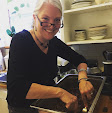
Melinda ready to rock.
Clad in a game bag, a giant stretchy sock to protect the carcass, then wrapped in a plastic sheet and bungied in the back of our truck, I drove down the freeway feeling a little conspicuous, but no one honked or pointed or, worse, called the cops. Norman was destined to hang for five days in the walk-in at Michael Madigan's Kitchen Cru, the only place, for various reasons from USDA regulations to the start of deer season, that I could find for a pasture-slaughtered lamb his size.
Grinding trim pieces for ground lamb.
Dry aging, or hanging, in a cool (below 40°) environment helps the natural enzymes in the meat start to break it down without spoiling it. As the cell structure breaks down, it causes the meat to become more tender and the flavor to become richer and more intense, according the John Neumeister of Cattail Creek Lamb, who was kind enough to advise a newbie on the particulars of dry aging.
Layering on the mashed potatoes for a classic shepherd's pie.
Now weighing about 75 to 80 pounds—dry-aging causes a carcass to lose moisture, approximately 15 to 20% of its weight—Norman traveled to Portland's Culinary Workshop where co-owner Melinda Casady and her array of butchering skills and tools made quick work of breaking down the carcass into its component parts. I chose to leave most in large, braisable chunks with a few roasts and chops, leaving the legs on the bone for special occasions, and hoping Dave can cure and smoke the breasts for bacon.
Packed in a cooler and transported to the freezer in our garage, Norman will be the subject of many toasts at many meals this winter. Thank you, Norman.
Shepherd's Pie with Ground Lamb
For the potatoes:
2 lbs. whole potatoes
4 Tbsp. butter or margarine
1/4 c. milk
Salt to taste
For the filling:
2 lbs. ground lamb
1 onion, chopped into dice
3 cloves garlic, minced
3 medium carrots, diced
1 c. chicken broth
1 c. frozen peas
1 tsp. dried thyme or tarragon
Salt to taste
Preheat oven to 400°.
Peel the potatoes if you prefer, then chop into 1/2" dice. (I used Yukon golds so didn't bother peeling them.) Put in medium-sized pot, cover with water and bring to boil over high heat. When water boils, reduce to low and simmer until potatoes are tender, about 20 mins.
While potatoes cook, heat large sauté pan over medium heat, add ground lamb and brown. When browned, drain off all but 2 Tbsp. of fat. Add onion, garlic and carrots to lamb and sauté till tender. Add chicken broth, peas and herbs and bring to a simmer, cooking for a couple of minutes. Season to taste with salt, then remove from heat while you mash the potatoes.
When potatoes are tender, drain them and add butter or margarine and milk. Mash with potato masher until smooth and thoroughly combined. Salt to taste.
Put lamb mixture in 9 by 12-inch baking dish and smooth the surface. Drop mashed potatoes onto the top of the lamb in dollops, spreading the potatoes out with the back of a spoon or spatula to completely seal in the lamb. Place baking dish in oven and bake for 25 minutes until potatoes begin to brown. If desired, you can then briefly place the baking dish under the broiler to crisp the top further, but it's not necessary.
Read the other posts in The Norman Chronicles: Braising Saddles, Shanks and Hearts and Neck and Neck.
Read about a lamb butchering class I took from Melinda in Class Cut-Up. Thanks also to Hank Shaw of Hunter Angler Gardener Cook and Ron Muise of Fearann Kisha for their help and advice.
Subscribe to:
Posts (Atom)